 Скачать презентацию Umalusi s presentation to the Portfolio Committee on Basic
7ef8b51fde98ff3dc9ba925e2ddb3375.ppt
- Количество слайдов: 36



Umalusi’s presentation to the Portfolio Committee on Basic Education 2009 / 10 Annual Report 14 October 2010 Dr Mafu S Rakometsi
Overview Purpose / Mandate Summarised External Environment : Impact on Umalusi Organisational Performance per Unit Financial Information Current Issues and Way Forward Conclusion
Purpose / Mandate Summarised Umalusi commenced with its new and extended mandate as a Quality Council for GFET on 1 June 2009. Umalusi’s mandate is determined by two Acts namely, the National Qualifications Framework Act of 2008; and the General and Further Education and Training Quality Assurance Act of 2001 amended in 2008. While it is now fully accountable for its new mandate its founding act, the GENFETQA Act no 58 of 2001 amended in 2008, allows for Umalusi to take on its mandate progressively subject to capacity.
Purpose / Mandate Summarised 2 Umalusi is tasked with the following: Qualifications Develop and manage a sub-framework of qualifications in collaboration with SAQA and the other two QCs supported by the necessary policies and processes Monitor and report on the adequacy and suitability of qualifications and standards in general and further education and training
Purpose / Mandate Summarised 2 Quality Assurance Develop and implement quality assurance policies that include: Accreditation of private providers of education and training and assessment to offer qualifications on the GFET sub-framework of qualifications; Quality assure assessments at exit points and certify learner achievement
Purpose / Mandate Summarised 3 Information Maintain a database of learner achievements and related matters; and submit such data in a format determined in consultation with the SAQA for recording on the national learners’ records database – this requirement has remained the same Research While Umalusi has always grounded its work in research this function was only formalised under the new and extended mandate, which requires Umalusi to commission and publish research on issues of importance to the development and implementation of the sub-framework
Purpose / Mandate Summarised 4 Advice and Collaboration Included in the amended mandate is the formalization of relationships which include: Advice to the relevant Minister on matters relating to the GFET sub-framework of qualifications Collaboration with the SAQA and other QCs in terms of the education and training system Establishment of co-operative relationships with professional bodies Advocacy of the sub-framework of qualifications
External Environment : Impact on Umalusi While maintaining the standard, routine quality assurance work, Umalusi has moved swiftly towards taking on all its new functions. However, the following aspects in the macro environment continue to impact on Umalusi: The passing of the NQF Act in 2009; which has required changes in relationships and functions with bodies in the quality assurance landscape; The amendment of the GENFETQA Act in 2008; which has required more capacity and a review of Umalusi’s positions and approaches; The amendment of the Skills Development Act and the establishment of the QCTO with new approaches that impact on the work of Umalusi; Amendment of the HE Act with approaches that impact on Umalusi’s work;
External Environment : Impact on Umalusi The introduction of two new and high profile qualifications during this time, namely the National Senior Certificate to replace the old Senior Certificate, and the National Certificate: Vocational to replace the old National Technical Certificates, has had significant new work implications; The splitting of the Education Ministry has placed Umalusi in the position of straddling the education and training system in respect of its quality assurance work, reporting lines and funding streams. This has effectively required the establishment of new and different relationships, and engagement with new priorities and demands.
Umalusi’s Quality Assurance Regime 2009/2010 Umalusi believes that educational standards and quality are set and maintained through a combination of processes and interventions and designed its rigorous quality assurance regime for 2009/2010 to encompass the following: Development of new qualifications (as identified); evaluation and benchmarking of existing qualifications and curricula (Intended curriculum) and issuing authentic certificates Ensuring through external moderation processes, analyses and benchmarking that assessments at exit points are of an acceptable standard and that the examinations are conducted in a credible manner through verifying the national and provincial monitoring systems (Examined curriculum)
Umalusi’s Quality Assurance Regime 2009/2010 Ensuring that standardisation processes are reliable, consistent and standardisation decisions are upheld Accrediting private institutions (schools, FET colleges and Adult Centres), and private assessment bodies to offer / assess the qualifications Umalusi certifies (Enacted curriculum) Conducting research to inform and support quality assurance functions and to support “Advice to the Minister”
Qualifications, Curriculum & Certification Unit (QCC) The role of QCC is to ensure and enhance the status and quality of the qualifications Umalusi certifies. Quality assuring the qualifications and their related curricula is QCC’s contribution to the overall quality of the certificate which Umalusi issues. This function also oversees the issuing and verification of certificates. (Qualifications: SC; N 3; NCV 4; GETC: adults)
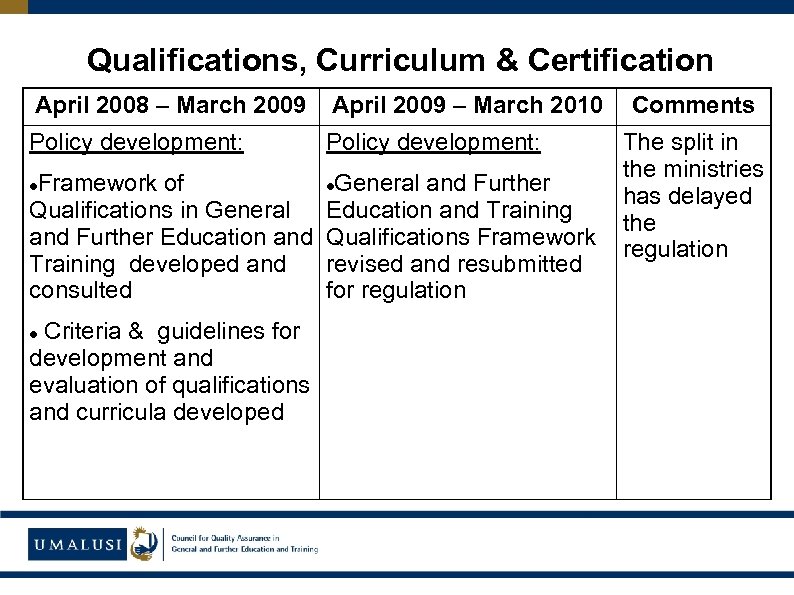
Qualifications, Curriculum & Certification April 2008 – March 2009 April 2009 – March 2010 Policy development: Comments The split in the ministries Framework of General and Further has delayed Qualifications in General Education and Training the and Further Education and Qualifications Framework regulation Training developed and revised and resubmitted consulted for regulation Criteria & guidelines for development and evaluation of qualifications and curricula developed
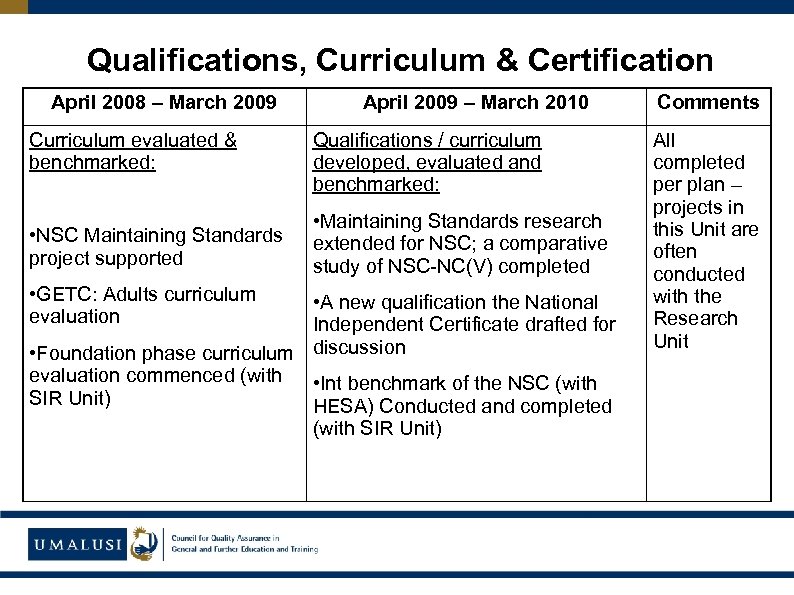
Qualifications, Curriculum & Certification April 2008 – March 2009 Curriculum evaluated & benchmarked: • NSC Maintaining Standards project supported • GETC: Adults curriculum evaluation April 2009 – March 2010 Qualifications / curriculum developed, evaluated and benchmarked: • Maintaining Standards research extended for NSC; a comparative study of NSC-NC(V) completed • A new qualification the National Independent Certificate drafted for • Foundation phase curriculum discussion evaluation commenced (with • Int benchmark of the NSC (with SIR Unit) HESA) Conducted and completed (with SIR Unit) Comments All completed per plan – projects in this Unit are often conducted with the Research Unit
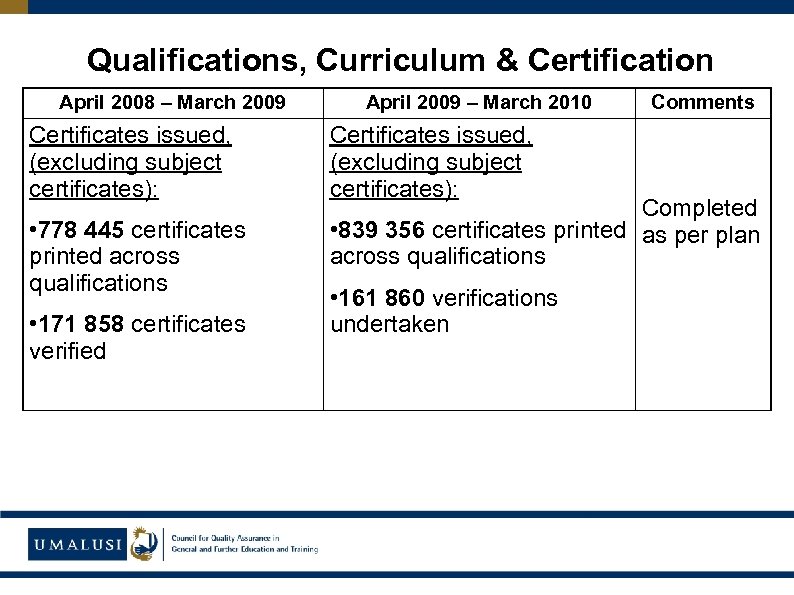
Qualifications, Curriculum & Certification April 2008 – March 2009 Certificates issued, (excluding subject certificates): • 778 445 certificates printed across qualifications • 171 858 certificates verified April 2009 – March 2010 Certificates issued, (excluding subject certificates): Comments Completed • 839 356 certificates printed as per plan across qualifications • 161 860 verifications undertaken
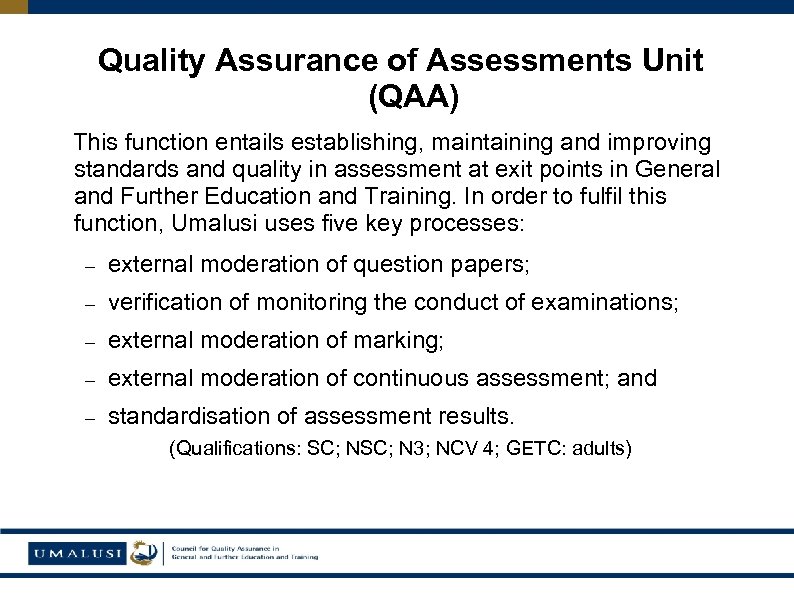
Quality Assurance of Assessments Unit (QAA) This function entails establishing, maintaining and improving standards and quality in assessment at exit points in General and Further Education and Training. In order to fulfil this function, Umalusi uses five key processes: external moderation of question papers; verification of monitoring the conduct of examinations; external moderation of marking; external moderation of continuous assessment; and standardisation of assessment results. (Qualifications: SC; N 3; NCV 4; GETC: adults)
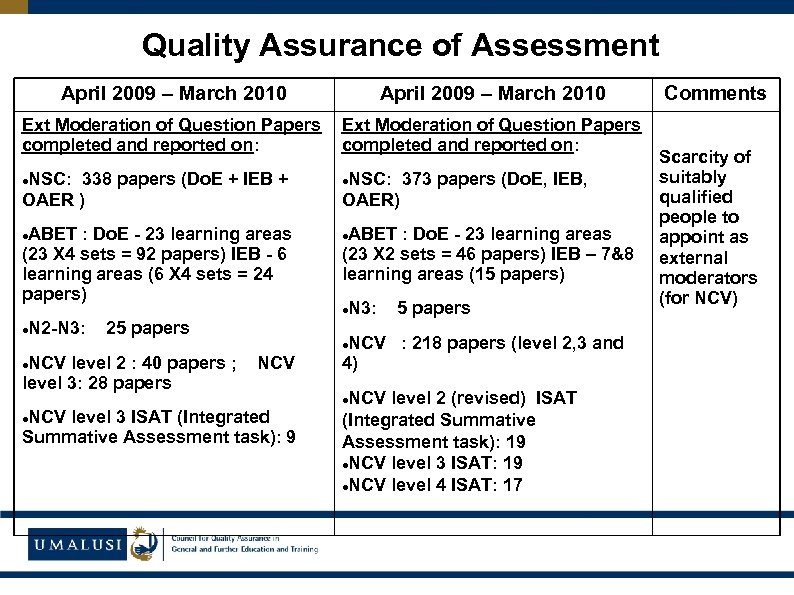
Quality Assurance of Assessment April 2009 – March 2010 Ext Moderation of Question Papers completed and reported on: NSC: 338 papers (Do. E + IEB + OAER ) ABET : Do. E - 23 learning areas (23 X 4 sets = 92 papers) IEB - 6 learning areas (6 X 4 sets = 24 papers) NSC: 373 papers (Do. E, IEB, OAER) ABET : Do. E - 23 learning areas (23 X 2 sets = 46 papers) IEB – 7&8 learning areas (15 papers) N 3: N 2 -N 3: 25 papers NCV : 218 papers (level 2, 3 and 4) NCV level 2 : 40 papers ; level 3: 28 papers NCV level 2 (revised) ISAT (Integrated Summative Assessment task): 19 NCV level 3 ISAT: 19 NCV level 4 ISAT: 17 NCV level 3 ISAT (Integrated Summative Assessment task): 9 Comments Scarcity of suitably qualified people to appoint as external moderators (for NCV)
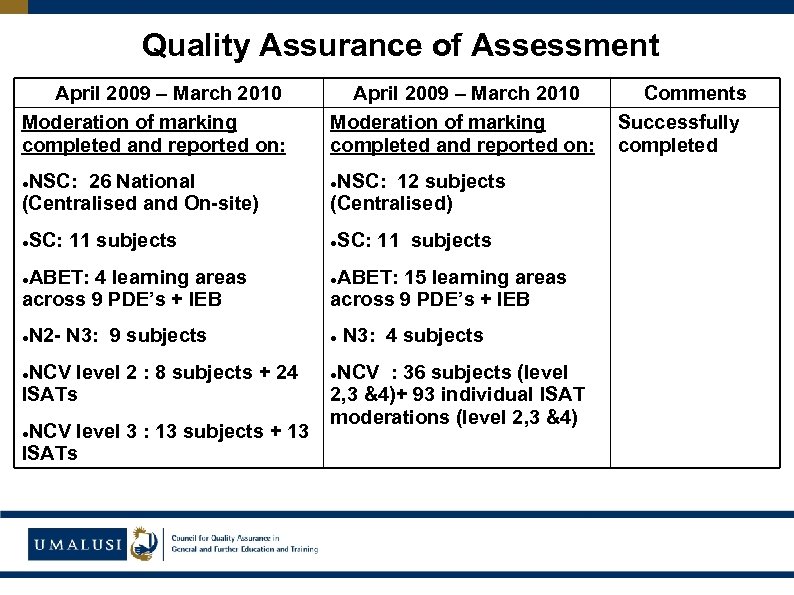
Quality Assurance of Assessment April 2009 – March 2010 Moderation of marking completed and reported on: NSC: 26 National (Centralised and On-site) SC: 11 subjects ABET: 4 learning areas across 9 PDE’s + IEB N 2 - N 3: 9 subjects NCV level 2 : 8 subjects + 24 ISATs NCV level 3 : 13 subjects + 13 ISATs April 2009 – March 2010 Moderation of marking completed and reported on: NSC: 12 subjects (Centralised) SC: 11 subjects ABET: 15 learning areas across 9 PDE’s + IEB N 3: 4 subjects NCV : 36 subjects (level 2, 3 &4)+ 93 individual ISAT moderations (level 2, 3 &4) Comments Successfully completed
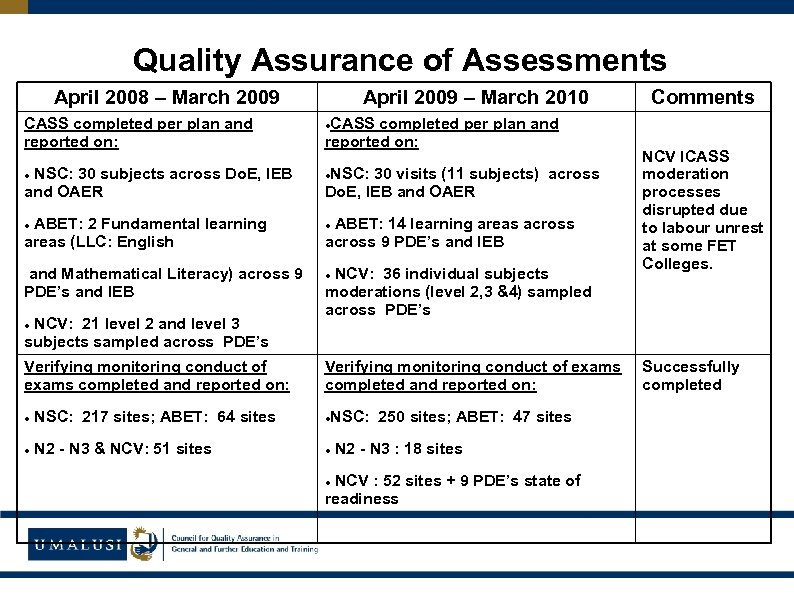
Quality Assurance of Assessments April 2008 – March 2009 CASS completed per plan and reported on: NSC: 30 subjects across Do. E, IEB and OAER ABET: 2 Fundamental learning areas (LLC: English and Mathematical Literacy) across 9 PDE’s and IEB NCV: 21 level 2 and level 3 subjects sampled across PDE’s April 2009 – March 2010 CASS completed per plan and reported on: Comments NSC: 30 visits (11 subjects) across Do. E, IEB and OAER ABET: 14 learning areas across 9 PDE’s and IEB NCV: 36 individual subjects moderations (level 2, 3 &4) sampled across PDE’s NCV ICASS moderation processes disrupted due to labour unrest at some FET Colleges. Verifying monitoring conduct of exams completed and reported on: NSC: 217 sites; ABET: 64 sites N 2 - N 3 & NCV: 51 sites NSC: 250 sites; ABET: 47 sites N 2 - N 3 : 18 sites NCV : 52 sites + 9 PDE’s state of readiness Successfully completed
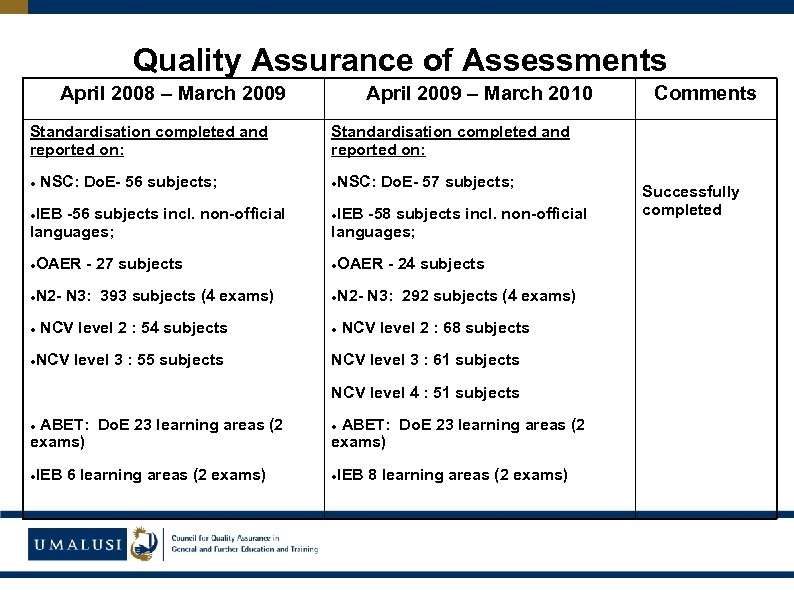
Quality Assurance of Assessments April 2008 – March 2009 Standardisation completed and reported on: NSC: Do. E- 56 subjects; IEB -56 subjects incl. non-official languages; April 2009 – March 2010 Standardisation completed and reported on: NSC: Do. E- 57 subjects; IEB -58 subjects incl. non-official languages; OAER - 27 subjects OAER - 24 subjects N 2 - N 3: 393 subjects (4 exams) N 2 - N 3: 292 subjects (4 exams) NCV level 2 : 54 subjects NCV level 3 : 55 subjects NCV level 2 : 68 subjects NCV level 3 : 61 subjects NCV level 4 : 51 subjects ABET: Do. E 23 learning areas (2 exams) IEB 6 learning areas (2 exams) Comments ABET: Do. E 23 learning areas (2 exams) IEB 8 learning areas (2 exams) Successfully completed
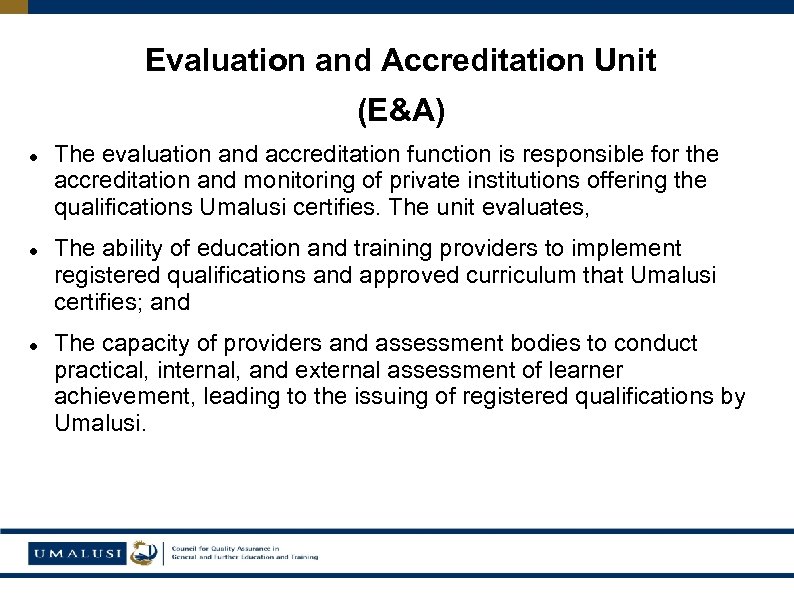
Evaluation and Accreditation Unit (E&A) The evaluation and accreditation function is responsible for the accreditation and monitoring of private institutions offering the qualifications Umalusi certifies. The unit evaluates, The ability of education and training providers to implement registered qualifications and approved curriculum that Umalusi certifies; and The capacity of providers and assessment bodies to conduct practical, internal, and external assessment of learner achievement, leading to the issuing of registered qualifications by Umalusi.
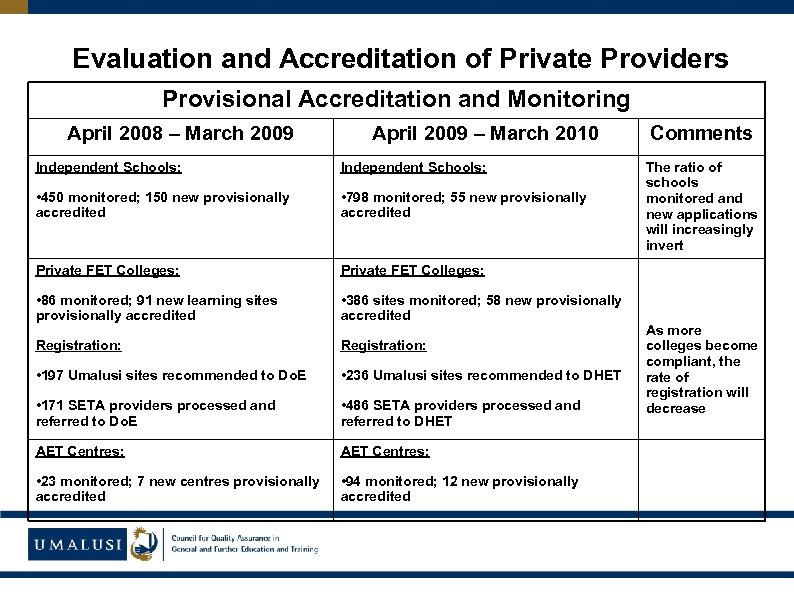
Evaluation and Accreditation of Private Providers Provisional Accreditation and Monitoring April 2008 – March 2009 April 2009 – March 2010 Independent Schools: • 450 monitored; 150 new provisionally accredited • 798 monitored; 55 new provisionally accredited Private FET Colleges: • 86 monitored; 91 new learning sites provisionally accredited • 386 sites monitored; 58 new provisionally accredited Registration: • 197 Umalusi sites recommended to Do. E • 236 Umalusi sites recommended to DHET • 171 SETA providers processed and referred to Do. E • 486 SETA providers processed and referred to DHET AET Centres: • 23 monitored; 7 new centres provisionally accredited • 94 monitored; 12 new provisionally accredited Comments The ratio of schools monitored and new applications will increasingly invert As more colleges become compliant, the rate of registration will decrease
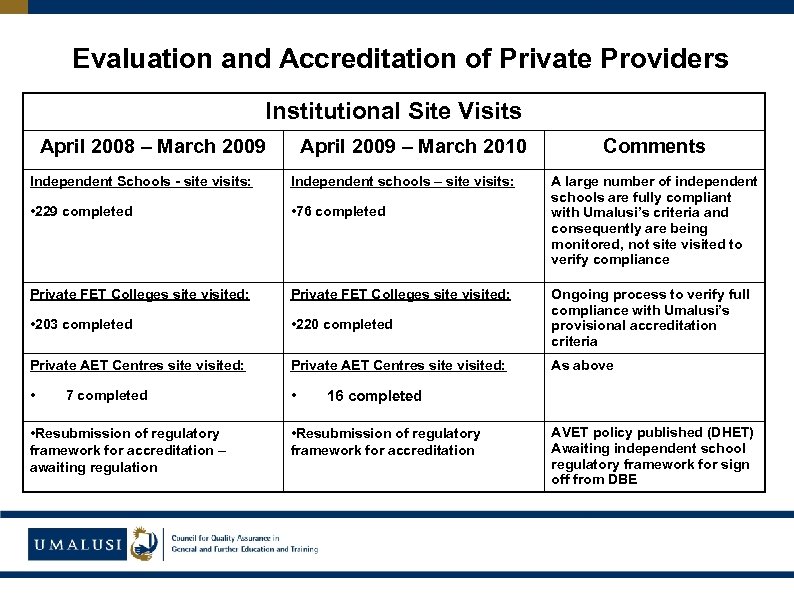
Evaluation and Accreditation of Private Providers Institutional Site Visits April 2008 – March 2009 April 2009 – March 2010 Comments Independent Schools - site visits: Independent schools – site visits: • 229 completed • 76 completed Private FET Colleges site visited: • 203 completed • 220 completed Ongoing process to verify full compliance with Umalusi’s provisional accreditation criteria Private AET Centres site visited: As above • • 7 completed • Resubmission of regulatory framework for accreditation – awaiting regulation A large number of independent schools are fully compliant with Umalusi’s criteria and consequently are being monitored, not site visited to verify compliance 16 completed • Resubmission of regulatory framework for accreditation AVET policy published (DHET) Awaiting independent school regulatory framework for sign off from DBE
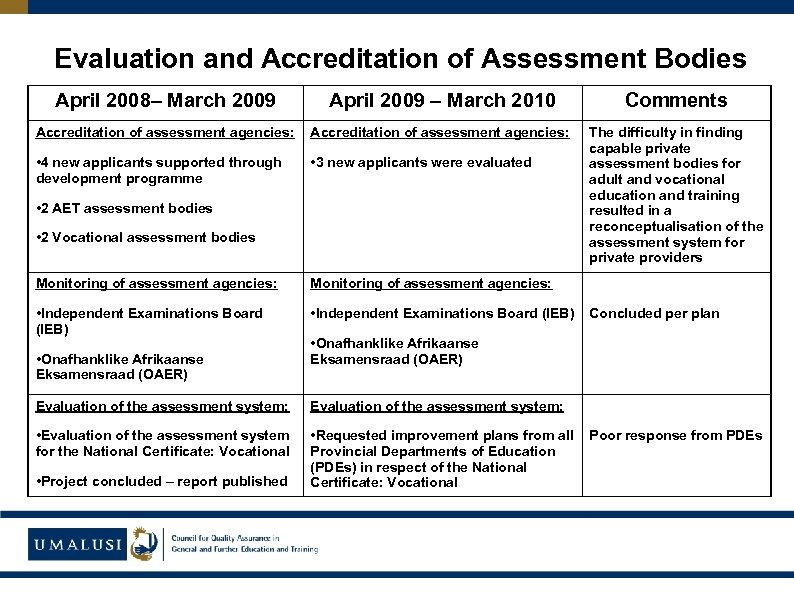
Evaluation and Accreditation of Assessment Bodies April 2008– March 2009 April 2009 – March 2010 Comments Accreditation of assessment agencies: • 4 new applicants supported through development programme • 3 new applicants were evaluated The difficulty in finding capable private assessment bodies for adult and vocational education and training resulted in a reconceptualisation of the assessment system for private providers • 2 AET assessment bodies • 2 Vocational assessment bodies Monitoring of assessment agencies: • Independent Examinations Board (IEB) • Onafhanklike Afrikaanse Eksamensraad (OAER) Concluded per plan • Onafhanklike Afrikaanse Eksamensraad (OAER) Evaluation of the assessment system: • Evaluation of the assessment system for the National Certificate: Vocational • Requested improvement plans from all Provincial Departments of Education (PDEs) in respect of the National Certificate: Vocational • Project concluded – report published Poor response from PDEs
Statistical Information and Research Unit (SIR) The mandate of the SIR unit is to conduct research as identified by the needs of the organisation and report on the key indicators of quality and standards in general and further education and training; the establishment and maintenance of databases; to lead statistical research and analysis; and to inform and provide statistical support for the work in other units. The SIR Unit also plays a role in organizational and professional development at Umalusi.
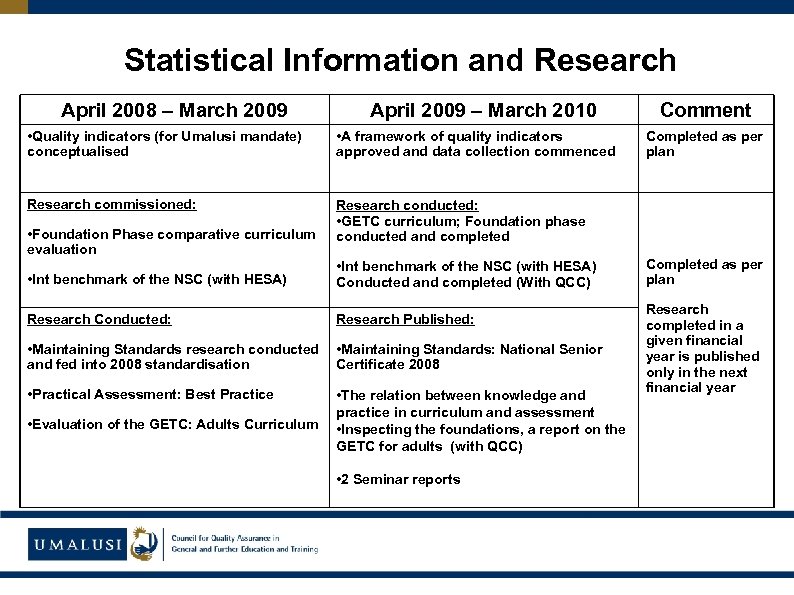
Statistical Information and Research April 2008 – March 2009 April 2009 – March 2010 • Quality indicators (for Umalusi mandate) conceptualised • A framework of quality indicators approved and data collection commenced Research commissioned: Comment Research conducted: • GETC curriculum; Foundation phase conducted and completed • Foundation Phase comparative curriculum evaluation • Int benchmark of the NSC (with HESA) Conducted and completed (With QCC) Research Conducted: Research Published: • Maintaining Standards research conducted and fed into 2008 standardisation • Maintaining Standards: National Senior Certificate 2008 • Practical Assessment: Best Practice • The relation between knowledge and practice in curriculum and assessment • Inspecting the foundations, a report on the GETC for adults (with QCC) • Evaluation of the GETC: Adults Curriculum • 2 Seminar reports Completed as per plan Research completed in a given financial year is published only in the next financial year
Management Support Structures (MSS) Management Support Structures ensures that: Strategic plans are in place and that the organisation carries out its remit Corporate Governance Advocacy of Umalusi’s work Stakeholders relationships
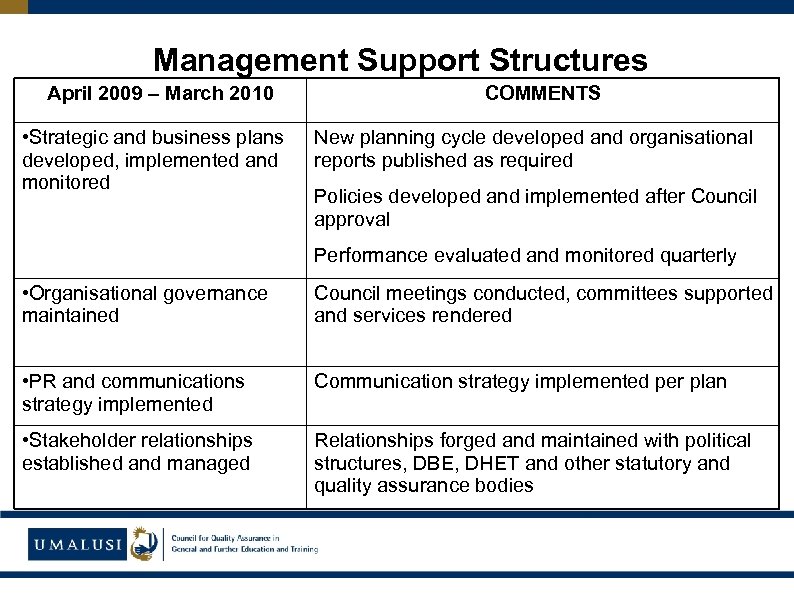
Management Support Structures April 2009 – March 2010 • Strategic and business plans developed, implemented and monitored COMMENTS New planning cycle developed and organisational reports published as required Policies developed and implemented after Council approval Performance evaluated and monitored quarterly • Organisational governance maintained Council meetings conducted, committees supported and services rendered • PR and communications strategy implemented Communication strategy implemented per plan • Stakeholder relationships established and managed Relationships forged and maintained with political structures, DBE, DHET and other statutory and quality assurance bodies
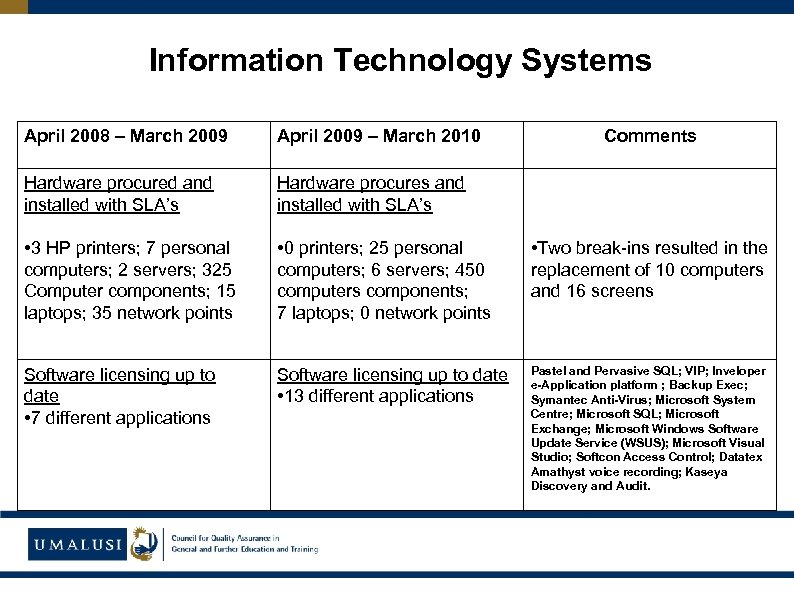
Information Technology Systems April 2008 – March 2009 April 2009 – March 2010 Comments Hardware procured and installed with SLA’s Hardware procures and installed with SLA’s • 3 HP printers; 7 personal computers; 2 servers; 325 Computer components; 15 laptops; 35 network points • 0 printers; 25 personal computers; 6 servers; 450 computers components; 7 laptops; 0 network points • Two break-ins resulted in the replacement of 10 computers and 16 screens Software licensing up to date • 7 different applications Software licensing up to date • 13 different applications Pastel and Pervasive SQL; VIP; Inveloper e-Application platform ; Backup Exec; Symantec Anti-Virus; Microsoft System Centre; Microsoft SQL; Microsoft Exchange; Microsoft Windows Software Update Service (WSUS); Microsoft Visual Studio; Softcon Access Control; Datatex Amathyst voice recording; Kaseya Discovery and Audit.
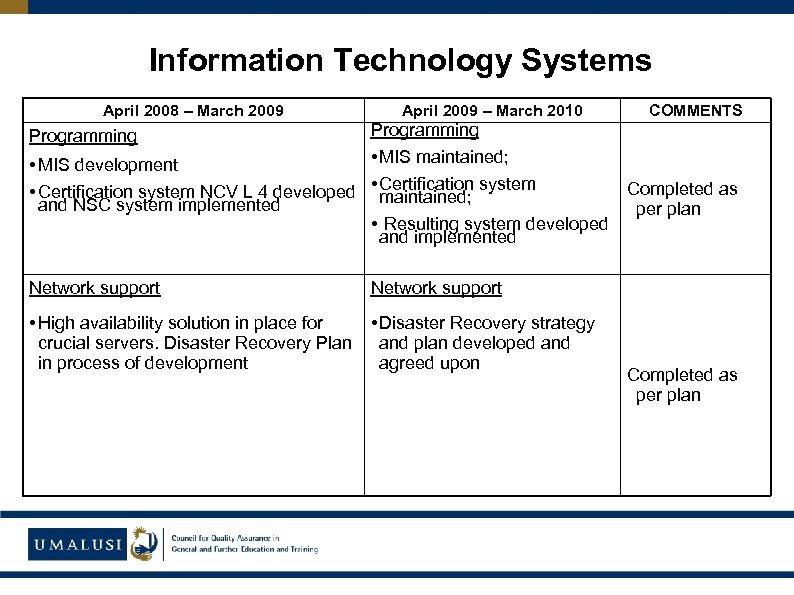
Information Technology Systems April 2008 – March 2009 April 2009 – March 2010 COMMENTS Programming • MIS maintained; • MIS development Completed as • Certification system NCV L 4 developed • Certification system maintained; and NSC system implemented per plan • Resulting system developed and implemented Programming Network support • High availability solution in place for • Disaster Recovery strategy crucial servers. Disaster Recovery Plan and plan developed and in process of development agreed upon Completed as per plan
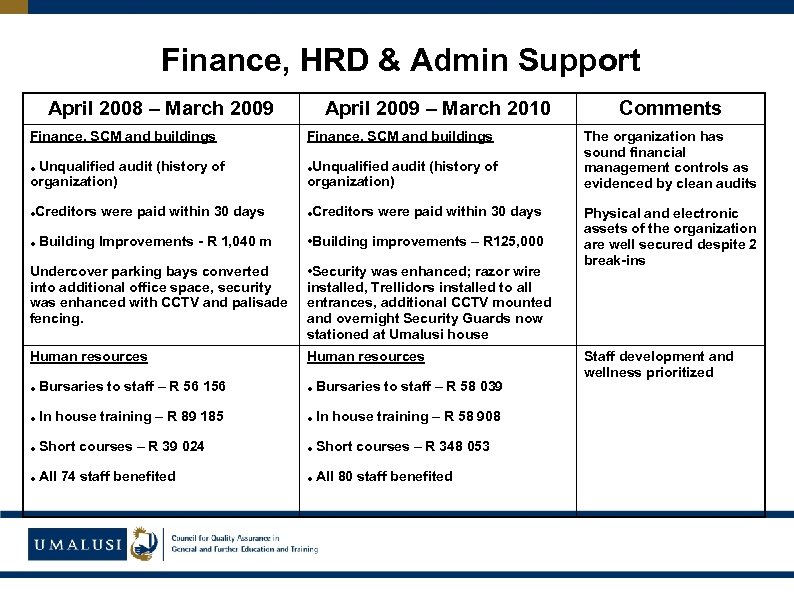
Finance, HRD & Admin Support April 2008 – March 2009 Finance, SCM and buildings Unqualified audit (history of organization) Creditors were paid within 30 days April 2009 – March 2010 Finance, SCM and buildings Unqualified audit (history of organization) Creditors were paid within 30 days Building Improvements - R 1, 040 m • Building improvements – R 125, 000 Undercover parking bays converted into additional office space, security was enhanced with CCTV and palisade fencing. • Security was enhanced; razor wire installed, Trellidors installed to all entrances, additional CCTV mounted and overnight Security Guards now stationed at Umalusi house Human resources Bursaries to staff – R 56 156 Bursaries to staff – R 58 039 In house training – R 89 185 In house training – R 58 908 Short courses – R 39 024 Short courses – R 348 053 All 74 staff benefited All 80 staff benefited Comments The organization has sound financial management controls as evidenced by clean audits Physical and electronic assets of the organization are well secured despite 2 break-ins Staff development and wellness prioritized
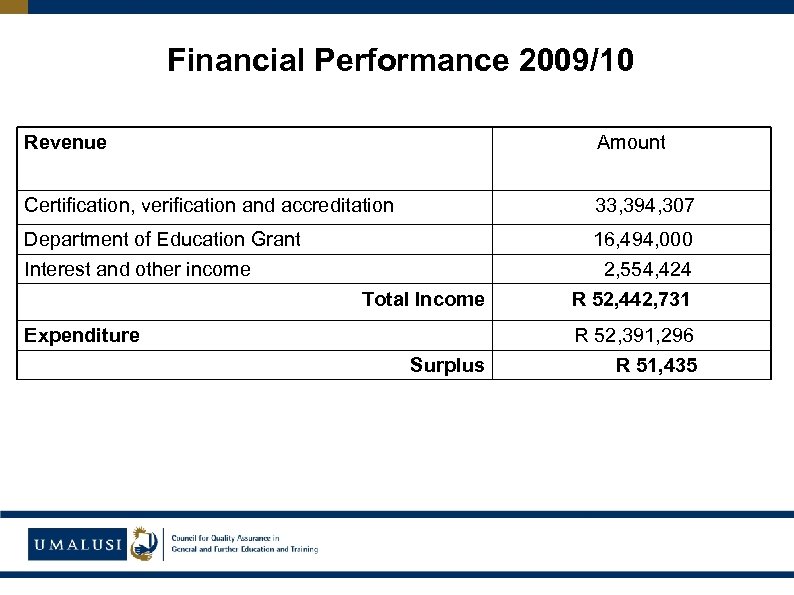
Financial Performance 2009/10 Revenue Amount Certification, verification and accreditation 33, 394, 307 Department of Education Grant Interest and other income Total Income 16, 494, 000 2, 554, 424 R 52, 442, 731 Surplus R 52, 391, 296 R 51, 435 Expenditure
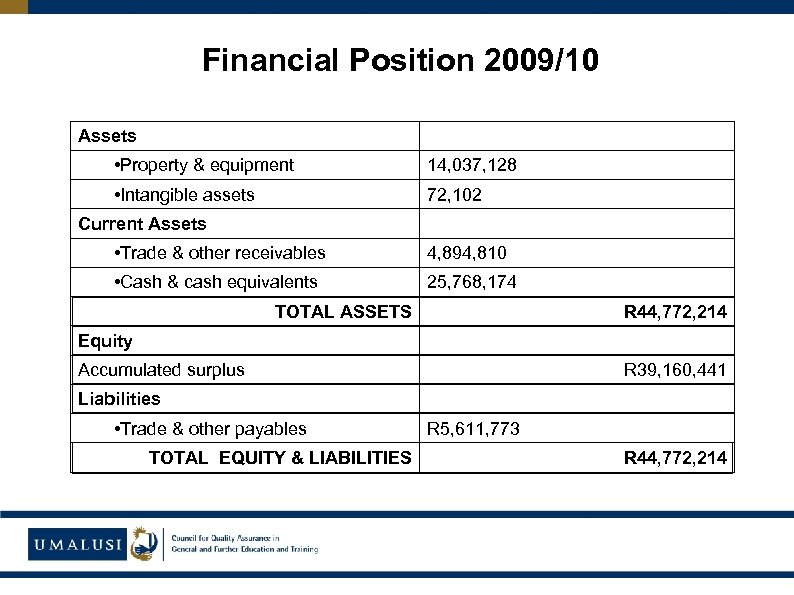
Financial Position 2009/10 Assets • Property & equipment 14, 037, 128 • Intangible assets 72, 102 Current Assets • Trade & other receivables 4, 894, 810 • Cash & cash equivalents 25, 768, 174 TOTAL ASSETS R 44, 772, 214 Equity Accumulated surplus R 39, 160, 441 Liabilities • Trade & other payables TOTAL EQUITY & LIABILITIES R 5, 611, 773 R 44, 772, 214
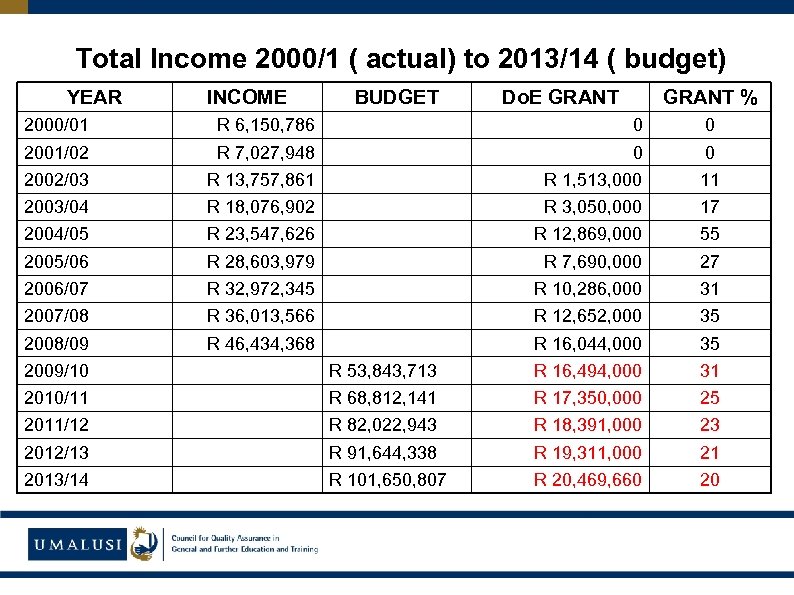
Total Income 2000/1 ( actual) to 2013/14 ( budget) YEAR INCOME BUDGET Do. E GRANT % 2000/01 R 6, 150, 786 0 0 2001/02 R 7, 027, 948 0 0 2002/03 R 13, 757, 861 R 1, 513, 000 11 2003/04 R 18, 076, 902 R 3, 050, 000 17 2004/05 R 23, 547, 626 R 12, 869, 000 55 2005/06 R 28, 603, 979 R 7, 690, 000 27 2006/07 R 32, 972, 345 R 10, 286, 000 31 2007/08 R 36, 013, 566 R 12, 652, 000 35 2008/09 R 46, 434, 368 R 16, 044, 000 35 2009/10 R 53, 843, 713 R 16, 494, 000 31 2010/11 R 68, 812, 141 R 17, 350, 000 25 2011/12 R 82, 022, 943 R 18, 391, 000 23 2012/13 R 91, 644, 338 R 19, 311, 000 21 2013/14 R 101, 650, 807 R 20, 469, 660 20
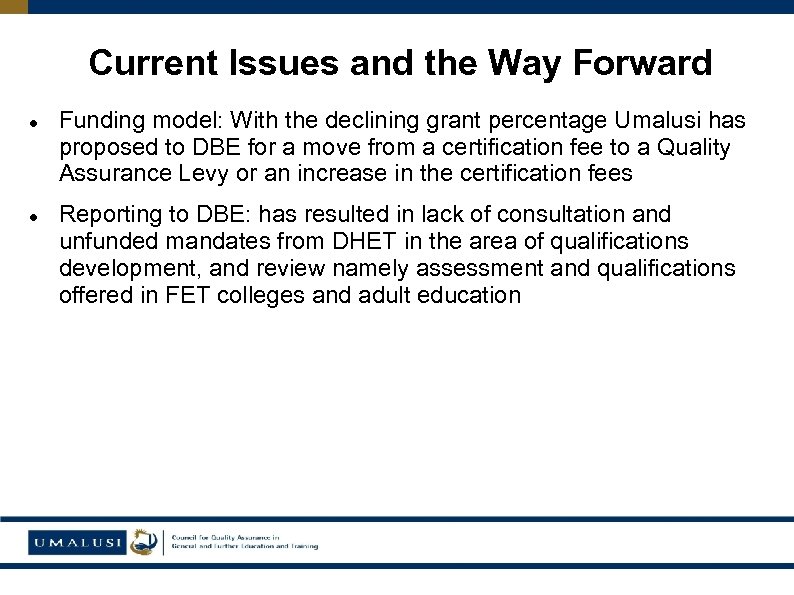
Current Issues and the Way Forward Funding model: With the declining grant percentage Umalusi has proposed to DBE for a move from a certification fee to a Quality Assurance Levy or an increase in the certification fees Reporting to DBE: has resulted in lack of consultation and unfunded mandates from DHET in the area of qualifications development, and review namely assessment and qualifications offered in FET colleges and adult education

Conclusion Consultative processes continue with the Departments of Basic and Higher Education, SAQA, QCTO and HEQC, and related stakeholders through the NQF Forum Thanks to the Portfolio Committee Chairperson, Ms F I Chohan and her members for their support
Скачать презентацию Umalusi s presentation to the Portfolio Committee on Basic
7ef8b51fde98ff3dc9ba925e2ddb3375.ppt