 Скачать презентацию Umalusi s presentation to the Basic Education Portfolio Committee
54ef2ca4d18ff0bdfab62a8dc6c796d3.ppt
- Количество слайдов: 32



Umalusi’s presentation to the Basic Education Portfolio Committee on the 2010/11 Annual Report 12 October 2011 Dr Mafu S Rakometsi
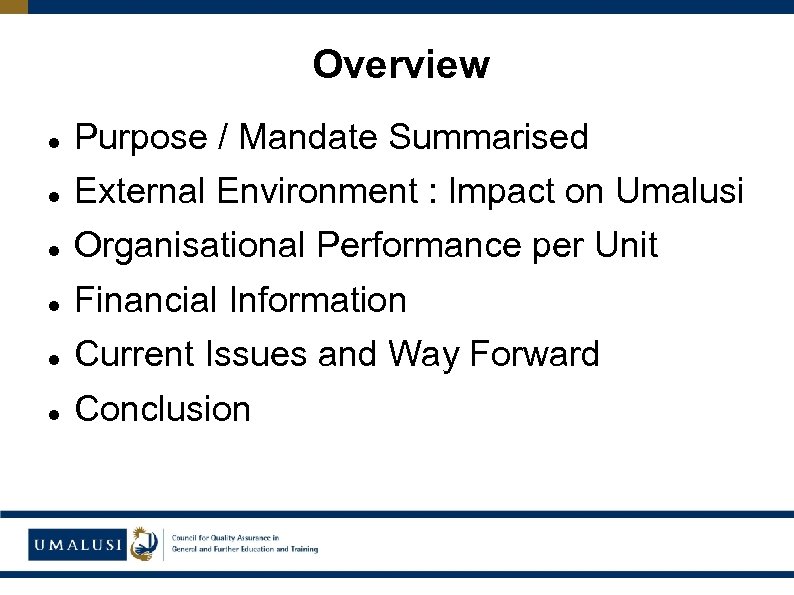
Overview Purpose / Mandate Summarised External Environment : Impact on Umalusi Organisational Performance per Unit Financial Information Current Issues and Way Forward Conclusion
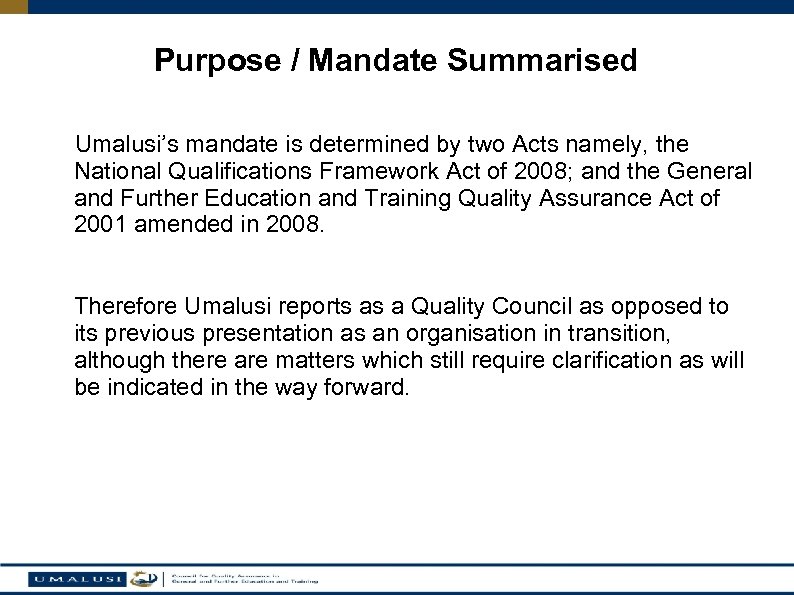
Purpose / Mandate Summarised Umalusi’s mandate is determined by two Acts namely, the National Qualifications Framework Act of 2008; and the General and Further Education and Training Quality Assurance Act of 2001 amended in 2008. Therefore Umalusi reports as a Quality Council as opposed to its previous presentation as an organisation in transition, although there are matters which still require clarification as will be indicated in the way forward.
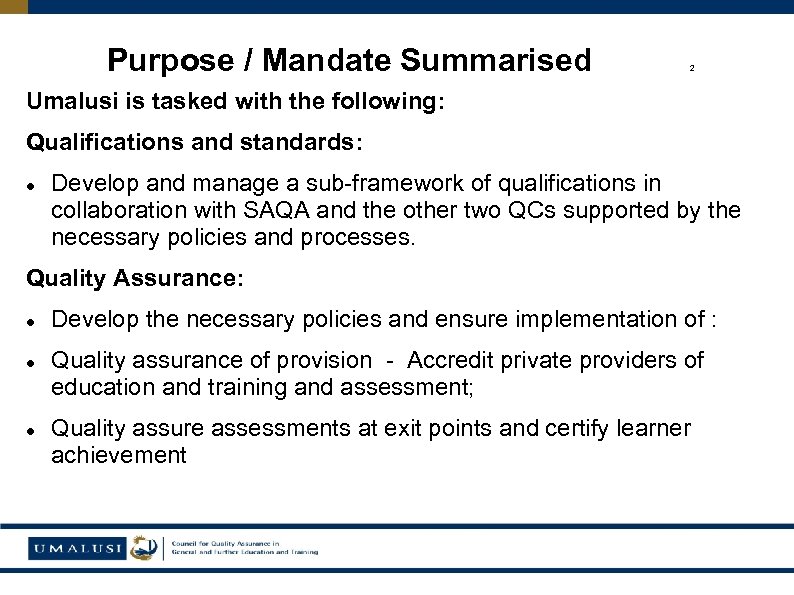
Purpose / Mandate Summarised 2 Umalusi is tasked with the following: Qualifications and standards: Develop and manage a sub-framework of qualifications in collaboration with SAQA and the other two QCs supported by the necessary policies and processes. Quality Assurance: Develop the necessary policies and ensure implementation of : Quality assurance of provision - Accredit private providers of education and training and assessment; Quality assure assessments at exit points and certify learner achievement
Purpose / Mandate Summarised 3 Information Maintain a database of learner achievements and related matters; and submit such data in a format determined in consultation with the SAQA for recording on the national learners’ records database Research Commission and publish research on issues of importance to the development and implementation of the sub-framework
Purpose / Mandate Summarised 4 Advice and Collaboration Formalization of relationships which include: Advice to the relevant Minister on matters relating to the GFET sub-framework of qualifications Collaboration with the SAQA and other QCs in terms of the NQF Establishment of co-operative relationships with professional bodies Advocacy of the sub-framework of qualifications
External Environment : Impact on Umalusi While maintaining the “old” and routine quality assurance work Umalusi has also had to accommodate development of functions to support the “new” and extended mandate. Certain aspects in the macro environment that have affected Umalusi are as follows: The passing of the NQF Act in 2009; changes in the roles and responsibilities of the various bodies in the quality assurance landscape; The amendment of the GENFETQA Act in 2008; the extended mandate which has required more capacity and a review of Umalusi’s positions and approaches; The amendment of the Skills Development Act and the establishment of the QCTO with mandates that impact on the mandate of Umalusi; Amendment of the HE Act with approaches that impact on Umalusi’s work;
External Environment : Impact on Umalusi NQF Implementation Framework from DHET putting pressure on policy development in an uncertain environment GFET FW has not been regulated and makes for further uncertainty The conceptualization of the post schools system through a green paper process which is nearing completion Review of the NCV – Ministerial Task team Revision of the N-courses with QCTO Revision of the school curriculum – CAPS Varying views on the nature of standard setting and quality assurance whose role it is – Umalusi’s? DHET? DBE? NEEDU?
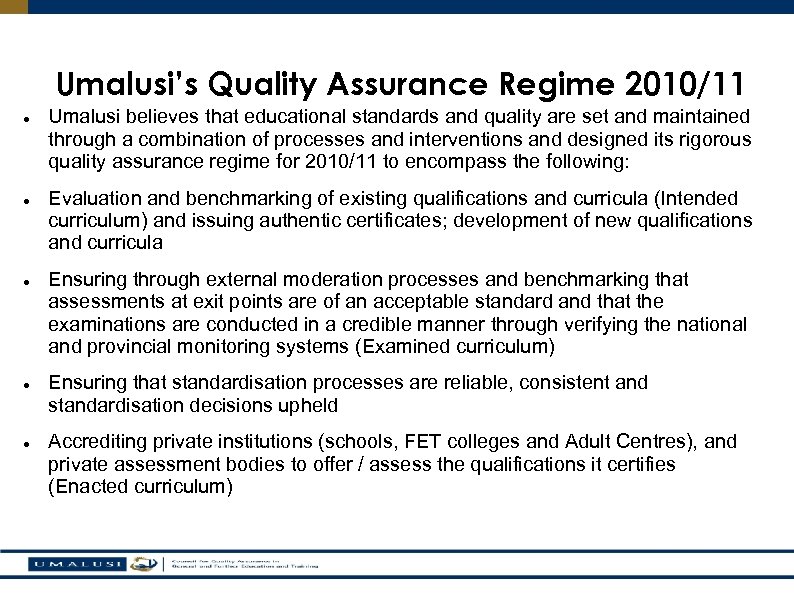
Umalusi’s Quality Assurance Regime 2010/11 Umalusi believes that educational standards and quality are set and maintained through a combination of processes and interventions and designed its rigorous quality assurance regime for 2010/11 to encompass the following: Evaluation and benchmarking of existing qualifications and curricula (Intended curriculum) and issuing authentic certificates; development of new qualifications and curricula Ensuring through external moderation processes and benchmarking that assessments at exit points are of an acceptable standard and that the examinations are conducted in a credible manner through verifying the national and provincial monitoring systems (Examined curriculum) Ensuring that standardisation processes are reliable, consistent and standardisation decisions upheld Accrediting private institutions (schools, FET colleges and Adult Centres), and private assessment bodies to offer / assess the qualifications it certifies (Enacted curriculum)
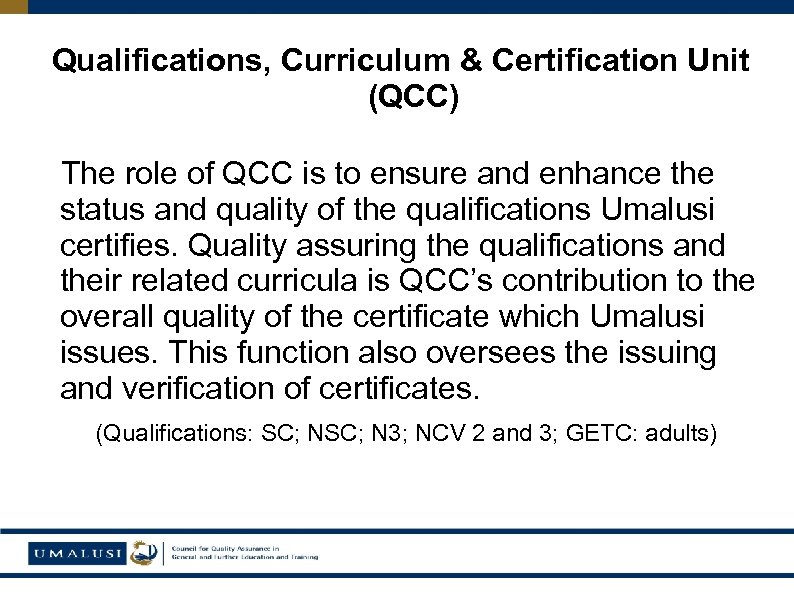
Qualifications, Curriculum & Certification Unit (QCC) The role of QCC is to ensure and enhance the status and quality of the qualifications Umalusi certifies. Quality assuring the qualifications and their related curricula is QCC’s contribution to the overall quality of the certificate which Umalusi issues. This function also oversees the issuing and verification of certificates. (Qualifications: SC; N 3; NCV 2 and 3; GETC: adults)
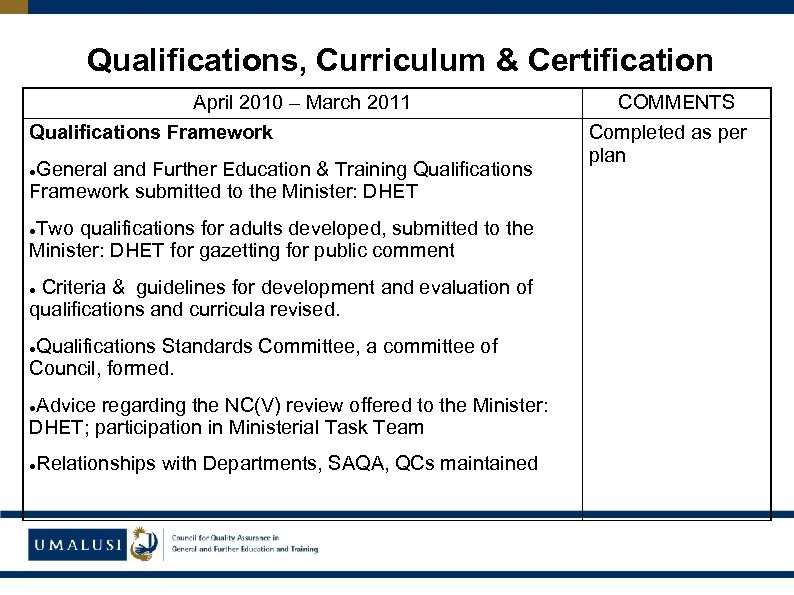
Qualifications, Curriculum & Certification April 2010 – March 2011 Qualifications Framework General and Further Education & Training Qualifications Framework submitted to the Minister: DHET Two qualifications for adults developed, submitted to the Minister: DHET for gazetting for public comment Criteria & guidelines for development and evaluation of qualifications and curricula revised. Qualifications Standards Committee, a committee of Council, formed. Advice regarding the NC(V) review offered to the Minister: DHET; participation in Ministerial Task Team Relationships with Departments, SAQA, QCs maintained COMMENTS Completed as per plan
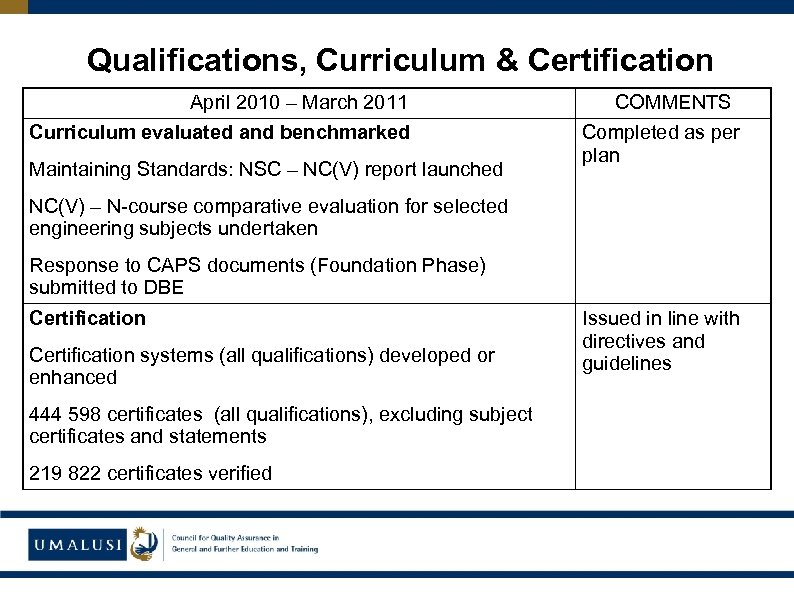
Qualifications, Curriculum & Certification April 2010 – March 2011 Curriculum evaluated and benchmarked Maintaining Standards: NSC – NC(V) report launched COMMENTS Completed as per plan NC(V) – N-course comparative evaluation for selected engineering subjects undertaken Response to CAPS documents (Foundation Phase) submitted to DBE Certification systems (all qualifications) developed or enhanced 444 598 certificates (all qualifications), excluding subject certificates and statements 219 822 certificates verified Issued in line with directives and guidelines
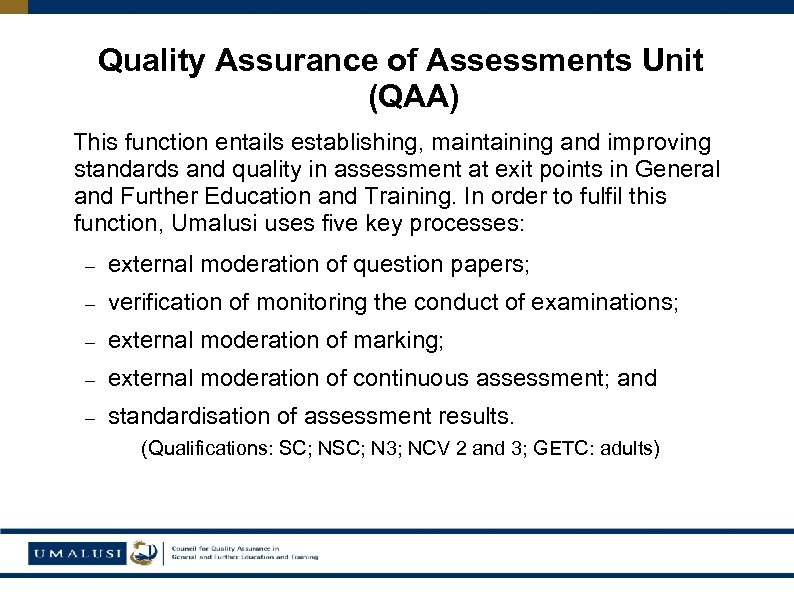
Quality Assurance of Assessments Unit (QAA) This function entails establishing, maintaining and improving standards and quality in assessment at exit points in General and Further Education and Training. In order to fulfil this function, Umalusi uses five key processes: external moderation of question papers; verification of monitoring the conduct of examinations; external moderation of marking; external moderation of continuous assessment; and standardisation of assessment results. (Qualifications: SC; N 3; NCV 2 and 3; GETC: adults)
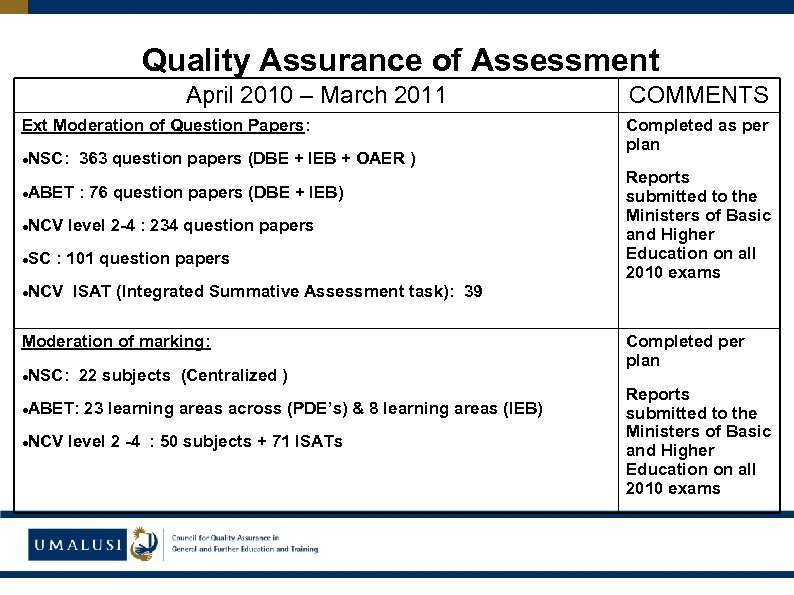
Quality Assurance of Assessment April 2010 – March 2011 Ext Moderation of Question Papers: NSC: 363 question papers (DBE + IEB + OAER ) ABET : 76 question papers (DBE + IEB) NCV level 2 -4 : 234 question papers SC : 101 question papers COMMENTS Completed as per plan Reports submitted to the Ministers of Basic and Higher Education on all 2010 exams NCV ISAT (Integrated Summative Assessment task): 39 Moderation of marking: NSC: 22 subjects (Centralized ) ABET: 23 learning areas across (PDE’s) & 8 learning areas (IEB) NCV level 2 -4 : 50 subjects + 71 ISATs Completed per plan Reports submitted to the Ministers of Basic and Higher Education on all 2010 exams
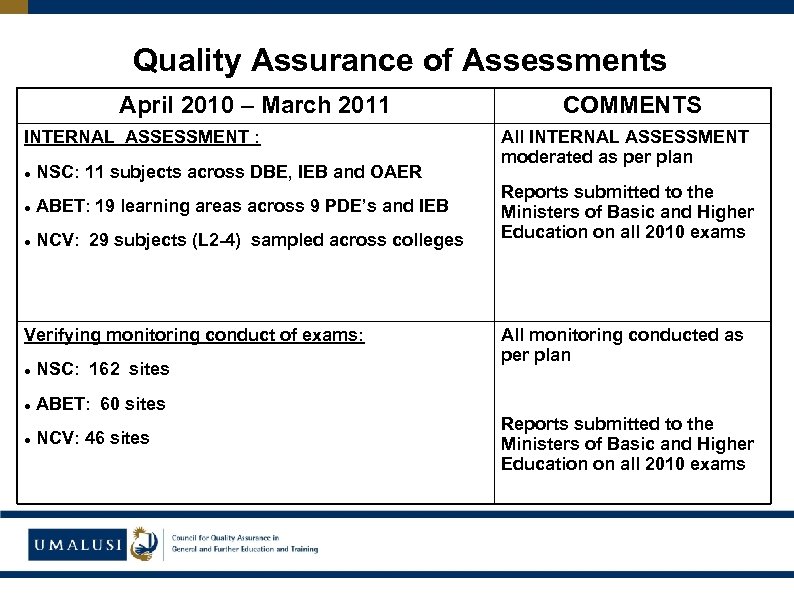
Quality Assurance of Assessments April 2010 – March 2011 INTERNAL ASSESSMENT : NSC: 11 subjects across DBE, IEB and OAER ABET: 19 learning areas across 9 PDE’s and IEB NCV: 29 subjects (L 2 -4) sampled across colleges Verifying monitoring conduct of exams: NSC: 162 sites COMMENTS All INTERNAL ASSESSMENT moderated as per plan Reports submitted to the Ministers of Basic and Higher Education on all 2010 exams All monitoring conducted as per plan ABET: 60 sites NCV: 46 sites Reports submitted to the Ministers of Basic and Higher Education on all 2010 exams
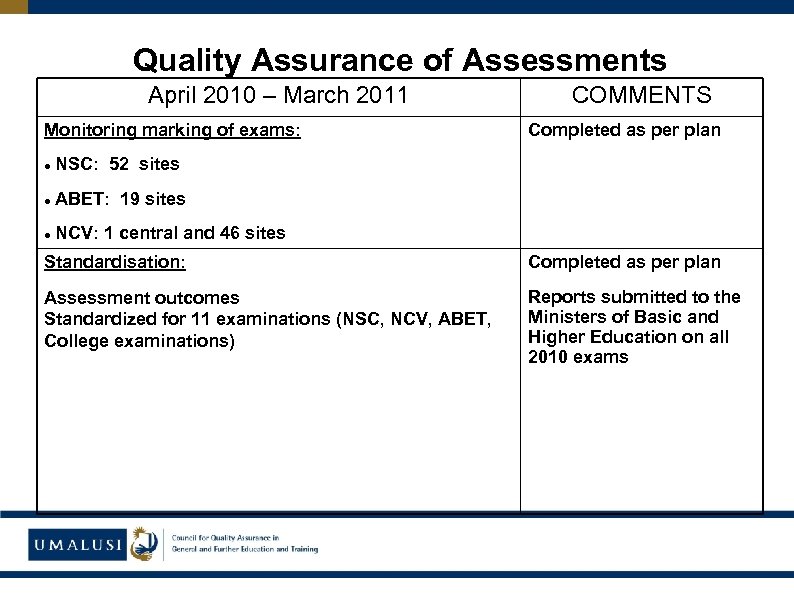
Quality Assurance of Assessments April 2010 – March 2011 Monitoring marking of exams: ABET: 19 sites Completed as per plan NSC: 52 sites COMMENTS NCV: 1 central and 46 sites Standardisation: Completed as per plan Assessment outcomes Standardized for 11 examinations (NSC, NCV, ABET, College examinations) Reports submitted to the Ministers of Basic and Higher Education on all 2010 exams
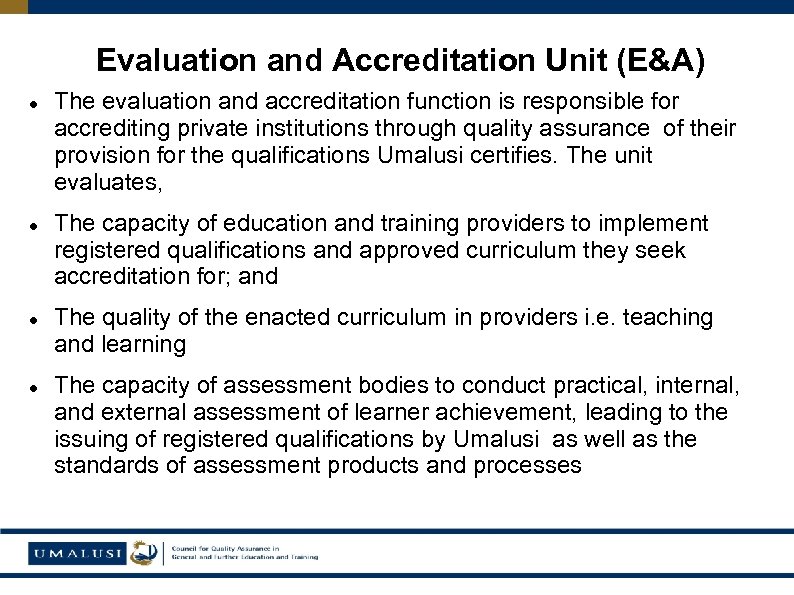
Evaluation and Accreditation Unit (E&A) The evaluation and accreditation function is responsible for accrediting private institutions through quality assurance of their provision for the qualifications Umalusi certifies. The unit evaluates, The capacity of education and training providers to implement registered qualifications and approved curriculum they seek accreditation for; and The quality of the enacted curriculum in providers i. e. teaching and learning The capacity of assessment bodies to conduct practical, internal, and external assessment of learner achievement, leading to the issuing of registered qualifications by Umalusi as well as the standards of assessment products and processes
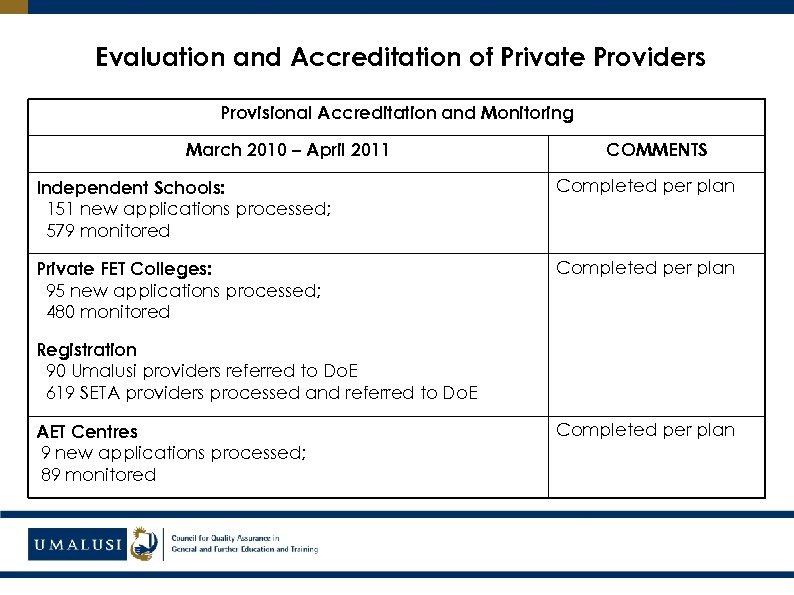
Evaluation and Accreditation of Private Providers Provisional Accreditation and Monitoring March 2010 – April 2011 COMMENTS Independent Schools: 151 new applications processed; 579 monitored Completed per plan Private FET Colleges: 95 new applications processed; 480 monitored Completed per plan Registration 90 Umalusi providers referred to Do. E 619 SETA providers processed and referred to Do. E AET Centres 9 new applications processed; 89 monitored Completed per plan
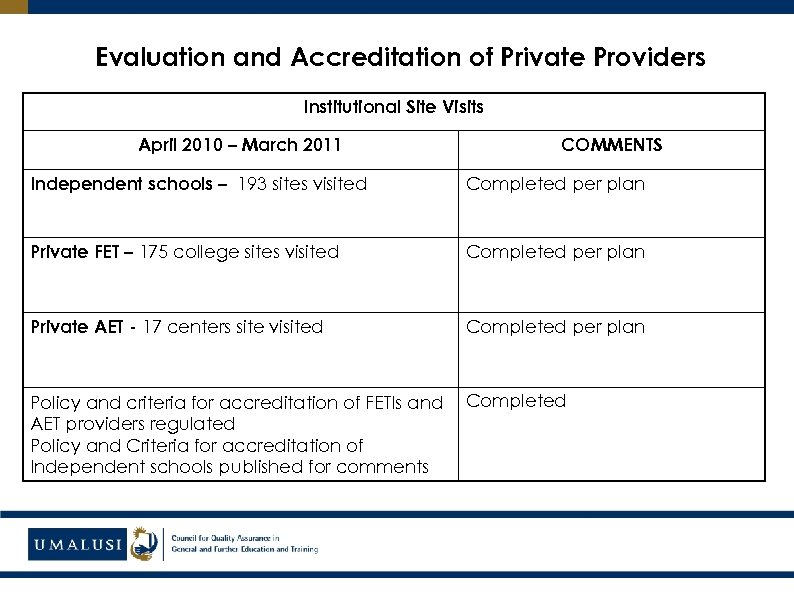
Evaluation and Accreditation of Private Providers Institutional Site Visits April 2010 – March 2011 COMMENTS Independent schools – 193 sites visited Completed per plan Private FET – 175 college sites visited Completed per plan Private AET - 17 centers site visited Completed per plan Policy and criteria for accreditation of FETIs and AET providers regulated Policy and Criteria for accreditation of Independent schools published for comments Completed
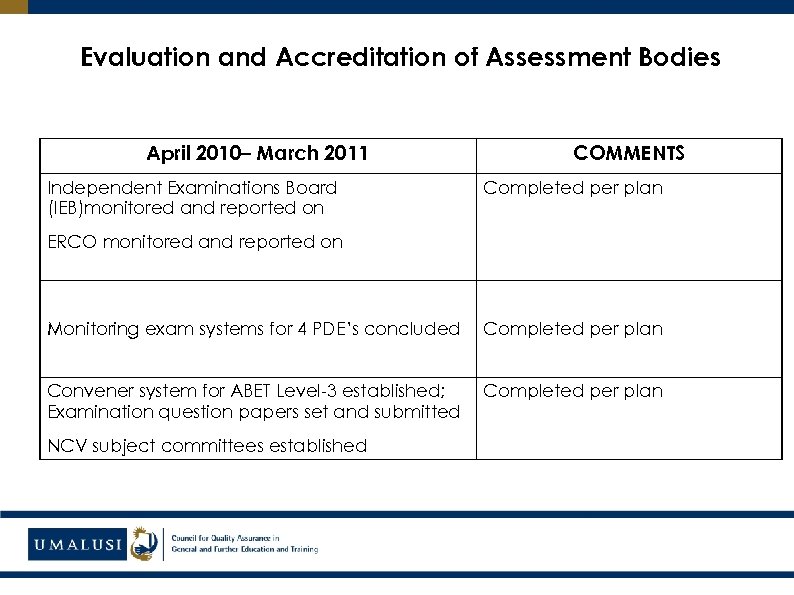
Evaluation and Accreditation of Assessment Bodies April 2010– March 2011 Independent Examinations Board (IEB)monitored and reported on COMMENTS Completed per plan ERCO monitored and reported on Monitoring exam systems for 4 PDE’s concluded Completed per plan Convener system for ABET Level-3 established; Examination question papers set and submitted Completed per plan NCV subject committees established
Statistical Information and Research Unit (SIR) The mandate of the SIR unit is to conduct research as identified by the needs of the organisation and report on the key indicators of quality and standards in general and further education and training; to establish and maintain databases; to lead statistical research and analysis; and to inform and provide statistical support for the work in other units. The SIR Unit also plays a role in organizational and professional development at Umalusi.
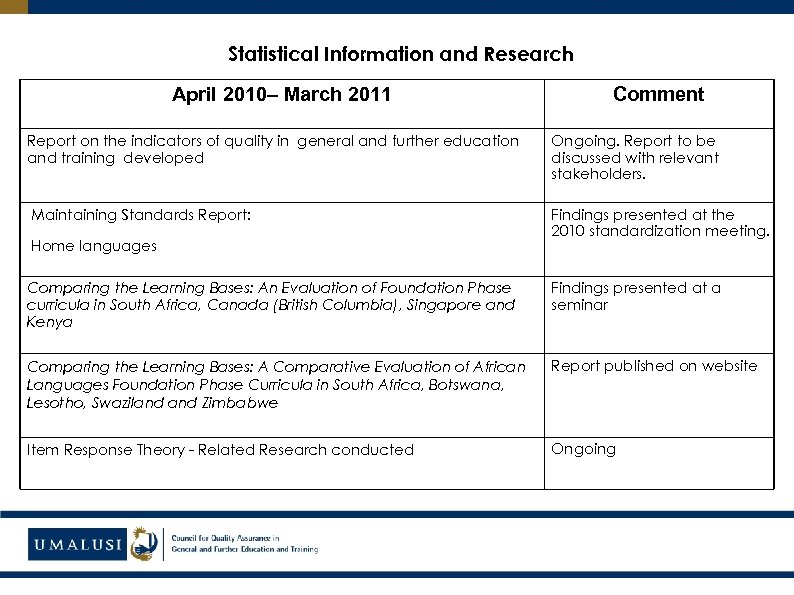
Statistical Information and Research April 2010– March 2011 Comment Report on the indicators of quality in general and further education and training developed Ongoing. Report to be discussed with relevant stakeholders. Maintaining Standards Report: Findings presented at the 2010 standardization meeting. Home languages Comparing the Learning Bases: An Evaluation of Foundation Phase curricula in South Africa, Canada (British Columbia), Singapore and Kenya Findings presented at a seminar Comparing the Learning Bases: A Comparative Evaluation of African Languages Foundation Phase Curricula in South Africa, Botswana, Lesotho, Swaziland Zimbabwe Report published on website Item Response Theory - Related Research conducted Ongoing
Management Support Structures (MSS) Management Support Structures ensures that: Strategic plans are in place and that the organisation carries out its remit Corporate Governance Advocacy of Umalusi’s work Stakeholders relationships
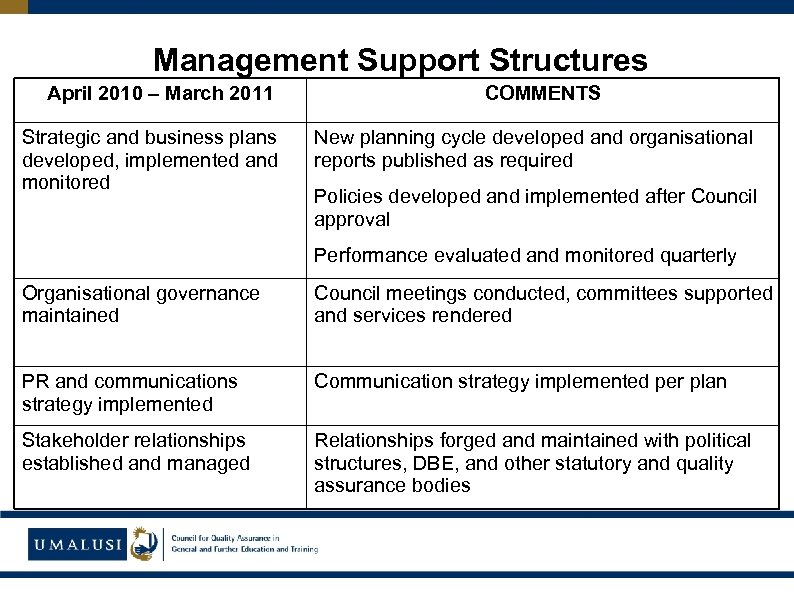
Management Support Structures April 2010 – March 2011 Strategic and business plans developed, implemented and monitored COMMENTS New planning cycle developed and organisational reports published as required Policies developed and implemented after Council approval Performance evaluated and monitored quarterly Organisational governance maintained Council meetings conducted, committees supported and services rendered PR and communications strategy implemented Communication strategy implemented per plan Stakeholder relationships established and managed Relationships forged and maintained with political structures, DBE, and other statutory and quality assurance bodies
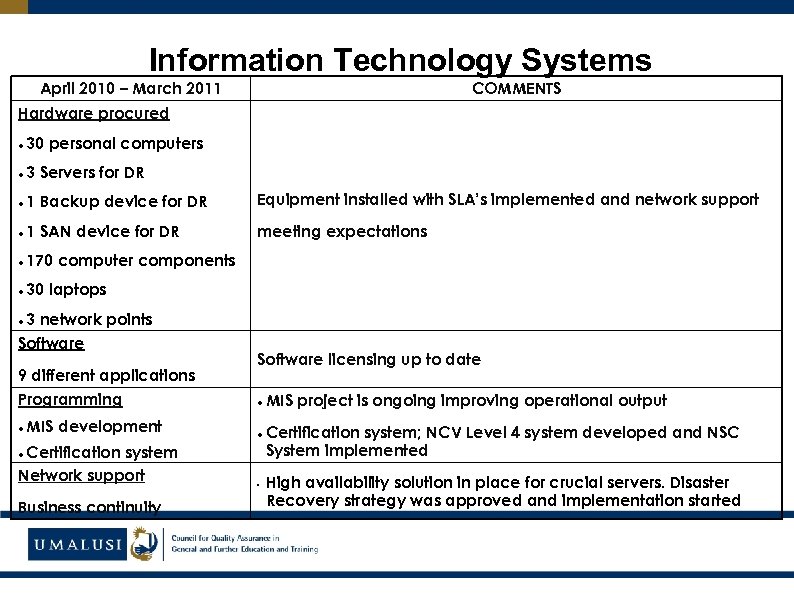
Information Technology Systems April 2010 – March 2011 COMMENTS Hardware procured 30 personal computers 3 Servers for DR 1 Backup device for DR Equipment installed with SLA’s implemented and network support 1 SAN device for DR meeting expectations 170 computer components 30 laptops 3 network points Software 9 different applications Programming MIS development Certification system Network support Software licensing up to date Business continuity • MIS project is ongoing improving operational output Certification system; NCV Level 4 system developed and NSC System implemented High availability solution in place for crucial servers. Disaster Recovery strategy was approved and implementation started
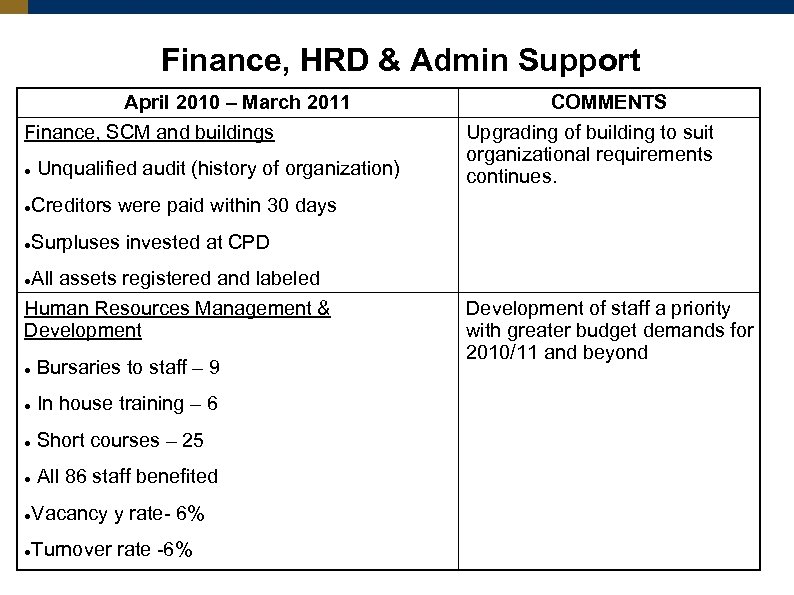
Finance, HRD & Admin Support April 2010 – March 2011 Finance, SCM and buildings Unqualified audit (history of organization) Creditors were paid within 30 days COMMENTS Upgrading of building to suit organizational requirements continues. Surpluses invested at CPD All assets registered and labeled Human Resources Management & Development Bursaries to staff – 9 In house training – 6 Short courses – 25 All 86 staff benefited Vacancy y rate- 6% Turnover rate -6% Development of staff a priority with greater budget demands for 2010/11 and beyond
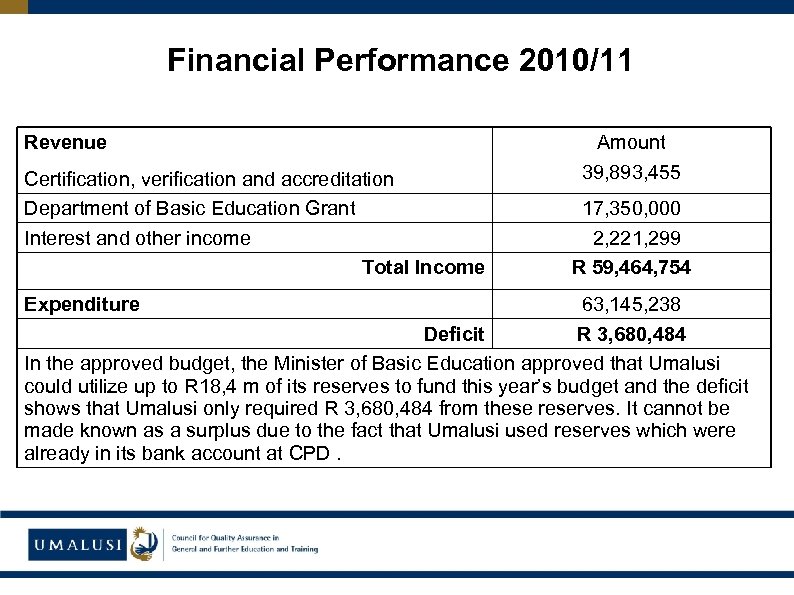
Financial Performance 2010/11 Revenue Certification, verification and accreditation Department of Basic Education Grant Interest and other income Total Income Expenditure Amount 39, 893, 455 17, 350, 000 2, 221, 299 R 59, 464, 754 63, 145, 238 Deficit R 3, 680, 484 In the approved budget, the Minister of Basic Education approved that Umalusi could utilize up to R 18, 4 m of its reserves to fund this year’s budget and the deficit shows that Umalusi only required R 3, 680, 484 from these reserves. It cannot be made known as a surplus due to the fact that Umalusi used reserves which were already in its bank account at CPD.

Financial Position 2010/11 Assets 13, 959 Property & equipment 13, 639, 755 Intangible assets 320, 204 • • Current Assets 29, 133, 651 Trade & other receivables 5, 674, 759 Cash & cash equivalents 23, 458, 892 • • TOTAL ASSETS R 43, 093, 610 Equity Accumulated surplus 35, 479, 957 Liabilities Trade & other payables • TOTAL EQUITY & LIABILITIES 7, 613, 653 R 43, 093, 610
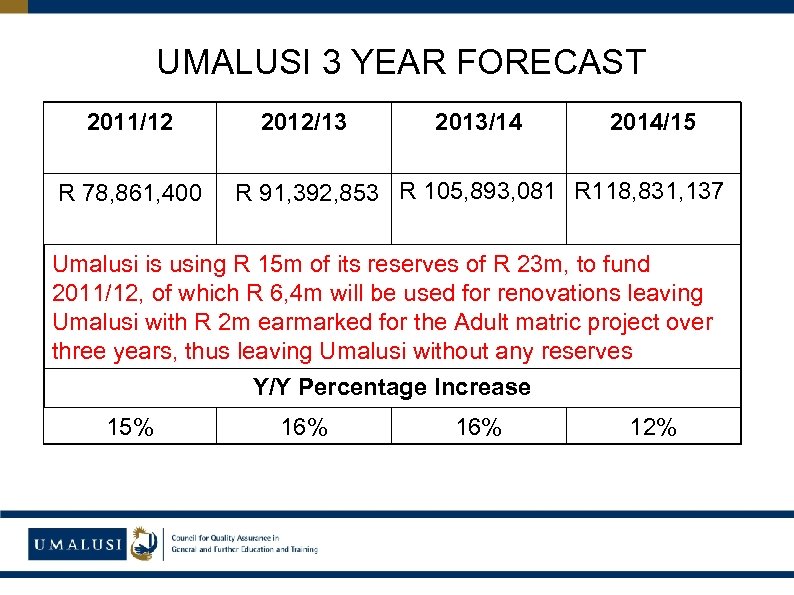
UMALUSI 3 YEAR FORECAST 2011/12 R 78, 861, 400 2012/13 2013/14 2014/15 R 91, 392, 853 R 105, 893, 081 R 118, 831, 137 Umalusi is using R 15 m of its reserves of R 23 m, to fund 2011/12, of which R 6, 4 m will be used for renovations leaving Umalusi with R 2 m earmarked for the Adult matric project over three years, thus leaving Umalusi without any reserves Y/Y Percentage Increase 15% 16% 12%
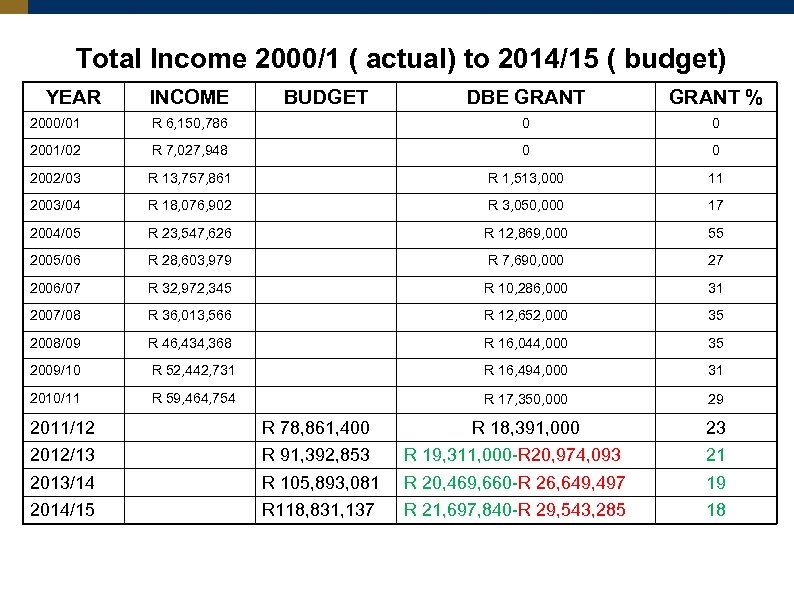
Total Income 2000/1 ( actual) to 2014/15 ( budget) YEAR INCOME BUDGET DBE GRANT % 2000/01 R 6, 150, 786 0 0 2001/02 R 7, 027, 948 0 0 2002/03 R 13, 757, 861 R 1, 513, 000 11 2003/04 R 18, 076, 902 R 3, 050, 000 17 2004/05 R 23, 547, 626 R 12, 869, 000 55 2005/06 R 28, 603, 979 R 7, 690, 000 27 2006/07 R 32, 972, 345 R 10, 286, 000 31 2007/08 R 36, 013, 566 R 12, 652, 000 35 2008/09 R 46, 434, 368 R 16, 044, 000 35 2009/10 R 52, 442, 731 R 16, 494, 000 31 2010/11 R 59, 464, 754 R 17, 350, 000 29 R 18, 391, 000 23 2011/12 R 78, 861, 400 2012/13 R 91, 392, 853 R 19, 311, 000 -R 20, 974, 093 21 2013/14 R 105, 893, 081 R 20, 469, 660 -R 26, 649, 497 19 2014/15 R 118, 831, 137 R 21, 697, 840 -R 29, 543, 285 18
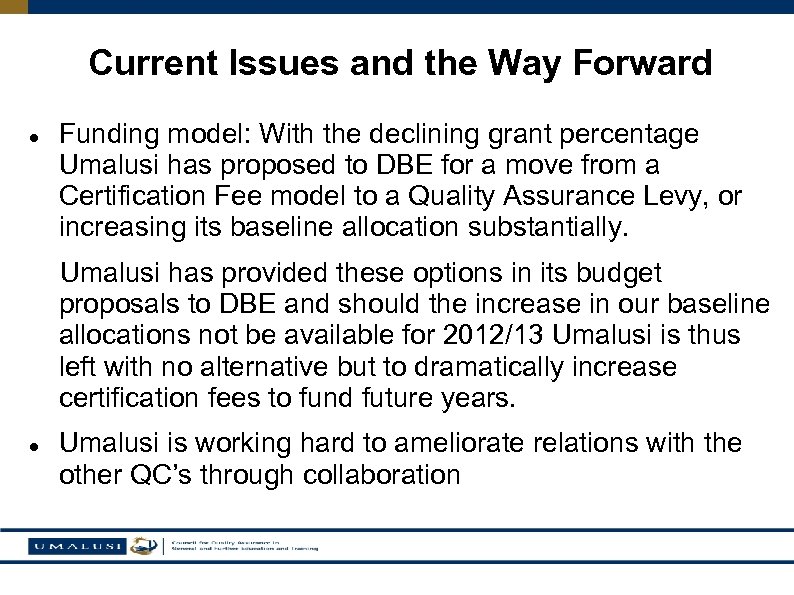
Current Issues and the Way Forward Funding model: With the declining grant percentage Umalusi has proposed to DBE for a move from a Certification Fee model to a Quality Assurance Levy, or increasing its baseline allocation substantially. Umalusi has provided these options in its budget proposals to DBE and should the increase in our baseline allocations not be available for 2012/13 Umalusi is thus left with no alternative but to dramatically increase certification fees to fund future years. Umalusi is working hard to ameliorate relations with the other QC’s through collaboration

Conclusion Umalusi wishes to thank the honorable Portfolio Committee Chairperson, Ms H Malgas and her members for their support
Скачать презентацию Umalusi s presentation to the Basic Education Portfolio Committee
54ef2ca4d18ff0bdfab62a8dc6c796d3.ppt