


 Скачать презентацию Uluslararası Politika ingilizce notlar Notlar ek ders çalışma
3f5ebc310eb350a09b58ba8a93fc01db.ppt
- Количество слайдов: 62
 Uluslararası Politika ingilizce notlar! Notlar ek ders çalışma amacıyla verilmiştir, öğrencilerin temel sorumluluğu okumaları yapmaktır.
 International Politics Week 1 -2 International History I (1900 -1945) Fulya Memisoglu Department of International Relations Cukurova University Spring Semester 2016
 Outline of Lecture • Key transformations in international politics between 1900 -1945 • World War I & Inter-War Period • The global economic crisis (1929 -1933) • The Decline of Europe
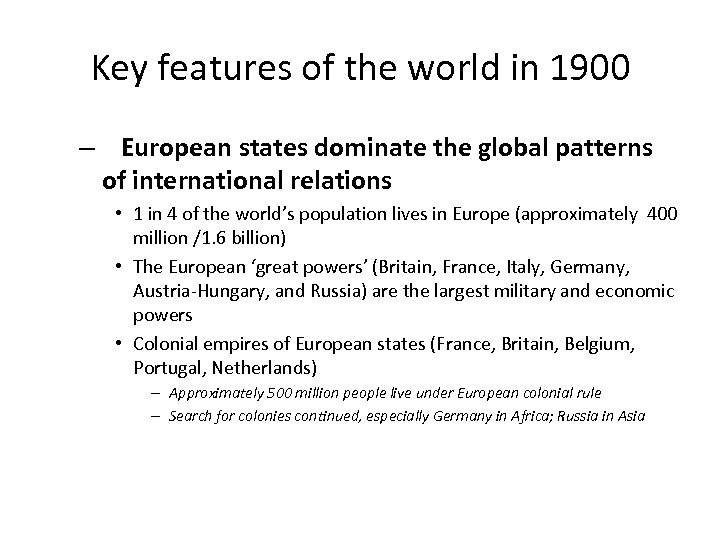 Key features of the world in 1900 – European states dominate the global patterns of international relations • 1 in 4 of the world’s population lives in Europe (approximately 400 million /1. 6 billion) • The European ‘great powers’ (Britain, France, Italy, Germany, Austria-Hungary, and Russia) are the largest military and economic powers • Colonial empires of European states (France, Britain, Belgium, Portugal, Netherlands) – Approximately 500 million people live under European colonial rule – Search for colonies continued, especially Germany in Africa; Russia in Asia
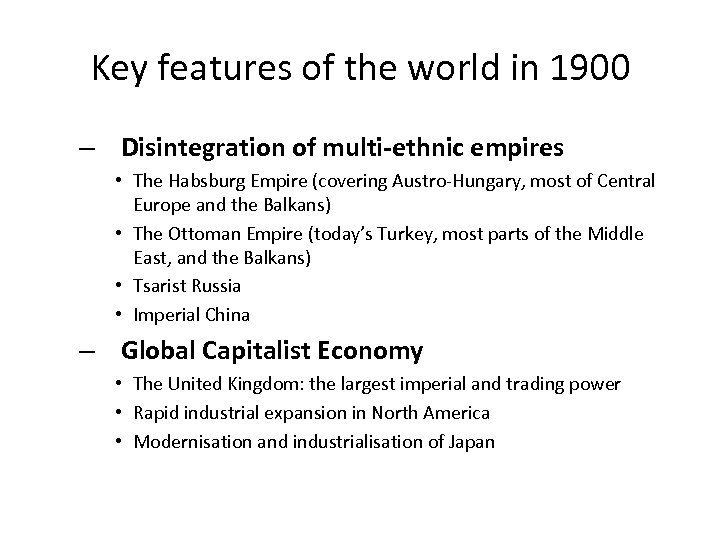 Key features of the world in 1900 – Disintegration of multi-ethnic empires • The Habsburg Empire (covering Austro-Hungary, most of Central Europe and the Balkans) • The Ottoman Empire (today’s Turkey, most parts of the Middle East, and the Balkans) • Tsarist Russia • Imperial China – Global Capitalist Economy • The United Kingdom: the largest imperial and trading power • Rapid industrial expansion in North America • Modernisation and industrialisation of Japan
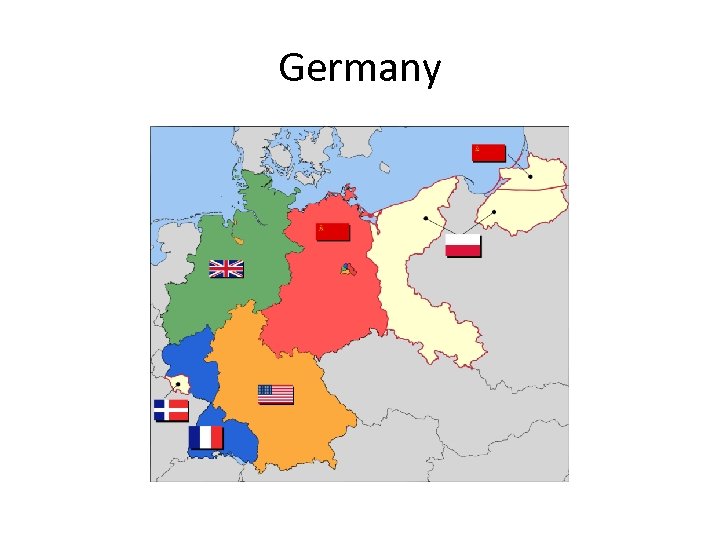
 Key features of the world in 1945 – Prominence of the US and USSR – The split of Germany until 1989 – National economies in ruin, large debts to US – Colonisation power is lessened by War – Collapse of Europe – Growing nationalism in the colonial empires – India seeking independence (achieved in 1947) – Vietnam seeking independence (Ho Chi Minh declaration in 1945) – Civil War in China – Ended with victory of Mao and establishment of the Peoples Republic of China (1949) – Together with the population of the USSR, 1/3 of the world now lives under communist rule
 The Origins of World War I – Why did Europe lose its predominant place in the world in the years between 1900 and 1945? – What are the main causes of the war? – Who won the war? – What are the ramifications of WWI?
 Why did Europe lose its prominent place between 1900 -1945? – Global economic developments: Severe economic and military challenges from rapidly industrialising states, e. g. The US and Japan – Expansionism of Germany/ Imperial Disputes: Following its unification Germany’s bid for world power status • Alliance between Britain, France, Tsarist Russia against Germany’s determined search for territory and markets • Germany: Mainly economic purposes. North Africa, Middle East (the plan to build a railway between Baghdad and Berlin)
 The Origins of World War I – The ‘German Problem’ • Unification of Germany in 1871 (collection of 25 states) – For the first time in modern history, the centre of Europe was dominated by a single, vast state – The territory, population, military and industrial strength disrupting balance of Power in Europe – Potential for expansionism – Germany second large population (60 m by 1913) after Russia – Rapid industrialisation: coal, steel and iron production – From 1871 to 1914, the value of Germany’s agricultural output doubled, industrial production quadrupled, and overseas trade more than tripled
 The Origins of World War I – The ‘Eastern Question’ • The slow collapse of the Ottoman Empire • Important source of instability in late 19 th and early 20 th century • Power vacuum in the region, • The rise of nationalism and claims to statehood – Particularly in the Balkans and Central Europe • National wars in the Balkans with the backing of various European great powers (e. g. Russia-Serbs)
 Consequences of WWI – The first time in history a conflict that involved so many different countries and peoples; mobilisation of people – The collapse Austro-Hungarian and Ottoman Empires, Russia – The urge for a peace settlement » Treaty of Versailles, 1919 » How to avoid war in the future? » What to do with Germany and collapsed empires? » President Wilson’s Fourteen Points » Kellogg-Briand Pact of 1926
 Consequences of WWI – President Wilson’s Fourteen Points » A set of principles to shape the subsequent peace » ‘A new approach to international diplomacy: open covenants rather than old-style secret diplomacy » The creation of an international organisations based on the principle of ‘collective security’ League of Nations » The principle of national self-determination: the rights of distinct national groups to govern themselves over their own territory drawing boundaries of the new states of Europe (in the Balkans and CEECs: Yugoslavia, Romania, Bulgaria, Czechoslovakia, Poland, Hungary)
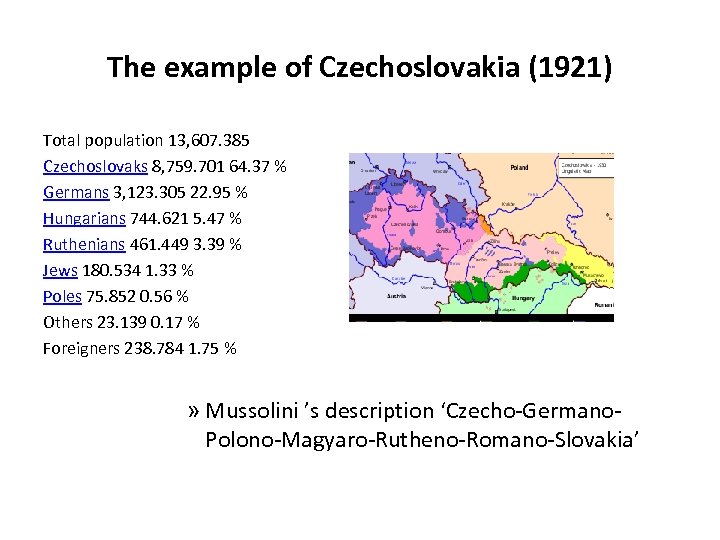 The example of Czechoslovakia (1921) Total population 13, 607. 385 Czechoslovaks 8, 759. 701 64. 37 % Germans 3, 123. 305 22. 95 % Hungarians 744. 621 5. 47 % Ruthenians 461. 449 3. 39 % Jews 180. 534 1. 33 % Poles 75. 852 0. 56 % Others 23. 139 0. 17 % Foreigners 238. 784 1. 75 % » Mussolini ’s description ‘Czecho-Germano. Polono-Magyaro-Rutheno-Romano-Slovakia’
 Consequences of WWI – President Wilson’s Fourteen Points » The principle of national self-determination(cont. ): 60 million people got a nation- state of their own while 25 million were transformed into minorities New nation-states of the Balkans and CEE: Ethnic cleavages, weak economies, fragile political institutions » Absolute freedom of navigation in the seas » Disarmament » The removal of economic barriers
 Consequences of WWI – Other key issues of Versailles » The creation of Union of Soviet Socialist Republics Spread of Bolshevism into Europe » The Moscow-led Communist International (Comintern) » Period of alliance building for European Security: France, Britain (and Italy, after 1925) extended guarantees to various Eastern and Central European states, promising action if their boundaries were violated by an agresssor
 Consequences of WWI – Other key issues of Versailles » How to avoid future resurgence of Germany 1. Germany lost 13 per cent of its land nearly 7 million people (to Poland, Alsace-Lorraine and Rhineland to France) 2. Disarmament of Germany 3. ‘The war guilt’ clause in the Versailles Treaty 4. The British economist John Maynard Keynes The economic consequences of the Peace: ‘Economic ruination of Germany- the result of punitive reparations would prevent the recovery of Europe as a whole’ 5. The rise of Hitler’s National Socialists in the 1930 s
 The League of Nations – The first institutional attempt to create an international body designed to mediate disputes with permanent structures and a codified Charter – Collective security: Any act of aggression towards a member by another state will receive a ‘collective response’ – Minority Rights Protection System » The issue of minority rights was a major component of the collective security regime introduced by the League of Nations » the first collective attempt of the twentieth century that placed the rights of minorities on the international agenda. » the role to monitor implementation of minority rights in certain states whose minority populations had significantly increased as the borders were redrawn at the end of World War I.
 Inter-War Period: The Collapse of International Economy – The war severely damaged the globalised world economy » America slowly taking over Britain’s position in the global economy » By 1929, the US produced 42 per cent of the world’s industrial output --- Germany, Britain &France all together 28 percent » The 1929 Wall Street Crash - Western Europe’s dependence on American loans worsened the crisis -Immediate consequences in Europe: hyper-inflation, a collapse of consumer demand in leading industrial countries decline in manufacturing industry massive unemployment
 Inter-War Period: The Rise of the Extremist Political Movements The impact of Globalisation: - Global consequences: International trade partners (Latin America, Asia, Colonial territories under the rule of Western European Powers) A Global free trade system isolation of national economies, protectionist policies, attempts to create selfsufficient economies the volume of international trade fell sharply – The fall of democracies and the rise of extreme right-wing dictatorships ( some link to Economic Depression) » Italy, Germany, and many countries of Latin America
 International History (I) Seminar Discussion Questions (next week) 1) 2) 3) 4) 5) 6) 7) In what ways did Europe dominate international politics at the start of the twentieth century? Why was Germany regarded as a problem after its unification in 1871? What factors resulted in the outbreak of WWI in 1914? What were the main weaknesses of the post-war peace settlement? Was Germany treated unfairly by the Treaty of Versailles? Why were the US and the USSR not more active in international politics in the inter-war period? Why did the Wall Street stock-market crash have such profound international consequences?
 The Evolution of International Politics Seminar Discussion Questions (this week) 1) 2) 3) 4) 5) 6) 7) 8) Is globalisation a new phenomenon in international politics? Which main theoretical approach best explains globalisation? Is globalisation a positive or negative development? Is globalisation merely the latest stage of capitalist development? Does globalisation make the state obsolete? Does globalisation make the world more or less democratic? Is globalisation merely Western imperialism in a new guise? Does globalisation make war less likely?
 International Politics Week 3 -5 International History III (1945 -1990) The end of Cold War Fulya Memisoglu Department of International Relations Cukurova University Spring Semester 2016
 Outline of Lecture • Key transformations in international politics between 1945 -1990 • Key themes: 2 nd World War, The Cold War & the creation of nuclear weapons, Decolonisation/ the end of European Imperialism
 World Politics after 1945 – The rise of the Soviet Union and the United States • Their increasing involvement in Europe, militarily and politically • ‘Superpowers’ : combining global objectives with military capabilities that included weapons of mass destruction – The breakup of the wartime alliance between the UK, the USSR, and the USA – Nuclear arms race: challenges to world politics and post-war diplomacy – The East-West confrontation
 Political, technological and ideological developments in the post-war period The end of Empire • The withdrawal of European countries from their empires in Africa and Asia The Cold War • The political and military confrontation between the SU and the US The Bomb • Development of the atomic and hydrogen bomb The transformation of the international political economy The creation of the United Nations
 Collapse of imperialism in the 20 th century – Decreasing importance of Europe as the leader of world affairs – ‘National self-determination’ – Britain: 49 territories were granted independence – France and Britain: British Commonwealth and the French Union in Africa were established – Methods of economic development assistance – France: Algerian civil war (1945 -1962) leading up to 45, 000 deaths – Portugal: Mozambique and Angola
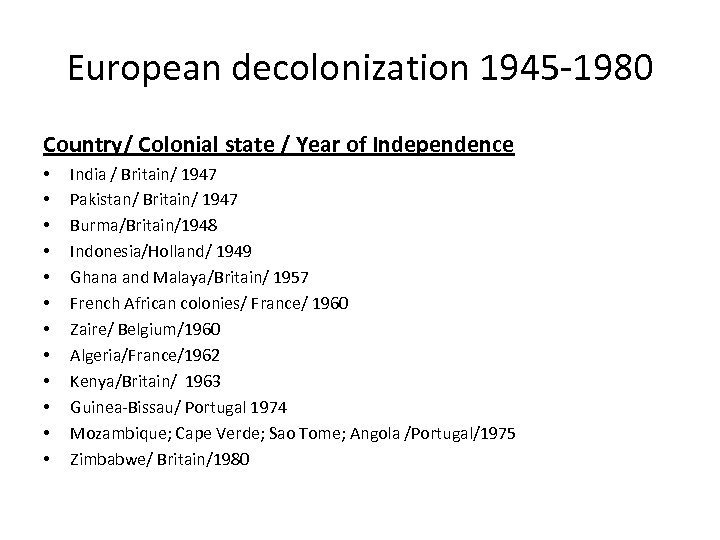 European decolonization 1945 -1980 Country/ Colonial state / Year of Independence • • • India / Britain/ 1947 Pakistan/ Britain/ 1947 Burma/Britain/1948 Indonesia/Holland/ 1949 Ghana and Malaya/Britain/ 1957 French African colonies/ France/ 1960 Zaire/ Belgium/1960 Algeria/France/1962 Kenya/Britain/ 1963 Guinea-Bissau/ Portugal 1974 Mozambique; Cape Verde; Sao Tome; Angola /Portugal/1975 Zimbabwe/ Britain/1980
 Decolonization in Africa and Asia – The local and nationalist movements – The involvement of external states, including the superpowers – The rise of communist movements: Malaya/ Britain 1948 -1960 Indo-China/ France 1946 -1954 Chinese and Soviet support for North Vietnam (the Viet Cong); European and American support for South Vietnam; the defeat of South Vietnam (withdrawal of American forces in 1973)
 Decolonization in Africa and Asia – Countries lost independence: – Tibet (invaded by China 1950) and East Timor (invaded by Indonesia 1975) – The fall of imperialism and the rise of hegemony – The Soviet ‘hegemony’ in Eastern Europe; The American hegemony in Central America – The struggle for independence/national liberation became part of cold war conflicts when the superpowers and their allies became involved – Has decolonisation been successful?
 The cold war (1945 -1953) – When did the cold war start? • The Russian revolution of 1917? • Or events between 1945 -150? – The rise of the United States and the Soviet Union as global powers – The conflicts between the US and the SU • The Union of Soviet Socialist Republics (USSR), Eastern European Allies, People’s Republic of China (PRC), revolutionary movements and governments in the third world
 The Cold War – The Policy of containment : the commitment of the US to defend Western Europe • The Truman doctrine (1947) • Marshall Plan for European Economic recovery (1947) – The first major confrontation • The deployment of American long-range bombers in Britain • The signing of the North Atlantic Treaty Organisation (1949) ‘The key principle of the treaty: collective self-defence’
 Truman Doktrini • 1947‘de Başkan Truman, Kongre’den Türkiye ve Yunanistan’ın Sovyetlere karşı desteklenmesi için 300 Milyon $’lık bir yardım yapılması için talepte bulundu. • Tartışmalar sonunda Başkan’a Türkiye ve Yunanistan’a askeri uzmanlar gönderme ve bu iki ülkeye yardım yapılabilmesi için 400 Milyon $ (300 Milyon $ Yunanistan, 100 Milyon $ Türkiye için) kullanabilme yetkisi verildi. • Askeri yardım
 Marshall Planı’nın nedenleri • Ekonomik nedenler – Savaş sonrası dönemde ABD’nin ekonomisi güçlü bir Avrupa’ya ihtiyaç duyması, – Avrupa’da işsizliğin azalması, ihracatın artması Avrupa’nın bütünleşmiş bir dünya ticaret sisteminin içine sokulması, • Stratejik nedenler – Orta ve Batı Avrupa’da oluşan güç boşluğu – Sovyetler Birliği etkisi – Avrupa’da ABD federal sistemine benzer bir yapı kurulması (bkz Erhan, p. 278)
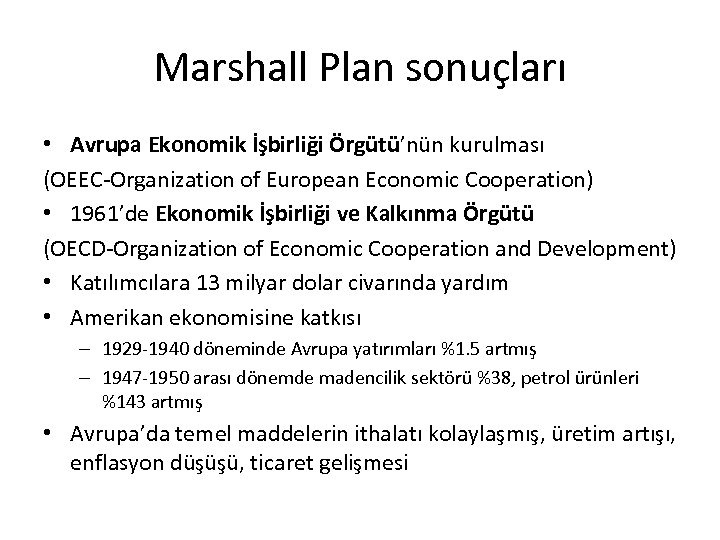 Marshall Plan sonuçları • Avrupa Ekonomik İşbirliği Örgütü’nün kurulması (OEEC-Organization of European Economic Cooperation) • 1961’de Ekonomik İşbirliği ve Kalkınma Örgütü (OECD-Organization of Economic Cooperation and Development) • Katılımcılara 13 milyar dolar civarında yardım • Amerikan ekonomisine katkısı – 1929 -1940 döneminde Avrupa yatırımları %1. 5 artmış – 1947 -1950 arası dönemde madencilik sektörü %38, petrol ürünleri %143 artmış • Avrupa’da temel maddelerin ithalatı kolaylaşmış, üretim artışı, enflasyon düşüşü, ticaret gelişmesi
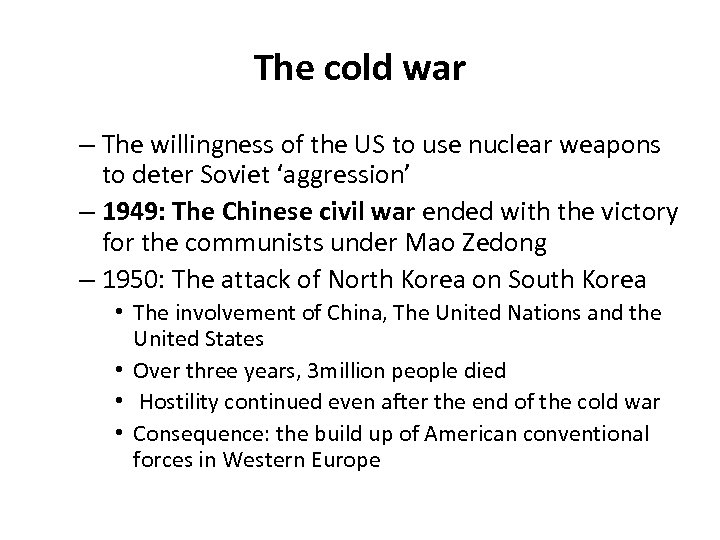 The cold war – The willingness of the US to use nuclear weapons to deter Soviet ‘aggression’ – 1949: The Chinese civil war ended with the victory for the communists under Mao Zedong – 1950: The attack of North Korea on South Korea • The involvement of China, The United Nations and the United States • Over three years, 3 million people died • Hostility continued even after the end of the cold war • Consequence: the build up of American conventional forces in Western Europe
 Germany
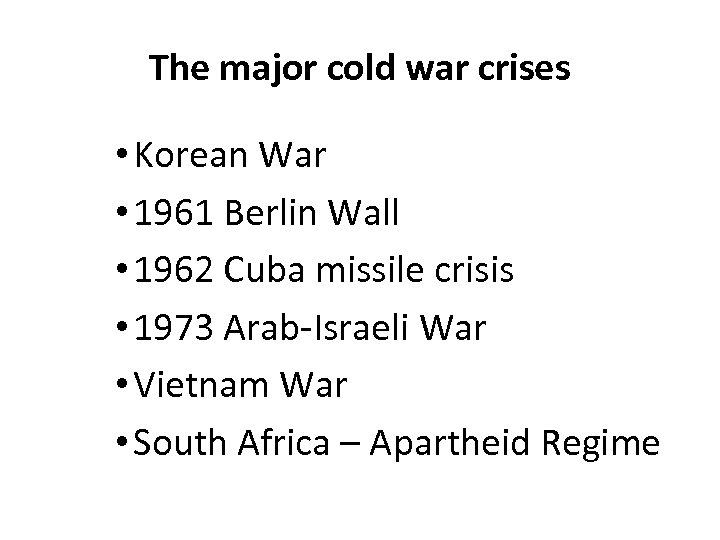 The major cold war crises • Korean War • 1961 Berlin Wall • 1962 Cuba missile crisis • 1973 Arab-Israeli War • Vietnam War • South Africa – Apartheid Regime
 The cold war (1953 -1969) • • The rearmament of the Federal Republic of Germany (1954) The creation of Warsaw Pact (1955) 7, 000 nuclear weapons installed in Europe by the 1960 s 1962: more stable period of coexistence and competition – – – Seeking ‘coexistence’ while pursuing confrontation Soviet support for movements of national liberation across the world Modernisation of the Soviet society Polish reformism `1956 Soviet intervention in Hungary (1956) • The death of Stalin (1953) Nikita Khrushchev – – The Vietnamese war The deterioration of Soviet-Chinese relations The Soviet- American detente; The Chinese- American rapproachment http: //www. slideshare. net/browniator/chapter-8 -coldwar? next_slideshow=7
 The cold war (Deterrence, Nuclear Strategy and Arms Control) Superpower relations: • Policy of containment • Nuclear strategy – The invention of the atomic bomb – Heavy expenditure on nuclear technology – Updating nuclear strategy for ‘deterrence’ » Mutual Assured Destruction » 1950 -60 s: US nuclear strategy: Passive deterrence ‘Intercontinental ballistic missiles’ (ICBMs) » 1957: USSR launched the satellite ‘SPUTNIK’
 The cold war (Deterrence, Nuclear Strategy and Arms Control) • Kitle imha silahları: Kitlesel ve ayrım gözetmeyen tahrip kapasitesine sahip, nükleer, radyolojik, kimyasal ve biyolojik silah kategorisi. • 1968 Nükleer Silahların Yayılmasını Önleme Antlaşması (Non-proliferation treaty)
 Why do states want nuclear weapons? • If you have nuclear weapons, it deters other countries of invading you; threaten your territorial integrity ‘in a big way’ • While you can be attacked in a number of different ways, but another state coming would be difficult. . • Nuclear weapons give a compelling power’, but it doesn’t work • What are the advantages of having nuclear power?
 Why do states want nuclear weapons Just 9 countries… • US motivation-Germany bombing Japan • Russian motivation- inevitable since the US has it; ‘nuclear weapons would avoid devastating wars: never again’ • France: didn’t want to rely on US& UK, dominant player WW 2; same reasoning applies as Russia • The UK: original study of feasibility, British scientists were in from the beginning in Manhattan project • China: early 50 s after the revolution, arrangement with SU that the latter would help. Motivation: blackmailed by the US, later by the SU. We won’t use them first, we prefer disarmament • Israel: functional nuclear weapon. ‘Logic was clear: never again’ surrounded by larger states not recognizing their existence. 1967 war was an example of this threat; so this capability was essential. France helped. It doesn’t acknowledge; doesn’t claim pride or prestige in possessing nuclear weapons. Very restrained existential provider of security. • India: 1974 first test; peaceful nuclear explosion. ‘Peaceful purposes’. 1962 defeat. Chinese test also played a role • Pakistan: Obsession with India • North Korea: end of Cold War they’re on their own, against S. Korea. İlk denemesi 2006’da • Iran: ?
 The cold war (Deterrence, Nuclear Strategy and Arms Control) Mutual Assured Destruction (MAD)- Karşılıklı Kesin Yıkım » A military strategy doctrine ‘a full-scale use of nuclear weapons by two opposing sides would effectively result in the destruction of both the attacker and the defender’ » Based on theory of deterrence: ‘the deployment of strong weapons is essential to threaten the enemy in order to prevent the use of the very same weapons’ » Aimed to prevent direct full-scale conflicts between the US and the SU while they engaged in smaller proxy wars around the world (Korea, Vietnam, the Middle East) » The theory’s dangerous and effective implications: the Cuban Missile Crisis (1962)
 The cold war (Deterrence, Nuclear Strategy and Arms Control) Cuban Missile Crisis (1962) » The Cold War came closest to a nuclear war starting with the placement of nuclear missiles in Cuba by the Cuban and Soviet governments » After much deliberation between the Soviet Union and Kennedy's cabinet, Kennedy secretly agreed to remove all missiles set in southern Italy and in Turkey, the latter on the border of the Soviet Union, in exchange for Khrushchev removing all missiles in Cuba. » Hotline Agreement : the Moscow-Washington hot line, a direct communications link between Moscow and Washington, D. C.
 The cold war (Deterrence, Nuclear Strategy and Arms Control) Superpower relations • Nuclear parity (1960 s) – The Kennedy Administration: ‘the US should develop 2 nd strike capability’ » Minutemen missiles » Polaris missiles: submarine launch ballistic missiles • Consequences of nuclear parity (1970 s) – Advanced technology & uncontrollable arms race – The Vietnam war & Oil crisis – Extended deterrence (USA-Europe) still credible?
 The cold war (Deterrence, Nuclear Strategy and Arms Control) NATO’s nuclear strategy (1950 s) - Massive retaliation: no accurate targeting strategy, nuclear weapons are not war fighting weapons - Flexible response(1967): both conventional and nuclear weapons can be used Western Europe between the Superpowers: - Extended deterrence: Europe was tied to the US by NATO 1) 2) Advancement in nuclear technology: SU launched Sputnik (1957) Psychological political problem: Western European security under threat?
 The cold war (Deterrence, Nuclear Strategy and Arms Control) French President Charles de Gaulle – Independent foreign policy from the US? – A first visit to Moscow – ‘The Two Fouchet Plans’: The Union of States; a common foreign and security policy (1960 s) – The establishment of a defence and security committee within the European Community (France, Germany, Italy, Netherlands, Belgium, Luxembourg) » European Coal and Steel Community, the European Economic Community and the European Atomic Energy Community
 The cold war (1969 -1979: The rise and fall of détente) Détente: the period when both superpowers attempted to manage their relations within a framework of negotiations and agreements - how to avoid nuclear crises and uncontrollable arms race - In the US: Political leadership of Richard Nixon and Henry Kissinger, e. g. Sino-American rapprochement - revolutionary movements in the third world, e. g. Moscow’s support for revolutionary forces in Ethiopia (1975); Angola (1978); the revolution in Iran (1979); Soviet intervention in Afghanistan (1979) - 1980 Ronald Reagan was elected as US president
 The cold war (Deterrence, Nuclear Strategy and Arms Control) Arms control Agreements: – Partial Test Ban Treaty (1963): Nuclear testing over ground is prohibited. – Non-proliferation Treaty (1968) : the aim is to limit the spread of nuclear weapons beyond the nuclear powers that already existed » There are currently 189 countries party to the treaty, 5 have nuclear weapons? » 4 sovereign states are not parties? » Three pillars: non-proliferation, disarmament, the right to peacefully use nuclear technology
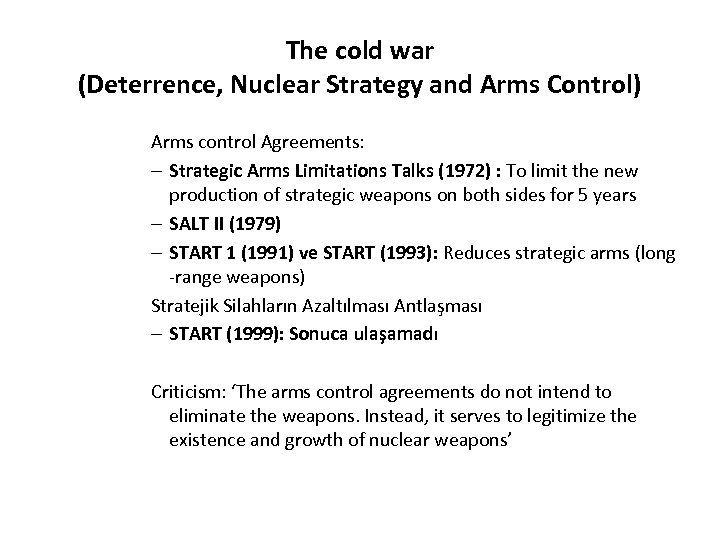 The cold war (Deterrence, Nuclear Strategy and Arms Control) Arms control Agreements: – Strategic Arms Limitations Talks (1972) : To limit the new production of strategic weapons on both sides for 5 years – SALT II (1979) – START 1 (1991) ve START (1993): Reduces strategic arms (long -range weapons) Stratejik Silahların Azaltılması Antlaşması – START (1999): Sonuca ulaşamadı Criticism: ‘The arms control agreements do not intend to eliminate the weapons. Instead, it serves to legitimize the existence and growth of nuclear weapons’
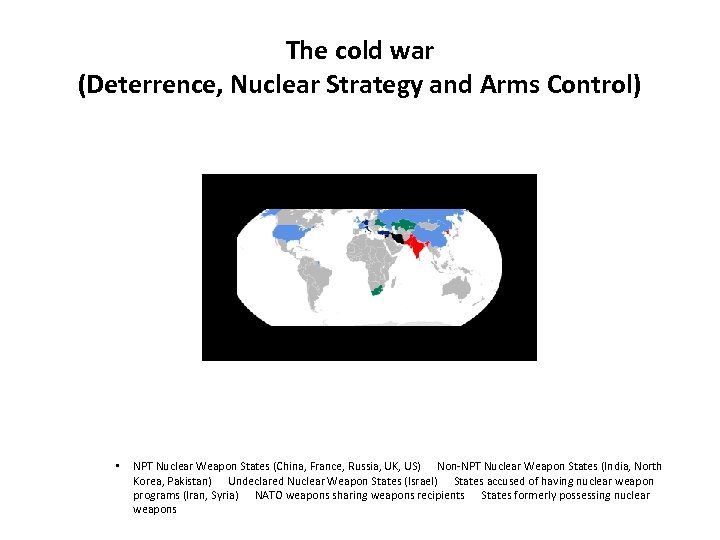 The cold war (Deterrence, Nuclear Strategy and Arms Control) • NPT Nuclear Weapon States (China, France, Russia, UK, US) Non-NPT Nuclear Weapon States (India, North Korea, Pakistan) Undeclared Nuclear Weapon States (Israel) States accused of having nuclear weapon programs (Iran, Syria) NATO weapons sharing weapons recipients States formerly possessing nuclear weapons
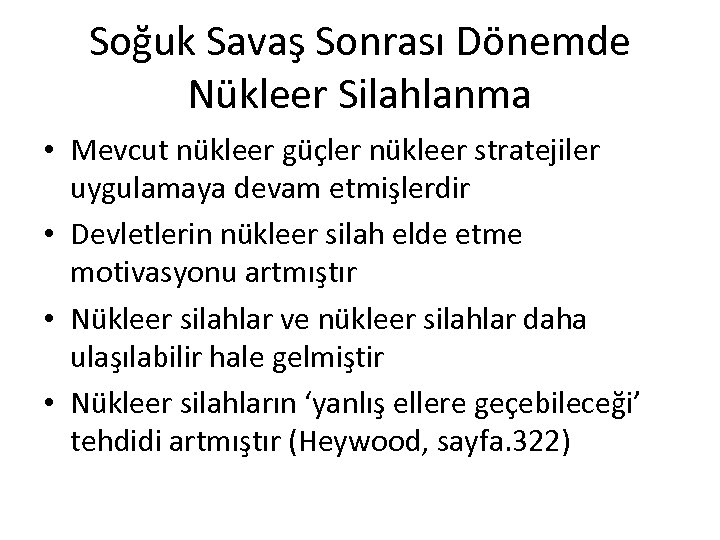 Soğuk Savaş Sonrası Dönemde Nükleer Silahlanma • Mevcut nükleer güçler nükleer stratejiler uygulamaya devam etmişlerdir • Devletlerin nükleer silah elde etme motivasyonu artmıştır • Nükleer silahlar ve nükleer silahlar daha ulaşılabilir hale gelmiştir • Nükleer silahların ‘yanlış ellere geçebileceği’ tehdidi artmıştır (Heywood, sayfa. 322)
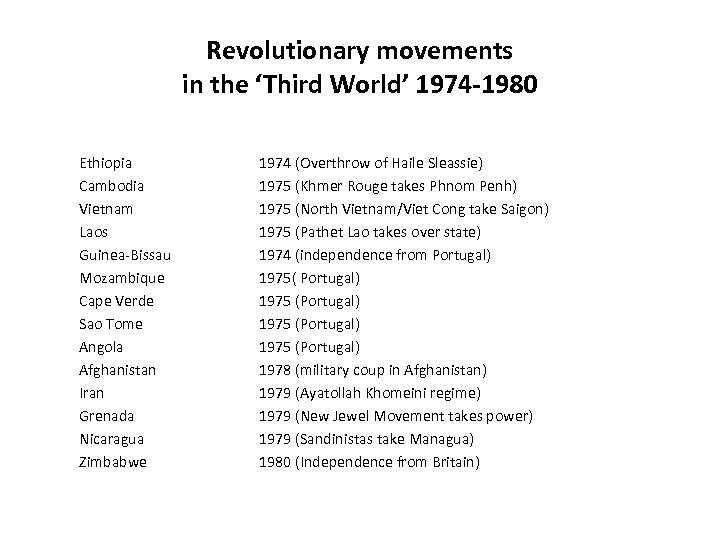 Revolutionary movements in the ‘Third World’ 1974 -1980 Ethiopia Cambodia Vietnam Laos Guinea-Bissau Mozambique Cape Verde Sao Tome Angola Afghanistan Iran Grenada Nicaragua Zimbabwe 1974 (Overthrow of Haile Sleassie) 1975 (Khmer Rouge takes Phnom Penh) 1975 (North Vietnam/Viet Cong take Saigon) 1975 (Pathet Lao takes over state) 1974 (independence from Portugal) 1975( Portugal) 1975 (Portugal) 1978 (military coup in Afghanistan) 1979 (Ayatollah Khomeini regime) 1979 (New Jewel Movement takes power) 1979 (Sandinistas take Managua) 1980 (Independence from Britain)
 The cold war (1979 -1986: The second cold war) The Reagan Administration: political discourse on nuclear weapons; military intervention in Grenada (1983) and Libya (1986); support for the rebel in Nicaragua - Fear of nuclear war in the SU and Europe -Tension in East-West relations: 1983: Soviet air defences shot down a South Korean civilian airliner in Soviet airspace. Immediate reaction of the US, deployment of US nuclear missiles in Europe 1986: International Court of Justice found the US guilty of violating international law for the CIA’s attacks on Nicaraguan harbours and support for the rebel groups (Contras)
 The cold war (1979 -1986: The second cold war) Gorbachev (1985): policies of ‘glasnost’(openness) and ‘perestrokia’ (restructuring) • Change of foreign policy with the Western Europe and US – ‘We are firmly opposed to the division of the continent into military blocs facing each other, against the accumulation of military arsenals in Europe, . . ’common European home’ with the recognition of a certain integral whole, although the states in question belong to different social systems and are members of opposing military-political blocs ranged against eacher other’ • Change of domestic policy toward the Central and Eastern European countries: ‘The Sinatra doctrine’
 The end of the cold war 1989 -1991: The collapse of the Iron Curtain 1991: Dismantling of the Soviet Union Changing global dynamics: (1) The end of the bipolar structure based on US-Soviet rivalry (2) The nation-state building: Central and Eastern European countries (Yugoslavia, Czechoslovakia, Baltic States: Estonia, Latvia, Lithuania) (3) The role of international organisations ( e. g. The United Nations, Warsaw Pact was disbanded, NATO , the European Union) » Transformation of domestic politics
 The end of the cold war The transformation of the Soviet Union - Systemic problems (Economic problems): both the agricultural and industrial sectors have been weakened due to central planning that lacked productivity and flexible practices - Strong war economy: The production of heavy industrial goods and military equipment; large reserves of oil, yet failure to modernise in the 1980 s - Policies of Gorbachev: ‘perestrokia and glasnost’
 The end of the cold war Policies of Gorbachev: ‘perestrokia and glasnost’ Glasnost: ‘openness’ - Promotion of principle of freedom to criticise - Loosening of controls on media (the press, radio, television, the film industry) - Freedom of expression - Freedom of worship - The emergence of public opinion and civil society distinct from the interest of the Communist Party and the government
 The end of the cold war Policies of Gorbachev: ‘perestrokia and glasnost’ Perestrokia: ‘restructuring’ - End of the leading role of the Communist Party - Elections of 1989: Congress of People’s Deputies (only 1/3 of the delegates are from the Communist Party, the rest were directly elected on the basis of popular choice - Creation of executive presidency - Joint Ventures Law: allowing foreign companies to own Soviet enterprises
 The end of the cold war Policies of Gorbachev: ‘perestrokia and glasnost’ Perestrokia: ‘economic restructuring’ - (1987) legalisation of private farming and business cooperatives - (1988) Enterprise Law: limited freedom to managers of state enterprises to sell a proportion of their products on the open market rather than to the government - Move towards free market: Joint Ventures Law (firstly 49 per cent, in 1990 100 per cent) - Results of perestrokia and glasnost: lack of new mechanisms, inflation, shortages, declining production ; rising crime rates, a general uncertain feeling about the future
 The end of the cold war The Collapse of the Soviet Union - Demands for independence: the Baltic states, Georgia, conflict between Azerbaijan and Armenia over Ngorny Karabakh Rising nationalism: suppression of nationalism by force? » Debate between the conservatives and liberals » In 1991, perestrokia and nationalism dismantling of the Soviet Union and its replacement by a loose Confederation of Independent States (CIS)
 Discussion Questions • Did détente succeed? • Should Reagan or Gorbachev claim the greater credit for the ending of the Cold War? • Did nuclear weapons help prevent war in Europe after 1945? • What role did nuclear weapons play in Soviet-American relations during the 1980 s? • Did the West ‘win’ the Cold War? • Why did experts by and large fail to anticipate the collapse of communism? • What do you think Gorbachev hoped to achieve through glasnost and perestrokia?