 Скачать презентацию Ultra-wideband Standards and Technology Development Jeff Foerster Ph
86bfdea740327434ea546dce1b131dd6.ppt
- Количество слайдов: 61



Ultra-wideband Standards and Technology Development Jeff Foerster, Ph. D. Wireless Researcher Corporate Technology Group Intel Corporation WCNC 2003 March 19, 2003
Communication and Interconnect Technology Lab Unique industry opportunities New & enhanced apps. for high-rate WPANs – Multimedia streaming capability – Better end-user experiences with very low-latency Reinforce FCC landmark decision (7. 5 GHz of new spectrum) – New spectrum overlay based regulations creates opportunity but still must prove peaceful coexistence – Demonstrate intelligent and responsible spectrum usage – International regulatory environment uncertain – Show UWB can peacefully coexist via standards Meet the interests of the PC, CE, and mobile communities – Desire a single, unified, short-range wireless access standard – Enable interoperability between different market segments www. intel. com/labs 2
Communication and Interconnect Technology Lab Desired UWB PHY Traits High bit rates ~ 480+ Mbps at 4 -5 m range (USB 2. 0) – 802. 15. 3 a target rate of 110 Mbps at 10 m range is just a starting point – System should be optimized for data rate rather than range – Narrowband technologies better at longer ranges – Multi-hop networks can help extend range Flexible spectrum usage – Coexistence with 802. 11 a (and other WLANs) critical – 4. 9 GHz in Japan – May have to adapt to different country regulations (allow for non-contiguous spectrum allocation) Robust to multipath, multiple access interference Low cost and low power consumption – Full transceiver could be integrated into CMOS www. intel. com/labs 3
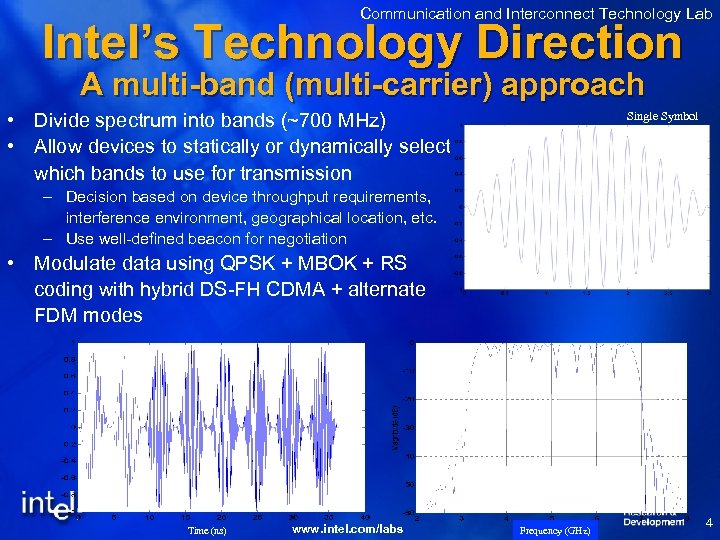
Communication and Interconnect Technology Lab Intel’s Technology Direction A multi-band (multi-carrier) approach • Divide spectrum into bands (~700 MHz) • Allow devices to statically or dynamically select which bands to use for transmission Single Symbol – Decision based on device throughput requirements, interference environment, geographical location, etc. – Use well-defined beacon for negotiation • Modulate data using QPSK + MBOK + RS coding with hybrid DS-FH CDMA + alternate FDM modes Time (ns) www. intel. com/labs Frequency (GHz) 4
Next Steps Communication and Interconnect Technology Lab Goal: Single, industry supported standard that meets technical and business requirements – Standards and a high level of device interoperability critical for high-volume markets – Work with 802. 15. 3 a members towards single standard Major next technical steps for 802. 15. 3 a – Digest all (22) presentations from last week and look to merger best ideas quickly – Lots of similarities – Most avoided 5 GHz 802. 11 a bands for better coexistence – Most used multiple bands (2, 3, up to ~16 bands) – How to divide and use the spectrum? – – – One band vs. multi-band simultaneous operation Wider bands (2+ GHz) vs. narrower bands (~500 MHz) Need to better understand implications on spectrum flexibility, robustness to multipath/MAI, complexity, power consumption www. intel. com/labs 5
Communication and Interconnect Technology Lab Backup www. intel. com/labs 6
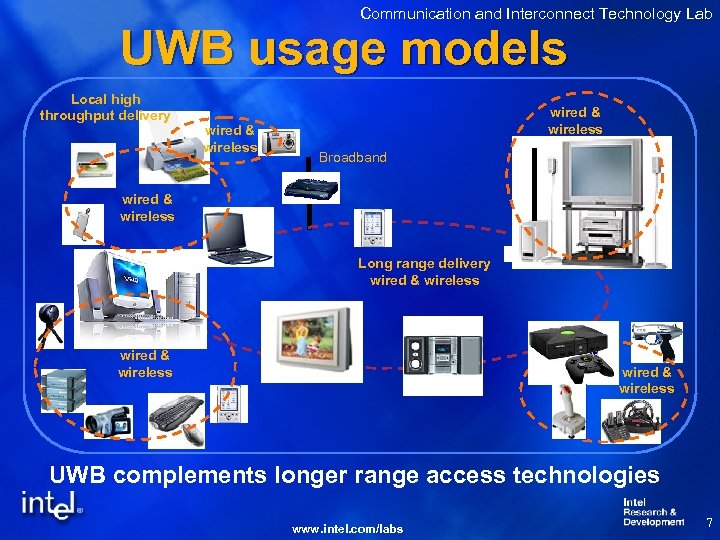
Communication and Interconnect Technology Lab UWB usage models Local high throughput delivery wired & wireless Broadband wired & wireless Long range delivery wired & wireless UWB complements longer range access technologies www. intel. com/labs 7
Communication and Interconnect Technology Lab Intel’s Submission to the IEEE 802. 15. 3 a task group March 2003 www. intel. com/labs 8
Project: IEEE P 802. 15 Working Group for Wireless Personal Area Networks (WPANs) Submission Title: [Intel CFP Presentation for a UWB PHY] Date Submitted: [3 March, 2003] Source: [Jeff Foerster, V. Somayazulu, S. Roy, E. Green, K. Tinsley, C. Brabenac, D. Leeper, M. Ho] Company [Intel Corporation] Address [JF 3 -212, 2111 N. E. 25 th Ave. , Hillsboro, OR, 97124] Voice [503 -264 -6859], FAX: [503 -264 -3483] E-Mail: [jeffrey. r. foerster@intel. com] Re: [The contribution is in response to the Call for Proposals for a high-rate WPAN extension to be developed in the IEEE 802. 15. 3 a task group. ] Abstract: [This contribution details a proposal for a high-rate, short-range WPAN physical layer approach based upon a multi-banded UWB system architecture. The system has variable data rates to address numerous application requirements; flexible spectrum management techniques to adapt, either dynamically or statically, to different interference and regulatory environments; good performance in the presence of multipath and multiple access interference with several areas for improvement in the future; and scalable levels of complexity and power consumption to support devices with different device implementation targets. ] Purpose: [This contribution is given to the IEEE 802. 15. 3 a task group for consideration as a possible high-rate, short-range physical layer solution for WPAN applications. ] Notice: This document has been prepared to assist the IEEE P 802. 15. It is offered as a basis for discussion and is not binding on the contributing individual(s) or organization(s). The material in this document is subject to change in form and content after further study. The contributor(s) reserve(s) the right to add, amend or withdraw material contained herein. Release: The contributor acknowledges and accepts that this contribution becomes the property of IEEE and may be made publicly available by P 802. 15.
Intel’s Multiband UWB PHY Proposal for IEEE 802. 15. 3 a Jeff Foerster, V. Somayazulu, S. Roy, E. Green, K. Tinsley, C. Brabenac, D. Leeper, M. Ho Intel Corporation
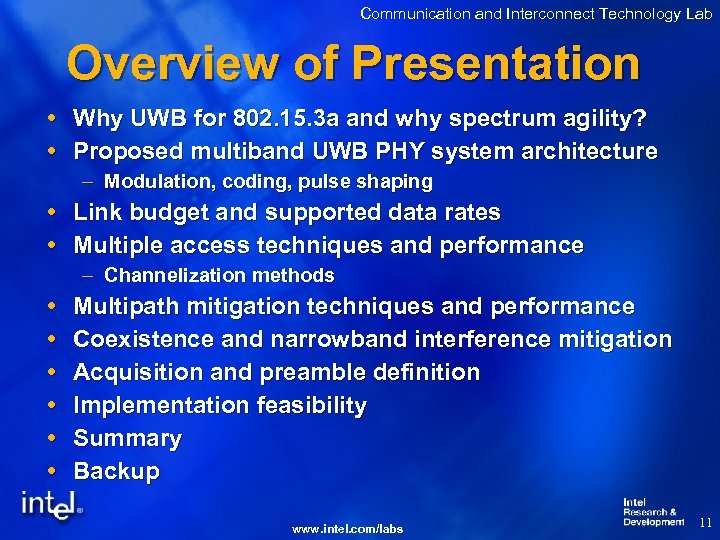
Communication and Interconnect Technology Lab Overview of Presentation Why UWB for 802. 15. 3 a and why spectrum agility? Proposed multiband UWB PHY system architecture – Modulation, coding, pulse shaping Link budget and supported data rates Multiple access techniques and performance – Channelization methods Multipath mitigation techniques and performance Coexistence and narrowband interference mitigation Acquisition and preamble definition Implementation feasibility Summary Backup www. intel. com/labs 11
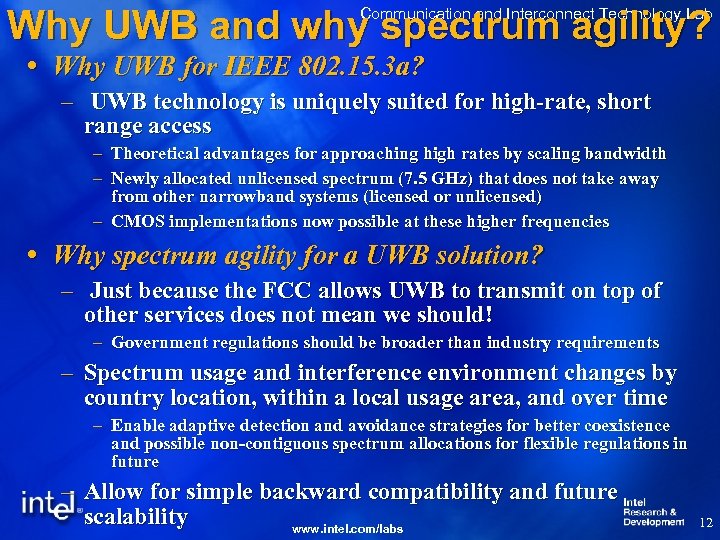
Why UWB and why spectrum agility? Communication and Interconnect Technology Lab Why UWB for IEEE 802. 15. 3 a? – UWB technology is uniquely suited for high-rate, short range access – Theoretical advantages for approaching high rates by scaling bandwidth – Newly allocated unlicensed spectrum (7. 5 GHz) that does not take away from other narrowband systems (licensed or unlicensed) – CMOS implementations now possible at these higher frequencies Why spectrum agility for a UWB solution? – Just because the FCC allows UWB to transmit on top of other services does not mean we should! – Government regulations should be broader than industry requirements – Spectrum usage and interference environment changes by country location, within a local usage area, and over time – Enable adaptive detection and avoidance strategies for better coexistence and possible non-contiguous spectrum allocations for flexible regulations in future – Allow for simple backward compatibility and future scalability www. intel. com/labs 12
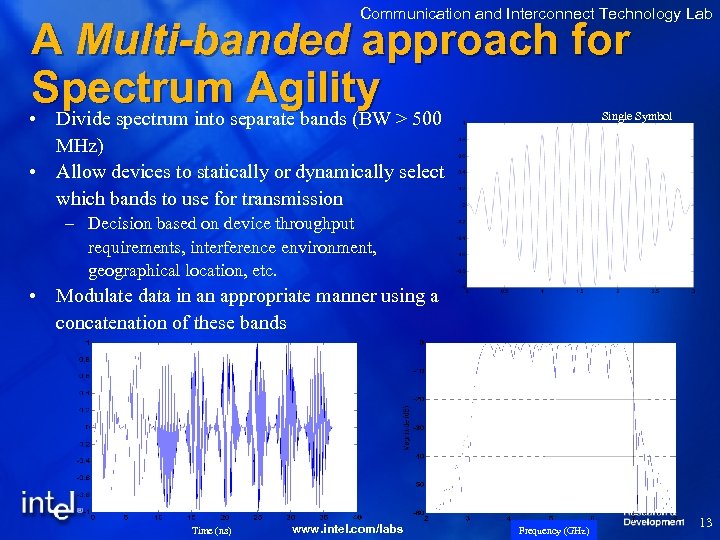
Communication and Interconnect Technology Lab A Multi-banded approach for Spectrum Agility • Divide spectrum into separate bands (BW > 500 Single Symbol MHz) • Allow devices to statically or dynamically select which bands to use for transmission – Decision based on device throughput requirements, interference environment, geographical location, etc. • Modulate data in an appropriate manner using a concatenation of these bands Time (ns) www. intel. com/labs Frequency (GHz) 13
Communication and Interconnect Technology Lab Proposed Multi-band UWB PHY System Architecture www. intel. com/labs 14
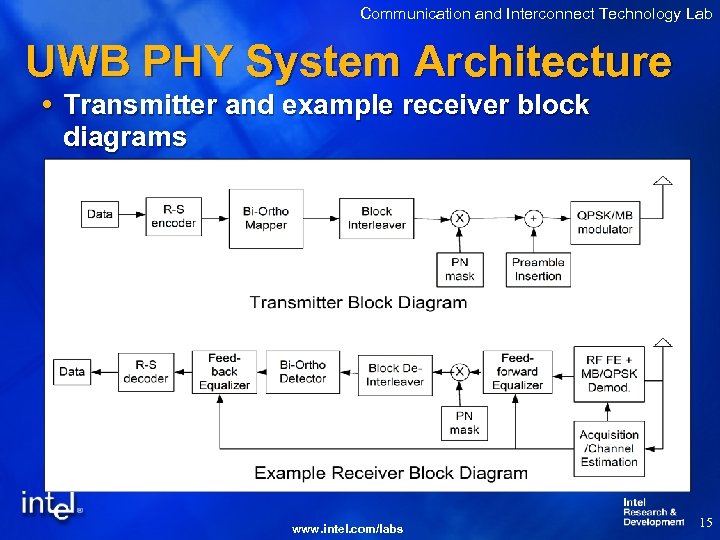
Communication and Interconnect Technology Lab UWB PHY System Architecture Transmitter and example receiver block diagrams – Coding/Interleaving/Modulation www. intel. com/labs 15
Communication and Interconnect Technology Lab UWB PHY System Architecture Proposed Modulation and Coding – M-ary Binary Orthogonal Keying (MBOK) + QPSK Modulation – Power efficient modulation – Orthogonal code (Walsh-Hadamard) with interleaving allows for symbol decision feedback equalization – Fast Hadamard Transforms exist with low latency and low complexity – Outer Reed-Solomon Code – Reed-Solomon used to correct burst errors – System architecture can accommodate any of these alternate coding options – – Punctured Convolutional Codes Concatenated Convolutional + Reed-Solomon Turbo codes (convolutional or product code based) Low density parity check (LDPC) codes www. intel. com/labs 16
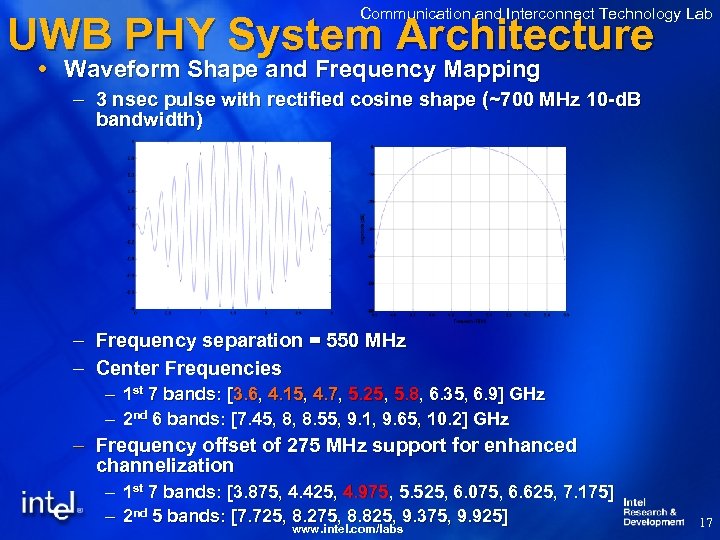
Communication and Interconnect Technology Lab UWB PHY System Architecture Waveform Shape and Frequency Mapping – 3 nsec pulse with rectified cosine shape (~700 MHz 10 -d. B bandwidth) – Frequency separation = 550 MHz – Center Frequencies – 1 st 7 bands: [3. 6, 4. 15, 4. 7, 5. 25, 5. 8, 6. 35, 6. 9] GHz – 2 nd 6 bands: [7. 45, 8, 8. 55, 9. 1, 9. 65, 10. 2] GHz – Frequency offset of 275 MHz support for enhanced channelization – 1 st 7 bands: [3. 875, 4. 425, 4. 975, 5. 525, 6. 075, 6. 625, 7. 175] – 2 nd 5 bands: [7. 725, 8. 275, 8. 825, 9. 375, 9. 925] www. intel. com/labs 17
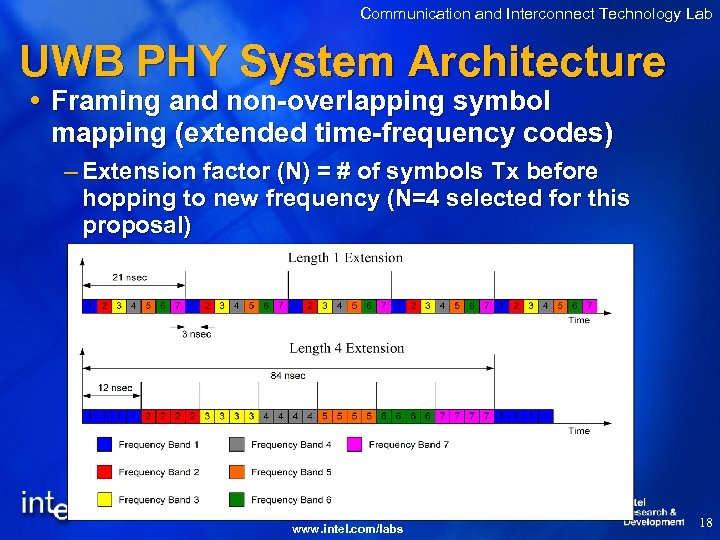
Communication and Interconnect Technology Lab UWB PHY System Architecture Framing and non-overlapping symbol mapping (extended time-frequency codes) – Extension factor (N) = # of symbols Tx before hopping to new frequency (N=4 selected for this proposal) www. intel. com/labs 18
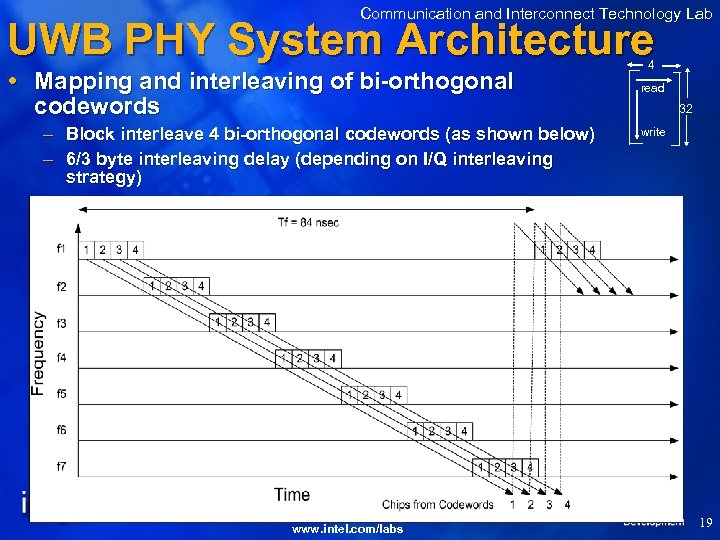
Communication and Interconnect Technology Lab UWB PHY System Architecture Mapping and interleaving of bi-orthogonal codewords – Block interleave 4 bi-orthogonal codewords (as shown below) – 6/3 byte interleaving delay (depending on I/Q interleaving strategy) www. intel. com/labs 4 read 32 write 19
Communication and Interconnect Technology Lab Link Budget and Supported Data Rates www. intel. com/labs 20
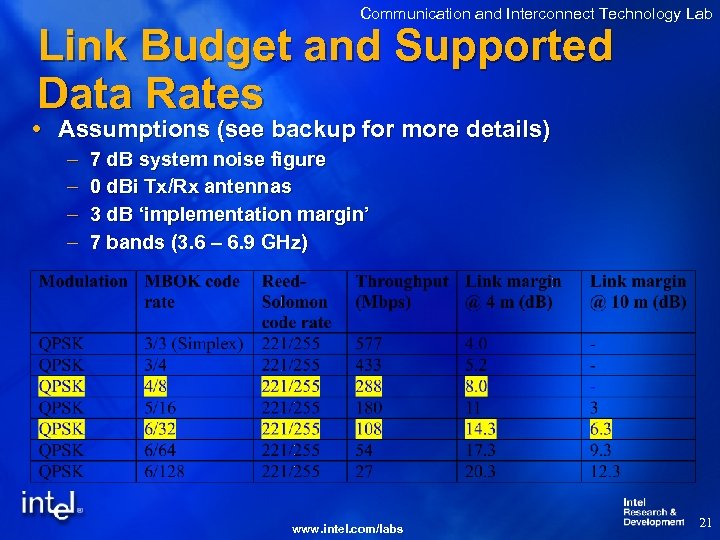
Communication and Interconnect Technology Lab Link Budget and Supported Data Rates Assumptions (see backup for more details) – – 7 d. B system noise figure 0 d. Bi Tx/Rx antennas 3 d. B ‘implementation margin’ 7 bands (3. 6 – 6. 9 GHz) www. intel. com/labs 21
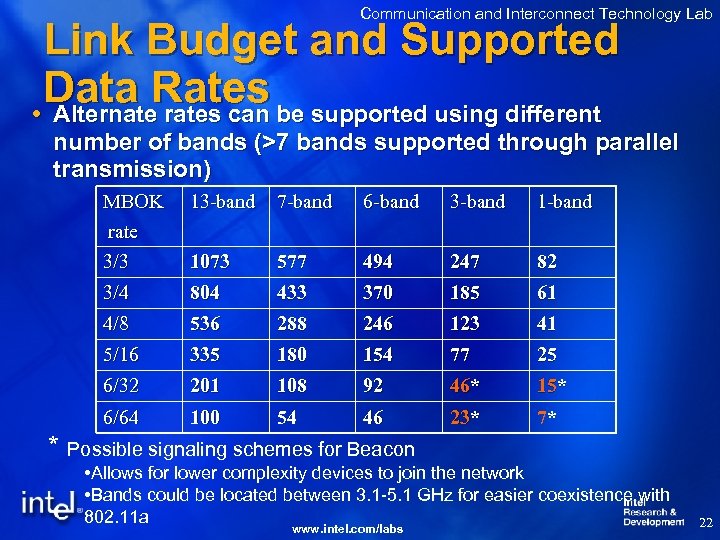
Communication and Interconnect Technology Lab Link Budget and Supported Data Rates be supported using different Alternate rates can number of bands (>7 bands supported through parallel transmission) MBOK rate 3/3 13 -band 7 -band 6 -band 3 -band 1073 577 494 247 82 3/4 804 433 370 185 61 4/8 536 288 246 123 41 5/16 335 180 154 77 25 6/32 201 108 92 46* 15* 6/64 100 54 46 23* 7* * Possible signaling schemes for Beacon • Allows for lower complexity devices to join the network • Bands could be located between 3. 1 -5. 1 GHz for easier coexistence with 802. 11 a www. intel. com/labs 22
Communication and Interconnect Technology Lab Multiple Access Techniques and Performance www. intel. com/labs 23
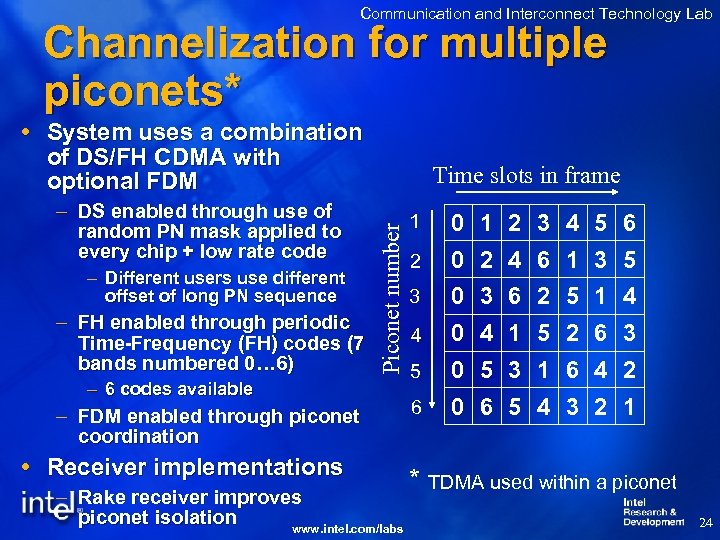
Communication and Interconnect Technology Lab Channelization for multiple piconets* System uses a combination of DS/FH CDMA with optional FDM – Different users use different offset of long PN sequence – FH enabled through periodic Time-Frequency (FH) codes (7 bands numbered 0… 6) Piconet number – DS enabled through use of random PN mask applied to every chip + low rate code Time slots in frame – 6 codes available – FDM enabled through piconet coordination Receiver implementations – Rake receiver improves piconet isolation www. intel. com/labs 1 0 1 2 3 4 5 6 2 0 2 4 6 1 3 5 3 0 3 6 2 5 1 4 4 0 4 1 5 2 6 3 5 0 5 3 1 6 4 2 6 0 6 5 4 3 2 1 * TDMA used within a piconet 24
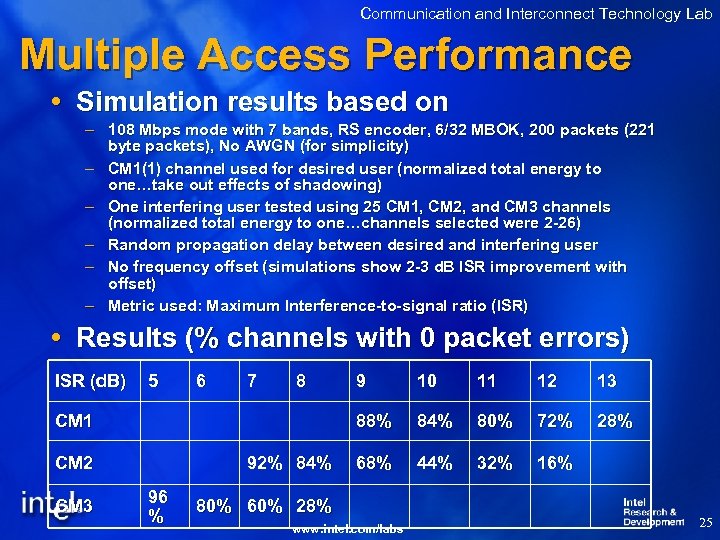
Communication and Interconnect Technology Lab Multiple Access Performance Simulation results based on – 108 Mbps mode with 7 bands, RS encoder, 6/32 MBOK, 200 packets (221 byte packets), No AWGN (for simplicity) – CM 1(1) channel used for desired user (normalized total energy to one…take out effects of shadowing) – One interfering user tested using 25 CM 1, CM 2, and CM 3 channels (normalized total energy to one…channels selected were 2 -26) – Random propagation delay between desired and interfering user – No frequency offset (simulations show 2 -3 d. B ISR improvement with offset) – Metric used: Maximum Interference-to-signal ratio (ISR) Results (% channels with 0 packet errors) ISR (d. B) 5 6 7 8 CM 2 CM 3 92% 84% 96 % 10 11 12 13 88% CM 1 9 84% 80% 72% 28% 68% 44% 32% 16% 80% 60% 28% www. intel. com/labs 25
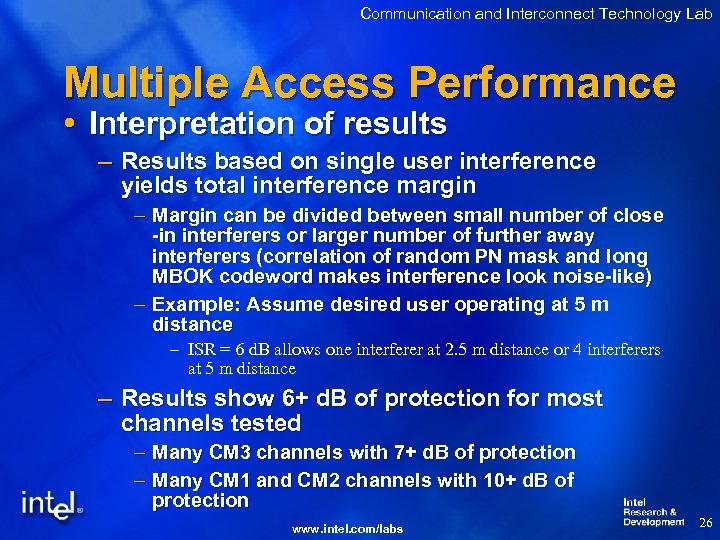
Communication and Interconnect Technology Lab Multiple Access Performance Interpretation of results – Results based on single user interference yields total interference margin – Margin can be divided between small number of close -in interferers or larger number of further away interferers (correlation of random PN mask and long MBOK codeword makes interference look noise-like) – Example: Assume desired user operating at 5 m distance – ISR = 6 d. B allows one interferer at 2. 5 m distance or 4 interferers at 5 m distance – Results show 6+ d. B of protection for most channels tested – Many CM 3 channels with 7+ d. B of protection – Many CM 1 and CM 2 channels with 10+ d. B of protection www. intel. com/labs 26
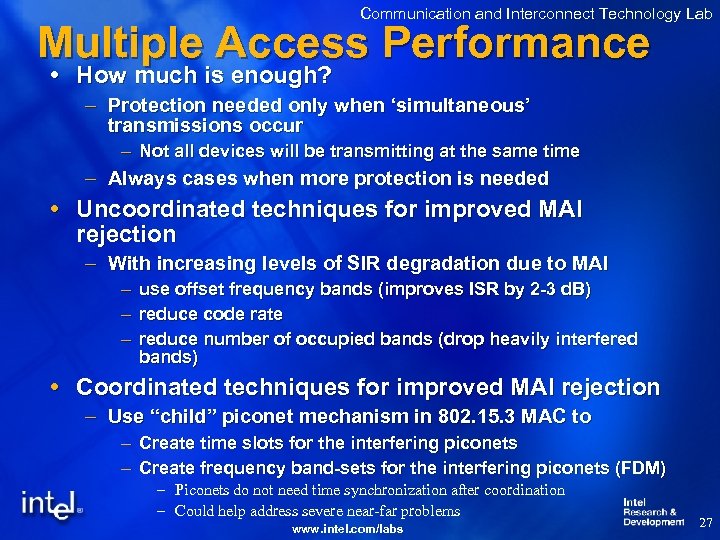
Communication and Interconnect Technology Lab Multiple Access Performance How much is enough? – Protection needed only when ‘simultaneous’ transmissions occur – Not all devices will be transmitting at the same time – Always cases when more protection is needed Uncoordinated techniques for improved MAI rejection – With increasing levels of SIR degradation due to MAI – – – use offset frequency bands (improves ISR by 2 -3 d. B) reduce code rate reduce number of occupied bands (drop heavily interfered bands) Coordinated techniques for improved MAI rejection – Use “child” piconet mechanism in 802. 15. 3 MAC to – Create time slots for the interfering piconets – Create frequency band-sets for the interfering piconets (FDM) – Piconets do not need time synchronization after coordination – Could help address severe near-far problems www. intel. com/labs 27
Communication and Interconnect Technology Lab Multipath Mitigation Techniques and Performance www. intel. com/labs 28
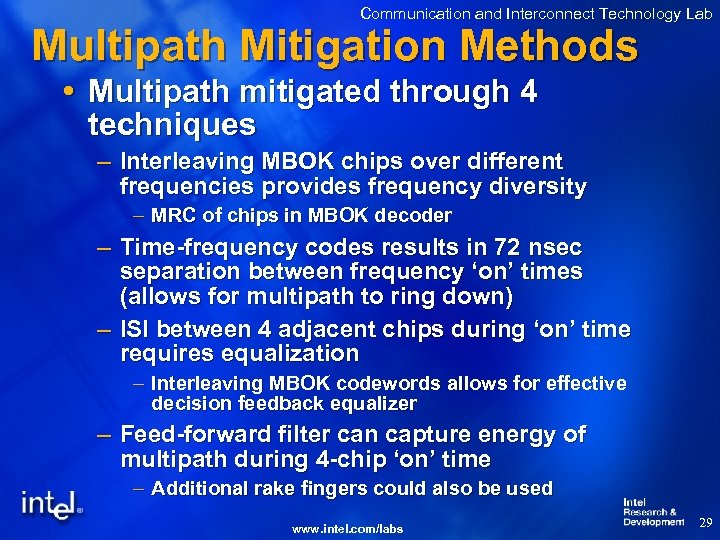
Communication and Interconnect Technology Lab Multipath Mitigation Methods Multipath mitigated through 4 techniques – Interleaving MBOK chips over different frequencies provides frequency diversity – MRC of chips in MBOK decoder – Time-frequency codes results in 72 nsec separation between frequency ‘on’ times (allows for multipath to ring down) – ISI between 4 adjacent chips during ‘on’ time requires equalization – Interleaving MBOK codewords allows for effective decision feedback equalizer – Feed-forward filter can capture energy of multipath during 4 -chip ‘on’ time – Additional rake fingers could also be used www. intel. com/labs 29
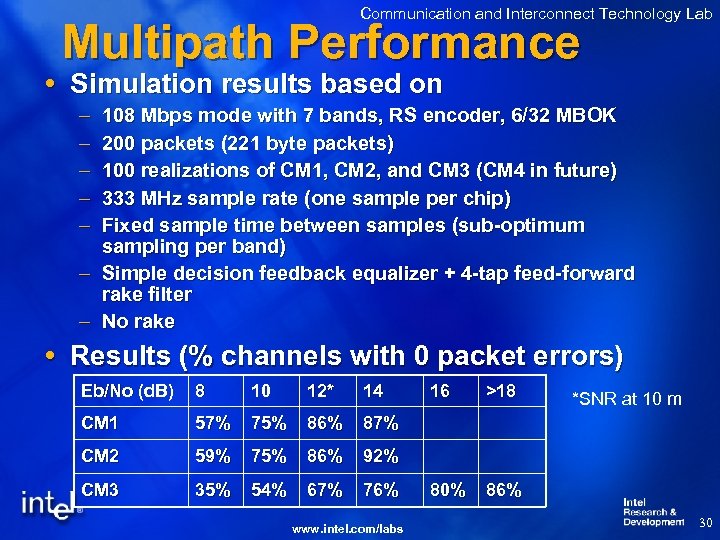
Communication and Interconnect Technology Lab Multipath Performance Simulation results based on – – – 108 Mbps mode with 7 bands, RS encoder, 6/32 MBOK 200 packets (221 byte packets) 100 realizations of CM 1, CM 2, and CM 3 (CM 4 in future) 333 MHz sample rate (one sample per chip) Fixed sample time between samples (sub-optimum sampling per band) – Simple decision feedback equalizer + 4 -tap feed-forward rake filter – No rake Results (% channels with 0 packet errors) Eb/No (d. B) 8 10 12* 14 CM 1 57% 75% 86% 87% CM 2 59% 75% 86% 92% CM 3 35% 54% 67% 76% www. intel. com/labs 16 >18 80% 86% *SNR at 10 m 30
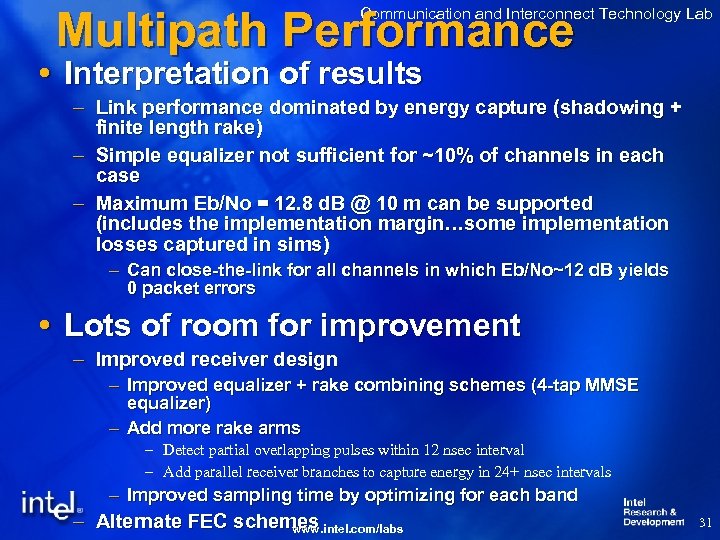
Multipath Performance Communication and Interconnect Technology Lab Interpretation of results – Link performance dominated by energy capture (shadowing + finite length rake) – Simple equalizer not sufficient for ~10% of channels in each case – Maximum Eb/No = 12. 8 d. B @ 10 m can be supported (includes the implementation margin…some implementation losses captured in sims) – Can close-the-link for all channels in which Eb/No~12 d. B yields 0 packet errors Lots of room for improvement – Improved receiver design – Improved equalizer + rake combining schemes (4 -tap MMSE equalizer) – Add more rake arms – Detect partial overlapping pulses within 12 nsec interval – Add parallel receiver branches to capture energy in 24+ nsec intervals – Improved sampling time by optimizing for each band – Alternate FEC schemes www. intel. com/labs 31
Communication and Interconnect Technology Lab Coexistence and Narrowband Interference Mitigation www. intel. com/labs 32
Communication and Interconnect Technology Lab Coexistence Strategies Static Control – Pre-configure device (through software control) not to use a particular band – Based on geographic region or device usage Dynamic Control – Allow device to detect presence of NBI and avoid – Device interoperability requirements could specify detection requirements to ensure adequate control – Similar methods used in 802. 11 h for WLAN coexistence with radar systems in Europe UWB power emitted into 802. 11 a bands – Avoiding 5. 25 (5. 8) GHz band for lower (upper) UNII band coexistence: < -20 d. B attenuation from Part 15 limits at band edge UWB power emitted into 4. 9 GHz WLAN band in Japan – Avoiding 4. 7 (4. 975 using frequency offset channels) GHz band: < -10 d. B (<-20 d. B) attenuation from Part 15 limits at band edge www. intel. com/labs 33
Communication and Interconnect Technology Lab Narrowband Interference RF Front End Implications – All UWB systems must deal with strong interference at antenna (not unique to multi-band solutions) – Can be handled through filters, component linearity requirements, and power consumption For strong NBI – Detect and avoid use of band via signaling to PNC – Rely on adjacent channel rejection of filters + receiver signal processing For moderate or weak NBI sources (SIR < X d. B) – Let link design and receiver implementations mitigate interference – UWB pulsed signaling + MBOK + RS coding – Interference suppression and/or cancellation techniques www. intel. com/labs 34
Communication and Interconnect Technology Lab Acquisition and Preamble Definition www. intel. com/labs 35
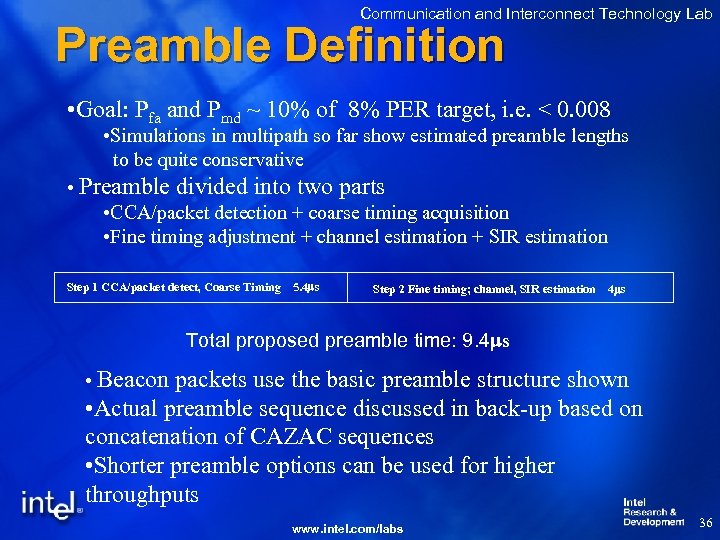
Communication and Interconnect Technology Lab Preamble Definition • Goal: Pfa and Pmd ~ 10% of 8% PER target, i. e. < 0. 008 • Simulations in multipath so far show estimated preamble lengths to be quite conservative • Preamble divided into two parts • CCA/packet detection + coarse timing acquisition • Fine timing adjustment + channel estimation + SIR estimation Step 1 CCA/packet detect, Coarse Timing 5. 4 ms Step 2 Fine timing; channel, SIR estimation 4 ms Total proposed preamble time: 9. 4 ms • Beacon packets use the basic preamble structure shown • Actual preamble sequence discussed in back-up based on concatenation of CAZAC sequences • Shorter preamble options can be used for higher throughputs www. intel. com/labs 36
Communication and Interconnect Technology Lab Implementation feasibility www. intel. com/labs 37
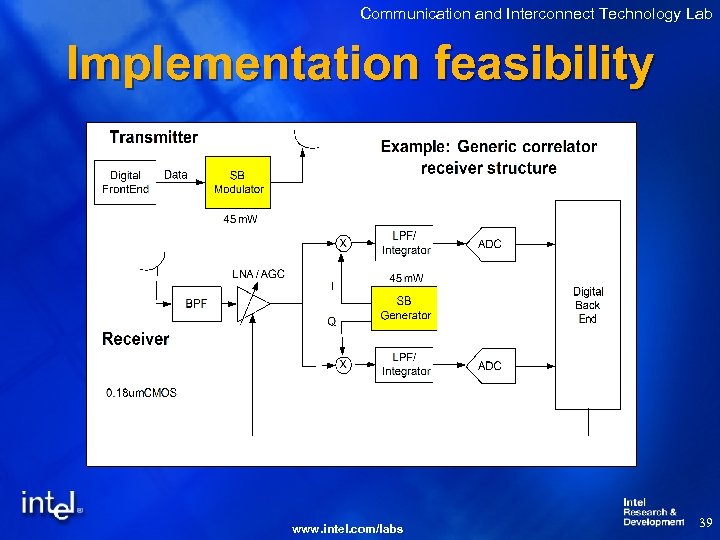
Communication and Interconnect Technology Lab Implementation feasibility Proposed multi-band architecture has many elements designed to reduce complexity and power consumption – Non-overlapped timing – Shared pulse generator, ADC, correlator, … – Reduced power consumption via duty cycle of bands – Don’t necessarily require N continuously running PLLs – ADC sampling at symbol rate (330 MHz for 1 sample/symbol or 660 MHz for 2 samples/symbol) – Reused circuits = smaller die area Many elements in common with other UWB architectures – LNA, mixers, BP/LP filters, AGC, VGA, digital processing (FEC, equalization, etc. ) Many possible transceiver implementations www. intel. com/labs 38
Communication and Interconnect Technology Lab Implementation feasibility www. intel. com/labs 39
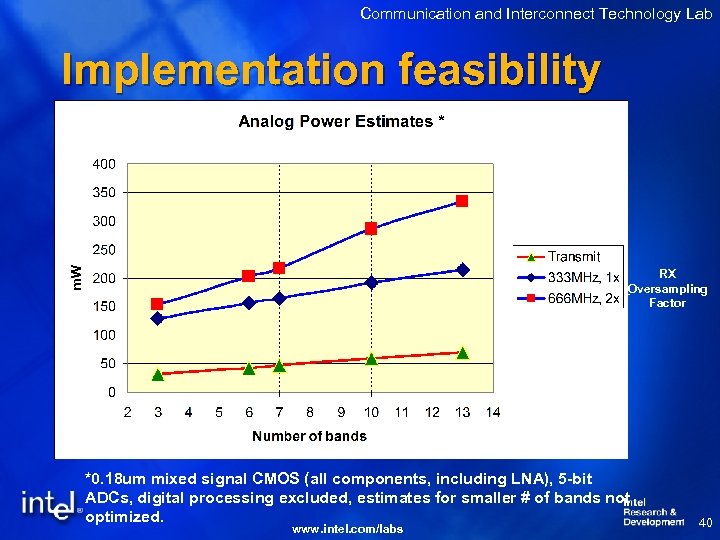
Communication and Interconnect Technology Lab Implementation feasibility RX Oversampling Factor *0. 18 um mixed signal CMOS (all components, including LNA), 5 -bit ADCs, digital processing excluded, estimates for smaller # of bands not optimized. www. intel. com/labs 40
Communication and Interconnect Technology Lab Summary www. intel. com/labs 41
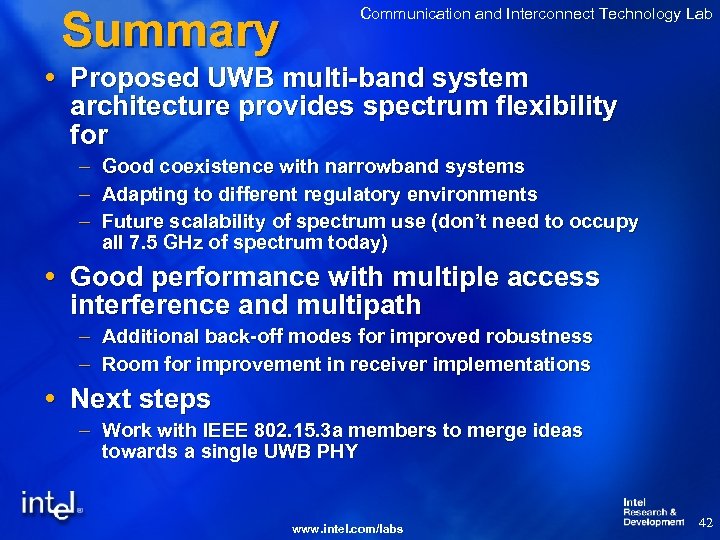
Summary Communication and Interconnect Technology Lab Proposed UWB multi-band system architecture provides spectrum flexibility for – Good coexistence with narrowband systems – Adapting to different regulatory environments – Future scalability of spectrum use (don’t need to occupy all 7. 5 GHz of spectrum today) Good performance with multiple access interference and multipath – Additional back-off modes for improved robustness – Room for improvement in receiver implementations Next steps – Work with IEEE 802. 15. 3 a members to merge ideas towards a single UWB PHY www. intel. com/labs 42
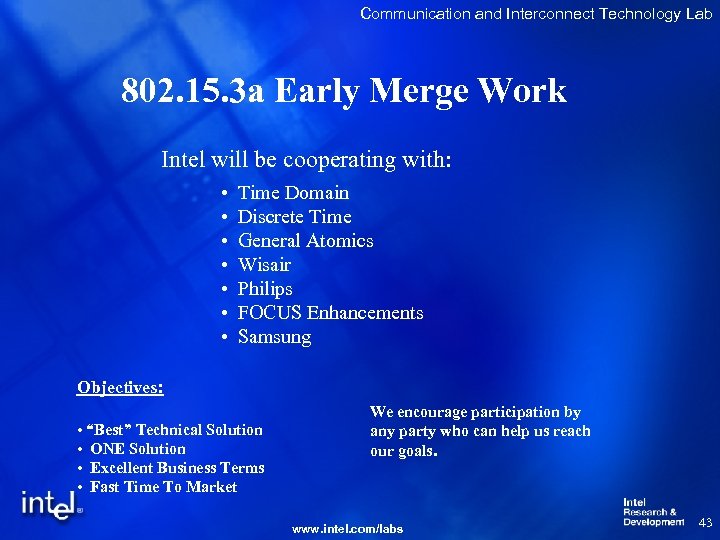
Communication and Interconnect Technology Lab 802. 15. 3 a Early Merge Work Intel will be cooperating with: • • Time Domain Discrete Time General Atomics Wisair Philips FOCUS Enhancements Samsung Objectives: • “Best” Technical Solution • ONE Solution • Excellent Business Terms • Fast Time To Market We encourage participation by any party who can help us reach our goals. www. intel. com/labs 43
Communication and Interconnect Technology Lab Backup Material www. intel. com/labs 44
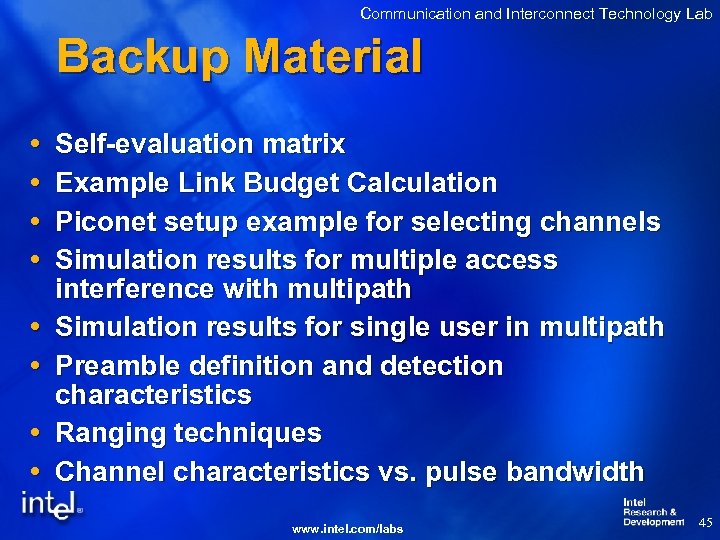
Communication and Interconnect Technology Lab Backup Material Self-evaluation matrix Example Link Budget Calculation Piconet setup example for selecting channels Simulation results for multiple access interference with multipath Simulation results for single user in multipath Preamble definition and detection characteristics Ranging techniques Channel characteristics vs. pulse bandwidth www. intel. com/labs 45
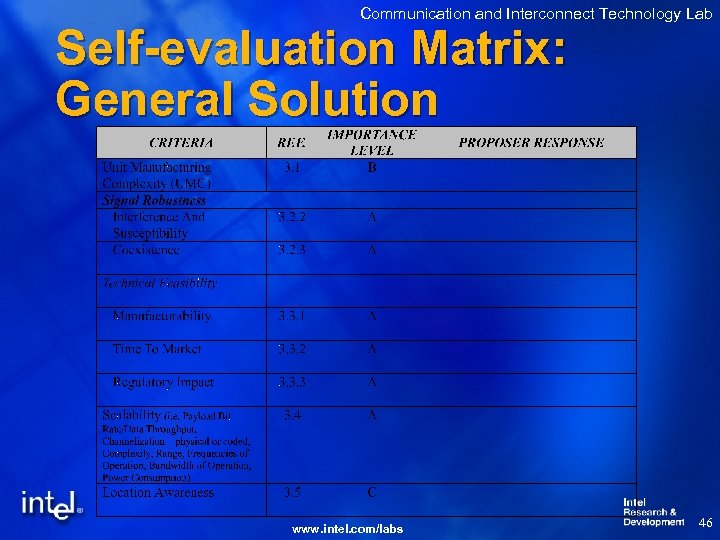
Communication and Interconnect Technology Lab Self-evaluation Matrix: General Solution www. intel. com/labs 46
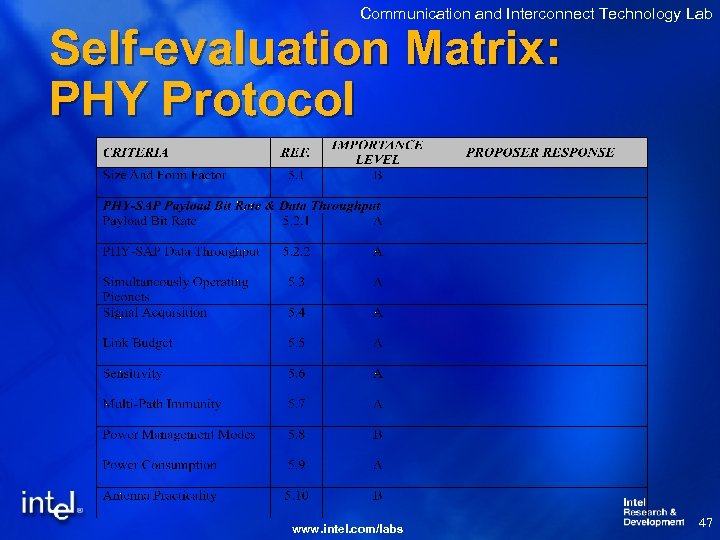
Communication and Interconnect Technology Lab Self-evaluation Matrix: PHY Protocol www. intel. com/labs 47
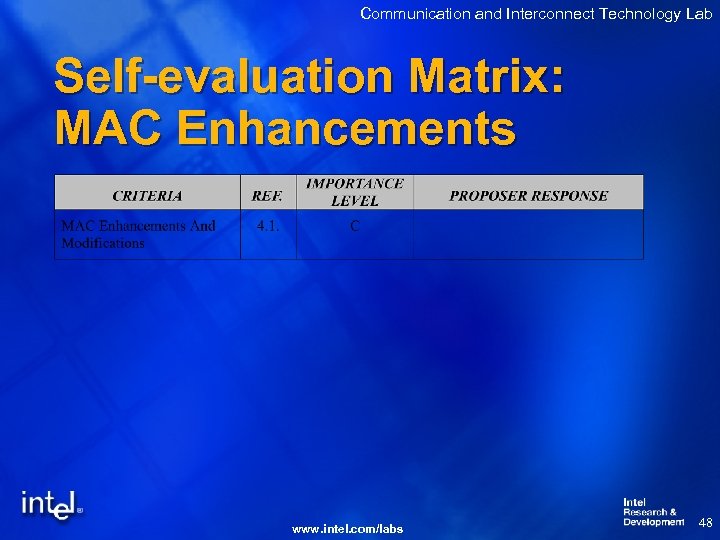
Communication and Interconnect Technology Lab Self-evaluation Matrix: MAC Enhancements www. intel. com/labs 48
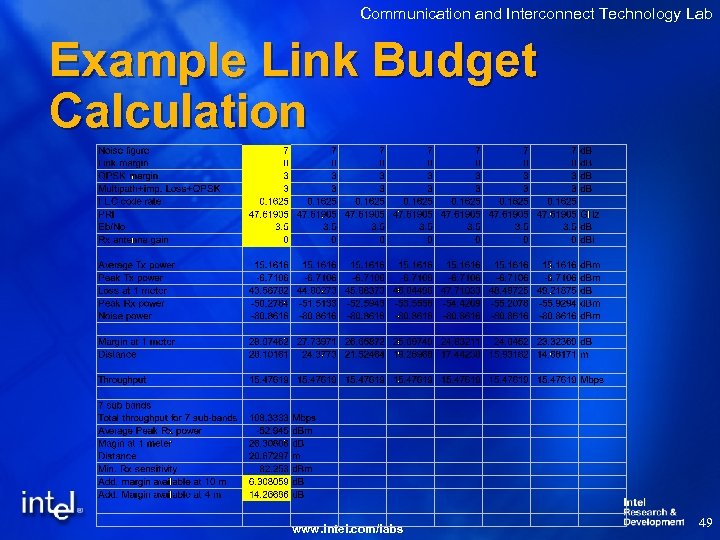
Communication and Interconnect Technology Lab Example Link Budget Calculation www. intel. com/labs 49
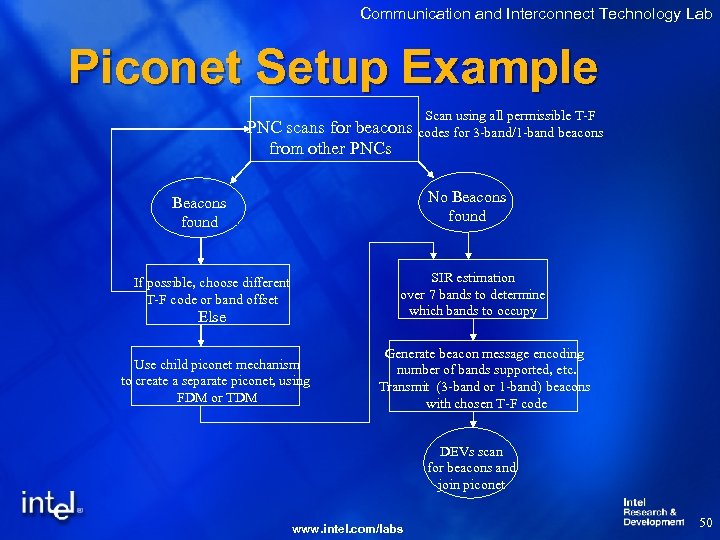
Communication and Interconnect Technology Lab Piconet Setup Example PNC scans for beacons from other PNCs Scan using all permissible T-F codes for 3 -band/1 -band beacons No Beacons found SIR estimation over 7 bands to determine which bands to occupy If possible, choose different T-F code or band offset Else Use child piconet mechanism to create a separate piconet, using FDM or TDM Generate beacon message encoding number of bands supported, etc. Transmit (3 -band or 1 -band) beacons with chosen T-F code DEVs scan for beacons and join piconet www. intel. com/labs 50
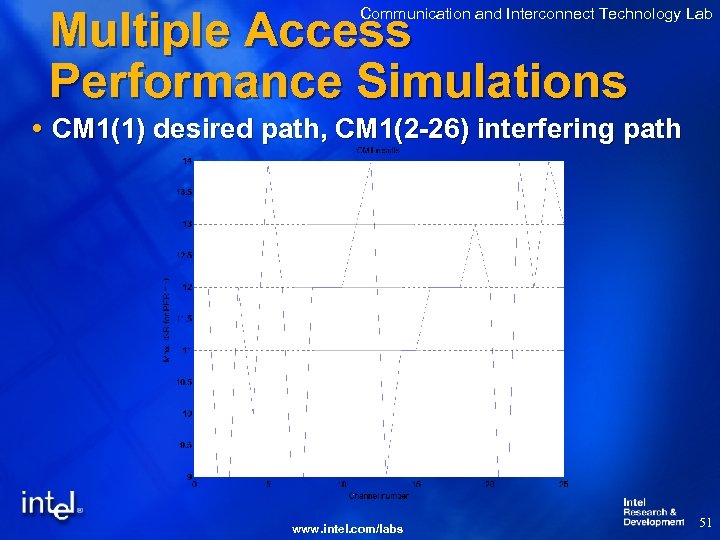
Multiple Access Performance Simulations Communication and Interconnect Technology Lab CM 1(1) desired path, CM 1(2 -26) interfering path www. intel. com/labs 51
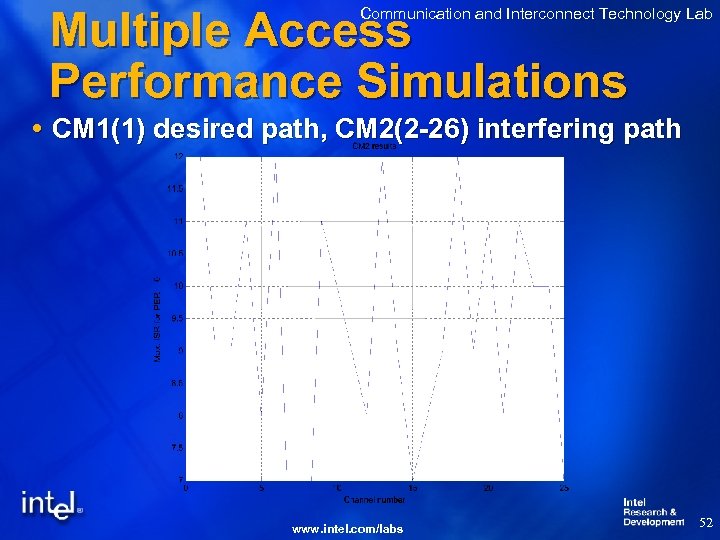
Multiple Access Performance Simulations Communication and Interconnect Technology Lab CM 1(1) desired path, CM 2(2 -26) interfering path www. intel. com/labs 52
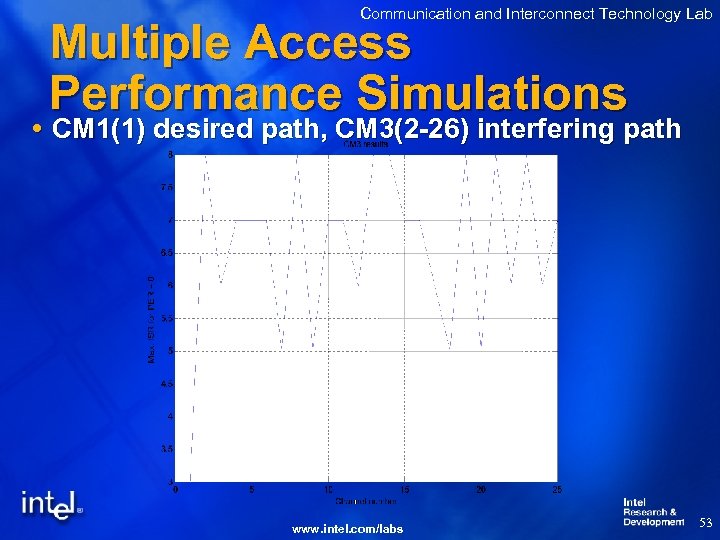
Communication and Interconnect Technology Lab Multiple Access Performance Simulations CM 1(1) desired path, CM 3(2 -26) interfering path www. intel. com/labs 53
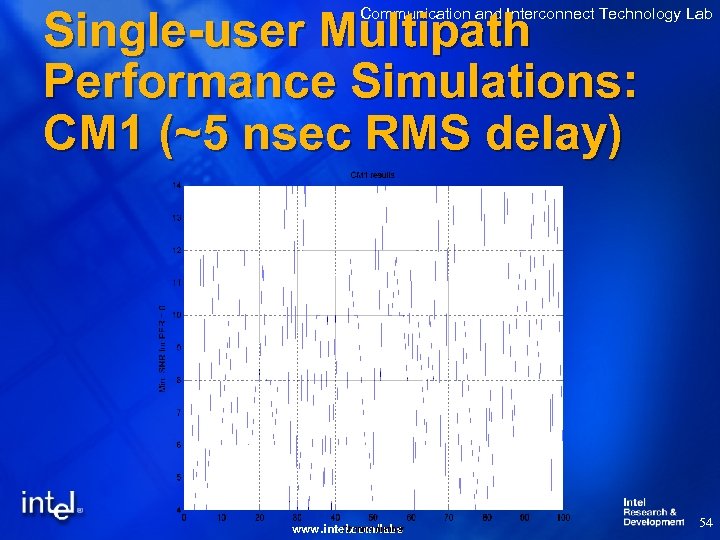
Single-user Multipath Performance Simulations: CM 1 (~5 nsec RMS delay) Communication and Interconnect Technology Lab www. intel. com/labs 54
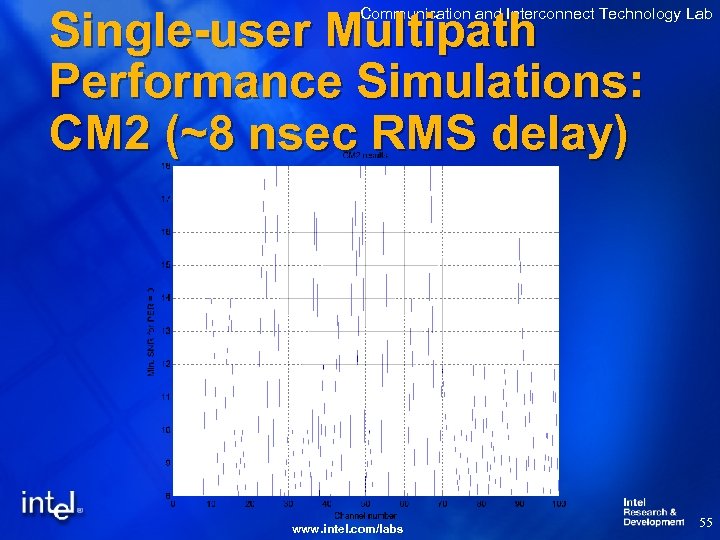
Single-user Multipath Performance Simulations: CM 2 (~8 nsec RMS delay) Communication and Interconnect Technology Lab www. intel. com/labs 55
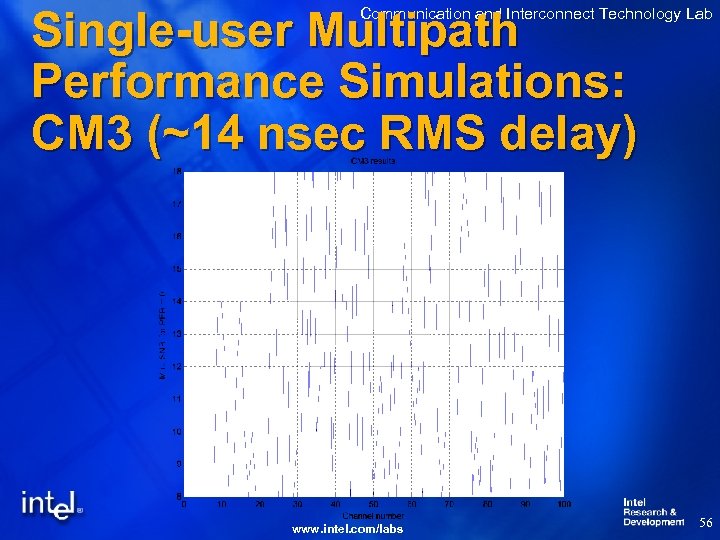
Single-user Multipath Performance Simulations: CM 3 (~14 nsec RMS delay) Communication and Interconnect Technology Lab www. intel. com/labs 56
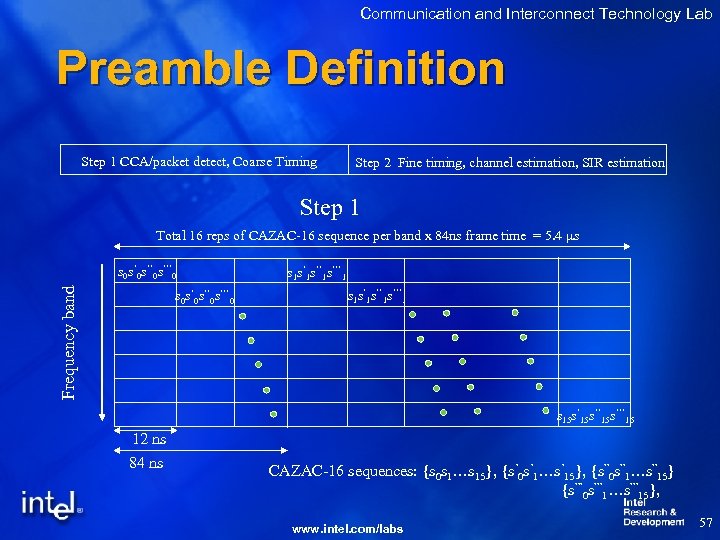
Communication and Interconnect Technology Lab Preamble Definition Step 1 CCA/packet detect, Coarse Timing Step 2 Fine timing, channel estimation, SIR estimation Step 1 Total 16 reps of CAZAC-16 sequence per band x 84 ns frame time = 5. 4 ms Frequency band s 0 s’ 0 s’’’ 0 s 1 s’ 1 s’’’ 1 s 15 s’’’ 15 12 ns 84 ns CAZAC-16 sequences: {s 0 s 1…s 15}, {s’ 0 s’ 1…s’ 15}, {s” 0 s” 1…s” 15} {s”’ 0 s”’ 1…s”’ 15}, www. intel. com/labs 57
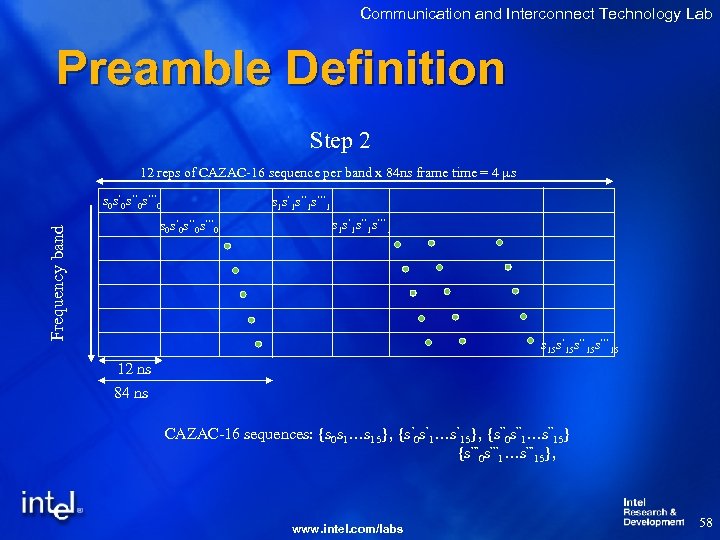
Communication and Interconnect Technology Lab Preamble Definition Step 2 12 reps of CAZAC-16 sequence per band x 84 ns frame time = 4 ms s 0 s’’’ 0 s 1 s’’’ 1 Frequency band s 0 s’’’ 0 s 1 s’’’ 1 s 15 s’’’ 15 12 ns 84 ns CAZAC-16 sequences: {s 0 s 1…s 15}, {s’ 0 s’ 1…s’ 15}, {s” 0 s” 1…s” 15} {s”’ 0 s”’ 1…s”’ 15}, www. intel. com/labs 58
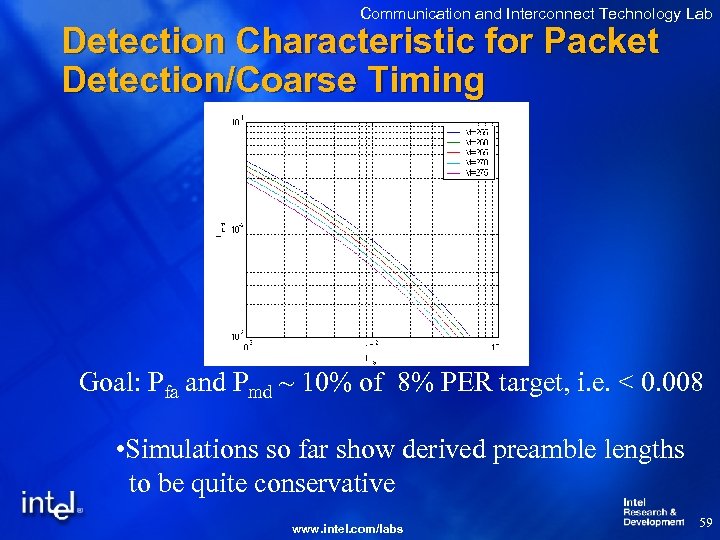
Communication and Interconnect Technology Lab Detection Characteristic for Packet Detection/Coarse Timing Goal: Pfa and Pmd ~ 10% of 8% PER target, i. e. < 0. 008 • Simulations so far show derived preamble lengths to be quite conservative www. intel. com/labs 59
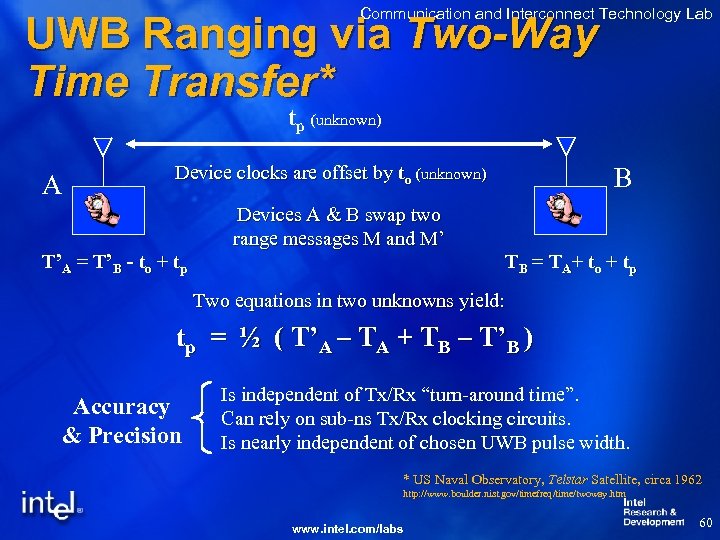
Communication and Interconnect Technology Lab UWB Ranging via Two-Way Time Transfer* tp (unknown) A Device clocks are offset by to (unknown) T’A = T’B - to + tp Devices A & B swap two range messages M and M’ B TB = TA+ to + tp Two equations in two unknowns yield: tp = ½ ( T’A – TA + TB – T’B ) Accuracy & Precision Is independent of Tx/Rx “turn-around time”. Can rely on sub-ns Tx/Rx clocking circuits. Is nearly independent of chosen UWB pulse width. * US Naval Observatory, Telstar Satellite, circa 1962 http: //www. boulder. nist. gov/timefreq/time/twoway. htm http: //www. boulder. nist. gov/ timefreq/time/twoway. www. intel. com/labs 60
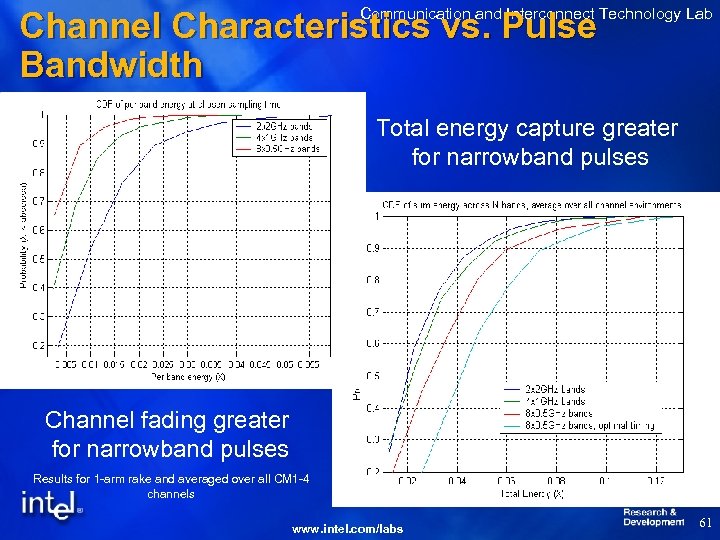
Communication and Interconnect Technology Lab Channel Characteristics vs. Pulse Bandwidth Total energy capture greater for narrowband pulses Channel fading greater for narrowband pulses Results for 1 -arm rake and averaged over all CM 1 -4 channels www. intel. com/labs 61
Скачать презентацию Ultra-wideband Standards and Technology Development Jeff Foerster Ph
86bfdea740327434ea546dce1b131dd6.ppt