


 Скачать презентацию Ultra-rad-hard Sensors for Particle Physics Applications Z
b04024bb6db2ff15e72dedd8718cc1b2.ppt
- Количество слайдов: 36
 Ultra-rad-hard Sensors for Particle Physics Applications Z. Li AA. Brookhaven National Laboratory On behalf of CERN RD 50 Collaboration Pixel 2002, September 9 -12, 2002, Carmel, CA
 RD 50 – 271 members J. Adey 1, A. Al-Ajili 2, P. Alexandrov 3, G. Alfieri 4, P. P. Allport 5, A. Andreazza 6, M. Artuso 7, S. Assouak 8, B. S. Avset 9, A. Baldi 10, L. Barabash 11, E. Baranova 3, A. Barcz 12, A. Basile 13, R. Bates 2, B. Bekenov 14, N. Belova 3, G. M. Bilei 15, D. Bisello 16, A. Blumenau 1, V. Boisvert 17, G. Bolla 18, V. Bondarenko 19, E. Borchi 10, L. Borrello 20, D. Bortoletto 18, M. Boscardin 21, L. Bosisio 22, G. Bredholt 9, L. Breivik 9, T. J. Brodbeck 23, J. Broz 24, A. Brukhanov 3, M. Bruzzi 10, A. Brzozowski 12, M. Bucciolini 10, P. Buhmann 25, C. Buttar 26, F. Campabadal 27, D. Campbell 23, C. Canali 13, A. Candelori 16, G. Casse 5, A. Chilingarov 23, D. Chren 24, V. Cindro 28, M. Citterio 6, R. Coluccia 29, D. Contarato 25, J. Coutinho 1, D. Creanza 30, L. Cunningham 2, V. Cvetkov 3, C. Da Via 31, G. -F. Dalla Betta 21, G. Davies 32, I. Dawson 26, W. de Boer 33, M. De Palma 30, P. Dervan 26, A. Dierlamm 33, S. Dittongo 22, L. Dobrzanski 12, Z. Dolezal 24, A. Dolgolenko 11, J. Due-Hansen 9, T. Eberlein 1, V. Eremin 34, C. Fall 1, C. Fleta 27, E. Forton 8, S. Franchenko 3, E. Fretwurst 25, F. Gamaz 35, C. Garcia 36, J. E. Garcia-Navarro 36, E. Gaubas 37, M. H. Genest 35, K. A. Gill 17, K. Giolo 18, M. Glaser 17, C. Goessling 38, V. Golovine 14, J. Goss 1, A. Gouldwell 2, G. Grégoire 8, P. Gregori 21, E. Grigoriev 14, C. Grigson 26, A. Groza 11, J. Guskov 39, L. Haddad 2, R. Harding 32, J. Härkönen 40, J. Hasi 31, F. Hauler 33, S. Hayama 32, F. Hönniger 25, T. Horazdovsky 24, R. Horisberger 41, M. Horn 2, A. Houdayer 35, B. Hourahine 1, A. Hruban 12, G. Hughes 23, I. Ilyashenko 34, A. Ivanov 34, K. Jarasiunas 37, R. Jasinskaite 37, T. Jin 32, B. K. Jones 23, R. Jones 1, C. Joram 17, L. Jungermann 33, S. Kallijärvi 42, P. Kaminski 12, A. Karpenko 11, A. Karpenko 31, A. Karpov 14, V. Kazlauskiene 37, V. Kazukauskas 37, M. Key 27, V. Khivrich 11, J. Kierstead 43, J. Klaiber. Lodewigs 38, M. Kleverman 44, R. Klingenberg 38, P. Kodys 24, Z. Kohout 24, A. Kok 31, A. Kontogeorgakos 45, G. Kordas 45, A. Kowalik 12, R. Kozlowski 12, M. Kozodaev 14, O. Krasel 38, R. Krause-Rehberg 19, M. Kuhnke 31, A. Kuznetsov 4, S. Kwan 29, S. Lagomarsino 10, T. Lari 6, K. Lassila-Perini 40, V. Lastovetsky 11, S. Latushkin 3, R. Lauhakangas 46, I. Lazanu 47, S. Lazanu 47, C. Lebel 35, C. Leroy 35, Z. Li 43, L. Lindstrom 44, G. Lindström 25, V. Linhart 24, A. P. Litovchenko 11, A. Litovchenko 16, V. Litvinov 3, M. Lozano 27, Z. Luczynski 12, A. Mainwood 32, I. Mandic 28, S. Marti i Garcia 36, C. Martínez 27, S. Marunko 39, K. Mathieson 2, A. Mazzanti 13, J. Melone 2, D. Menichelli 10, C. Meroni 6, A. Messineo 20, S. Miglio 10, M. Mikuz 28, J. Miyamoto 18, M. Moll 17, E. Monakhov 4, L. Murin 44, F. Nava 13, H. Nikkilä 42, E. Nossarzewska-Orlowska 12, S. Nummela 40, J. Nysten 40, R. Orava 46, V. OShea 2, K. Osterberg 46, S. Parker 48, C. Parkes 2, D. Passeri 15, U. Pein 25, G. Pellegrini 2, L. Perera 49, B. Piatkowski 12, C. Piemonte 21, G. U. Pignatel 15, N. Pinho 1, S. Pini 10, I. Pintilie 25, L. Plamu 42, L. Polivtsev 11, P. Polozov 14, J. Popule 50, S. Pospisil 24, G. Pucker 21, V. Radicci 30, J. M. Rafí 27, F. Ragusa 6, M. Rahman 2, R. Rando 16, K. Remes 42, R. Roeder 51, T. Rohe 41, S. Ronchin 21, C. Rott 18, A. Roy 18, P. Roy 2, A. Ruzin 39, A. Ryazanov 3, S. Sakalauskas 37, J. Sanna 46, L. Schiavulli 30, S. Schnetzer 49, T. Schulman 46, S. Sciortino 10, G. Sellberg 29, P. Sellin 52, D. Sentenac 20, I. Shipsey 18, P. Sicho 50, T. Sloan 23, M. Solar 24, S. Son 18, B. Sopko 24, J. Stahl 25, A. Starodumov 20, D. Stolze 51, R. Stone 49, J. Storasta 37, N. Strokan 34, W. Strupinski 12, M. Sudzius 37, B. Surma 12, A. Suvorov 14, B. G. Svensson 4, M. Tomasek 50, C. Trapalis 45, C. Troncon 6, A. Tsvetkov 24, E. Tuominen 40, E. Tuovinen 40, T. Tuuva 42, M. Tylchin 39, H. Uebersee 51, J. Uher 24, M. Ullán 27, J. V. Vaitkus 37, P. Vanni 13, E. Verbitskaya 34, G. Verzellesi 13, V. Vrba 50, S. Watts 31, A. Werner 9, I. Wilhelm 24, S. Worm 49, V. Wright 2, R. Wunstorf 38, P. Zabierowski 12, A. Zaluzhnyi 14, M. Zavrtanik 28, M. Zen 21, V. Zhukov 33, N. Zorzi 21
 RD 50 – 52 institutes 1 University of Exeter, Department of Physics, Exeter, EX 4 4 QL, United Kingdom; 2 Dept. of Physics & Astronomy, Glasgow University, Glasgow, UK; 3 Russian Research Center "Kurchatov Institute", Moscow, Russia; 4 University of Oslo, Physics Department/Physical Electronics, Oslo, Norway; 5 Department of Physics, University of Liverpool, United Kingdom; 6 INFN and University of Milano, Department of Physics, Milano, Italy; 7 Experimental Particle Physics Group, Syracuse University, Syracuse, USA; 8 Université catholique de Louvain, Institut de Physique Nucléaire, Louvain-la-Neuve, Belgium; 9 SINTEF Electronics and Cybernetics Microsystems P. O. Box 124 Blindern N-0314 Oslo, Norway; 10 INFN Florence – Department of Energetics, University of Florence, Italy; 11 Institute for Nuclear Research of the Academy of Sciences of Ukraine, Radiation Physic. Departments; 12 Institute of Electronic Materials Technology, Warszawa, Poland; 13 Dipartimento di Fisica-Università di Modena e Reggio Emilia, Italy; 14 State Scientific Center of Russian Federation, Institute for Theoretical and Experimental Physics, Moscow, Russia; 15 I. N. F. N. and Università di Perugia – Italy; 6 Dipartimento di Fisica and INFN, Sezione di Padova, Italy; 17 CERN, Geneva, Switzerland; 18 Purdue University, USA; 19 University of Halle; Dept. of Physics, Halle, Germany; 20 Universita` di Pisa and INFN sez. di Pisa, Italy; 21 ITCIRST, Microsystems Division, Povo, Trento, Italy; 22 I. N. F. N. -Sezione di Trieste, Italy; 23 Department of Physics, Lancaster University, Lancaster, United Kingdom; 24 Czech Technical University in Prague&Charles University Prague, Czech Republic; 25 Institute for Experimental Physics, University of Hamburg, Germany; 26 Experimental Particle Physics Group, Dept of Physics, University of Sheffield, U. K. ; 27 Centro Nacional de Microelectrónica (IMB-CNM, CSIC); 28 Jozef Stefan Institute and Department of Physics, University of Ljubljana, Slovenia; 29 Fermilab, USA; 30 Dipartimento Interateneo di Fisica & INFN - Bari, Italy; 31 Brunel University, Electronic and Computer Engineering Department, Uxbridge, United Kingdom; 32 Physics Department, Kings College London, United Kingdom; 33 University of Karlsruhe, Institut fuer Experimentelle Kernphysik, Karlsruhe, Germany; 34 Ioffe Phisico-Technical Institute of Russian Academy of Sciences, St. Petersburg, Russia; ; 35 Groupe de la Physique des Particules, Université de Montreal, Canada; 36 IFIC Valencia, Apartado 22085, 46071 Valencia, Spain; 37 Institute of Materials Science and Applied Research, Vilnius University, Vilnius, Lithuania; 38 Universitaet Dortmund, Lehrstuhl Experimentelle Physik IV, Dortmund, Germany; 39 Tel Aviv University, Israel; 40 Helsinki Institute of Physics, Helsinki, Finland; 41 Paul Scherrer Institut, Laboratory for Particle Physics, Villigen, Switzerland; 42 University of Oulu, Microelectronics Instrumentation Laboratory, Finland; 43 Brookhaven National Laboratory, Upton, NY, USA; 44 Department of Solid State Physics, University of Lund, Sweden; 45 NCSR DEMOKRITOS, Institute of Materials Science, Aghia Paraskevi Attikis, Greece; 46 High Energy Division of the Department of Physical Science, University of Helsinki, Finland; 47 National Institute for Materials Physics, Bucharest - Magurele, Romania; 48 University of Hawaii; 49 Rutgers University, Piscataway, New Jersey, USA; 50 Institute of Physics, Academy of Sciences of the Czech Republic, Praha, Czech Republic; 51 Ci. S Institut für Mikrosensorik g. Gmb. H, Erfurt, Germany; 52 Department of Physics, University of Surrey, Guildford, United Kingdom
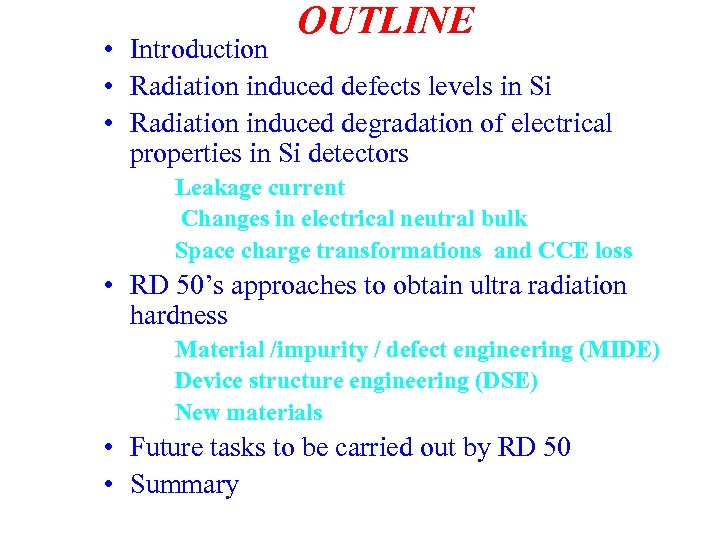 OUTLINE • Introduction • Radiation induced defects levels in Si • Radiation induced degradation of electrical properties in Si detectors Leakage current Changes in electrical neutral bulk Space charge transformations and CCE loss • RD 50’s approaches to obtain ultra radiation hardness Material /impurity / defect engineering (MIDE) Device structure engineering (DSE) New materials • Future tasks to be carried out by RD 50 • Summary
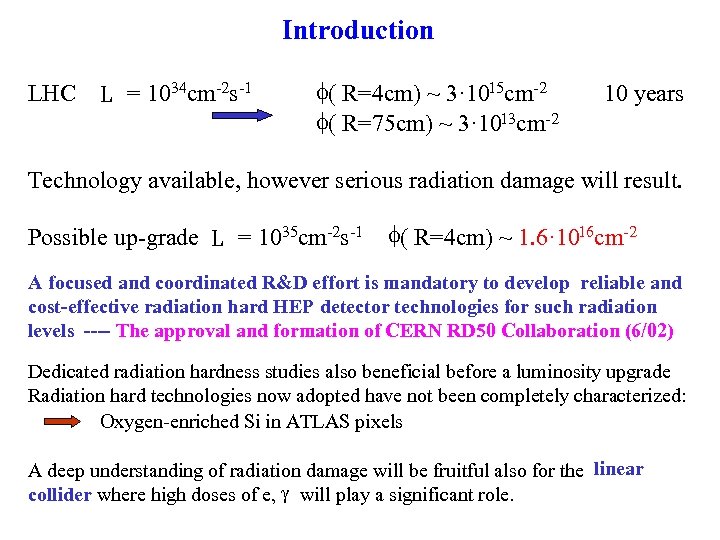 Introduction LHC L = 1034 cm-2 s-1 f( R=4 cm) ~ 3· 1015 cm-2 f( R=75 cm) ~ 3· 1013 cm-2 10 years Technology available, however serious radiation damage will result lt. Possible up-grade L = 1035 cm-2 s-1 f( R=4 cm) ~ 1. 6· 1016 cm-2 A focused and coordinated R&D effort is mandatory to develop reliable and cost-effective radiation hard HEP detector technologies for such radiation levels ---- The approval and formation of CERN RD 50 Collaboration (6/02) Dedicated radiation hardness studies also beneficial before a luminosity upgrade Radiation hard technologies now adopted have not been completely characterized: Oxygen-enriched Si in ATLAS pixels A deep understanding of radiation damage will be fruitful also for the linear collider where high doses of e, g will play a significant role.
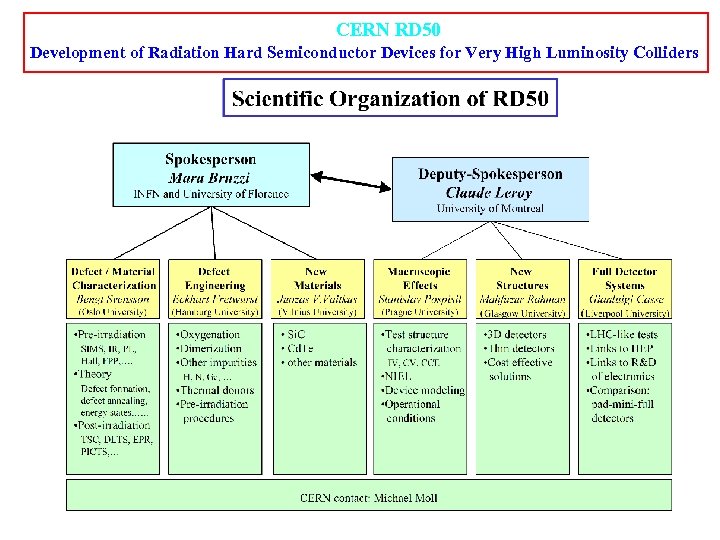 CERN RD 50 Development of Radiation Hard Semiconductor Devices for Very High Luminosity Colliders
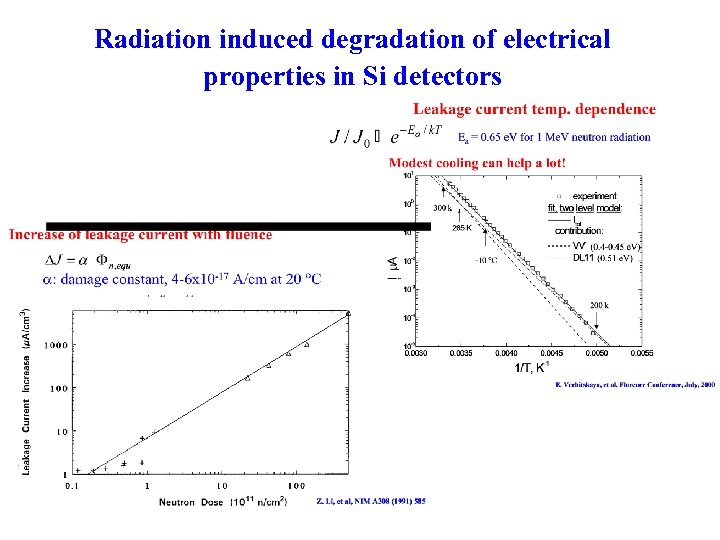 Radiation induced degradation of electrical properties in Si detectors
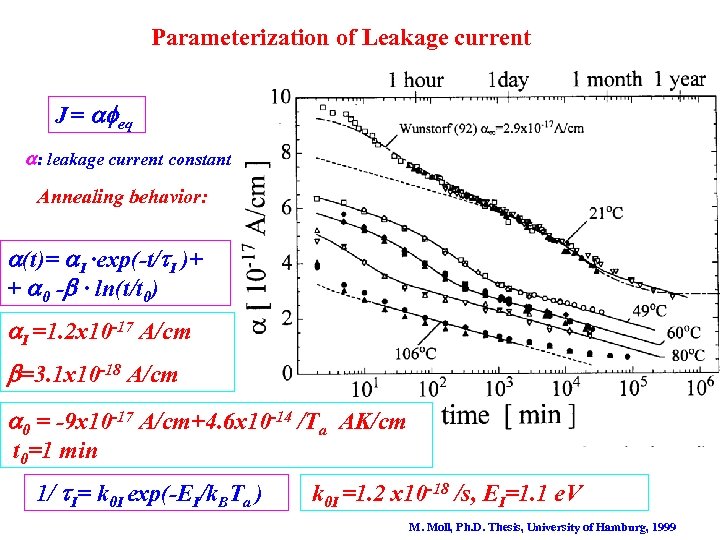 Parameterization of Leakage current J = eq : leakage current constant Annealing behavior: (t)= I ·exp(-t/ I )+ + 0 - · ln(t/t 0) I =1. 2 x 10 -17 A/cm =3. 1 x 10 -18 A/cm 0 = -9 x 10 -17 A/cm+4. 6 x 10 -14 /Ta AK/cm t 0=1 min 1/ I= k 0 I exp(-EI/k. BTa ) k 0 I =1. 2 x 10 -18 /s, EI=1. 1 e. V M. Moll, Ph. D. Thesis, University of Hamburg, 1999
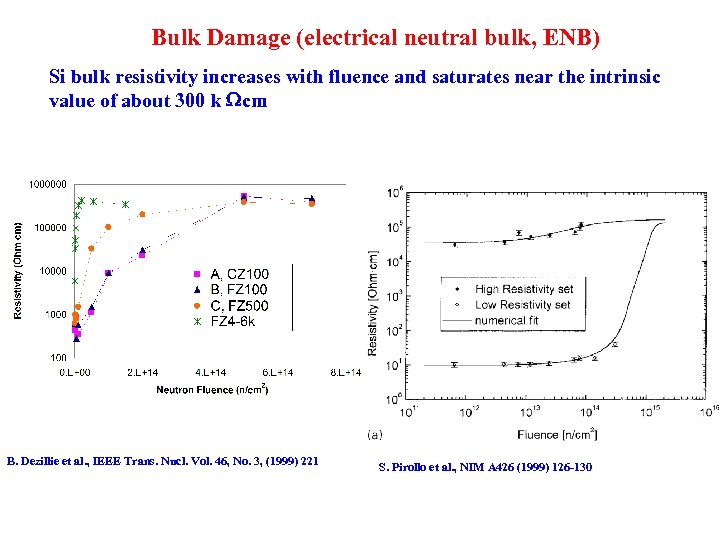 Bulk Damage (electrical neutral bulk, ENB) Si bulk resistivity increases with fluence and saturates near the intrinsic value of about 300 k cm B. Dezillie et al. , IEEE Trans. Nucl. Vol. 46, No. 3, (1999) 221 S. Pirollo et al. , NIM A 426 (1999) 126 -130
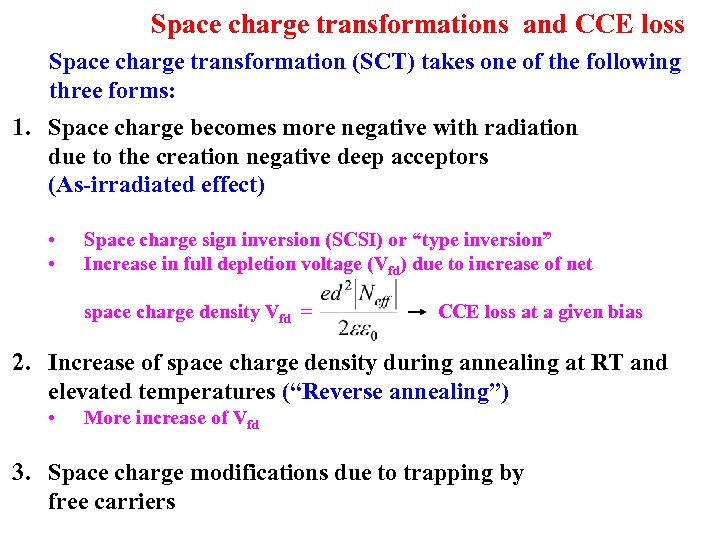 Space charge transformations and CCE loss Space charge transformation (SCT) takes one of the following three forms: 1. Space charge becomes more negative with radiation due to the creation negative deep acceptors (As-irradiated effect) • • Space charge sign inversion (SCSI) or “type inversion” Increase in full depletion voltage (Vfd) due to increase of net space charge density Vfd = CCE loss at a given bias 2. Increase of space charge density during annealing at RT and elevated temperatures (“Reverse annealing”) • More increase of Vfd 3. Space charge modifications due to trapping by free carriers
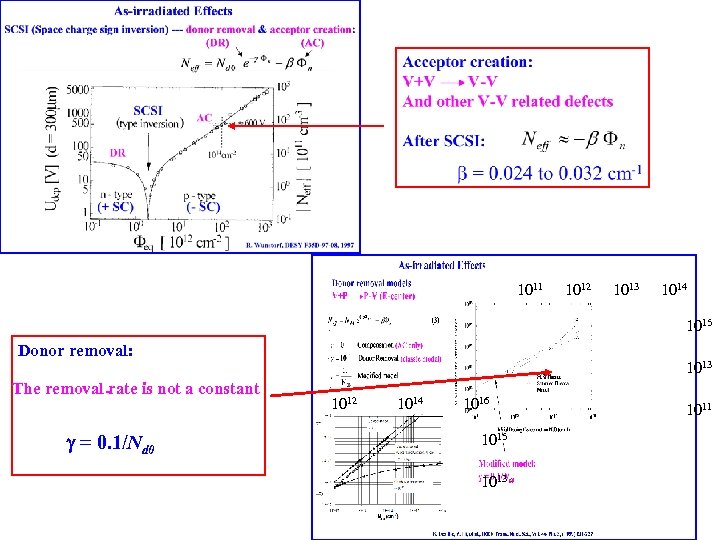 1011 1012 1013 1014 1015 Donor removal: The removal rate is not a constant - = 0. 1/Nd 0 1013 1012 1014 1016 1015 1013 1011
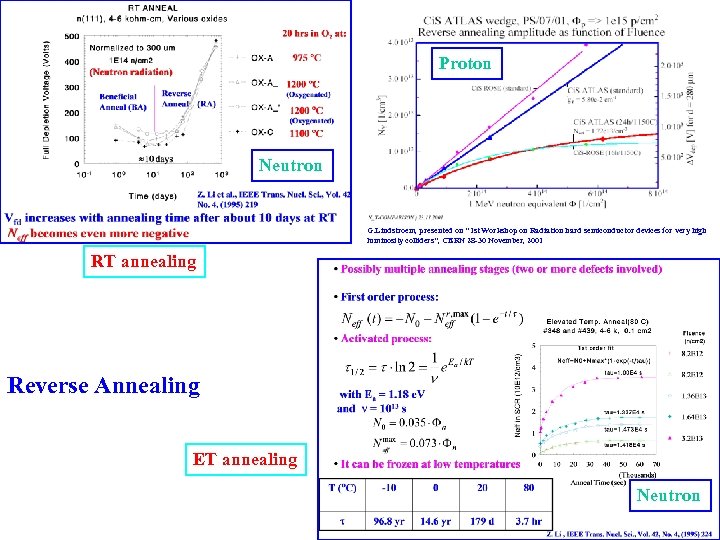 Proton Neutron G. Lindstroem, presented on "1 st Workshop on Radiation hard semiconductor devices for very high luminosity colliders", CERN 28 -30 November, 2001 RT annealing Reverse Annealing ET annealing Neutron
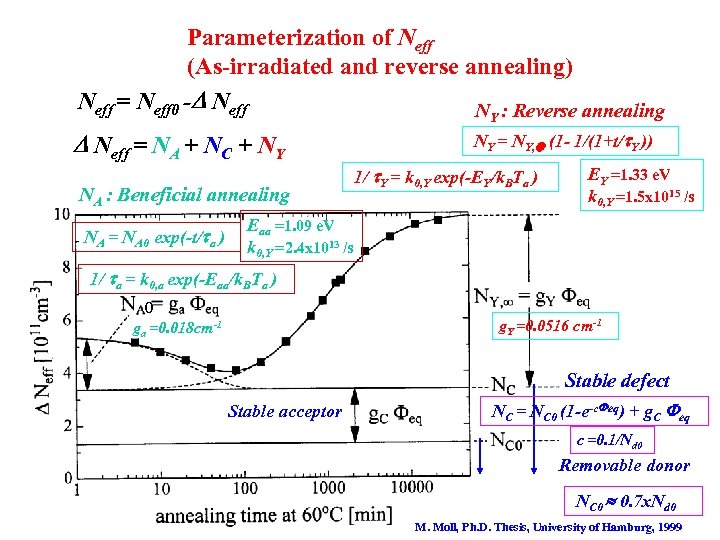 Parameterization of Neff (As-irradiated and reverse annealing) Neff = Neff 0 - Neff N : Reverse annealing Y Neff = NA + NC + NY NA : Beneficial annealing NA = NA 0 exp(-t/ a ) NY = NY, (1 - 1/(1+t/ Y )) 1/ Y = k 0, Y exp(-EY/k. BTa ) EY =1. 33 e. V k 0, Y =1. 5 x 10¹⁵ /s Eaa =1. 09 e. V k 0, Y =2. 4 x 10¹³ /s 1/ a = k 0, a exp(-Eaa/k. BTa ) 0 ga =0. 018 cm-1 g. Y =0. 0516 cm-1 Stable defect Stable acceptor NC = NC 0 (1 -e-c eq) + g. C eq c =0. 1/Nd 0 Removable donor NC 0 0. 7 x. Nd 0 M. Moll, Ph. D. Thesis, University of Hamburg, 1999
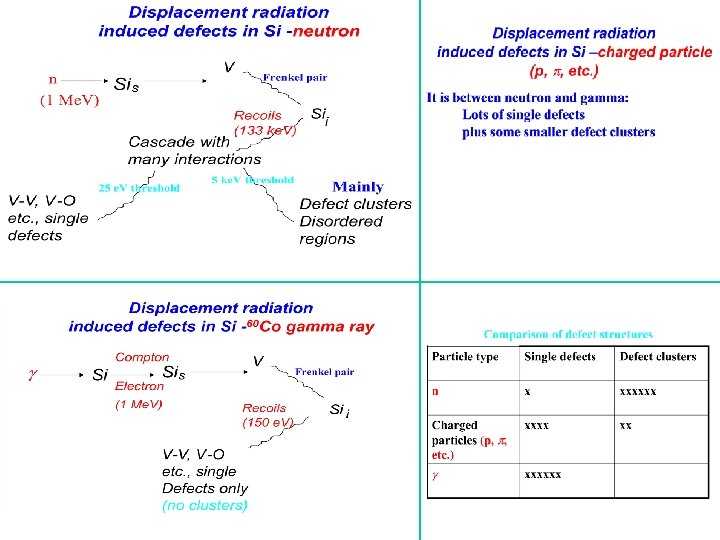
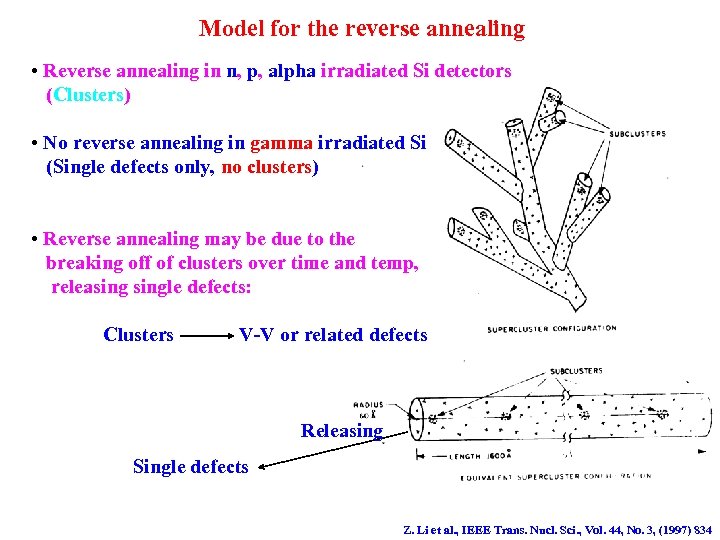 Model for the reverse annealing • Reverse annealing in n, p, alpha irradiated Si detectors (Clusters) • No reverse annealing in gamma irradiated Si (Single defects only, no clusters) • Reverse annealing may be due to the breaking off of clusters over time and temp, releasingle defects: Clusters V-V or related defects Releasing Single defects Z. Li et al. , IEEE Trans. Nucl. Sci. , Vol. 44, No. 3, (1997) 834
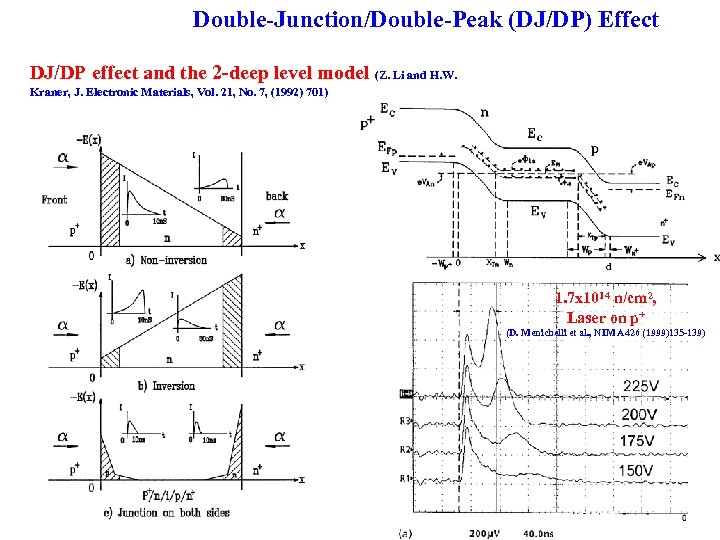 Double-Junction/Double-Peak (DJ/DP) Effect DJ/DP effect and the 2 -deep level model (Z. Li and H. W. Kraner, J. Electronic Materials, Vol. 21, No. 7, (1992) 701) 1. 7 x 10¹⁴ n/cm 2, Laser on p+ (D. Menichelli et al. , NIM A 426 (1999)135 -139)
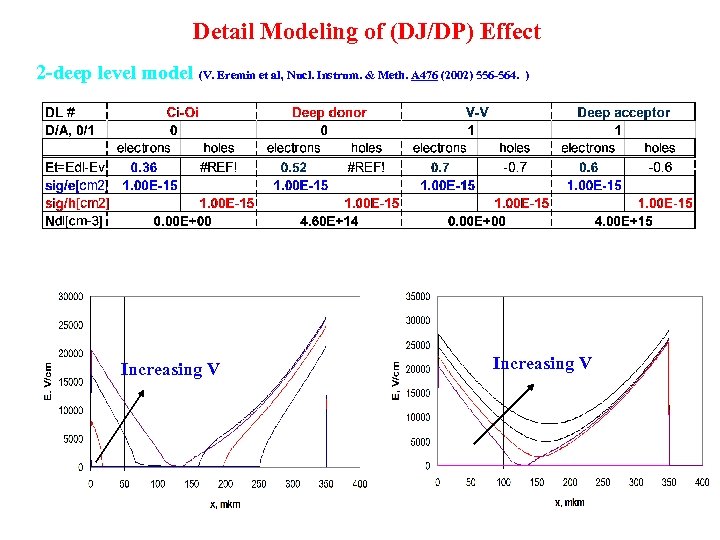 Detail Modeling of (DJ/DP) Effect 2 -deep level model (V. Eremin et al, Nucl. Instrum. & Meth. A 476 (2002) 556 -564. ) Increasing V
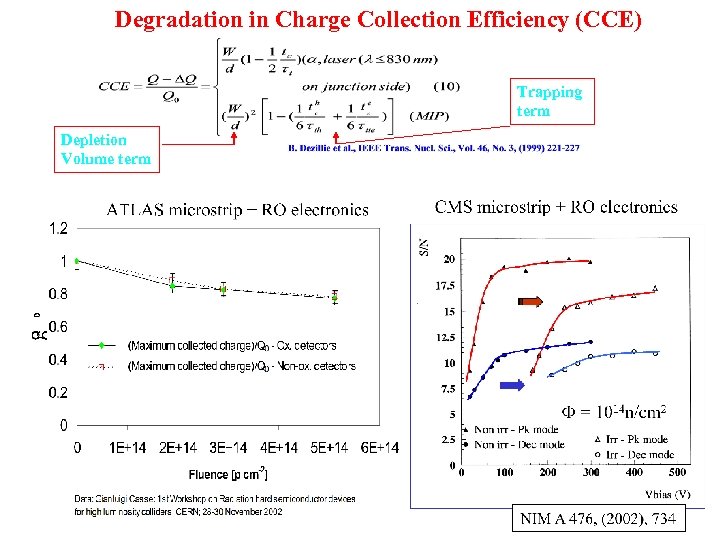 Degradation in Charge Collection Efficiency (CCE) Trapping term Depletion Volume term
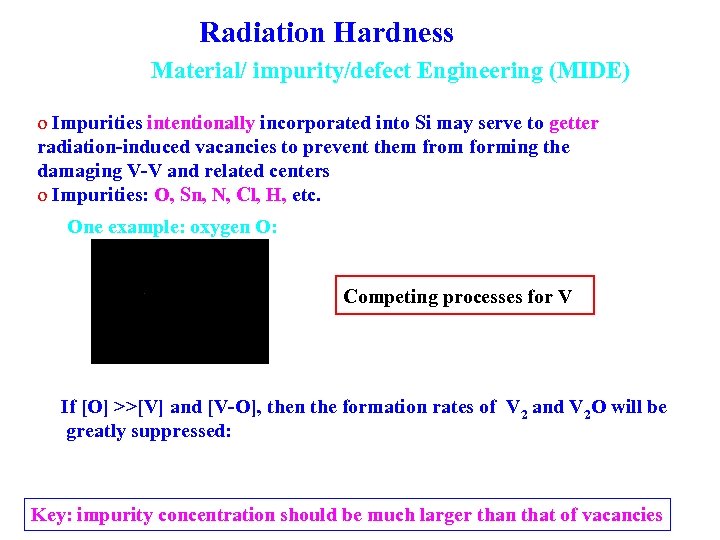 Radiation Hardness Material/ impurity/defect Engineering (MIDE) o Impurities intentionally incorporated into Si may serve to getter radiation-induced vacancies to prevent them from forming the damaging V-V and related centers o Impurities: O, Sn, N, Cl, H, etc. One example: oxygen O: Competing processes for V If [O] >>[V] and [V-O], then the formation rates of V 2 and V 2 O will be greatly suppressed: Key: impurity concentration should be much larger than that of vacancies
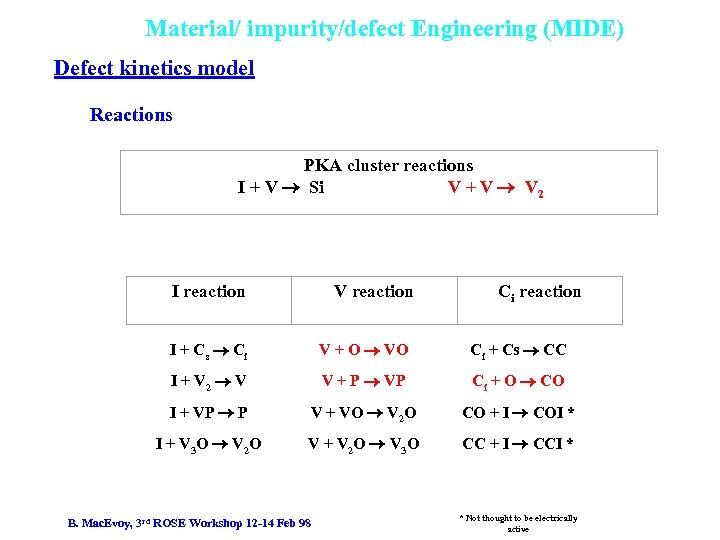 Material/ impurity/defect Engineering (MIDE) Defect kinetics model Reactions PKA cluster reactions I + V Si V + V V 2 I reaction V reaction Ci reaction I + Cs Ci V + O VO Ci + Cs CC I + V 2 V V + P VP Ci + O CO I + VP P V + VO V 2 O CO + I COI * I + V 3 O V 2 O V + V 2 O V 3 O CC + I CCI * * Not thought to be electrically active B. Mac. Evoy, 3 rd ROSE Workshop 12 -14 Feb 98
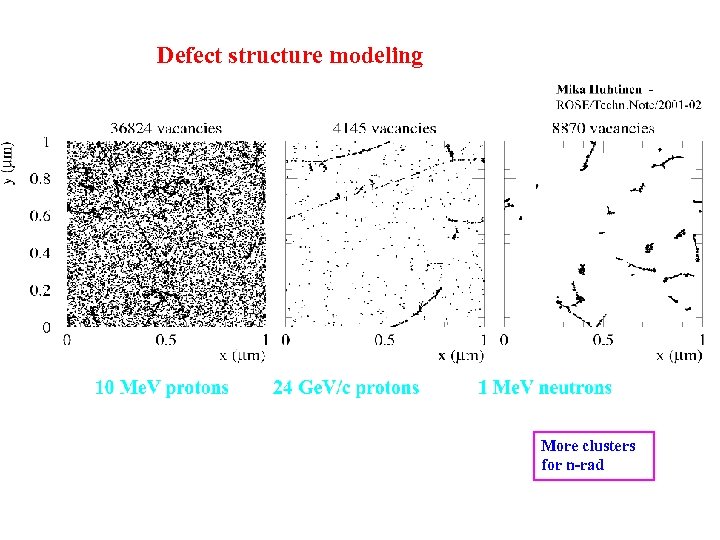 Defect structure modeling More clusters for n-rad
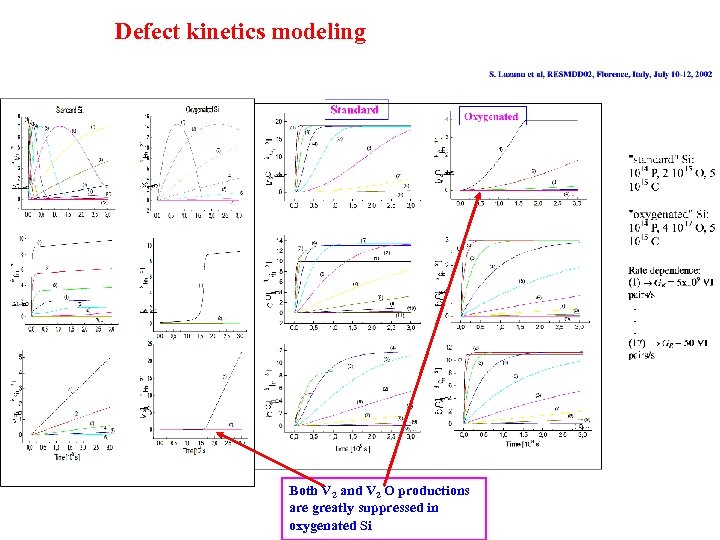 Defect kinetics modeling Both V 2 and V 2 O productions are greatly suppressed in oxygenated Si
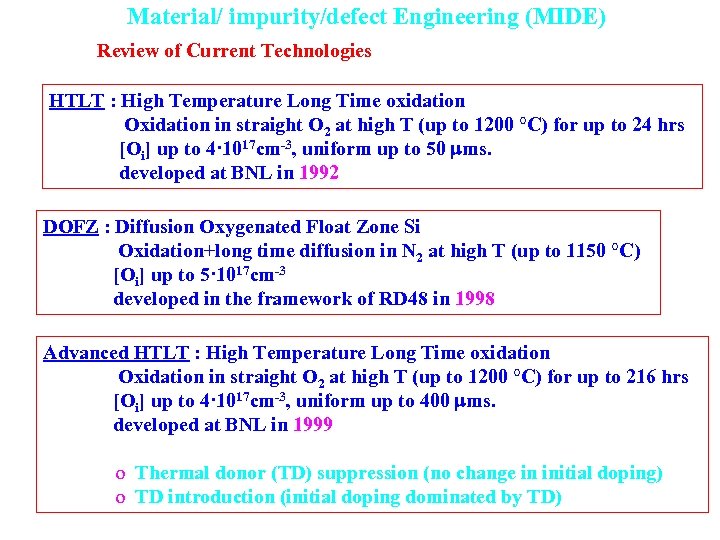 Material/ impurity/defect Engineering (MIDE) Review of Current Technologies HTLT : High Temperature Long Time oxidation Oxidation in straight O 2 at high T (up to 1200 °C) for up to 24 hrs [Oi] up to 4· 1017 cm-3, uniform up to 50 ms. developed at BNL in 1992 DOFZ : Diffusion Oxygenated Float Zone Si Oxidation+long time diffusion in N 2 at high T (up to 1150 °C) [Oi] up to 5· 1017 cm-3 developed in the framework of RD 48 in 1998 Advanced HTLT : High Temperature Long Time oxidation Oxidation in straight O 2 at high T (up to 1200 °C) for up to 216 hrs [Oi] up to 4· 1017 cm-3, uniform up to 400 ms. developed at BNL in 1999 o Thermal donor (TD) suppression (no change in initial doping) o TD introduction (initial doping dominated by TD)
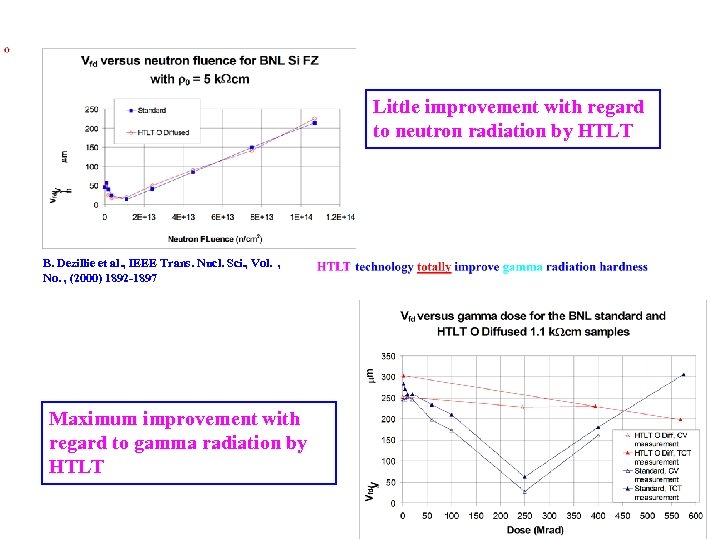 Little improvement with regard to neutron radiation by HTLT B. Dezillie et al. , IEEE Trans. Nucl. Sci. , Vol. , No. , (2000) 1892 -1897 Maximum improvement with regard to gamma radiation by HTLT
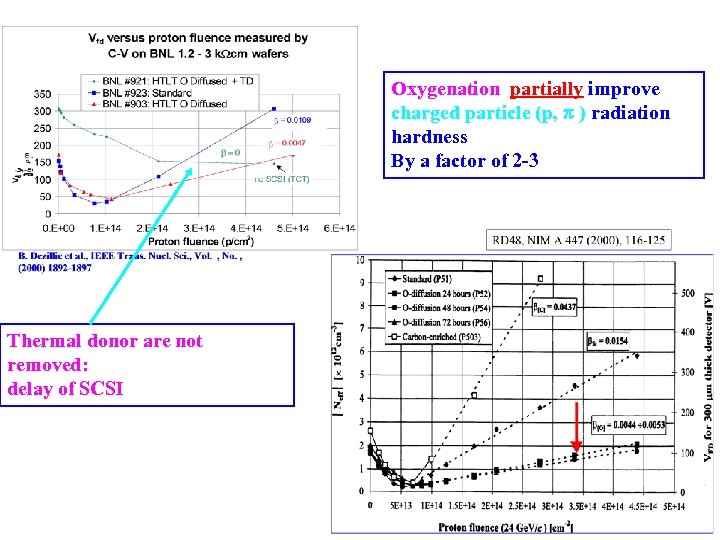 Oxygenation partially improve charged particle (p, ) radiation hardness By a factor of 2 -3 Thermal donor are not removed: delay of SCSI
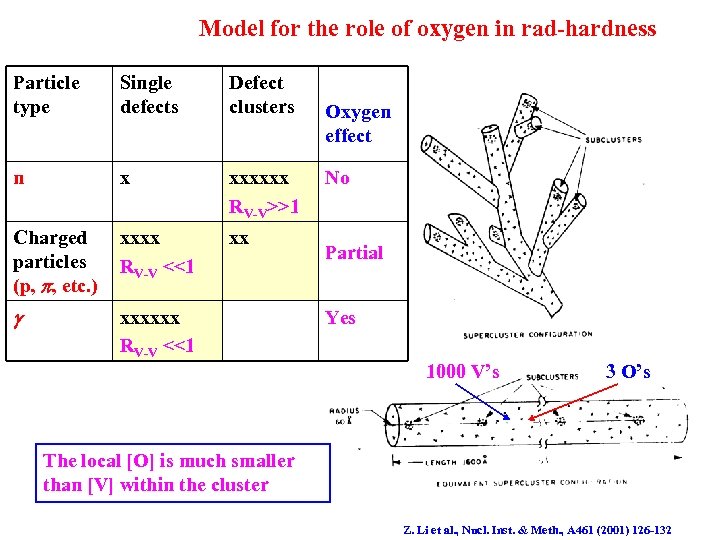 Model for the role of oxygen in rad-hardness Particle type Single defects Defect clusters n x xxxxxx RV-V>>1 Charged particles (p, , etc. ) xxxx RV-V <<1 xx xxxxxx RV-V <<1 Oxygen effect No Partial Yes 1000 V’s 3 O’s The local [O] is much smaller than [V] within the cluster Z. Li et al. , Nucl. Inst. & Meth. , A 461 (2001) 126 -132
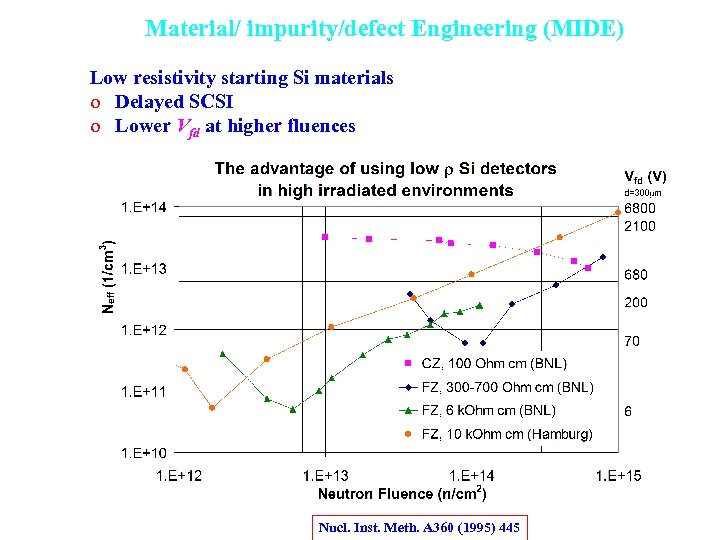 Material/ impurity/defect Engineering (MIDE) Low resistivity starting Si materials o Delayed SCSI o Lower Vfd at higher fluences Nucl. Inst. Meth. A 360 (1995) 445
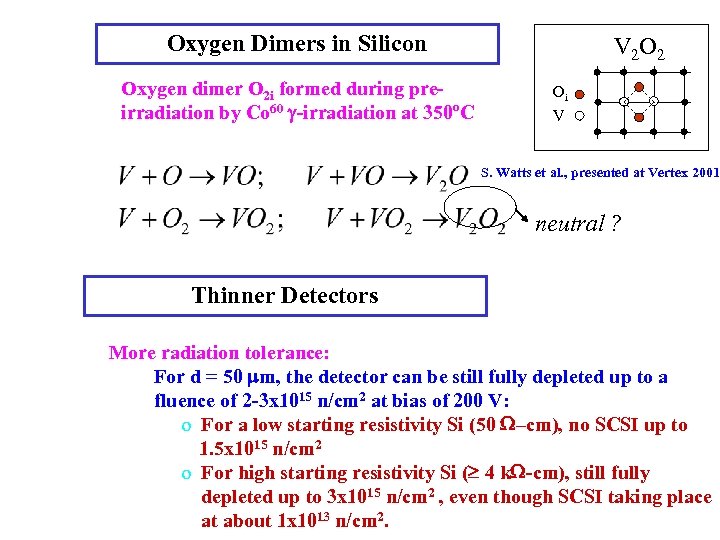 Oxygen Dimers in Silicon Oxygen dimer O 2 i formed during preirradiation by Co 60 -irradiation at 350ºC V 2 O 2 Oi V S. Watts et al. , presented at Vertex 2001 neutral ? Thinner Detectors More radiation tolerance: For d = 50 m, the detector can be still fully depleted up to a fluence of 2 -3 x 10¹⁵ n/cm 2 at bias of 200 V: o For a low starting resistivity Si (50 –cm), no SCSI up to 1. 5 x 10¹⁵ n/cm 2 o For high starting resistivity Si ( 4 k -cm), still fully depleted up to 3 x 10¹⁵ n/cm 2 , even though SCSI taking place at about 1 x 10¹³ n/cm 2.
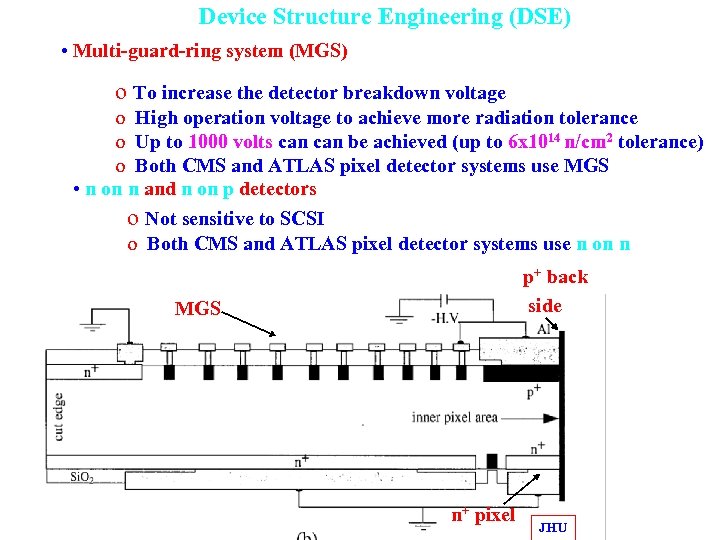 Device Structure Engineering (DSE) • Multi-guard-ring system (MGS) o To increase the detector breakdown voltage o High operation voltage to achieve more radiation tolerance o Up to 1000 volts can be achieved (up to 6 x 10¹⁴ n/cm 2 tolerance) o Both CMS and ATLAS pixel detector systems use MGS • n on n and n on p detectors o Not sensitive to SCSI o Both CMS and ATLAS pixel detector systems use n on n p+ back side MGS n+ pixel JHU
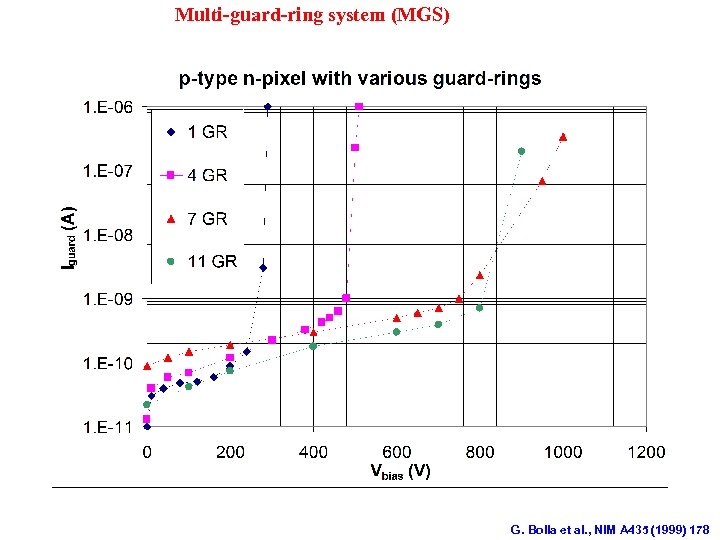 Multi-guard-ring system (MGS) G. Bolla et al. , NIM A 435 (1999) 178
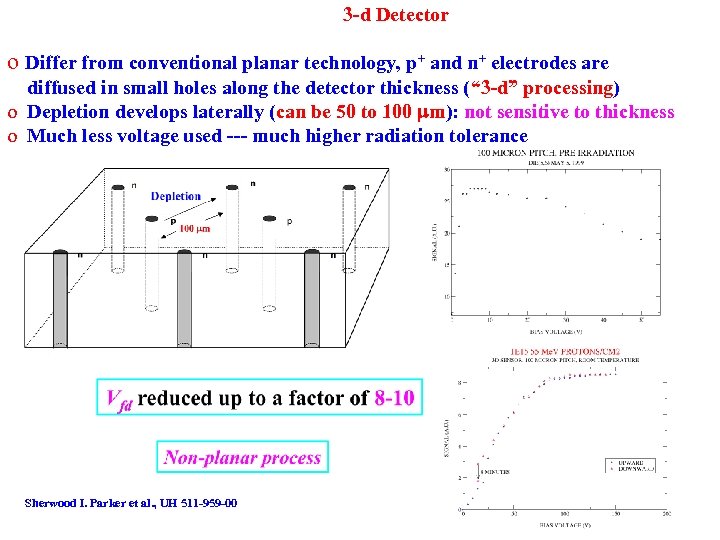 3 -d Detector o Differ from conventional planar technology, p+ and n+ electrodes are diffused in small holes along the detector thickness (“ 3 -d” processing) o Depletion develops laterally (can be 50 to 100 m): not sensitive to thickness o Much less voltage used --- much higher radiation tolerance Sherwood I. Parker et al. , UH 511 -959 -00
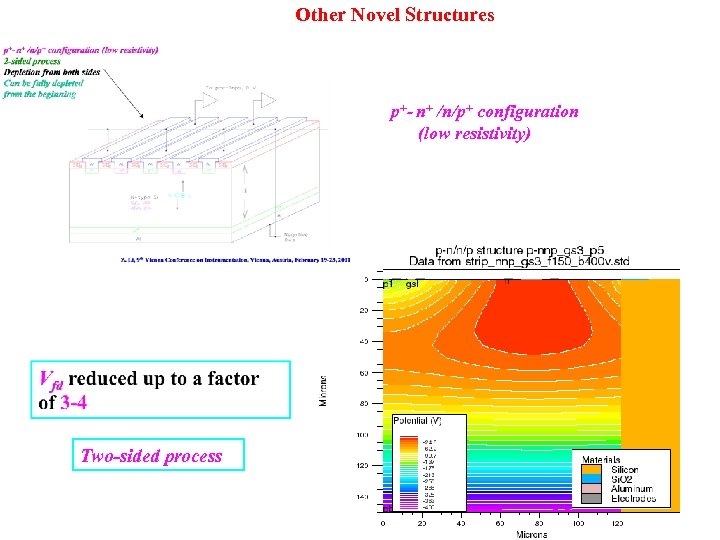 Other Novel Structures p+- n+ /n/p+ configuration (low resistivity) Two-sided process -
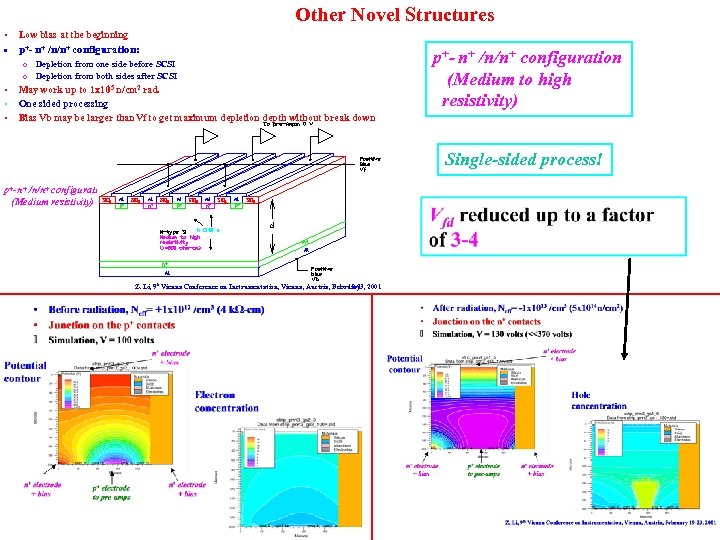 Other Novel Structures • Low bias at the beginning • p+- n+ /n/n+ configuration: o Depletion from one side before SCSI o Depletion from both sides after SCSI • • • 15 May work up to 1 x 10 n/cm 2 rad. One sided processing Bias Vb may be larger than Vf to get maximum depletion depth without break down p+- n+ /n/n+ configuration (Medium to high resistivity) Single-sided process! p+- n+ /n/n+ configuration (Medium resistivity) th Z. Li, 9 Vienna Conference on Instrumentation, Vienna, Austria, February 19 -23, 2001
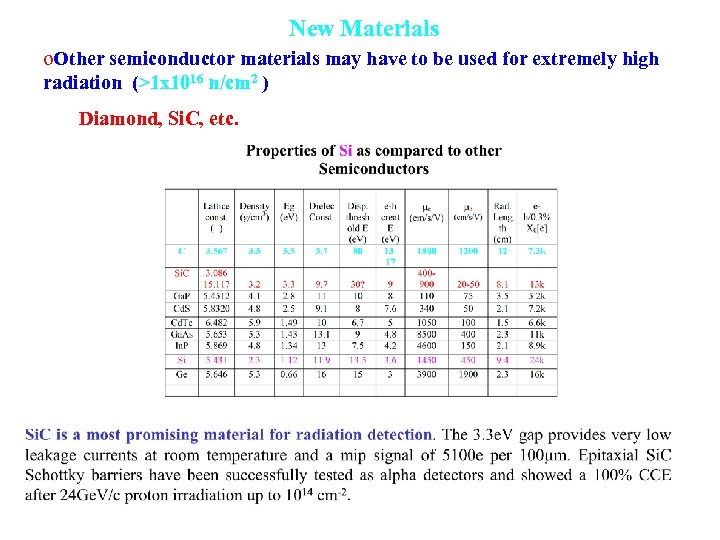 New Materials o. Other semiconductor materials may have to be used for extremely high radiation (>1 x 10¹⁶ n/cm 2 ) Diamond, Si. C, etc.
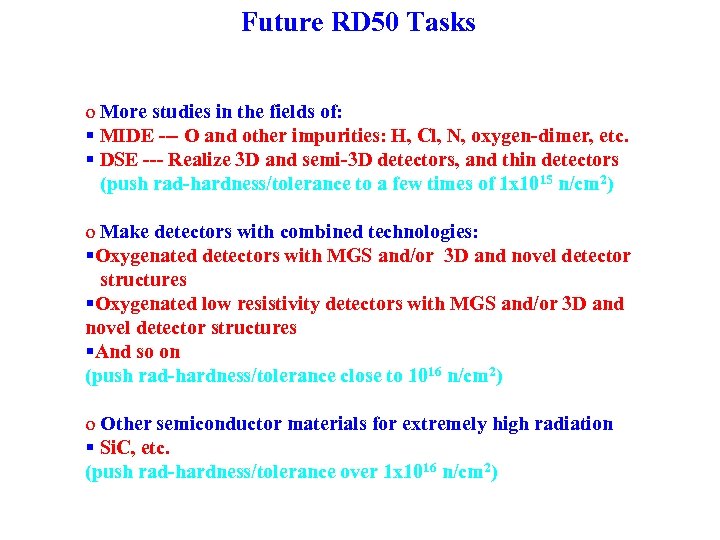 Future RD 50 Tasks o More studies in the fields of: § MIDE --- O and other impurities: H, Cl, N, oxygen-dimer, etc. § DSE --- Realize 3 D and semi-3 D detectors, and thin detectors (push rad-hardness/tolerance to a few times of 1 x 10¹⁵ n/cm 2) o Make detectors with combined technologies: §Oxygenated detectors with MGS and/or 3 D and novel detector structures §Oxygenated low resistivity detectors with MGS and/or 3 D and novel detector structures §And so on (push rad-hardness/tolerance close to 1016 n/cm 2) o Other semiconductor materials for extremely high radiation § Si. C, etc. (push rad-hardness/tolerance over 1 x 10¹⁶ n/cm 2)
 Summary o Different particles cause different displacement damage in Si material and detectors o Radiation-induced damages cause detector electrical properties to degrade: § increase of detector leakage current § compensation of Si bulk (intrinsic bulk resistivity) § increase of negative space charge during radiation and annealing § space charge maybe modified by charge trapping o To obtain ultra high Radiation hardness/tolerance, newly-formed CERN RD 50 Collaboration is poised to carry out various tasks § Material/impurity/defect engineering § Device structure engineering § Detector operation and modeling § Full detector integration § Other semiconductor materials for extreme radiation (> 1016 n/cm 2) 1 st RD 50 - Workshop on Radiation hard semiconductor devices for very high luminosity colliders, CERN 2 -4 October, 2002 http: //rd 50. web. cern. ch/rd 50/1 st-workshop/default. htm