


 Скачать презентацию Ultra Light Status Report Shawn Mc Kee
7381a3d609bd51397fbaa00edfb5f318.ppt
- Количество слайдов: 20
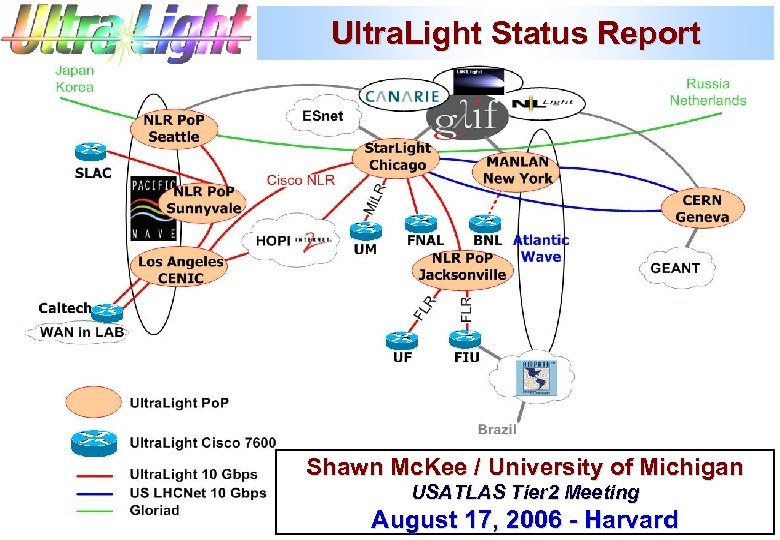 Ultra. Light Status Report Shawn Mc. Kee / University of Michigan USATLAS Tier 2 Meeting August 17, 2006 - Harvard
 Reminder: The Ultra. Light Project Ultra. Light is n A four year $2 M NSF ITR funded by MPS. n Application driven Network R&D. n A collaboration of BNL, Buffalo, Caltech, CERN, Florida, FIU, FNAL, Internet 2, Michigan, MIT, SLAC, Vanderbilt. n Significant international participation: Brazil, Japan, Korea amongst many others. Goal: Enable the network as a managed resource. Meta-Goal: Enable physics analysis and discoveries which could not otherwise be achieved.
 Status Update There are three areas which I want to make note of for the Tier-2 s 1. Work on new Ultra. Light kernel 2. Development of VINCI/LISA/Endhost agents (US ATLAS test of this in Fall…) 3. Work on FTS (either with FTS developers or as an equivalent project) 4. …and one addendum on US LHCNet…
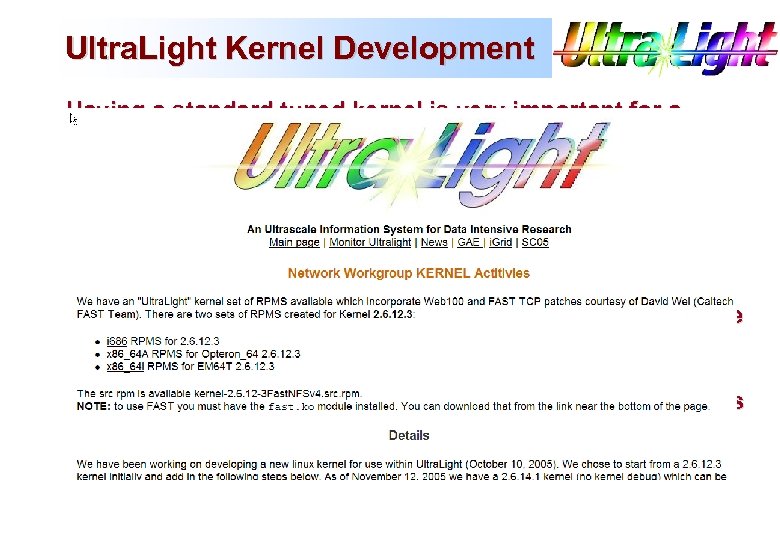 Ultra. Light Kernel Development Having a standard tuned kernel is very important for a number of Ultra. Light activities: 1. Breaking the 1 GB/sec disk-to-disk barrier 2. Exploring TCP congestion control protocols 3. Optimizing our capability for demos and performance 4. The planned kernel incorporates the latest FAST and Web 100 patches over a 2. 6. 17 -7 kernel and includes the latest RAID and 10 GE NIC drivers. 5. The Ultra. Light web page (http: //www. ultralight. org ) has a Kernel page which provides the details off the Workgroup->Network page
 Optical Path Plans Emerging “light path” technologies are becoming popular in the Grid community: n They can extend augment existing grid computing infrastructures, currently focused on CPU/storage, to include the network as an integral Grid component. n Those technologies seem to be the most effective way to offer network resource provisioning on-demand between end-systems. A major capability we are developing in Ultralight is the ability to dynamically switch optical paths across the node, bypassing electronic equipment via a fiber cross connect. The ability to switch dynamically provides additional functionality and also models the more abstract case where switching is done between colors (ITU grid lambdas).
 VINCI: A Multi-Agent System Ø VINCI and the underlying Mon. ALISA framework use a system of autonomous agents to support a wide range of dynamic services Ø Agents in the Mon. ALISA servers self-organize and collaborate with each other to manage access to distributed resources, to make effective decisions in planning workflow, to respond to problems that affect multiple sites, or to carry out other globally-distributed tasks Ø Agents running on end-users’ desktops or clusters detect and adapt to their local environment so they can function properly. They locate and receive real-time information from a variety of Mon. ALISA services, aggregate and present results to users, or feed information to higher level services Ø Agents with built-in “intelligence” are required to engage in negotiations (for network resources, for example), and to make proactive run-time decisions, while responding to changes in the environment
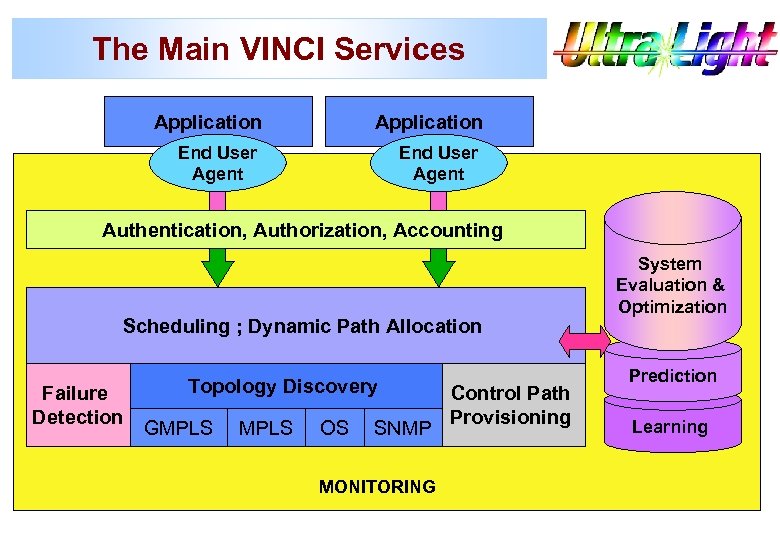 The Main VINCI Services Application End User Agent Authentication, Authorization, Accounting Scheduling ; Dynamic Path Allocation Failure Detection Topology Discovery GMPLS OS SNMP MONITORING Control Path Provisioning System Evaluation & Optimization Prediction Learning
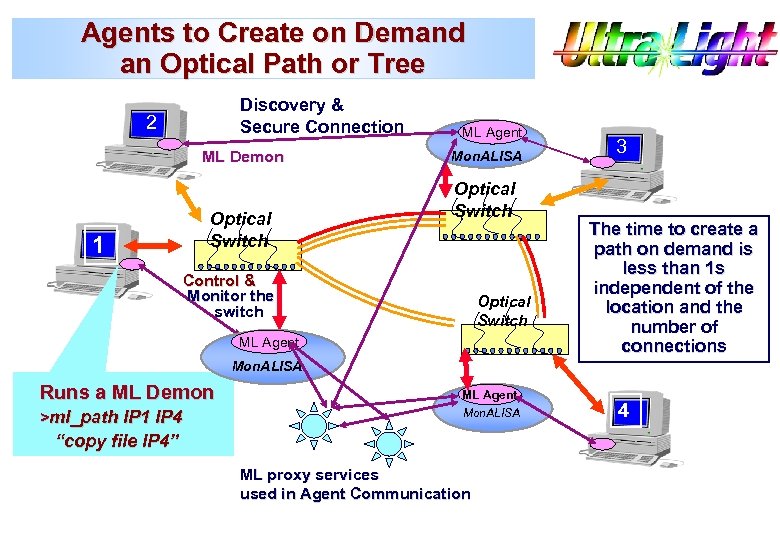 Agents to Create on Demand an Optical Path or Tree Discovery & Secure Connection 2 ML Demon Optical Switch 1 ML Agent Mon. ALISA Optical Switch Control & Monitor the switch Optical Switch ML Agent 3 The time to create a path on demand is less than 1 s independent of the location and the number of connections Mon. ALISA Runs a ML Demon ML Agent >ml_path IP 1 IP 4 Mon. ALISA “copy file IP 4” ML proxy services used in Agent Communication 4
 DEMO: Mon. ALISA and path-building An example of optical path building using Mon. ALISA is shown at: http: //ultralight. caltech. edu/website/gae/movies/ml_optical_path/ml_os. htm One of the focus areas for Ultra. Light is being able to dynamically construct point-to-point light-paths where supported. We still have a pending proposal (PLa. Net. S) focused on creating a managed dynamic network infrastructure…
 LISA, EVO and Endhosts Many of you are familiar with VRVS. Its successor is called EVO (Enabling Virtual Organizations). It improves on VRVS in a number of ways: n Support for H. 263 (capture and send your desktop as another n n n u u video source for a conference) IM like capability (presence/chat) Better device / OS / Language support Significantly improved reliability and scalability Related to this last point is a the “merger” of Mon. ALISA and VRVS in EVO. Endhost agents (LISA) are now an integral part of EVO. Endhost agents monitor the user’s hosts and react to changing conditions Something like this is envisioned as a component of deploying a ‘managed network’ Prototype testing of network agent this fall?
 FTS and Ultra. Light… To date there has been little interaction between people working on the network and those working on data transport for ATLAS (or LHC in general) There is a significant amount of work architecting, developing and hardening the data management (and transport) for ATLAS…little time (or understanding of possibilities) for the network. A dynamic managed network introduces new possibilities. Research efforts in networking need to be fed into the data transport architecting. Ultra. Light is planning to engage the FTS developers and try to determine their understanding of (and plans for) the network. GOAL: Account for the network and improve robustness and performance of data transport and the overall infrastructure.
 Aside: US LHCNet Status and Plans The following 7 slides (from Harvey Newman) provide some details about US LHCNet and its plans to support LHC scale physics requirements. Details are provided for reference but I won’t cover them in my limited time.
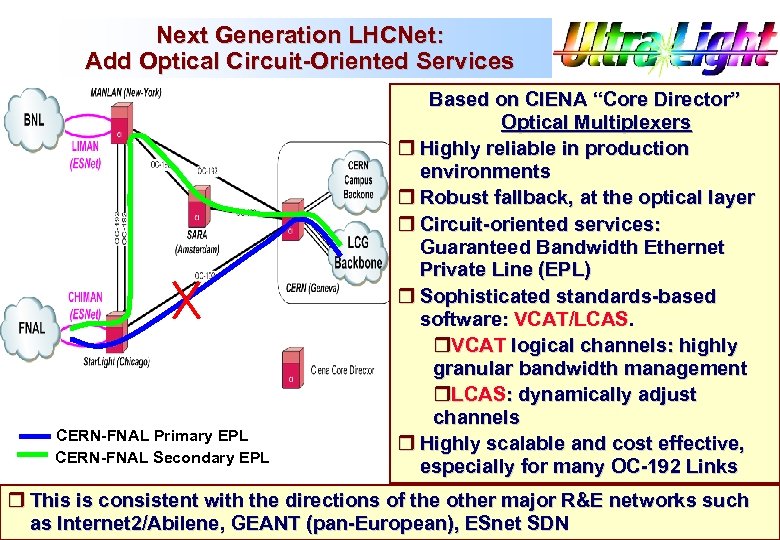 Next Generation LHCNet: Add Optical Circuit-Oriented Services CERN-FNAL Primary EPL CERN-FNAL Secondary EPL Based on CIENA “Core Director” Optical Multiplexers r Highly reliable in production environments r Robust fallback, at the optical layer r Circuit-oriented services: Guaranteed Bandwidth Ethernet Private Line (EPL) r Sophisticated standards-based software: VCAT/LCAS. r. VCAT logical channels: highly granular bandwidth management r. LCAS: dynamically adjust channels r Highly scalable and cost effective, especially for many OC-192 Links r This is consistent with the directions of the other major R&E networks such as Internet 2/Abilene, GEANT (pan-European), ESnet SDN
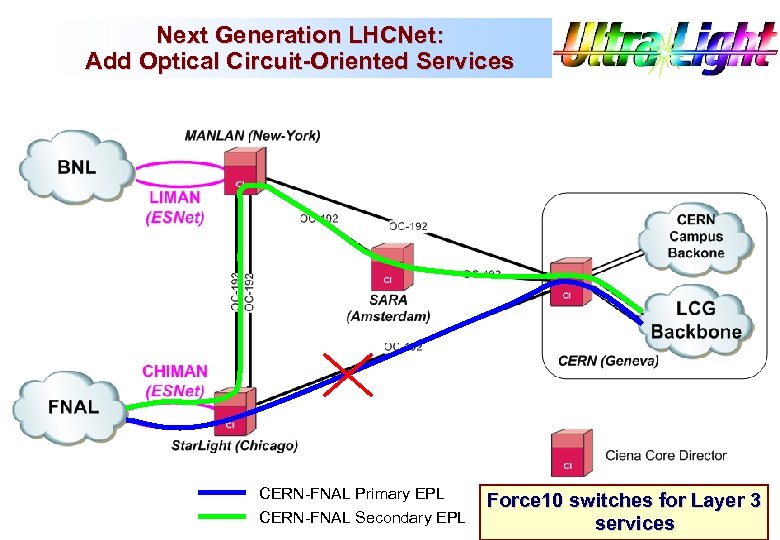 Next Generation LHCNet: Add Optical Circuit-Oriented Services CERN-FNAL Primary EPL CERN-FNAL Secondary EPL Force 10 switches for Layer 3 services
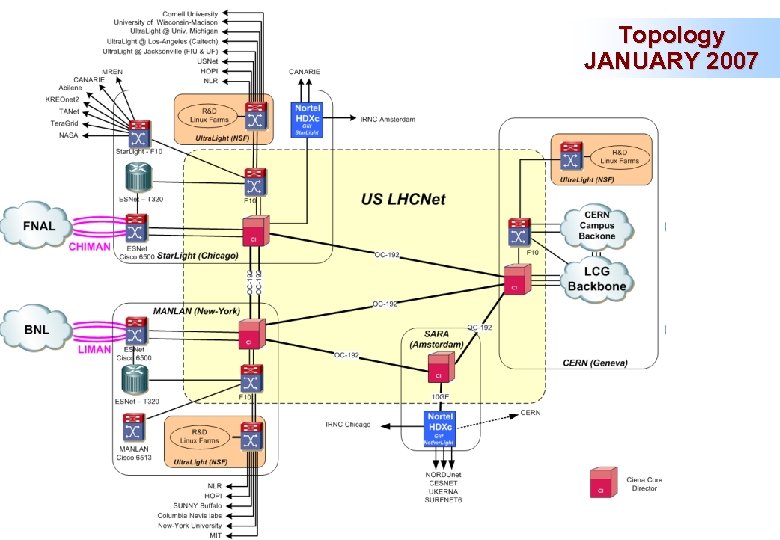 Topology JANUARY 2007
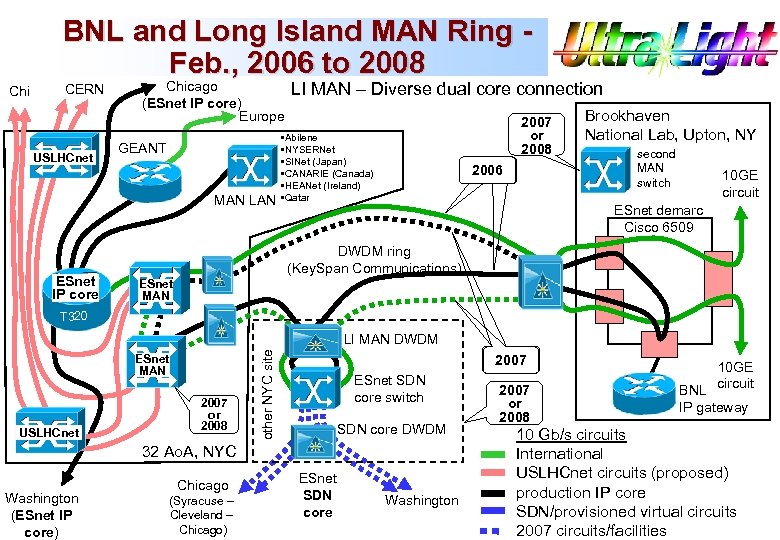 BNL and Long Island MAN Ring Feb. , 2006 to 2008 Chi CERN USLHCnet Chicago (ESnet IP core) Europe GEANT MAN LAN ESnet IP core LI MAN – Diverse dual core connection 2007 or 2008 • Abilene • NYSERNet • SINet (Japan) • CANARIE (Canada) • HEANet (Ireland) • Qatar 2006 Brookhaven National Lab, Upton, NY second MAN switch 10 GE circuit ESnet demarc Cisco 6509 DWDM ring (Key. Span Communications) ESnet MAN T 320 ESnet MAN USLHCnet 2007 or 2008 other NYC site LI MAN DWDM 2007 ESnet SDN core switch SDN core DWDM 32 Ao. A, NYC Washington (ESnet IP core) Chicago (Syracuse – Cleveland – Chicago) ESnet SDN core Washington 2007 or 2008 10 GE BNL circuit IP gateway 10 Gb/s circuits International USLHCnet circuits (proposed) production IP core SDN/provisioned virtual circuits 2007 circuits/facilities
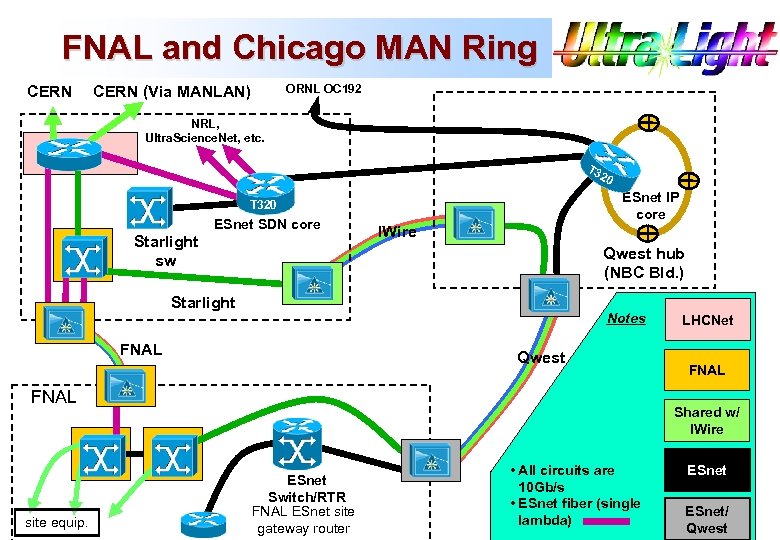 FNAL and Chicago MAN Ring CERN ORNL OC 192 CERN (Via MANLAN) NRL, Ultra. Science. Net, etc. T 3 20 ESnet IP core T 320 ESnet SDN core Starlight sw IWire Qwest hub (NBC Bld. ) Starlight Notes FNAL Qwest FNAL site equip. LHCNet FNAL Shared w/ IWire ESnet Switch/RTR FNAL ESnet site gateway router • All circuits are 10 Gb/s • ESnet fiber (single lambda) ESnet/ Qwest
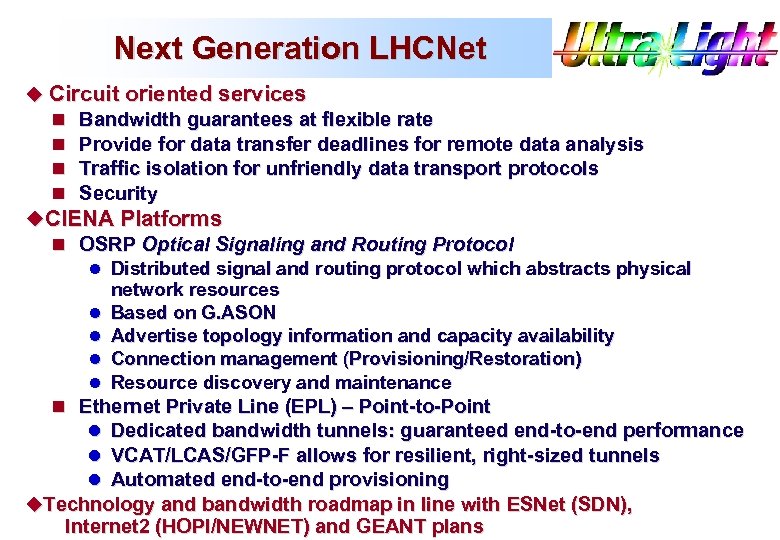 Next Generation LHCNet u Circuit oriented services n Bandwidth guarantees at flexible rate n Provide for data transfer deadlines for remote data analysis n Traffic isolation for unfriendly data transport protocols n Security u. CIENA Platforms n OSRP Optical Signaling and Routing Protocol l Distributed signal and routing protocol which abstracts physical l l network resources Based on G. ASON Advertise topology information and capacity availability Connection management (Provisioning/Restoration) Resource discovery and maintenance n Ethernet Private Line (EPL) – Point-to-Point l Dedicated bandwidth tunnels: guaranteed end-to-end performance l VCAT/LCAS/GFP-F allows for resilient, right-sized tunnels l Automated end-to-end provisioning u. Technology and bandwidth roadmap in line with ESNet (SDN), Internet 2 (HOPI/NEWNET) and GEANT plans
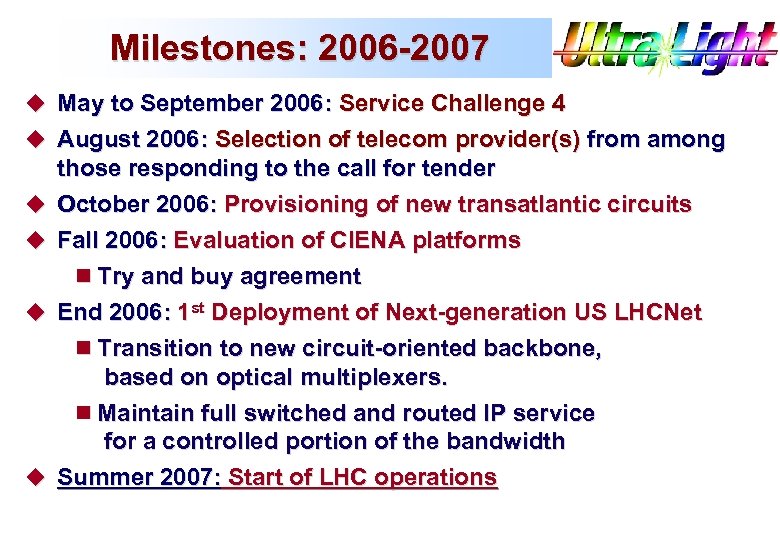 Milestones: 2006 -2007 u May to September 2006: Service Challenge 4 u August 2006: Selection of telecom provider(s) from among u u u those responding to the call for tender October 2006: Provisioning of new transatlantic circuits Fall 2006: Evaluation of CIENA platforms n Try and buy agreement End 2006: 1 st Deployment of Next-generation US LHCNet n Transition to new circuit-oriented backbone, based on optical multiplexers. n Maintain full switched and routed IP service for a controlled portion of the bandwidth u Summer 2007: Start of LHC operations
 Conclusion A number of developments are in progress. Tier-2’s should be able to benefit and can hopefully help drive these developments via testing feedback Networking developments need to be feed into existing and planned software for LHC US LHCNet is planning to support LHC scale requirements for connectivity and manageability