


 Скачать презентацию Ultra-Efficient Exascale Scientific Computing Lenny Oliker John Shalf
e67a64bf82f1e3b19a01c525f555690a.ppt
- Количество слайдов: 24
 Ultra-Efficient Exascale Scientific Computing Lenny Oliker, John Shalf, Michael Wehner And other LBNL staff
 Exascale is Critical to the DOE SC Mission “…exascale computing (will) revolutionize our approaches to global challenges in energy, environmental sustainability, and security. ” E 3 report
 Green Flash: Ultra-Efficient Climate Modeling • We present an alternative route to exascale computing – DOE SC exascale science questions are already identified. – Our idea is to target specific machine designs to each of these questions. • This is possible because of new technologies driven by the consumer market. • We want to turn the process around. – Ask “What machine do we need to answer a question? ” – Not “What can we answer with that machine? ”
 Green Flash: Ultra-Efficient Climate Modeling • We present an alternative route to exascale computing – DOE SC exascale science questions are already identified. – Our idea is to target specific machine designs to each of these questions. • This is possible because of new technologies driven by the consumer market. • We want to turn the process around. – Ask “What machine do we need to answer a question? ” – Not “What can we answer with that machine? ” • Caveat: – We present here a feasibility design study. – Goal is to influence the HPC industry by evaluating a prototype design.
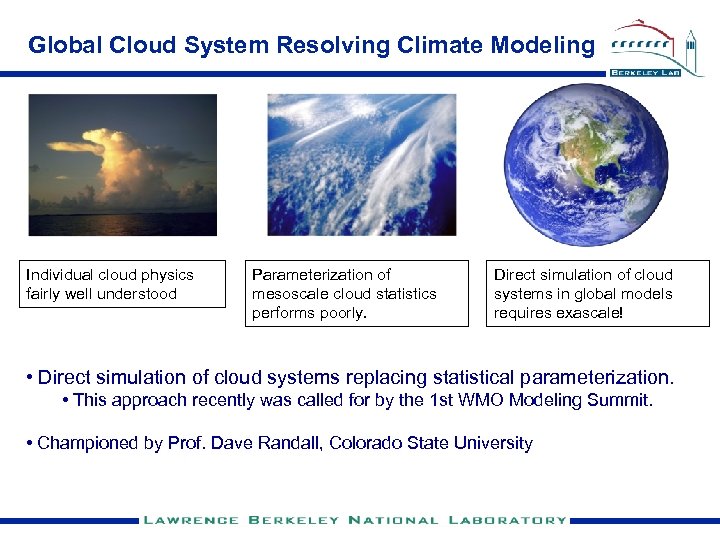 Global Cloud System Resolving Climate Modeling Individual cloud physics fairly well understood Parameterization of mesoscale cloud statistics performs poorly. Direct simulation of cloud systems in global models requires exascale! • Direct simulation of cloud systems replacing statistical parameterization. • This approach recently was called for by the 1 st WMO Modeling Summit. • Championed by Prof. Dave Randall, Colorado State University
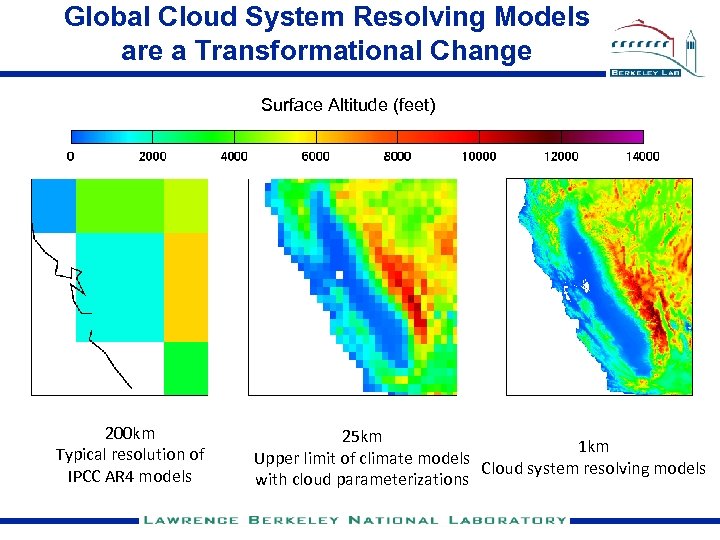 Global Cloud System Resolving Models are a Transformational Change Surface Altitude (feet) 200 km Typical resolution of IPCC AR 4 models 25 km 1 km Upper limit of climate models Cloud system resolving models with cloud parameterizations
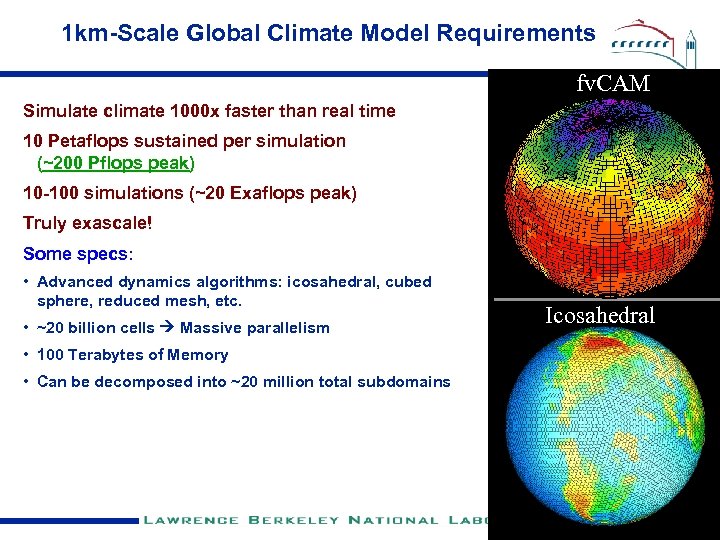 1 km-Scale Global Climate Model Requirements fv. CAM Simulate climate 1000 x faster than real time 10 Petaflops sustained per simulation (~200 Pflops peak) 10 -100 simulations (~20 Exaflops peak) Truly exascale! Some specs: • Advanced dynamics algorithms: icosahedral, cubed sphere, reduced mesh, etc. • ~20 billion cells Massive parallelism • 100 Terabytes of Memory • Can be decomposed into ~20 million total subdomains Icosahedral
 Proposed Ultra-Efficient Computing • Cooperative “science-driven system architecture” approach • Radically change HPC system development via applicationdriven hardware/software co-design – Achieve 100 x power efficiency over mainstream HPC approach for targeted high impact applications, at significantly lower cost – Accelerate development cycle for exascale HPC systems – Approach is applicable to numerous scientific areas in the DOE Office of Science • Research activity to understand feasibility of our approach
 Primary Design Constraint: POWER • Transistors still getting smaller – Moore’s Law: alive and well • Power efficiency and clock rates no longer improving at historical rates • Demand for supercomputing capability is accelerating • E 3 report considered an Exaflop system for 2016 • Power estimates for exascale systems based on extrapolation of current design trends range up to 179 MW • DOE E 3 Report 2008 • DARPA Exascale Report (in production) • LBNL IJHPCA Climate Simulator Study 2008 (Wehner, Oliker, Shalf) Need fundamentally new approach to computing designs
 Our Approach • Identify high-impact Exascale scientific applications important to DOE Office of Science (E 3 report) • Tailor system to requirements of target scientific problem – Use design principles from embedded computing – Leverage commodity components in novel ways - not full custom design • Tightly couple hardware/software/science development – Simulate hardware before you build it (RAMP) – Use applications for validation, not kernels – Automate software tuning process (Auto-Tuning)
 Path to Power Efficiency Reducing Waste in Computing • Examine methodology of embedded computing market – Optimized for low power, low cost, and high computational efficiency “Years of research in low-power embedded computing have shown only one design technique to reduce power: reduce waste. ” Mark Horowitz, Stanford University & Rambus Inc. • Sources of Waste – – Wasted transistors (surface area) Wasted computation (useless work/speculation/stalls) Wasted bandwidth (data movement) Designing for serial performance • Technology now favors parallel throughput over peak sequential performance
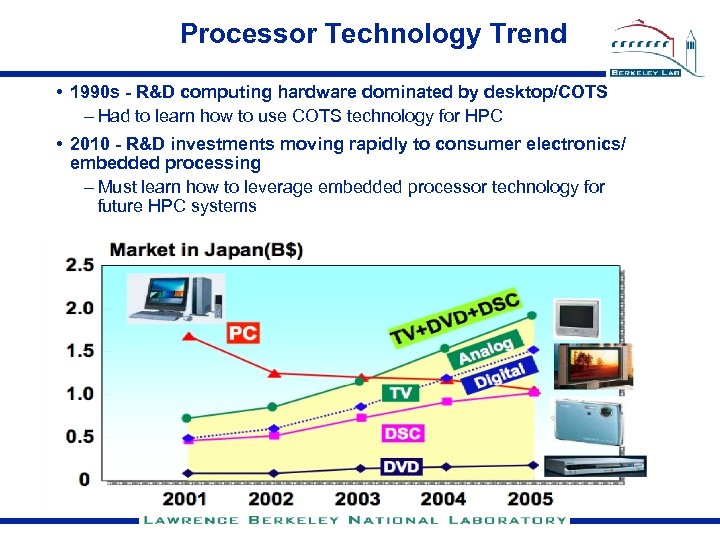 Processor Technology Trend • 1990 s - R&D computing hardware dominated by desktop/COTS – Had to learn how to use COTS technology for HPC • 2010 - R&D investments moving rapidly to consumer electronics/ embedded processing – Must learn how to leverage embedded processor technology for future HPC systems
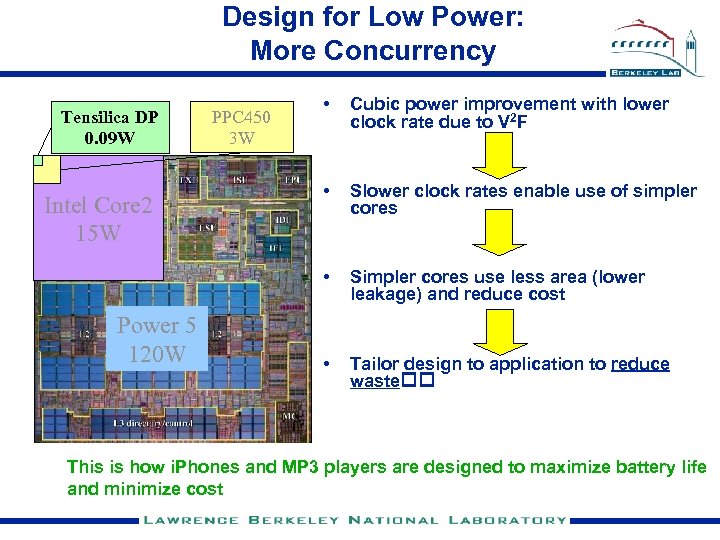 Design for Low Power: More Concurrency Intel Core 2 15 W Power 5 120 W PPC 450 3 W • Cubic power improvement with lower clock rate due to V 2 F • Slower clock rates enable use of simpler cores • Tensilica DP 0. 09 W Simpler cores use less area (lower leakage) and reduce cost • Tailor design to application to reduce waste This is how i. Phones and MP 3 players are designed to maximize battery life and minimize cost
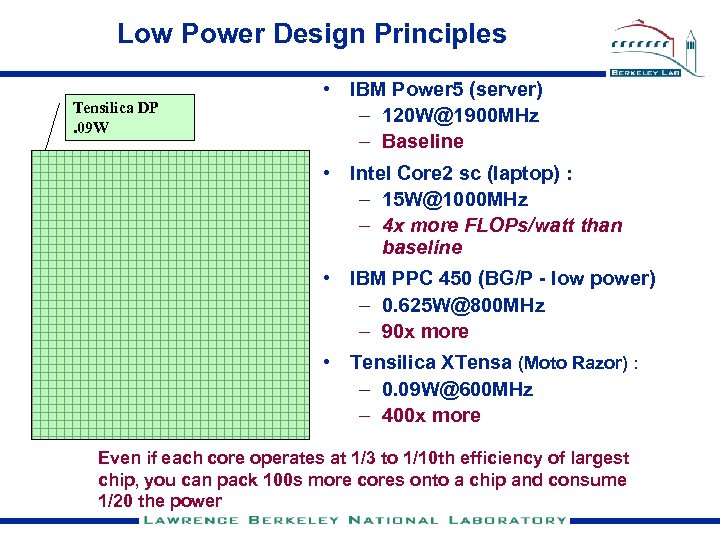 Low Power Design Principles Tensilica DP. 09 W Intel Core 2 Power 5 • IBM Power 5 (server) – 120 W@1900 MHz – Baseline • Intel Core 2 sc (laptop) : – 15 W@1000 MHz – 4 x more FLOPs/watt than baseline • IBM PPC 450 (BG/P - low power) – 0. 625 W@800 MHz – 90 x more • Tensilica XTensa (Moto Razor) : – 0. 09 W@600 MHz – 400 x more Even if each core operates at 1/3 to 1/10 th efficiency of largest chip, you can pack 100 s more cores onto a chip and consume 1/20 the power
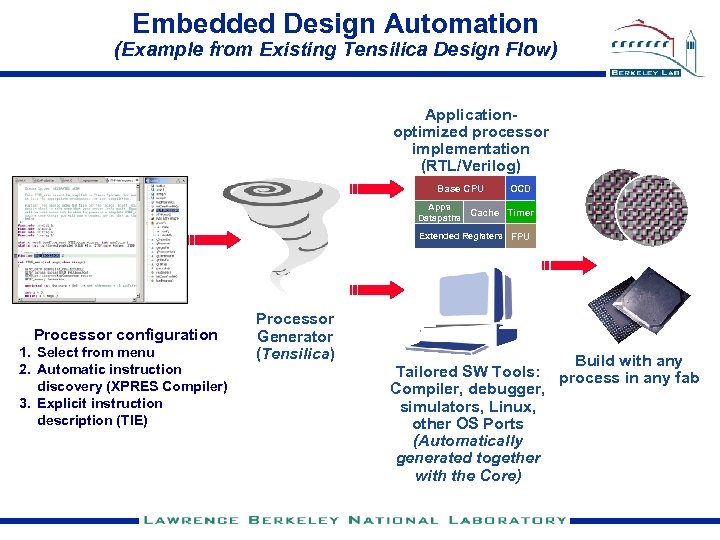 Embedded Design Automation (Example from Existing Tensilica Design Flow) Applicationoptimized processor implementation (RTL/Verilog) Base CPU OCD Apps Cache Timer Datapaths Extended Registers FPU Processor configuration 1. Select from menu 2. Automatic instruction discovery (XPRES Compiler) 3. Explicit instruction description (TIE) Processor Generator (Tensilica) Build with any Tailored SW Tools: process in any fab Compiler, debugger, simulators, Linux, other OS Ports (Automatically generated together with the Core)
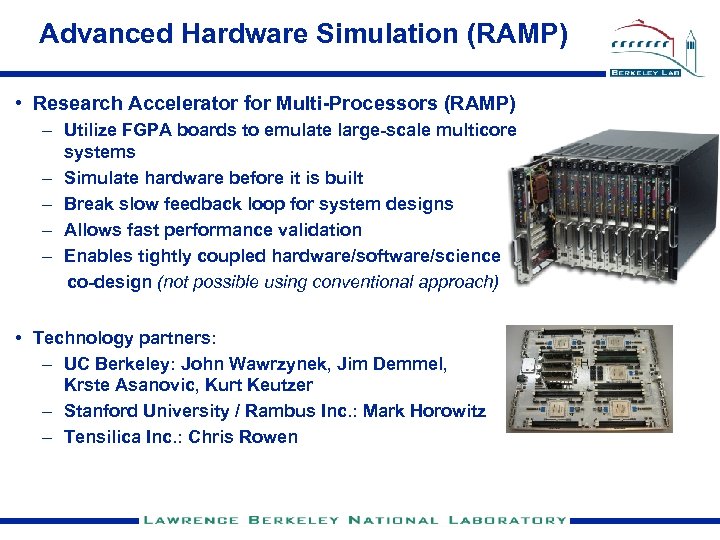 Advanced Hardware Simulation (RAMP) • Research Accelerator for Multi-Processors (RAMP) – Utilize FGPA boards to emulate large-scale multicore systems – Simulate hardware before it is built – Break slow feedback loop for system designs – Allows fast performance validation – Enables tightly coupled hardware/software/science co-design (not possible using conventional approach) • Technology partners: – UC Berkeley: John Wawrzynek, Jim Demmel, Krste Asanovic, Kurt Keutzer – Stanford University / Rambus Inc. : Mark Horowitz – Tensilica Inc. : Chris Rowen
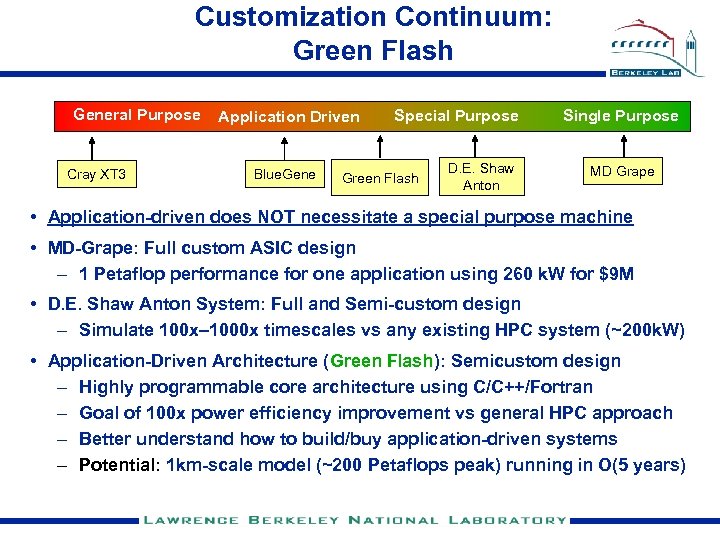 Customization Continuum: Green Flash General Purpose Cray XT 3 Application Driven Blue. Gene Special Purpose Green Flash D. E. Shaw Anton Single Purpose MD Grape • Application-driven does NOT necessitate a special purpose machine • MD-Grape: Full custom ASIC design – 1 Petaflop performance for one application using 260 k. W for $9 M • D. E. Shaw Anton System: Full and Semi-custom design – Simulate 100 x– 1000 x timescales vs any existing HPC system (~200 k. W) • Application-Driven Architecture (Green Flash): Semicustom design – Highly programmable core architecture using C/C++/Fortran – Goal of 100 x power efficiency improvement vs general HPC approach – Better understand how to build/buy application-driven systems – Potential: 1 km-scale model (~200 Petaflops peak) running in O(5 years)
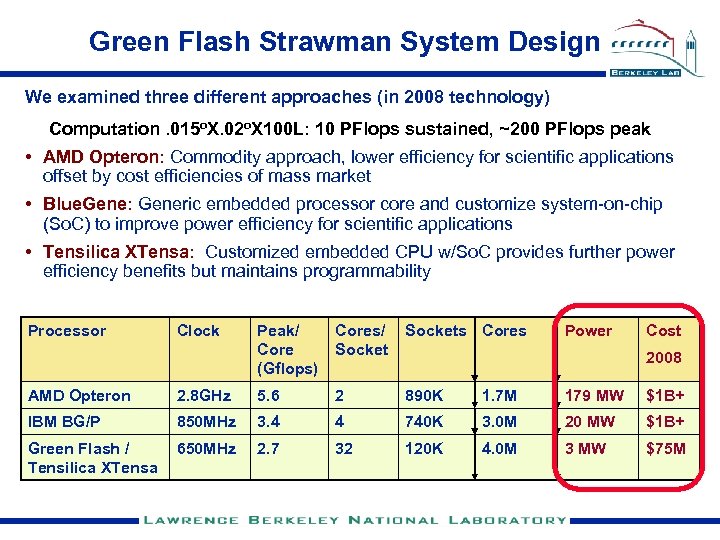 Green Flash Strawman System Design We examined three different approaches (in 2008 technology) Computation. 015 o. X. 02 o. X 100 L: 10 PFlops sustained, ~200 PFlops peak • AMD Opteron: Commodity approach, lower efficiency for scientific applications offset by cost efficiencies of mass market • Blue. Gene: Generic embedded processor core and customize system-on-chip (So. C) to improve power efficiency for scientific applications • Tensilica XTensa: Customized embedded CPU w/So. C provides further power efficiency benefits but maintains programmability Processor Clock Peak/ Core (Gflops) Cores/ Sockets Cores Power Cost 2008 AMD Opteron 2. 8 GHz 5. 6 2 890 K 1. 7 M 179 MW $1 B+ IBM BG/P 850 MHz 3. 4 4 740 K 3. 0 M 20 MW $1 B+ Green Flash / Tensilica XTensa 650 MHz 2. 7 32 120 K 4. 0 M 3 MW $75 M
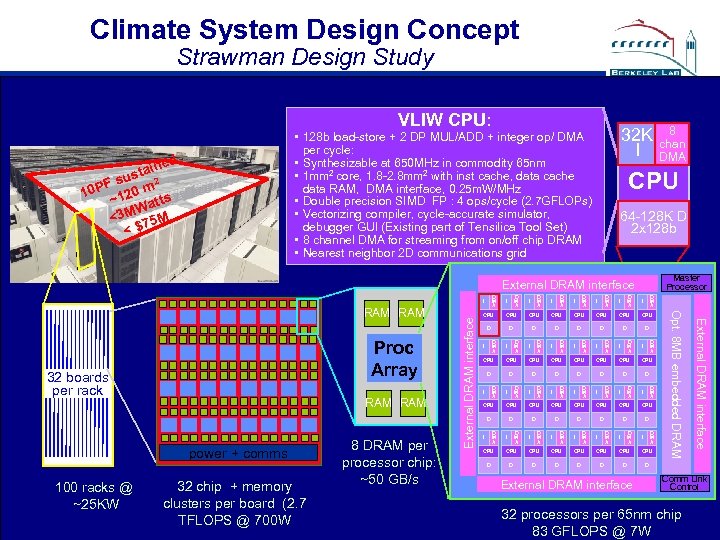 Climate System Design Concept Strawman Design Study VLIW CPU: 32 K I • 128 b load-store + 2 DP MUL/ADD + integer op/ DMA per cycle: • Synthesizable at 650 MHz in commodity 65 nm • 1 mm 2 core, 1. 8 -2. 8 mm 2 with inst cache, data cache data RAM, DMA interface, 0. 25 m. W/MHz • Double precision SIMD FP : 4 ops/cycle (2. 7 GFLOPs) • Vectorizing compiler, cycle-accurate simulator, debugger GUI (Existing part of Tensilica Tool Set) • 8 channel DMA for streaming from on/off chip DRAM • Nearest neighbor 2 D communications grid ned stai 2 su 0 PF 20 m 1 ~1 tts Wa <3 M 75 M <$ CPU 64 -128 K D 2 x 128 b Master Processor External DRAM interface D M A 32 boards per rack RAM power + comms 100 racks @ ~25 KW 32 chip + memory clusters per board (2. 7 TFLOPS @ 700 W 8 DRAM per processor chip: ~50 GB/s D M A I D M A I D M A I CPU CPU CPU CPU D D D D D M A I D M A I D M A I CPU CPU D D D D D M A I D M A I CPU CPU D D D D External DRAM interface Proc Array D M A I Opt. 8 MB embedded DRAM RAM External DRAM interface I 8 chan DMA D External DRAM interface Comm Link Control 32 processors per 65 nm chip 83 GFLOPS @ 7 W
 Portable Performance for Green Flash • Challenge: Our approach would produce multiple architectures, each different in the details – Labor-intensive user optimizations for each specific architecture – Different architectural solutions require vastly different optimizations – Non-obvious interactions between optimizations & HW yield best results • Our solution: Auto-tuning – Automate search across a complex optimization space – Achieve performance far beyond current compilers – Attain performance portability for diverse architectures
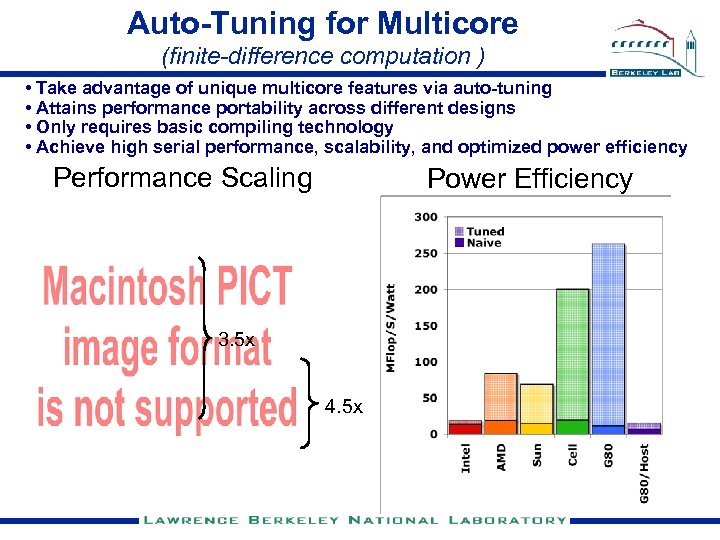 Auto-Tuning for Multicore (finite-difference computation ) • Take advantage of unique multicore features via auto-tuning • Attains performance portability across different designs • Only requires basic compiling technology • Achieve high serial performance, scalability, and optimized power efficiency Performance Scaling Power Efficiency 23. 3 x 2. 0 x 3. 5 x 4. 4 x 4. 5 x 1. 4 x 4. 6 x 2. 3 x
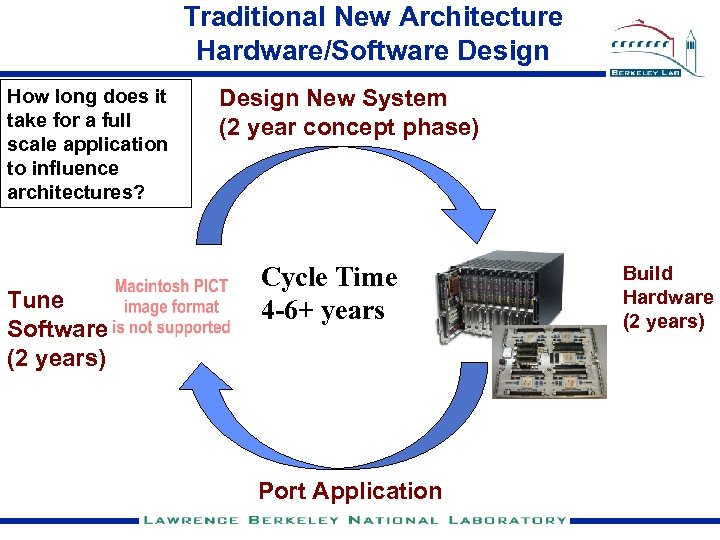 Traditional New Architecture Hardware/Software Design How long does it take for a full scale application to influence architectures? Tune Software (2 years) Design New System (2 year concept phase) Cycle Time 4 -6+ years Port Application Build Hardware (2 years)
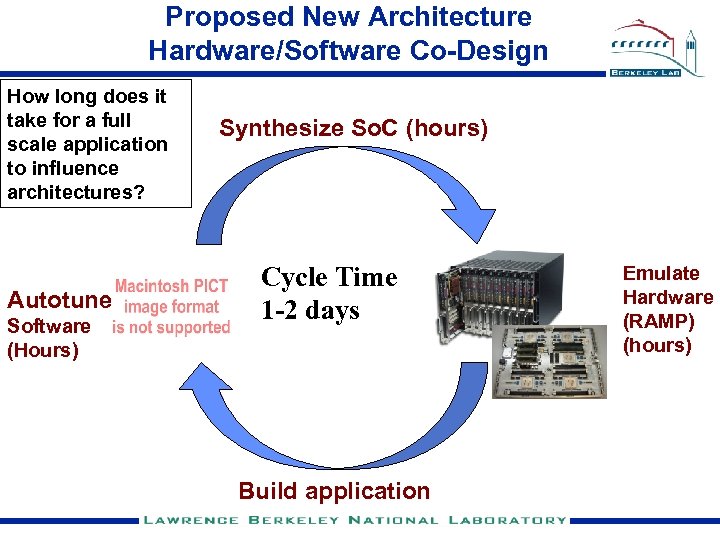 Proposed New Architecture Hardware/Software Co-Design How long does it take for a full scale application to influence architectures? Autotune Software (Hours) Synthesize So. C (hours) Cycle Time 1 -2 days Build application Emulate Hardware (RAMP) (hours)
 Summary • Exascale computing is vital to the DOE SC mission • We propose a new approach to high-end computing that enables transformational changes for science • Research effort: study feasibility and share insight w/ community • This effort will augment high-end general purpose HPC systems – Choose the science target first (climate in this case) – Design systems for applications (rather than the reverse) – Leverage power efficient embedded technology – Design hardware, software, scientific algorithms together using hardware emulation and auto-tuning – Achieve exascale computing sooner and more efficiently Applicable to broad range of exascale-class DOE applications