


 Скачать презентацию Ulrich Zwingli The Swiss Reformation Swiss
1044094f5abe3eb037356fbe68ee2af6.ppt
- Количество слайдов: 25
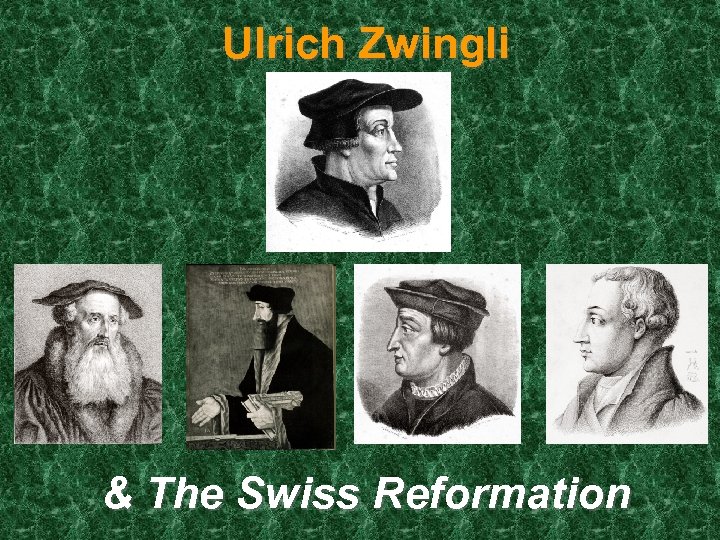 Ulrich Zwingli & The Swiss Reformation
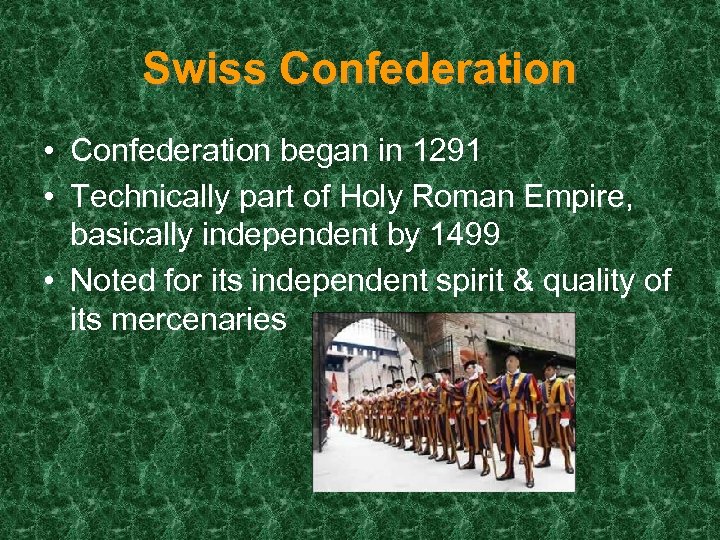 Swiss Confederation • Confederation began in 1291 • Technically part of Holy Roman Empire, basically independent by 1499 • Noted for its independent spirit & quality of its mercenaries
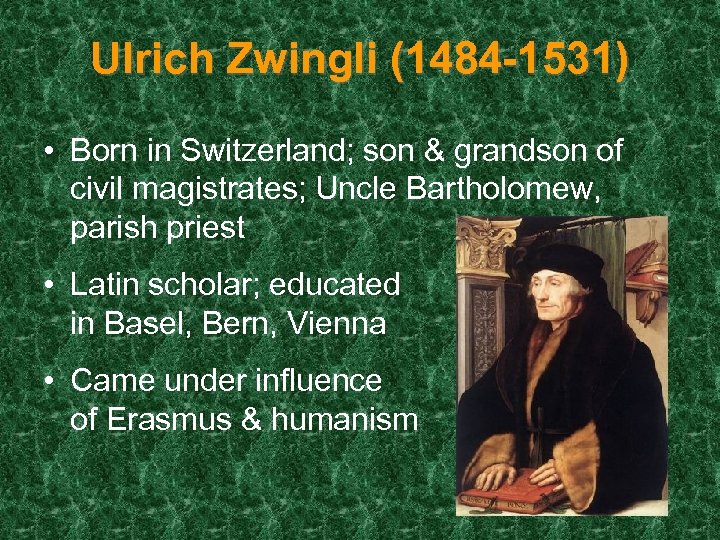 Ulrich Zwingli (1484 -1531) • Born in Switzerland; son & grandson of civil magistrates; Uncle Bartholomew, parish priest • Latin scholar; educated in Basel, Bern, Vienna • Came under influence of Erasmus & humanism
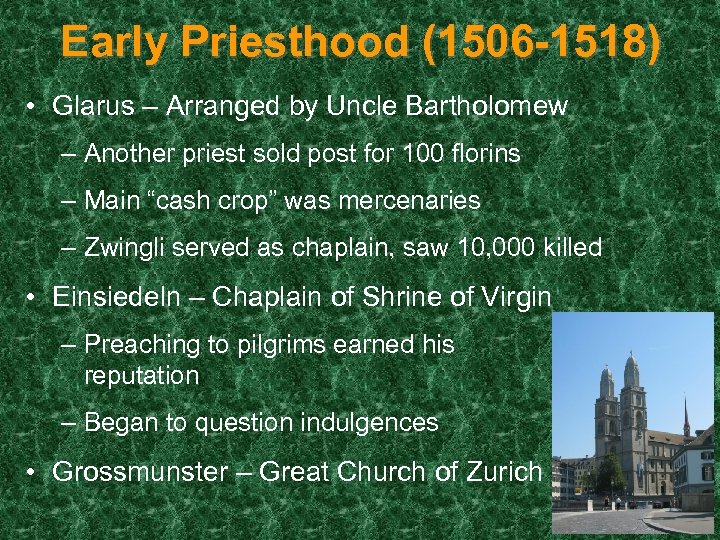 Early Priesthood (1506 -1518) • Glarus – Arranged by Uncle Bartholomew – Another priest sold post for 100 florins – Main “cash crop” was mercenaries – Zwingli served as chaplain, saw 10, 000 killed • Einsiedeln – Chaplain of Shrine of Virgin – Preaching to pilgrims earned his reputation – Began to question indulgences • Grossmunster – Great Church of Zurich
 Zurich & Early Reform • Zurich: key city of Switzerland & important religious center • Pastorate: preaching, mass, visiting sick • Preached through books of Bible instead of prescribed Scriptures • Spiritual crisis: plague, brother’s death, his own sickness after ministering to victims
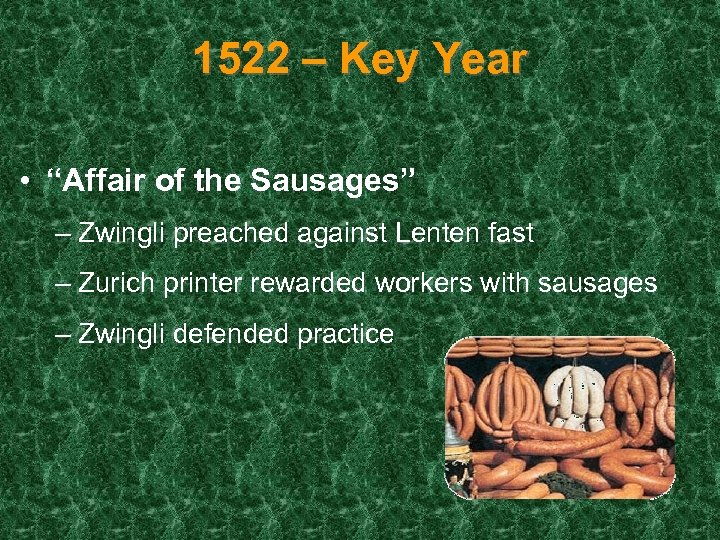 1522 – Key Year • “Affair of the Sausages” – Zwingli preached against Lenten fast – Zurich printer rewarded workers with sausages – Zwingli defended practice
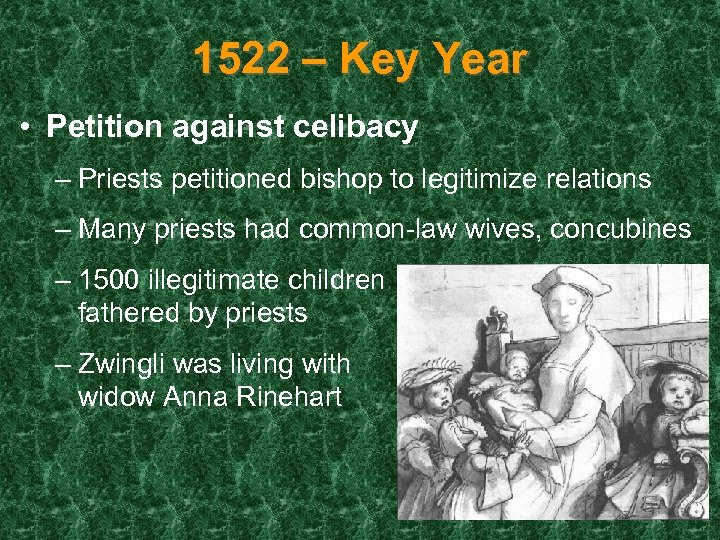 1522 – Key Year • Petition against celibacy – Priests petitioned bishop to legitimize relations – Many priests had common-law wives, concubines – 1500 illegitimate children fathered by priests – Zwingli was living with widow Anna Rinehart
 First Disputation – Jan. 1523 • Debate between Zwingli and Vicar General of Bishopric of Constance • Zwingli presented 67 Articles for church life • City Council supported Zwingli’s Reformation: – Affirmation of Scripture as basis of authority – Condemned corruption of Roman Catholic Church – Denounced: purgatory; papal office; priestly garments; priesthood; clerical celibacy; traditional mass (Lord’s Supper should be memorial) • Zwingli’s Reformation depended on Council
 Second Disputation – Oct. 1523 • Topics: Use of images; the mass; purgatory – Quick agreement to reject use of images – Purgatory was never discussed – Instead remainder of discussion was spent on replacing the mass with simple Lord’s Supper: magistrates delayed implementation; Zwingli’s followers insisted on immediate action; Zwingli sided with magistrates • No action was taken • Christmas Day, Zwingli did not conduct simple Lord’s Supper as planned • Many of his student-followers broke with Zwingli
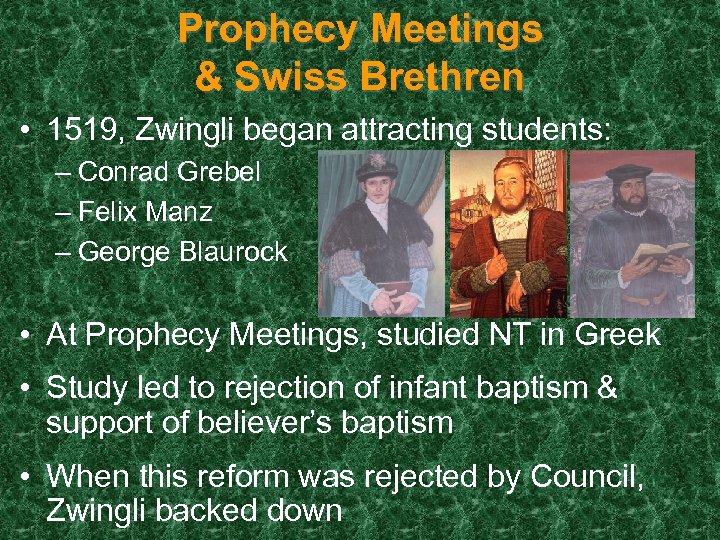 Prophecy Meetings & Swiss Brethren • 1519, Zwingli began attracting students: – Conrad Grebel – Felix Manz – George Blaurock • At Prophecy Meetings, studied NT in Greek • Study led to rejection of infant baptism & support of believer’s baptism • When this reform was rejected by Council, Zwingli backed down
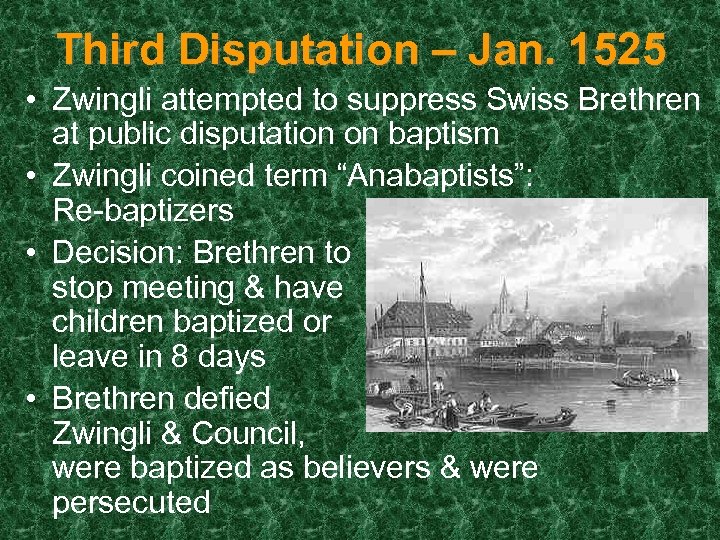 Third Disputation – Jan. 1525 • Zwingli attempted to suppress Swiss Brethren at public disputation on baptism • Zwingli coined term “Anabaptists”: Re-baptizers • Decision: Brethren to stop meeting & have children baptized or leave in 8 days • Brethren defied Zwingli & Council, were baptized as believers & were persecuted
 Zwingli on Church-State • State-church in Zurich: Reformation depended upon support from Council • Christian Civic Union: allied with other Swiss cantons to spread Reformation
 Zwingli on Baptism • Adhered to infant baptism • Nature of baptism – Infants are not guilty – Baptism not necessary for salvation – Infant was elect; in covenant community • Predestination – Fit his view of infant baptism, which was sign of covenant for those elected by God – Covenant concept of church • Used OT to show that baptism is NT parallel to circumcision
 Zwingli on Lord’s Supper • Easter 1525, Zwingli observed “evangelical” Lord’s Supper – Advocated symbolic view of Lord’s Supper – Taught that bread & cup were signs or symbols to be observed in remembrance & thanksgiving for Christ’s sacrifice – Holy Spirit uses these signs/symbols to testify that participants are joined in true & spiritual way to resurrected & ascended Christ; but Christ was not actually present in elements of Supper
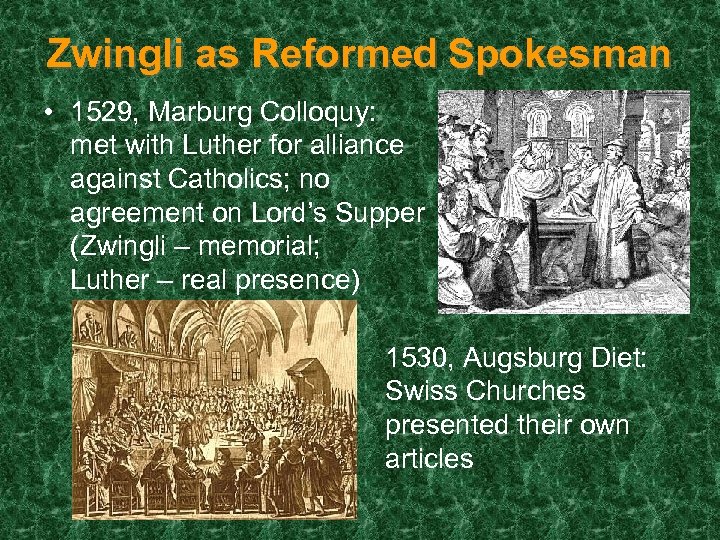 Zwingli as Reformed Spokesman • 1529, Marburg Colloquy: met with Luther for alliance against Catholics; no agreement on Lord’s Supper (Zwingli – memorial; Luther – real presence) 1530, Augsburg Diet: Swiss Churches presented their own articles
 Zwingli’s Contribution to Reformed Churches • Zwingli set out goal & early model • Creation of disciplined people of God governed by biblical principles required extensive reform of doctrine, worship, church government & entire society • Laws enforcing state church’s worship were based on precedent of Israel & OT laws on religion & civil matters • Infant baptism, like OT circumcision, included children in covenant community
 Zwingli’s Contribution to Reformed Churches • Biblical lessons became focus of worship • Worship attendance was mandatory • Music & organs, images removed from churches • Tight control on moral behavior; curfew • Religious uniformity strictly enforced; deviation considered treasonous; Anabaptist targeted especially
 Zwingli’s Writings (1525) • On Baptism, Anabaptism and Infant Baptism – Baptism is sign of covenant: infant baptism is NT expression of circumcision – OT is precedent for covenant community • Commentary on True and False Religion – Lord’s Supper is symbolic remembrance • On Human and Divine Justice – Union of Church & State
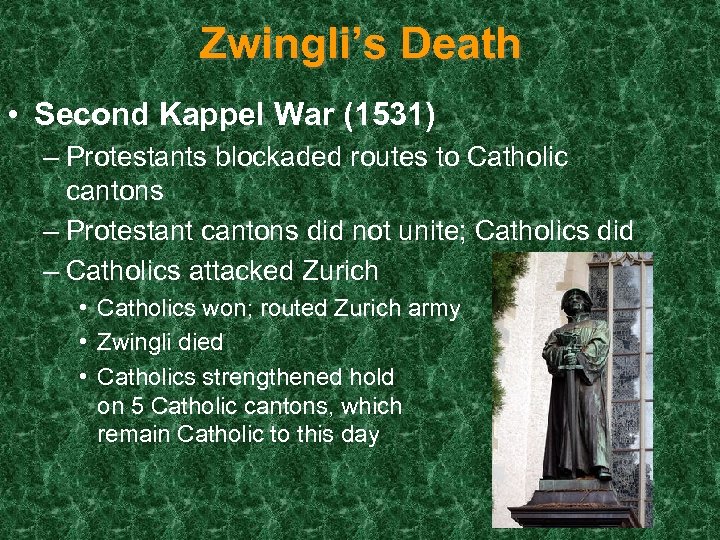 Zwingli’s Death • Second Kappel War (1531) – Protestants blockaded routes to Catholic cantons – Protestant cantons did not unite; Catholics did – Catholics attacked Zurich • Catholics won; routed Zurich army • Zwingli died • Catholics strengthened hold on 5 Catholic cantons, which remain Catholic to this day
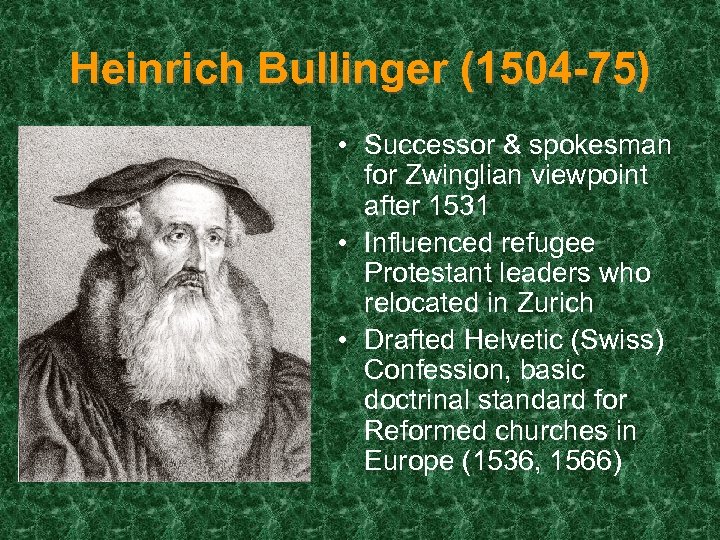 Heinrich Bullinger (1504 -75) • Successor & spokesman for Zwinglian viewpoint after 1531 • Influenced refugee Protestant leaders who relocated in Zurich • Drafted Helvetic (Swiss) Confession, basic doctrinal standard for Reformed churches in Europe (1536, 1566)
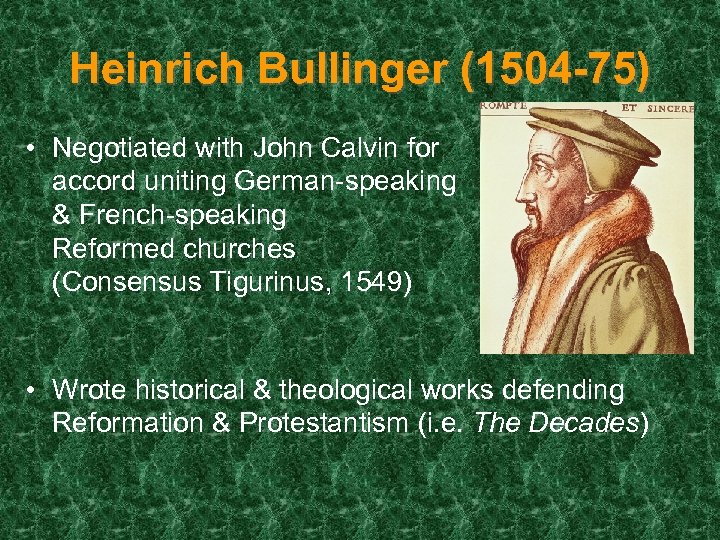 Heinrich Bullinger (1504 -75) • Negotiated with John Calvin for accord uniting German-speaking & French-speaking Reformed churches (Consensus Tigurinus, 1549) • Wrote historical & theological works defending Reformation & Protestantism (i. e. The Decades)
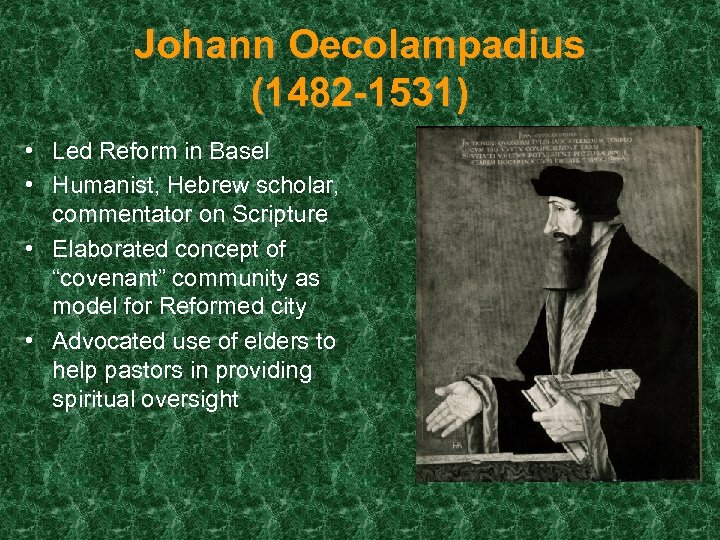 Johann Oecolampadius (1482 -1531) • Led Reform in Basel • Humanist, Hebrew scholar, commentator on Scripture • Elaborated concept of “covenant” community as model for Reformed city • Advocated use of elders to help pastors in providing spiritual oversight
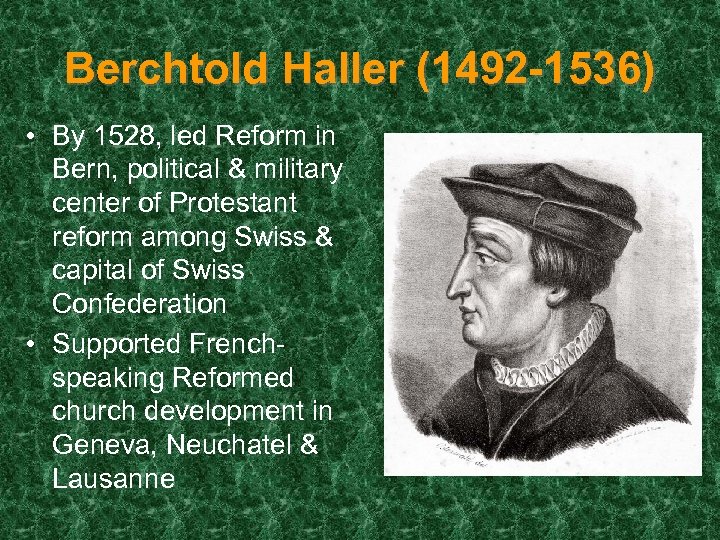 Berchtold Haller (1492 -1536) • By 1528, led Reform in Bern, political & military center of Protestant reform among Swiss & capital of Swiss Confederation • Supported Frenchspeaking Reformed church development in Geneva, Neuchatel & Lausanne
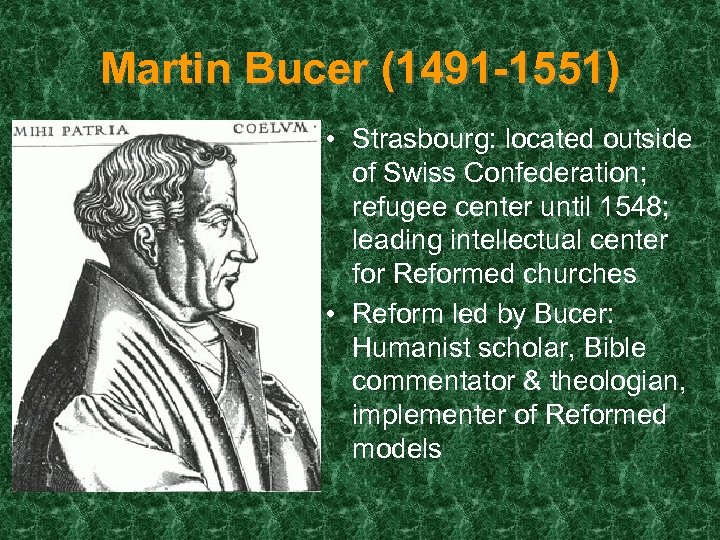 Martin Bucer (1491 -1551) • Strasbourg: located outside of Swiss Confederation; refugee center until 1548; leading intellectual center for Reformed churches • Reform led by Bucer: Humanist scholar, Bible commentator & theologian, implementer of Reformed models
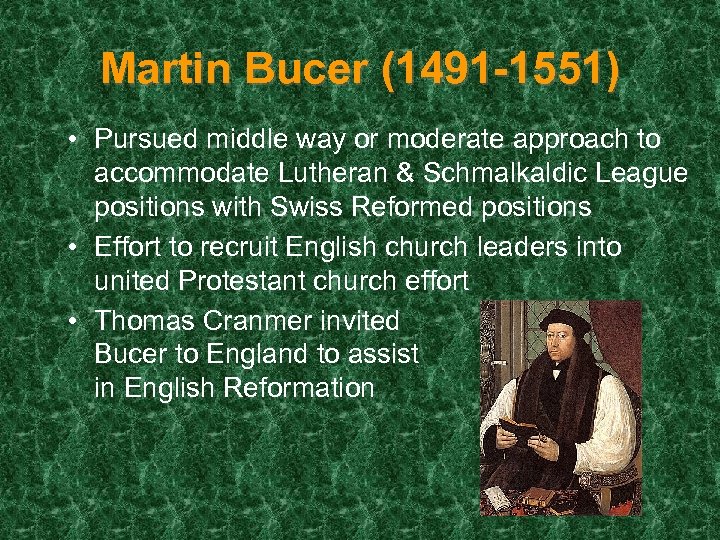 Martin Bucer (1491 -1551) • Pursued middle way or moderate approach to accommodate Lutheran & Schmalkaldic League positions with Swiss Reformed positions • Effort to recruit English church leaders into united Protestant church effort • Thomas Cranmer invited Bucer to England to assist in English Reformation