 Скачать презентацию UK Renewable Energy Policy Ted Hayden Strategy
eacf647620fc983b65e6636ab7354e52.ppt
- Количество слайдов: 21



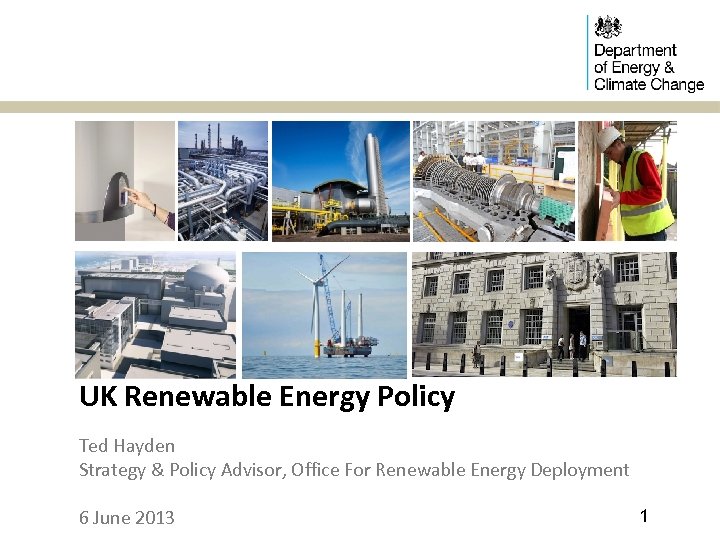
UK Renewable Energy Policy Ted Hayden Strategy & Policy Advisor, Office For Renewable Energy Deployment 6 June 2013 1
Agenda • • Department of Energy & Climate Change Our carbon and renewables targets UK Renewable Energy Policy Office for Renewable Energy Deployment (ORED) Priority activities Support measures Progress & Benefits Emerging issues and opportunities
DECC Responsibilities The Department of Energy & Climate Change (DECC) works to make sure the UK has secure, clean, affordable energy supplies and promote international action to mitigate climate change. • • Energy security Action on climate change Renewable energy Affordability Protect the most vulnerable and fuel poor households Ensure competitiveness for energy intensive industries Supporting growth
The legal framework Ambitious binding targets • The Climate Change Act set a target to reduce emissions by at least 80% by 2050 relative to 1990 levels and by at least 34% by 2020 • The EU Renewable Energy Directive requires the UK to meet 15% of energy demand from renewable sources by 2020 (from 3. 8% in 2011) Accountability • Publish policies and proposals on how we will meet our carbon budgets and report annually on progress • Set up the independent Committee on Climate Change (CCC) 4
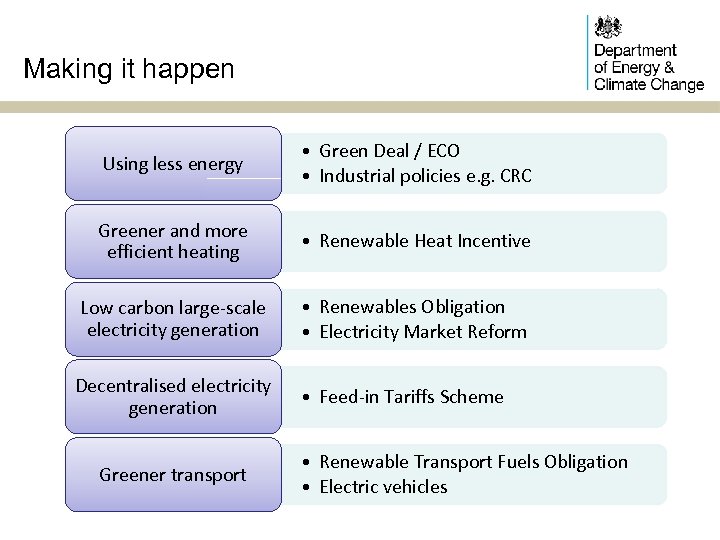
Making it happen Using less energy • Green Deal / ECO • Industrial policies e. g. CRC Greener and more efficient heating • Renewable Heat Incentive Low carbon large-scale electricity generation • Renewables Obligation • Electricity Market Reform Decentralised electricity generation • Feed-in Tariffs Scheme Greener transport • Renewable Transport Fuels Obligation • Electric vehicles
UK Renewable Energy • The UK has some of the best wind, wave and tidal resources in Europe. • All major renewable energy technologies are supported and are seen as a key component of the future low-carbon mix. The Public are Supportive • 8 in 10 people support the use of renewable energy to generate electricity • Solar power had the highest backing (82%), followed by offshore wind (72%) and wave and tidal (71%). Onshore wind was opposed by 13% of respondents.
Office for Renewable Energy Deployment (ORED) • Renewable Energy Targets • In 2009 The Government published its Renewable Energy Strategy and set up the Office for Renewable Energy Deployment (ORED) to drive forward renewable energy in the UK. • ORED addresses deployment issues by working alongside central Government Departments, local and regional authorities, stakeholders and other NGOs. • Every year the government publishes the UK Renewable Energy Roadmap.
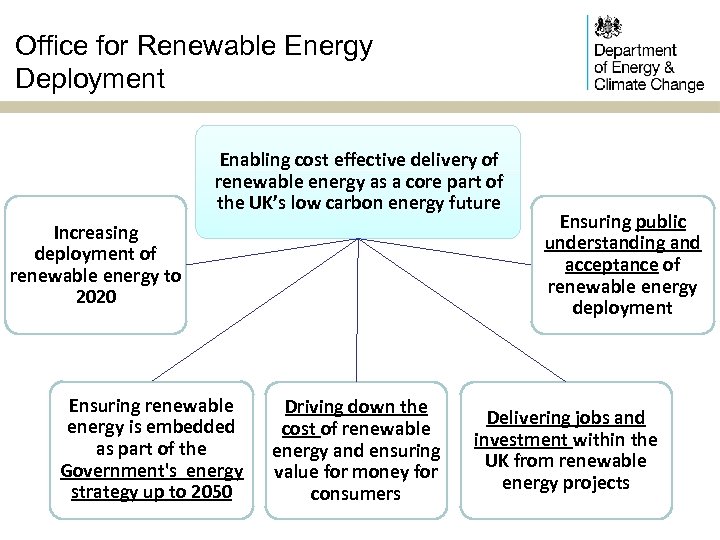
Office for Renewable Energy Deployment Enabling cost effective delivery of renewable energy as a core part of the UK’s low carbon energy future Increasing deployment of renewable energy to 2020 Ensuring renewable energy is embedded as part of the Government's energy strategy up to 2050 Driving down the cost of renewable energy and ensuring value for money for consumers Ensuring public understanding and acceptance of renewable energy deployment Delivering jobs and investment within the UK from renewable energy projects
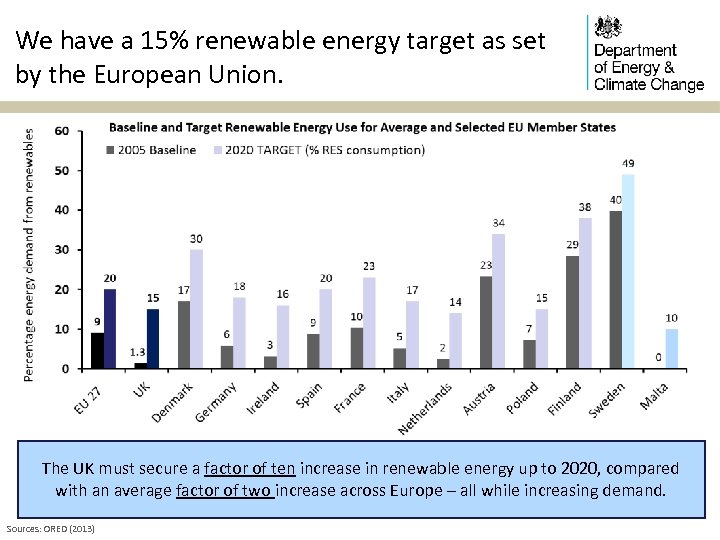
We have a 15% renewable energy target as set by the European Union. The UK must secure a factor of ten increase in renewable energy up to 2020, compared with an average factor of two increase across Europe – all while increasing demand. Sources: ORED (2013)
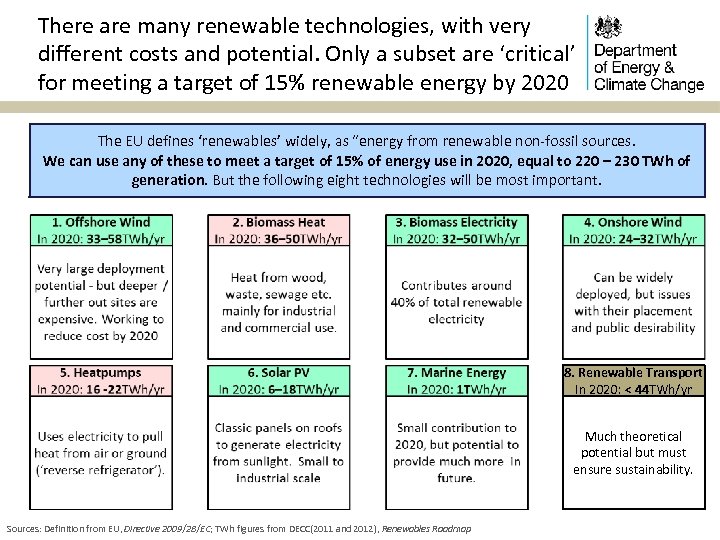
There are many renewable technologies, with very different costs and potential. Only a subset are ‘critical’ for meeting a target of 15% renewable energy by 2020 The EU defines ‘renewables’ widely, as “energy from renewable non-fossil sources. We can use any of these to meet a target of 15% of energy use in 2020, equal to 220 – 230 TWh of generation. But the following eight technologies will be most important. 8. Renewable Transport In 2020: < 44 TWh/yr Much theoretical potential but must ensure sustainability. Sources: Definition from EU, Directive 2009/28/EC; TWh figures from DECC(2011 and 2012), Renewables Roadmap
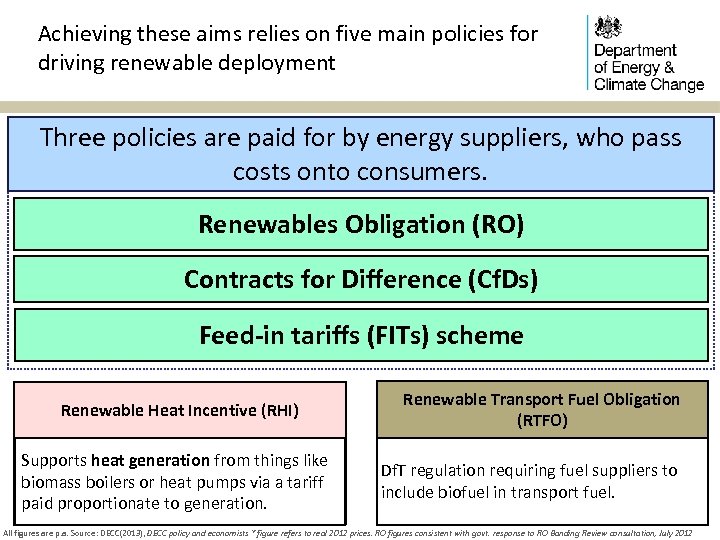
Achieving these aims relies on five main policies for driving renewable deployment Three policies are paid for by energy suppliers, who pass costs onto consumers. Renewables Obligation (RO) Contracts for Difference (Cf. Ds) Feed-in tariffs (FITs) scheme Renewable Heat Incentive (RHI) Supports heat generation from things like biomass boilers or heat pumps via a tariff paid proportionate to generation. Renewable Transport Fuel Obligation (RTFO) Df. T regulation requiring fuel suppliers to include biofuel in transport fuel. All figures are p. a. Source: DECC(2013), DECC policy and economists * figure refers to real 2012 prices. RO figures consistent with govt. response to RO Banding Review consultation, July 2012
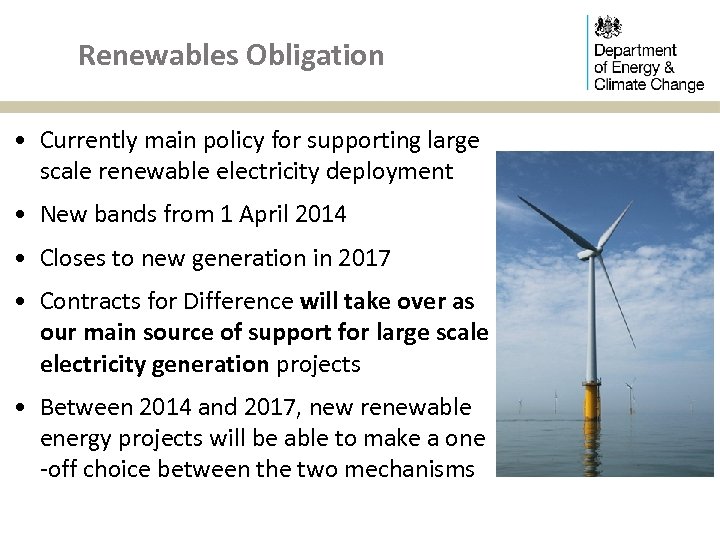
Renewables Obligation • Currently main policy for supporting large scale renewable electricity deployment • New bands from 1 April 2014 • Closes to new generation in 2017 • Contracts for Difference will take over as our main source of support for large scale electricity generation projects • Between 2014 and 2017, new renewable energy projects will be able to make a one -off choice between the two mechanisms
Feed-in tariffs • Over 400, 000 installations by January 2013 • Comprehensive review completed during 2012 • Greater certainty for industry and generators and reduced impact on consumer bills • Over 400, 000 PV tariff reductions maximum quarterly, depending on take-up • Details on www. ofgem. gov. uk
Electricity Market Reform Contract for Difference (Cf. D) Capacity Market Carbon Price Floor Early Delivery • Greater visibility, long term stable cashflows, indexed to inflation • For renewables, 15 year fixed revenue contracts paid for energy produced • CCS and nuclear projects also eligible • New long-term contracts for capacity, minded to let first contracts from 2014 • Gas generation eligible • Long-term certainty of the cost of carbon in the UK • Starts April 2013 • Not just for new nuclear • Transitional Cf. Ds for some renewable and CCS projects • For projects seeking to achieve financial close or make major supply chain commitments this year
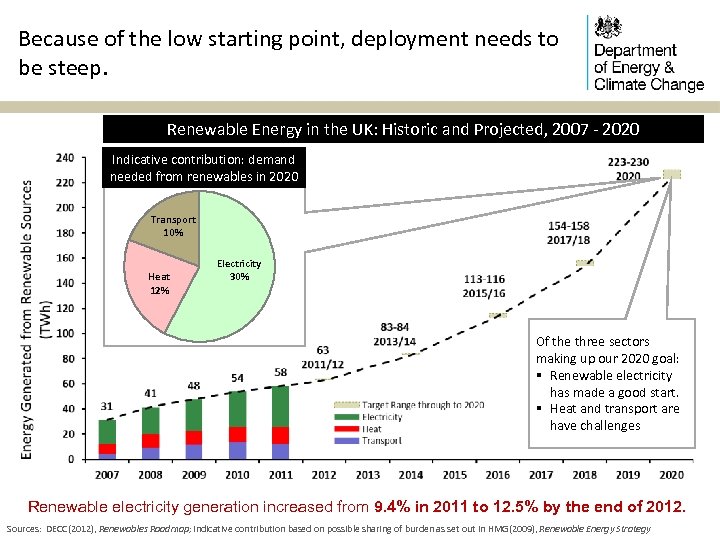
Because of the low starting point, deployment needs to be steep. Renewable Energy in the UK: Historic and Projected, 2007 - 2020 Indicative contribution: demand needed from renewables in 2020 Transport 10% Heat 12% Electricity 30% Of the three sectors making up our 2020 goal: § Renewable electricity has made a good start. § Heat and transport are have challenges Renewable electricity generation increased from 9. 4% in 2011 to 12. 5% by the end of 2012. Sources: DECC(2012), Renewables Roadmap; indicative contribution based on possible sharing of burden as set out in HMG(2009), Renewable Energy Strategy
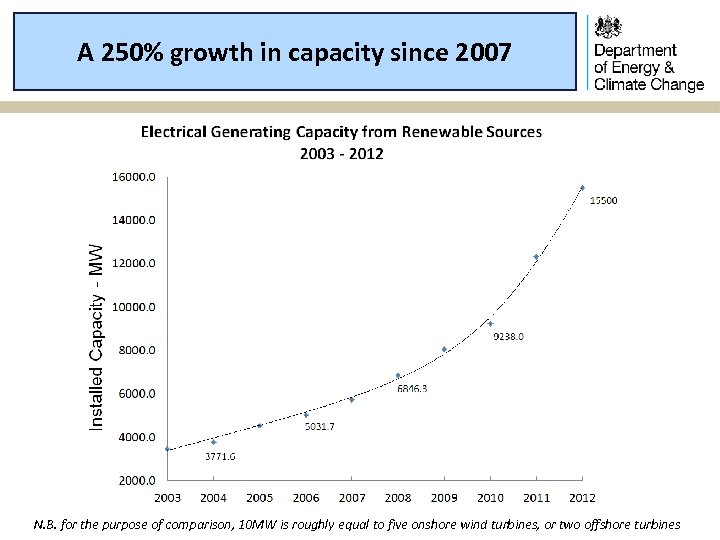
A 250% growth in capacity since 2007 N. B. for the purpose of comparison, 10 MW is roughly equal to five onshore wind turbines, or two offshore turbines
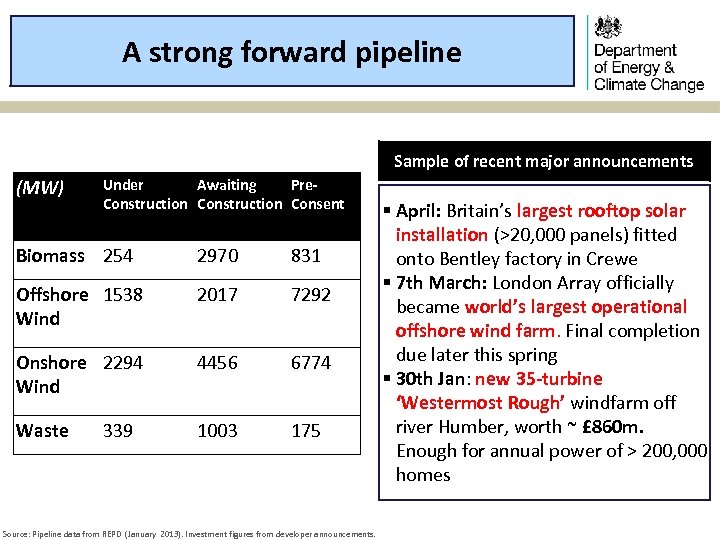
A strong forward pipeline Sample of recent major announcements (MW) Under Awaiting Pre. Construction Consent Biomass 254 2970 831 Offshore 1538 Wind 2017 7292 Onshore 2294 Wind 4456 6774 Waste 1003 175 339 Source: Pipeline data from REPD (January 2013). Investment figures from developer announcements. § April: Britain’s largest rooftop solar installation (>20, 000 panels) fitted onto Bentley factory in Crewe § 7 th March: London Array officially became world’s largest operational offshore wind farm. Final completion due later this spring § 30 th Jan: new 35 -turbine ‘Westermost Rough’ windfarm off river Humber, worth ~ £ 860 m. Enough for annual power of > 200, 000 homes
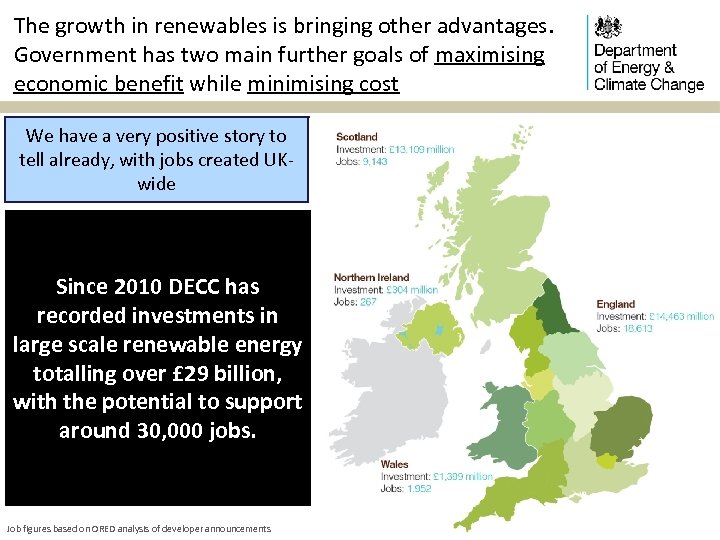
The growth in renewables is bringing other advantages. Government has two main further goals of maximising economic benefit while minimising cost We have a very positive story to tell already, with jobs created UKwide Since 2010 DECC has recorded investments in large scale renewable energy totalling over £ 29 billion, with the potential to support around 30, 000 jobs. Job figures based on ORED analysis of developer announcements
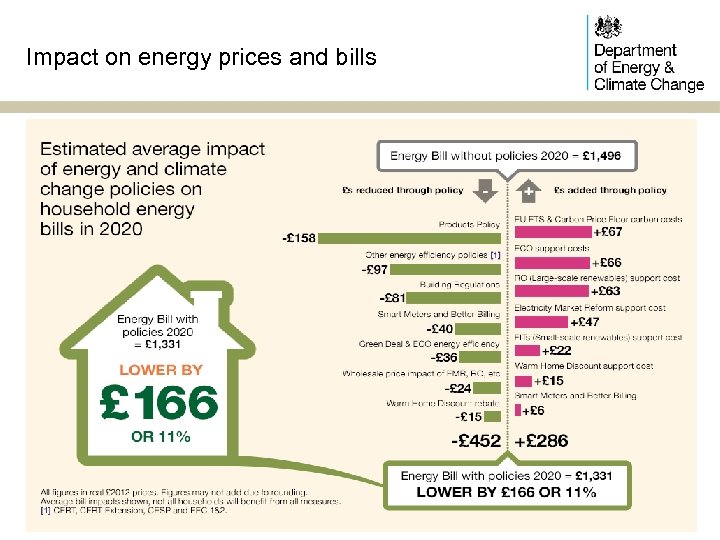
Impact on energy prices and bills 19
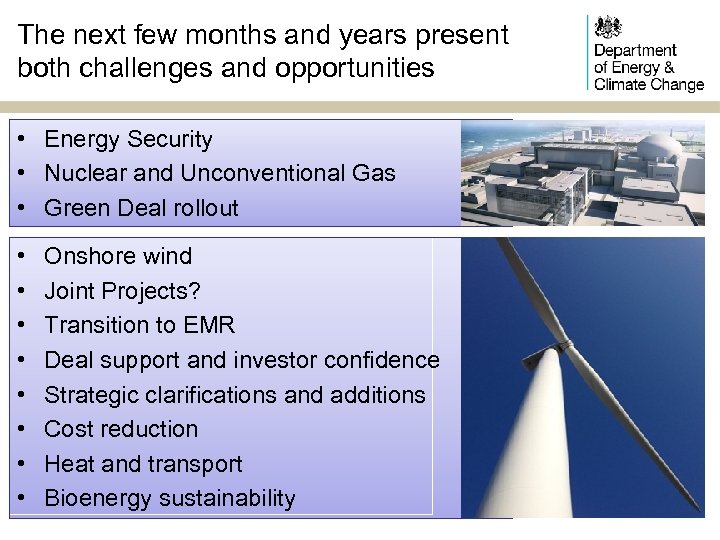
The next few months and years present both challenges and opportunities • Energy Security • Nuclear and Unconventional Gas • Green Deal rollout • • Onshore wind Joint Projects? Transition to EMR Deal support and investor confidence Strategic clarifications and additions Cost reduction Heat and transport Bioenergy sustainability
Website: https: //www. gov. uk/government/organisations/department-of-energy-climate-change Contact: ted. hayden@decc. gsi. gov. uk Follow: @deccgovuk www. youtube. com/deccgovuk Department for Energy and Climate Change 6 June 2013
Скачать презентацию UK Renewable Energy Policy Ted Hayden Strategy
eacf647620fc983b65e6636ab7354e52.ppt