 Скачать презентацию UK Parliament s ICT Strategy Rob Sanders Customer Services
07c630be8162d957561d1368f191f2e1.ppt
- Количество слайдов: 32



UK Parliament’s ICT Strategy Rob Sanders Customer Services Manager
The Vision “Connect Members, the public and the administration to the information and services they need from anywhere at any time [from any device]. Reduce the cost of ICT and provide new opportunities and pathways for greater efficiency and effectiveness for Parliament. ”
The Drivers Why are we doing this? • External drivers • Responding to demand
The outcomes ØAn enhanced customer experience - leading to increased effectiveness for Members and the administration through better use of ICT. ØImproved access to services - it is easier for Members, the public and the administration to connect to ICT services, helping them to be more informed. ØReduced ICT costs and increased opportunity for Parliament to be more efficient as generic commercial solutions are used in generic areas, and bespoke solutions used only for Parliament’s unique activities. Ø A transformed PICT – a reorganised, smaller, ICT department, helping Members and the administration get the most out of ICT.
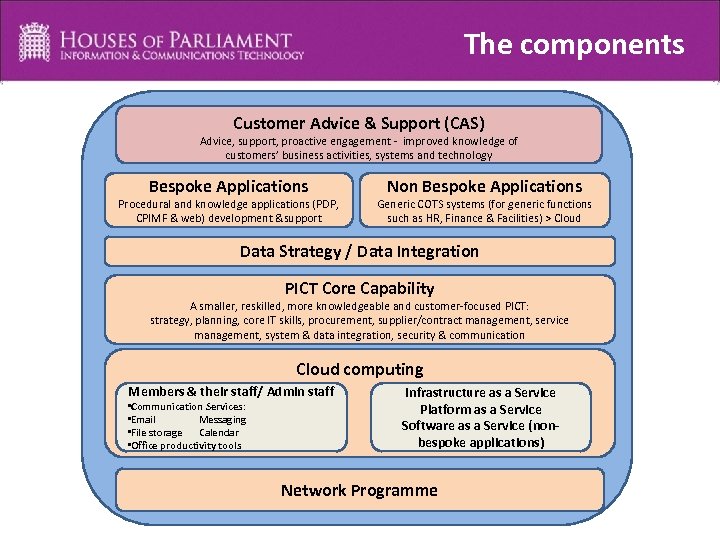
The components Customer Advice & Support (CAS) Advice, support, proactive engagement - improved knowledge of customers’ business activities, systems and technology Bespoke Applications Procedural and knowledge applications (PDP, CPIMF & web) development &support Non Bespoke Applications Generic COTS systems (for generic functions such as HR, Finance & Facilities) > Cloud Data Strategy / Data Integration PICT Core Capability A smaller, reskilled, more knowledgeable and customer-focused PICT: strategy, planning, core IT skills, procurement, supplier/contract management, service management, system & data integration, security & communication Cloud computing Members & their staff/ Admin staff • Communication Services: • Email Messaging • File storage Calendar • Office productivity tools Infrastructure as a Service Platform as a Service Software as a Service (nonbespoke applications) Network Programme
BYOD • We already use Mobile Device Manager (MDM) for i. Pads for Members • We support access to parliamentary email on personal devices • But how far can we go with BYOD • What does it really mean?
UK Parliament’s Data Strategy Margaret Hardie Principal Architect (Data and Applications)
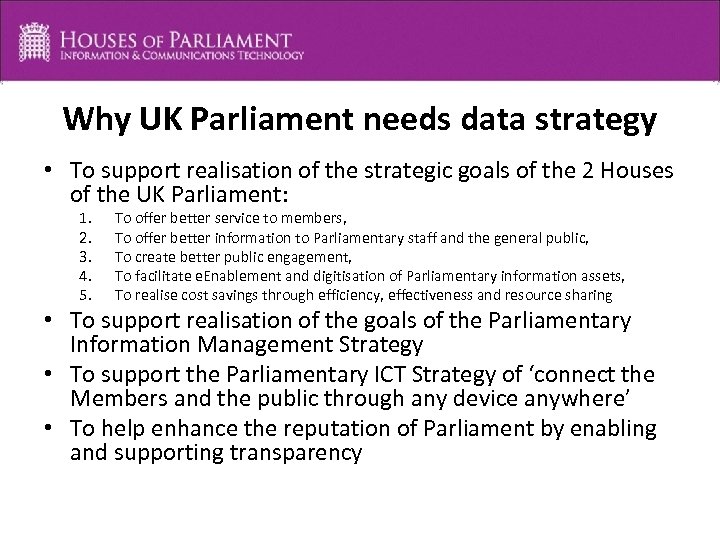
Why UK Parliament needs data strategy • To support realisation of the strategic goals of the 2 Houses of the UK Parliament: 1. 2. 3. 4. 5. To offer better service to members, To offer better information to Parliamentary staff and the general public, To create better public engagement, To facilitate e. Enablement and digitisation of Parliamentary information assets, To realise cost savings through efficiency, effectiveness and resource sharing • To support realisation of the goals of the Parliamentary Information Management Strategy • To support the Parliamentary ICT Strategy of ‘connect the Members and the public through any device anywhere’ • To help enhance the reputation of Parliament by enabling and supporting transparency
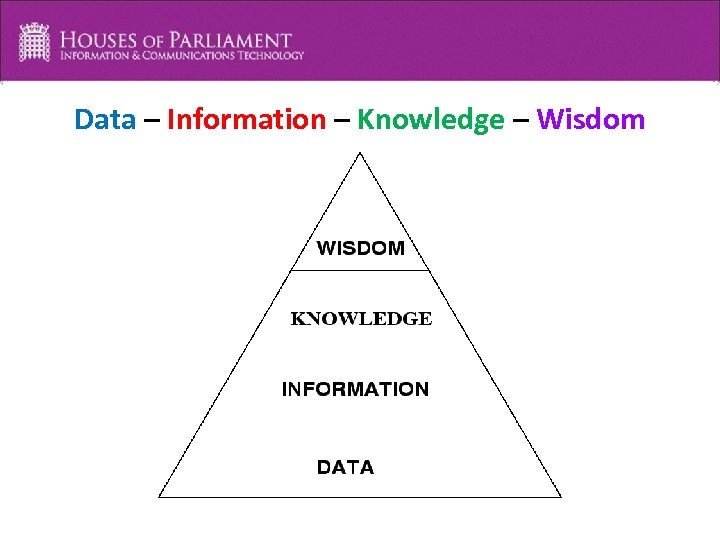
Data – Information – Knowledge – Wisdom
Data Strategy Vision in UK Parliament • The work of UK Parliament relies heavily on information and knowledge for all its operations • Therefore effective information management is vital to the success of all UK parliamentary activity • Information is created when right data are meaningfully organised • Therefore effective data management underpins and enables the effective information management • UK Parliament recognises the key role data plays in enabling its information management and in creation of knowledge it relies on • Therefore UK Parliament regards and manages its data as a strategic asset
Data Strategy Vision in UK Parliament (2) • UK Parliament designs and plans its data architecture to promote agility, re-use and value creation for the benefit of its entire community • UK Parliament works to free its data from the line of business silos and is committed to making it available for use and re-use to its whole community and the general public • UK Parliament is building a powerful data delivery framework which will provide the members, administration and public with quick, effective and secure access to its data
Data Strategy Vision in UK Parliament (3) • UK Parliament is committed to promoting a culture of data transparency, information sharing and re-use internally and externally • UK Parliament designs and manage its data at the enterprise level to maximise benefit to all members of its community and the general public • UK Parliament is in the process of developing a set of Data Principles which will inform its policies and standards of data architecture and management • The Data Principles address the areas of Architectural, Governance and Compliance aspects of its data • UK Parliament is building organisational and technical support structures to assist members of its community in fulfilment of their responsibilities with regard to data
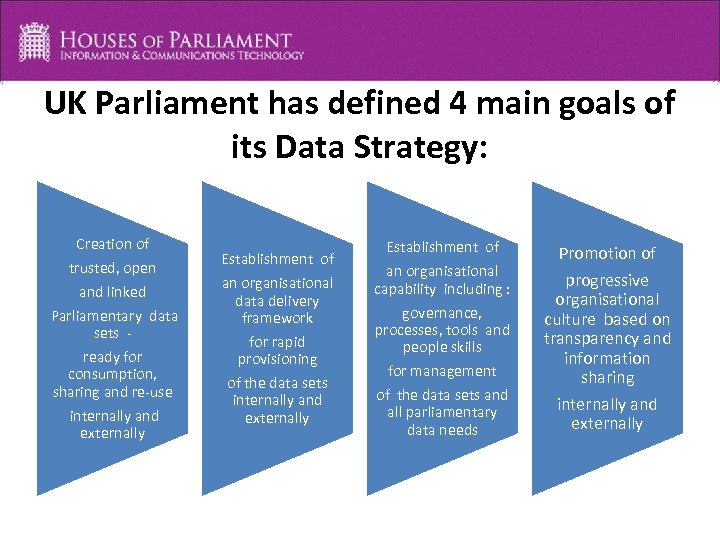
UK Parliament has defined 4 main goals of its Data Strategy: Creation of trusted, open and linked Parliamentary data sets ready for consumption, sharing and re-use internally and externally Establishment of an organisational data delivery framework for rapid provisioning of the data sets internally and externally Establishment of an organisational capability including : governance, processes, tools and people skills for management of the data sets and all parliamentary data needs Promotion of progressive organisational culture based on transparency and information sharing internally and externally
UK Parliament Data Principles Architectural: • Data is a strategic organisational asset and should be managed accordingly. • Data should be developed within the agreed architectural parameters to align it with the goals of Parliament. • Data should be managed at the enterprise level to maximise benefit to the Parliament as a whole. • Data should be easily accessible to all who need it, subject to appropriate security.
UK Parliament Data Principles Architectural (cont): • Data should be shared internally and externally as appropriate. • Data should be re-used to achieve consistency and single version of the truth. • Data should not be duplicated operationally. Where relevant existing data should be referenced. • Data should be well described, have common definitions and standards. • Data security should be considered in the context of business risk and benefit.
UK Parliament Data Principles Governance: • Parliamentary data belongs to the whole organisation, not just to the line of business unit where it is maintained. • Data should be actively governed and have nominated owners responsible for it. • Data quality should be actively managed according to clearly defined measures related to business objectives. Compliance: • All Parliamentary data management activities must comply with all relevant laws and regulations. • Everyone in Parliament has the responsibility to protect parliamentary data and to ensure its security in their daily work.
Some activities and projects on the UK Parliament’s Data Strategy Roadmap • Definition of Parliamentary Data Architecture: – Data Principles, Policies and Standards – Mapping of the Parliamentary data landscape – Realisation of the Parliamentary Data Architecture blueprint, comprising: integration platform, governance and quality management, provision of data products through agile application development (apps, mash-ups ) • Creation of Data. parliament – an internal and external data sharing platform • Creation of the People Directory – the first re-usable ‘corporate’ data set – as the first step to establishment of the Parliamentary Master Data Management
Some activities and projects on the UK Parliament’s Data Strategy Roadmap • Meta data management for a re-engineered Parliamentary Audio Visual delivery framework parliament. tv • Data integration - engineering of the data delivery platform (message oriented middleware based integration tool – Biz. Talk) • Data governance and data quality management • Data sovereignty and security • Data classification and assurance in Cloud readiness work streams
Current Awareness Tool: case study in social bookmarking Tim Youngs Business Relationship Manager for Information and Online Services
Enabling Knowledge Sharing The problem: Give Members of Parliament easy access to a range of material, but without compounding a sense of information overload
What was already in place • Formal subject indexing/tagging of official parliamentary material • Users can carry out focused searches of parliamentary material and research briefings • New Parliamentary Search tool, based on Open Source technology, has been well received • But, there was a gap. . .
What was missing • Members miss out on useful contextual information about what is being debated • Lot of knowledge spread about Parliament • But locked up in people’s heads, on their internet favourites, in hard copy folders • Members have to know who to speak to • Lot of manual processes for creating, managing and accessing that material
The solution • New Current Awareness tool developed, went live in October 2012 • Provides the staff in the Library and Research Service with a tool for tagging items of significance • In effect, a corporate “social bookmarking” tool • Works with web-based and desktop RSS Readers (e. g. Google Reader, Feed Demon)
What it covers • Research staff identify useful material when – browsing the web – reading RSS feeds from sources – reading hard copy publications – compiling briefing papers for Members • Anything can be included: – Press or Journal articles – Web pages – References to hard copy only material
What is involved • Click ‘add to Current Awareness’ - tool takes key metadata (title, date, description, source) and auto completes fields where possible • User checks it, adds subject tags and saves it to the database • Users across Parliament can create their own bespoke RSS feeds, to follow a particular specialist or track a specific subject • Material also available through our Parliamentary Search tool
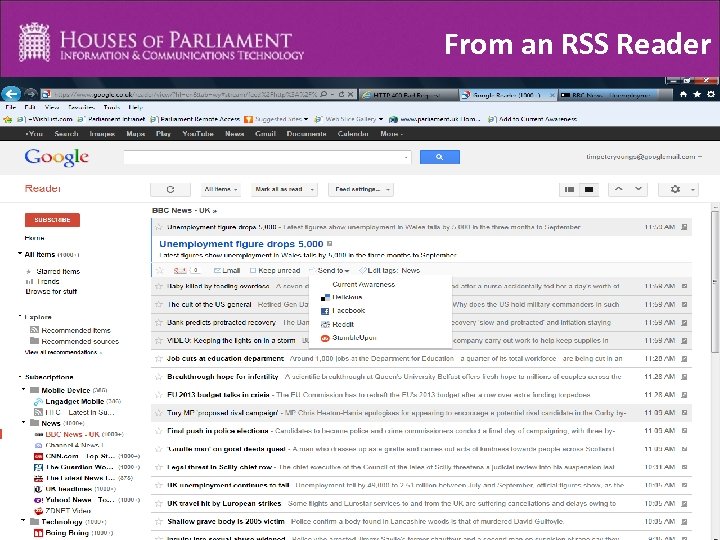
From an RSS Reader
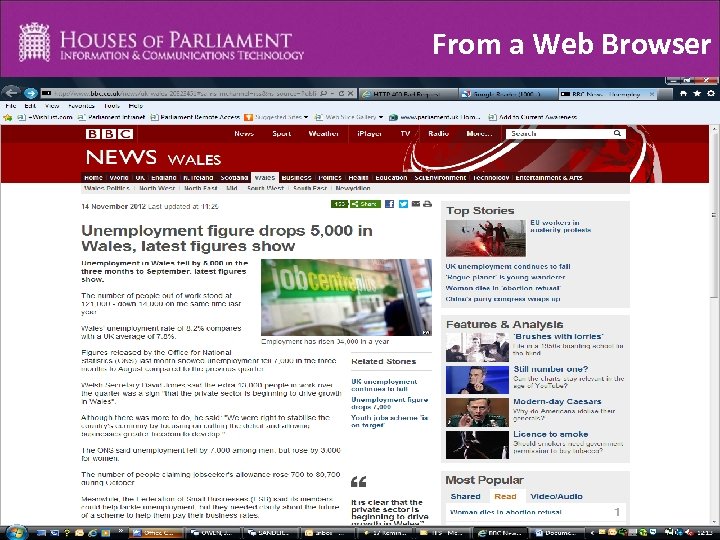
From a Web Browser
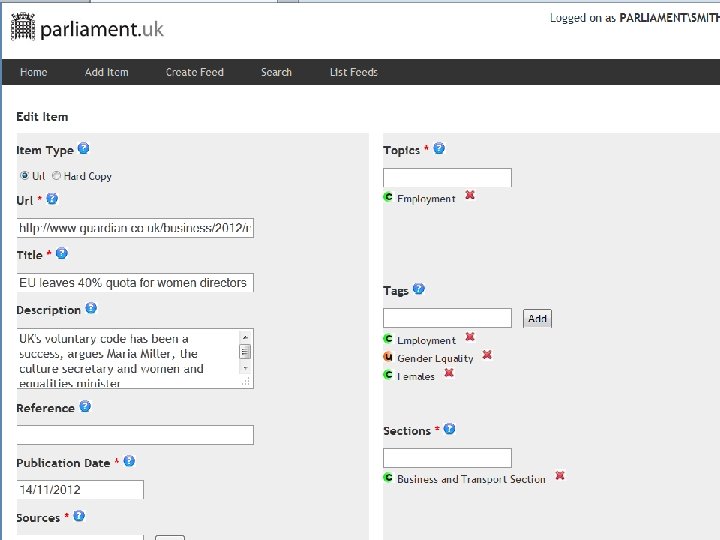
Adding an item
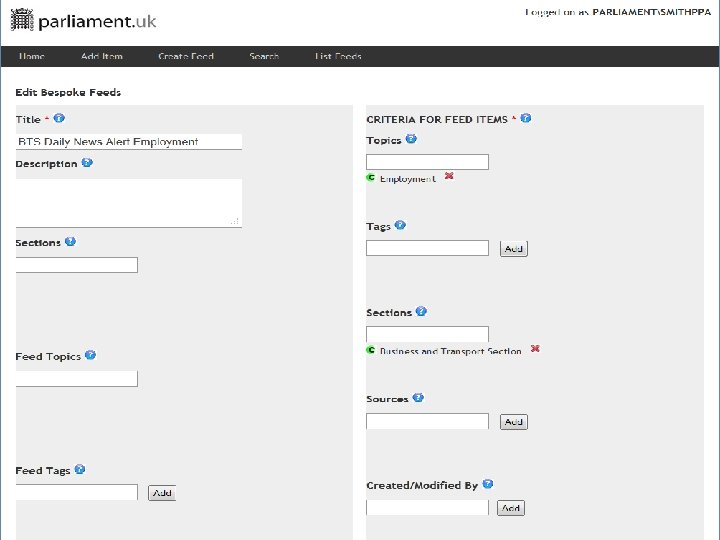
Creating bespoke RSS feeds
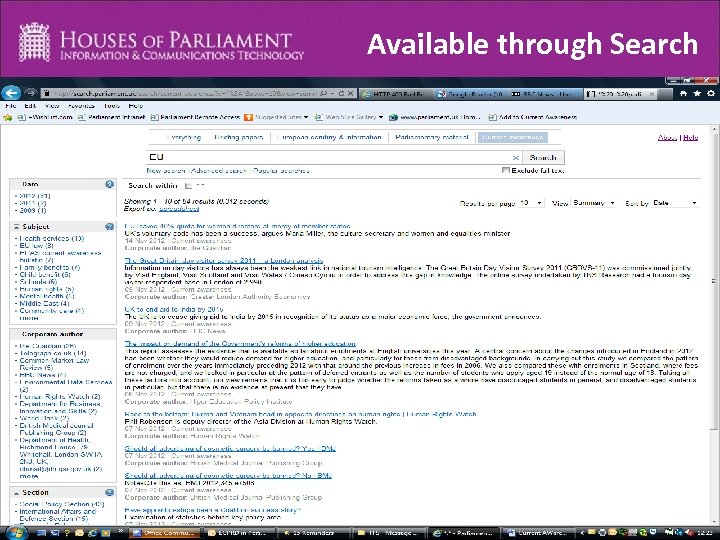
Available through Search
How to ensure success Key factors for success: • Needs buy in of a wide range of users • Has to be as quick as adding it to your Internet Favourites • Has to serve users’ self-interest first, make their lives easier • Adopting a soft launch, let word spread • Over time, the hope is it will provide a rich corporate knowledge base for Parliament
What next? • Prove the concept and let usage grow • Bring in Committee staff and others outside the Library • If successful, use it to drive improvements to other services: – Topic Pages on the Intranet and Website – Bespoke alerting services that Members can control – Personalised aggregation pages
Скачать презентацию UK Parliament s ICT Strategy Rob Sanders Customer Services
07c630be8162d957561d1368f191f2e1.ppt