


 Скачать презентацию UK Opportunities in Si D Calorimetry Paul Dauncey
eefde04743e26025bcf81262bf8c2bc9.ppt
- Количество слайдов: 23
 UK Opportunities in Si. D Calorimetry Paul Dauncey Imperial College London 7 Sept 2007 Paul Dauncey - Calorimetry 1
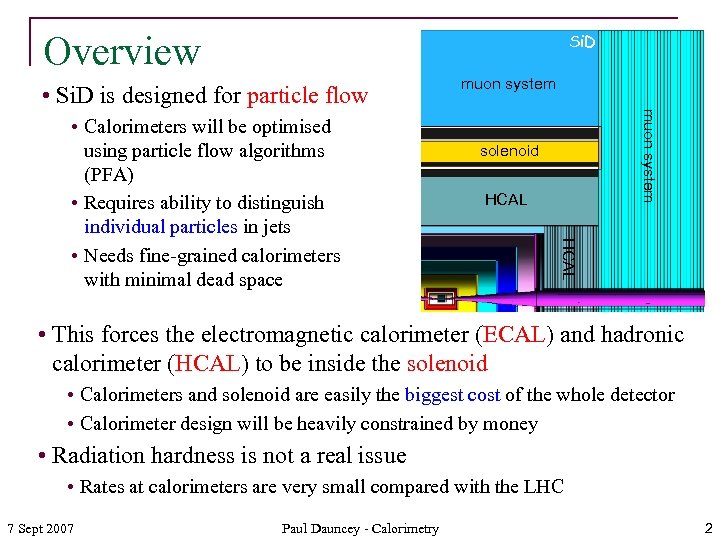 Overview Si. D • Si. D is designed for particle flow muon system solenoid HCAL • Calorimeters will be optimised using particle flow algorithms (PFA) • Requires ability to distinguish individual particles in jets • Needs fine-grained calorimeters with minimal dead space muon system • This forces the electromagnetic calorimeter (ECAL) and hadronic calorimeter (HCAL) to be inside the solenoid • Calorimeters and solenoid are easily the biggest cost of the whole detector • Calorimeter design will be heavily constrained by money • Radiation hardness is not a real issue • Rates at calorimeters are very small compared with the LHC 7 Sept 2007 Paul Dauncey - Calorimetry 2
 • ECAL • HCAL • Forward calorimeters • Calorimeter DAQ • Physics studies 7 Sept 2007 Paul Dauncey - Calorimetry 3
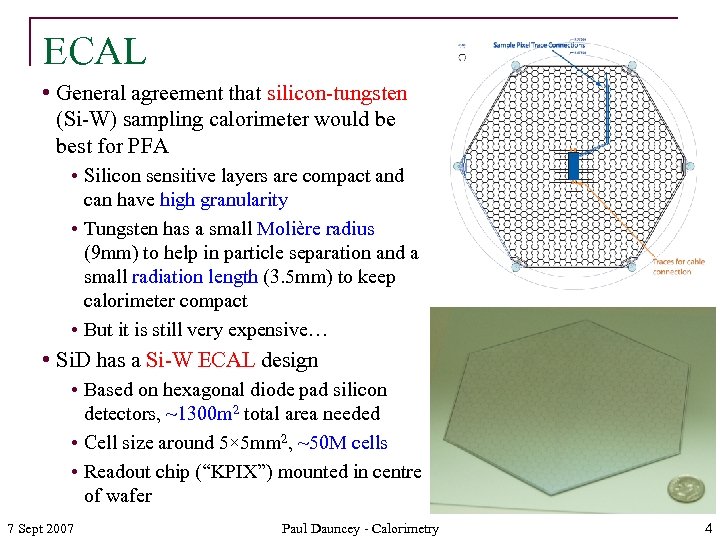 ECAL • General agreement that silicon-tungsten (Si-W) sampling calorimeter would be best for PFA • Silicon sensitive layers are compact and can have high granularity • Tungsten has a small Molière radius (9 mm) to help in particle separation and a small radiation length (3. 5 mm) to keep calorimeter compact • But it is still very expensive… • Si. D has a Si-W ECAL design • Based on hexagonal diode pad silicon detectors, ~1300 m 2 total area needed • Cell size around 5× 5 mm 2, ~50 M cells • Readout chip (“KPIX”) mounted in centre of wafer 7 Sept 2007 Paul Dauncey - Calorimetry 4
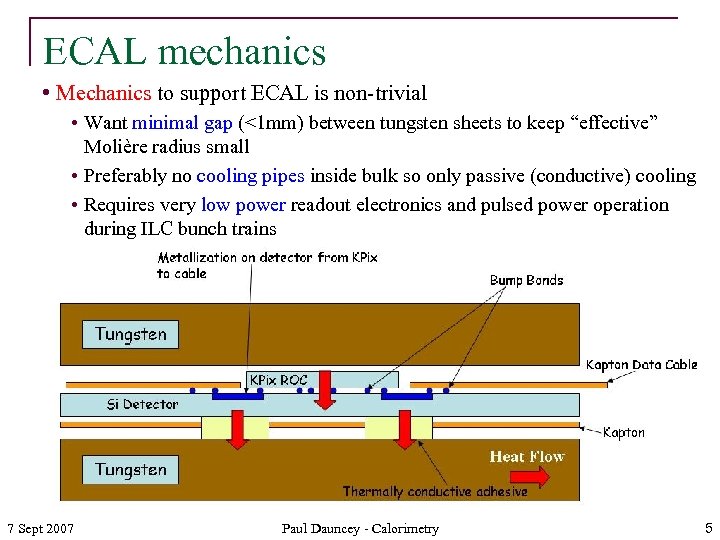 ECAL mechanics • Mechanics to support ECAL is non-trivial • Want minimal gap (<1 mm) between tungsten sheets to keep “effective” Molière radius small • Preferably no cooling pipes inside bulk so only passive (conductive) cooling • Requires very low power readout electronics and pulsed power operation during ILC bunch trains 7 Sept 2007 Paul Dauncey - Calorimetry 5
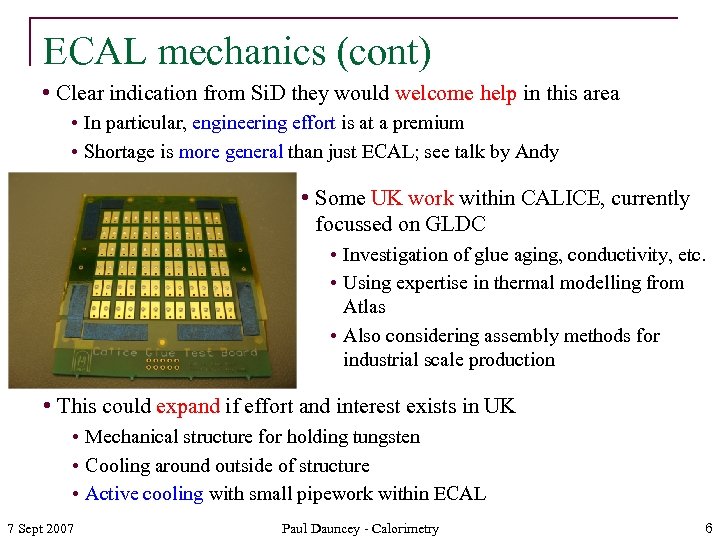 ECAL mechanics (cont) • Clear indication from Si. D they would welcome help in this area • In particular, engineering effort is at a premium • Shortage is more general than just ECAL; see talk by Andy • Some UK work within CALICE, currently focussed on GLDC • Investigation of glue aging, conductivity, etc. • Using expertise in thermal modelling from Atlas • Also considering assembly methods for industrial scale production • This could expand if effort and interest exists in UK • Mechanical structure for holding tungsten • Cooling around outside of structure • Active cooling with small pipework within ECAL 7 Sept 2007 Paul Dauncey - Calorimetry 6
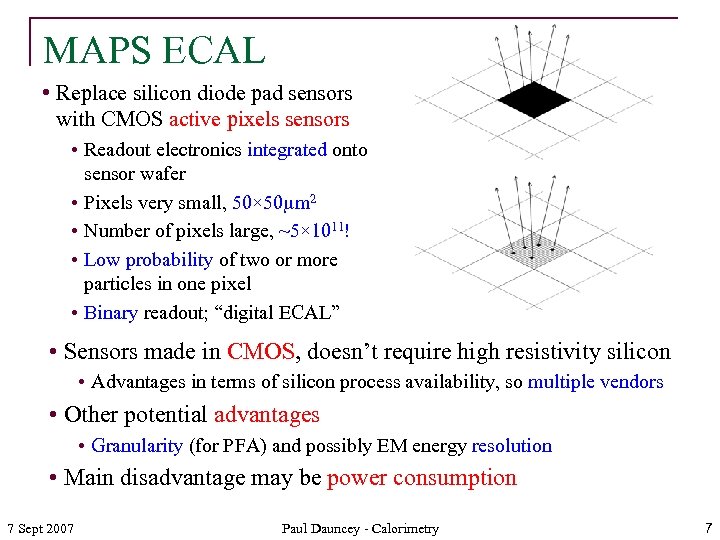 MAPS ECAL • Replace silicon diode pad sensors with CMOS active pixels sensors • Readout electronics integrated onto sensor wafer • Pixels very small, 50× 50 mm 2 • Number of pixels large, ~5× 10¹¹! • Low probability of two or more particles in one pixel • Binary readout; “digital ECAL” • Sensors made in CMOS, doesn’t require high resistivity silicon • Advantages in terms of silicon process availability, so multiple vendors • Other potential advantages • Granularity (for PFA) and possibly EM energy resolution • Main disadvantage may be power consumption 7 Sept 2007 Paul Dauncey - Calorimetry 7
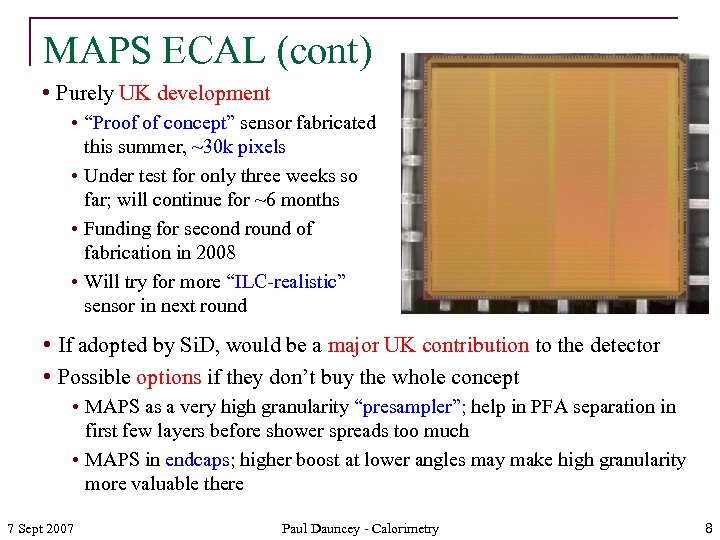 MAPS ECAL (cont) • Purely UK development • “Proof of concept” sensor fabricated this summer, ~30 k pixels • Under test for only three weeks so far; will continue for ~6 months • Funding for second round of fabrication in 2008 • Will try for more “ILC-realistic” sensor in next round • If adopted by Si. D, would be a major UK contribution to the detector • Possible options if they don’t buy the whole concept • MAPS as a very high granularity “presampler”; help in PFA separation in first few layers before shower spreads too much • MAPS in endcaps; higher boost at lower angles may make high granularity more valuable there 7 Sept 2007 Paul Dauncey - Calorimetry 8
 Other ECAL opportunities • Comparison of KPIX and FLC_PHY readout chips • LDC readout chip is very similar (in concept) to KPIX • R&D review this summer said they should try to work together • Experience in CALICE of LDC ASIC which could be applied • Apply CALICE beam test data to verification of Si. D ECAL simulation • Huge dataset (300 M events so far) to all verification of electron and hadron showers in simulation • Get involved with ECAL beam tests in 2008/9 • Si. D plan ECAL beam test with 30 -layer stack • Take on endcap design • Very little work in this area; almost all studies for the barrel 7 Sept 2007 Paul Dauncey - Calorimetry 9
 • ECAL • HCAL • Forward calorimeters • Calorimeter DAQ • Physics studies 7 Sept 2007 Paul Dauncey - Calorimetry 10
 HCAL • Two general concepts being considered; analogue and digital sampling calorimeters, both with steel converter • Both projects are being done within the CALICE framework • Digital is small pads (~1× 1 cm 2) with binary readout, either RPCs or GEMs • Analogue is larger scintillating tiles (~3× 3 cm 2) with Si. PM and ADC readout • UK has no involvement in either HCAL in CALICE • Would need to start a new activity from scratch • UK has recent experience in Si. PMs through T 2 K and long history in RPCs (but not GEMs) • First step could be analysis of CALICE beam test data, both existing (2006/7, analogue HCAL) and future (2008, digital HCAL) 7 Sept 2007 Paul Dauncey - Calorimetry 11
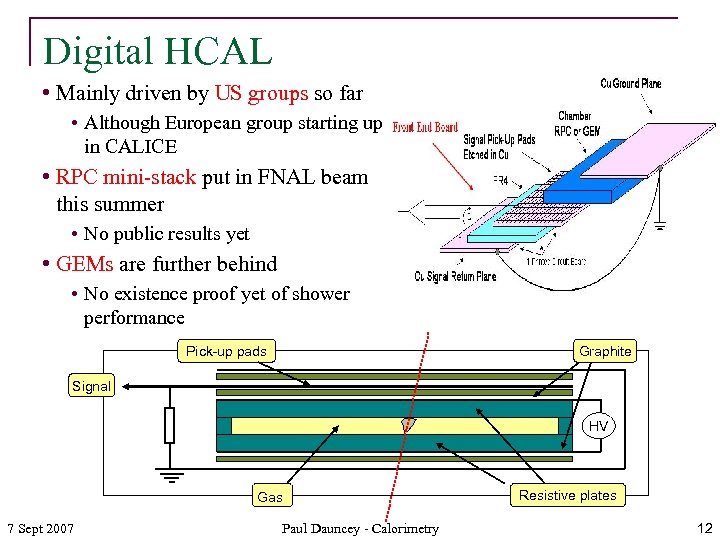 Digital HCAL • Mainly driven by US groups so far • Although European group starting up in CALICE • RPC mini-stack put in FNAL beam this summer • No public results yet • GEMs are further behind • No existence proof yet of shower performance Pick-up pads Graphite Signal HV Gas 7 Sept 2007 Paul Dauncey - Calorimetry Resistive plates 12
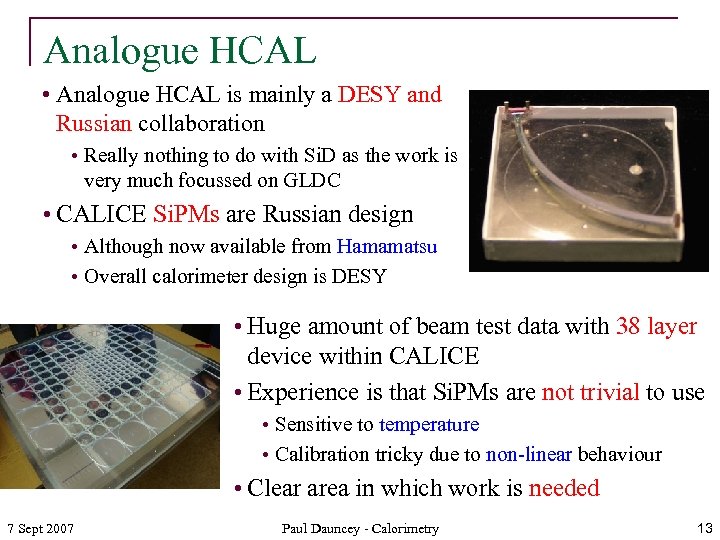 Analogue HCAL • Analogue HCAL is mainly a DESY and Russian collaboration • Really nothing to do with Si. D as the work is very much focussed on GLDC • CALICE Si. PMs are Russian design • Although now available from Hamamatsu • Overall calorimeter design is DESY • Huge amount of beam test data with 38 layer device within CALICE • Experience is that Si. PMs are not trivial to use • Sensitive to temperature • Calibration tricky due to non-linear behaviour • Clear area in which work is needed 7 Sept 2007 Paul Dauncey - Calorimetry 13
 • ECAL • HCAL • Forward calorimeters • Calorimeter DAQ • Physics studies 7 Sept 2007 Paul Dauncey - Calorimetry 14
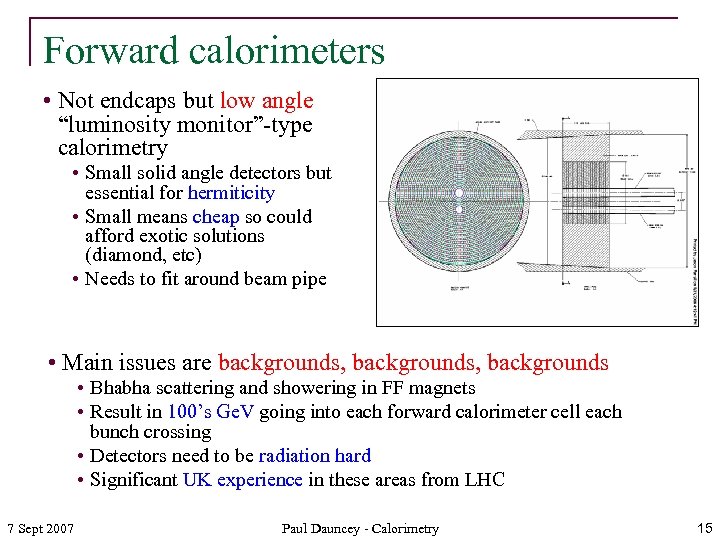 Forward calorimeters • Not endcaps but low angle “luminosity monitor”-type calorimetry • Small solid angle detectors but essential for hermiticity • Small means cheap so could afford exotic solutions (diamond, etc) • Needs to fit around beam pipe • Main issues are backgrounds, backgrounds • Bhabha scattering and showering in FF magnets • Result in 100’s Ge. V going into each forward calorimeter cell each bunch crossing • Detectors need to be radiation hard • Significant UK experience in these areas from LHC 7 Sept 2007 Paul Dauncey - Calorimetry 15
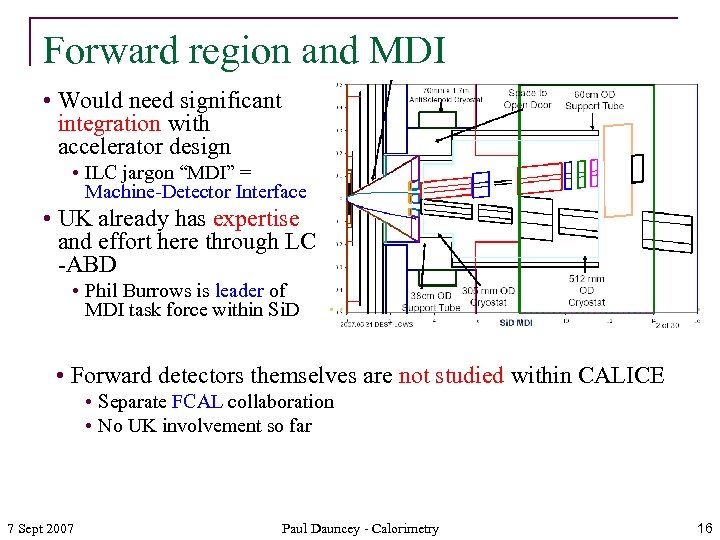 Forward region and MDI • Would need significant integration with accelerator design • ILC jargon “MDI” = Machine-Detector Interface • UK already has expertise and effort here through LC -ABD • Phil Burrows is leader of MDI task force within Si. D • Forward detectors themselves are not studied within CALICE • Separate FCAL collaboration • No UK involvement so far 7 Sept 2007 Paul Dauncey - Calorimetry 16
 • ECAL • HCAL • Forward calorimeters • Calorimeter DAQ • Physics studies 7 Sept 2007 Paul Dauncey - Calorimetry 17
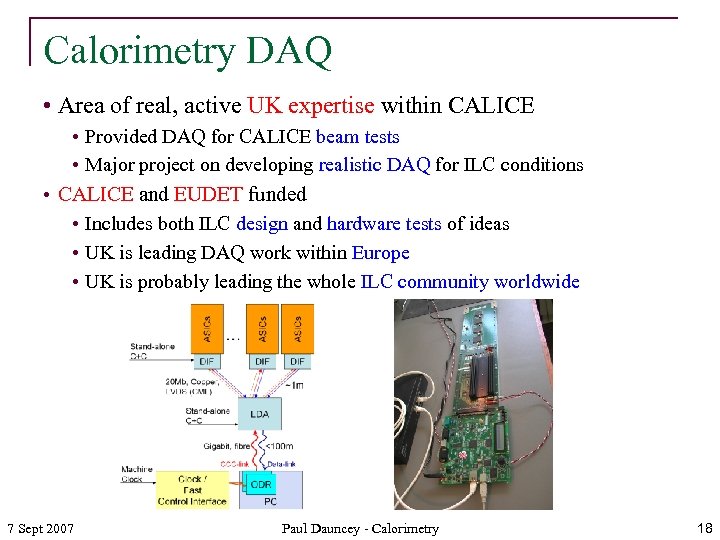 Calorimetry DAQ • Area of real, active UK expertise within CALICE • Provided DAQ for CALICE beam tests • Major project on developing realistic DAQ for ILC conditions • CALICE and EUDET funded • Includes both ILC design and hardware tests of ideas • UK is leading DAQ work within Europe • UK is probably leading the whole ILC community worldwide 7 Sept 2007 Paul Dauncey - Calorimetry 18
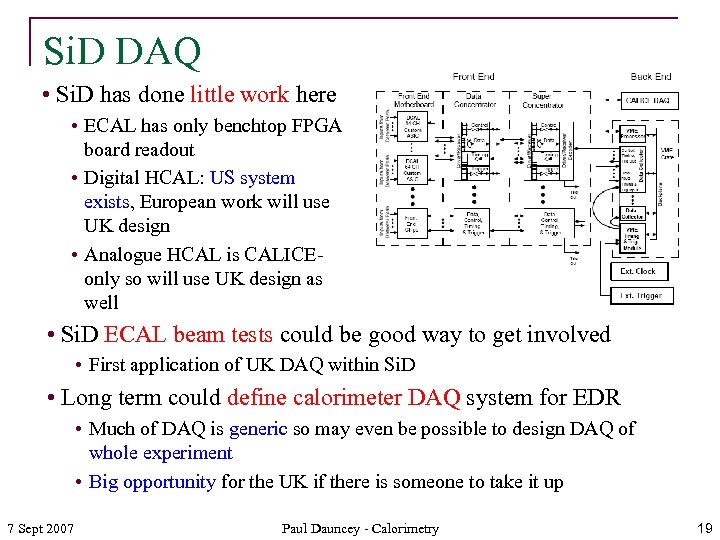 Si. D DAQ • Si. D has done little work here • ECAL has only benchtop FPGA board readout • Digital HCAL: US system exists, European work will use UK design • Analogue HCAL is CALICEonly so will use UK design as well • Si. D ECAL beam tests could be good way to get involved • First application of UK DAQ within Si. D • Long term could define calorimeter DAQ system for EDR • Much of DAQ is generic so may even be possible to design DAQ of whole experiment • Big opportunity for the UK if there is someone to take it up 7 Sept 2007 Paul Dauncey - Calorimetry 19
 • ECAL • HCAL • Forward calorimeters • Calorimeter DAQ • Physics studies 7 Sept 2007 Paul Dauncey - Calorimetry 20
 Physics studies: ECAL resolution • Main driver for calorimeter designs will be PFA for jet resolution • See talks by Andrei and Tomas • But there are other physics issues which need to be considered at the same time • Consider two ECAL examples here • Relative weighting of these and PFA is an open question • ECAL resolution • Ongoing argument about the main driver for requirement here • Probably defined by H gg (assuming this is seen at LHC soon) • Important for ILC to then confirm the decay and measure the BF • Signal is “easy”; two ~60 Ge. V photons together with a Z • But Higgs BF is tiny so backgrounds are the issue (radiative Z, ZZ, …) • This needs a serious study to see how much resolution can help 7 Sept 2007 Paul Dauncey - Calorimetry 21
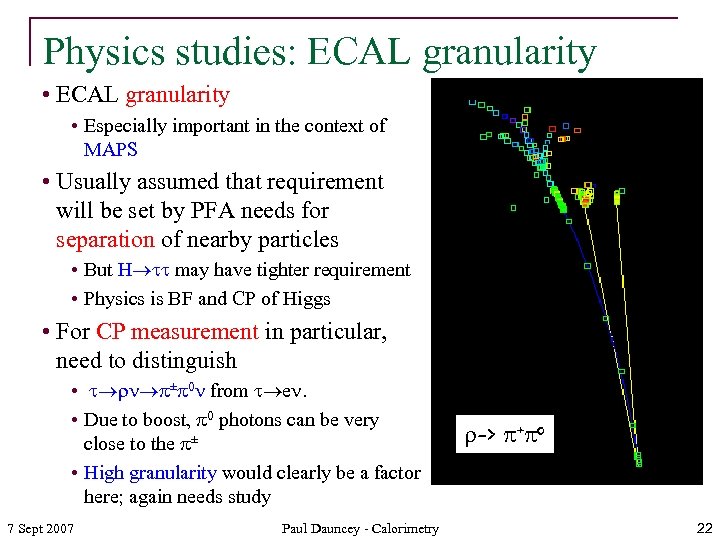 Physics studies: ECAL granularity • Especially important in the context of MAPS • Usually assumed that requirement will be set by PFA needs for separation of nearby particles • But H tt may have tighter requirement • Physics is BF and CP of Higgs • For CP measurement in particular, need to distinguish • t rn p±p 0 n from t en. • Due to boost, p 0 photons can be very close to the p± • High granularity would clearly be a factor here; again needs study 7 Sept 2007 Paul Dauncey - Calorimetry r-> p+po 22
 Conclusions • There are several places in Si. D calorimetry where the existing CALICE UK work can be exploited • There are several other places where more effort would be very welcome within Si. D although it may require new projects (and probably new funding) within the UK to get started • CALICE is covering many aspects of the calorimetry studies needed and this might be the way to get involved easily • If you are interested in this, please let us know! 7 Sept 2007 Paul Dauncey - Calorimetry 23