


 Скачать презентацию UK 200 Agricultural Group Specialist Training Course Wednesday
3381b7fd297fd64e0e20856d8d8d2d92.ppt
- Количество слайдов: 176
 UK 200 Agricultural Group Specialist Training Course Wednesday 23 June 2010
 FARM SUPPORT AFTER 2012 RICHARD KING June 2010
 THE IMPORTANCE OF SUPPORT
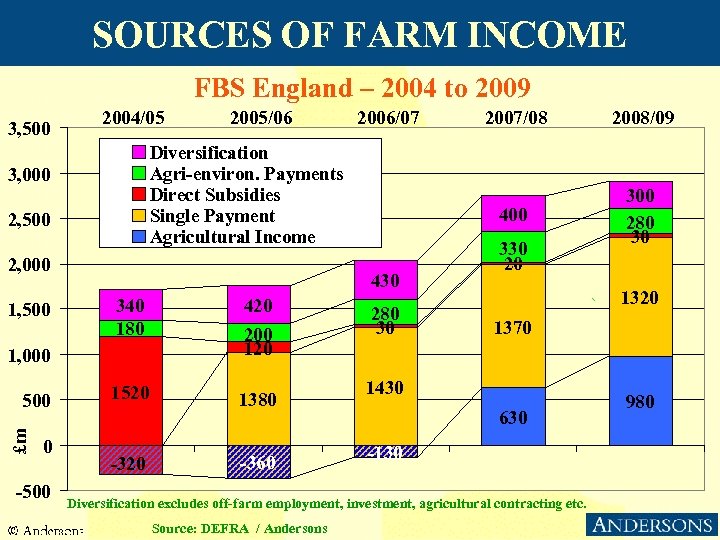 SOURCES OF FARM INCOME FBS England – 2004 to 2009 3, 500 2004/05 2005/06 2, 500 2, 000 430 340 180 420 200 120 1520 1380 1, 000 £m 500 0 -500 -320 -360 280 30 2007/08 2008/09 400 Diversification Agri-environ. Payments Direct Subsidies Single Payment Agricultural Income 3, 000 1, 500 2006/07 300 280 30 330 20 1370 1430 630 -130 Diversification excludes off-farm employment, investment, agricultural contracting etc. Source: DEFRA / Andersons 980
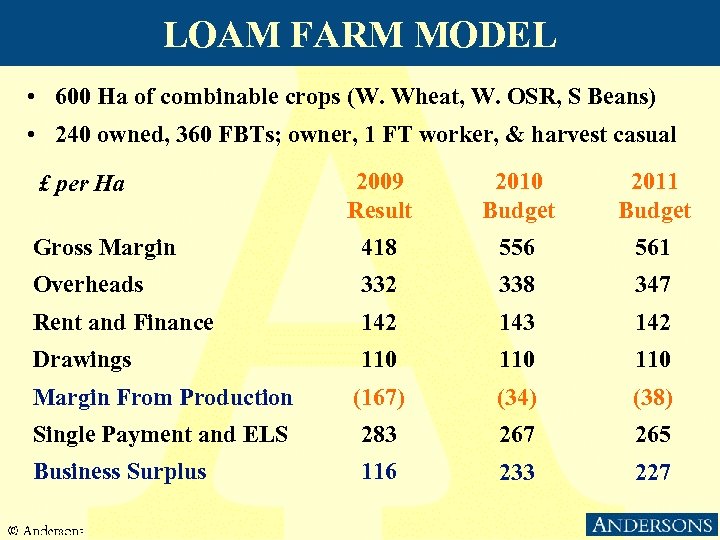 LOAM FARM MODEL • 600 Ha of combinable crops (W. Wheat, W. OSR, S Beans) • 240 owned, 360 FBTs; owner, 1 FT worker, & harvest casual 2009 Result 2010 Budget 2011 Budget Gross Margin 418 556 561 Overheads 332 338 347 Rent and Finance 142 143 142 Drawings 110 110 Margin From Production (167) (34) (38) Single Payment and ELS 283 267 265 Business Surplus 116 233 227 £ per Ha
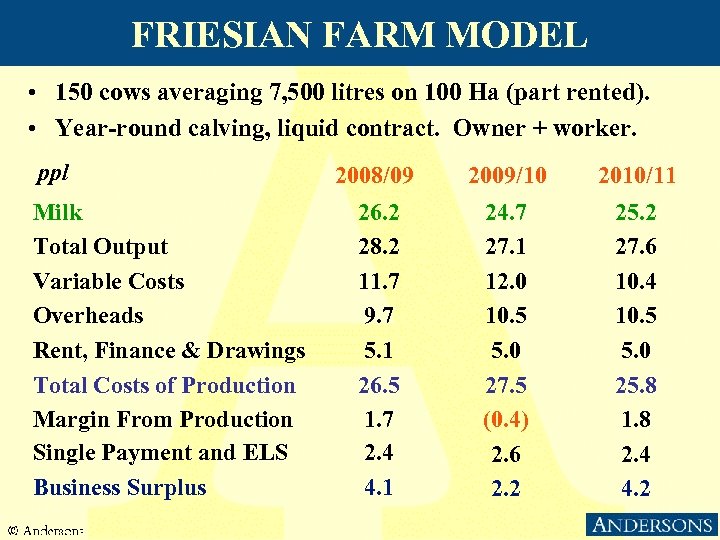 FRIESIAN FARM MODEL • 150 cows averaging 7, 500 litres on 100 Ha (part rented). • Year-round calving, liquid contract. Owner + worker. ppl Milk Total Output Variable Costs Overheads Rent, Finance & Drawings Total Costs of Production Margin From Production Single Payment and ELS Business Surplus 2008/09 2009/10 2010/11 26. 2 28. 2 11. 7 9. 7 5. 1 26. 5 1. 7 2. 4 4. 1 24. 7 27. 1 12. 0 10. 5 5. 0 27. 5 (0. 4) 2. 6 2. 2 25. 2 27. 6 10. 4 10. 5 5. 0 25. 8 1. 8 2. 4 4. 2
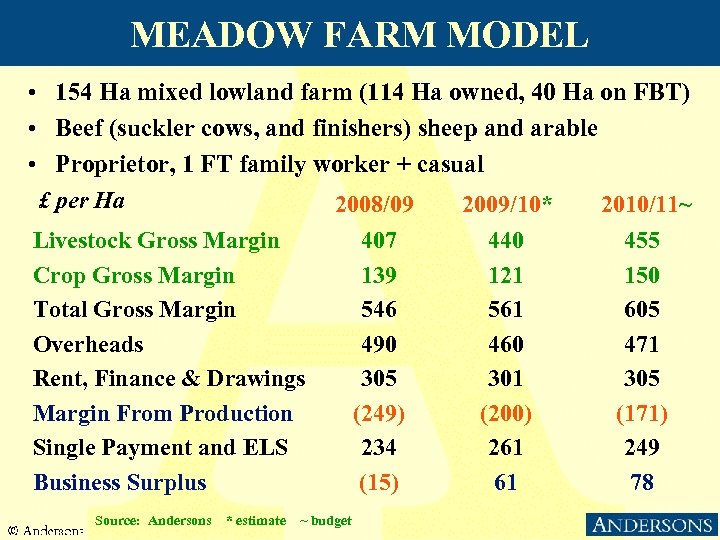 MEADOW FARM MODEL • 154 Ha mixed lowland farm (114 Ha owned, 40 Ha on FBT) • Beef (suckler cows, and finishers) sheep and arable • Proprietor, 1 FT family worker + casual £ per Ha 2008/09 2009/10* 2010/11~ 407 139 546 490 305 (249) 234 (15) 440 121 561 460 301 (200) 261 61 455 150 605 471 305 (171) 249 78 Livestock Gross Margin Crop Gross Margin Total Gross Margin Overheads Rent, Finance & Drawings Margin From Production Single Payment and ELS Business Surplus Source: Andersons * estimate ~ budget
 BACKGROUND TO THE NEXT REFORM
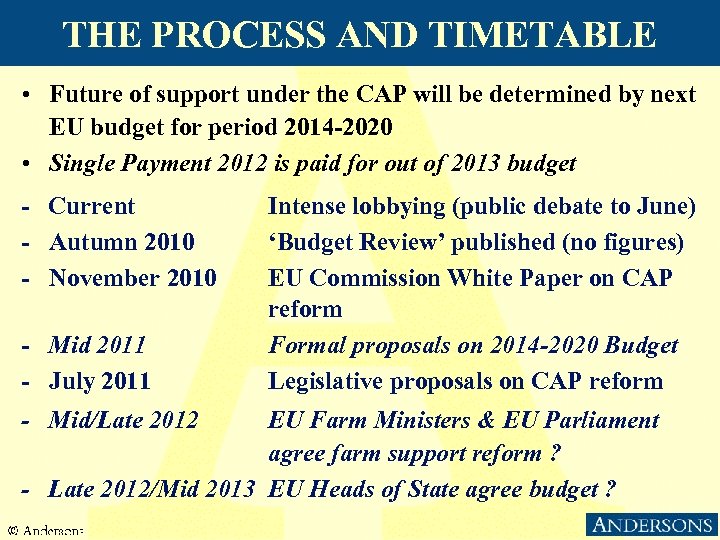 THE PROCESS AND TIMETABLE • Future of support under the CAP will be determined by next EU budget for period 2014 -2020 • Single Payment 2012 is paid for out of 2013 budget - Current - Autumn 2010 - November 2010 - Mid 2011 - July 2011 - Mid/Late 2012 Intense lobbying (public debate to June) ‘Budget Review’ published (no figures) EU Commission White Paper on CAP reform Formal proposals on 2014 -2020 Budget Legislative proposals on CAP reform EU Farm Ministers & EU Parliament agree farm support reform ? - Late 2012/Mid 2013 EU Heads of State agree budget ?
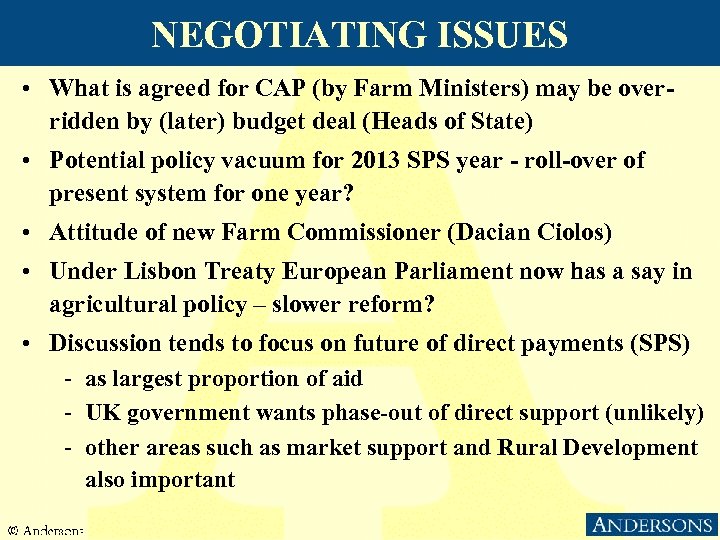 NEGOTIATING ISSUES • What is agreed for CAP (by Farm Ministers) may be overridden by (later) budget deal (Heads of State) • Potential policy vacuum for 2013 SPS year - roll-over of present system for one year? • Attitude of new Farm Commissioner (Dacian Ciolos) • Under Lisbon Treaty European Parliament now has a say in agricultural policy – slower reform? • Discussion tends to focus on future of direct payments (SPS) as largest proportion of aid UK government wants phase-out of direct support (unlikely) other areas such as market support and Rural Development also important
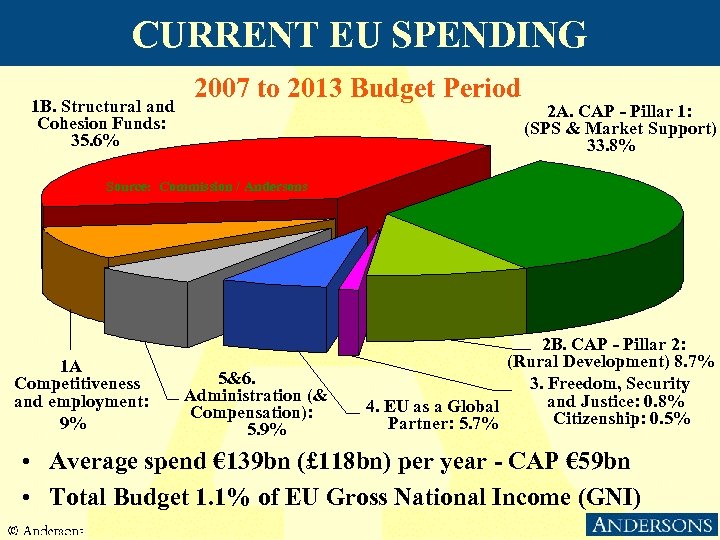 CURRENT EU SPENDING 1 B. Structural and Cohesion Funds: 35. 6% 2007 to 2013 Budget Period 2 A. CAP - Pillar 1: (SPS & Market Support) 33. 8% Source: Commission / Andersons 1 A Competitiveness and employment: 9% 5&6. Administration (& Compensation): 5. 9% 2 B. CAP - Pillar 2: (Rural Development) 8. 7% 3. Freedom, Security and Justice: 0. 8% 4. EU as a Global Citizenship: 0. 5% Partner: 5. 7% • Average spend € 139 bn (£ 118 bn) per year - CAP € 59 bn • Total Budget 1. 1% of EU Gross National Income (GNI)
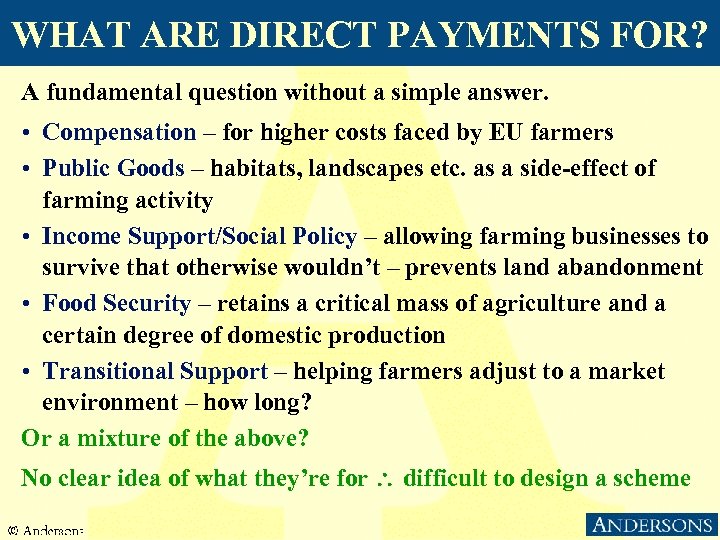 WHAT ARE DIRECT PAYMENTS FOR? A fundamental question without a simple answer. • Compensation – for higher costs faced by EU farmers • Public Goods – habitats, landscapes etc. as a side-effect of farming activity • Income Support/Social Policy – allowing farming businesses to survive that otherwise wouldn’t – prevents land abandonment • Food Security – retains a critical mass of agriculture and a certain degree of domestic production • Transitional Support – helping farmers adjust to a market environment – how long? Or a mixture of the above? No clear idea of what they’re for difficult to design a scheme
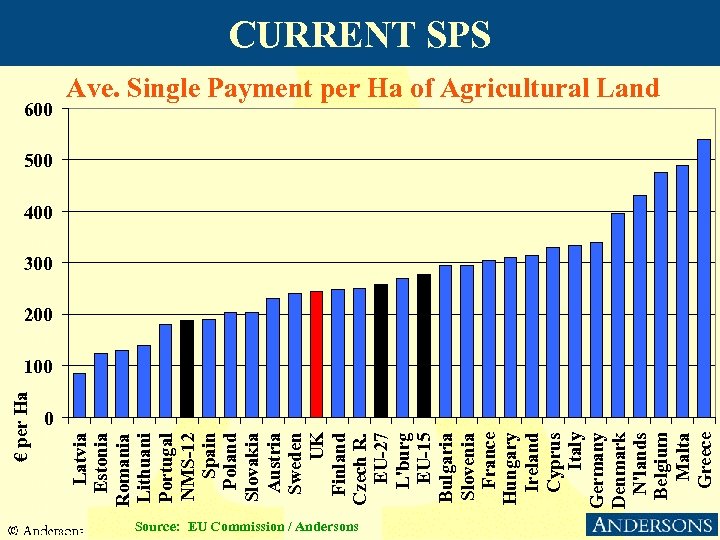 600 Latvia Estonia Romania Lithuani Portugal NMS-12 Spain Poland Slovakia Austria Sweden UK Finland Czech R. EU-27 L'burg EU-15 Bulgaria Slovenia France Hungary Ireland Cyprus Italy Germany Denmark N'lands Belgium Malta Greece € per Ha CURRENT SPS Ave. Single Payment per Ha of Agricultural Land 500 400 300 200 100 0 Source: EU Commission / Andersons
 WHAT MIGHT HAPPEN
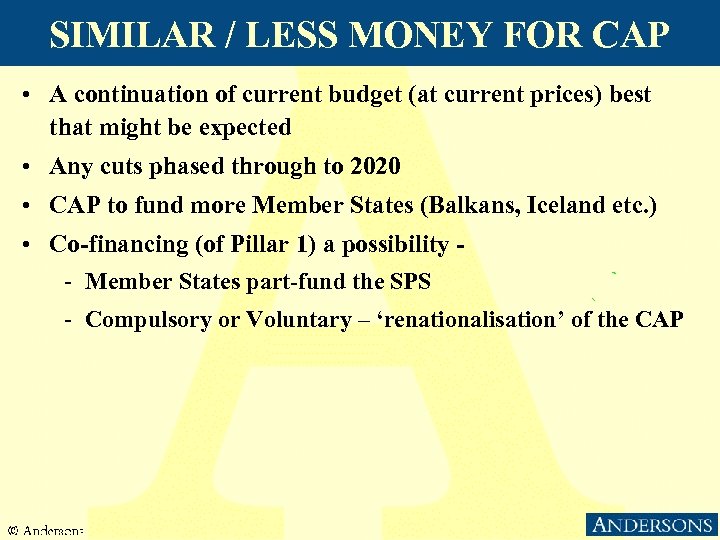 SIMILAR / LESS MONEY FOR CAP • A continuation of current budget (at current prices) best that might be expected • Any cuts phased through to 2020 • CAP to fund more Member States (Balkans, Iceland etc. ) • Co-financing (of Pillar 1) a possibility Member States part-fund the SPS Compulsory or Voluntary – ‘renationalisation’ of the CAP
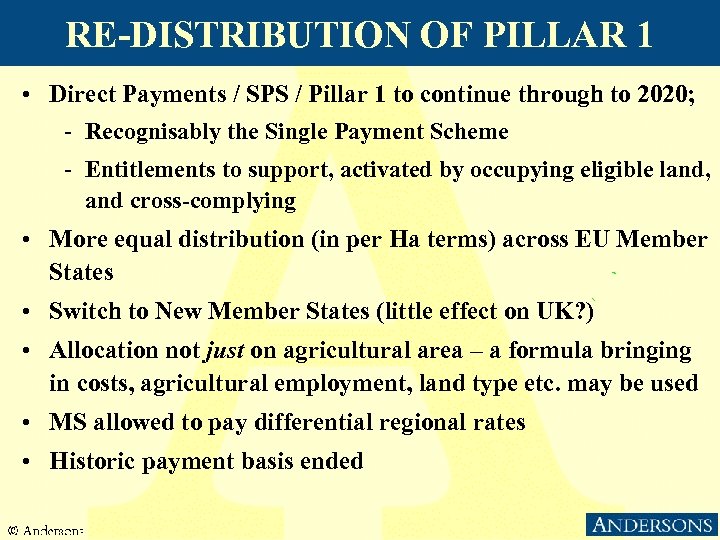 RE-DISTRIBUTION OF PILLAR 1 • Direct Payments / SPS / Pillar 1 to continue through to 2020; Recognisably the Single Payment Scheme Entitlements to support, activated by occupying eligible land, and cross-complying • More equal distribution (in per Ha terms) across EU Member States • Switch to New Member States (little effect on UK? ) • Allocation not just on agricultural area – a formula bringing in costs, agricultural employment, land type etc. may be used • MS allowed to pay differential regional rates • Historic payment basis ended
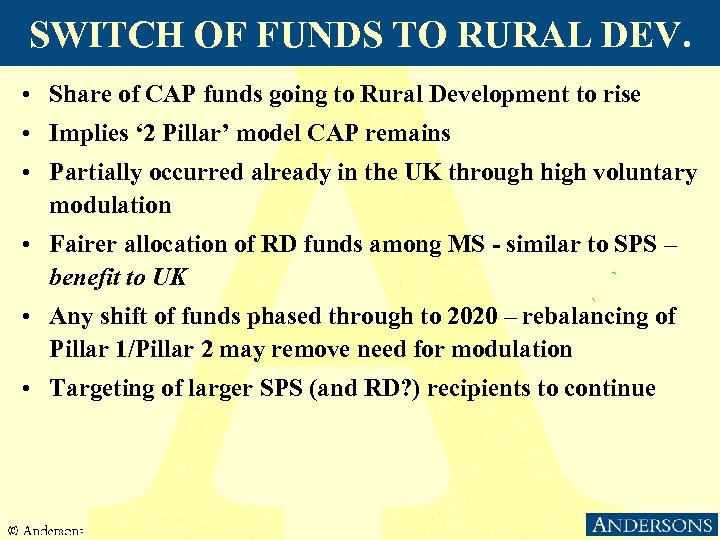 SWITCH OF FUNDS TO RURAL DEV. • Share of CAP funds going to Rural Development to rise • Implies ‘ 2 Pillar’ model CAP remains • Partially occurred already in the UK through high voluntary modulation • Fairer allocation of RD funds among MS - similar to SPS – benefit to UK • Any shift of funds phased through to 2020 – rebalancing of Pillar 1/Pillar 2 may remove need for modulation • Targeting of larger SPS (and RD? ) recipients to continue
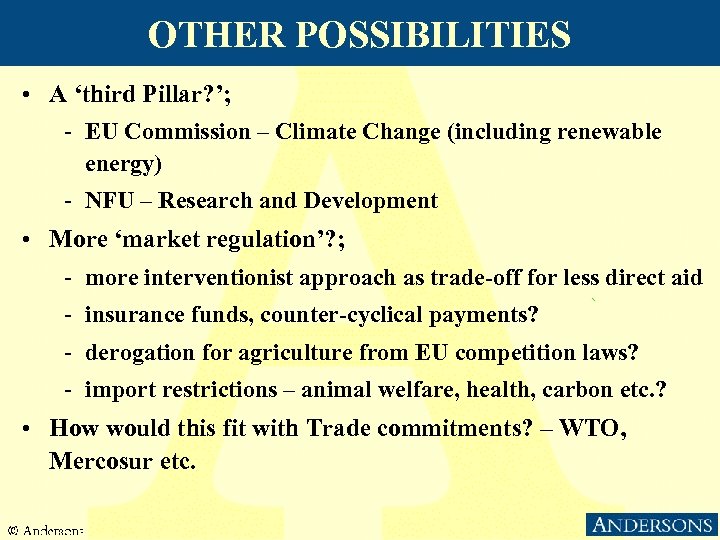 OTHER POSSIBILITIES • A ‘third Pillar? ’; EU Commission – Climate Change (including renewable energy) NFU – Research and Development • More ‘market regulation’? ; more interventionist approach as trade-off for less direct aid insurance funds, counter-cyclical payments? derogation for agriculture from EU competition laws? import restrictions – animal welfare, health, carbon etc. ? • How would this fit with Trade commitments? – WTO, Mercosur etc.
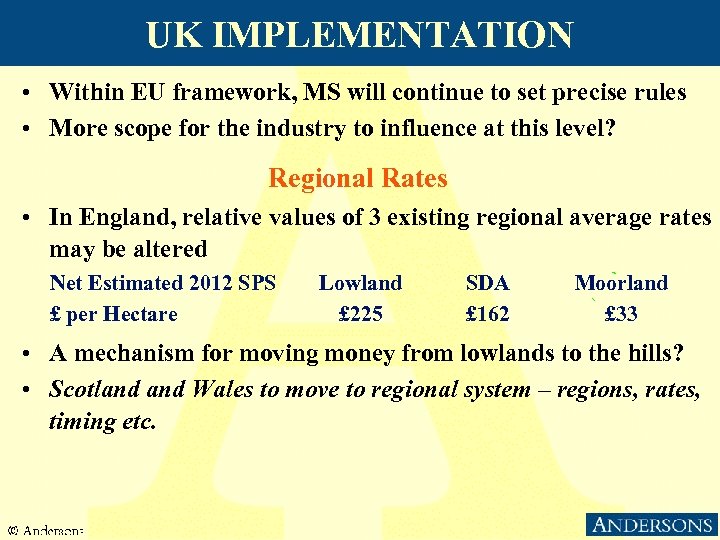 UK IMPLEMENTATION • Within EU framework, MS will continue to set precise rules • More scope for the industry to influence at this level? Regional Rates • In England, relative values of 3 existing regional average rates may be altered Net Estimated 2012 SPS £ per Hectare Lowland £ 225 SDA £ 162 Moorland £ 33 • A mechanism for moving money from lowlands to the hills? • Scotland Wales to move to regional system – regions, rates, timing etc.
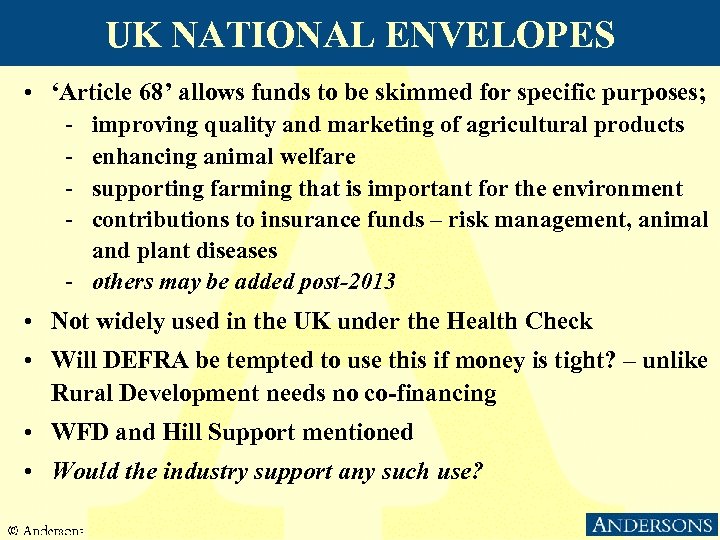 UK NATIONAL ENVELOPES • ‘Article 68’ allows funds to be skimmed for specific purposes; improving quality and marketing of agricultural products enhancing animal welfare supporting farming that is important for the environment contributions to insurance funds – risk management, animal and plant diseases others may be added post-2013 • Not widely used in the UK under the Health Check • Will DEFRA be tempted to use this if money is tight? – unlike Rural Development needs no co-financing • WFD and Hill Support mentioned • Would the industry support any such use?
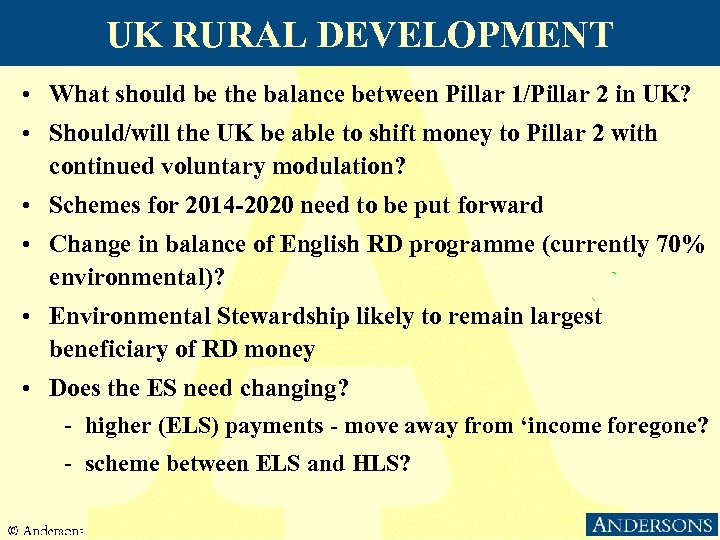 UK RURAL DEVELOPMENT • What should be the balance between Pillar 1/Pillar 2 in UK? • Should/will the UK be able to shift money to Pillar 2 with continued voluntary modulation? • Schemes for 2014 -2020 need to be put forward • Change in balance of English RD programme (currently 70% environmental)? • Environmental Stewardship likely to remain largest beneficiary of RD money • Does the ES need changing? higher (ELS) payments - move away from ‘income foregone? scheme between ELS and HLS?
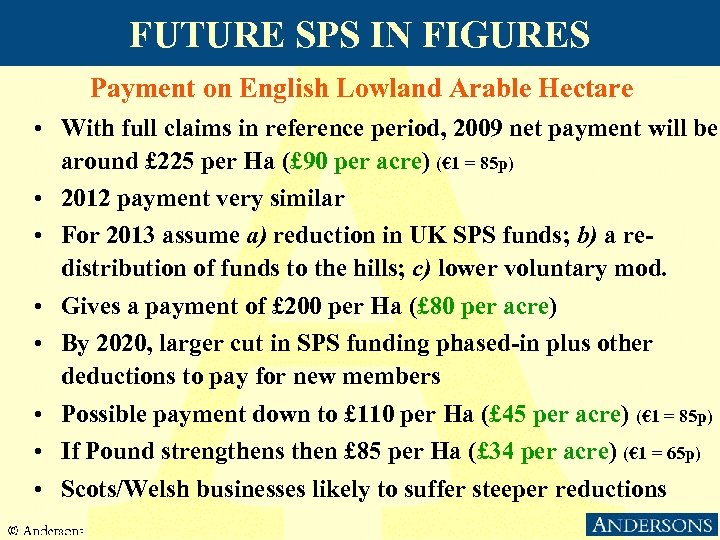 FUTURE SPS IN FIGURES Payment on English Lowland Arable Hectare • With full claims in reference period, 2009 net payment will be around £ 225 per Ha (£ 90 per acre) (€ 1 = 85 p) • 2012 payment very similar • For 2013 assume a) reduction in UK SPS funds; b) a redistribution of funds to the hills; c) lower voluntary mod. • Gives a payment of £ 200 per Ha (£ 80 per acre) • By 2020, larger cut in SPS funding phased-in plus other deductions to pay for new members • Possible payment down to £ 110 per Ha (£ 45 per acre) (€ 1 = 85 p) • If Pound strengthens then £ 85 per Ha (£ 34 per acre) (€ 1 = 65 p) • Scots/Welsh businesses likely to suffer steeper reductions
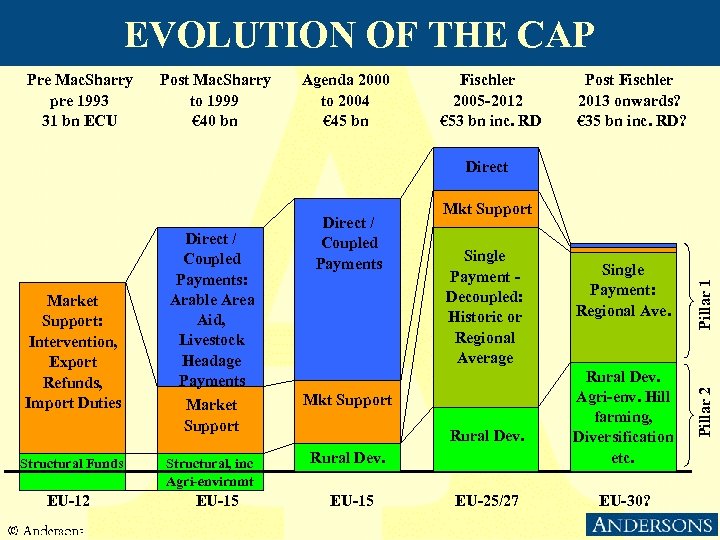 EVOLUTION OF THE CAP Pre Mac. Sharry pre 1993 31 bn ECU Post Mac. Sharry to 1999 € 40 bn Agenda 2000 to 2004 € 45 bn Fischler 2005 -2012 € 53 bn inc. RD Post Fischler 2013 onwards? € 35 bn inc. RD? Direct Structural Funds EU-12 Structural, inc Agri-envirnmt EU-15 Single Payment Decoupled: Historic or Regional Average Mkt Support Rural Dev. EU-15 EU-25/27 Single Payment: Regional Ave. Rural Dev. Agri-env. Hill farming, Diversification etc. EU-30? Pillar 1 Mkt Support Pillar 2 Market Support: Intervention, Export Refunds, Import Duties Direct / Coupled Payments: Arable Area Aid, Livestock Headage Payments Market Support Direct / Coupled Payments
 CONCLUSIONS / IMPLICATIONS
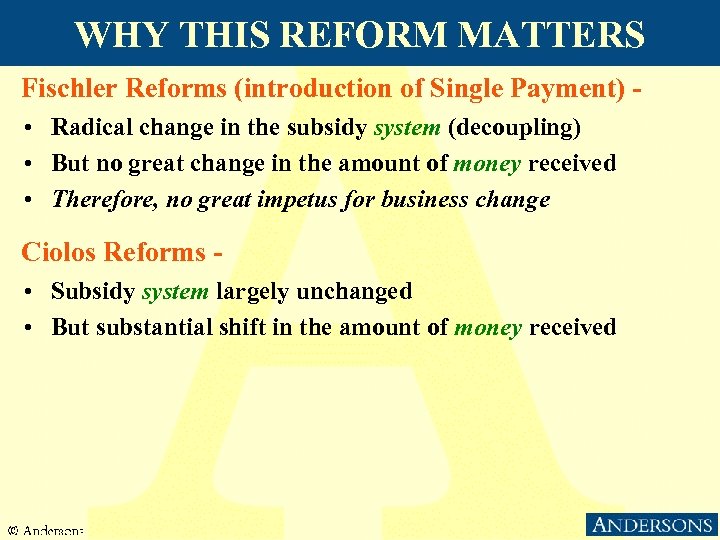 WHY THIS REFORM MATTERS Fischler Reforms (introduction of Single Payment) • Radical change in the subsidy system (decoupling) • But no great change in the amount of money received • Therefore, no great impetus for business change Ciolos Reforms • Subsidy system largely unchanged • But substantial shift in the amount of money received
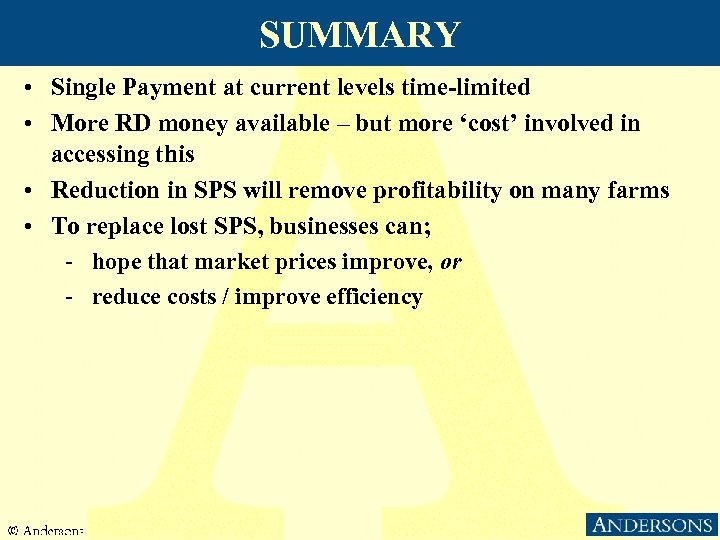 SUMMARY • Single Payment at current levels time-limited • More RD money available – but more ‘cost’ involved in accessing this • Reduction in SPS will remove profitability on many farms • To replace lost SPS, businesses can; hope that market prices improve, or reduce costs / improve efficiency
 CONTACT INFO Richard King Partner – Andersons Research Team 01664 503200 rking@theandersonscentre. co. uk
 FARM SUPPORT AFTER 2012 RICHARD KING June 2010
 UK 200 Agricultural Group Specialist Training Course Wednesday 23 June 2010
 Renewable Energy: Grasp the Opportunity David Harries Head of Renewables Aaron & Partners LLP
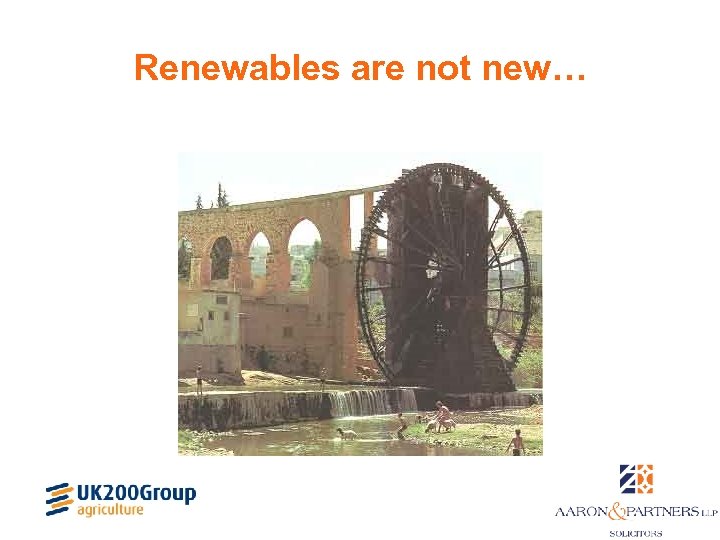 Renewables are not new…
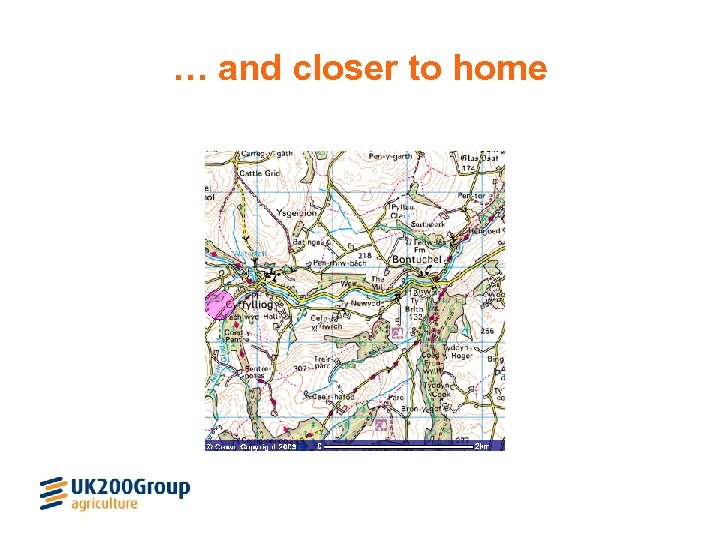 … and closer to home
 So why is renewable energy such a hot topic? • • • Climate Change Technical Developments Recognition of Resource Ageing Conventional Generators Energy Security
 Existing Generation • • • Coal supplied over 50% of winter consumption 2008/9 70% of our coal imported 50% from Russia Average coal station over 40 years old 6 of 19 coal stations scheduled to close by 2015 1/3 rd of UK generation to close within 10 years
 Energy Security
 Government Policy • • UK government targets: 10% by renewables by 2010 15% by 2020 80% reduction in carbon emissions by 2050
 Government Policy • In reality, economically driven: – “ 3 square meals from anarchy” • In response, Government policy has made renewable energy a good investment
 The Economics You sell your energy… • You get paid the market price plus ROCS and LECS • or FITS • A levy on the power generation industry • Ultimately paid for by higher consumer prices
 ROCS Economics ROCS: • “Renewables Obligation Certificates” • Base price set by government but can be traded • Targeted to encourage particular developments
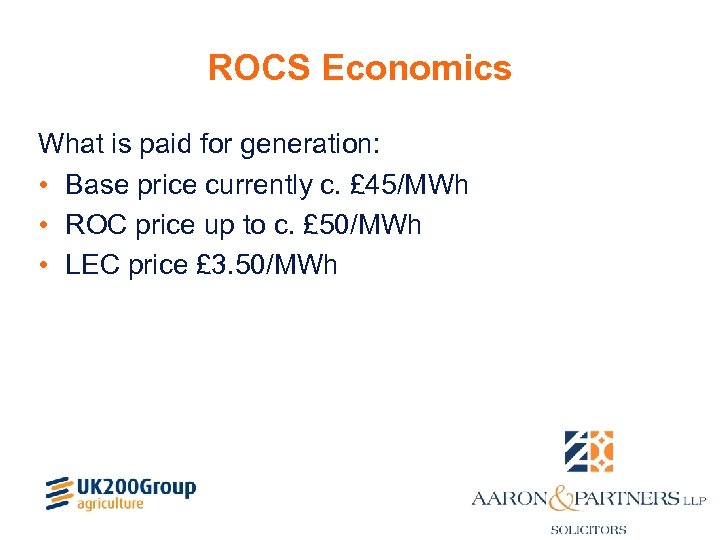 ROCS Economics What is paid for generation: • Base price currently c. £ 45/MWh • ROC price up to c. £ 50/MWh • LEC price £ 3. 50/MWh
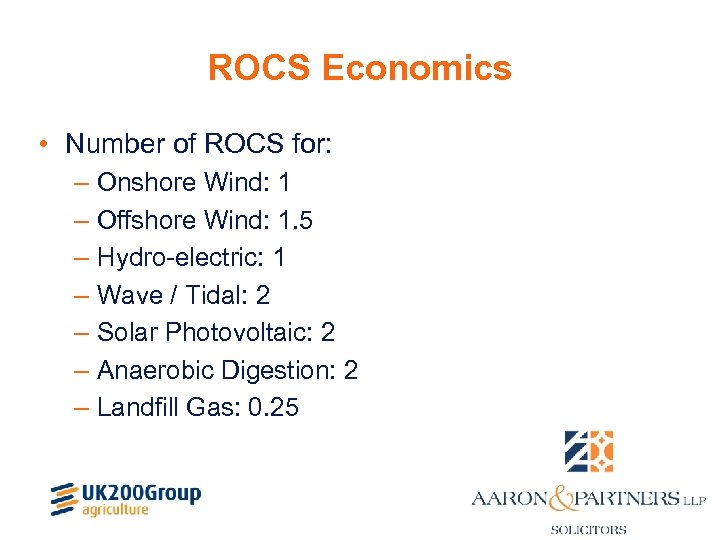 ROCS Economics • Number of ROCS for: – Onshore Wind: 1 – Offshore Wind: 1. 5 – Hydro-electric: 1 – Wave / Tidal: 2 – Solar Photovoltaic: 2 – Anaerobic Digestion: 2 – Landfill Gas: 0. 25
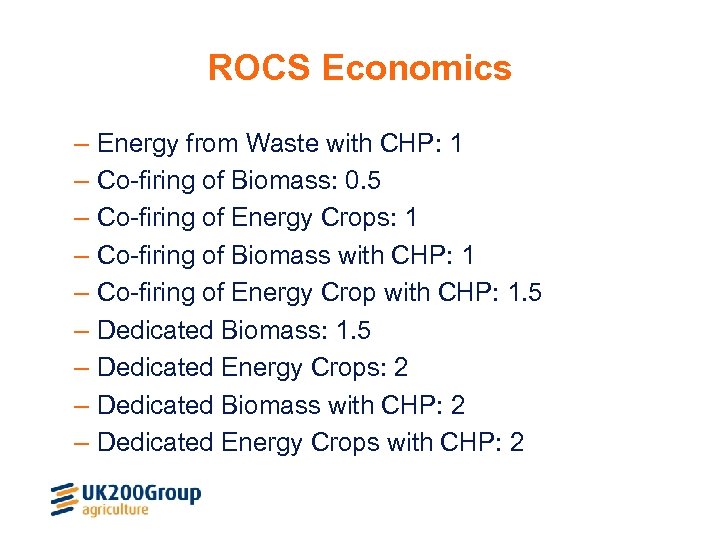 ROCS Economics – Energy from Waste with CHP: 1 – Co-firing of Biomass: 0. 5 – Co-firing of Energy Crops: 1 – Co-firing of Biomass with CHP: 1 – Co-firing of Energy Crop with CHP: 1. 5 – Dedicated Biomass: 1. 5 – Dedicated Energy Crops: 2 – Dedicated Biomass with CHP: 2 – Dedicated Energy Crops with CHP: 2
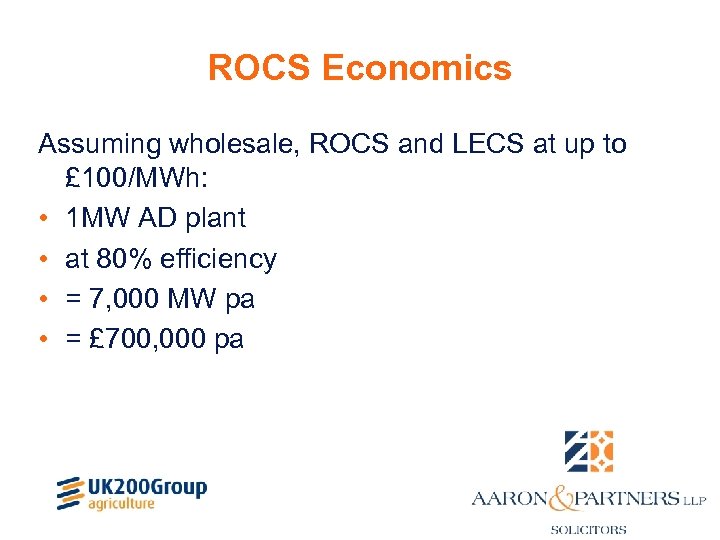 ROCS Economics Assuming wholesale, ROCS and LECS at up to £ 100/MWh: • 1 MW AD plant • at 80% efficiency • = 7, 000 MW pa • = £ 700, 000 pa
 ROCS Economics 1 MW wind farm • at 33% efficiency • = 2, 890 MW pa • = £ 289, 000 • 10 MW = £ 2, 890, 000
 Feed-in Tariffs • • • Aimed at smaller generators Maximum 5 MW Will run alongside the ROCS system Came into force 1 st April 2010 Can apply to retrospectively to schemes built after 15 July 2009
 Feed-in Tariffs Payable in two components: • Generation Tariff according to type • Export Tariff @ 3 p/k. Wh regardless of type
 Feed-in Tariffs • Generation Tariffs (pence / k. W) for: – Hydro-electric <15 k. W: 19. 9 – Hydro-electric 15 -100 k. W: 17. 8 – Hydro-electric 100 k. W – 2 MW: 11. 0 – Hydro-electric 2 MW – 5 MW: 4. 5 • (Note: >5 MW = ROCS)
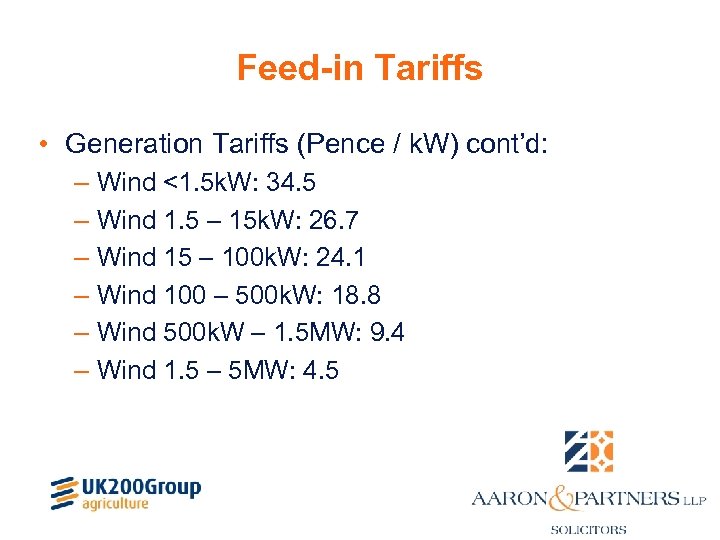 Feed-in Tariffs • Generation Tariffs (Pence / k. W) cont’d: – Wind <1. 5 k. W: 34. 5 – Wind 1. 5 – 15 k. W: 26. 7 – Wind 15 – 100 k. W: 24. 1 – Wind 100 – 500 k. W: 18. 8 – Wind 500 k. W – 1. 5 MW: 9. 4 – Wind 1. 5 – 5 MW: 4. 5
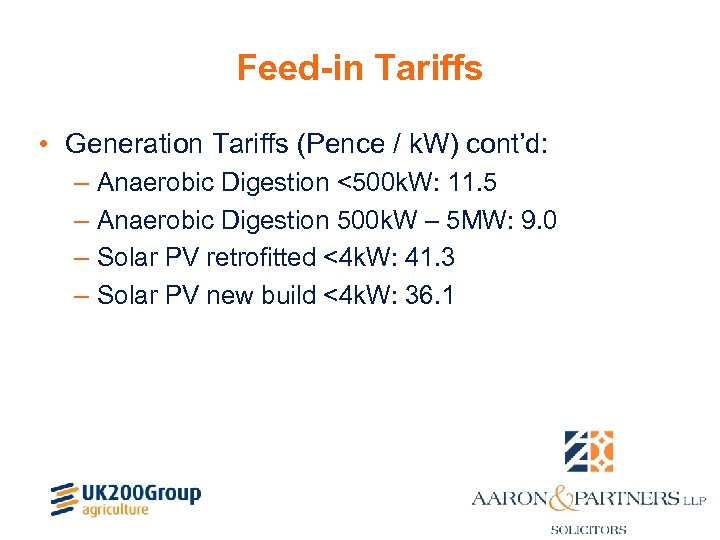 Feed-in Tariffs • Generation Tariffs (Pence / k. W) cont’d: – Anaerobic Digestion <500 k. W: 11. 5 – Anaerobic Digestion 500 k. W – 5 MW: 9. 0 – Solar PV retrofitted <4 k. W: 41. 3 – Solar PV new build <4 k. W: 36. 1
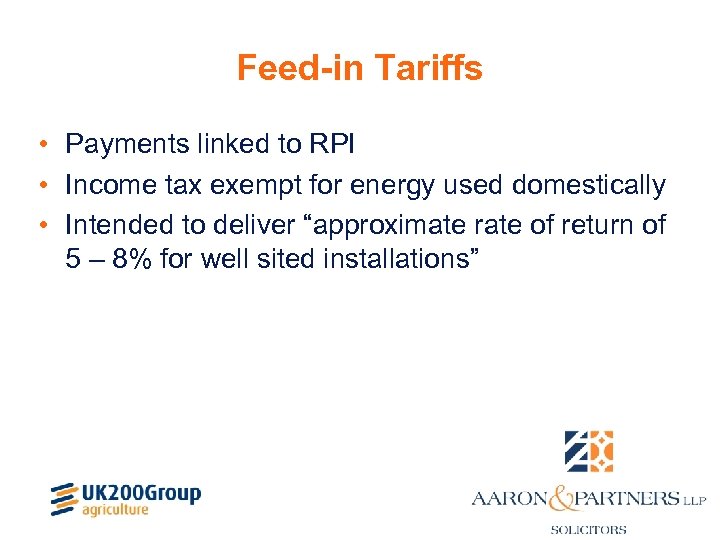 Feed-in Tariffs • Payments linked to RPI • Income tax exempt for energy used domestically • Intended to deliver “approximate rate of return of 5 – 8% for well sited installations”
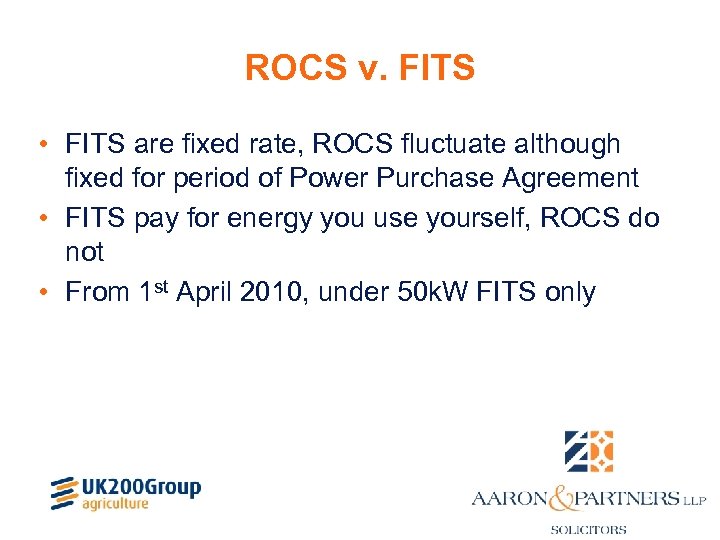 ROCS v. FITS • FITS are fixed rate, ROCS fluctuate although fixed for period of Power Purchase Agreement • FITS pay for energy you use yourself, ROCS do not • From 1 st April 2010, under 50 k. W FITS only
 ROCS v. FITS • Generally: – Small generator / self use = FITS – Large generator + export = ROCS
 FITS Bureaucracy • Installations have to be MCS Compliant (Microgeneration Certification Scheme) • Support is for “new” schemes • Ofgem still feeling its way and under-resourced
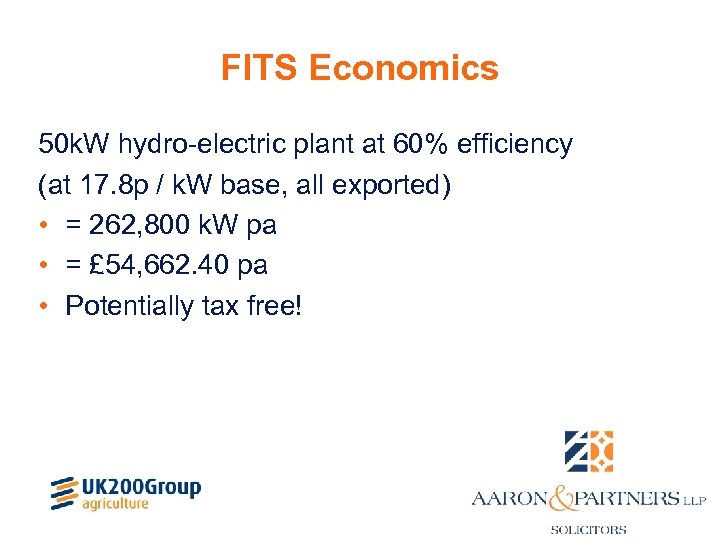 FITS Economics 50 k. W hydro-electric plant at 60% efficiency (at 17. 8 p / k. W base, all exported) • = 262, 800 k. W pa • = £ 54, 662. 40 pa • Potentially tax free!
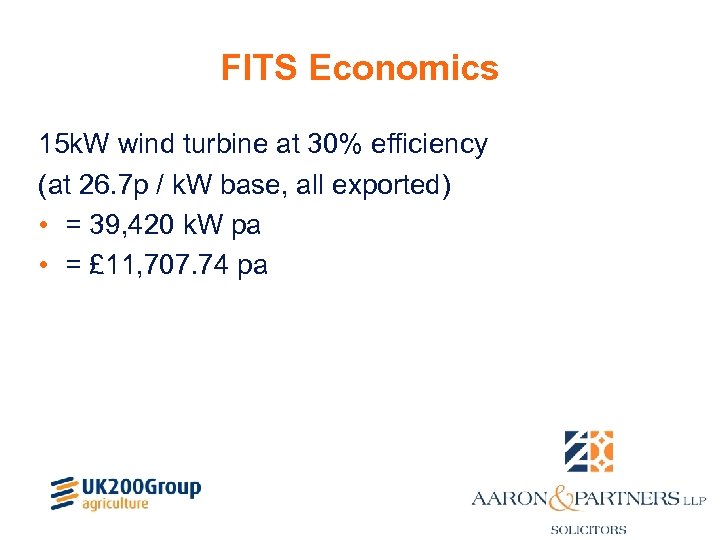 FITS Economics 15 k. W wind turbine at 30% efficiency (at 26. 7 p / k. W base, all exported) • = 39, 420 k. W pa • = £ 11, 707. 74 pa
 The Renewable Heat Incentive • Due to come in 1 st April 2011 • Intended to incentivise renewably generated heat • Same mechanism as FITS • Will apply to new equipment installed after 15 July 2009 • Transitional arrangements to be put in place for the time being • Anticipates 12% investment return (6% for solar thermal)
 The Renewable Heat Incentive Eligible technologies: • Biomass • Biogas • Ground air source heat pumps • Solar Thermal
 The Renewable Heat Incentive Proposed tarriff examples: • Biomass up to 45 k. W: 9 p/k. W, 15 years • Biogas up to 45 k. W: 5. 5 p, 10 years • Ground source heat pump up to 45 k. W: 7 p, 23 years • Solar Thermal up to 20 k. W: 18 p, 20 years • Ground source heat pump 350 k. W+: 1. 5 p, 20 years
 More Economics Capacity to gild the lily: • Combine with cost saving; eg. avoiding gate fees for waste • Or with other capital projects, eg consider AD when planning new slurry handling / storage facilities • Combine forces: enter into partnerships to maximise resource. • Use the energy yourself
 Do you DIY? Why not? • Lack of knowledge • Lack of cash • Lack of time • Risk of mistakes • Complexity • Scale
 Do you DIY? Why should I? • Potentially far greater return • Potential to increase prospects of success • Retention of control • Virtually guaranteed sales revenue • Potential for substantial tax savings
 Tax • • • Rental income = unearned income DIY = earned income + potential for BPR + capital allowances on machinery IHT – where agricultural land involved minimise leased areas to preserve APR • Above all – don’t skimp on tax advice for large projects
 Do you DIY? Middle ground – joint venture: • Uses developer’s cash (in whole or part) • Uses developer’s expertise • Improved returns over leasing • Should maintain tax benefits
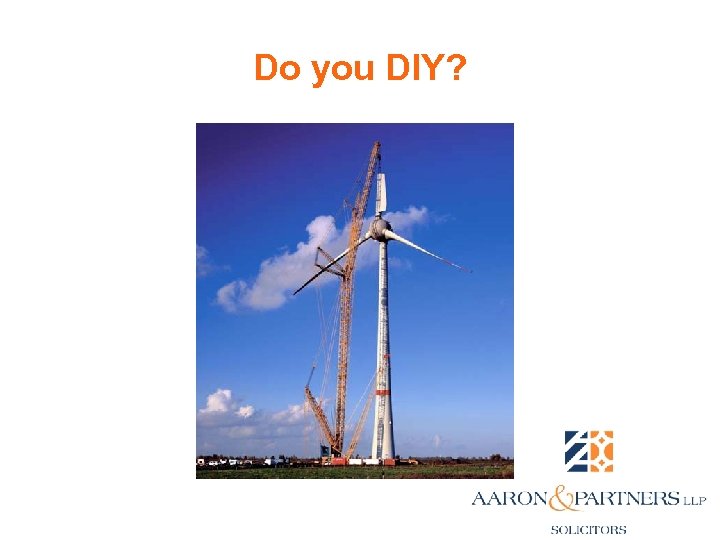
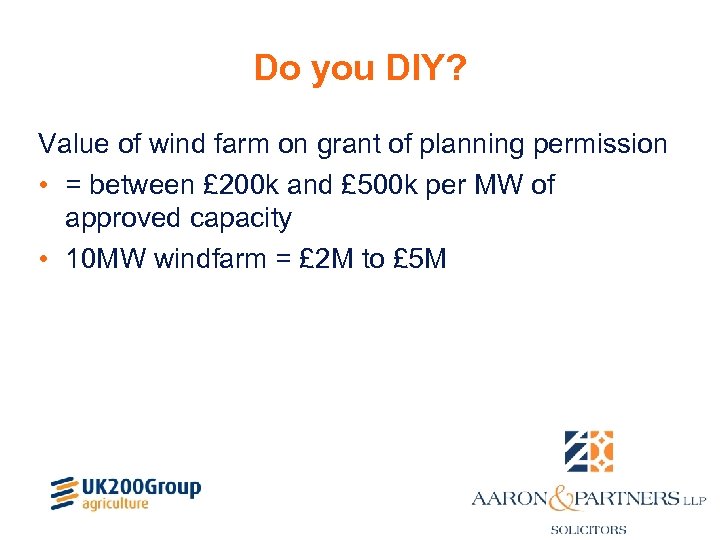 Do you DIY? Value of wind farm on grant of planning permission • = between £ 200 k and £ 500 k per MW of approved capacity • 10 MW windfarm = £ 2 M to £ 5 M
 Do you DIY?
 Do you DIY?
 Contact Details David Harries Partner Head of Renewable Energy david. harries@aaronandpartners. com Tel 01244 405527 Mobile 07970 916517 www. aaronandpartners. com
 UK 200 Agricultural Group Specialist Training Course Wednesday 23 June 2010
 Anaerobic Digestion “A local solution to a global problem” Farm Renewable Environmental Energy Ltd www. fre-energy. co. uk Tel: 0845 8330504
 The world is changing • Global warming. • Depletion of conventional energy resources. • Increasing world food demand. • Reduction of fertile land. • Financial Instability. “It is not the strongest of the species that survives, nor the most intelligent, but the one most responsive to change” - Charles Darwin
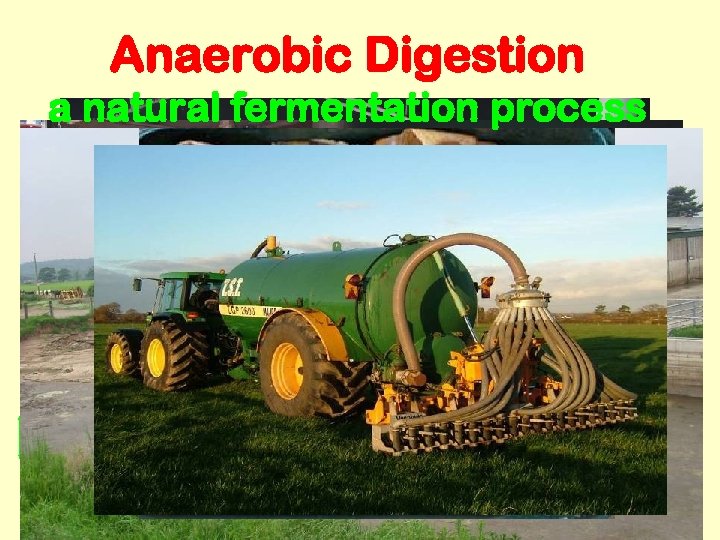 Anaerobic Digestion a natural fermentation process Biogas Renewable Electricity & Heat 38° C Bio Fertiliser Other organic matter Agitation
 Anaerobic Digestion √ A renewable energy process The electrical power is available 24 hours a day - 365 days a year i. e. it is not dependent upon the wind blowing or the water flowing. √ A waste management process √ A nutrient recycling process Cow slurry can be mixed 50: 50 with food waste, harvesting the energy, reducing; Landfill, Green house gas emissions, Odour (by 80%), BOD (by 90%) and killing most pathogens. AD reduces cattle Carbon Footprint by 20%. The end product (digestate) is an environmentally valuable organic fertiliser. Which will remove farm reliance upon energy hungry chemical fertilisers. 30% of the Carbon Footprint of food is down to artificial fertilisers. AD ticks all the environmental boxes
 ‘Waste’ Materials available for AD • The UK produces 110 million tonnes of organic waste. – 18 m tonnes food waste. – 2 m tonnes Sewage sludge. – 90 m tonnes of agricultural waste such as manure and slurry. DEFRA-DTI-Df. T (2007) AND Enviros (2008) • This could produce approximately 5% of UK energy demand. • The resultant material will displace energy hungry artificial fertiliser. 30% of the carbon footprint of food is down to artificial fertiliser. • 82% of the inputs are farm generated 100% of the outputs must be returned to farm land.
 On Farm AD options Just Animal Slurries • • Low cost, low energy yield. Captures methane, provides hot water, heating & power. 22% improvement in slurry performance. 90% reduction in BOD. Animal Slurries and Crops • Medium cost, medium energy output. • Improved fertiliser value. Animal slurries and food wastes • • High cost, high energy output. High nutrient value of fertiliser (will have a value in the future). Second revenue stream. (gate fees) Requires waste licences, permits and bio-security.
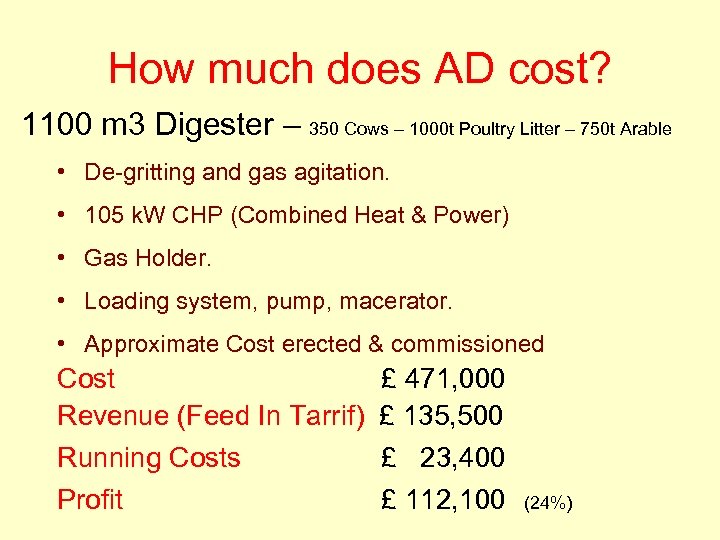 How much does AD cost? 1100 m 3 Digester – 350 Cows – 1000 t Poultry Litter – 750 t Arable • De-gritting and gas agitation. • 105 k. W CHP (Combined Heat & Power) • Gas Holder. • Loading system, pump, macerator. • Approximate Cost erected & commissioned Cost £ 471, 000 Revenue (Feed In Tarrif) £ 135, 500 Running Costs £ 23, 400 Profit £ 112, 100 (24%)
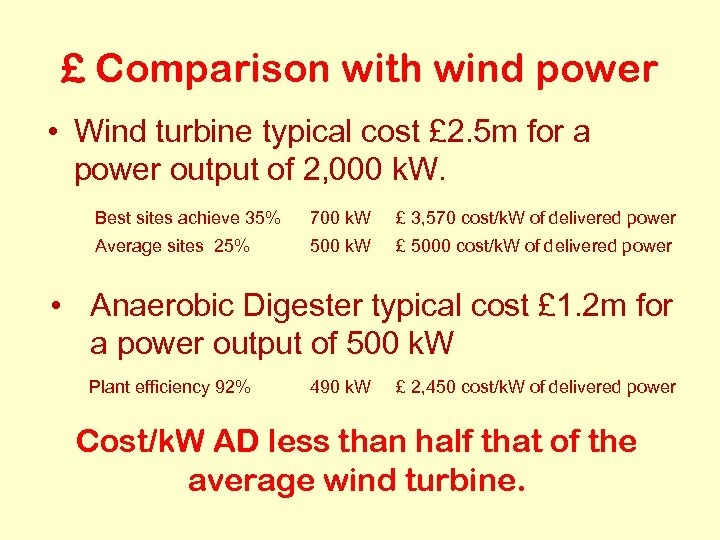 £ Comparison with wind power • Wind turbine typical cost £ 2. 5 m for a power output of 2, 000 k. W. Best sites achieve 35% 700 k. W £ 3, 570 cost/k. W of delivered power Average sites 25% 500 k. W £ 5000 cost/k. W of delivered power • Anaerobic Digester typical cost £ 1. 2 m for a power output of 500 k. W Plant efficiency 92% 490 k. W £ 2, 450 cost/k. W of delivered power Cost/k. W AD less than half that of the average wind turbine.
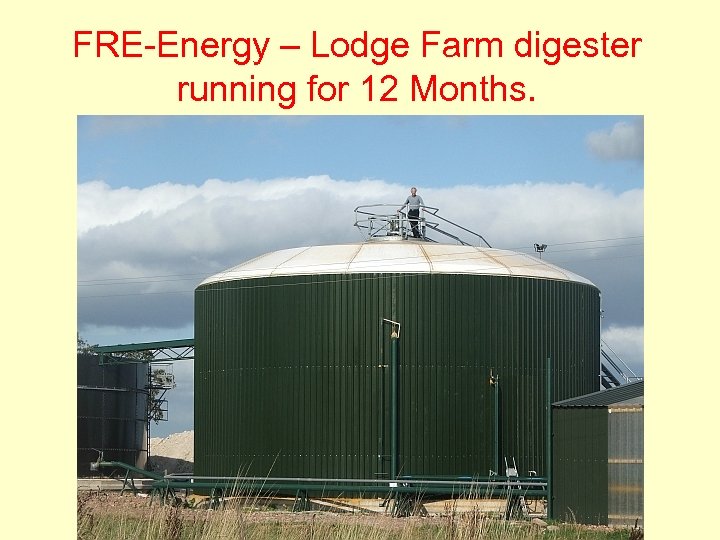 FRE-Energy – Lodge Farm digester running for 12 Months.
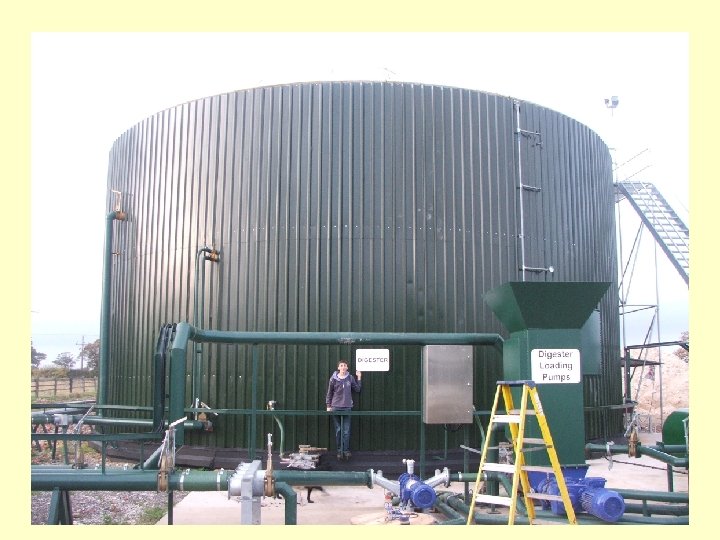
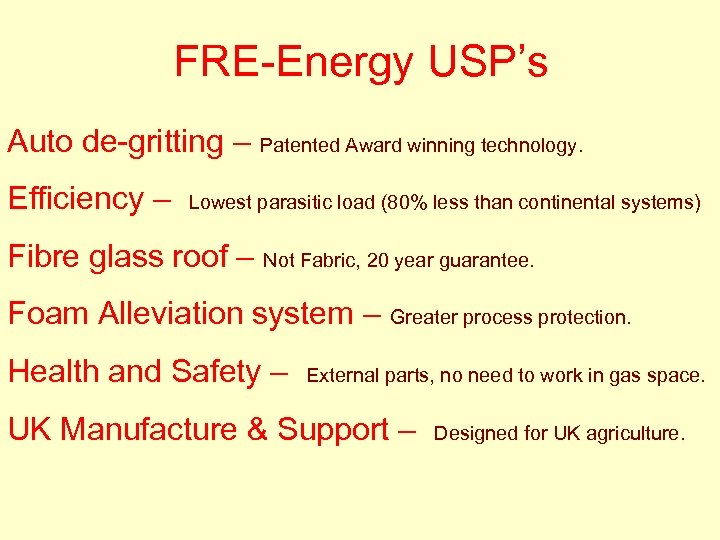 FRE-Energy USP’s Auto de-gritting – Patented Award winning technology. Efficiency – Lowest parasitic load (80% less than continental systems) Fibre glass roof – Not Fabric, 20 year guarantee. Foam Alleviation system – Greater process protection. Health and Safety – External parts, no need to work in gas space. UK Manufacture & Support – Designed for UK agriculture.
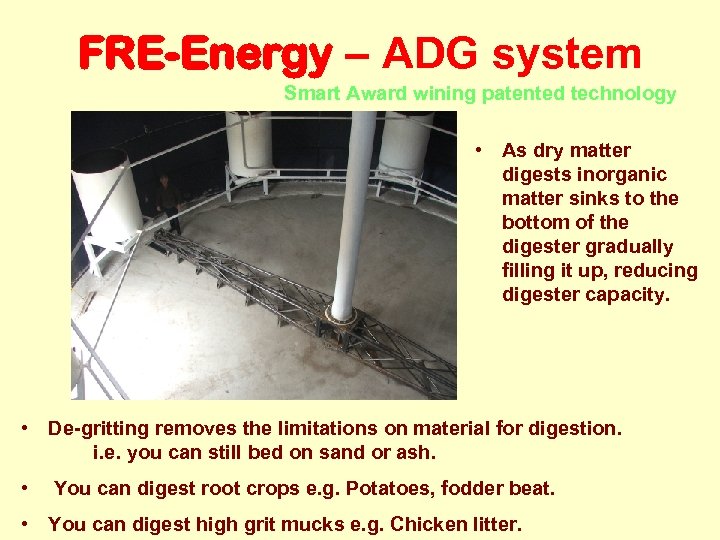 FRE-Energy – ADG system Smart Award wining patented technology • As dry matter digests inorganic matter sinks to the bottom of the digester gradually filling it up, reducing digester capacity. • De-gritting removes the limitations on material for digestion. i. e. you can still bed on sand or ash. • You can digest root crops e. g. Potatoes, fodder beat. • You can digest high grit mucks e. g. Chicken litter.
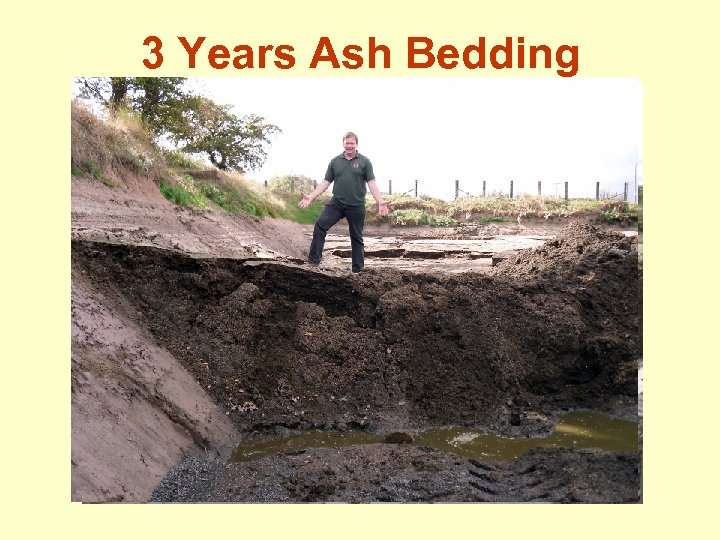 3 Years Ash Bedding
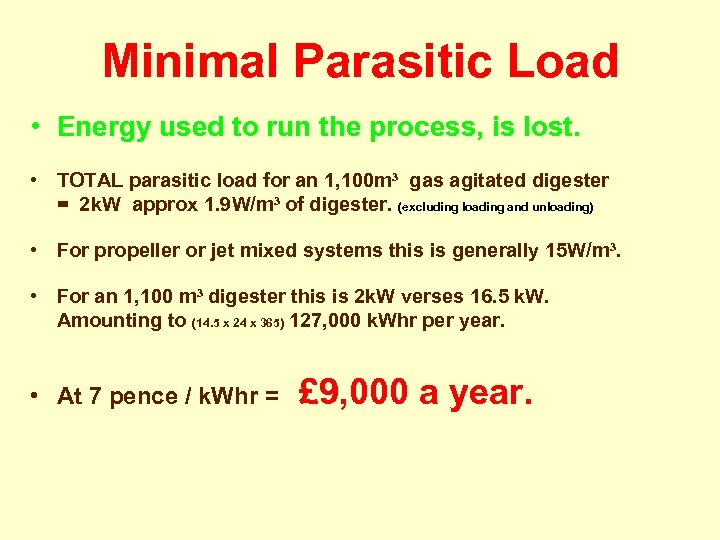 Minimal Parasitic Load • Energy used to run the process, is lost. • TOTAL parasitic load for an 1, 100 m³ gas agitated digester = 2 k. W approx 1. 9 W/m³ of digester. (excluding loading and unloading) • For propeller or jet mixed systems this is generally 15 W/m³. • For an 1, 100 m³ digester this is 2 k. W verses 16. 5 k. W. Amounting to (14. 5 x 24 x 365) 127, 000 k. Whr per year. • At 7 pence / k. Whr = £ 9, 000 a year.
 Health and Safety • There is no need to enter the gas space or break the gas seal to maintain any FRE-Energy digester parts. • Gas pumps are duplicated and external to the digester. • De-gritting arm is suspended from the digester roof with external bearings. All Serviceable Parts are external to the digester
 Benefits to Farming • The nutrients in Digestate are in a far more available form. There is between 20 & 25% better nutrient uptake. Improvement in fertiliser value for 350 Cattle £ 7, 700 pa • The AD process kills weed seeds and pathogens e. g: Foot & mouth. TB. Salmonella. Coliform Bacteria. … dna • The Process reduces odour by 80% and BOD by 90% • Digestate does not taint grass eliminating rejection by grazing animals. • Digestate from AD with added food / imported waste has far greater fertiliser value than straight slurry.
 How is the UK performing? • In the last 18 months, only 6 digesters have been commissioned in the UK and we are still sending food waste to landfill. • The UK target is to build 1, 000 by 2020. • In the last 5 years Germany has built 5, 000 AD plants producing renewable energy equivalent to one nuclear power station. • To meet our target we will have to start building systems, instead of doing pilot studies and commissioning reports.
 Why so few AD plants? • Historically, we have had North Sea Oil & Gas giving low energy costs and a high level of energy security. • The government is focused on single ‘big fixes’ i. e. Nuclear Power & Large off-shore wind farms. • Lack of joined up thinking from the regulatorsthey look at problems in isolation. Only a handful of Anaerobic Digesters in the UK due to a lack of effective government support and the blinkered approach of planners and regulators.
 AD versus the three P’s Politicians. • Are vocal in their support of AD, however the message is not getting through to the administrators. Planners. • Currently view AD as an industrial process best suited to industrial estates and not rural locations. Power companies. • Are keen to encourage renewable generation but make it very difficult and expensive to connect to the national grid. – (Turkeys voting for Christmas).
 Final comment We'll be up to our necks in water, fireballs and hurricanes will rage across the sky, but there'll still be men in suits telling us we've filled the form in incorrectly. Unfortunately, like cockroaches, I fear they will be the ones to survive climate change!
 Anaerobic Digestion “A local solution to a global problem” Farm Renewable Environmental Energy Ltd www. fre-energy. co. uk Tel: 0845 8330504
 Future generations will look back at the 20 th century with embarrassment. The energy resource of 150 million years of planetary evolution has been squandered in a little over 100 years. It is our responsibility to embrace renewable energy solutions sooner rather than later.
 Carbon will become the currency of the 21 st Centaury In the post oil age, agriculture will play a key role in both feeding and powering the planet. The answers to the problems lie in a multitude of localised solutions; there is no single big fix. The swear words of the next generation will be: ‘Globalisation & Centralisation’
 Anaerobic Digestion “A local solution to a global problem” Farm Renewable Environmental Energy Ltd www. fre-energy. co. uk Tel: 0845 8330504
 UK 200 Agricultural Group Specialist Training Course Wednesday 23 June 2010
 A BRISK CANTER THROUGH CAPITAL TAX DEVELOPMENTS FOR MIXED AGRICULTURAL ESTATES by Adrian Baird CLA Chief Taxation Adviser
 (1) Scope • IHT reliefs APR & BPR – but mainly APR • Within IHT APR – mainly on occupation – new IHTM and Case Law have clarified much of the definition of agricultural property • The continued importance of APR for CGT hold-over relief • Surrender and re-grants & CGT
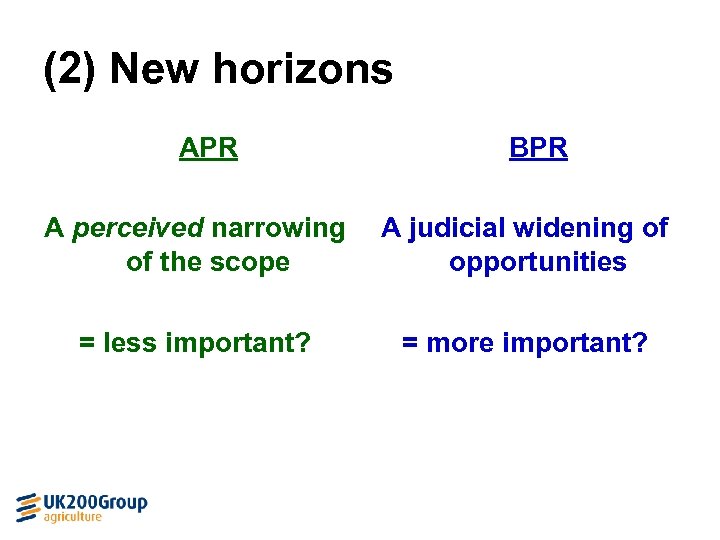 (2) New horizons APR BPR A perceived narrowing of the scope A judicial widening of opportunities = less important? = more important?
 (3) Recent APR case law • The ‘definitional’ problem – Starke • Indicia of character appropriateness – Dixon, Higginson, Antrobus 1 (and via Antrobus 1 to Korner) • The problem of the predicate – Rosser 1 (& Williams) • What is a farmhouse? – Arnander
 (4) What APR case law can do • Tell us how to judge whether a house is a farmhouse • Tell us what is the predicate of the character test • Tell us what factors (indicia) may suggest a farmhouse is of an appropriate character
 (5) What APR case law can’t do • When does agricultural property satisfies the ‘occupation test’ in the common, borderline cases – Eg. , where the farmer is absent, or in ill-health or quasi-retired
 (6) Recent BPR case law You never had it so good… • BPR can apply to the transfer of assets comprised in a business – the ‘loss to donor’ – Nelson Dance • Not wholly or mainly holding or making investments – Farmer, George
 (7) Recent BPR case law Just perhaps it was too good… • Although active involvement not required for BPR this may lead to the holding of investments – Mc. Call • What comes first – the ‘business’ or ‘excluded property’? – Brander
 (8) APR is still important • APR applies to farmhouses – Brave or stupid? 9 th Marquees of Hertford • The extent of BPR on investment property may be curtailed – Brander may answer this & Mc. Call has already made cautions • APR status helps CGT – the ‘agricultural extension’ to holdover relief (now apt for FHL)
 (9) APR: The basic structure APR takes priority over BPR and applies to • property • in UK, Channel Islands & Isle of Man, and (22 April 2009) property in EEA states • @ 50% or 100% • on that part “…of the value transferred by a transfer of value [that] is attributable to the agricultural value of agricultural property…” • if, but only if, the occupation test is satisfied. APR is given before exemptions & grossing up
 (10) The occupation test Throughout the period immediately before the transfer the agricultural property must be occupied for the purposes of agriculture 2 years by transferor 7 years transferor must own property by any person
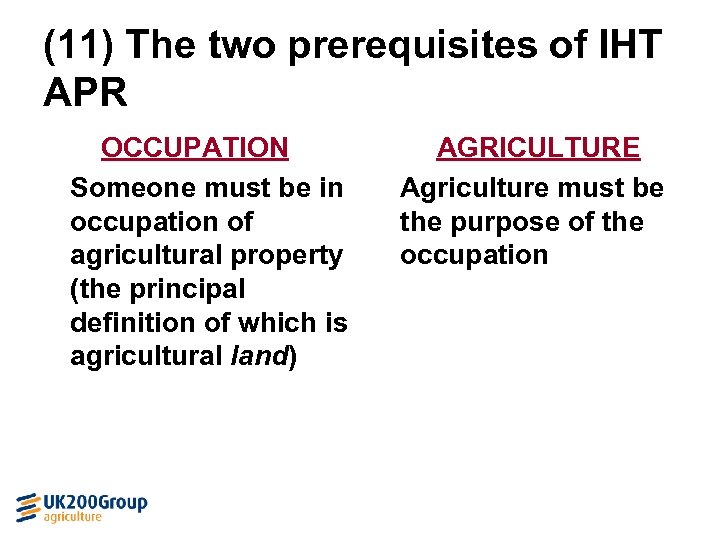 (11) The two prerequisites of IHT APR OCCUPATION Someone must be in occupation of agricultural property (the principal definition of which is agricultural land) AGRICULTURE Agriculture must be the purpose of the occupation
 (12) Definition of agriculture? APR property = (primarily) ‘…occupation of agricultural land for purposes of agriculture… WHAT IS AGRICULTURE? IT INCLUDES • Breeding and rearing of horses (+ grazing of same) on a stud farm • Short rotation coppicing (only if in UK) IHTA 1984 ss 115(4) & 117 & FA 2005 s 154
 (13) Definition of agriculture? ‘Agriculture’ is not further defined Where land is used for arable or pastoral farming then it will be used for agriculture IHTM 24062
 (14) Farming as a trade • All farming or market gardening conducted within the UK is treated as a trade for IT & CT – All UK farming conducted by same person is a single trade – Farming conducted by a partnership is separate from farming conducted by individual partners ITTOIA 2005 s 9(1) & CTA 2009 s 36(1)
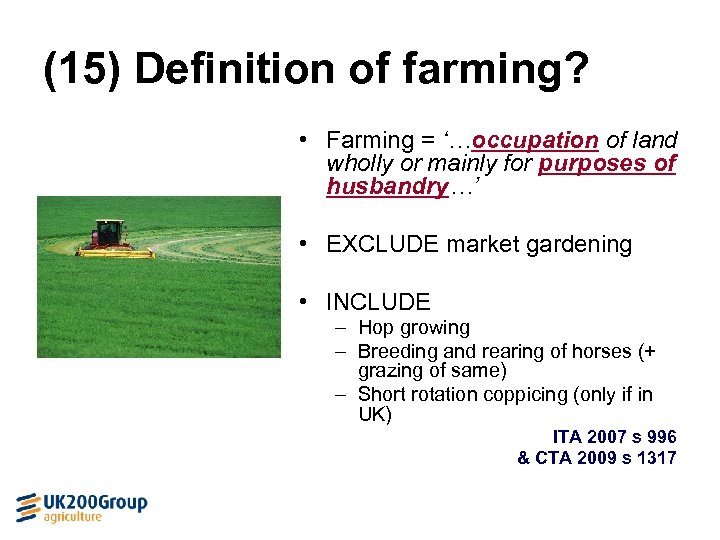 (15) Definition of farming? • Farming = ‘…occupation of land wholly or mainly for purposes of husbandry…’ • EXCLUDE market gardening • INCLUDE – Hop growing – Breeding and rearing of horses (+ grazing of same) – Short rotation coppicing (only if in UK) ITA 2007 s 996 & CTA 2009 s 1317
 (16) The two prerequisites of farming OCCUPATION For a person to be farming they must be in occupation of land that is not market garden land HUSBANDRY Husbandry must be the main purpose of the occupation
 (17) An interim conclusion IF land is occupied for husbandry THEN the land will satisfy the APR occupation test
 (18) Husbandry • Husbandry = every industry conducted by a husbandsman • Husbandsman = someone who tills or cultivates the soil.
 (19) Husbandry & case law • Cavan (Industrial & Provident society) bought in milk from members. • Cavan separated out cream, churned it into butter and then sold the butter • The buttermilk and skimmed milk returned to members • Is this husbandry? Cavan Central Co-operative Agriculture and Dairy Society Ltd [1917] 12 TC 1
 (20) Husbandry: Cavan case • Husbandry = every industry conducted by a husbandsman = someone who tilled the soil. – but may also include an activity conducted on land whose ‘…manifest object [is] the benefit of mankind and the support of life. . . ’ • Thomas Tusser’s 500 Points of Good Husbandry (originally published 1557) remains valuable. • Many acts of husbandry have ceased to be so because ‘ under different social and economic conditions…’ they are no longer performed by husbandsmen
 (21) Key point • ‘husbandry’ is a word of very wide meaning • limitation is that the husbandry activity has to be carried on by someone who tills or cultivates (ie, performs an activity upon) the soil
 (22) Consequences Activities normally performed by a husbandsman can be husbandry and may thereby be agriculture. Examples: • Short-rotation coppice • Growing biomass crops
 (23) APR Consequences This explanation is consistent with IHTM 24061 • which links ‘agriculture’ first to the production of food and the tending of livestock; but then • extends ‘agriculture’ to the sort of activities that an occupier of land using it for food production, &c. , would additionally perform
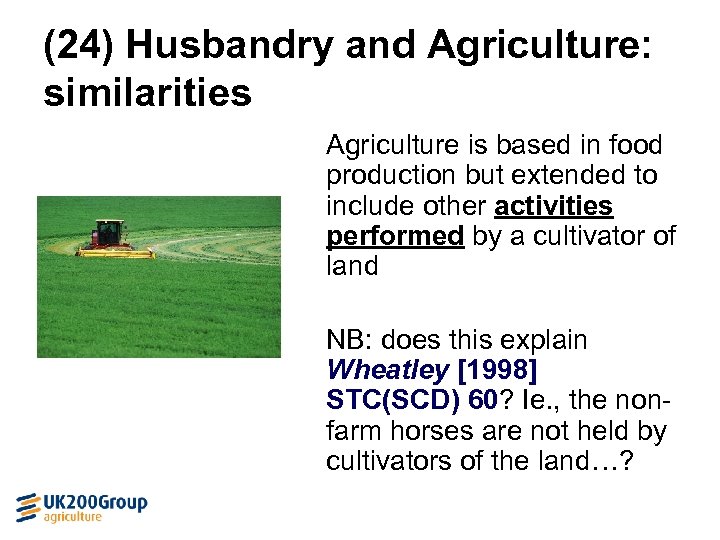 (24) Husbandry and Agriculture: similarities Agriculture is based in food production but extended to include other activities performed by a cultivator of land NB: does this explain Wheatley [1998] STC(SCD) 60? Ie. , the nonfarm horses are not held by cultivators of the land…?
 (25) The meaning of ‘occupation’ • Long correspondence between CLA and IR on meaning in relation to share farming • IR initially contended that only the share operator (& not the landowner) could be in occupation of the land & thereby farming the land
 (26) One or more occupiers? Dawson v Counsell Only one occupier • (normally) person with exclusive possession • (exceptionally) paramount occupier = person with paramount use at the requisite time [1938] 22 TC 149 Back v Daniels May be more than one occupier where two or more persons have simultaneous paramount use. [1924] 9 TC 183
 (27) More than one occupier • After receiving a Counsel’s opinion, IR agree more than one occupier possible • The power to exclude others ‘persuasive’ but NOT essential BIM 55055 • Person who farms is in occupation meaning of ‘farming’ imported into APR IHTM 24072 & 24083
 (28) More than one occupier The 1991 agreement now in BIM 55055 The power to exclude others ‘persuasive’ but NOT essential
 (29) An occupier of land For a person to be an occupier of land: • the person must perform some activity in the capacity as user of the land; AND • The person must have a degree of permanent physical presence or possession – but, by analogy to tenant of house under Rent Act, this need not be continuous presence or possession (see Ticker v Hearn [1960] 1 WLR 406)
 (30) Occupation and old case law FORSYTH-GRANT Grassland can be occupied by the owner and be subject to seasonal agreements provided the owner performs acts of husbandry commensurate with growing the grass as a crop. [1943] 25 TC 369 RATIO • Landowner was performing some activity – as user – with degree of permanent physical presence and possession • The activity performed was husbandry NB: Court conflate ‘husbandry’ and ‘agriculture’
 (31) Extending occupation IHTM 24072 • Partnership in occupation each partner in occupation • Company in occupation controlling shareholder in occupation • Beneficiary with qualifying interest in possession is in occupation
 (32) Atkinson & occupation • Partnership occupied farm under tenancy to individual partners • Senior partner occupied bungalow HELD: Partnership occupation of farm sufficient to satisfy s 117(b) even though senior partner may not satisfy s 117(a) NB: Subject to appeal
 (33) Implications for elderly, &c. • The occupation test applies throughout period immediately before transfer • The transferor will often be elderly and/or unwell
 (34) Implications for elderly, &c. ‘…a temporary cessation of activity. . ’ may not prevent relief provided farmhouse remains ‘…functionally attached to the farm…’ But a need to be objective in assessing illness
 (35) Post mortem Watch out for • Death Certificates stating ‘Retired’ • Lack of records on the deceased’s level of activity… • …or records that show it was minimal!
 (36) Post mortem • Can you supply extensive and detailed analysis of the activities actually performed? • Remember question on the land may be directed to the predicate of the character test • If reliance placed upon s 117(b) then no BPR
 (37) Residential care If landowner goes into residential care then – ASSESS the likelihood of return realistically – THEN consider whether younger generation should move into the house quickly
 (38) Survivors Common scenario of surviving widow • ASSESS whether performing an activity on the land (NB bookkeeping is not such an activity…. ) • THEN consider how the family might relocate the survivor (if need be)
 (39) The paradox of non-occupation Where the farmhouse is NOT occupied • ASSESS whether family members can use the house as a functional farmhouse • NB: they do not have to ‘move in’ but the elderly/infirm owner may have to ‘move out’
 (40) The real message of Mc. Call? Do NOT delay making transfers of property that may soon not qualify for either APR or BPR.
 (41 NB) IHT clawback on lifetime gifts PETS Clawback operates to withdraw relief and affect cumulative total Chargeable transfers Clawback operates for purpose of additional tax and does not affect cumulative total if within NRB @ death
 (41) The ‘right’ strategy • Is additional tax likely? – If unlikely gift into settlement • Reliefs locked in & clawbacks unlikely • CGT hold-over under s 260 • Relevant property regime may be comparatively benign – If likely then CGT becomes a factor for a PET • This is the key area where the CGT hol-over relief ‘agricultural extension’ may help
![(42) And finally… Griffiths [2008] STC 776 Make gifts void where: • donor was](https://present5.com/presentation/3381b7fd297fd64e0e20856d8d8d2d92/image-137.jpg "(42) And finally… Griffiths [2008] STC 776 Make gifts void where: • donor was") (42) And finally… Griffiths [2008] STC 776 Make gifts void where: • donor was acting under a mistake of ‘true facts’ (eg. , having undiagnosed terminal cancer) • donor would have acted differently if true facts were known
(42) And finally… Griffiths [2008] STC 776 Make gifts void where: • donor was acting under a mistake of ‘true facts’ (eg. , having undiagnosed terminal cancer) • donor would have acted differently if true facts were known
 (43) Specific hold-over & use Under specific hold-over relief the asset must be in trade, &c. , USE at time of disposal But does this mean the whole asset has to be so used? TCGA 1992 s 165(2)(a) CG 66950
 (44) the 2 apportionment hold-over relief rules 1. (General rule) where any asset has not been wholly used during ownership (includes pre 31 iii 82 periods) 2. (Specific rule) where a building or structure not used for any substantial part of ownership
 (45) The value of the ‘agricultural extension’ Apportionments do not apply to where the ‘agricultural extension’ operates – – not in trade use Comprises agricultural property qualifying for APR important implications for part disposals and for use of alternative basis and for whether gift is made as PET or not!
 (46) Let (residential) property The ‘agricultural extension’ and its implications for apportionments are important where let, non-agricultural property (eg. , residential property) is gifted as a PART-DISPOSAL of an asset. Where the part-disposal includes let agricultural property the consequences are significant.
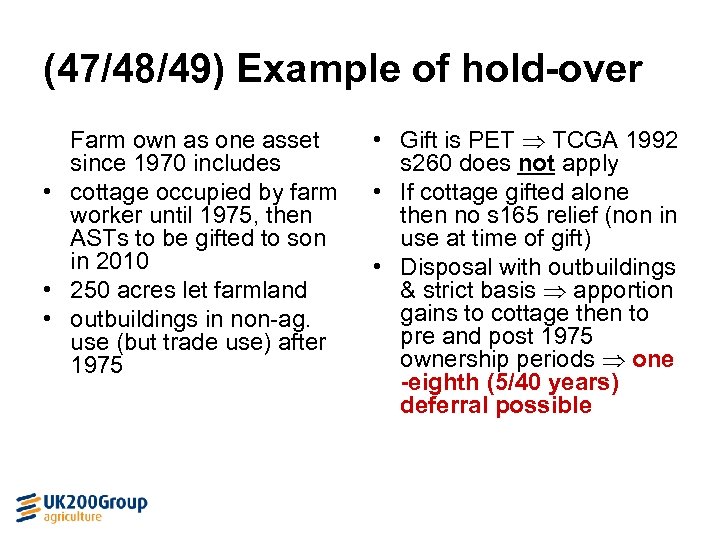 (47/48/49) Example of hold-over Farm own as one asset since 1970 includes • cottage occupied by farm worker until 1975, then ASTs to be gifted to son in 2010 • 250 acres let farmland • outbuildings in non-ag. use (but trade use) after 1975 • Gift is PET TCGA 1992 s 260 does not apply • If cottage gifted alone then no s 165 relief (non in use at time of gift) • Disposal with outbuildings & strict basis apportion gains to cottage then to pre and post 1975 ownership periods one -eighth (5/40 years) deferral possible
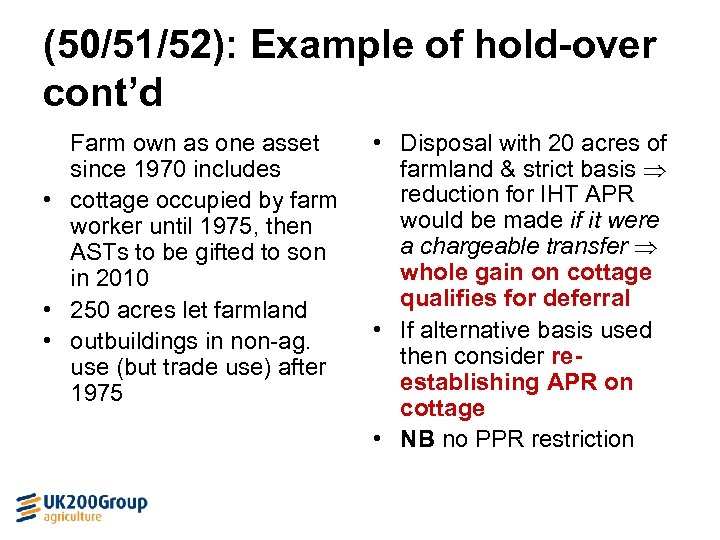 (50/51/52): Example of hold-over cont’d Farm own as one asset since 1970 includes • cottage occupied by farm worker until 1975, then ASTs to be gifted to son in 2010 • 250 acres let farmland • outbuildings in non-ag. use (but trade use) after 1975 • Disposal with 20 acres of farmland & strict basis reduction for IHT APR would be made if it were a chargeable transfer whole gain on cottage qualifies for deferral • If alternative basis used then consider reestablishing APR on cottage • NB no PPR restriction
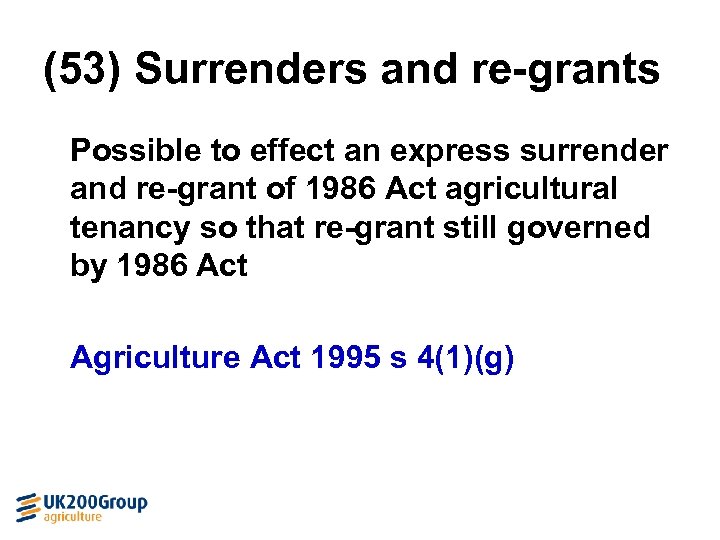 (53) Surrenders and re-grants Possible to effect an express surrender and re-grant of 1986 Act agricultural tenancy so that re-grant still governed by 1986 Act Agriculture Act 1995 s 4(1)(g)
 (54) CGT implications for tenant? Does tenant’s surrender (disposal) give rise to a significant capital gain?
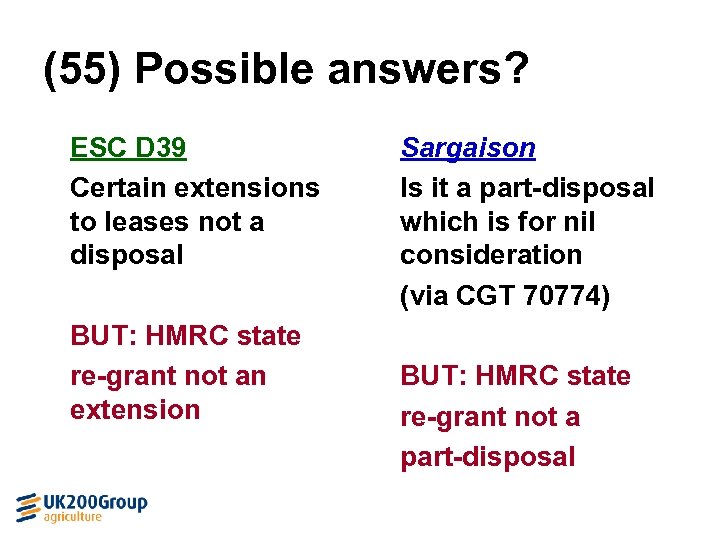 (55) Possible answers? ESC D 39 Certain extensions to leases not a disposal BUT: HMRC state re-grant not an extension Sargaison Is it a part-disposal which is for nil consideration (via CGT 70774) BUT: HMRC state re-grant not a part-disposal
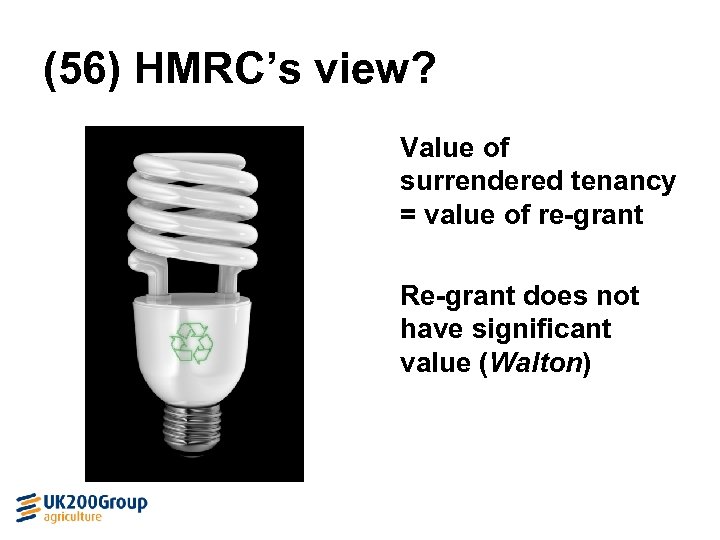 (56) HMRC’s view? Value of surrendered tenancy = value of re-grant Re-grant does not have significant value (Walton)
 THANK YOU FOR YOUR ATTENTION Adrian Baird
 UK 200 Agricultural Group Specialist Training Course Wednesday 23 June 2010
 Gruesome Tales from the Countryside
 Midsomer Murders? - Gruesome Tales from the Countryside Simon Morgan – Fellow of the Agricultural Law Association – Bright & Sons, Witham, Essex – 01376 512338
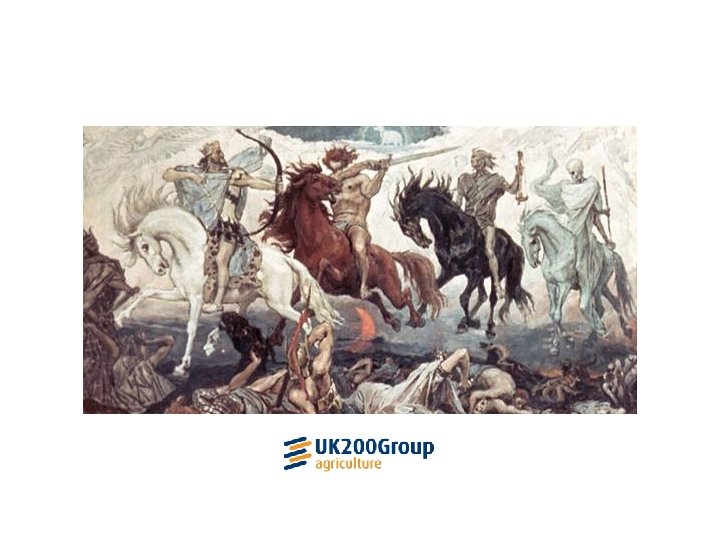
 Wills and Lasting Powers of Attorney
 Gruesome Tales from the Countryside
 Adverse Possession Continuous user as of right for 12 years – un-registered land - 10 years for registered land
 Section 31(6) Highways Act 1980 Map and Statement valid for 10 years
 Village Greens Significant number of locals using an area for sports or past times – 20 year’s use as of right – no 31(6) remedy
 Gruesome Tales from the Countryside
 Mc. Kaskie v Cameron (2009)
 Risk Assessment Take advice
 Gruesome Tales from the Countryside
 Criminal Justice and Public Order Act 1994 Sections 61 and 62 A
 Animal Welfare Act 2006
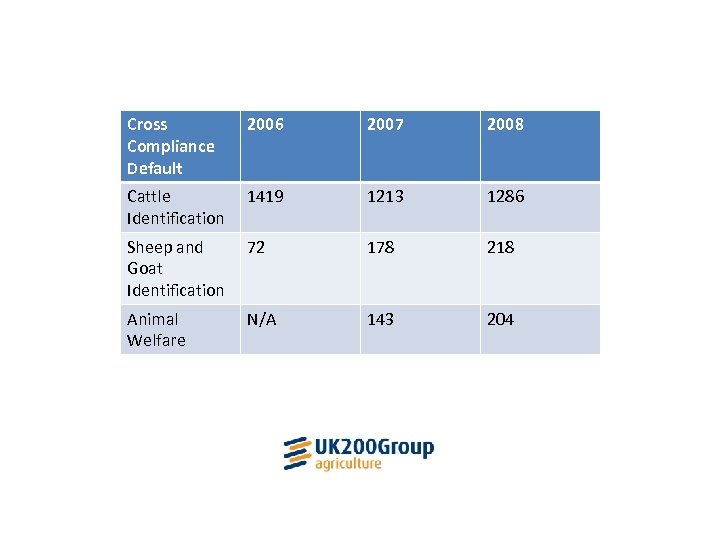 Cross Compliance Default 2006 2007 2008 Cattle Identification 1419 1213 1286 Sheep and Goat Identification 72 178 218 Animal Welfare N/A 143 204
 The End
 UK 200 Agricultural Group Specialist Training Course Wednesday 23 June 2010
 UK 200 Group Agriculture 23 rd June 2010 James O’Mahony Head of Agribusiness
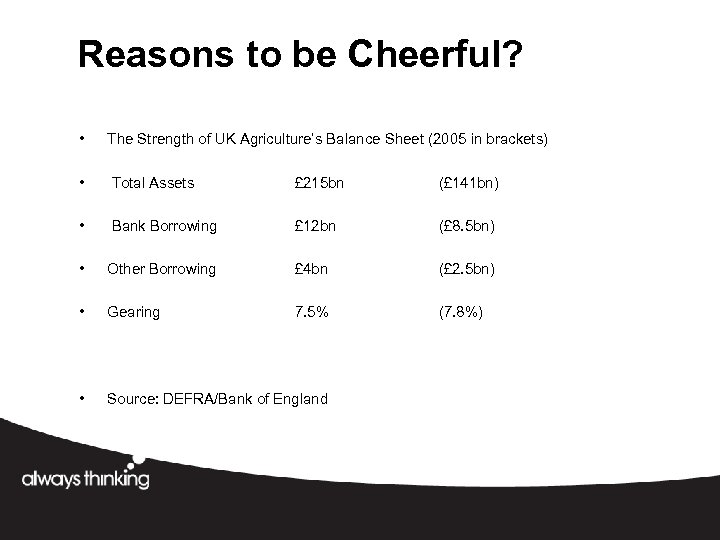 Reasons to be Cheerful? • The Strength of UK Agriculture’s Balance Sheet (2005 in brackets) • Total Assets £ 215 bn (£ 141 bn) • Bank Borrowing £ 12 bn (£ 8. 5 bn) • Other Borrowing £ 4 bn (£ 2. 5 bn) • Gearing 7. 5% (7. 8%) • Source: DEFRA/Bank of England
 The P&L Account • Sector by Sector • • • Wide range of performance in each sector. Some common trends Scale / Size • Profitability as a prime driver of business? • Impact of non – agricultural incomes • New income Generating opportunities
 What has changed? • Permanent • • Need to price for risk Cash flow focus- requirement for customer ownership Better business management Business Banking is not just order taking – a partnership as trusted adviser • Temporary ( maybe ) • • Increased Cost of Funds ( Libor, deposit rates and cost of capital ) Market Liquidity Increase in difficulty in debt servicing and repayment (for some) Effects of global recession
 What has changed? (2) • Different Banks are in different positions and have different lending and pricing policy responses from each other and from the past. • Capital management , risk appetite , reward , terms & conditions have changed ( substantially in some cases ). • Changes in team structures for some lenders. • Fewer Players in the Market (will they return? )
 What are we looking for? • C – character • A – ability • M – Means • P – Purpose • A – Amount • R – Repayment • I – Insurance
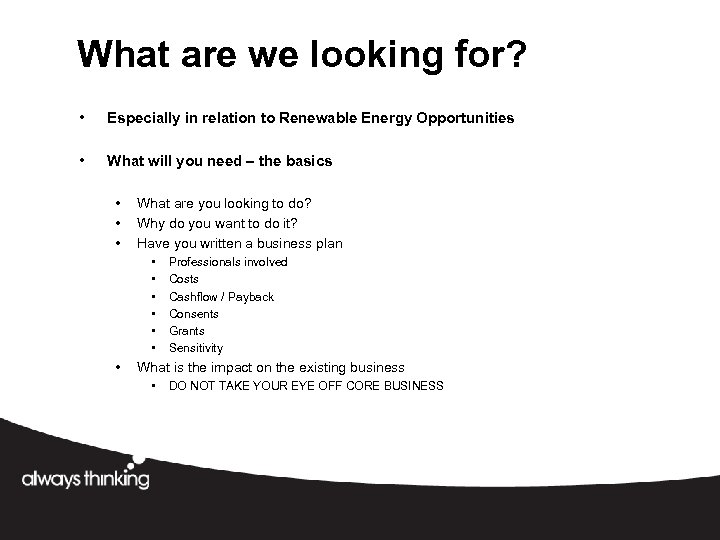 What are we looking for? • Especially in relation to Renewable Energy Opportunities • What will you need – the basics • • • What are you looking to do? Why do you want to do it? Have you written a business plan • • Professionals involved Costs Cashflow / Payback Consents Grants Sensitivity What is the impact on the existing business • DO NOT TAKE YOUR EYE OFF CORE BUSINESS
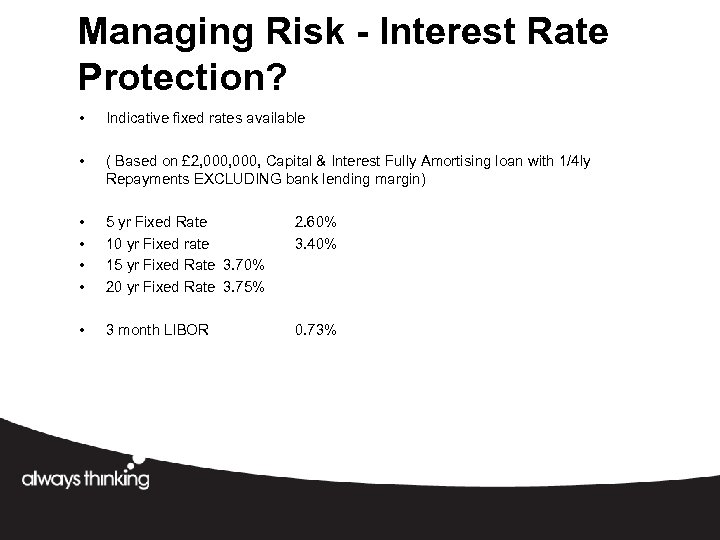 Managing Risk - Interest Rate Protection? • Indicative fixed rates available • ( Based on £ 2, 000, Capital & Interest Fully Amortising loan with 1/4 ly Repayments EXCLUDING bank lending margin) • • 5 yr Fixed Rate 10 yr Fixed rate 15 yr Fixed Rate 3. 70% 20 yr Fixed Rate 3. 75% 2. 60% 3. 40% • 3 month LIBOR 0. 73%
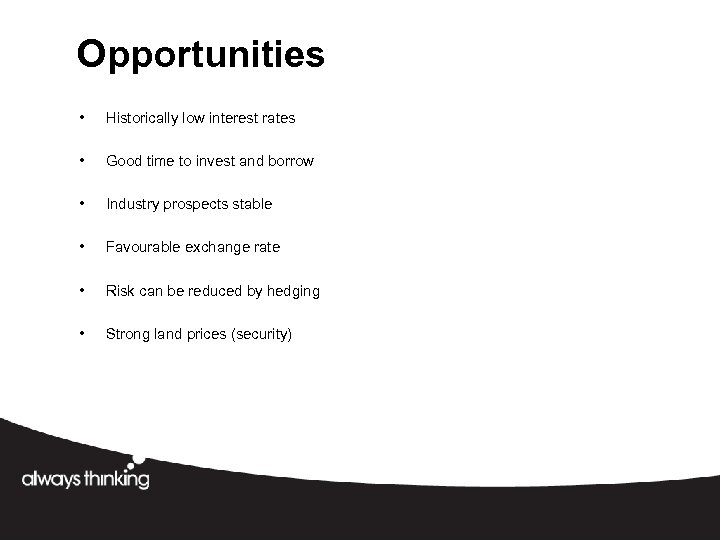 Opportunities • Historically low interest rates • Good time to invest and borrow • Industry prospects stable • Favourable exchange rate • Risk can be reduced by hedging • Strong land prices (security)
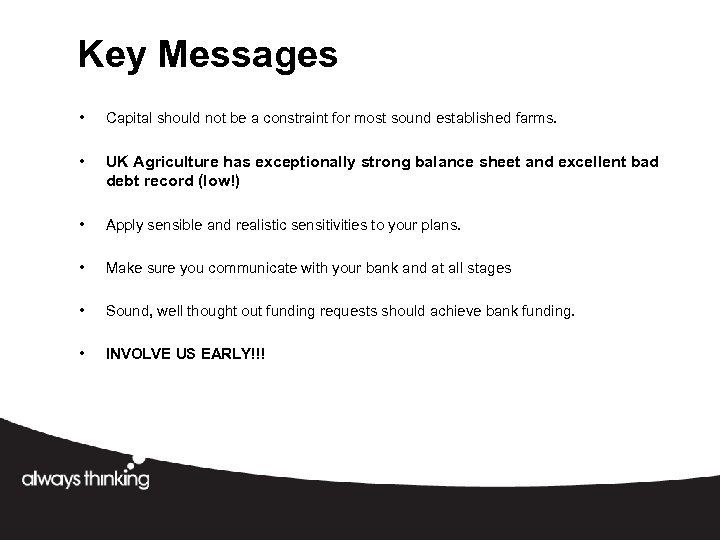 Key Messages • Capital should not be a constraint for most sound established farms. • UK Agriculture has exceptionally strong balance sheet and excellent bad debt record (low!) • Apply sensible and realistic sensitivities to your plans. • Make sure you communicate with your bank and at all stages • Sound, well thought out funding requests should achieve bank funding. • INVOLVE US EARLY!!!