 Скачать презентацию UIUC Accelerator Physics Group by Deborah Errede ICAR
cf5019d2718412241d6c4d940a91e859.ppt
- Количество слайдов: 41



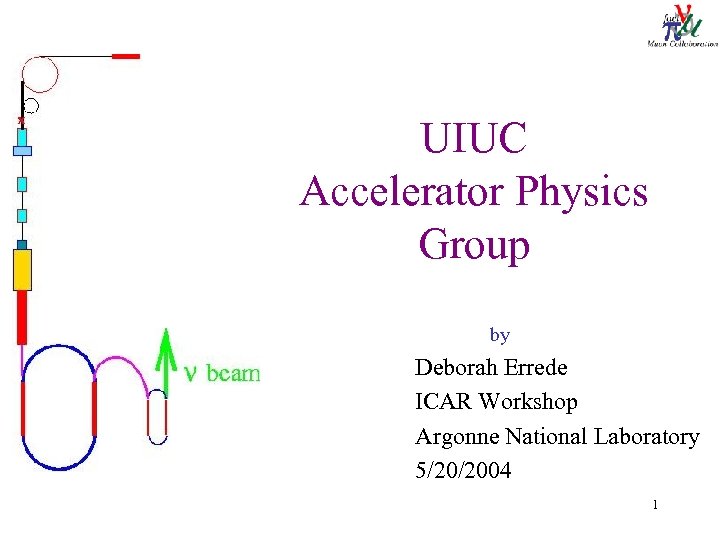
UIUC Accelerator Physics Group by Deborah Errede ICAR Workshop Argonne National Laboratory 5/20/2004 1
What and Who are We? 1) The Muon Collaboration - Neutrino Factories, Muon Colliders - institutions * (USA, China, Europe(CERN), Germany, Great Britain, Israel, Italy, Japan, South Korea, Russia and California) - cooling channel, targetry, machine simulations and design A) Mucool Experiment - Muon Cooling Channel absorber, high field NCRF cavity, magnet, machine simulations and design - Mucool Test Area (MTA) equipment for experimental hall, shielding studies 2
What and Who are We? 1) The Muon Collaboration --------------- B) MICE - International Muon Ionization Cooling Experiment 3
What and Who are We? *The Muon Collaboration – Argonne National Laboratory Brookhaven National Laboratory Budker Institute of Nuclear Physics CERN Columbia University Cornell University DESY Zeuthen Fermi National Accelerator Laboratory Forschungszentrum Karlsruhe Illinois Institute of Technology Imperial College London Indiana University INFN-LNF Joint Institute for Nuclear Research, Dubna Kernfysisch Versneller Instituut, Rijksuniversiteit Groningen Lawrence Berkeley Laboratory Michigan State University Northern Illinois University Northwestern University 4
What and Who are We? *The Muon Collaboration – Oak Ridge National Laboratory Osaka University Oxford University Pohang University of Science and Technology Princeton University Rutherford Appleton Laboratory Tech-X Corporation Tel Aviv University / BNL Thomas Jefferson National Laboratory University of California, Berkeley University of California, Davis University of California, Riverside University of Illinois, Urbana-Champaign University of Iowa University of Mississippi University of Wisconsin 5
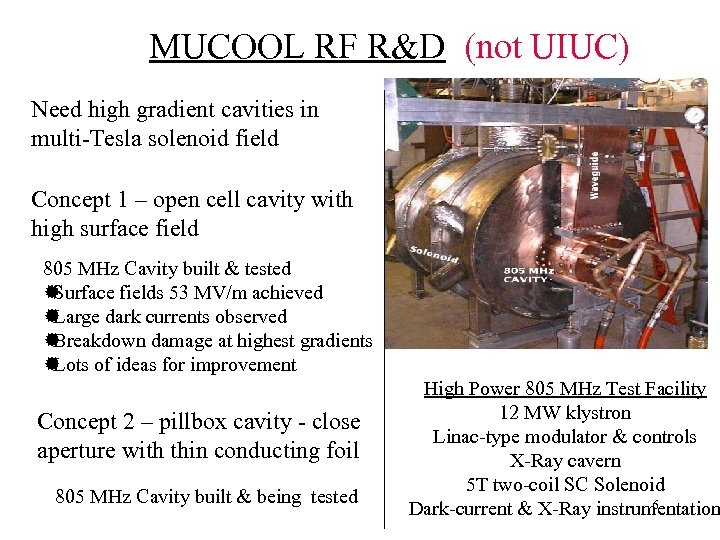
MUCOOL RF R&D (not UIUC) Need high gradient cavities in multi-Tesla solenoid field Concept 1 – open cell cavity with high surface field 805 MHz Cavity built & tested ® Surface fields 53 MV/m achieved ® Large dark currents observed ® Breakdown damage at highest gradients ® Lots of ideas for improvement Concept 2 – pillbox cavity - close aperture with thin conducting foil 805 MHz Cavity built & being tested High Power 805 MHz Test Facility 12 MW klystron Linac-type modulator & controls X-Ray cavern 5 T two-coil SC Solenoid 6 Dark-current & X-Ray instrumentation
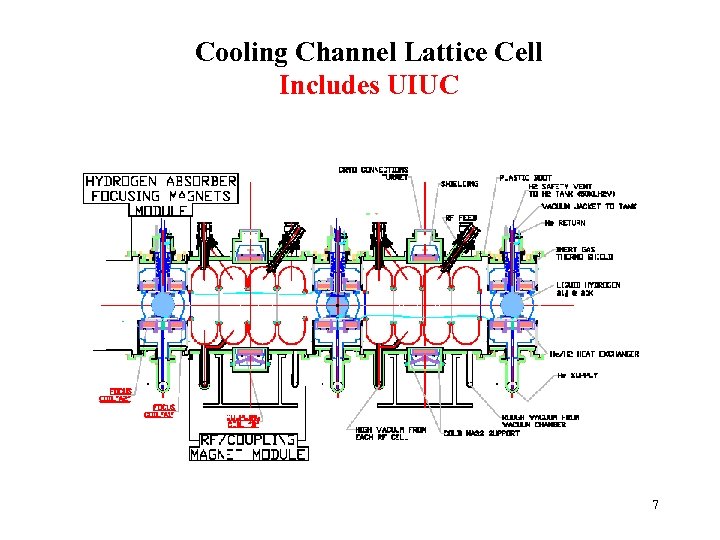
Cooling Channel Lattice Cell Includes UIUC 7
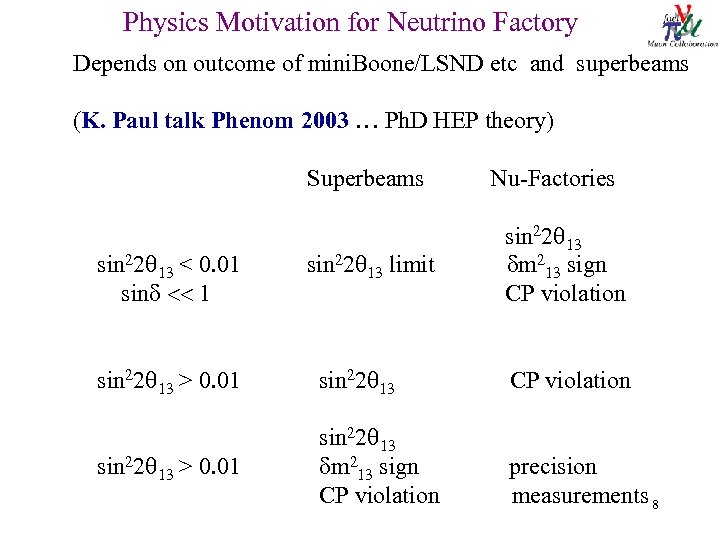
Physics Motivation for Neutrino Factory Depends on outcome of mini. Boone/LSND etc and superbeams (K. Paul talk Phenom 2003 … Ph. D HEP theory) Superbeams Nu-Factories sin 22 q 13 < 0. 01 sin 22 q 13 limit m 213 sign sin << 1 CP violation sin 22 q 13 > 0. 01 sin 22 q 13 CP violation sin 22 q 13 > 0. 01 m 213 sign precision CP violation measurements 8
What and Who are We? 3) UIUC Group: present Debbie Errede (principal investigator) Zachary Conway – grad student (accelerator physics) Gefei Qian – grad student (condensed matter theory) Mike Haney – electrical engineer Dave Lesny – Mucool Cluster manager Larry Nelson – Mucool Cluster manager Kevin Paul – computational accelerator theorist Igor Rakhno – computational nuclear theorist *George Gollin – hep experimental physicist 9
What and Who are We? 3) UIUC Group: past Jason Crnkovic – NSF REU student Lauren Ducas – UIUC undergrad Stephanie Majewski – UIUC undergrad 10
What and Who are We? UIUC Group: projects Cooling Channel Energy Absorber – Conway, Crnkovic, Ducas, Errede, Haney, Majewski, Qian - absorber window testing - absorber instrumentation and daq - temperature probe R&D (fiber optic transducers at cryogenic temperatures and calibration) - absorber flow tests, heat tests, beam tests Mucool Computation Cluster – Lesny, Nelson - 15 -20 2 to 3 GHz dual processor boxes 11
What and Who are We? UIUC Group: projects Mucool Test Area (experimental) – Errede, Haney, Qian RF Cavity dark current measurements – Ducas SCRF Development – Conway (UIUC grad student) (this is Argonne Natl Lab with Ken Shepard et al) * Tesla Damping Ring kicker magnet tests (George Gollin-UIUC) 12

Absorber Window Program UIUC’s contributions include: -design and implementation of a data acquisition system for stress/strain testing, pressure/burst testing. [testing mode changed to photogrametry (new technique) which required verification by standard strain gauge techniques] -engineering for construction of pressure regulation apparatus -undergraduate (Stephanie Majewski) data handling and analysis 13
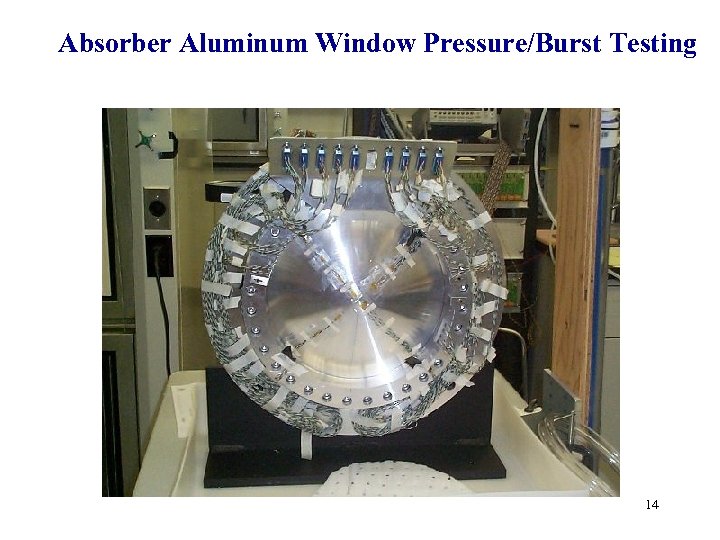
Absorber Aluminum Window Pressure/Burst Testing 14
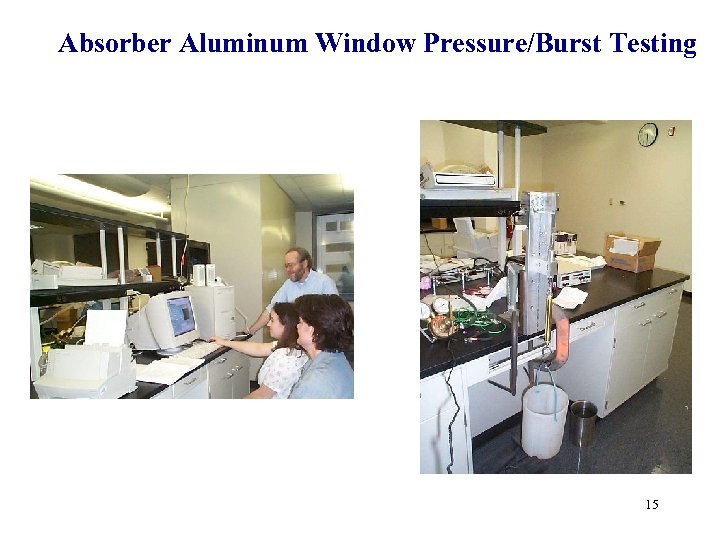
Absorber Aluminum Window Pressure/Burst Testing 15
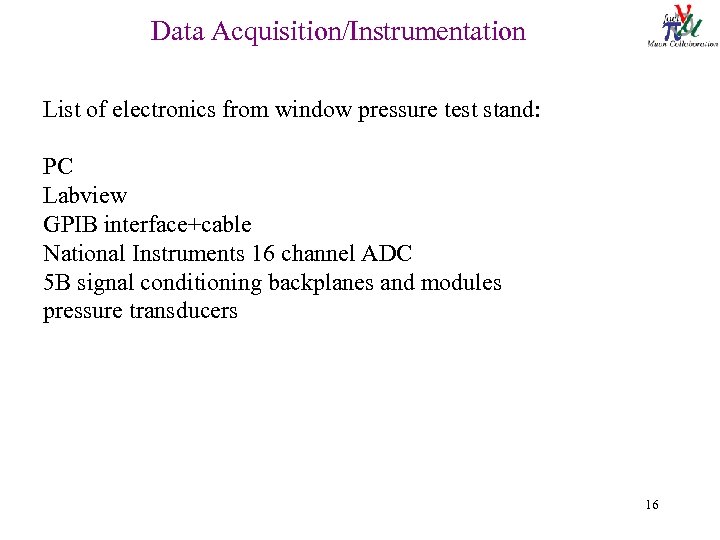
Data Acquisition/Instrumentation List of electronics from window pressure test stand: PC Labview GPIB interface+cable National Instruments 16 channel ADC 5 B signal conditioning backplanes and modules pressure transducers 16
Absorber Instrumentation The absorber will live in a hostile environment: -The absorber will absorb 100 -1000 Watts depending on beam intensity in cooling channel muon beam. -The MTA will provide a 400 Me. V proton beam of ~ 1013 protons/pulse @ 15 Hz to mimic the d. E/dx deposition of a muon beam. -The absorber sits inside a solenoid of 4 Tesla (~1. 5 T at absorber in cooling channel design) - The absorber is filled with liquid hydrogen thus operates at cryogenic temperature (14 – 20 K) THUS the monitoring devices must be rad-hard, and able to 17 operate in high magnetic fields and cryogenic temps.
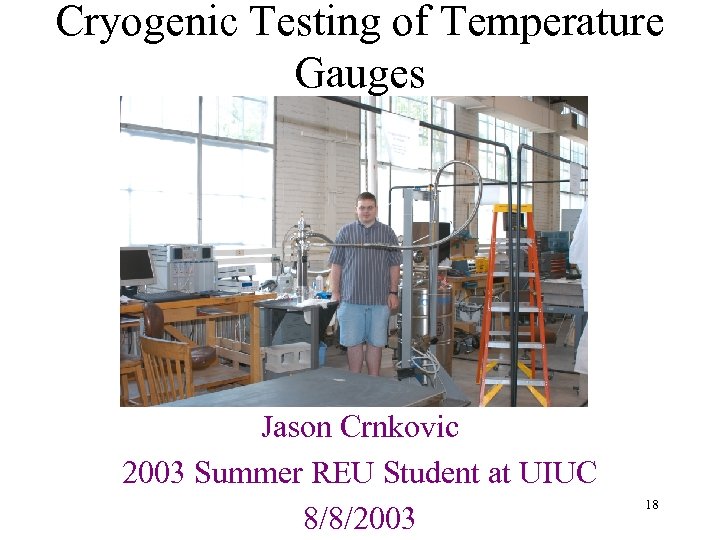
Cryogenic Testing of Temperature Gauges Jason Crnkovic 2003 Summer REU Student at UIUC 8/8/2003 18
Purpose Providing temperature information for cooling channel energy absorber undergoing testing in Mucool Test Area Study properties of fiberoptic gauges at cryogenic temperatures. History Z. Conway, M. Haney, (D. Errede) got the experiment going, purchasing equipment, setting up cryostat, installing sensors. Zack wrote the daq for our test setup and absorber testing in situ. Jason Crnkovic, D. Errede, M. Haney studied the systematic errors associated with the test setup. Gefei Qian has added some nice modifications to the daq and written a 19 temperature conversion program whose algorithm looks better than Lakeshores.
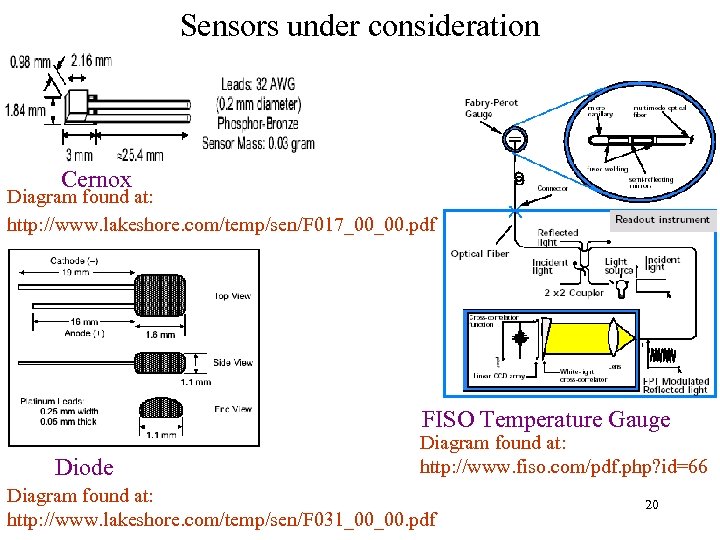
Sensors under consideration Cernox Diagram found at: http: //www. lakeshore. com/temp/sen/F 017_00_00. pdf FISO Temperature Gauge Diode Diagram found at: http: //www. fiso. com/pdf. php? id=66 Diagram found at: http: //www. lakeshore. com/temp/sen/F 031_00_00. pdf 20
Cernox devices For the record: the sensitive part of the device is a chip ceramic oxynitride, gold pads, and sapphire substrate. SD package: chip mounted on sapphire base with alumina body and lid. Molybdenum/Manganese with nickel and gold plating on base and lid. Goldtin solder as hermitic lid seal. 21
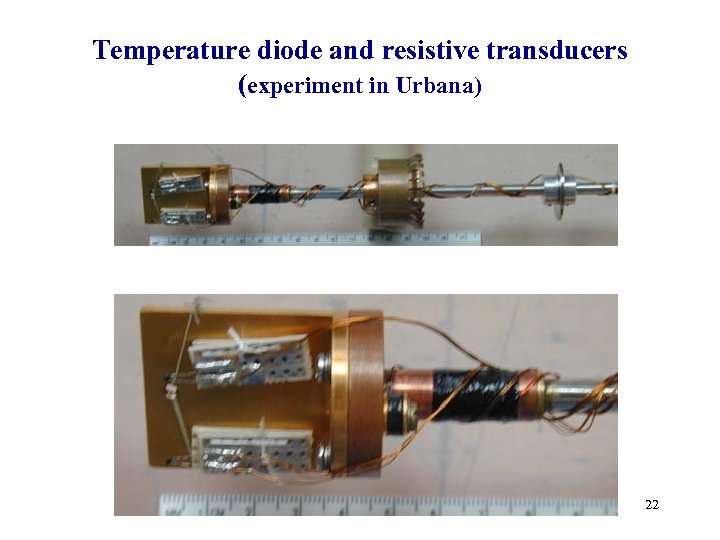
Temperature diode and resistive transducers (experiment in Urbana) 22
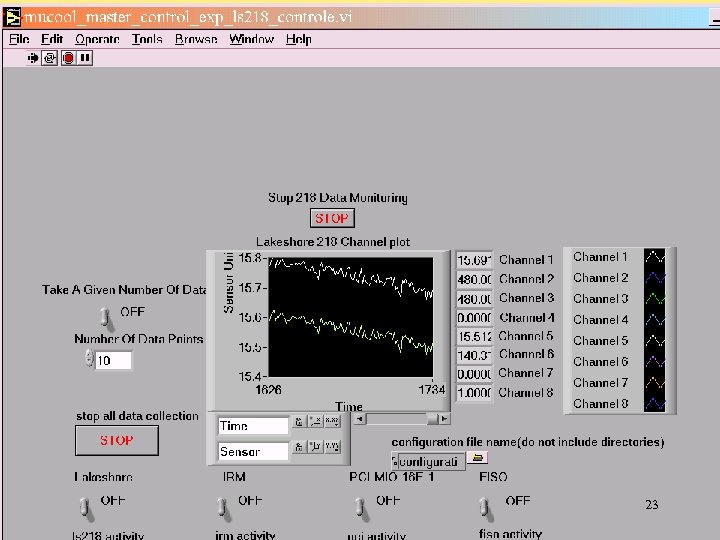
Picture of daq screen. 23
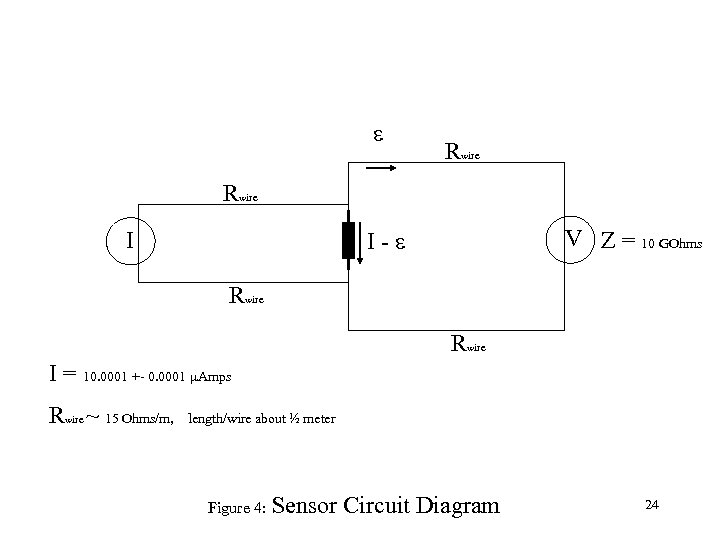
e Rwire I V Z = 10 GOhms I - e Rwire I = 10. 0001 +- 0. 0001 m. Amps Rwire ~ 15 Ohms/m, length/wire about ½ meter Figure 4: Sensor Circuit Diagram 24
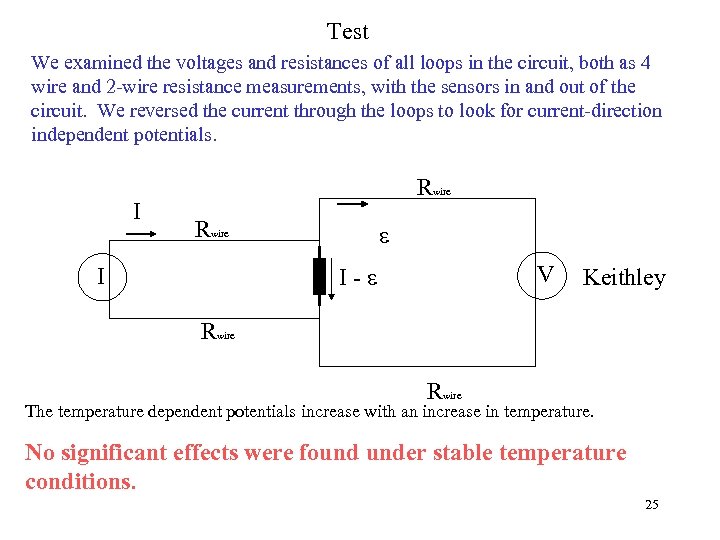
Test We examined the voltages and resistances of all loops in the circuit, both as 4 wire and 2 -wire resistance measurements, with the sensors in and out of the circuit. We reversed the current through the loops to look for current-direction independent potentials. I Rwire I e V I - e Keithley Rwire The temperature dependent potentials increase with an increase in temperature. No significant effects were found under stable temperature conditions. 25
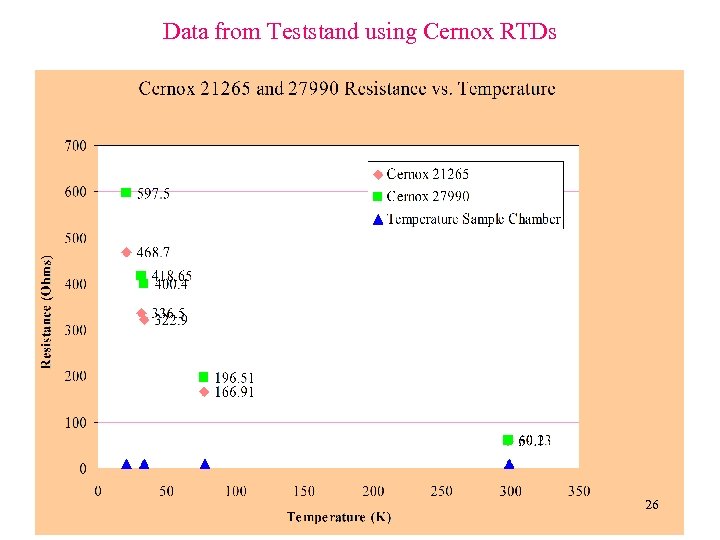
Data from Teststand using Cernox RTDs 26
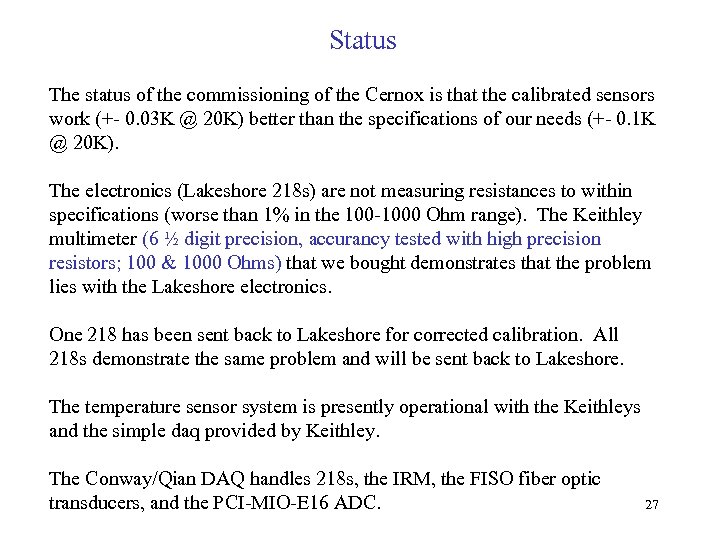
Status The status of the commissioning of the Cernox is that the calibrated sensors work (+- 0. 03 K @ 20 K) better than the specifications of our needs (+- 0. 1 K @ 20 K). The electronics (Lakeshore 218 s) are not measuring resistances to within specifications (worse than 1% in the 100 -1000 Ohm range). The Keithley multimeter (6 ½ digit precision, accurancy tested with high precision resistors; 100 & 1000 Ohms) that we bought demonstrates that the problem lies with the Lakeshore electronics. One 218 has been sent back to Lakeshore for corrected calibration. All 218 s demonstrate the same problem and will be sent back to Lakeshore. The temperature sensor system is presently operational with the Keithleys and the simple daq provided by Keithley. The Conway/Qian DAQ handles 218 s, the IRM, the FISO fiber optic transducers, and the PCI-MIO-E 16 ADC. 27
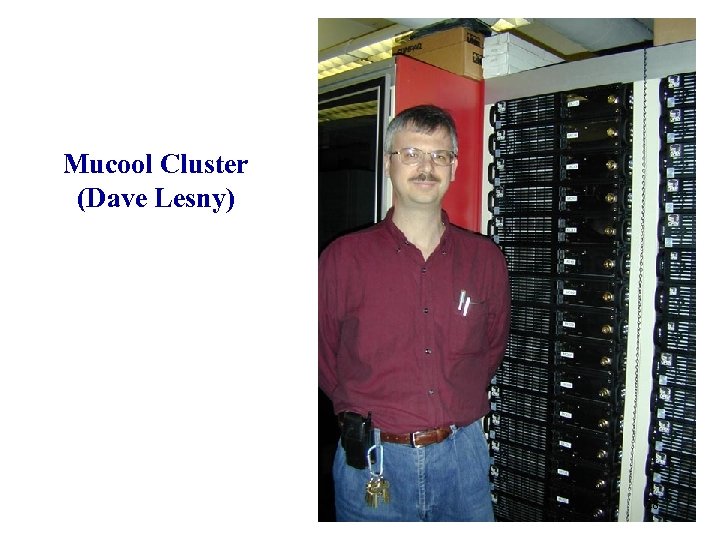
Mucool Cluster (Dave Lesny) 28
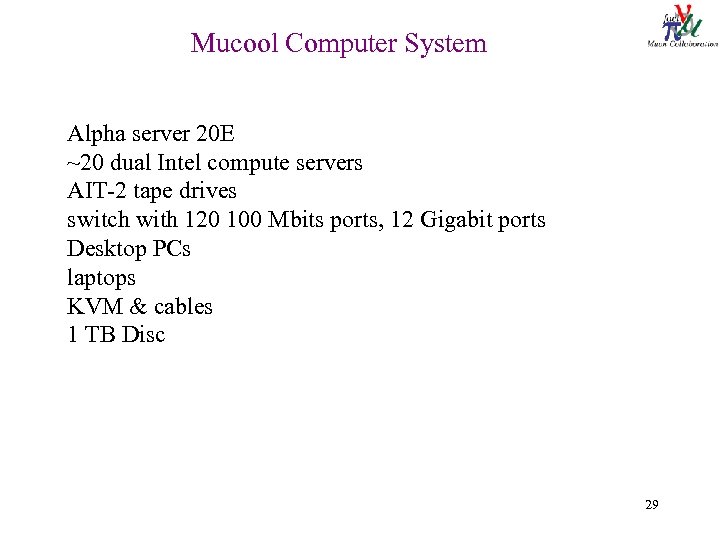
Mucool Computer System Alpha server 20 E ~20 dual Intel compute servers AIT-2 tape drives switch with 120 100 Mbits ports, 12 Gigabit ports Desktop PCs laptops KVM & cables 1 TB Disc 29
Mucool Test Area -purchase of quadlog daq system for cryogenic system -engineering consulation for vacuum fixtures and their purchase -hiring I. Rakhno for shielding calculations for experimental hall and beam dump (fall 2003) (and of course, location of experiment/instrumentation) 30
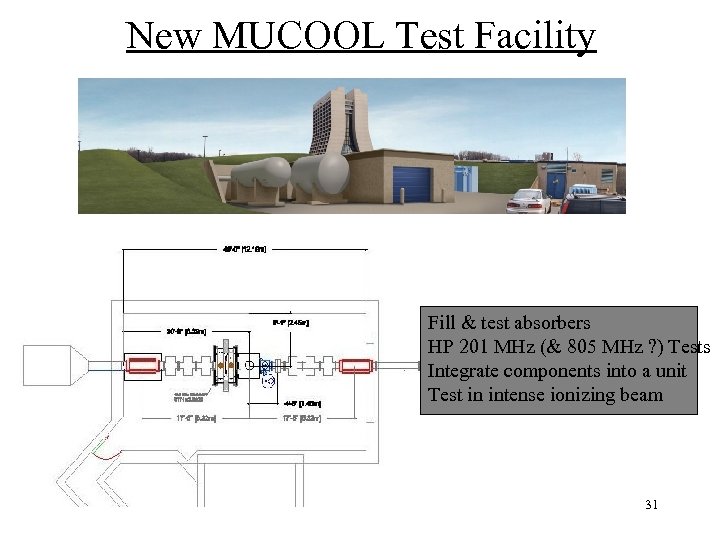
New MUCOOL Test Facility Fill & test absorbers HP 201 MHz (& 805 MHz ? ) Tests Integrate components into a unit Test in intense ionizing beam 31
RF Cavity Field Emission Tests (summer 2001) UIUC Undergraduate Lauren Ducas under supervision of Jim Norem (ANL) -studied made dark current measurements (Fowler-Nordheim field emission) using spectrometer in Lab G (800 MHz cavity) -undergraduate independent study paper on polishing techniques for cavities including new magnetorheological finishing. Contribution of equipment (ccd camera, pc, digital scope) for studies 32
What and Who are We? UIUC Group: projects Simulations – Errede, Makino, Paul, Rakhno Quadrupole Cooling Channel & Design Comparisons(COSY INFINITY) – Errede, Makino, Paul Quadrupole Buncher - Paul Tetra Muon Ring Cooler, Muon Storage Ring with Combined Function Magnets(COSY INFINITY) - Makino Neutrino Factory Targetry and Collection System Design (MARS) – Paul Development of Computational Tools – Makino Shielding Calculations for MTA – Rakhno Energy Deposition Studies in Absorber – Rakhno APS Neutrinos Physics study – Paul (Ph. D in Particle physics) 33
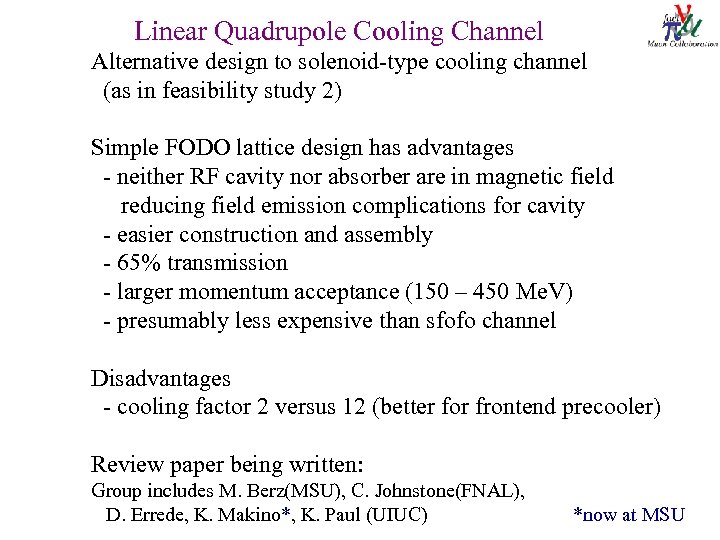
Linear Quadrupole Cooling Channel Alternative design to solenoid-type cooling channel (as in feasibility study 2) Simple FODO lattice design has advantages - neither RF cavity nor absorber are in magnetic field reducing field emission complications for cavity - easier construction and assembly - 65% transmission - larger momentum acceptance (150 – 450 Me. V) - presumably less expensive than sfofo channel Disadvantages - cooling factor 2 versus 12 (better for frontend precooler) Review paper being written: Group includes M. Berz(MSU), C. Johnstone(FNAL), D. Errede, K. Makino*, K. Paul (UIUC) *now at MSU
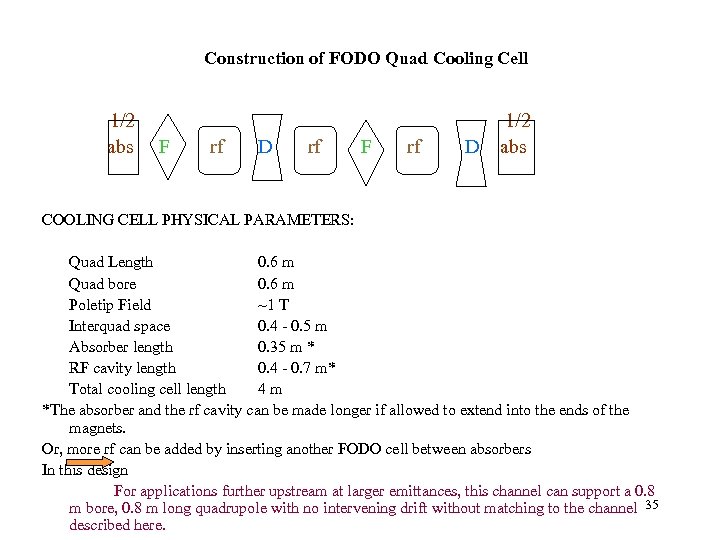
Construction of FODO Quad Cooling Cell 1/2 abs F rf D rf F rf D abs COOLING CELL PHYSICAL PARAMETERS: Quad Length 0. 6 m Quad bore 0. 6 m Poletip Field ~1 T Interquad space 0. 4 - 0. 5 m Absorber length 0. 35 m * RF cavity length 0. 4 - 0. 7 m* Total cooling cell length 4 m *The absorber and the rf cavity can be made longer if allowed to extend into the ends of the magnets. Or, more rf can be added by inserting another FODO cell between absorbers In this design For applications further upstream at larger emittances, this channel can support a 0. 8 m bore, 0. 8 m long quadrupole with no intervening drift without matching to the channel 35 described here.
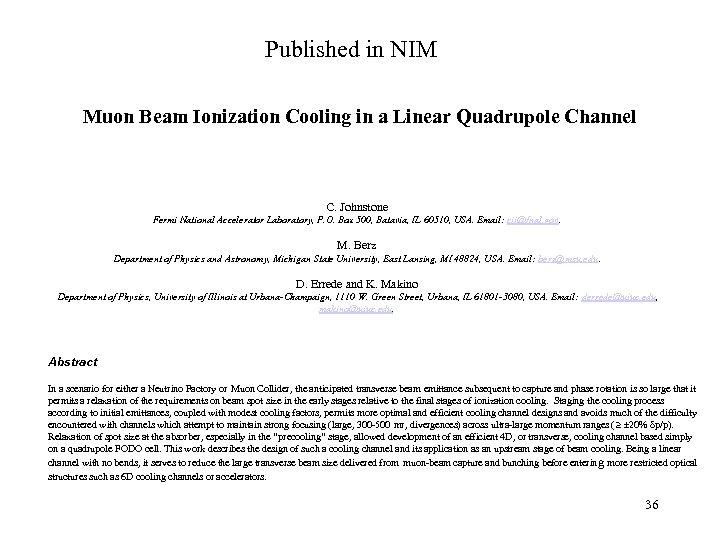
Published in NIM Muon Beam Ionization Cooling in a Linear Quadrupole Channel C. Johnstone Fermi National Accelerator Laboratory, P. O. Box 500, Batavia, IL 60510, USA. Email: cjj@fnal. gov. M. Berz Department of Physics and Astronomy, Michigan State University, East Lansing, MI 48824, USA. Email: berz@msu. edu. D. Errede and K. Makino Department of Physics, University of Illinois at Urbana-Champaign, 1110 W. Green Street, Urbana, IL 61801 -3080, USA. Email: derrede@uiuc. edu, makino@uiuc. edu. Abstract In a scenario for either a Neutrino Factory or Muon Collider, the anticipated transverse beam emittance subsequent to capture and phase rotation is so large that it permits a relaxation of the requirements on beam spot size in the early stages relative to the final stages of ionization cooling. Staging the cooling process according to initial emittances, coupled with modest cooling factors, permits more optimal and efficient cooling channel designs and avoids much of the difficulty encountered with channels which attempt to maintain strong focusing (large, 300 -500 mr, divergences) across ultra-large momentum ranges ( 20% p/p). Relaxation of spot size at the absorber, especially in the “precooling” stage, allowed development of an efficient 4 D, or transverse, cooling channel based simply on a quadrupole FODO cell. This work describes the design of such a cooling channel and its application as an upstream stage of beam cooling. Being a linear channel with no bends, it serves to reduce the large transverse beam size delivered from muon-beam capture and bunching before enterin g more restricted optical structures such as 6 D cooling channels or accelerators. 36
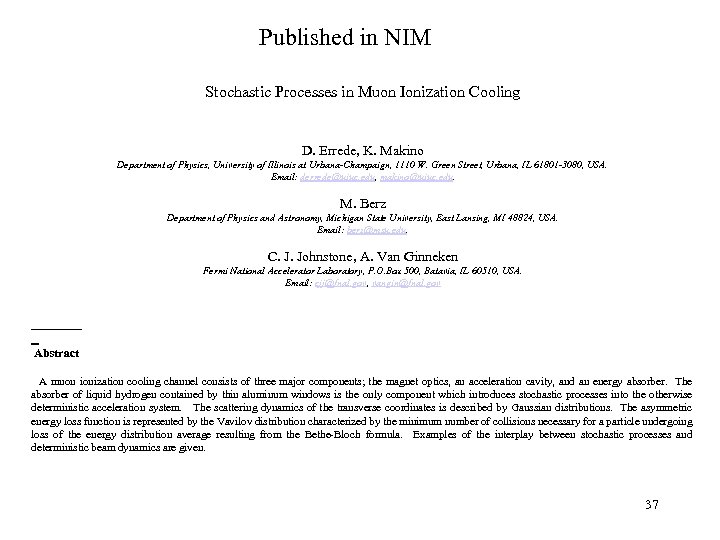
Published in NIM Stochastic Processes in Muon Ionization Cooling D. Errede, K. Makino Department of Physics, University of Illinois at Urbana-Champaign, 1110 W. Green Street, Urbana, IL 61801 -3080, USA. Email: derrede@uiuc. edu, makino@uiuc. edu. M. Berz Department of Physics and Astronomy, Michigan State University, East Lansing, MI 48824, USA. Email: berz@msu. edu. C. J. Johnstone, A. Van Ginneken Fermi National Accelerator Laboratory, P. O. Box 500, Batavia, IL 60510, USA. Email: cjj@fnal. gov, vangin@fnal. gov Abstract A muon ionization cooling channel consists of three major components; the magnet optics, an acceleration cavity, and an energy absorber. The absorber of liquid hydrogen contained by thin aluminum windows is the only component which introduces stochastic processes into the otherwise deterministic acceleration system. The scattering dynamics of the transverse coordinates is described by Gaussian distributions. The asymmetric energy loss function is represented by the Vavilov distribution characterized by the minimum number of collisions necessary for a particle undergoing loss of the energy distribution average resulting from the Bethe-Bloch formula. Examples of the interplay between stochastic processes and deterministic beam dynamics are given. 37
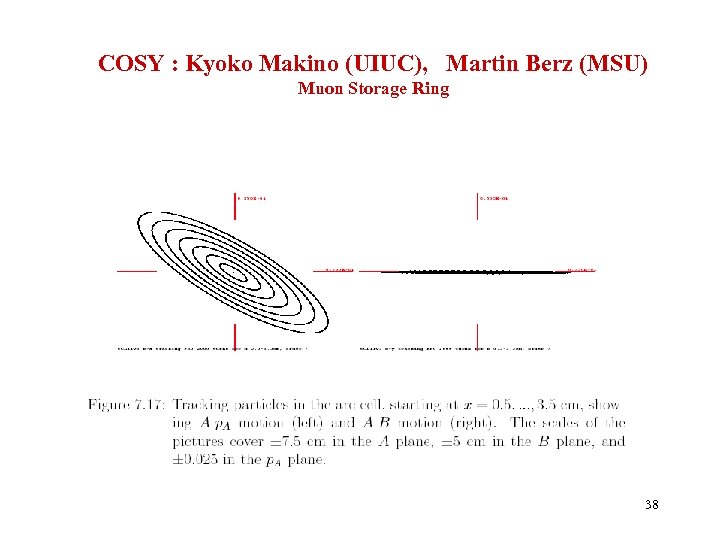
COSY : Kyoko Makino (UIUC), Martin Berz (MSU) Muon Storage Ring 38
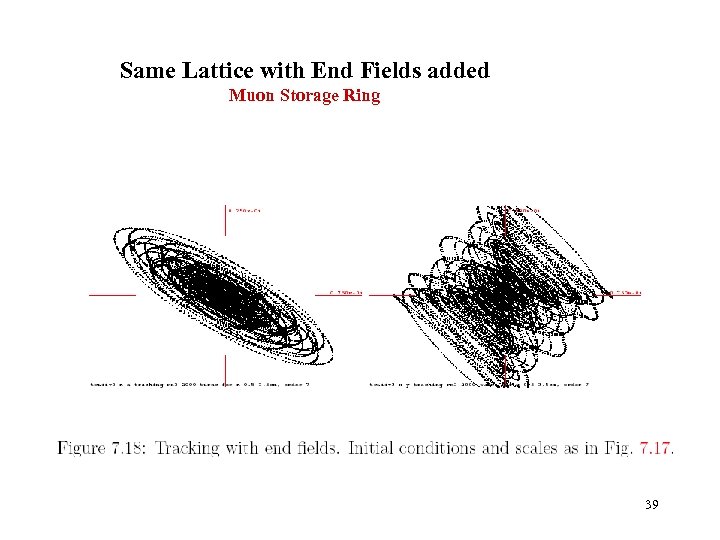
Same Lattice with End Fields added Muon Storage Ring 39
Conclusions • The University of Illinois has a strong program in both experimental development - absorber development and instrumentation (absorber flow testing scheduled for this fall in MTA) and simulation and design - linear cooling channels, ring coolers, muon storage ring : COSY INFINITY - targetry collection system: MARS - MTA shielding studies: MARS - MICE uncertainty sensitivity studies and particle theory!! - APS neutrino physics study • A test area for cooling channel components is under contruction at Fermilab (MTA)…partial completion…. (eventually linac 400 Me. V proton beam)…. presently in use for KEK convection absorber tests. 40
Conclusions • A Muon Collaboration exists that has done two feasibility studies on neutrino factory designs and R&D on targetry, absorbers, 800 (200) MHz NCRF cavities, solenoid magnets, and constructing a test area off of the Fermilab 400 Me. V/c proton linac. Design studies for Linear Cooling Channels, Ring Coolers, FFAG machines, Emittance Exchange are ongoing. • Alternative technologies pursued at CERN and in Japan. • Future plans include the construction of a cooling channel lattice cell to be tested in a low intensity muon beam at Rutherford Labs near Oxford, England (MICE) • Contributing 10 k$ towards bpm’s for Tesla Damping Ring kicker magnet tests. (George Gollin-UIUC) 41
Скачать презентацию UIUC Accelerator Physics Group by Deborah Errede ICAR
cf5019d2718412241d6c4d940a91e859.ppt