 Скачать презентацию UFS Universities Finance Seminars BRITISH UNIVERSITIES FINANCE DIRECTORS
589ec45185269e6282b19ed6cf11e477.ppt
- Количество слайдов: 66



UFS Universities Finance Seminars BRITISH UNIVERSITIES FINANCE DIRECTORS GROUP Pricing Decisions, Marketing & Contribution Analysis u Brian Plowman u u u Director Develin & Partners, Ash House, Fairfield Avenue, Staines, Middlesex TW 18 4 AB, UK Tel: 01784 224207 brian. plowman@develin. co. uk www. develin. co. uk
UFS Develin & Partners Approaches we implement: 8 Activity Based Management 8 Business Process Management 8 Value Based Management 8 Performance Measurement 8 Change Management 8 Information Systems Strategy 8 Overhead Effectiveness 8 Organisation Strategy
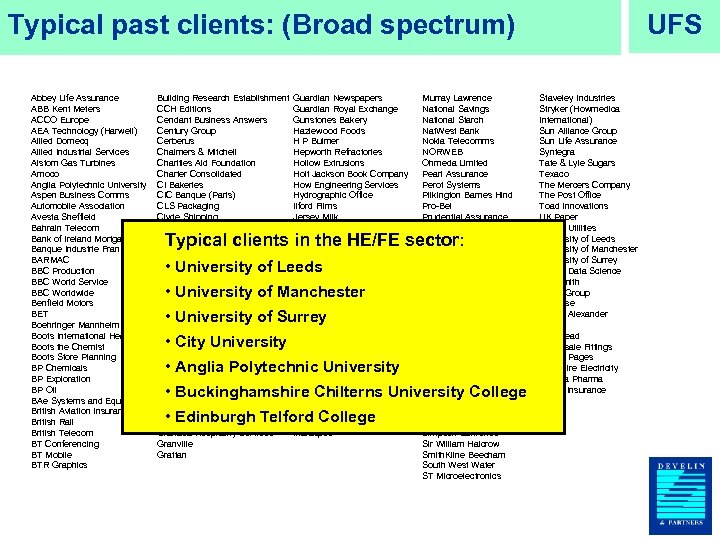
UFS Typical past clients: (Broad spectrum) Abbey Life Assurance ABB Kent Meters ACCO Europe AEA Technology (Harwell) Allied Domecq Allied Industrial Services Alstom Gas Turbines Amoco Anglia Polytechnic University Aspen Business Comms Automobile Association Avesta Sheffield Bahrain Telecom Bank of Ireland Mortgages Banque Industrie Fran aise BARMAC BBC Production BBC World Service BBC Worldwide Benfield Motors BET Boehringer Mannheim Limited Boots International Healthcare Boots the Chemist Boots Store Planning BP Chemicals BP Exploration BP Oil BAe Systems and Equipment British Aviation Insurance British Rail British Telecom BT Conferencing BT Mobile BTR Graphics Building Research Establishment CCH Editions Cendant Business Answers Century Group Cerberus Chalmers & Mitchell Charities Aid Foundation Charter Consolidated CI Bakeries CIC Banque (Paris) CLS Packaging Clyde Shipping Comag Co-operative Bank Co-operative Retail Services Copystatic Systems Costain Department of the Environment, Transport and the Regions DHL Worldwide Dominic Group East Midlands Electricity Enron Equifax Estonian Railways Factory Mutual International Fisons Pharmaceuticals Fleet Air Arm Forth River Purification Board Franklin Mint Glostal Granada Hospitality Services Granville Grattan Guardian Newspapers Guardian Royal Exchange Gunstones Bakery Hazlewood Foods H P Bulmer Hepworth Refractories Hollow Extrusions Holt Jackson Book Company How Engineering Services Hydrographic Office Ilford Films Jersey Milk Kao Infosystems (UK) Kleinwort Benson Kuwait Investment Office Kyle Stewart Limited Lab of the Govnt Chemist Le Riche Group Leeds Permanent Bldg Society LIFFE Livpl Victoria Friendly Society Lloyds Bowmaker Lombard North Central London Electricity Lucas Aftermarket Operations Lucas Automotive Electronics Lyons Tetley Meggitt Mercantile Credit Metal Castings Ministry of Defence Muraspec Murray Lawrence National Savings National Starch Nat. West Bank Nokia Telecomms NORWEB Ohmeda Limited Pearl Assurance Perot Systems Pilkington Barnes Hind Pro-Bel Prudential Assurance Prudential Home Service Prudential Portfolio Pyroban Quadrant Rhone Poulenc Rorer Ross Breeders Rover Group Royal Automobile Club Royal Bank of Scotland RTZ Pillar Saudi International Bank Schroder Unit Trusts Scottish Courage Scottish Environment PA Severn Trent Systems SG Hambros Simpson Lawrence Sir William Halcrow Smith. Kline Beecham South West Water ST Microelectronics Typical clients in the HE/FE sector: • University of Leeds • University of Manchester • University of Surrey • City University • Anglia Polytechnic University • Buckinghamshire Chilterns University College • Edinburgh Telford College Staveley Industries Stryker (Howmedica International) Sun Alliance Group Sun Life Assurance Syntegra Tate & Lyle Sugars Texaco The Mercers Company The Post Office Toad Innovations UK Paper United Utilities University of Leeds University of Manchester University of Surrey Vertex Data Science WH Smith Wace Group Waitrose Walter Alexander Wella Whitbread Wholesale Fittings Yellow Pages Yorkshire Electricity Zeneca Pharma Zurich Insurance
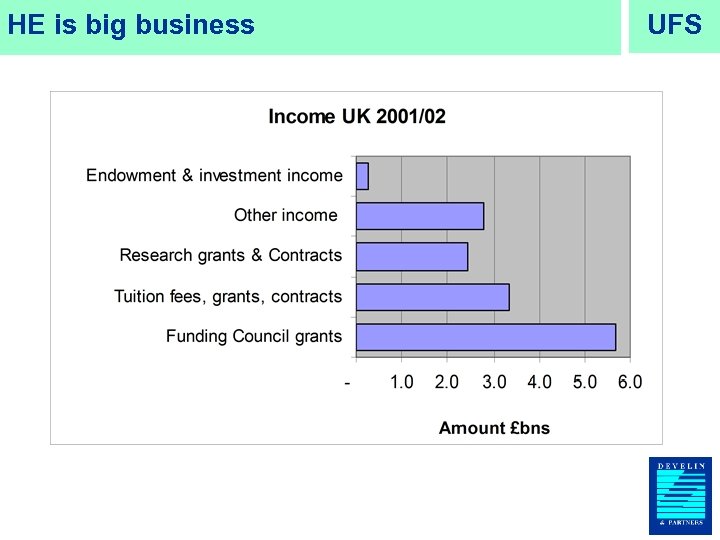
HE is big business UFS
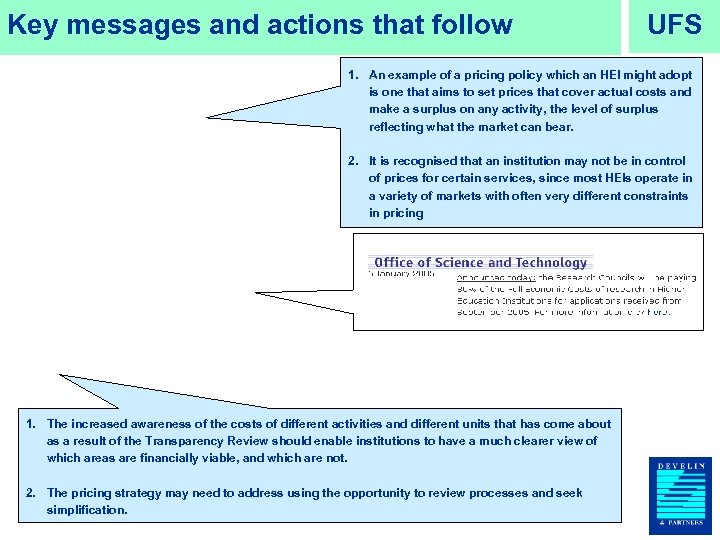
Key messages and actions that follow UFS 1. An example of a pricing policy which an HEI might adopt is one that aims to set prices that cover actual costs and make a surplus on any activity, the level of surplus reflecting what the market can bear. 2. It is recognised that an institution may not be in control of prices for certain services, since most HEIs operate in a variety of markets with often very different constraints in pricing 1. The increased awareness of the costs of different activities and different units that has come about as a result of the Transparency Review should enable institutions to have a much clearer view of which areas are financially viable, and which are not. 2. The pricing strategy may need to address using the opportunity to review processes and seek simplification.
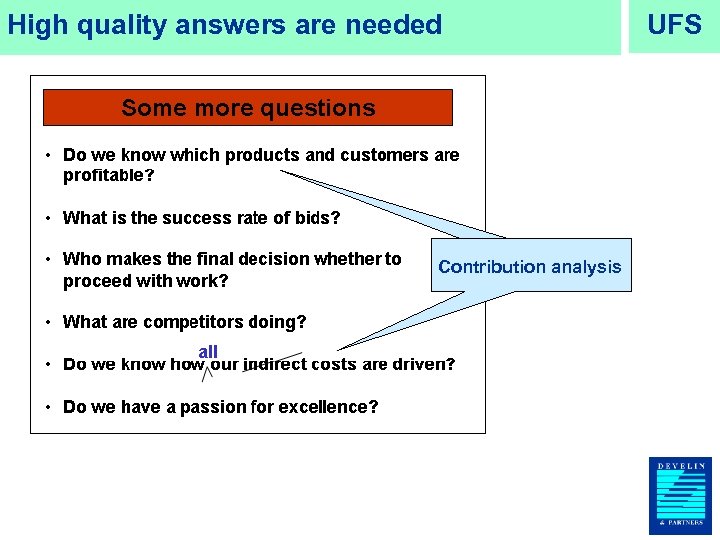
High quality answers are needed Contribution analysis UFS
Key points • Meaningful information. Not buried by data. • • • UFS
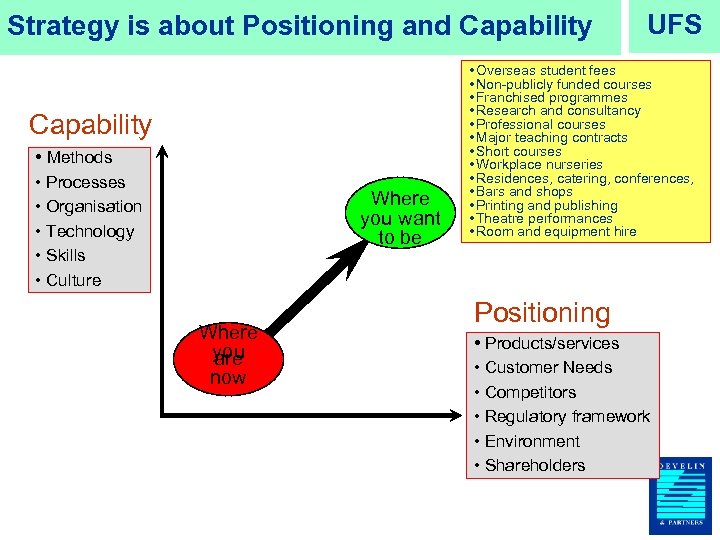
Strategy is about Positioning and Capability • Methods • Processes • Organisation • Technology • Skills • Culture Where you want to be Where you are now UFS • Overseas student fees • Non-publicly funded courses • Franchised programmes • Research and consultancy • Professional courses • Major teaching contracts • Short courses • Workplace nurseries • Residences, catering, conferences, • Bars and shops • Printing and publishing • Theatre performances • Room and equipment hire Positioning • Products/services • Customer Needs • Competitors • Regulatory framework • Environment • Shareholders
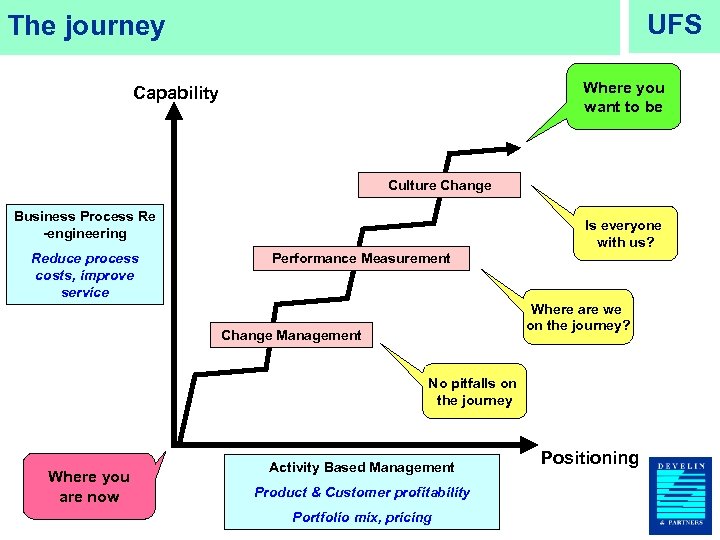
UFS The journey Where you want to be Capability Culture Change Business Process Re -engineering Reduce process costs, improve service Is everyone with us? Performance Measurement Where are we on the journey? Change Management No pitfalls on the journey Where you are now Activity Based Management Product & Customer profitability Portfolio mix, pricing Positioning
Key points • Meaningful information. Not buried by data. • Need to work on both axes: Positioning & Capability • • UFS
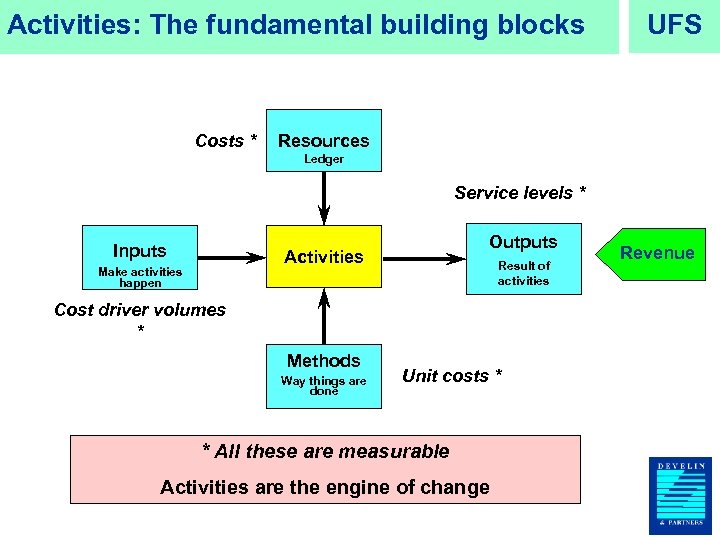
Activities: The fundamental building blocks Costs * UFS Resources Ledger Service levels * Inputs Outputs Activities Make activities happen Result of activities Cost driver volumes * Methods Way things are done Unit costs * * All these are measurable Activities are the engine of change Revenue
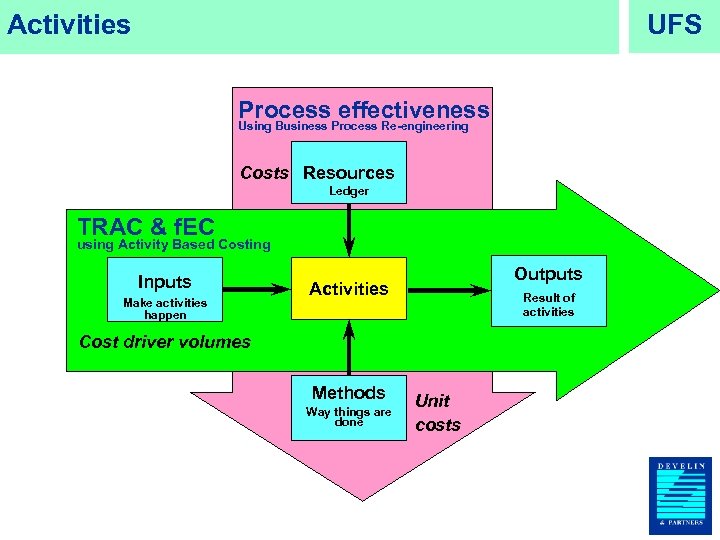
UFS Activities Process Re-engineering effectiveness Using Business Costs Resources Ledger TRAC & f. EC using Activity Based Costing Inputs Make activities happen Outputs Activities Result of activities Cost driver volumes Methods Way things are done Unit costs
Key points • Create meaningful information. Don’t get buried by data. • Need to work on both axes: Positioning & Capability – plot the journey • ‘Activities’: useful for TRAC, f. EC and improving process effectiveness • • • UFS
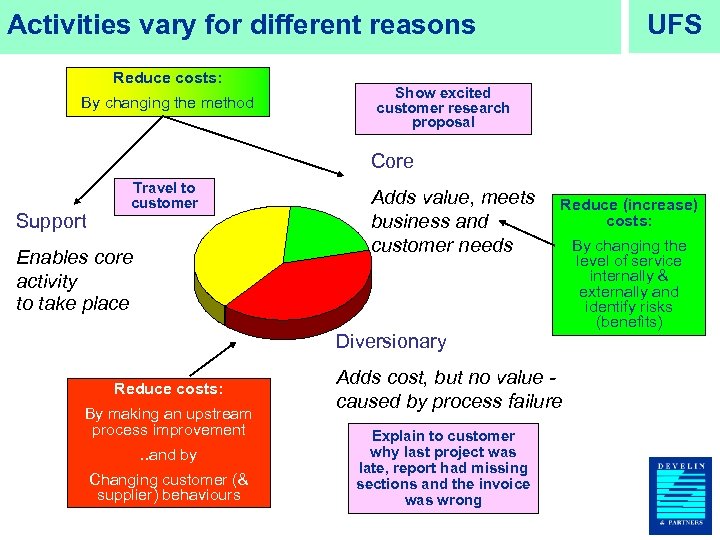
UFS Activities vary for different reasons Reduce costs: By changing the method Show excited customer research proposal Core Support Travel to customer Enables core activity to take place Adds value, meets business and customer needs Reduce (increase) costs: Diversionary Reduce costs: By making an upstream process improvement. . and by Changing customer (& supplier) behaviours Adds cost, but no value caused by process failure Explain to customer why last project was late, report had missing sections and the invoice was wrong By changing the level of service internally & externally and identify risks (benefits)
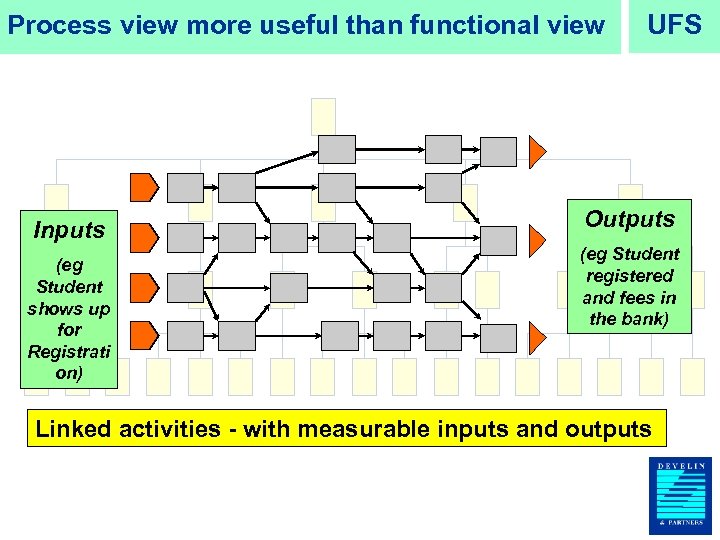
Process view more useful than functional view Inputs (eg Student shows up for Registrati on) UFS Outputs (eg Student registered and fees in the bank) Linked activities - with measurable inputs and outputs
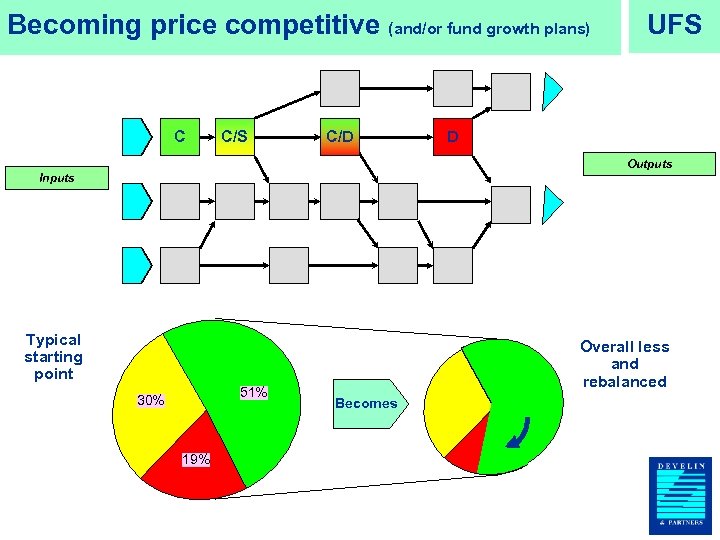
Becoming price competitive (and/or fund growth plans) C C/S C/D UFS D Outputs Inputs Typical starting point 51% 30% 19% Overall less and rebalanced Becomes
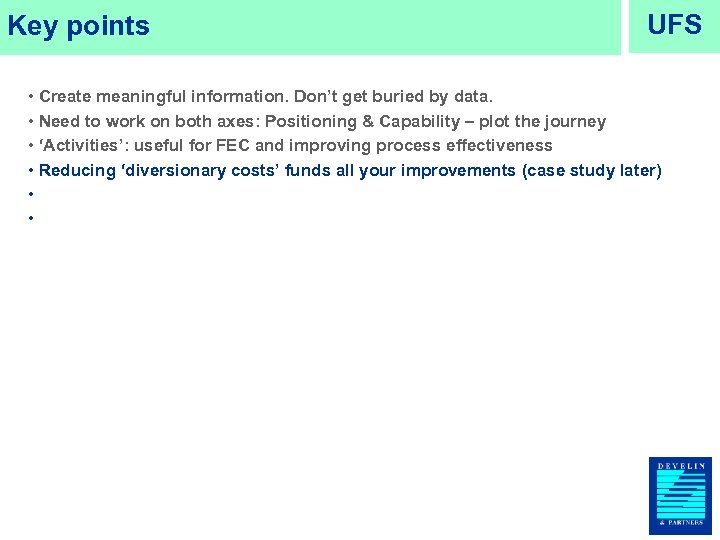
Key points UFS • Create meaningful information. Don’t get buried by data. • Need to work on both axes: Positioning & Capability – plot the journey • ‘Activities’: useful for FEC and improving process effectiveness • Reducing ‘diversionary costs’ funds all your improvements (case study later) • •
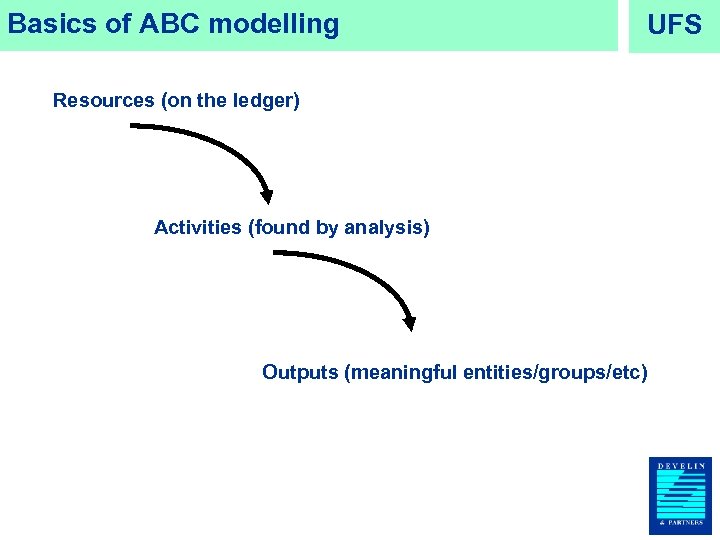
Basics of ABC modelling UFS Resources (on the ledger) Activities (found by analysis) Outputs (meaningful entities/groups/etc)
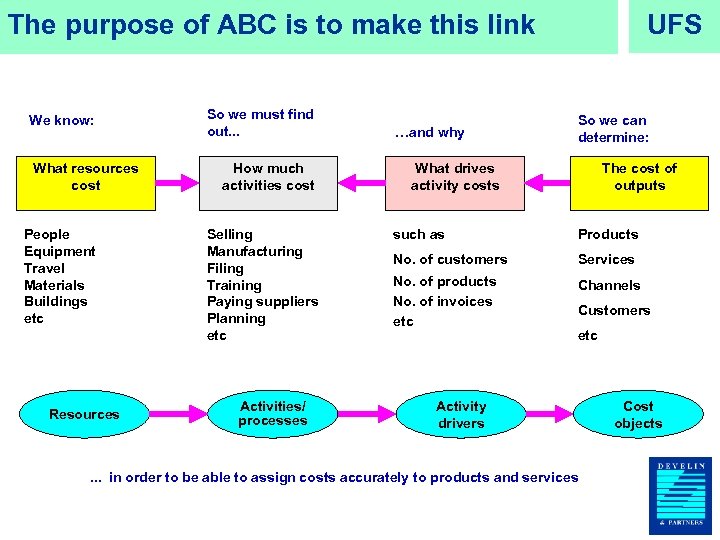
UFS The purpose of ABC is to make this link We know: What resources cost People Equipment Travel Materials Buildings etc Resources So we must find out. . . How much activities cost Selling Manufacturing Filing Training Paying suppliers Planning etc Activities/ processes …and why So we can determine: The cost of outputs What drives activity costs such as Products No. of customers Services No. of products No. of invoices etc Channels Customers etc Activity drivers . . . in order to be able to assign costs accurately to products and services Cost objects
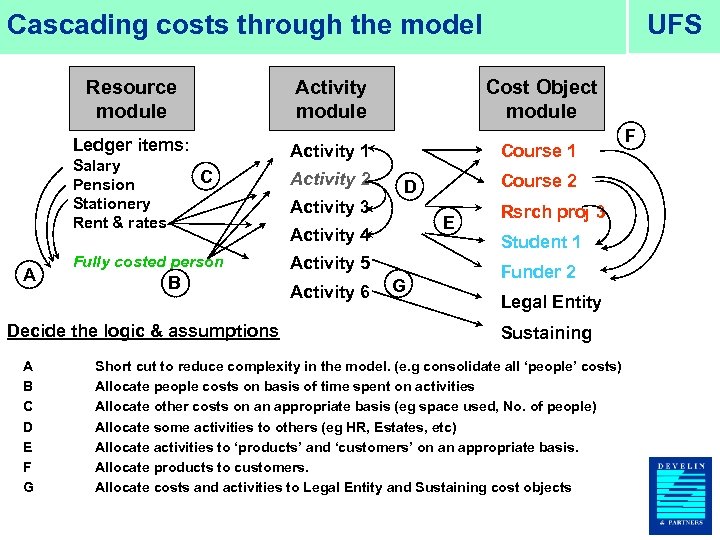
UFS Cascading costs through the model Resource module Activity module Ledger items: Salary Pension Stationery Rent & rates A Activity 1 C Activity 2 Course 1 E Activity 4 Fully costed person B Activity 5 Activity 6 Course 2 D Activity 3 Decide the logic & assumptions A B C D E F G Cost Object module G Rsrch proj 3 Student 1 Funder 2 Legal Entity Sustaining Short cut to reduce complexity in the model. (e. g consolidate all ‘people’ costs) Allocate people costs on basis of time spent on activities Allocate other costs on an appropriate basis (eg space used, No. of people) Allocate some activities to others (eg HR, Estates, etc) Allocate activities to ‘products’ and ‘customers’ on an appropriate basis. Allocate products to customers. Allocate costs and activities to Legal Entity and Sustaining cost objects F
Key points • Create meaningful information. Don’t get buried by data. • Need to work on both axes: Positioning & Capability – plot the journey • ‘Activities’: useful for FEC and improving process effectiveness • Reducing ‘diversionary costs’ funds all your improvements (case study later) • ABC modelling helps to deliver f. EC (and every aspect of profitability in the university – case study later) • • UFS
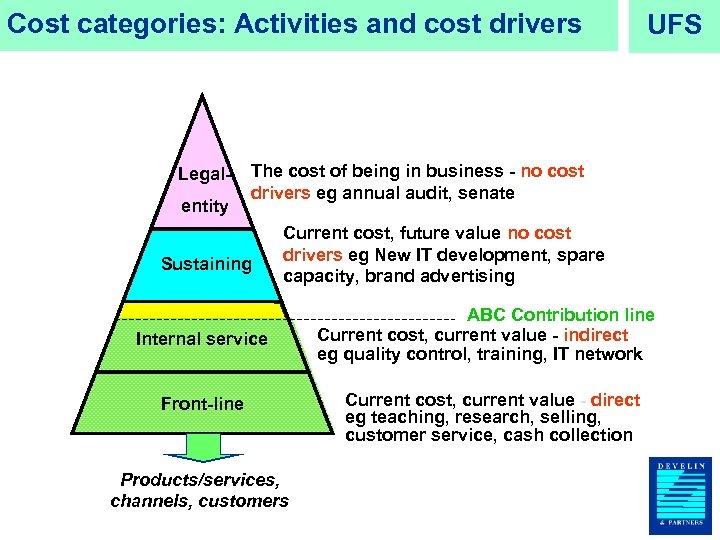
Cost categories: Activities and cost drivers Legalentity UFS The cost of being in business - no cost drivers eg annual audit, senate Sustaining Current cost, future value no cost drivers eg New IT development, spare capacity, brand advertising Internal service Front-line Products/services, channels, customers ABC Contribution line Current cost, current value - indirect eg quality control, training, IT network Current cost, current value - direct eg teaching, research, selling, customer service, cash collection
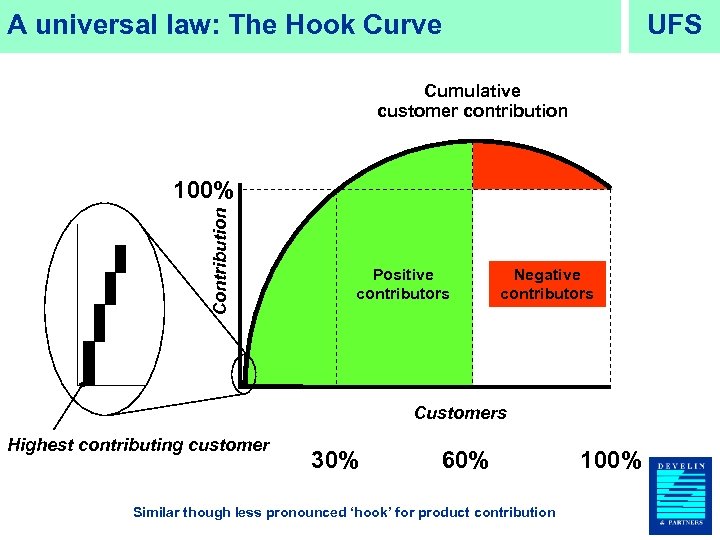
A universal law: The Hook Curve UFS Cumulative customer contribution Contribution 100% Positive contributors Negative contributors Customers Highest contributing customer 30% 60% Similar though less pronounced ‘hook’ for product contribution 100%
Key points UFS • Create meaningful information. Don’t get buried by data. • Need to work on both axes: Positioning & Capability – plot the journey • ‘Activities’: useful for FEC and cost reduction • Reducing ‘diversionary costs’ funds all your improvements (case study later) • ABC modelling delivers FEC • Contribution analysis delivers Product & customer profitability. (case studies later) • •
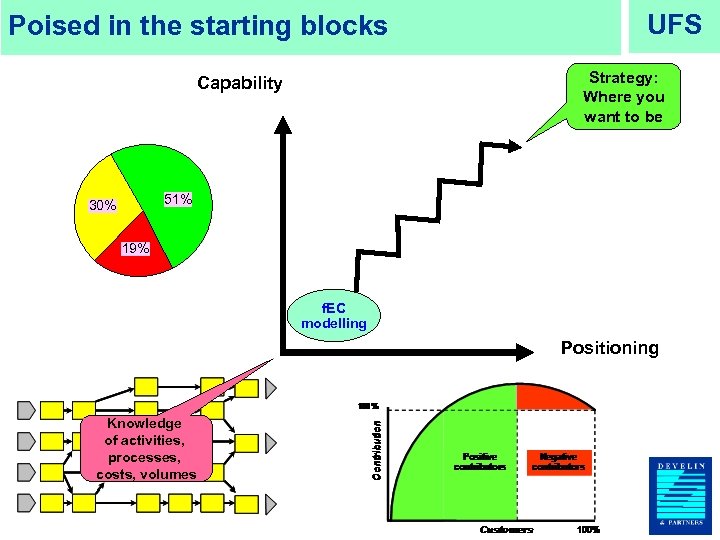
Poised in the starting blocks UFS Strategy: Where you want to be Capability 51% 30% 19% f. EC modelling Positioning Knowledge of activities, processes, costs, volumes
Key points • • • UFS Create meaningful information. Don’t get buried by data. Need to work on both axes: Positioning & Capability – plot the journey ‘Activities’: useful for FEC and cost reduction Reducing ‘diversionary costs’ funds all your improvements (case study later) ABC modelling helps to deliver f. EC (and every aspect of the university – case study later) • Contribution analysis delivers Product & customer profitability. (case studies later) • All functions work together concurrently on Positioning & Capability
UFS Case studies Positioning
Key points • • UFS Create meaningful information. Don’t get buried by data. Need to work on both axes: Positioning & Capability – plot the journey ‘Activities’: useful for FEC and cost reduction Reducing ‘diversionary costs’ funds all your improvements (case study later) ABC modelling delivers FEC Contribution analysis delivers Product & customer profitability. (case studies later) All functions work together concurrently on Positioning & Capability ABC analysis produces surprising insights.
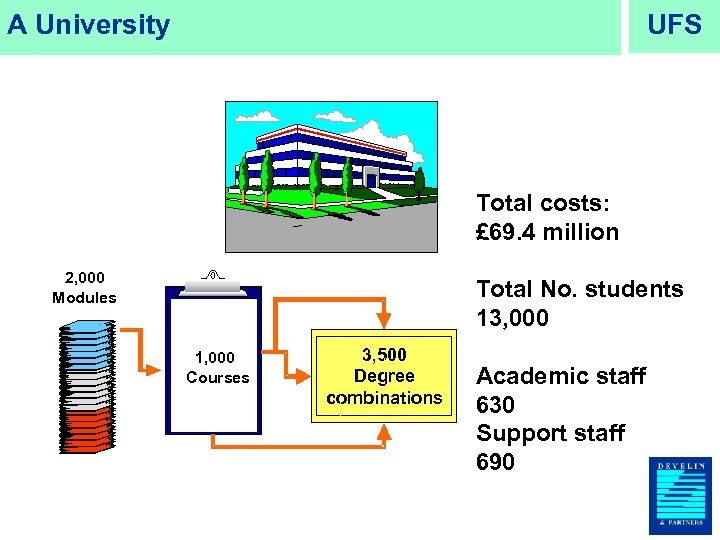
UFS A University Total costs: £ 69. 4 million 2, 000 Modules Total No. students 13, 000 1, 000 Courses 3, 500 Degree combinations Academic staff 630 Support staff 690
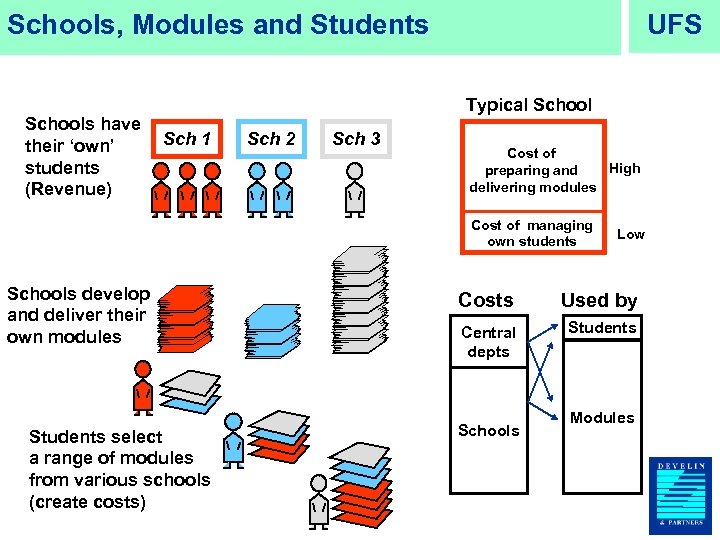
UFS Schools, Modules and Students Schools have their ‘own’ students (Revenue) Typical School Sch 1 Sch 2 Sch 3 Cost of High preparing and delivering modules Cost of managing own students Schools develop and deliver their own modules Students select a range of modules from various schools (create costs) Low Costs Used by Central depts Students Schools Modules
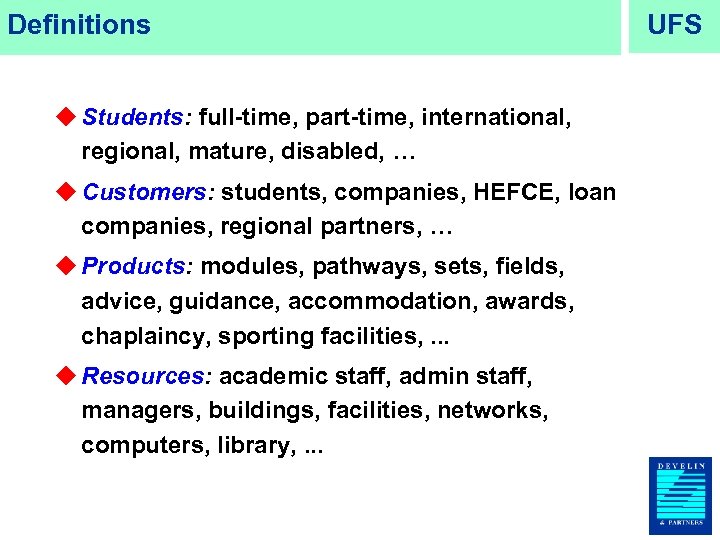
Definitions u Students: full-time, part-time, international, regional, mature, disabled, … u Customers: students, companies, HEFCE, loan companies, regional partners, … u Products: modules, pathways, sets, fields, advice, guidance, accommodation, awards, chaplaincy, sporting facilities, . . . u Resources: academic staff, admin staff, managers, buildings, facilities, networks, computers, library, . . . UFS
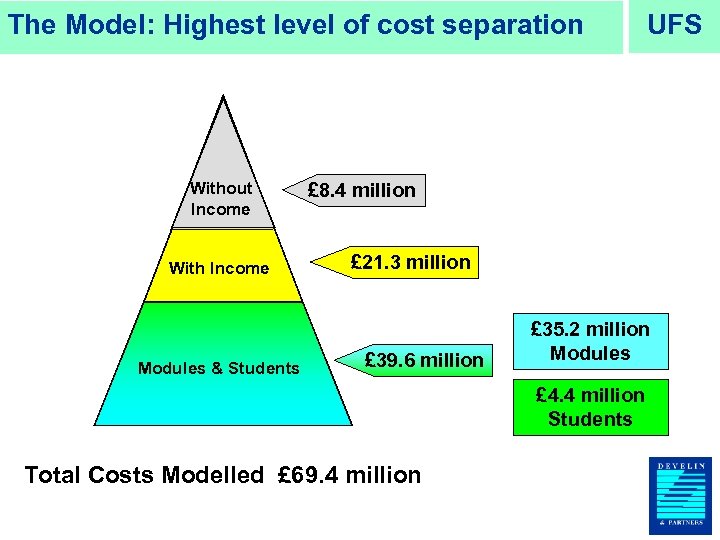
The Model: Highest level of cost separation Without Income With Income Modules & Students UFS £ 8. 4 million £ 21. 3 million £ 39. 6 million £ 35. 2 million Modules £ 4. 4 million Students Total Costs Modelled £ 69. 4 million

ABC model UFS
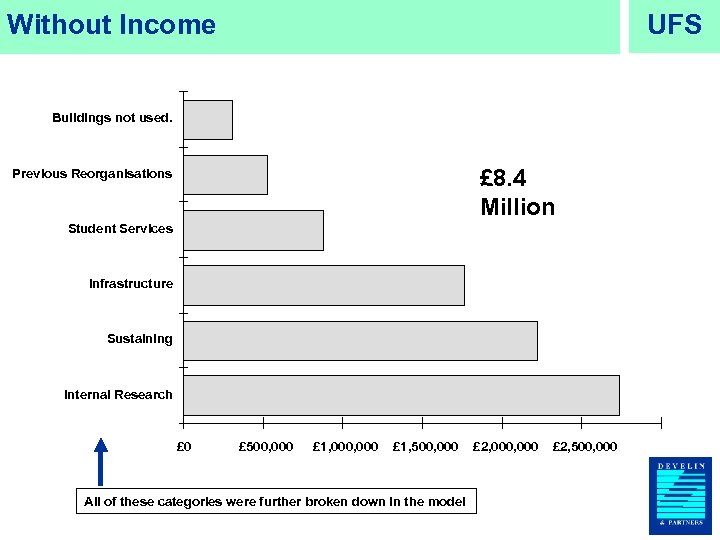
UFS Without Income Buildings not used. £ 8. 4 Million Previous Reorganisations Student Services Infrastructure Sustaining Internal Research £ 0 £ 500, 000 £ 1, 500, 000 All of these categories were further broken down in the model £ 2, 000 £ 2, 500, 000
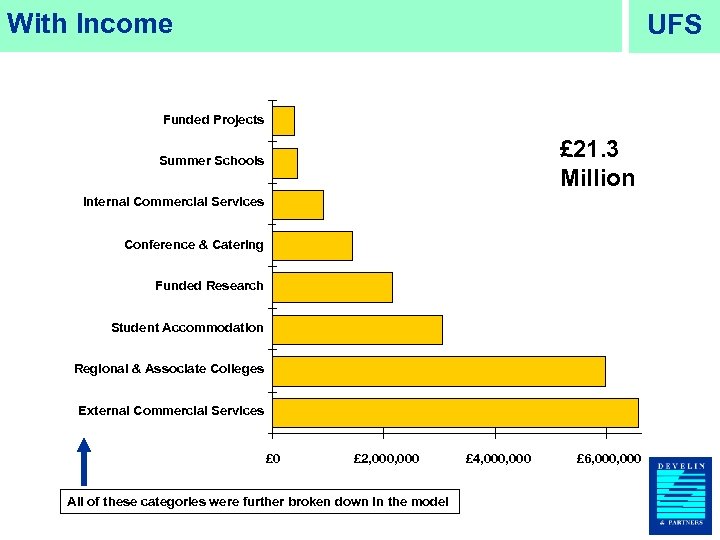
With Income UFS Funded Projects £ 21. 3 Million Summer Schools Internal Commercial Services Conference & Catering Funded Research Student Accommodation Regional & Associate Colleges External Commercial Services £ 0 £ 2, 000 All of these categories were further broken down in the model £ 4, 000 £ 6, 000
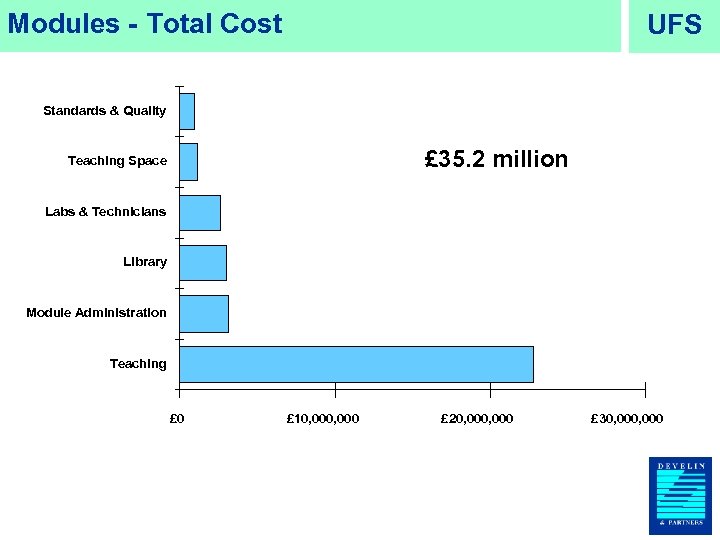
Modules - Total Cost UFS Standards & Quality £ 35. 2 million Teaching Space Labs & Technicians Library Module Administration Teaching £ 0 £ 10, 000 £ 20, 000 £ 30, 000
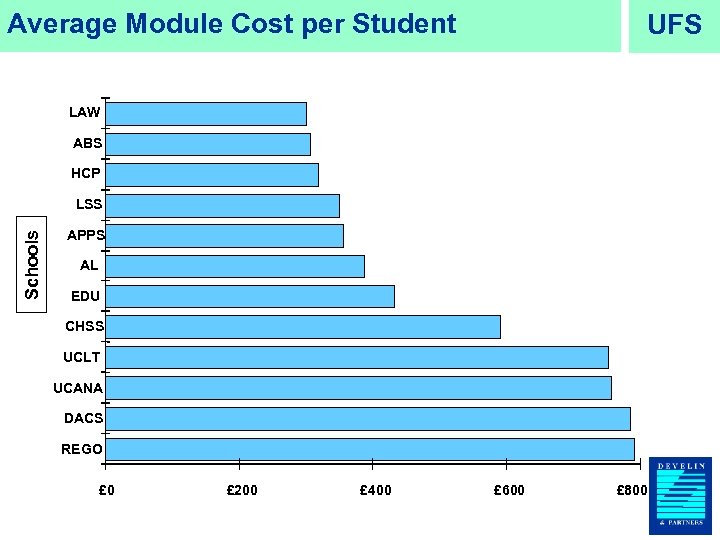
Average Module Cost per Student UFS LAW ABS HCP Schools LSS APPS AL EDU CHSS UCLT UCANA DACS REGO £ 0 £ 200 £ 400 £ 600 £ 800
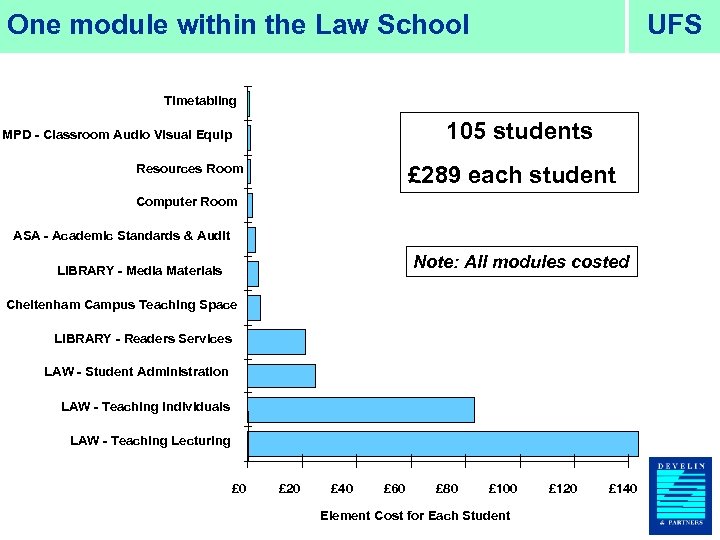
One module within the Law School UFS Timetabling 105 students MPD - Classroom Audio Visual Equip £ 289 each student Resources Room Computer Room ASA - Academic Standards & Audit Note: All modules costed LIBRARY - Media Materials Cheltenham Campus Teaching Space LIBRARY - Readers Services LAW - Student Administration LAW - Teaching Individuals LAW - Teaching Lecturing £ 0 £ 20 £ 40 £ 60 £ 80 £ 100 Element Cost for Each Student £ 120 £ 140
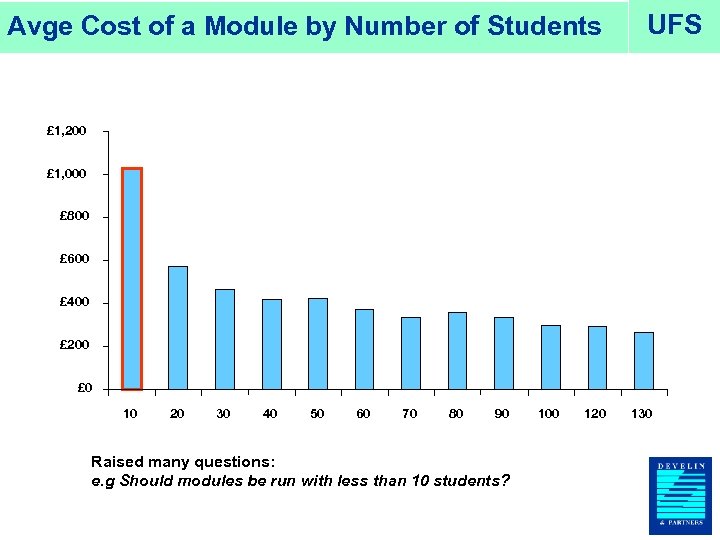
Avge Cost of a Module by Number of Students UFS £ 1, 200 £ 1, 000 £ 800 £ 600 £ 400 £ 200 £ 0 10 20 30 40 50 60 70 80 90 Raised many questions: e. g Should modules be run with less than 10 students? 100 120 130
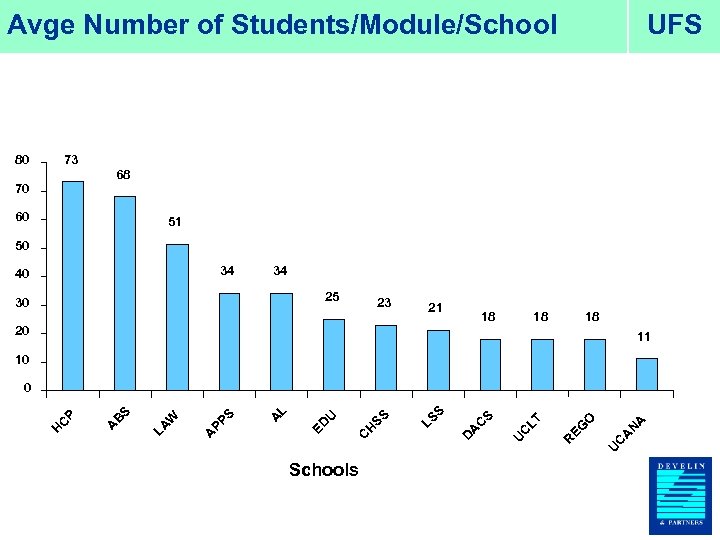
Avge Number of Students/Module/School 80 UFS 73 68 70 60 51 50 34 40 34 25 30 23 21 18 20 18 18 11 10 U C A N A O EG R LT C U C S A D S LS SS H C ED U L A S PP A LA W S B A H C P 0 Schools
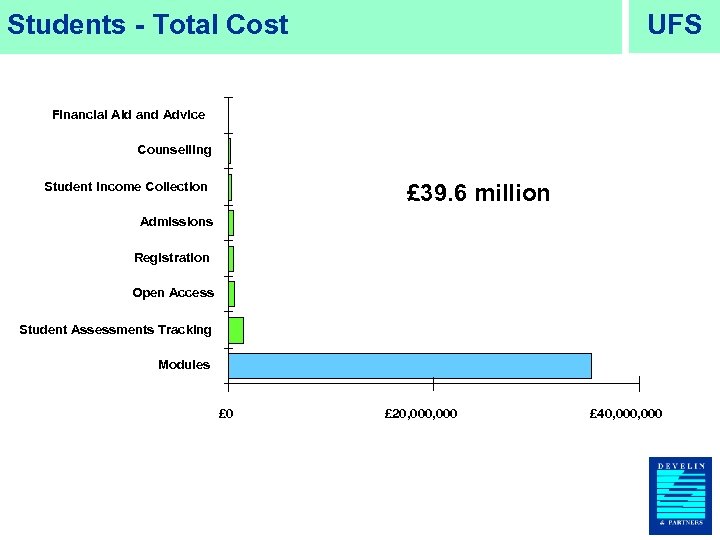
UFS Students - Total Cost Financial Aid and Advice Counselling Student Income Collection £ 39. 6 million Admissions Registration Open Access Student Assessments Tracking Modules £ 0 £ 20, 000 £ 40, 000
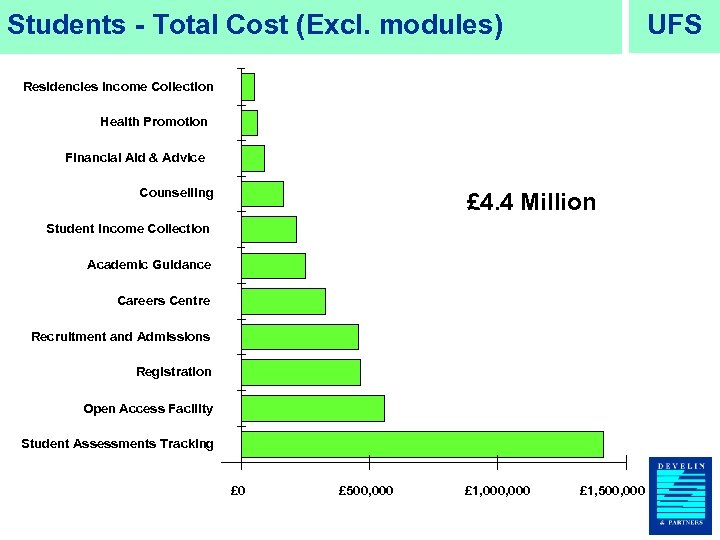
UFS Students - Total Cost (Excl. modules) Residencies Income Collection Health Promotion Financial Aid & Advice Counselling £ 4. 4 Million Student Income Collection Academic Guidance Careers Centre Recruitment and Admissions Registration Open Access Facility Student Assessments Tracking £ 0 £ 500, 000 £ 1, 500, 000
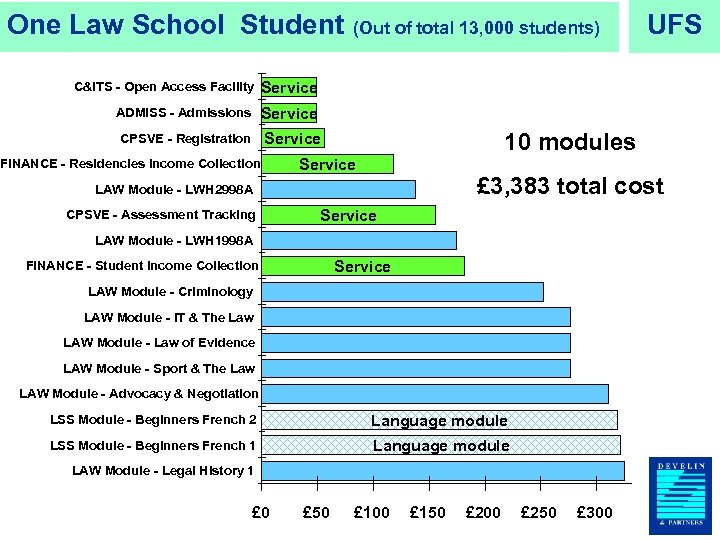
One Law School Student (Out of total 13, 000 students) C&ITS - Open Access Facility Service ADMISS - Admissions Service CPSVE - Registration Service UFS FINANCE - Residencies Income Collection 10 modules Service £ 3, 383 total cost LAW Module - LWH 2998 A CPSVE - Assessment Tracking Service LAW Module - LWH 1998 A Service FINANCE - Student Income Collection LAW Module - Criminology LAW Module - IT & The Law LAW Module - Law of Evidence LAW Module - Sport & The Law LAW Module - Advocacy & Negotiation LSS Module - Beginners French 2 Language module LSS Module - Beginners French 1 Language module LAW Module - Legal History 1 £ 0 £ 50 £ 100 £ 150 £ 200 £ 250 £ 300
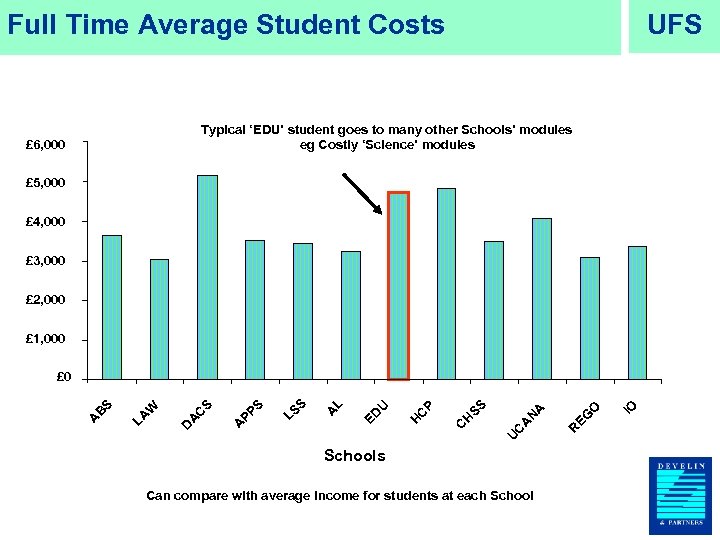
UFS Full Time Average Student Costs Typical ‘EDU’ student goes to many other Schools’ modules eg Costly ‘Science’ modules £ 6, 000 £ 5, 000 £ 4, 000 £ 3, 000 £ 2, 000 £ 1, 000 Schools Can compare with average income for students at each School IO O EG R A A N U C SS H C P C H ED U L A S LS S PP A C S A D LA W A B S £ 0
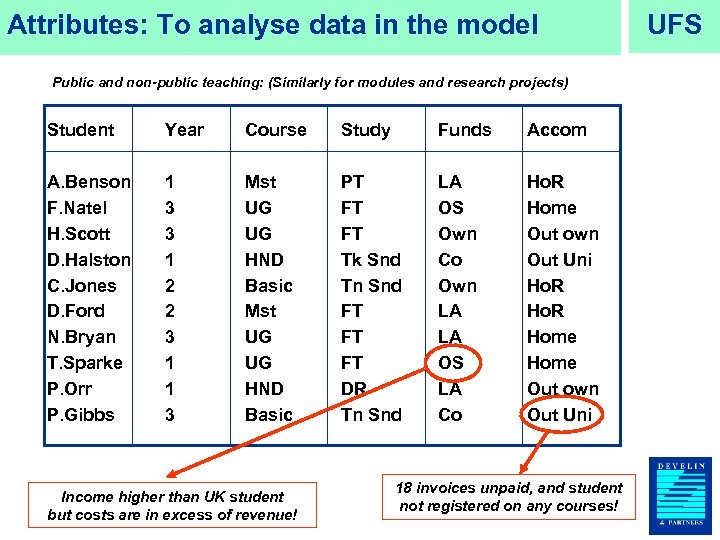
Attributes: To analyse data in the model Public and non-public teaching: (Similarly for modules and research projects) Student Year Course Study Funds Accom A. Benson F. Natel H. Scott D. Halston C. Jones D. Ford N. Bryan T. Sparke P. Orr P. Gibbs 1 3 3 1 2 2 3 1 1 3 Mst UG UG HND Basic PT FT FT Tk Snd Tn Snd FT FT FT DR Tn Snd LA OS Own Co Own LA LA OS LA Co Ho. R Home Out own Out Uni Income higher than UK student but costs are in excess of revenue! 18 invoices unpaid, and student not registered on any courses! UFS
Key points • • • UFS Create meaningful information. Don’t get buried by data. Need to work on both axes: Positioning & Capability – plot the journey ‘Activities’: useful for FEC and cost reduction Reducing ‘diversionary costs’ funds all your improvements (case study later) ABC modelling delivers FEC Contribution analysis delivers Product & customer profitability. (case studies later) All functions work together concurrently on Positioning & Capability ABC analysis produces surprising insights even in simple businesses. …and as many shocks and surprises in a University
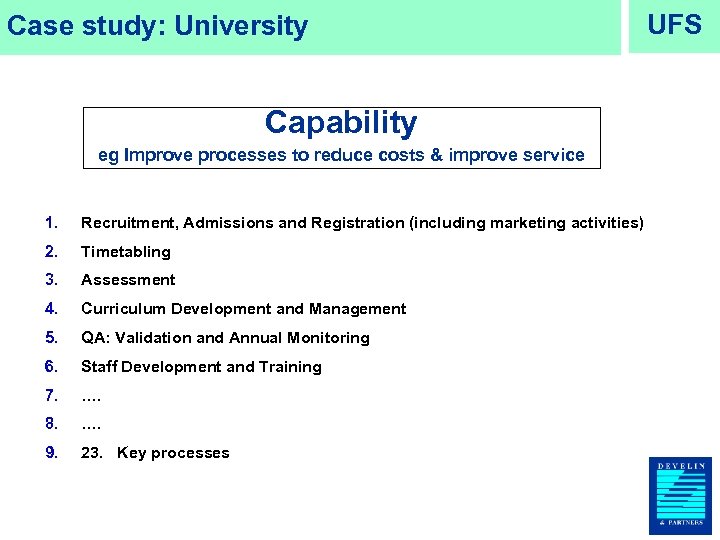
Case study: University Capability eg Improve processes to reduce costs & improve service 1. Recruitment, Admissions and Registration (including marketing activities) 2. Timetabling 3. Assessment 4. Curriculum Development and Management 5. QA: Validation and Annual Monitoring 6. Staff Development and Training 7. …. 8. …. 9. 23. Key processes UFS
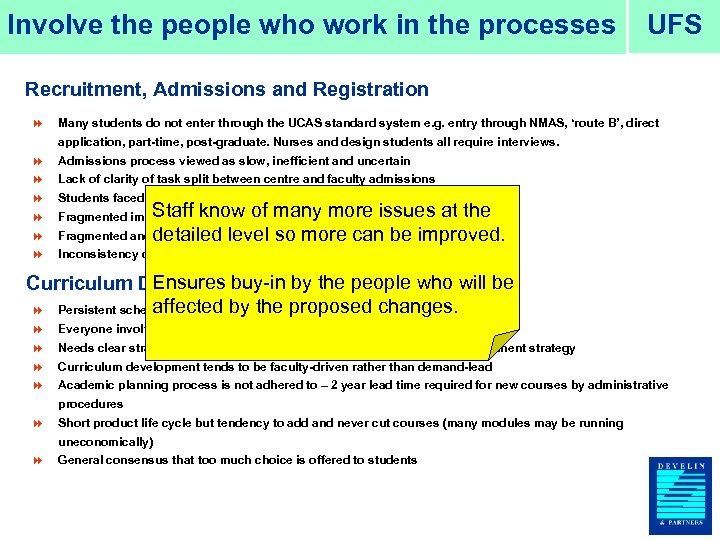
Involve the people who work in the processes UFS Recruitment, Admissions and Registration 8 Many students do not enter through the UCAS standard system e. g. entry through NMAS, ‘route B’, direct application, part-time, post-graduate. Nurses and design students all require interviews. 8 8 8 Admissions process viewed as slow, inefficient and uncertain Lack of clarity of task split between centre and faculty admissions Students faced with queues, delays and repetition Staff know of many more issues at the Fragmented and detailed level sothroughout universityimproved. duplicate data collected more can be Fragmented impression given to student – may lose potential students Inconsistency of processes in different parts of organisation Ensures buy-in by the people who Curriculum Development and Management will be affected deadlines felt to be unrealistic 8 Persistent schedule slippage, by the proposed changes. 8 8 Everyone involved in much diversionary chasing activity Needs clear strategic direction – no real course planning or portfolio development strategy Curriculum development tends to be faculty-driven rather than demand-lead Academic planning process is not adhered to – 2 year lead time required for new courses by administrative procedures 8 Short product life cycle but tendency to add and never cut courses (many modules may be running uneconomically) 8 General consensus that too much choice is offered to students
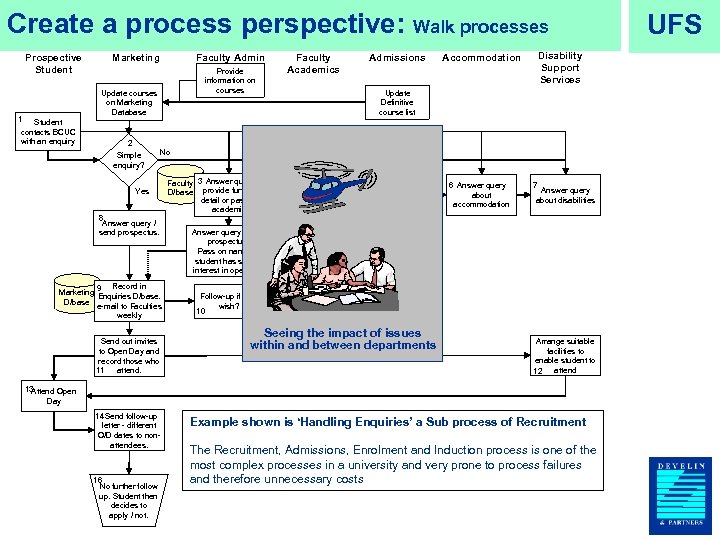
Create a process perspective: Walk processes Prospective Student Marketing Faculty Admin Provide information on courses Update courses on Marketing Database 1 Student contacts BCUC with an enquiry Faculty Academics Admissions Disability Support Services Accommodation Update Definitive course list 2 Simple enquiry? No Yes 8 Answer query / send prospectus. 9 Record in Marketing Enquiries D/base e-mail to Faculties weekly Send out invites to Open Day and record those who 11 attend. Faculty 3 Answer query / D/base provide further detail or pass to academic 4 Answer query / provide further detail 5 Answer query about entry qualifications 6 Answer query about accommodation 7 Answer query about disabilities Answer query / send prospectus. 15 Pass on names if student has shown interest in open day Follow-up if they wish? 10 Seeing the impact of issues within and between departments Arrange suitable facilities to enable student to attend 12 13 Attend Open Day 14 Send follow-up letter - different O/D dates to nonattendees. 16 No further follow up. Student then decides to apply / not. Example shown is ‘Handling Enquiries’ a Sub process of Recruitment The Recruitment, Admissions, Enrolment and Induction process is one of the most complex processes in a university and very prone to process failures and therefore unnecessary costs UFS
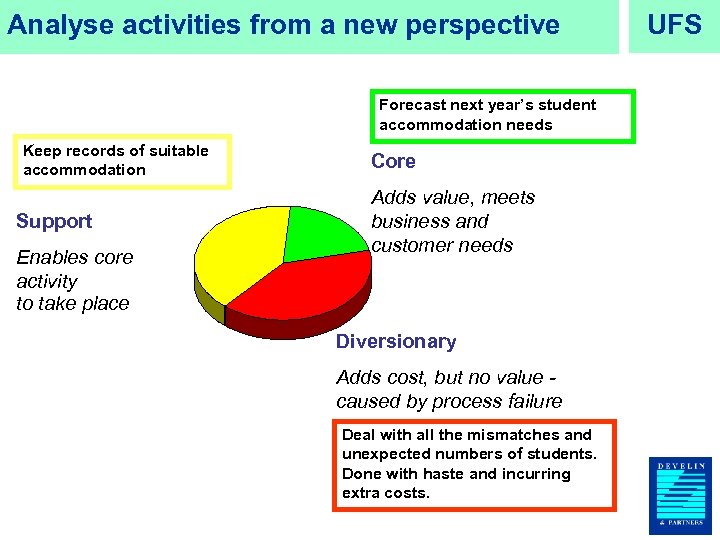
Analyse activities from a new perspective Forecast next year’s student accommodation needs Keep records of suitable accommodation Support Enables core activity to take place Core Adds value, meets business and customer needs Diversionary Adds cost, but no value caused by process failure Deal with all the mismatches and unexpected numbers of students. Done with haste and incurring extra costs. UFS
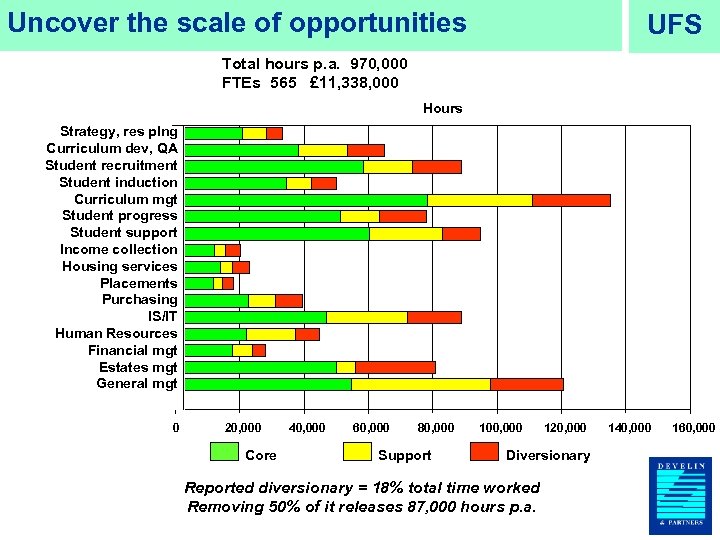
Uncover the scale of opportunities UFS Total hours p. a. 970, 000 FTEs 565 £ 11, 338, 000 Hours Strategy, res plng Strategy, res planning Curriculum dev, QA Student recruitment Student induction Curriculum mgt Student progress Student support Income collection Housing services Placements Purchasing IS/IT Human Resources Financial mgt Estates mgt General mgt Not in scope 0 20, 000 Core 40, 000 60, 000 80, 000 Support 100, 000 120, 000 Diversionary Reported diversionary = 18% total time worked Removing 50% of it releases 87, 000 hours p. a. 140, 000 160, 000
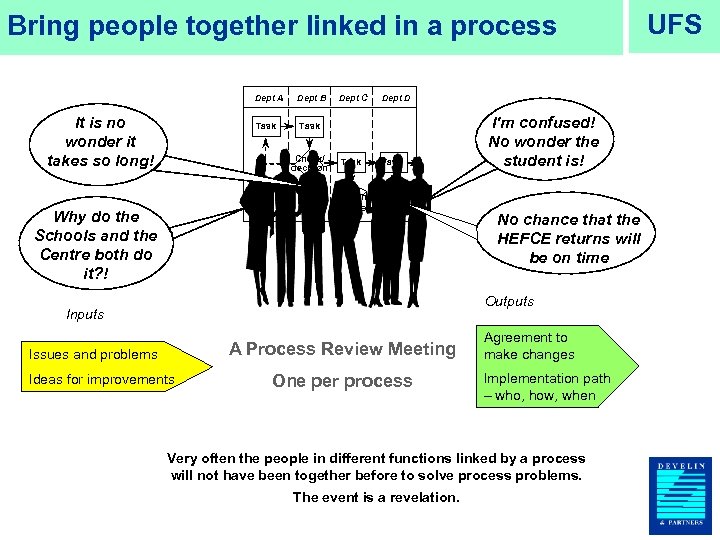
Bring people together linked in a process Dept A Task It is no wonder it takes so long! Dept B Task Check/ decision Dept C Task Dept D Task No Marketing Further action D/base Why do the Schools and the Centre both do it? ! I'm confused! No wonder the student is! No chance that the HEFCE returns will be on time Outputs Inputs A Process Review Meeting Issues and problems Ideas for improvements One per process Agreement to make changes Implementation path – who, how, when Very often the people in different functions linked by a process will not have been together before to solve process problems. The event is a revelation. UFS
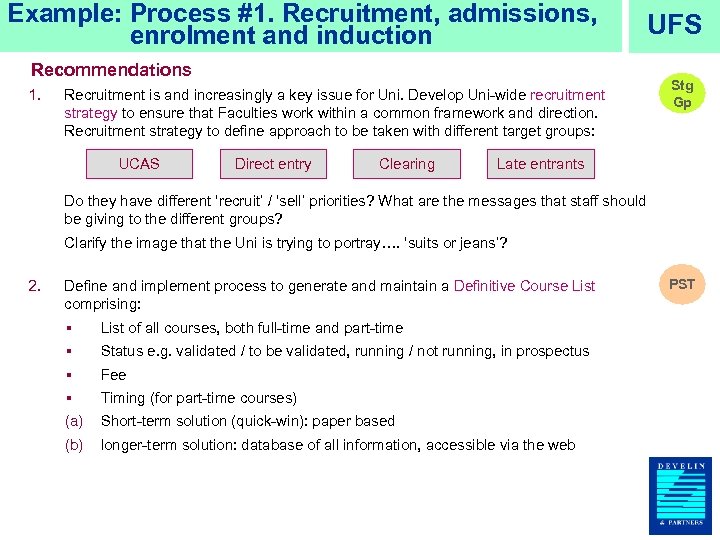
Example: Process #1. Recruitment, admissions, enrolment and induction UFS Recommendations 1. Recruitment is and increasingly a key issue for Uni. Develop Uni-wide recruitment strategy to ensure that Faculties work within a common framework and direction. Recruitment strategy to define approach to be taken with different target groups: UCAS Direct entry Clearing Stg Gp Late entrants Do they have different ‘recruit’ / ‘sell’ priorities? What are the messages that staff should be giving to the different groups? Clarify the image that the Uni is trying to portray…. ‘suits or jeans’? 2. Define and implement process to generate and maintain a Definitive Course List comprising: § List of all courses, both full-time and part-time § Status e. g. validated / to be validated, running / not running, in prospectus § Fee § Timing (for part-time courses) (a) Short-term solution (quick-win): paper based (b) longer-term solution: database of all information, accessible via the web PST
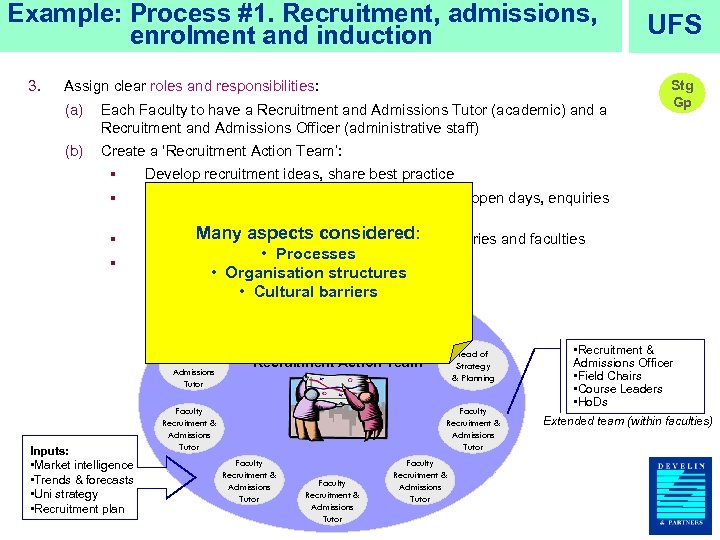
Example: Process #1. Recruitment, admissions, enrolment and induction 3. Assign clear roles and responsibilities: (a) Each Faculty to have a Recruitment and Admissions Tutor (academic) and a Recruitment and Admissions Officer (administrative staff) (b) UFS Stg Gp Create a ‘Recruitment Action Team’: § Develop recruitment ideas, share best practice § Ensure common approach and consistency (e. g. open days, enquiries handling and follow up) § Many aspects considered: Enable communication between marketing, enquiries and faculties § Ensure standardisation of Joining Instructions • Processes • Organisation structures • Cultural barriers Admissions Marketing Faculty Recruitment & Admissions Tutor Inputs: • Market intelligence • Trends & forecasts • Uni strategy • Recruitment plan Local School Liaison Coordinator Head of Strategy & Planning Recruitment Action Team Faculty Recruitment & Admissions Tutor Faculty Recruitment & Admissions Tutor • Recruitment & Admissions Officer • Field Chairs • Course Leaders • Ho. Ds Extended team (within faculties)
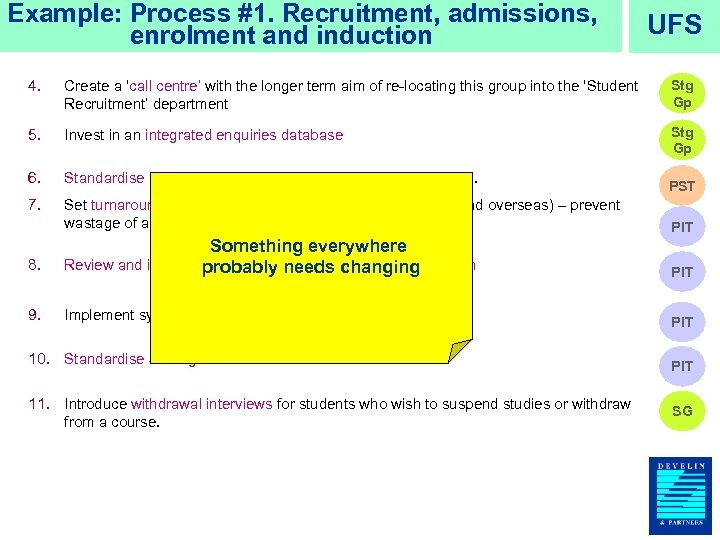
Example: Process #1. Recruitment, admissions, enrolment and induction UFS 4. Create a ‘call centre’ with the longer term aim of re-locating this group into the ‘Student Recruitment’ department Stg Gp 5. Invest in an integrated enquiries database Stg Gp 6. Standardise part-time and post-graduate applications process. PST 7. Set turnaround-time targets for applications (both domestic and overseas) – prevent wastage of applicants due to delay in offer process. PIT 8. Something everywhere Review and implement quick fixes for enrolment and induction probably needs changing PIT 9. Implement systematic late enrolment process PIT 10. Standardise Joining Instructions. 11. Introduce withdrawal interviews for students who wish to suspend studies or withdraw from a course. PIT SG
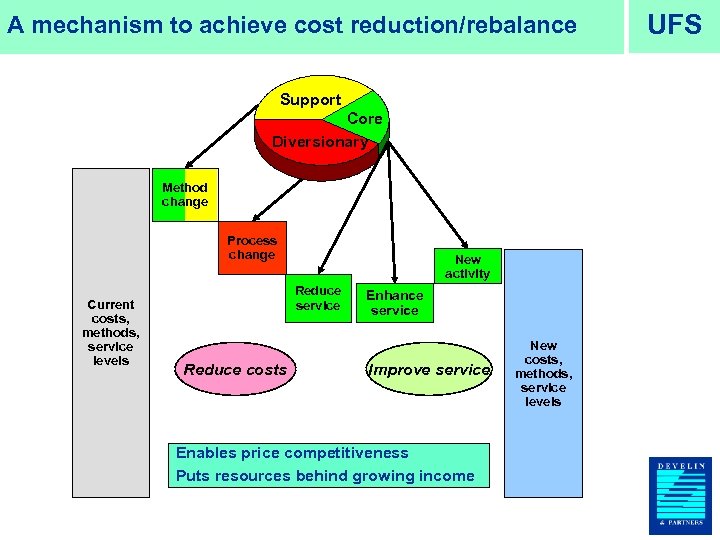
A mechanism to achieve cost reduction/rebalance Support Core Diversionary Method change Process change Current costs, methods, service levels New activity Reduce service Reduce costs Enhance service Improve service Enables price competitiveness Puts resources behind growing income New costs, methods, service levels UFS
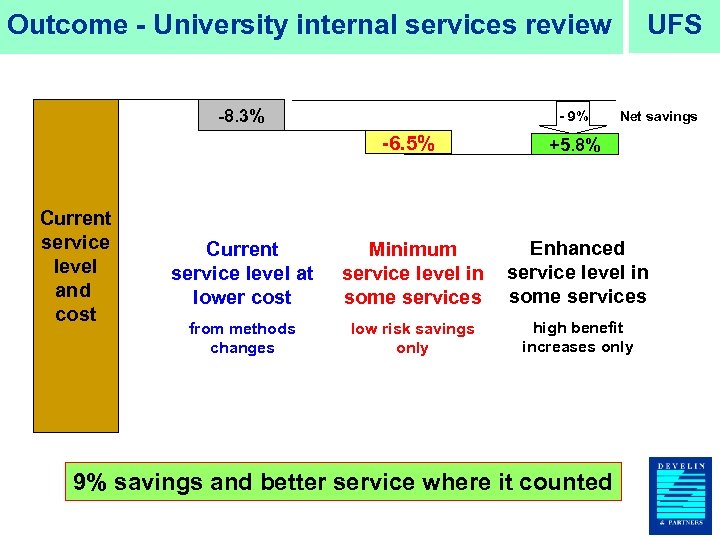
UFS Outcome - University internal services review -8. 3% - 9% Net savings -6. 5% Current service level and cost +5. 8% Current service level at lower cost Minimum service level in some services Enhanced service level in some services from methods changes low risk savings only high benefit increases only 9% savings and better service where it counted
Key points • • • UFS Create meaningful information. Don’t get buried by data. Need to work on both axes: Positioning & Capability – plot the journey ‘Activities’: useful for FEC and cost reduction Reducing ‘diversionary costs’ funds all your improvements (case study later) ABC modelling delivers FEC Contribution analysis delivers Product & customer profitability. (case studies later) All functions work together concurrently on Positioning & Capability ABC analysis produces surprising insights even in simple businesses. …and as many shocks and surprises in a University • Process analysis uncovers ways to improve methods and reduce/eliminate process failures. The savings can be used to finance growth and improve service levels.
Implications for 2005 onwards The bigger picture UFS
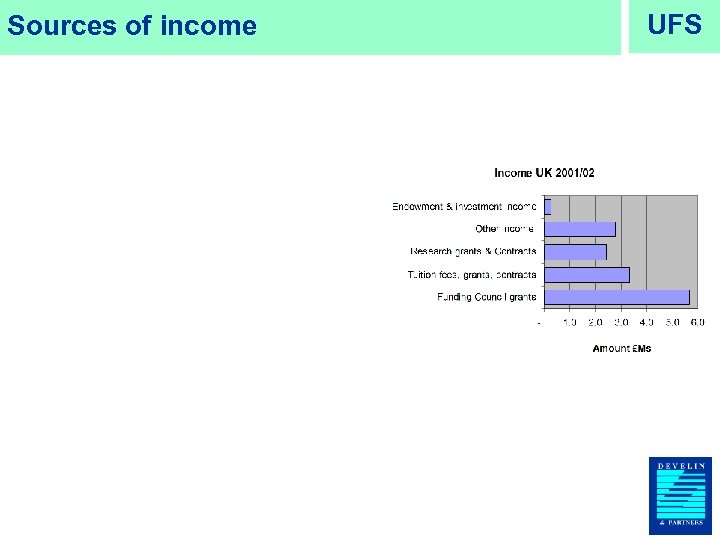
Sources of income UFS
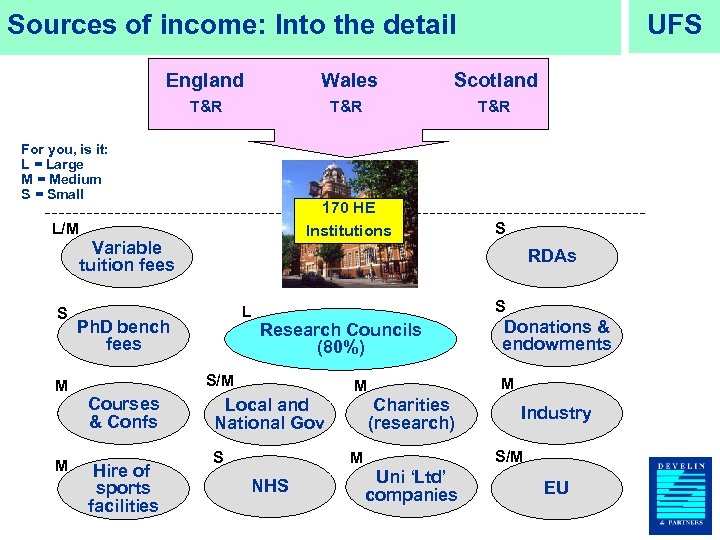
UFS Sources of income: Into the detail England Wales Scotland T&R T&R For you, is it: L = Large M = Medium S = Small 170 HE Institutions L/M Variable tuition fees S M M RDAs L Ph. D bench fees S Research Councils (80%) S/M Courses & Confs Hire of sports facilities S M M Local and National Gov S Charities (research) Industry S/M M NHS Donations & endowments Uni ‘Ltd’ companies EU
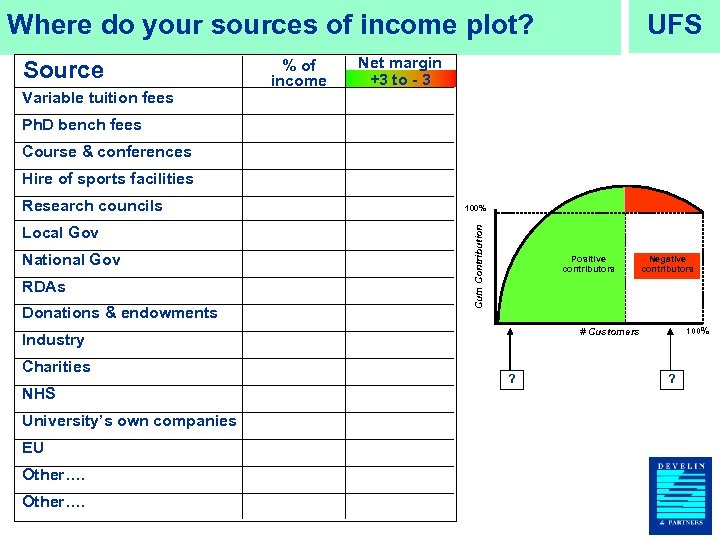
UFS Where do your sources of income plot? Source Variable tuition fees % of income Net margin +3 to - 3 Ph. D bench fees Course & conferences Hire of sports facilities Local Gov National Gov RDAs Donations & endowments 100% Cum Contribution Research councils Positive contributors # Customers Industry Charities NHS University’s own companies EU Other…. Negative contributors ? 100% ?
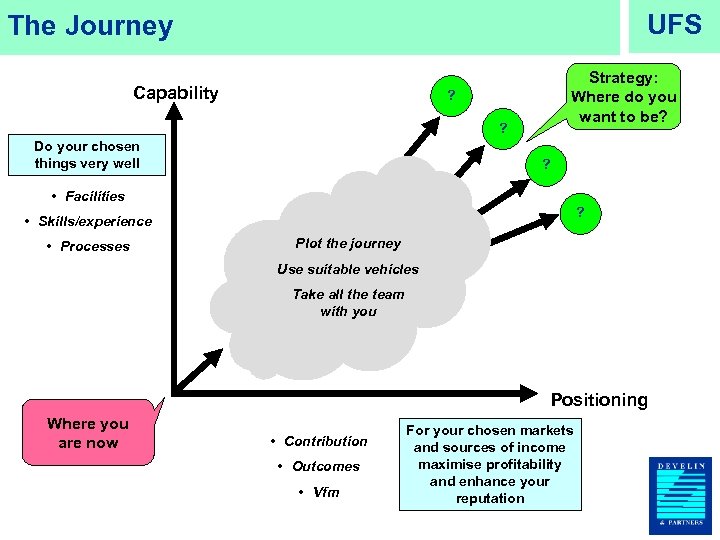
UFS The Journey Capability Strategy: Where do you want to be? ? ? Do your chosen things very well ? • Facilities ? • Skills/experience • Processes Plot the journey Use suitable vehicles Take all the team with you Positioning Where you are now • Contribution • Outcomes • Vfm For your chosen markets and sources of income maximise profitability and enhance your reputation
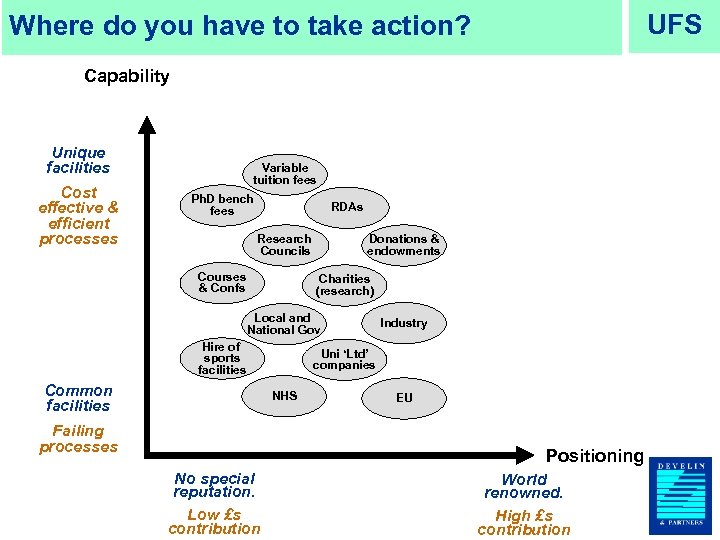
UFS Where do you have to take action? Capability Unique facilities Cost effective & efficient processes Variable tuition fees Ph. D bench fees RDAs Research Councils Courses & Confs Donations & endowments Charities (research) Local and National Gov Hire of sports facilities Common facilities Uni ‘Ltd’ companies NHS Failing processes Industry EU Positioning No special reputation. Low £s contribution World renowned. High £s contribution
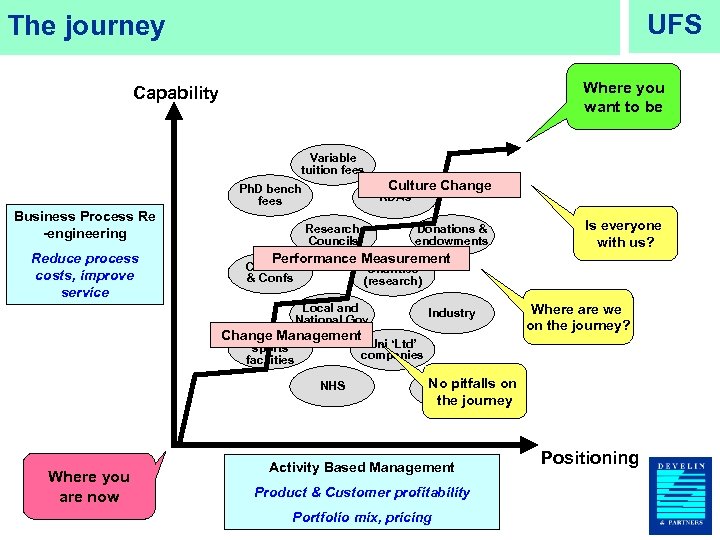
UFS The journey Where you want to be Capability Variable tuition fees Culture Change Ph. D bench fees Business Process Re -engineering Reduce process costs, improve service RDAs Research Councils Donations & endowments Performance Measurement Courses & Confs Charities (research) Local and National Gov Industry Change Management Hire of Where are we on the journey? Uni ‘Ltd’ companies sports facilities NHS Where you are now Is everyone with us? No pitfalls on EU the journey Activity Based Management Product & Customer profitability Portfolio mix, pricing Positioning
UFS Thank you Brian Plowman Director Develin & Partners, Ash House, Fairfield Avenue, Staines, Middlesex TW 18 4 AB, UK Tel: 01784 224207 brian. plowman@develin. co. uk www. develin. co. uk
Скачать презентацию UFS Universities Finance Seminars BRITISH UNIVERSITIES FINANCE DIRECTORS
589ec45185269e6282b19ed6cf11e477.ppt