


 Скачать презентацию Uformell tvang utenfor sykehus Internasjonal forskning og en
d7e3df320e055962504a349fb50aecc1.ppt
- Количество слайдов: 29
 Uformell tvang utenfor sykehus: Internasjonal forskning og en mulig norsk multisenterstudie TVANGSFORSKNINGNETTVERKET 11. mai 2016 Jorun Rugkåsa Akershus University Hospital and University of Oxford jorun. rugkasa@ahus. no
 Bakgrunn • Deinstitusjonalisering: pasienter med alvorlige psykiatriske lidelser blir behandlet hjemme • ’Svingdør syndromet’ gjør pasienter og pårørendes liv vanskelige, og er utfordrene (og dyre) for tjenestene • Nye lovformer som tillater tvang utenfor sykehus vokser frem; TUD • Nye måter å organisere tjenester på (for eksempel ACT, FACT)
 ‘Formal’ and ‘informal’ community coercion Formal coercion Informal coercion • Compulsion permitted by mental health legislation • ‘Community treatment orders’ • More assertive models for community teams • Wide range of pressures placed on patients to adhere to treatment • Service users also report this from family and others Co·er·cion noun -ˈər-zhən, -shən: the act, process, or power of coercing Synonyms: arm-twisting, force, compulsion, constraint, duress, pressure
 Objective vs subjective coercion • Coercion can be perceived both as what is done to someone and what is experienced by someone: “it is thus both an objective set of actions and a subjectively experienced result of particular actions” (Hoge et al. , 1993, p. 282) • ‘Perceived coercion’ • To fully understand the effect of coercion we must take perceived coercion into account (especially regarding forml coercion) 4
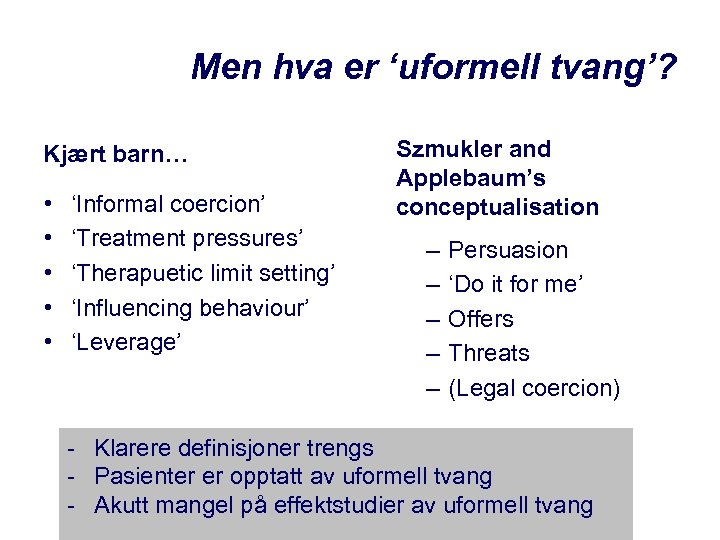 Men hva er ‘uformell tvang’? Kjært barn… • • • ‘Informal coercion’ ‘Treatment pressures’ ‘Therapuetic limit setting’ ‘Influencing behaviour’ ‘Leverage’ Szmukler and Applebaum’s conceptualisation – – – Persuasion ‘Do it for me’ Offers Threats (Legal coercion) - Klarere definisjoner trengs - Pasienter er opptatt av uformell tvang - Akutt mangel på effektstudier av uformell tvang
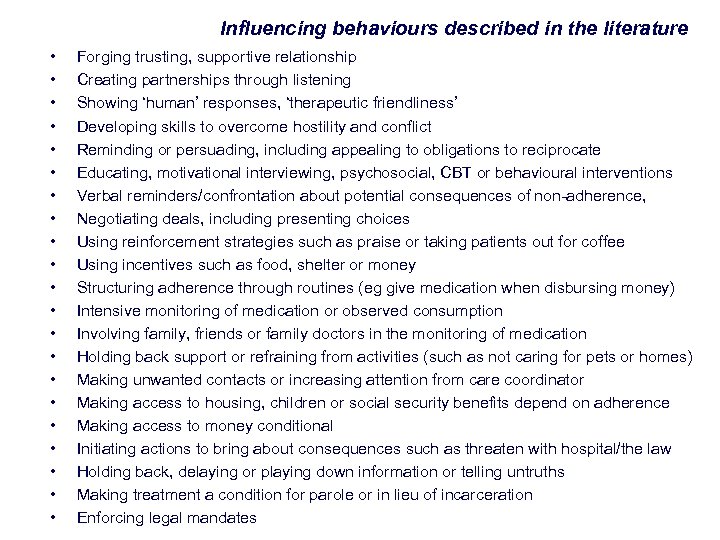 Influencing behaviours described in the literature • • • • • • Forging trusting, supportive relationship Creating partnerships through listening Showing ‘human’ responses, ‘therapeutic friendliness’ Developing skills to overcome hostility and conflict Reminding or persuading, including appealing to obligations to reciprocate Educating, motivational interviewing, psychosocial, CBT or behavioural interventions Verbal reminders/confrontation about potential consequences of non-adherence, Negotiating deals, including presenting choices Using reinforcement strategies such as praise or taking patients out for coffee Using incentives such as food, shelter or money Structuring adherence through routines (eg give medication when disbursing money) Intensive monitoring of medication or observed consumption Involving family, friends or family doctors in the monitoring of medication Holding back support or refraining from activities (such as not caring for pets or homes) Making unwanted contacts or increasing attention from care coordinator Making access to housing, children or social security benefits depend on adherence Making access to money conditional Initiating actions to bring about consequences such as threaten with hospital/the law Holding back, delaying or playing down information or telling untruths Making treatment a condition for parole or in lieu of incarceration Enforcing legal mandates
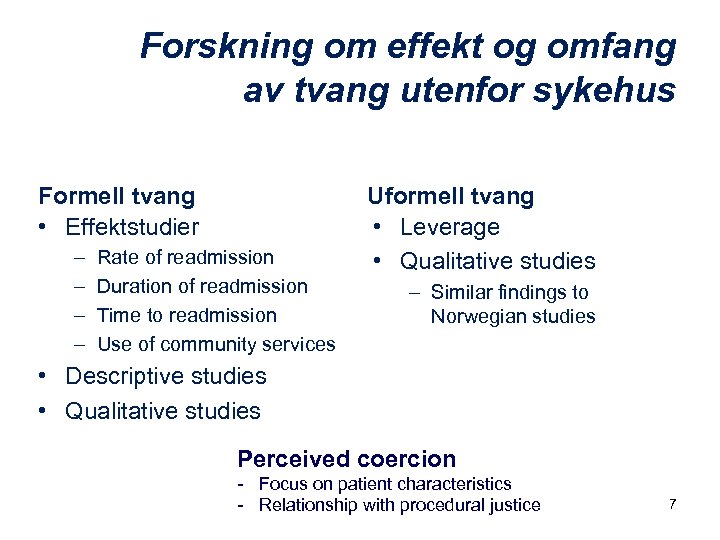 Forskning om effekt og omfang av tvang utenfor sykehus Formell tvang • Effektstudier – – Rate of readmission Duration of readmission Time to readmission Use of community services Uformell tvang • Leverage • Qualitative studies – Similar findings to Norwegian studies • Descriptive studies • Qualitative studies Perceived coercion - Focus on patient characteristics - Relationship with procedural justice 7
 Coercion in mental health: Patterns and prevalence of coercion in mental health care and a trial of the effectiveness and costs of Community Treatment Orders Funded by the National Institute of Health Research* * This presentation discusses independent research funded by the National Institute for Health Research (NIHR) under its Programme Grants for Applied Research scheme (RP-PG-0606 -1006). The views expressed in this presentation are those of the authors and not necessarily those of the NHS, the NIHR or the Department of Health.
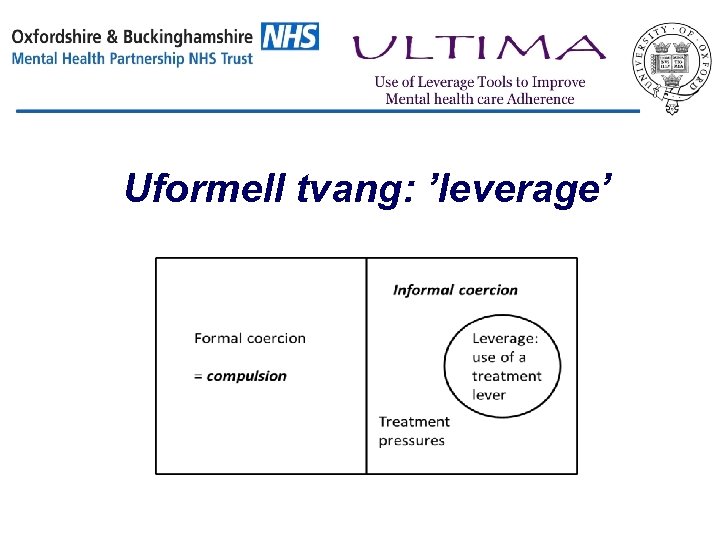 Uformell tvang: ’leverage’
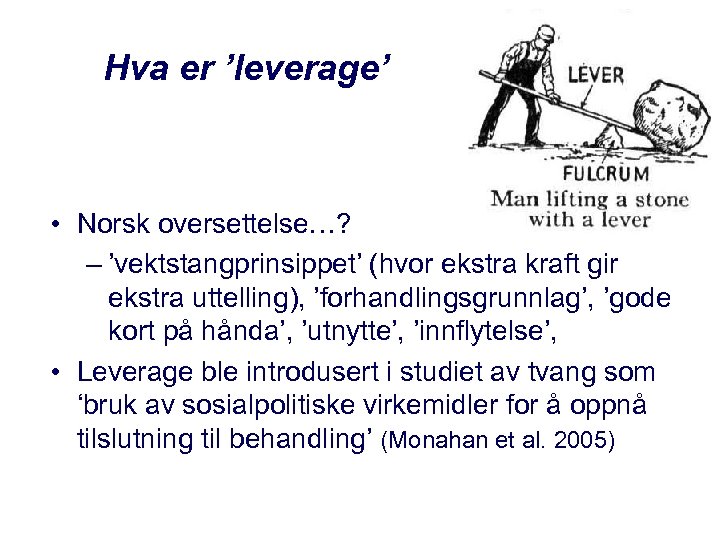 Hva er ’leverage’ • Norsk oversettelse…? – ’vektstangprinsippet’ (hvor ekstra kraft gir ekstra uttelling), ’forhandlingsgrunnlag’, ’gode kort på hånda’, ’utnytte’, ’innflytelse’, • Leverage ble introdusert i studiet av tvang som ‘bruk av sosialpolitiske virkemidler for å oppnå tilslutning til behandling’ (Monahan et al. 2005)
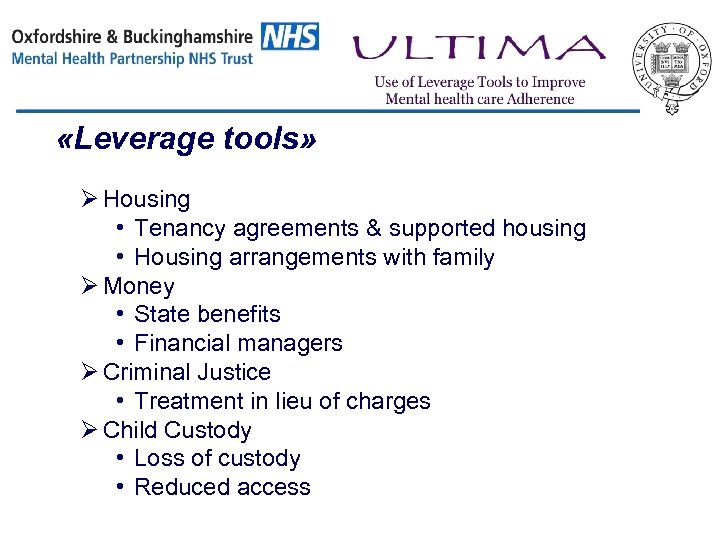 «Leverage tools» Ø Housing • Tenancy agreements & supported housing • Housing arrangements with family Ø Money • State benefits • Financial managers Ø Criminal Justice • Treatment in lieu of charges Ø Child Custody • Loss of custody • Reduced access
 Organisering av engelske tjenester • Primærtjenesten: Fastlegen som førstelinje, kan henvise til • Spesialisttjenesten: Regionale helseforetak med ansvar for – Generelle områdebaserte Community Mental Health Teams, ofte med komplemetære – Fokuserte team • Assertive Community Treatment • Early Intervention Teams • Addiction Services
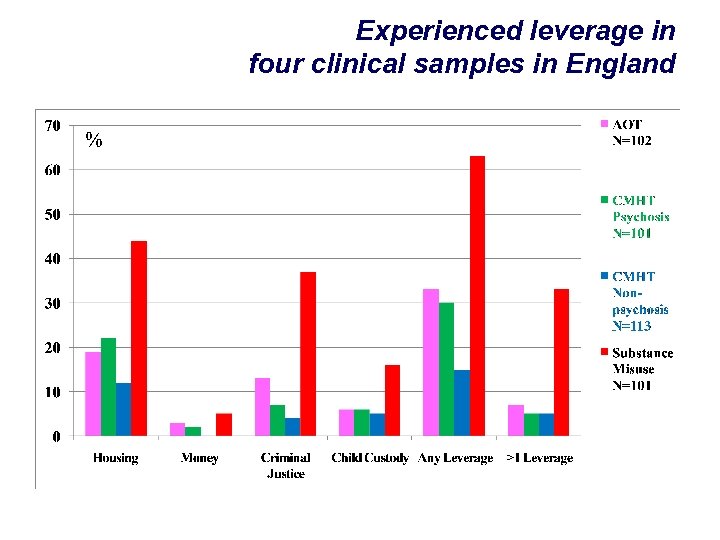
 ULTIMA study • 400 patients in 4 clinical samples interviewed about experiences of ‘leverage’ – – – CMHT psychotic CMHT non-psychotic ACT Substance misuse Before CTO
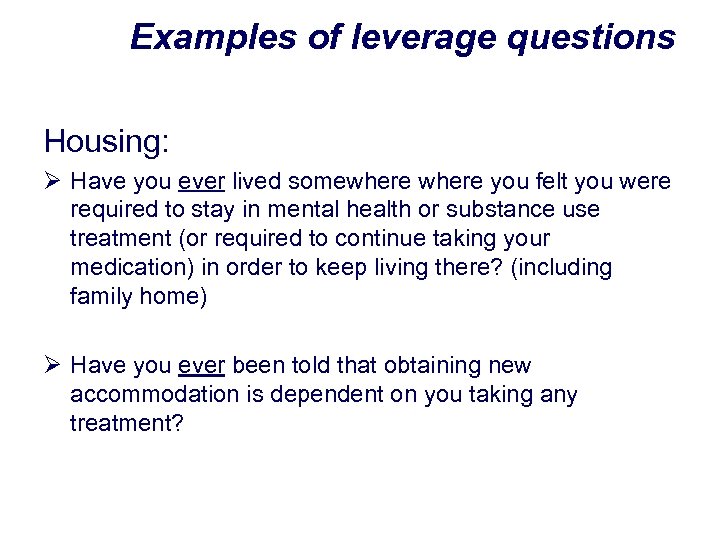 Examples of leverage questions Housing: Ø Have you ever lived somewhere you felt you were required to stay in mental health or substance use treatment (or required to continue taking your medication) in order to keep living there? (including family home) Ø Have you ever been told that obtaining new accommodation is dependent on you taking any treatment?
 15
15
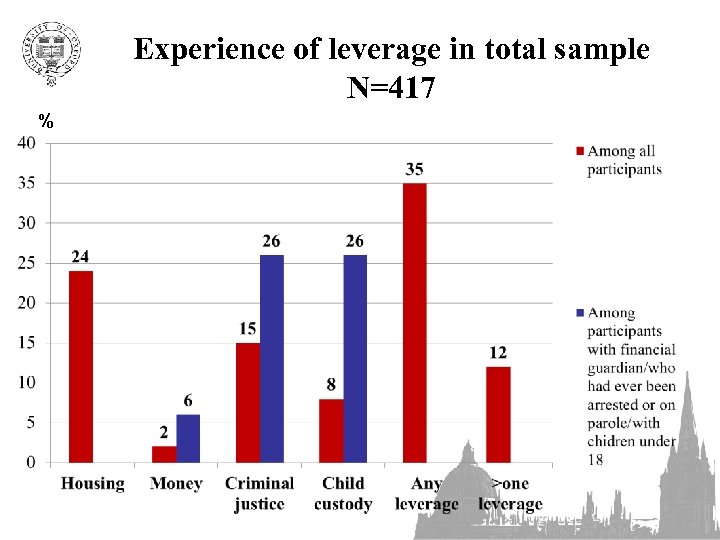 Experience of leverage in total sample N=417 %
 Experienced leverage in four clinical samples in England %
 Multivariate associations of baseline characteristics with… Experiencing any leverage - associated with: § Substance misuse diagnosis § More than two hospitalisations § Lower score on the insight and treatment attitude measure (ITAQ) Experiencing more than one leverage – associated with: § Substance misuse diagnosis § Independent accommodation § Imprisonment
 International comparison 19
 Patients’ views on leverage 20
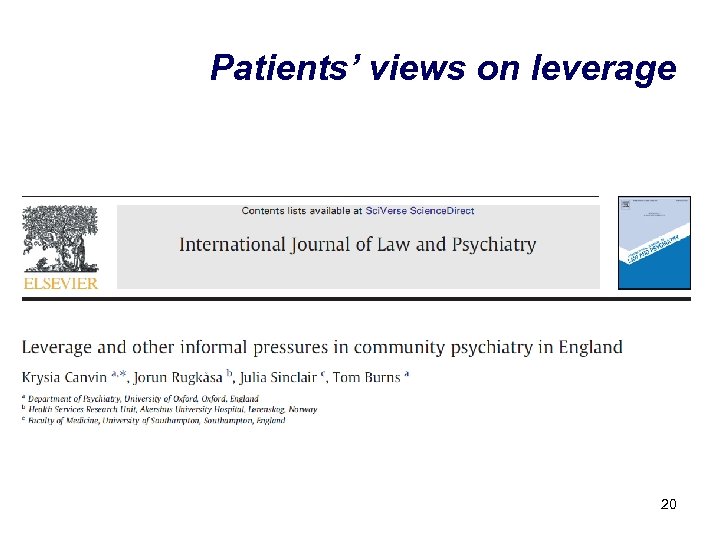
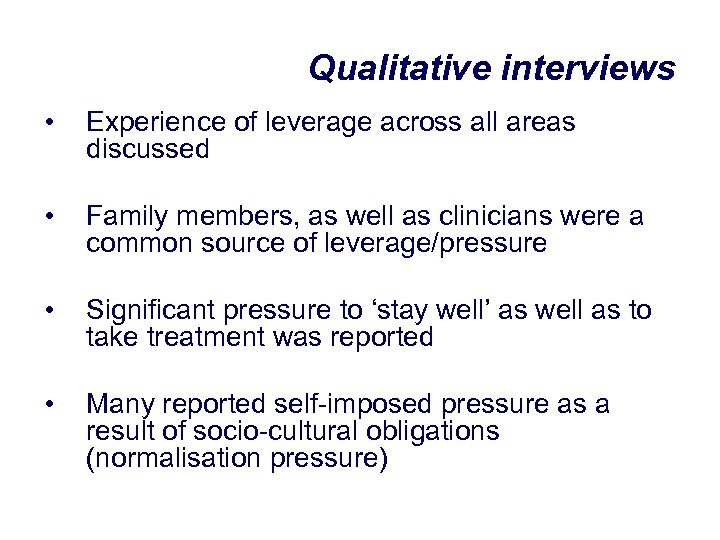 Qualitative interviews • Experience of leverage across all areas discussed • Family members, as well as clinicians were a common source of leverage/pressure • Significant pressure to ‘stay well’ as well as to take treatment was reported • Many reported self-imposed pressure as a result of socio-cultural obligations (normalisation pressure)
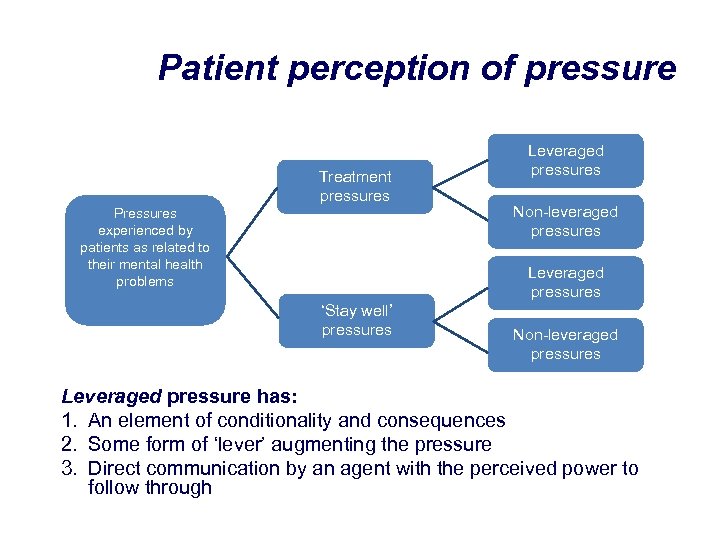 Patient perception of pressure Treatment pressures Pressures experienced by patients as related to their mental health problems Leveraged pressures Non-leveraged pressures Leveraged pressures ‘Stay well’ pressures Non-leveraged pressures Leveraged pressure has: 1. An element of conditionality and consequences 2. Some form of ‘lever’ augmenting the pressure 3. Direct communication by an agent with the perceived power to follow through
![Pressure Leveraged Treatment ’Stay well’ The [nurse] said that I had to take medicine](https://present5.com/presentation/d7e3df320e055962504a349fb50aecc1/image-23.jpg "Pressure Leveraged Treatment ’Stay well’ The [nurse] said that I had to take medicine") Pressure Leveraged Treatment ’Stay well’ The [nurse] said that I had to take medicine all the time, no matter what, but if I didn’t take it for a long time I couldn’t function and I’d lose my place [in supported housing]. (36 AOT) The other slight pressure that was put on me was people saying things like, “Well of course if you’re going to be self-harming you won’t be allowed to have your daughter with you. ” (38 CMHT-NP) Non-leveraged If I don’t get treated I’m not going to be well enough to see [my daughter] and to be able to get anything out of it. […] That was just coming from me. (5 CMHT-NP) [Staff member] dropped by and he’s a star, he said to me, “I’ve been telling you to give up drinking but I’m drinking myself, ” so he’s actually stopped drinking so that he can support me. (9 CMHT-NP)
Pressure Leveraged Treatment ’Stay well’ The [nurse] said that I had to take medicine all the time, no matter what, but if I didn’t take it for a long time I couldn’t function and I’d lose my place [in supported housing]. (36 AOT) The other slight pressure that was put on me was people saying things like, “Well of course if you’re going to be self-harming you won’t be allowed to have your daughter with you. ” (38 CMHT-NP) Non-leveraged If I don’t get treated I’m not going to be well enough to see [my daughter] and to be able to get anything out of it. […] That was just coming from me. (5 CMHT-NP) [Staff member] dropped by and he’s a star, he said to me, “I’ve been telling you to give up drinking but I’m drinking myself, ” so he’s actually stopped drinking so that he can support me. (9 CMHT-NP)
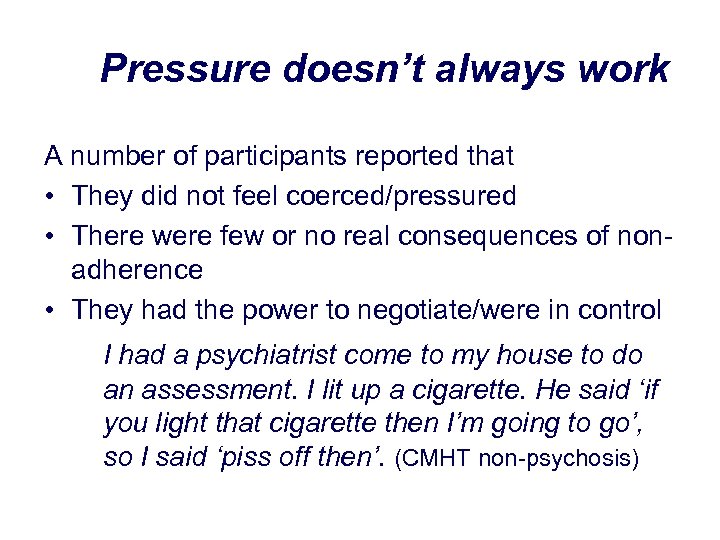 Pressure doesn’t always work A number of participants reported that • They did not feel coerced/pressured • There were few or no real consequences of nonadherence • They had the power to negotiate/were in control I had a psychiatrist come to my house to do an assessment. I lit up a cigarette. He said ‘if you light that cigarette then I’m going to go’, so I said ‘piss off then’. (CMHT non-psychosis)
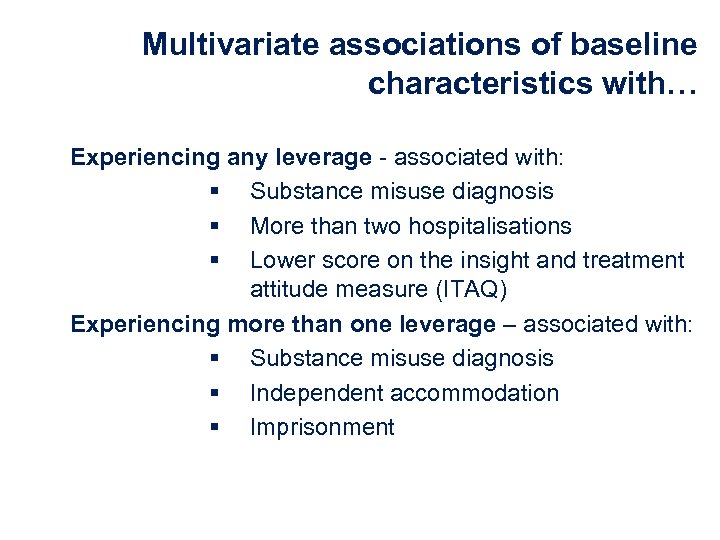
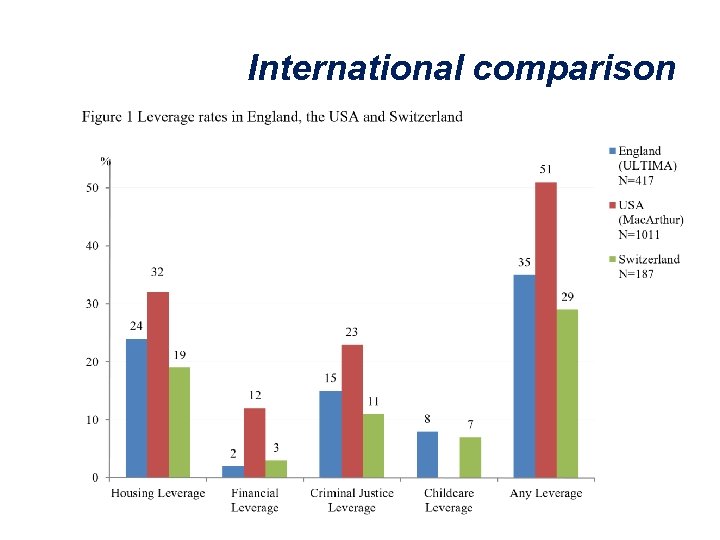
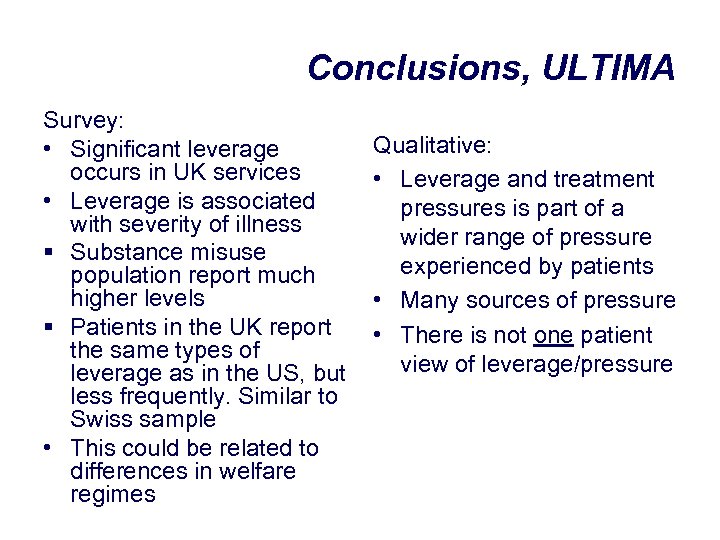 Conclusions, ULTIMA Survey: • Significant leverage occurs in UK services • Leverage is associated with severity of illness § Substance misuse population report much higher levels § Patients in the UK report the same types of leverage as in the US, but less frequently. Similar to Swiss sample • This could be related to differences in welfare regimes Qualitative: • Leverage and treatment pressures is part of a wider range of pressure experienced by patients • Many sources of pressure • There is not one patient view of leverage/pressure
 Interactions between formal and informal coercion 1 • Hoge et al: No straightforward relationship between legal status and perceived coercion – signigicant numbers of informal patients report high ‘perceived coercion’ – signigicant numbers of formal patients report low ‘perceived coercion’ • Jaeger & Røssler: Perceived coercion is correlated to procedural justice
 Interactions between formal and informal coercion 1 • Ultima, Professionals: – Relationship building, negotiation, asserting authority – But uneven playing field: “Anne would perhaps prefer not to take any medication at all but in terms of the deals we might strike with her they’re a bit stacked on our side ‘cause we’ve got the Mental Health Act” • Laughrane and Priebe: Patients report the same • Sjöström: Coercion context • OCTET: No difference between CTO patients and controls in perceived coercion – Does long experiences of coercion mean CTOs do not add much? – Are instruments too blunt? 27
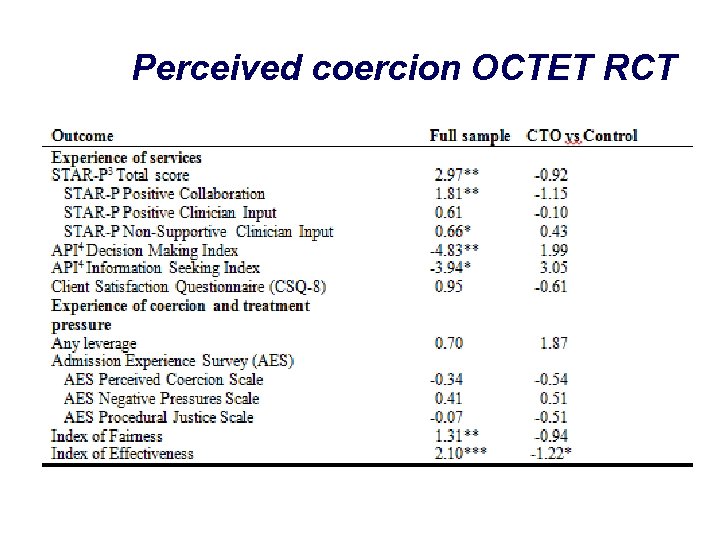 Perceived coercion OCTET RCT
 Hjelper tvang/press brukerne? • Formell tvang: Nei, TUD har ingen støtte i evidensen • Uformell tvang/press: Vet ikke. For å finne ut trenger vi – – – mer kunnskap om dagens praksis måling av uformell og ‘perceived’ tvang prospektive studier, prediktor- og utfallsanalyser kunnskap om behandlerenes perspektiv og erfaringer bedre forståelse av kontekst (sosial og personlig)