


 Скачать презентацию UEMS STATEMENT ON PREVENTING ALCOHOL AND ILLICIT DRUG
abfcd664cc45363f143d07ba502cd3ba.ppt
- Количество слайдов: 10
 UEMS STATEMENT ON PREVENTING ALCOHOL AND ILLICIT DRUG USE IN THE WORKPLACE Groupe Pompidou 2 e Conférence Int “Prévention en milieu professionnel de la consommation d’alcool et de drogues”, Strasbourg, 15 -16 oct 2014 Dr Alenka Škerjanc President of UEMS Section of Occupational medicine
 Union of European Medical Specialists § Members: National Medical Associations of the 28 European Member States + European Economic Area (Iceland & Norway) + Switzerland + countries of the Council of Europe (Georgia, Israel, Turkey) § established in 1958 § 1 million specialists § 50 medical specialties including Occupational medicine Jean-Baptiste ROUFFET, UEMS Coordinator for Specialties 2
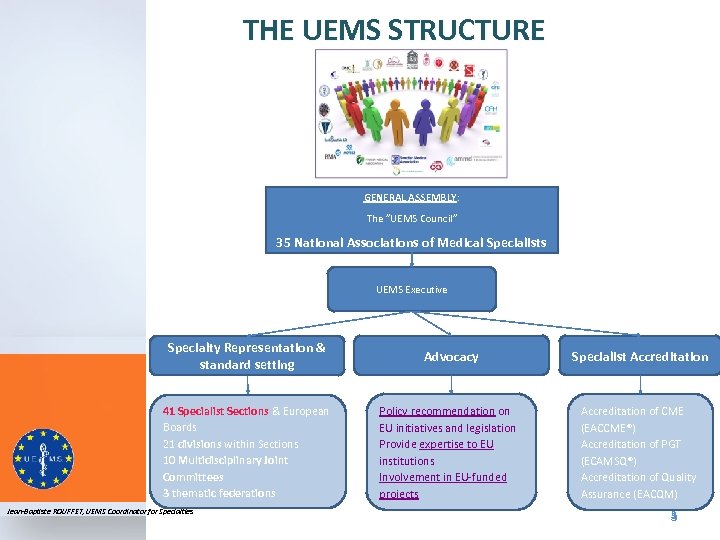 THE UEMS STRUCTURE GENERAL ASSEMBLY: The ”UEMS Council” 35 National Associations of Medical Specialists UEMS Executive Specialty Representation & standard setting 41 Specialist Sections & European Boards 21 divisions within Sections 10 Multidisciplinary Joint Committees 3 thematic federations Jean-Baptiste ROUFFET, UEMS Coordinator for Specialties Advocacy Policy recommendation on EU initiatives and legislation Provide expertise to EU institutions Involvement in EU-funded projects Specialist Accreditation of CME (EACCME®) Accreditation of PGT (ECAMSQ®) Accreditation of Quality Assurance (EACQM) 3
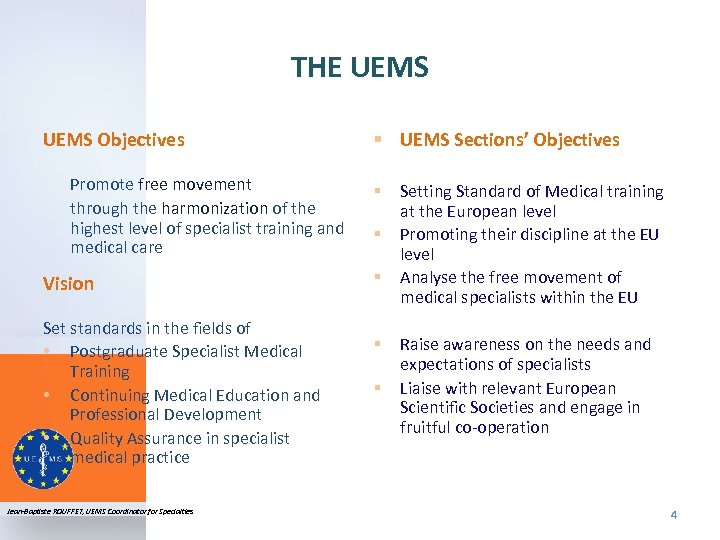 THE UEMS Objectives § UEMS Sections’ Objectives Promote free movement through the harmonization of the highest level of specialist training and medical care Vision § § § Set standards in the fields of • Postgraduate Specialist Medical Training • Continuing Medical Education and Professional Development • Quality Assurance in specialist medical practice Jean-Baptiste ROUFFET, UEMS Coordinator for Specialties § § Setting Standard of Medical training at the European level Promoting their discipline at the EU level Analyse the free movement of medical specialists within the EU Raise awareness on the needs and expectations of specialists Liaise with relevant European Scientific Societies and engage in fruitful co-operation 4
 UEMS STATEMENT ON PREVENTING ALCOHOL AND ILLICIT DRUG USE IN THE WORKPLACE 5
 1. Preventing alcohol and illicit drug use in the workplace • . . . it is on the first place the role of all employers to define their tasks and obligations. . . 6
 2. Medical Specialists in Occupational Medicine – key player in preventing alcohol and illicit drug use • • • . . . develop programs and models for action and prevention, develop and promote tools to be used, provide training programs for occupational service teams. . . 7
 3. Recommendation from the UEMS Occupational Medicine Section • • . . . the rate of (zero) tolerance must be defined and declared by the employer, testing for alcohol and/or illicit drugs – informed consent, role of employers and coworkers in detecting problem, current tendencies. . . work related activities outside work. 8
 • Levels to interact and help workers: 1. The legislative level 2. Human resources department 3. Advisors (. . . medical specialists in occupational medicine. . . ) 9
 ON TI EN T AT R OU Y OR F U YO K N HA T http: //www. uems. eu http: //www. uems-occupationalmedicine. org/