 Скачать презентацию Учитель высшей категории Цаплина Т С ГБОУ СОШ
230d17d5a1994989930d008a275ade82.ppt
- Количество слайдов: 22



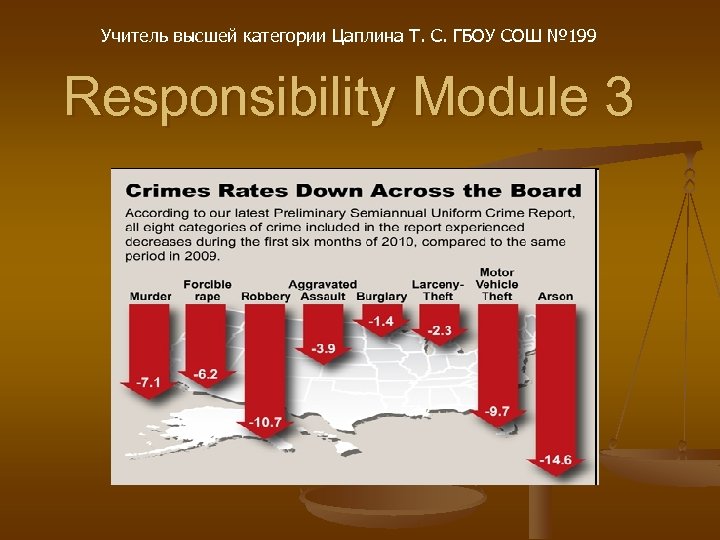
Учитель высшей категории Цаплина Т. С. ГБОУ СОШ № 199 Responsibility Module 3
3 a ex 3 Have you been the victim of a crime? n n n n n petty ― small/minor out of the blue ― unexpectedly fell for it ― was deceived gullible ― trusting/easily tricked broke into ― got into by force shaken up ― in shock wipe it off ― remove it with a cloth lately ― recently distract ― take someone’s attention away from something
Words and definitions n n n n n taken for a ride: tricked lottery: gambling game with numbered tickets contacted: communicated with fee: payment for a service process: series of actions to achieve sth winnings: amount of money won idiot: foolish person scam: trick came out of nowhere: suddenly appeared threatened: stated an intention to hurt grabbed: took suddenly by the hand identify: be able to formally recognise sb or sth bird mess: organic material from a bird’s body so-called: incorrectly/unsuitably named reached for: tried to get realised: understood a situation means: way(s)
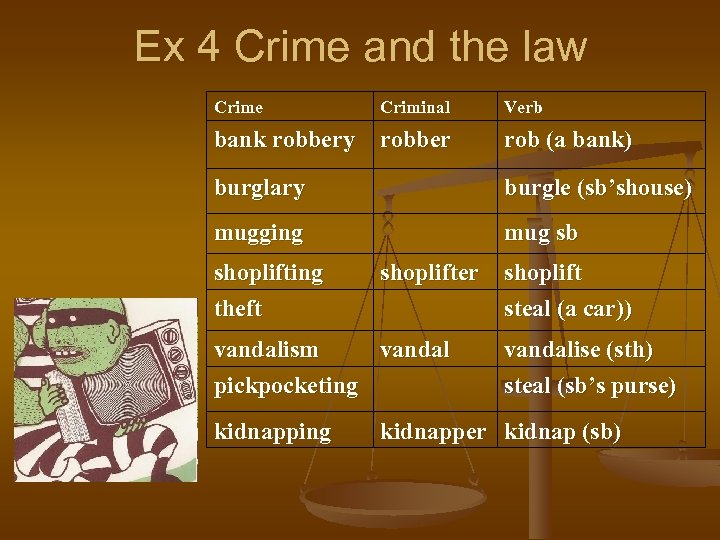
Ex 4 Crime and the law Crime Criminal Verb bank robbery robber rob (a bank) burglary burgle (sb’shouse) mugging mug sb shoplifting theft shoplifter vandalism vandal pickpocketing kidnapping shoplift steal (a car)) vandalise (sth) steal (sb’s purse) kidnapper kidnap (sb)
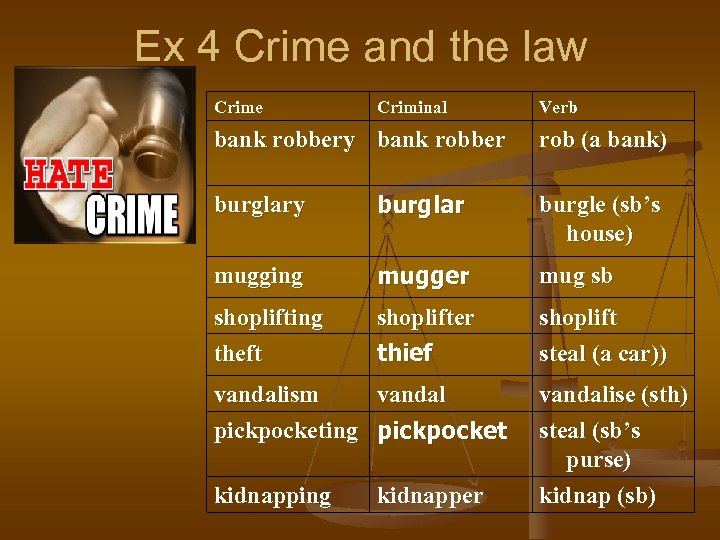
Ex 4 Crime and the law Crime Criminal bank robbery bank robber Verb rob (a bank) burglary burglar burgle (sb’s house) mugging mugger mug sb shoplifting theft shoplifter thief shoplift steal (a car)) vandalism vandal pickpocketing pickpocket kidnapping kidnapper vandalise (sth) steal (sb’s purse) kidnap (sb)
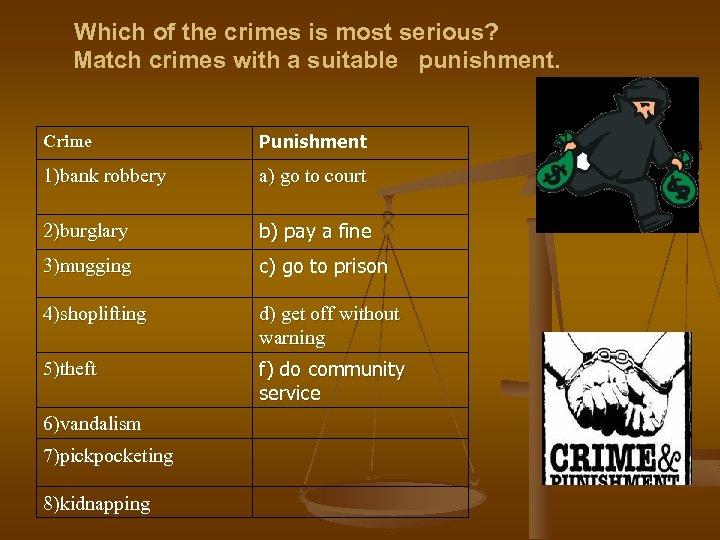
Which of the crimes is most serious? Match crimes with a suitable punishment. Crime Punishment 1)bank robbery a) go to court 2)burglary b) pay a fine 3)mugging c) go to prison 4)shoplifting d) get off without warning 5)theft f) do community service 6)vandalism 7)pickpocketing 8)kidnapping
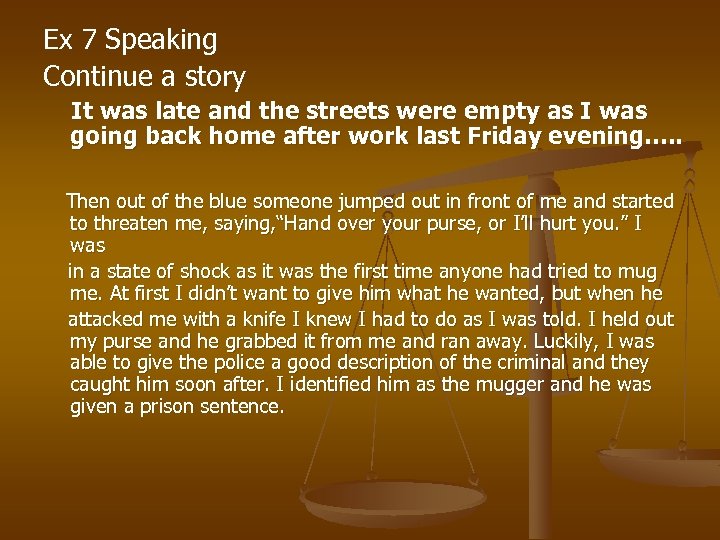
Ex 7 Speaking Continue a story It was late and the streets were empty as I was going back home after work last Friday evening…. . Then out of the blue someone jumped out in front of me and started to threaten me, saying, “Hand over your purse, or I’ll hurt you. ” I was in a state of shock as it was the first time anyone had tried to mug me. At first I didn’t want to give him what he wanted, but when he attacked me with a knife I knew I had to do as I was told. I held out my purse and he grabbed it from me and ran away. Luckily, I was able to give the police a good description of the criminal and they caught him soon after. I identified him as the mugger and he was given a prison sentence.
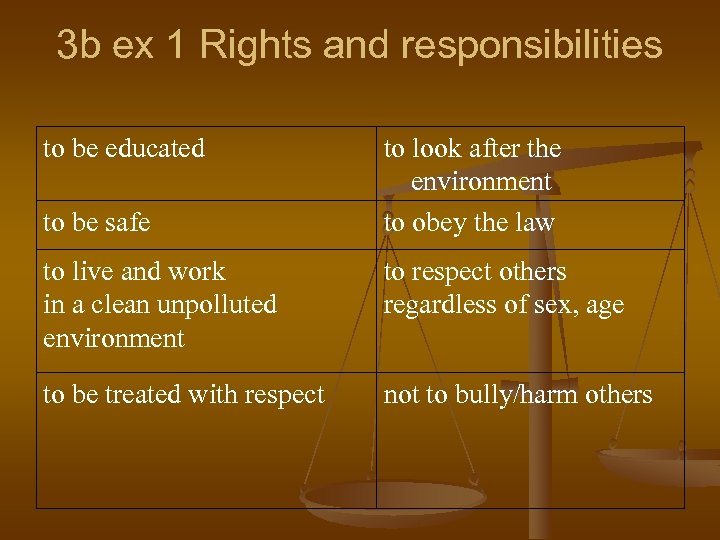
3 b ex 1 Rights and responsibilities to be educated to be safe to look after the environment to obey the law to live and work in a clean unpolluted environment to respect others regardless of sex, age to be treated with respect not to bully/harm others
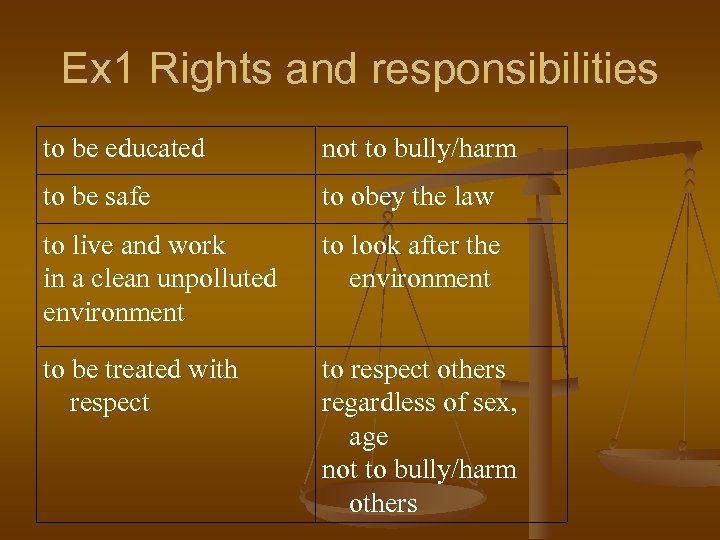
Ex 1 Rights and responsibilities to be educated not to bully/harm to be safe to obey the law to live and work in a clean unpolluted environment to look after the environment to be treated with respect to respect others regardless of sex, age not to bully/harm others
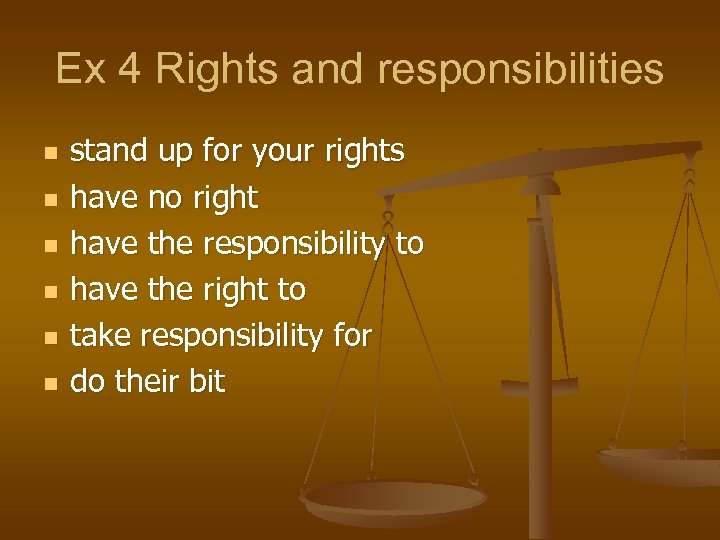
Ex 4 Rights and responsibilities n n n stand up for your rights have no right have the responsibility to have the right to take responsibility for do their bit
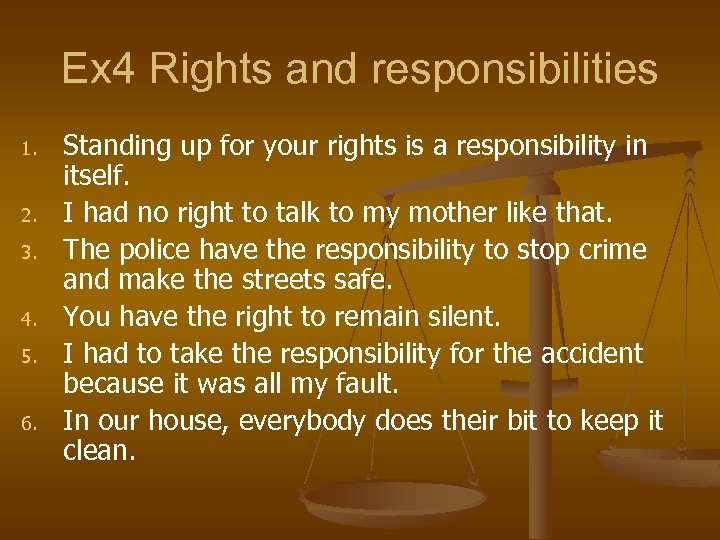
Ex 4 Rights and responsibilities 1. 2. 3. 4. 5. 6. Standing up for your rights is a responsibility in itself. I had no right to talk to my mother like that. The police have the responsibility to stop crime and make the streets safe. You have the right to remain silent. I had to take the responsibility for the accident because it was all my fault. In our house, everybody does their bit to keep it clean.
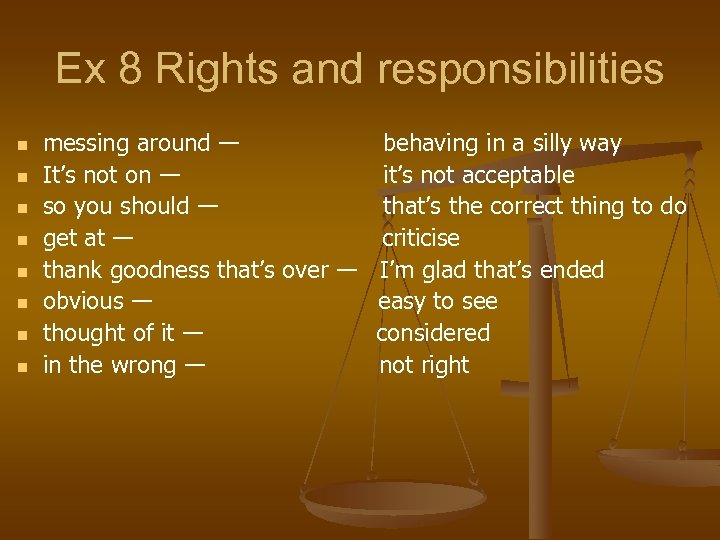
Ex 8 Rights and responsibilities n n n n messing around ― behaving in a silly way It’s not on ― it’s not acceptable so you should ― that’s the correct thing to do get at ― criticise thank goodness that’s over ― I’m glad that’s ended obvious ― easy to see thought of it ― considered in the wrong ― not right
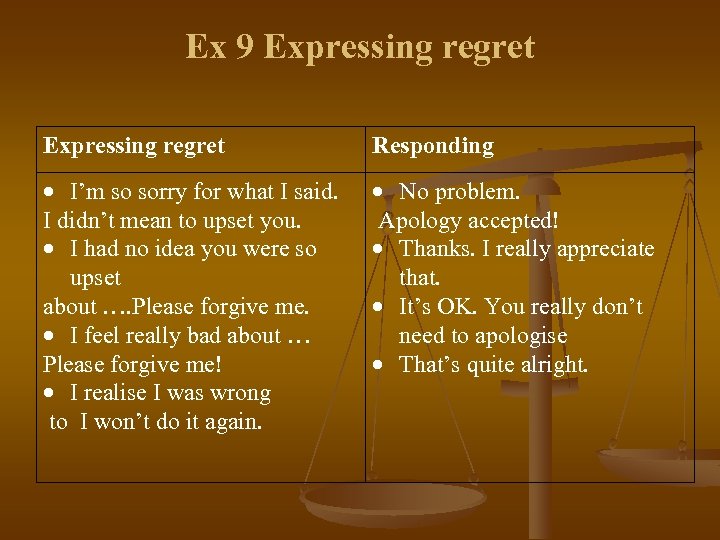
Ex 9 Expressing regret Responding I’m so sorry for what I said. I didn’t mean to upset you. I had no idea you were so upset about …. Please forgive me. I feel really bad about … Please forgive me! I realise I was wrong to I won’t do it again. No problem. Apology accepted! Thanks. I really appreciate that. It’s OK. You really don’t need to apologise That’s quite alright.
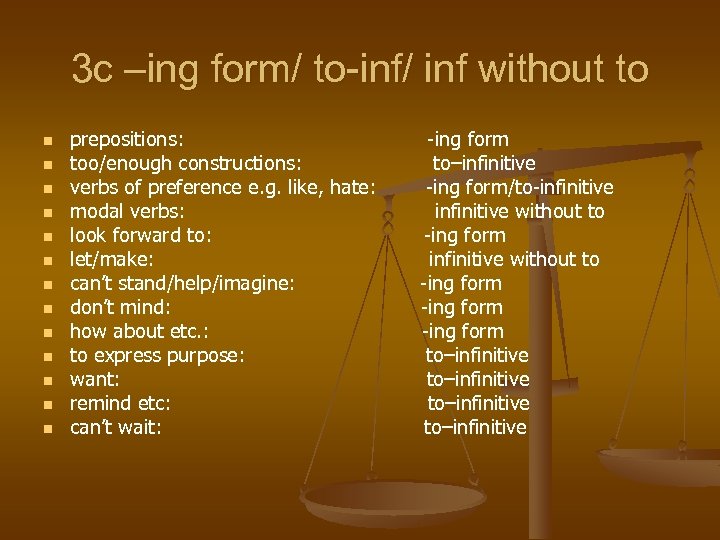
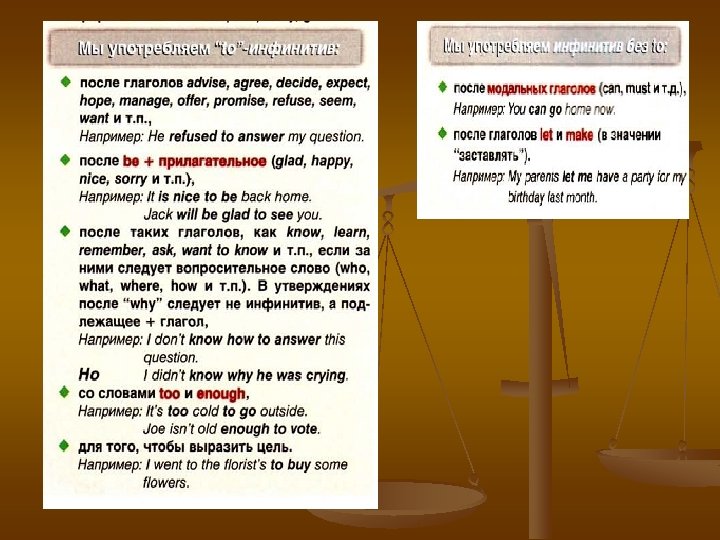
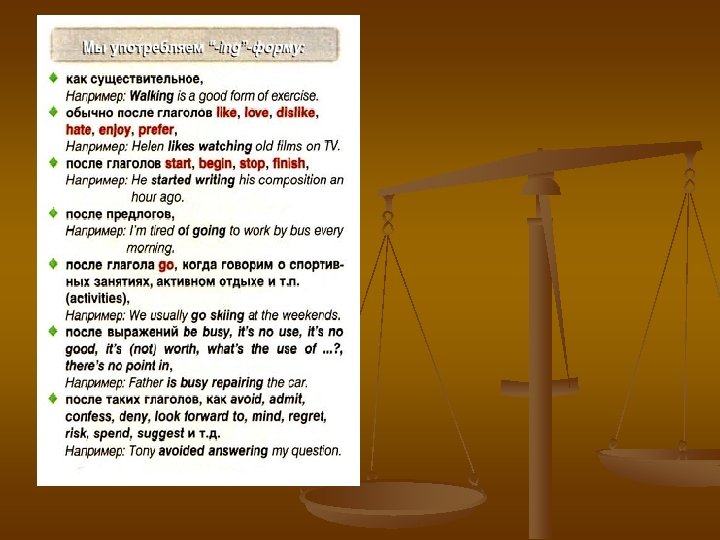
3 c –ing form/ to-inf/ inf without to n n n n prepositions: too/enough constructions: verbs of preference e. g. like, hate: modal verbs: look forward to: let/make: can’t stand/help/imagine: don’t mind: how about etc. : to express purpose: want: remind etc: can’t wait: -ing form to–infinitive -ing form/to-infinitive without to -ing form -ing form to–infinitive
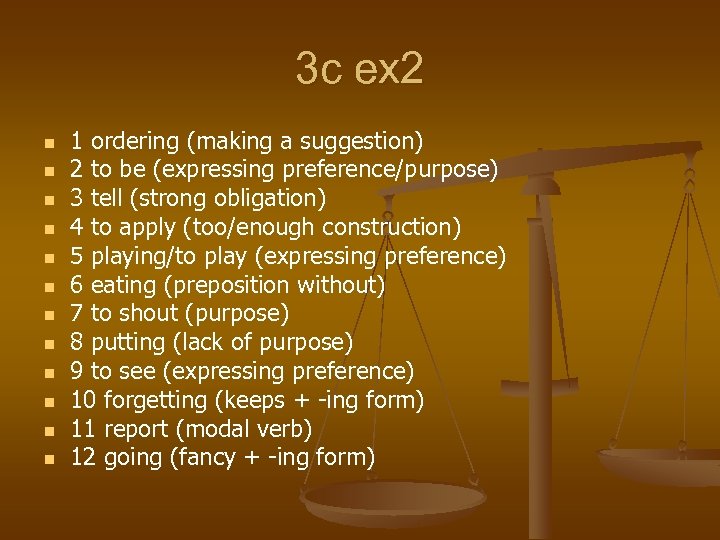
3 c ex 2 n n n 1 ordering (making a suggestion) 2 to be (expressing preference/purpose) 3 tell (strong obligation) 4 to apply (too/enough construction) 5 playing/to play (expressing preference) 6 eating (preposition without) 7 to shout (purpose) 8 putting (lack of purpose) 9 to see (expressing preference) 10 forgetting (keeps + -ing form) 11 report (modal verb) 12 going (fancy + -ing form)
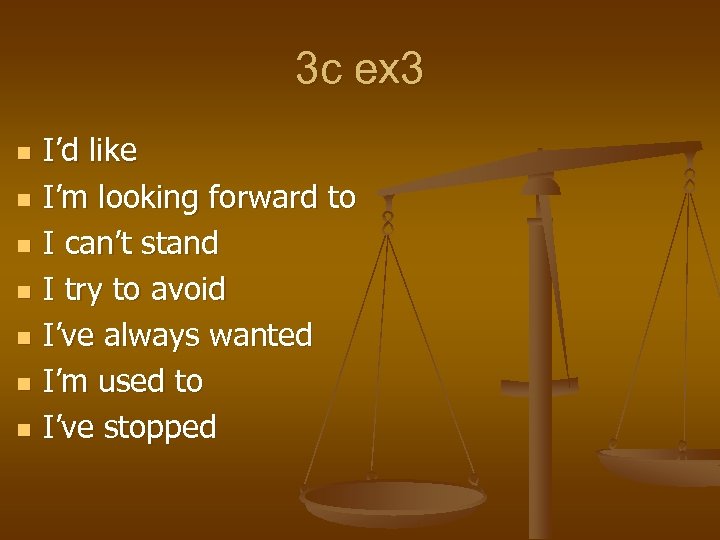
3 c ex 3 n n n n I’d like I’m looking forward to I can’t stand I try to avoid I’ve always wanted I’m used to I’ve stopped
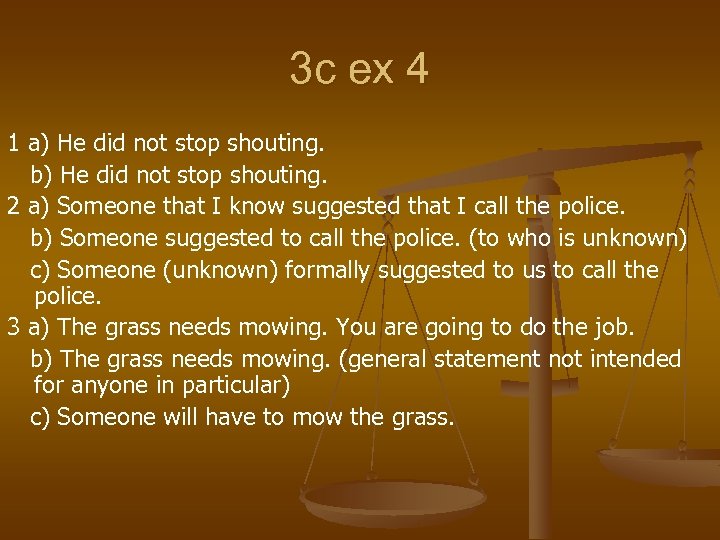
3 c ex 4 1 a) He did not stop shouting. b) He did not stop shouting. 2 a) Someone that I know suggested that I call the police. b) Someone suggested to call the police. (to who is unknown) c) Someone (unknown) formally suggested to us to call the police. 3 a) The grass needs mowing. You are going to do the job. b) The grass needs mowing. (general statement not intended for anyone in particular) c) Someone will have to mow the grass.
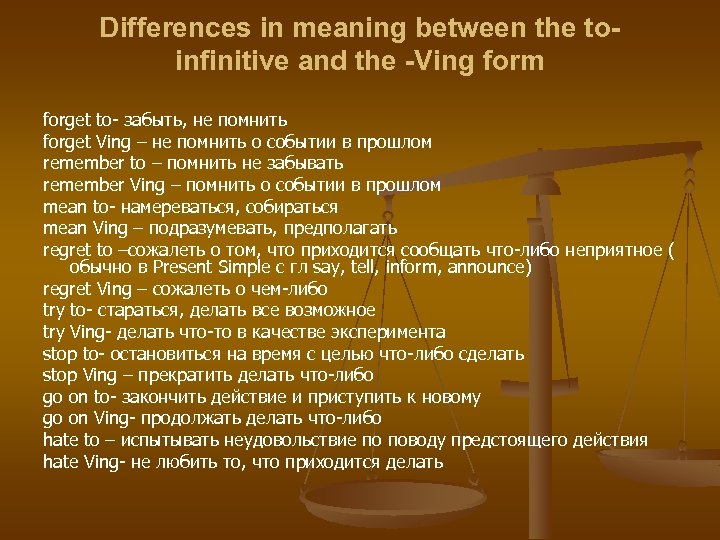
Differences in meaning between the toinfinitive and the -Ving form forget to- забыть, не помнить forget Ving – не помнить о событии в прошлом remember to – помнить не забывать remember Ving – помнить о событии в прошлом mean to- намереваться, собираться mean Ving – подразумевать, предполагать regret to –сожалеть о том, что приходится сообщать что-либо неприятное ( обычно в Present Simple c гл say, tell, inform, announce) regret Ving – сожалеть о чем-либо try to- стараться, делать все возможное try Ving- делать что-то в качестве эксперимента stop to- остановиться на время с целью что-либо сделать stop Ving – прекратить делать что-либо go on to- закончить действие и приступить к новому go on Ving- продолжать делать что-либо hate to – испытывать неудовольствие по поводу предстоящего действия hate Ving- не любить то, что приходится делать
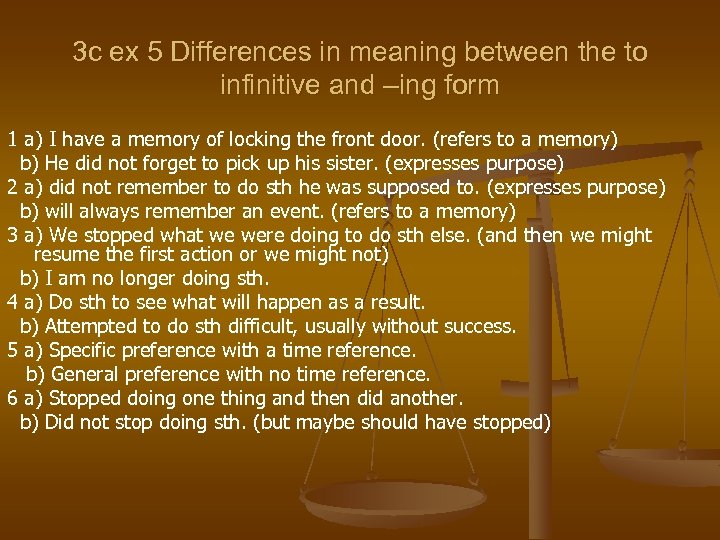
3 c ex 5 Differences in meaning between the to infinitive and –ing form 1 a) I have a memory of locking the front door. (refers to a memory) b) He did not forget to pick up his sister. (expresses purpose) 2 a) did not remember to do sth he was supposed to. (expresses purpose) b) will always remember an event. (refers to a memory) 3 a) We stopped what we were doing to do sth else. (and then we might resume the first action or we might not) b) I am no longer doing sth. 4 a) Do sth to see what will happen as a result. b) Attempted to do sth difficult, usually without success. 5 a) Specific preference with a time reference. b) General preference with no time reference. 6 a) Stopped doing one thing and then did another. b) Did not stop doing sth. (but maybe should have stopped)
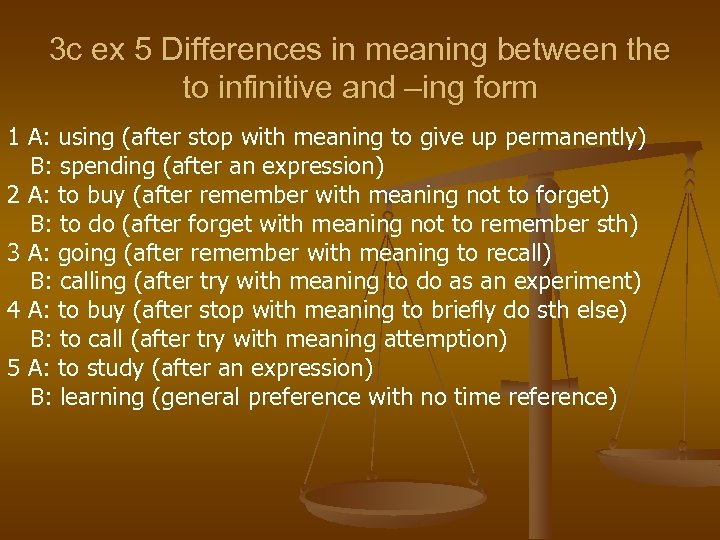
3 c ex 5 Differences in meaning between the to infinitive and –ing form 1 A: using (after stop with meaning to give up permanently) B: spending (after an expression) 2 A: to buy (after remember with meaning not to forget) B: to do (after forget with meaning not to remember sth) 3 A: going (after remember with meaning to recall) B: calling (after try with meaning to do as an experiment) 4 A: to buy (after stop with meaning to briefly do sth else) B: to call (after try with meaning attemption) 5 A: to study (after an expression) B: learning (general preference with no time reference)
 Скачать презентацию Учитель высшей категории Цаплина Т С ГБОУ СОШ
230d17d5a1994989930d008a275ade82.ppt