 Скачать презентацию UC C B IS Project Executive Steering Committee January
b2f3ff2668e7e88c282cdecfb61a918b.ppt
- Количество слайдов: 28



UC C&B IS Project Executive Steering Committee January 21, 2010 Project Status Report
Agenda Introduction Meeting Minutes Approval Project Status Report Other Business Public Comments Review of Action from Meeting Scheduling of Next Meeting Adjourn Page 2
Agenda Introduction Meeting Minutes Approval Project Status Report Other Business Public Comments Review of Action from Meeting Scheduling of Next Meeting Adjourn Page 3
Project Status Report Budget & Timeline Metrics Tracking and Reporting Invitation To Negotiate (ITN) Independent Validation and Verification (IV&V) Workforce Services, Workforce Florida and Workforce Boards Interviews with Other States “To-Be” Process Review Workshop Next Steps: Use Cases Process Improvement Reviews Page 4
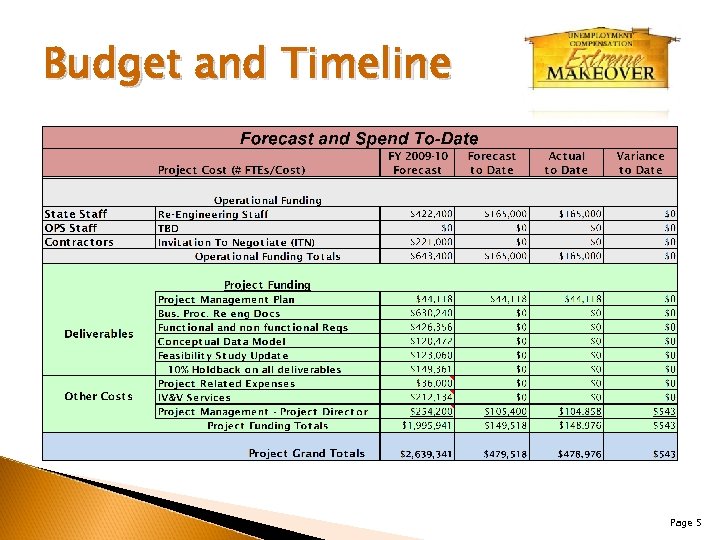
Budget and Timeline Page 5
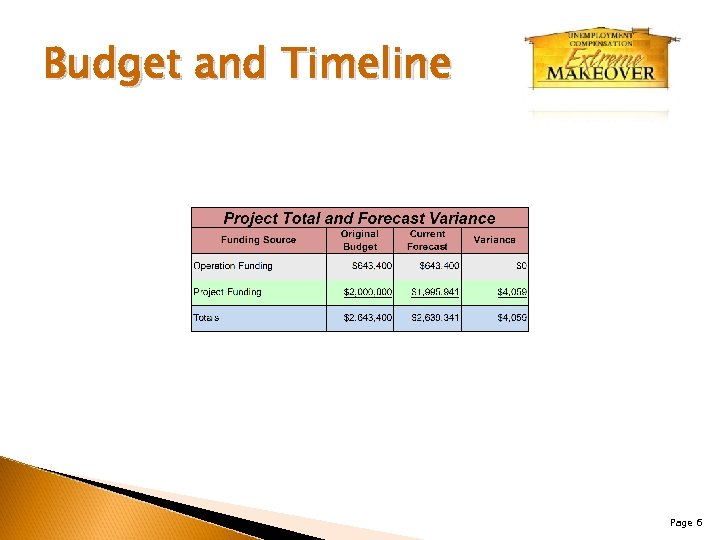
Budget and Timeline Page 6
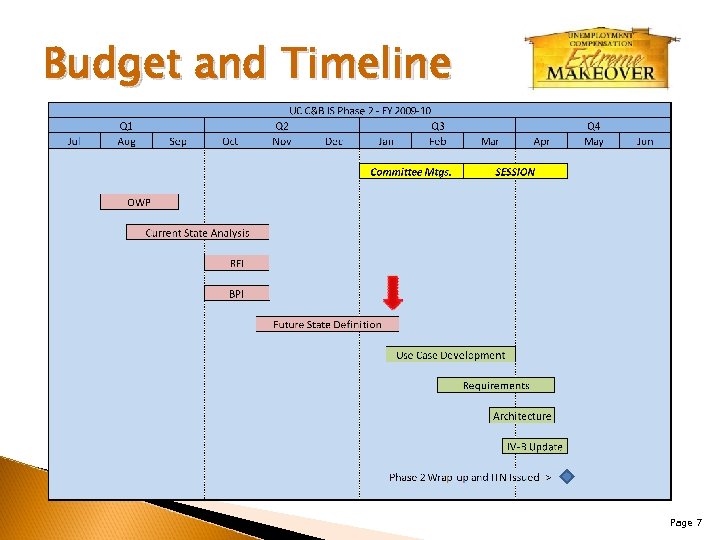
Budget and Timeline Page 7
Metrics Tracking and Reporting Feasibility Study has targeted $43 M in annualized savings Begin to document the cost drivers behind those savings, identify the supporting metrics and begin a disciplined process for collecting those metrics Plan to complete a Benefits Realization Strategy and Plan prior to Phase 3 kick-off (October 2010) Page 8
Invitation To Negotiate Approved to use existing available budget authority Decision made to competitively procure the development of the ITN and Evaluation/Selection/Negotiation Strategy RFQ currently under review Page 9
Independent Validation and Verification (IV&V) Ernst & Young contract currently being approved Prepared to start next Monday Page 10
Workforce Project Description ◦ Conduct additional analysis into the Workforce Program as it relates to potential improvements that might be realized as part of the UC modernization effort ◦ Determining the possibility and plausibility of improving Workforce processes to provide better integration with the UC Program Page 11
Workforce February 9, 2010 ◦ Workforce & UC Integration Goals and Objectives February 19, 2010 ◦ High Level As-Is Process Flow Document ◦ Plan and estimate for potential definition of To-Be process flows and corresponding requirements related to the UC system February 28, 2010 ◦ Final high-level requirements for UC Page 12
Interviews with Other States – New York Background ◦ Moving toward modernization for 10 years ◦ Presently in year 2 of a 5 year $150 M effort for Tax and Benefits ◦ In-house development - 150+ project team 15 -20 dedicated SMEs ◦ Have broad requirements Developing detailed requirements “Just In Time” through the Agile Methodology ◦ Technology driven initiative Service Oriented Architecture (SOA) & Java Page 13
Interviews with Other States – New York Lessons Learned ◦ Had multiple vendors for requirements and switched project managers ◦ Contracts were poorly managed ◦ Did not develop quality use cases ◦ Did not have an enterprise architecture group ◦ Should have hired skilled consultants as needed Page 14
Interviews with Other States – Illinois Background ◦ 2002 defined requirements, use cases at a very high level - Issued RFP in 2003 ◦ After one year, realized that the project effort was underestimated by 100% ◦ Restarted detail design in 2007 ◦ Project team size 12 SME’s for 12 functional areas who were responsible for getting additional resources from program areas and 30 UAT testers 60 System Integrator (SI) staff Page 15
Interviews with Other States – Illinois Lessons learned ◦ Business process changes are only now being defined. Should have done this initially Page 16
Interviews with Other States – Minnesota Background ◦ Benefits redesign phase began in 2005. Went to production in October 2007 ◦ Currently timely in all business areas, even with 3 x normal workload ◦ Were focused on business vs. technical solution ◦ Project team 30 agency SME’s & 12 agency technical staff 30 SI developers; 30 SI technical staff ◦ Agency positions were not backfilled which created difficulties for Operations Page 17
Interviews with Other States – Minnesota Lessons learned: ◦ Entire organization must be committed to the goal ◦ Important to understand that there will be unavoidable risks ◦ Ensure that your staff is integrated and understand their clearly defined roles ◦ Workforce Integration: built open structures so that integrations can be developed at a later date Page 18
Interviews with Other States – Mississippi Background ◦ Benefit redesign timeline: January 2005 – March 2009 (included Katrina and EUC) ◦ Workflow was a major driving force ◦ Value added: number of claims takers down 30% and minimal incremental operational cost in ’ 09, but with triple the number of claims ◦ Project Team 20 dedicated agency resources Business analysts were assigned specific areas throughout development, implementation and testing 40 SI associates dedicated to the project. Page 19
Interviews with Other States – Mississippi Lesson learned: ◦ Would have developed federal reports as we went along instead of waiting until the end to develop reports. Page 20
Interviews with Other States – General Themes Lessons learned ◦ Broad consensus that we can begin with a transfer system from another state ◦ Project timeline of 4 years and $68 M “feels” right ◦ Contract needs deliverable based milestones ◦ Key roles Agency driven project – not System Integrator driven SMEs to focus on functional knowledge Business Analysts to pull operational vision together for continuity System Integrator for technical and system expertise Get agency technical staff involved early Page 21
Interviews with Other States – General Themes Lessons learned con’t ◦ Create an incentive structure for SMEs assigned to the project ◦ Ensure that you have a sponsor who can change spending authority and make scope decisions ◦ Phased implementation approach Lower project risk but can cause operational challenges working with two systems during the interim Develop a transition plan and training plan to mitigate identified risks ◦ Get interdependent agencies involved early including the shared data center Page 22
“To-Be” and Use Cases The “To-Be” Process Flow Workshop was held January 6 -7 with UC senior management in attendance Great dialog from a business process viewpoint – not technological Agreement on overall process vision ◦ Sign-off occurring this week as scheduled Efforts underway to define Use Cases ◦ Based on Use Case training conducted in November Page 23
To-Be Process Benefit Enablers All incoming and outgoing correspondence will be scanned, indexed and available on-line in electronic format The system will include a business-rules driven workflow engine used to create work items, manage work queues, and route work items between queues The system will include Case and Document Management functionality to manage related work components and artifacts Generic work queues will be established, as appropriate, to support the processing of unknown, misrouted, or incomplete work items The system will include clearly defined roles and authorities for all users; every user will be assigned to a specific role
To-Be Process Benefit Enablers con’t Employers, Claimants, and authorized third-parties will have system accounts, protected by appropriate security credentials, and all work items will be associated to those accounts The system will maintain balances for all accounts and automatically recalculate balances based on the reversal or modification of prior actions Claimants, Employers, and authorized third-parties will be able to opt for electronic communication Email will be an accepted communication method for external parties (claimants, employers, and authorized third-parties) ◦ Communication will be in accordance with the preferred method (e. g. , email notifications, fax, paper)
To-Be Process Benefit Enablers con’t The system will not send sensitive information via email. Users will be notified documents are ready to be viewed using their online accounts. Access to documents will be controlled using appropriate security credentials All claims, claim weeks, determinations, and payments will be traceable to funding sources and employer chargeability records The system will create and maintain an online history of all activities related to a particular claimant, employer, or authorized third-party to include claims, claim weeks, determinations, and decisions
Questions? Page 27
Agenda Introduction Meeting Minutes Approval Project Status Report Other Business Public Comments Review of Action from Meeting Scheduling of Next Meeting Adjourn Page 28
Скачать презентацию UC C B IS Project Executive Steering Committee January
b2f3ff2668e7e88c282cdecfb61a918b.ppt