 Скачать презентацию UC Berkeley Par Lab Technology Trends The Datacenter
98517cd3fecc7da17fdd648ac1ba37f9.ppt
- Количество слайдов: 12



UC Berkeley Par Lab Technology Trends: The Datacenter is the Computer, The Cellphone/Laptop is the Computer David Patterson Director, Reliable Adaptive Distributed Lab Director, Parallel Computing Lab Past President, ACM October, 2007 1
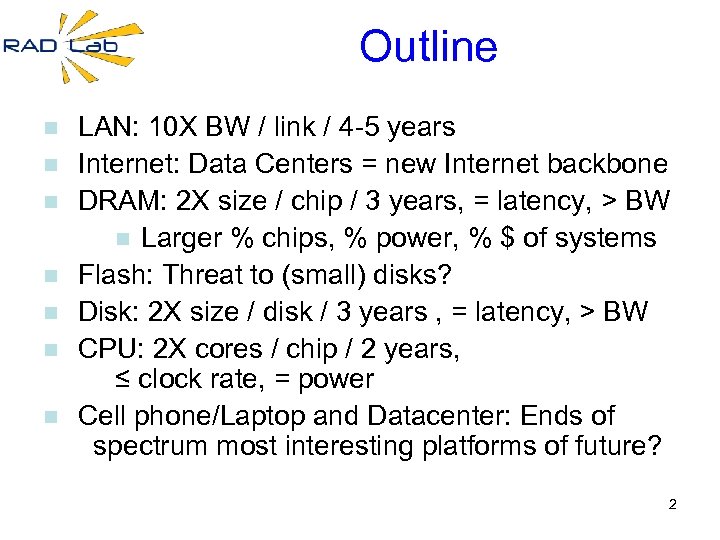
Outline n n n n LAN: 10 X BW / link / 4 -5 years Internet: Data Centers = new Internet backbone DRAM: 2 X size / chip / 3 years, = latency, > BW n Larger % chips, % power, % $ of systems Flash: Threat to (small) disks? Disk: 2 X size / disk / 3 years , = latency, > BW CPU: 2 X cores / chip / 2 years, ≤ clock rate, = power Cell phone/Laptop and Datacenter: Ends of spectrum most interesting platforms of future? 2
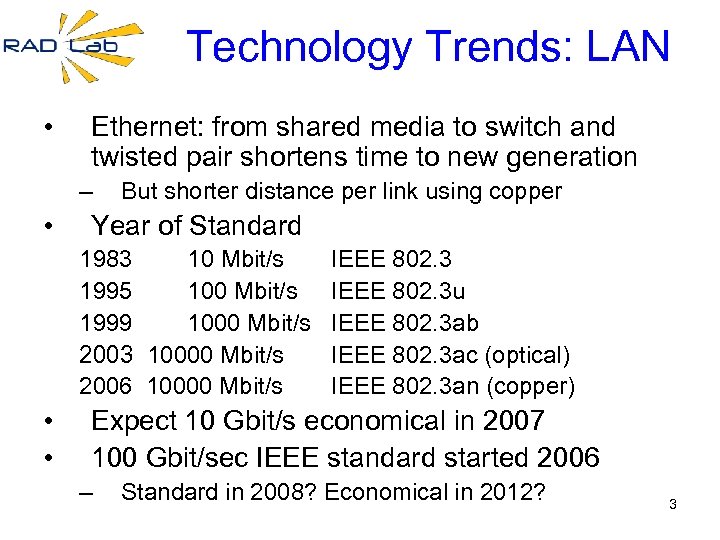
Technology Trends: LAN • Ethernet: from shared media to switch and twisted pair shortens time to new generation – • But shorter distance per link using copper Year of Standard 1983 10 Mbit/s 1995 100 Mbit/s 1999 1000 Mbit/s 2003 10000 Mbit/s 2006 10000 Mbit/s • • IEEE 802. 3 u IEEE 802. 3 ab IEEE 802. 3 ac (optical) IEEE 802. 3 an (copper) Expect 10 Gbit/s economical in 2007 100 Gbit/sec IEEE standard started 2006 – Standard in 2008? Economical in 2012? 3
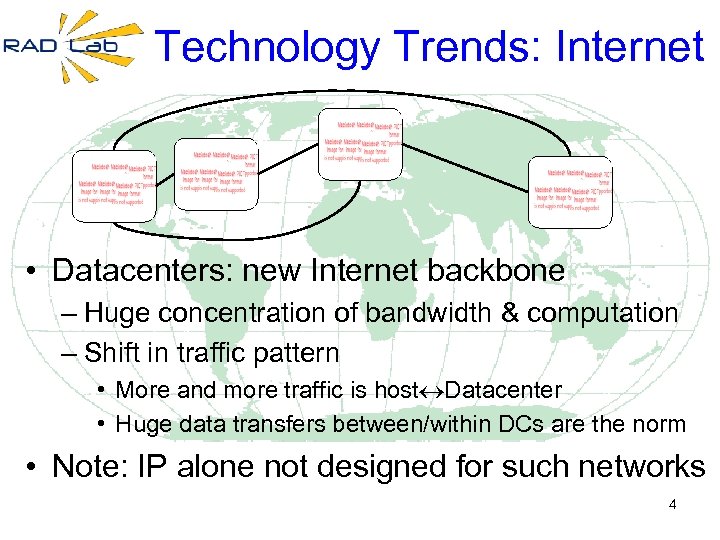
Technology Trends: Internet • Datacenters: new Internet backbone – Huge concentration of bandwidth & computation – Shift in traffic pattern • More and more traffic is host Datacenter • Huge data transfers between/within DCs are the norm • Note: IP alone not designed for such networks 4
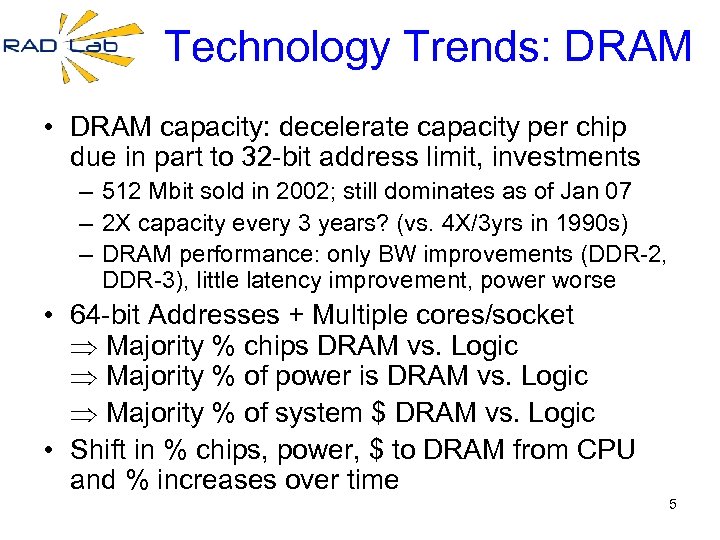
Technology Trends: DRAM • DRAM capacity: decelerate capacity per chip due in part to 32 -bit address limit, investments – 512 Mbit sold in 2002; still dominates as of Jan 07 – 2 X capacity every 3 years? (vs. 4 X/3 yrs in 1990 s) – DRAM performance: only BW improvements (DDR-2, DDR-3), little latency improvement, power worse • 64 -bit Addresses + Multiple cores/socket Majority % chips DRAM vs. Logic Majority % of power is DRAM vs. Logic Majority % of system $ DRAM vs. Logic • Shift in % chips, power, $ to DRAM from CPU and % increases over time 5
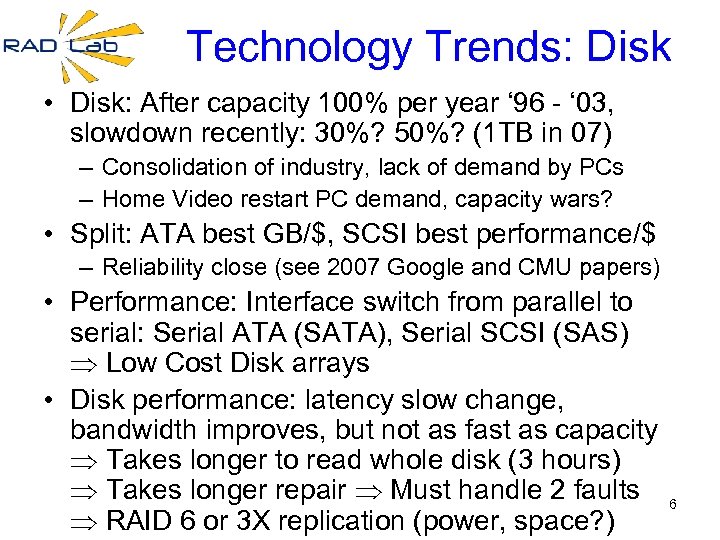
Technology Trends: Disk • Disk: After capacity 100% per year ‘ 96 - ‘ 03, slowdown recently: 30%? 50%? (1 TB in 07) – Consolidation of industry, lack of demand by PCs – Home Video restart PC demand, capacity wars? • Split: ATA best GB/$, SCSI best performance/$ – Reliability close (see 2007 Google and CMU papers) • Performance: Interface switch from parallel to serial: Serial ATA (SATA), Serial SCSI (SAS) Low Cost Disk arrays • Disk performance: latency slow change, bandwidth improves, but not as fast as capacity Takes longer to read whole disk (3 hours) Takes longer repair Must handle 2 faults RAID 6 or 3 X replication (power, space? ) 6
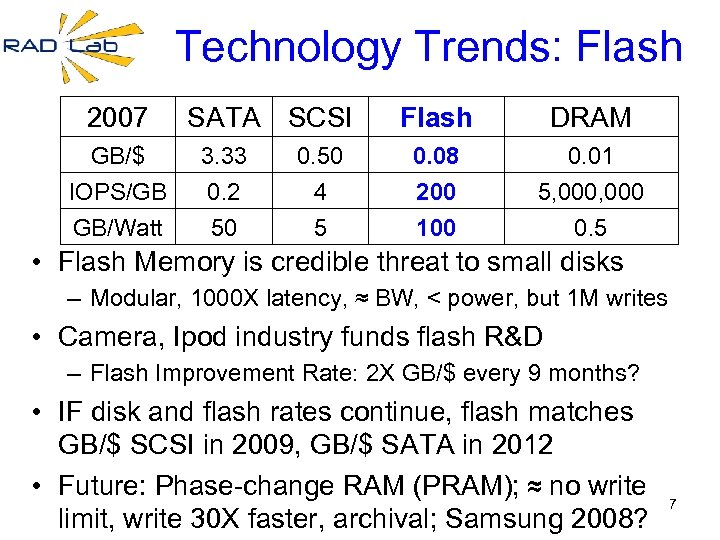
Technology Trends: Flash 2007 GB/$ IOPS/GB GB/Watt SATA SCSI 3. 33 0. 2 50 0. 50 4 5 Flash DRAM 0. 08 200 100 0. 01 5, 000 0. 5 • Flash Memory is credible threat to small disks – Modular, 1000 X latency, ≈ BW, < power, but 1 M writes • Camera, Ipod industry funds flash R&D – Flash Improvement Rate: 2 X GB/$ every 9 months? • IF disk and flash rates continue, flash matches GB/$ SCSI in 2009, GB/$ SATA in 2012 • Future: Phase-change RAM (PRAM); ≈ no write limit, write 30 X faster, archival; Samsung 2008? 7
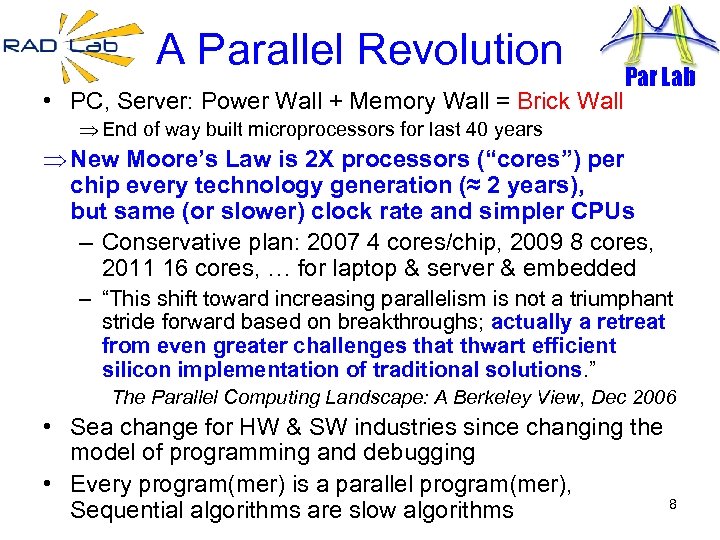
A Parallel Revolution • PC, Server: Power Wall + Memory Wall = Brick Wall Par Lab End of way built microprocessors for last 40 years New Moore’s Law is 2 X processors (“cores”) per chip every technology generation (≈ 2 years), but same (or slower) clock rate and simpler CPUs – Conservative plan: 2007 4 cores/chip, 2009 8 cores, 2011 16 cores, … for laptop & server & embedded – “This shift toward increasing parallelism is not a triumphant stride forward based on breakthroughs; actually a retreat from even greater challenges that thwart efficient silicon implementation of traditional solutions. ” The Parallel Computing Landscape: A Berkeley View, Dec 2006 • Sea change for HW & SW industries since changing the model of programming and debugging • Every program(mer) is a parallel program(mer), 8 Sequential algorithms are slow algorithms
100+ Cores? Par Lab • 5 -year research program aim 8+ years out • Multicore: 2 X / 2 yrs ≈ 64 cores in 8 years • Manycore: 8 X multicore 80 x 86 Uniprocessors No longer sold 16 -way MP laptops for sale in 2011 9
Revolution May Fail Par Lab • John Hennessy, President, Stanford University, 1/07: “…when we start talking about parallelism and ease of use of truly parallel computers, we're talking about a problem that's as hard as any that computer science has faced. … I would be panicked if I were in industry. ” “A Conversation with Hennessy & Patterson, ” ACM Queue Magazine, 4: 10, 1/07. • 100% failure rate of Parallel Computer Companies – Convex, Encore, Mas. Par, NCUBE, Kendall Square Research, Sequent, (Silicon Graphics), Transputer, Thinking Machines, … • What if IT goes from a growth industry to a replacement industry? – If SW can’t effectively use 8, 16, 32, . . . cores per chip SW no faster on new computer Only buy if computer wears out • Accelerate trend to Saa. S? 10
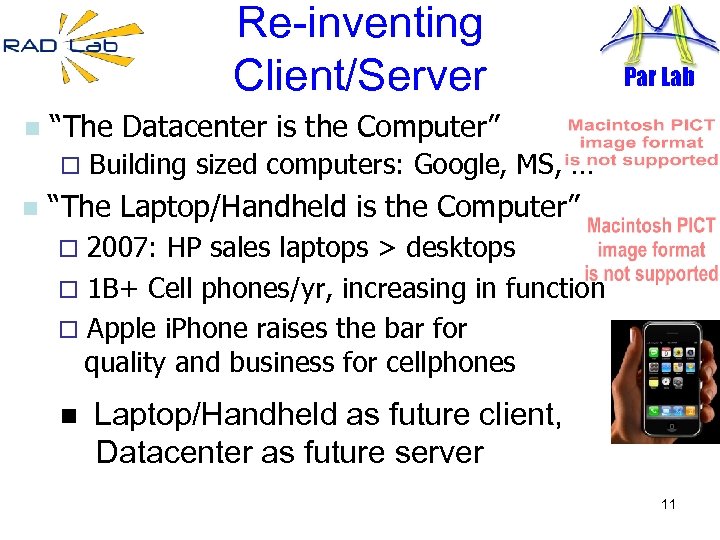
Re-inventing Client/Server n “The Datacenter is the Computer” ¨ n Par Lab Building sized computers: Google, MS, … “The Laptop/Handheld is the Computer” 2007: HP sales laptops > desktops ¨ 1 B+ Cell phones/yr, increasing in function ¨ Apple i. Phone raises the bar for quality and business for cellphones ¨ n Laptop/Handheld as future client, Datacenter as future server 11
Trends Summary Par Lab CPU: 2 X cores / chip / 2 years, ≤ clock rate, = power n (La-Z-boy programmer era is over) n DRAM: 2 X size / chip / 3 years, = latency, > BW n Larger % chips, % power, % $ of systems n Flash: Threat to (small) disks? n Disk: 2 X size / disk / 3 years , = latency, > BW n LAN: 10 X BW / link / 4 -5 years n Internet: Data Centers = new Internet backbone n Cell phone/Laptop and Datacenter: Ends of 12 spectrum most interesting platforms of future? n
Скачать презентацию UC Berkeley Par Lab Technology Trends The Datacenter
98517cd3fecc7da17fdd648ac1ba37f9.ppt