 Скачать презентацию Ubiquitous Computing The Next Computing Generation Authors Jelena
8835d1639a84fd0b5ac859fe4491a61f.ppt
- Количество слайдов: 53



Ubiquitous Computing The Next Computing Generation Authors: Jelena Mirković, mirkovic_j@yahoo. com Vlado Ilić, otac@eunet. yu Andrija Bošnjaković, andrija@etf. bg. ac. yu Veljko Milutinović, vm@etf. bg. ac. yu
Preview You will learn about: l l Past computing trends The major development trend – Ubiquitous computing (UC) l l Facts and myths Hardware (HW) issues Legal & Social issues Projects related to UC l l Aura Project l Coda, Odyssey, Spectra, Prism Mobile Phones Programming - JAVA MIDP “Ubiquitous Computing” University of Belgrade 2
Intro "Any technology sufficiently advanced is indistinguishable from magic. “ Arthur C. Clarke “Ubiquitous Computing” University of Belgrade 3
The Essence Of Understanding Computers Computer – a job title! “Computer science is the only major branch of science that is named after a gadget. ”[1]. What matters is not technology itself, but its impact on us and vice versa. “Ubiquitous Computing” University of Belgrade 4
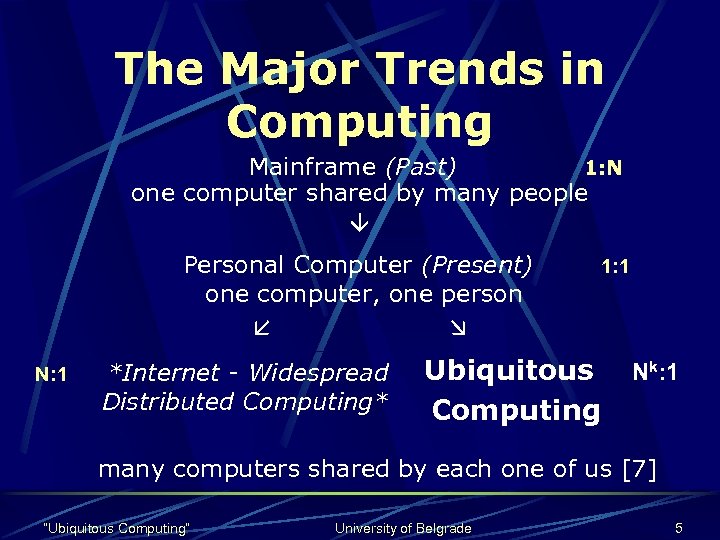
The Major Trends in Computing Mainframe (Past) 1: N one computer shared by many people Personal Computer (Present) one computer, one person N: 1 *Internet - Widespread Distributed Computing* 1: 1 Ubiquitous Computing Nk: 1 many computers shared by each one of us [7] “Ubiquitous Computing” University of Belgrade 5
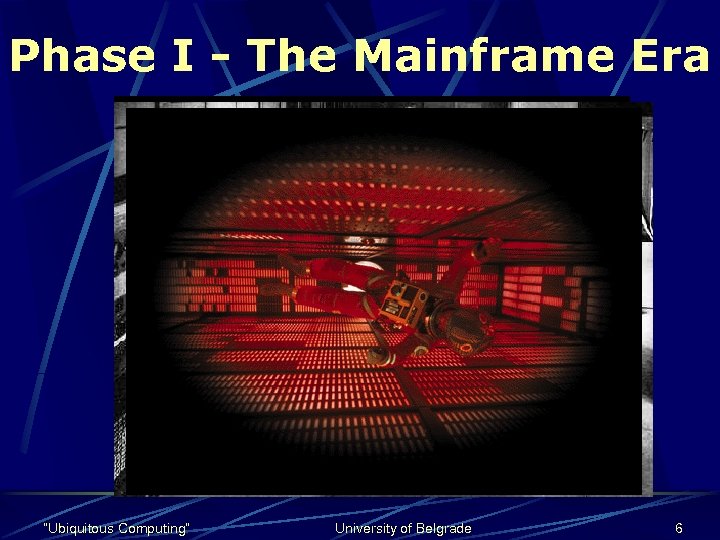
Phase I - The Mainframe Era Computers were a scarce resource run by experts behind closed doors. “Ubiquitous Computing” University of Belgrade 6
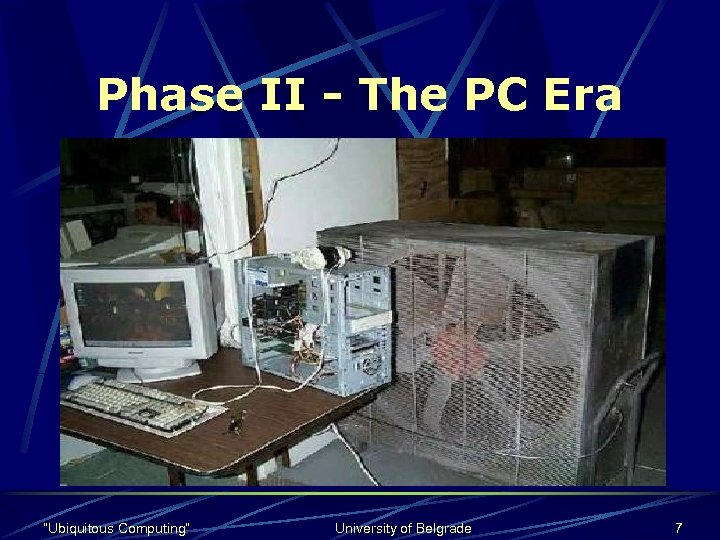
Phase II - The PC Era In 1984 the number of people using PCs surpassed that of people using mainframe computers. PC Era: You have your computer, it contains your stuff, and you interact directly and deeply with it. The PC is most analogous to the automobile. “Ubiquitous Computing” University of Belgrade 7
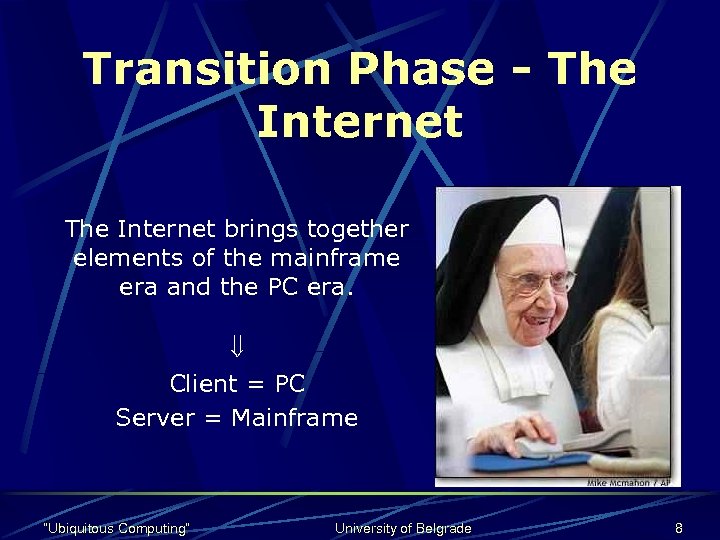
Transition Phase - The Internet brings together elements of the mainframe era and the PC era. Client = PC Server = Mainframe “Ubiquitous Computing” University of Belgrade 8
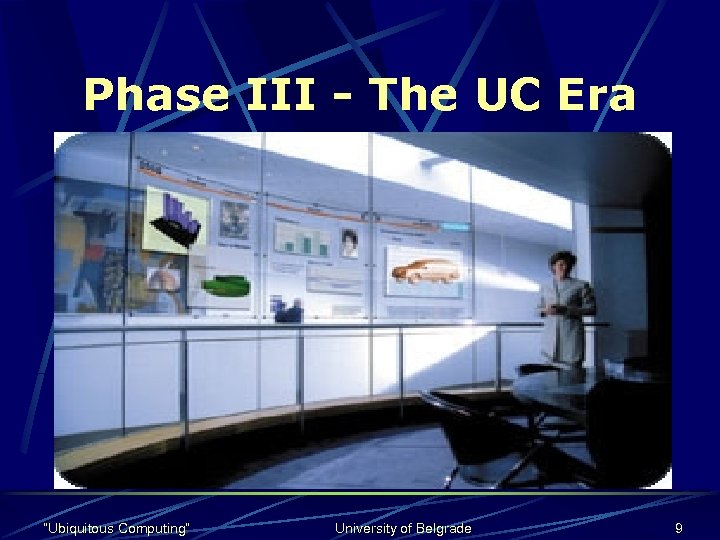
Phase III - The UC Era The UC era will have lots of computers shared by each one of us. UC is fundamentally characterized by the connection of things in the world with Frequently used related terms: computation. Pervasive computing, Wearable computers, Intelligent environment, Things That Think (T³), Wearware, Personal Area Networking (PAN). [3] “Ubiquitous Computing” University of Belgrade 9
![UC - Definition 1) 2) 3) 4) Elements that define ubiquitous computing: [4] Ubiquity/Pervasiveness](https://present5.com/presentation/8835d1639a84fd0b5ac859fe4491a61f/image-10.jpg "UC - Definition 1) 2) 3) 4) Elements that define ubiquitous computing: [4] Ubiquity/Pervasiveness")
UC - Definition 1) 2) 3) 4) Elements that define ubiquitous computing: [4] Ubiquity/Pervasiveness – lots of devices Connectedness – the devices are networked Context-awareness – the system is aware of the context of users Invisibility – device effectively becomes invisible “Ubiquitous Computing” University of Belgrade 10
UC – How To Understand It UC goal: enhancing computer use by making many computers available throughout the physical environment, but making them effectively invisible to the user. Ubiquity – Everywhere – Adaptation to environment – Intuitive, transparent, natural interfaces “Ubiquitous Computing” University of Belgrade 11
What UC is NOT It is not science fiction (SF), though it relies a great deal on it. It is not impossible. It is not Virtual Reality (VR). It is not a Personal Digital Assistant (PDA). It is not a personal agent (PA). “Ubiquitous Computing” University of Belgrade 12
Early work in Ubiquitous Computing A vision of a future form of computing set forth by Mark Weiser (1991) • The computer has ceased to exist as a distinct entity and merged with the normal everyday objects that people use in their daily tasks. • The normal physical environment will become equipped with extreamly cheap but powerful devices for computing and networking. The PARCTAB system: "tabs", "pads", and "boards" (forms of inch-, foot-, and yard-sized computers) built at Xerox PARC, 1988 -1994. [8] MIT's AI-oriented "Things That Think" program[3] “Ubiquitous Computing” University of Belgrade 13
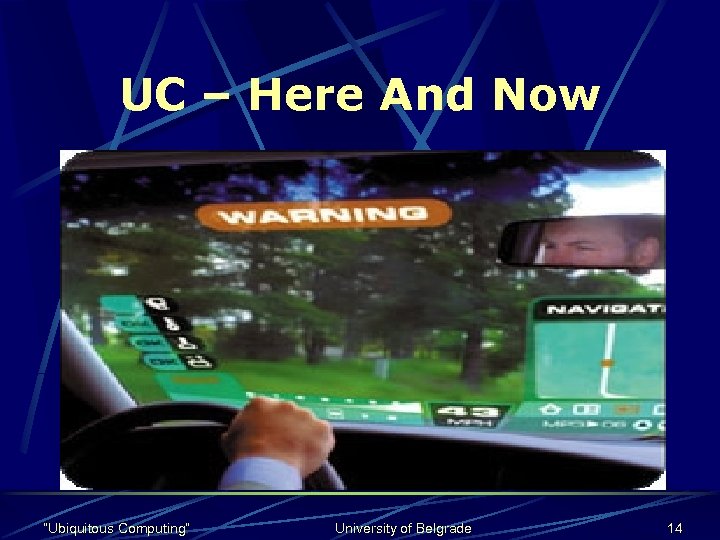
UC – Here And Now Most work now is concentrating on the mobile infrastructure for wireless networking TCP/IP and OSI are unprepared for handling mobility (machine's name, and its network address are variant ). [6] “Calm Technology”: Calmness is a new challenge that UC brings to computing [7] “The Periphery”: Calm technology will move easily from the periphery of our attention, to the center, and back. “Ubiquitous Computing” University of Belgrade 14
UC – Our Angle The most powerful things are those that are effectively invisible to the user. Make a computer so embedded and so natural, that we use it without even thinking about it. Important issues: location and size: l l l UC must know where they are (Context-awareness, Legal issues); Hundreds of wireless UCs person; Size: 1 mm to wall size. “Ubiquitous Computing” University of Belgrade 15
UC – Hardware Demands Technology required for UC : l l l Cheap, highly advanced VLSI technology (nanotech), Very low-power computers with convenient displays, Low-power, ultra-fast network for interconnection: l l l wireless end-points cellular topology wide-bandwidth range Software systems for UC applications and support. “Ubiquitous Computing” University of Belgrade 16
UC – The Prophecy Whenever people learn how to use something sufficiently well, they stop being aware of it. Pushing computers into the background will make people more aware of those on the other end of link. UC will help resolve the problem of info overload. “Ubiquitous Computing” University of Belgrade 17
UC – Privacy & Security Who will have the control: “the owner” or the central authority? How private can one be? l l l Preserving privacy of location. [5] Morris's[2] rule: “Build computer systems to have the same privacy safeguards as the real world. ” Legal issues: “Burglar Problem” l l l Steganography “fingerprinting” Social issues: “Problem of Restricted Individuality”. Secure and reliable services “Ubiquitous Computing” University of Belgrade 18
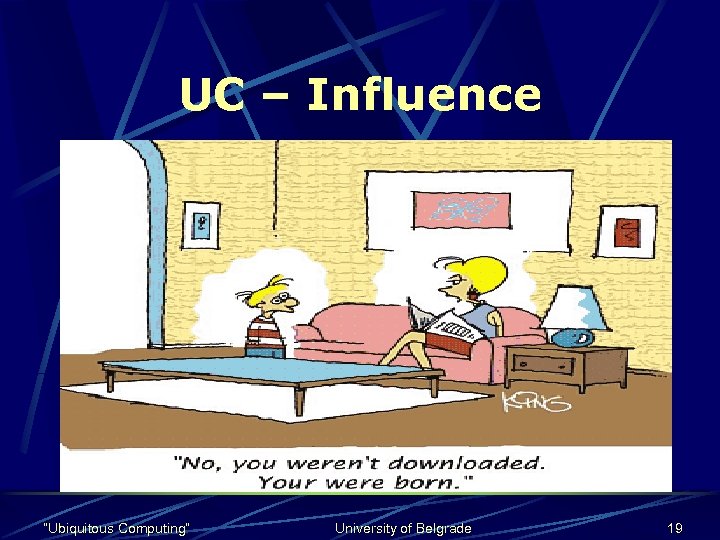
UC – Influence Social issues: l l l Decreased alienation Health: physical & psychological influence Privacy: power & control Global legality: digital law; equality or not? Business: benefit? transparency or not? “Ubiquitous Computing” University of Belgrade 19
Overview So far you have learned: l l l How to understand computers Trends in human-computer relationship Ubiquitous computing (UC) l l l What it is and what it is not How to understand UC and its significance Where UC was, where it is now, and where it will be in the future We have also discussed: l l l Location and size questions Hardware demands and solutions Security and legal issues “Ubiquitous Computing” University of Belgrade 20
Summary “The most profound technologies are those that disappear. They weave themselves into the fabric of everyday life until they are indistinguishable from it. “ Mark Weiser “Ubiquitous Computing” University of Belgrade 21
![References [1] Bruce Sterling speech at the "CRA Conference on Grand Research Challenges in](https://present5.com/presentation/8835d1639a84fd0b5ac859fe4491a61f/image-22.jpg "References [1] Bruce Sterling speech at the \"CRA Conference on Grand Research Challenges in")
References [1] Bruce Sterling speech at the "CRA Conference on Grand Research Challenges in Computer Science and Engineering“, Airlie House, Warrenton, Virginia June 23, 2002. [2] Jim Morris of Carnegie-Mellon University [3] MIT: http: //www. mit. edu, http: //oxygen. lcs. mit. edu/ [4] Mark Burnett, Chris P. Rainsford, Department of Defense, Australia, “A Hybrid Evaluation Approach for Ubiquitous Computing Environments” [5] Mark Weiser, “Some Computer Science Issues in Ubiquitous Computing”, July 1993. [6] Mark Weiser, “Ubiquitous Computing” IEEE Computer "Hot Topics", October 1993. [7] Mark Weiser and John Seely Brown, Xerox PARC “The Coming Age of Calm Technology ”, October 1996. [8] Xerox PARC: http: //www. xerox. com Ubicomp: http: //www. ubiq. com [9] www. cs. hut. fi/Opinnot/Tik-86. 161/2001_files/Merviranta. pdf [10] Computer History: http: //www. computersciencelab. com/History. htm “Ubiquitous Computing” University of Belgrade 22
Projects Related to UC The Steps Towards the UC Society
Preview You will learn about: l l “Ubiquitous Computing” Aura Project Mobile Phones Programming University of Belgrade 24
Aura Carnegie Mellon University Distraction-Free Pervasive Computing
![Aura’s starting points Project by Carnegie Mellon University, USA[1] User of the Future will](https://present5.com/presentation/8835d1639a84fd0b5ac859fe4491a61f/image-26.jpg "Aura’s starting points Project by Carnegie Mellon University, USA[1] User of the Future will")
Aura’s starting points Project by Carnegie Mellon University, USA[1] User of the Future will be preoccupied with real-world interactions. Human attention will become a scarce resource Computers of the Future require certain level of pervasiveness “Ubiquitous Computing” University of Belgrade 26
Aura Involves: Wireless communication, l Wearable or handheld computers, l Smart spaces. l Introduces: [3] Proactivity l Self-tuning l “Ubiquitous Computing” University of Belgrade 27
![Aura – Architecture Aura consists of: [3] Coda – nomadic file access l Odyssey](https://present5.com/presentation/8835d1639a84fd0b5ac859fe4491a61f/image-28.jpg "Aura – Architecture Aura consists of: [3] Coda – nomadic file access l Odyssey")
Aura – Architecture Aura consists of: [3] Coda – nomadic file access l Odyssey – resource monitoring l Spectra – adaptive remote execution mechanism l Prism – support for proactivity and self-tuning l “Ubiquitous Computing” University of Belgrade 28
Aura – WBA Wireless bandwidth advisor (WBA) for: l Monitoring (info gathering) l Prediction (info producing) Uses: l SNMP (Simple Network Management Protocol) l AP Segment Service l AP Device Service “Ubiquitous Computing” University of Belgrade 29
![Aura – Coda Uses: [3] Cyber Foraging l Surrogate Servers l Possible solutions: Aggressive](https://present5.com/presentation/8835d1639a84fd0b5ac859fe4491a61f/image-30.jpg "Aura – Coda Uses: [3] Cyber Foraging l Surrogate Servers l Possible solutions: Aggressive")
Aura – Coda Uses: [3] Cyber Foraging l Surrogate Servers l Possible solutions: Aggressive use of Caching (Problem: Cache misses) l Data staging[3] l “Ubiquitous Computing” University of Belgrade 30
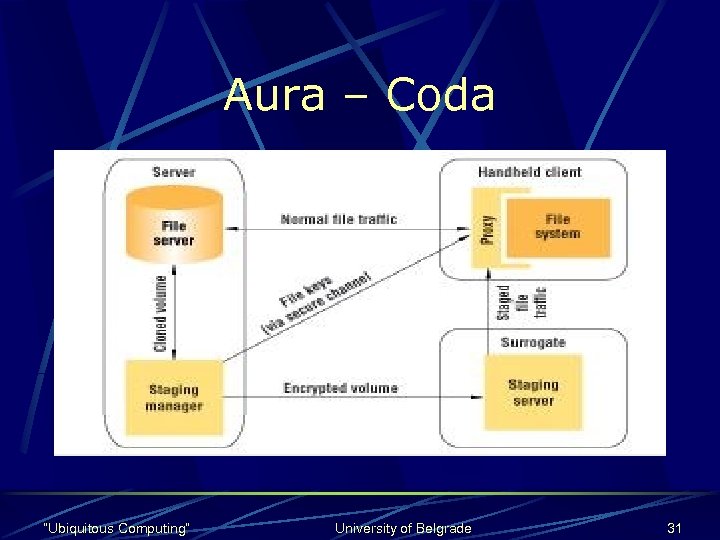
Aura – Coda Data staging: Prefatching for pervasive computing l Snapshots l “Caching trust rather than content” l Privacy: end-to-end encryption (DES, Triple-DES) l “Ubiquitous Computing” University of Belgrade 31
![Aura – Odyssey Features: Application-aware Adaptability[2] l Shared OS-Application Responsibility l Fidelity[2] l System](https://present5.com/presentation/8835d1639a84fd0b5ac859fe4491a61f/image-32.jpg "Aura – Odyssey Features: Application-aware Adaptability[2] l Shared OS-Application Responsibility l Fidelity[2] l System")
Aura – Odyssey Features: Application-aware Adaptability[2] l Shared OS-Application Responsibility l Fidelity[2] l System Agility l “Ubiquitous Computing” University of Belgrade 32
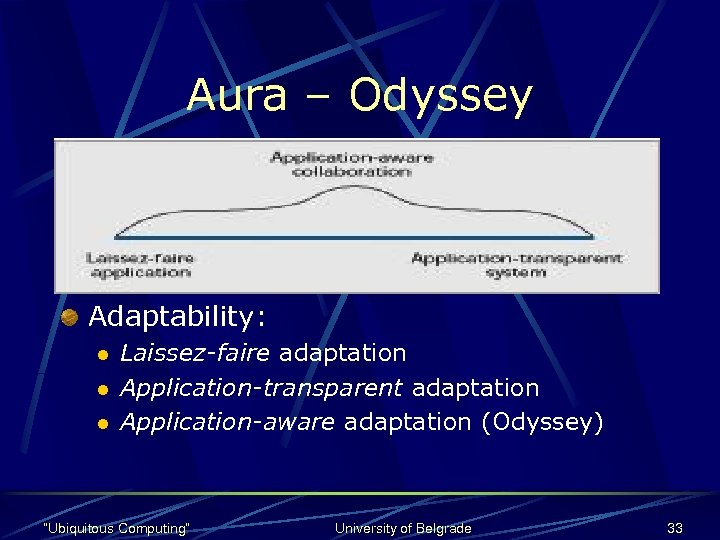
Aura – Odyssey Fidelity: l l Odyssey’s notion of data quality Degree to which a data used by a mobile client matches the reference copy Adaptability: l l l Laissez-faire adaptation Application-transparent adaptation Application-aware adaptation (Odyssey) “Ubiquitous Computing” University of Belgrade 33
![Aura – Odyssey Architecture: [2] Interceptor l Viceroy l Set of Wardens: l Web](https://present5.com/presentation/8835d1639a84fd0b5ac859fe4491a61f/image-34.jpg "Aura – Odyssey Architecture: [2] Interceptor l Viceroy l Set of Wardens: l Web")
Aura – Odyssey Architecture: [2] Interceptor l Viceroy l Set of Wardens: l Web warden l Voice warden l “Ubiquitous Computing” University of Belgrade 34
Aura – Prism Aura’s most important capabilities: l l Supporting user mobility Protection from variations in resource availability Prism (task layer)– high-level support for: l l Proactivity Self-tuning “Ubiquitous Computing” University of Belgrade 35
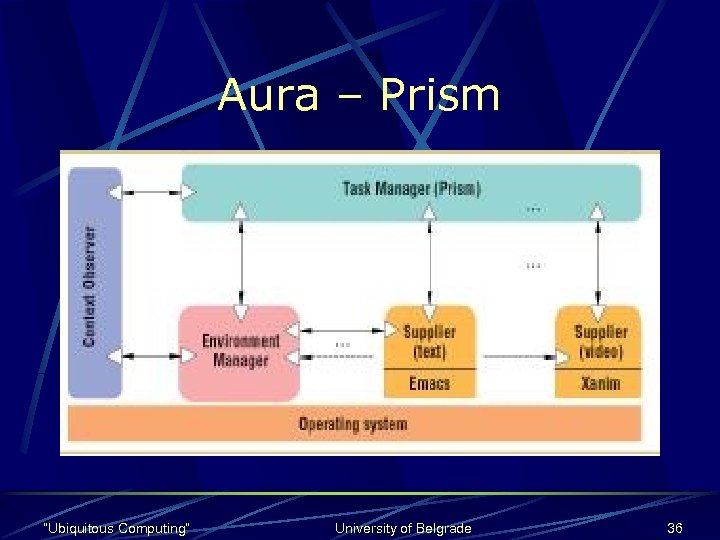
Aura – Prism’s architecture features: l l l Context observation Environment management infrastructure Task explicit representation “Ubiquitous Computing” University of Belgrade 36
![Resources [1] Project Aura, Carnegie Mellon University, http: // www-2. cs. cmu. edu/~aura [2]](https://present5.com/presentation/8835d1639a84fd0b5ac859fe4491a61f/image-37.jpg "Resources [1] Project Aura, Carnegie Mellon University, http: // www-2. cs. cmu. edu/~aura [2]")
Resources [1] Project Aura, Carnegie Mellon University, http: // www-2. cs. cmu. edu/~aura [2] Brian Noble, University of Michigan, “System Support for Mobile, Adaptive Applications”, IEEE Personal Communications, February 2000. [3] David Garlan, Daniel P. Siewiorek, Asim Smailagic, Peter Steenkiste Carnegie Mellon University, “Project Aura: Toward Distraction-Free Pervasive Computing”, http: //computer. org/pervasive “Ubiquitous Computing” University of Belgrade 37
JAVA MIDP - CLDC Mobile Phones Programming
INTRODUCTION Connected Limited Device Configuration (CLDC) - set of core Java APIs l l closely tied to a Java Virtual Machine (JVM) defines the Java language features and the core Java libraries of the JVM The Mobile Information Device Profile (MIDP) l a set of Java APIs that together with the CLDC l provides a complete J 2 ME application runtime environment targeted at mobile information devices, such as cellular phones “Ubiquitous Computing” University of Belgrade 39
Developing Applications with MIDP MIDlet - an J 2 ME/MIDP platform application Various sizes of displays, different keyboards, and the "look and feel" of devices Incoming phone call or SMS during the execution of a MIDlet Losing network connection while a MIDlet is running “Ubiquitous Computing” University of Belgrade 40
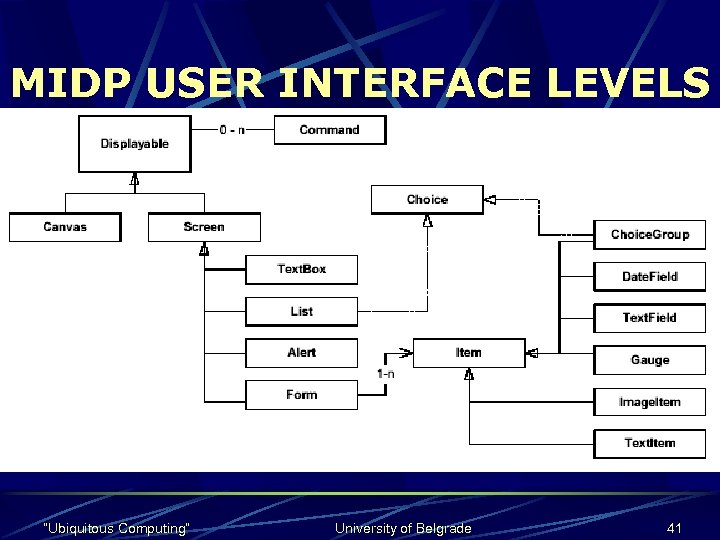
MIDP USER INTERFACE LEVELS “Ubiquitous Computing” University of Belgrade 41
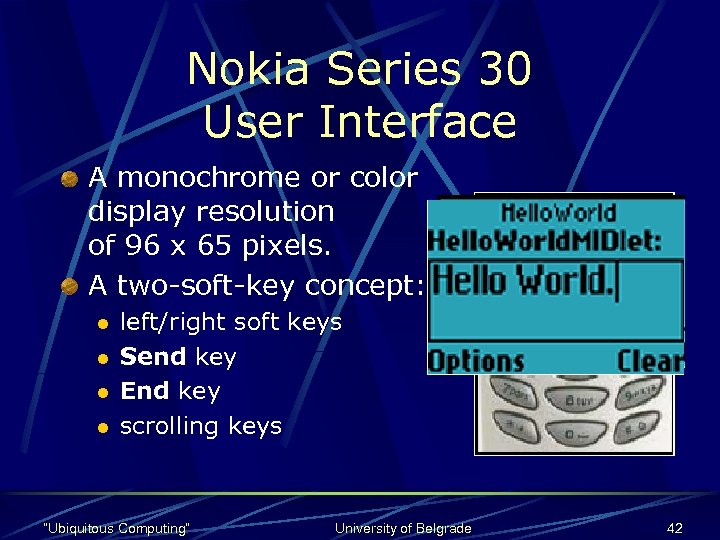
Nokia Series 30 User Interface A monochrome or color display resolution of 96 x 65 pixels. A two-soft-key concept: l l left/right soft keys Send key End key scrolling keys “Ubiquitous Computing” University of Belgrade 42
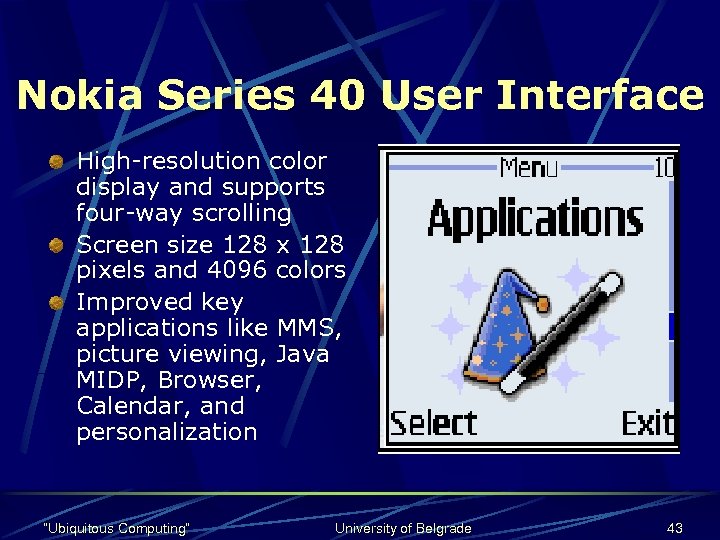
Nokia Series 40 User Interface High-resolution color display and supports four-way scrolling Screen size 128 x 128 pixels and 4096 colors Improved key applications like MMS, picture viewing, Java MIDP, Browser, Calendar, and personalization “Ubiquitous Computing” University of Belgrade 43
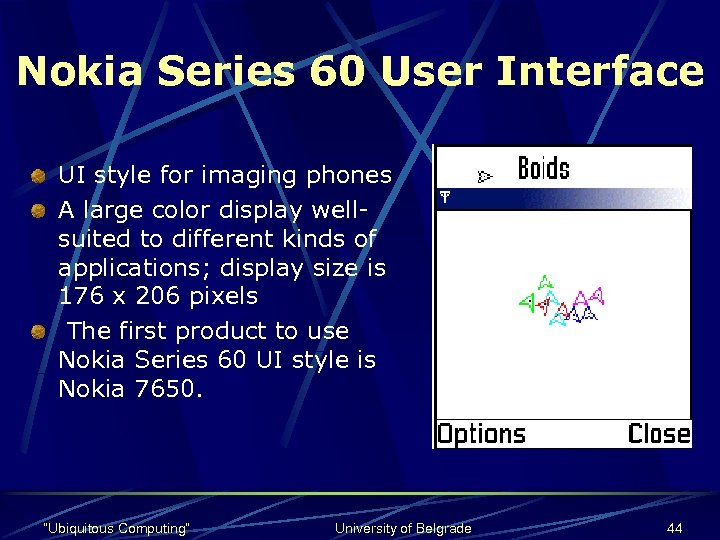
Nokia Series 60 User Interface UI style for imaging phones A large color display wellsuited to different kinds of applications; display size is 176 x 206 pixels The first product to use Nokia Series 60 UI style is Nokia 7650. “Ubiquitous Computing” University of Belgrade 44
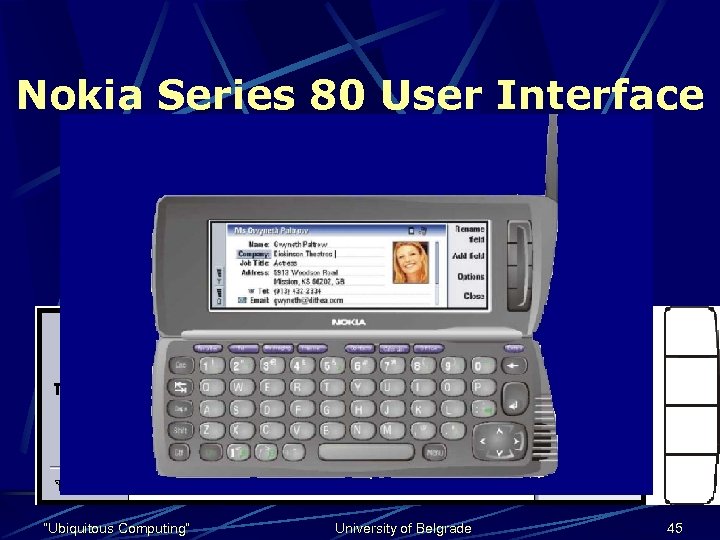
Nokia Series 80 User Interface A two-hand-operated “feature concept” platform A color screen and abundant space for different types of applications “Ubiquitous Computing” University of Belgrade 45
Nokia Developer's Suite for J 2 ME Automated code generation tools, archive builders, and software development tools, including visual MIDP phone emulators. Integrated with either Borland's Jbuilder or Sun Microsystem's Forte for Java Used as a standalone “Ubiquitous Computing” University of Belgrade 46
A SIMPLE EXAMLPE: TIC TAC TOE Phones having MIDlet application for TIC Tac TOE installed Server side application: l l Servlet for connecting players Game objects for keeping track of games Emulated on Nokia 6310 i – Nokia Series 30 User Interface “Ubiquitous Computing” University of Belgrade 47
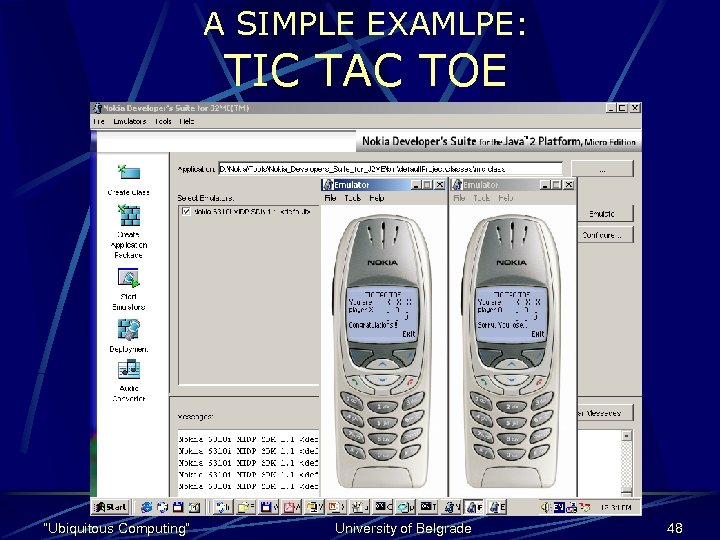
A SIMPLE EXAMLPE: TIC TAC TOE “Ubiquitous Computing” University of Belgrade 48
Downloading and Installing Java Applications to Nokia Phones Applications pre-installed at the factory, Downloaded over a serial cable from a PC, Downloaded Over the Air (OTA) by an application such as a WAP browser OTA downloading is expected to be the most important way to download MIDlets to phones For example, Club Nokia will offer downloadable Java applications to Nokia mobile phone users. “Ubiquitous Computing” University of Belgrade 49
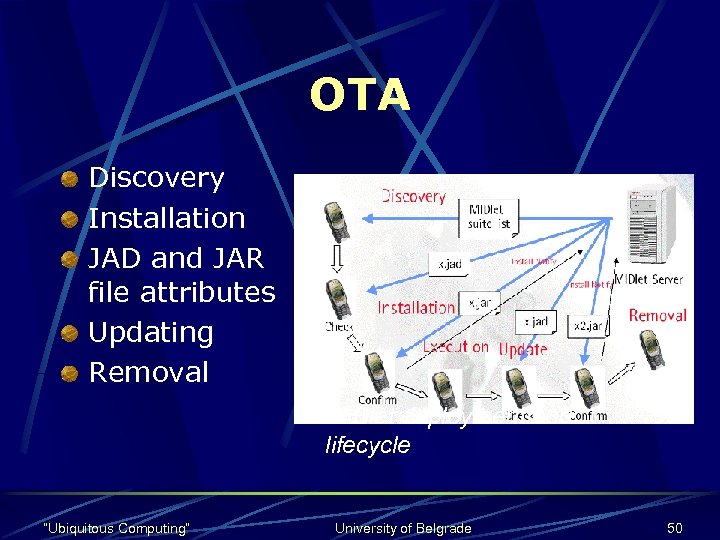
OTA Discovery Installation JAD and JAR file attributes Updating Removal MIDlet deployment and lifecycle “Ubiquitous Computing” University of Belgrade 50
Resources http: //www. nokia. com http: //java. sun. com “Ubiquitous Computing” University of Belgrade 51
Overview You have learned about: l l Distraction-Free Pervasive Computing - Aura Mobile Phones Programming: JAVA MIDP - CLDC Related projects: l l l l Data-centric vision of future computing – Portolano Project (Xerox PARC & University of Washington) UC – education & entertainment – Geney, E³, FPS Oxygen Project (MIT) Wearable Computers “Endeavour” (Berkeley) Future client-centric pervasive approach – PSI (HP Labs) “Cool. Town” (HP Labs) “Ubiquitous Computing” University of Belgrade 52
Summary “Our computers should be like our childhood: an invisible foundation that is quickly forgotten, but always with us, and effortlessly used throughout our lives. ” Mark Weiser “Ubiquitous Computing” University of Belgrade 53
Скачать презентацию Ubiquitous Computing The Next Computing Generation Authors Jelena
8835d1639a84fd0b5ac859fe4491a61f.ppt