


 Скачать презентацию UAS Air Traffic Management Presented to Russian Federal
09ced799f106c322987a32ca30518438.ppt
- Количество слайдов: 37
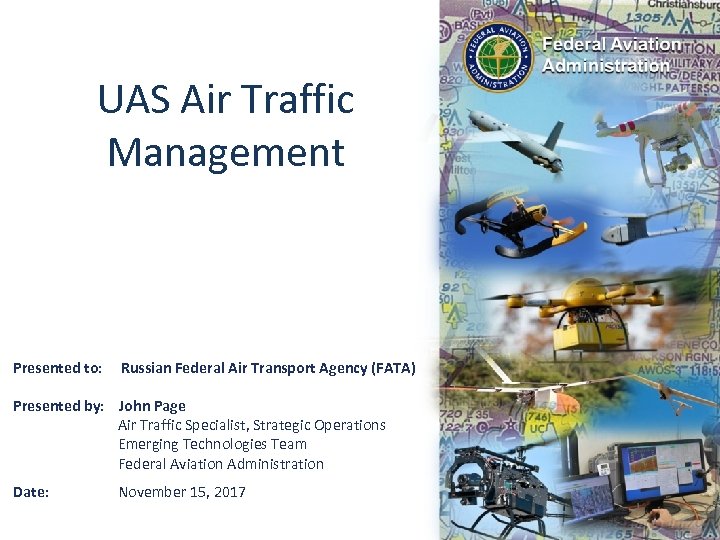 UAS Air Traffic Management Presented to: Russian Federal Air Transport Agency (FATA) Presented by: John Page Air Traffic Specialist, Strategic Operations Emerging Technologies Team Federal Aviation Administration Date: November 15, 2017 Federal Aviation Administration
 Agenda • Policy Considerations • Airspace Considerations • Air Traffic Management Infrastructure Considerations • Training Considerations • Collaboration • Approval Process • Moving forward UAS Air Traffic Management November 15, 2017 Federal Aviation Administration www. faa. gov/uas 2
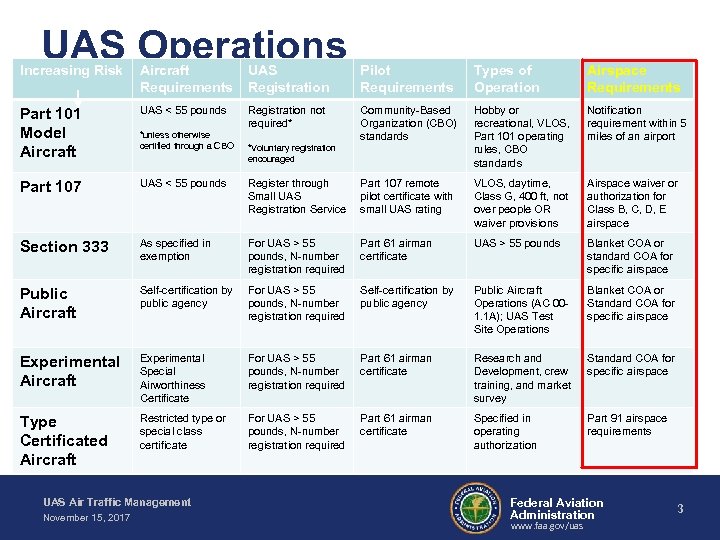 UAS Operations Increasing Risk Aircraft Requirements UAS Registration Pilot Requirements Types of Operation Airspace Requirements Part 101 Model Aircraft UAS < 55 pounds Registration not required* Community-Based Organization (CBO) standards Hobby or recreational, VLOS, Part 101 operating rules, CBO standards Notification requirement within 5 miles of an airport Part 107 UAS < 55 pounds Register through Small UAS Registration Service Part 107 remote pilot certificate with small UAS rating VLOS, daytime, Class G, 400 ft, not over people OR waiver provisions Airspace waiver or authorization for Class B, C, D, E airspace Section 333 As specified in exemption For UAS > 55 pounds, N-number registration required Part 61 airman certificate UAS > 55 pounds Blanket COA or standard COA for specific airspace Public Aircraft Self-certification by public agency For UAS > 55 pounds, N-number registration required Self-certification by public agency Public Aircraft Operations (AC 001. 1 A); UAS Test Site Operations Blanket COA or Standard COA for specific airspace Experimental Aircraft Experimental Special Airworthiness Certificate For UAS > 55 pounds, N-number registration required Part 61 airman certificate Research and Development, crew training, and market survey Standard COA for specific airspace Type Certificated Aircraft Restricted type or special class certificate For UAS > 55 pounds, N-number registration required Part 61 airman certificate Specified in operating authorization Part 91 airspace requirements *unless otherwise certified through a CBO UAS Air Traffic Management November 15, 2017 *Voluntary registration encouraged Federal Aviation Administration www. faa. gov/uas 3
 Policy Considerations • • • Why is policy important to the airspace discussion? • Don’t get caught off guard • Policy change is required to be in place in order to support airspace implementation of rules Feedback from operators is crucial – Operational data collection Collaboration within organization – Harmonized and complimentary Policy maturation takes time – Typically incremental – Often through lessons learned – Documentation is critical Safety Management – Identifying Risks and mitigations – Incident/accident data UAS Air Traffic Management November 15, 2017 Federal Aviation Administration www. faa. gov/uas 4
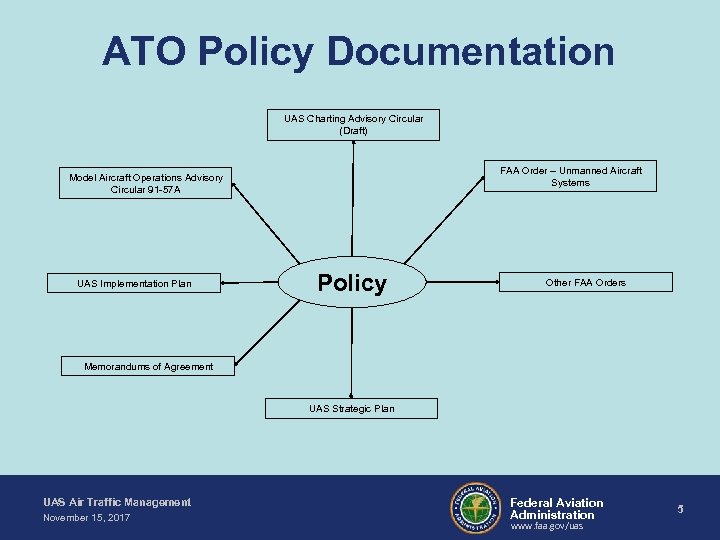 ATO Policy Documentation UAS Charting Advisory Circular (Draft) FAA Order – Unmanned Aircraft Systems Model Aircraft Operations Advisory Circular 91 -57 A UAS Implementation Plan Policy Other FAA Orders Memorandums of Agreement UAS Strategic Plan UAS Air Traffic Management November 15, 2017 Federal Aviation Administration www. faa. gov/uas 5
 FAA UAS Safety Studies • Key Drivers – Why we do it? - FAA Air Traffic Organization Safety Management System Policy - FAA Modernization and Reform Act of 2012 • Section 335. Safety Studies “The Administrator of the Federal Aviation Administration shall carry out all safety studies necessary to support the integration of unmanned aircraft systems into the national airspace system. ” UAS Air Traffic Management November 15, 2017 Federal Aviation Administration www. faa. gov/uas 6
 Past UAS Safety Studies • Safety Risk Management (SRM) panels convened to: • Baseline each class of airspace • Enable Civil UAS Operations (Section 333) • Enable Civil UAS Operations (Part 107 Operations) – Certificate of Waiver or Authorization (COA) process for UAS low‑altitude operations under Section 333 (200 feet Above Ground Level (AGL)) – COA process for UAS low‑altitude operations under Section 333 at or below 400 feet AGL – Part 107. 41 controlled airspace UAS Facility Maps UAS Air Traffic Management November 15, 2017 – – – – Class A and High E Class B Class C Class D Class E Class G Conditions and limitations for allowing operations in Class E Surface Area Federal Aviation Administration www. faa. gov/uas 7
 Common Hazards Across Safety Analyses Lost Link - The loss of real-time command control (C 2) data link. If the link between the Pilot in Command (PIC) and the UAS is lost, the Unmanned Aircraft (UA) utilizes pre-programmed contingency (i. e. , lost link) procedures until the link is reestablished or until the UAS ends the flight in a safe manner Fly Away - Interruption or loss of the control link, or when the pilot is unable to affect control of the aircraft and, as a result, the UA is not operating in a predicable or planned manner Difficulty to be Seen by Manned Aircraft - Due to size of UA due to speed, body composition, and markings UAS Air Traffic Management November 15, 2017 Federal Aviation Administration www. faa. gov/uas 8
 Common Hazards Across Safety Analyses (cont. ) Loss of Visual Line of Sight - The Pilot in Command (PIC) has lost visual contact with the UA as required by 14 Code of Federal Regulations Section 91. 113 Loss of Communications Between Pilot and Observer because of radio failure and they are not co-located UAS Air Traffic Management November 15, 2017 Federal Aviation Administration www. faa. gov/uas 9
 Airspace Considerations • Current operational challenges – Mission driven flights (aerial photo, fire/rescue) • Existing airspace structure vs desired UAS operations – Package delivery – ATM vs Unmanned Aircraft Traffic Management System (UTM) airspace environment • Airspace regulatory change – Needed? Or can existing structure support? • Separation standards – Small UAS integration will drive different thoughts UAS Air Traffic Management November 15, 2017 Federal Aviation Administration www. faa. gov/uas 10
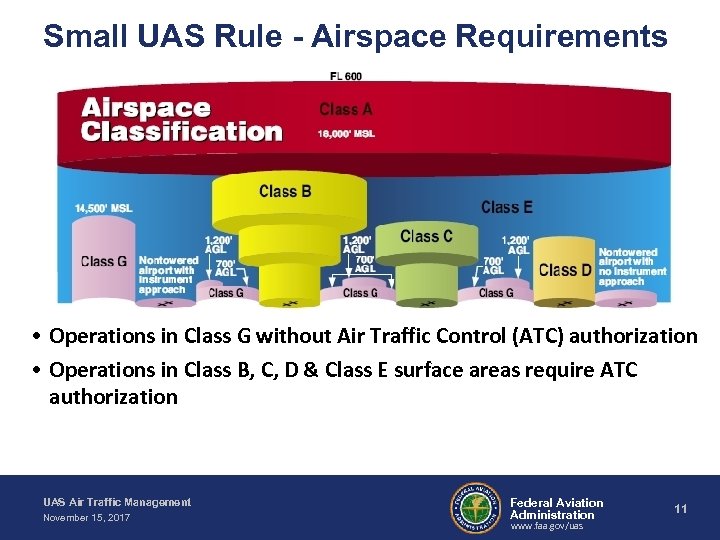 Small UAS Rule - Airspace Requirements • Operations in Class G without Air Traffic Control (ATC) authorization • Operations in Class B, C, D & Class E surface areas require ATC authorization UAS Air Traffic Management November 15, 2017 Federal Aviation Administration www. faa. gov/uas 11
 ATC Automation Considerations • Automation/UAS Procedure Development – Modifications to recognize unique operating characteristics (Conflict probe, vertical/spiral take-off) – ATM Software • Secondary Surveillance Code allocation for UAS lost link (Code 7400) – Publishing of UAS Facility Maps – Low Altitude Authorization and Notification System (LAANC) UAS Air Traffic Management November 15, 2017 Federal Aviation Administration www. faa. gov/uas 12
 Operational Review Process History • Manual processing completed via email – Pre 2007 • Development of Certificate of Waiver or Authorization (COA) Online (2007) – Automated manual process – Allowed applicants to submitted paperwork online – Continued improvements over time allowing additional functions and capabilities • COA Application Processing System (CAPS) – Online November 2017 – Improved capabilities – Improved flexibility for system changes UAS Air Traffic Management November 15, 2017 Federal Aviation Administration www. faa. gov/uas 13
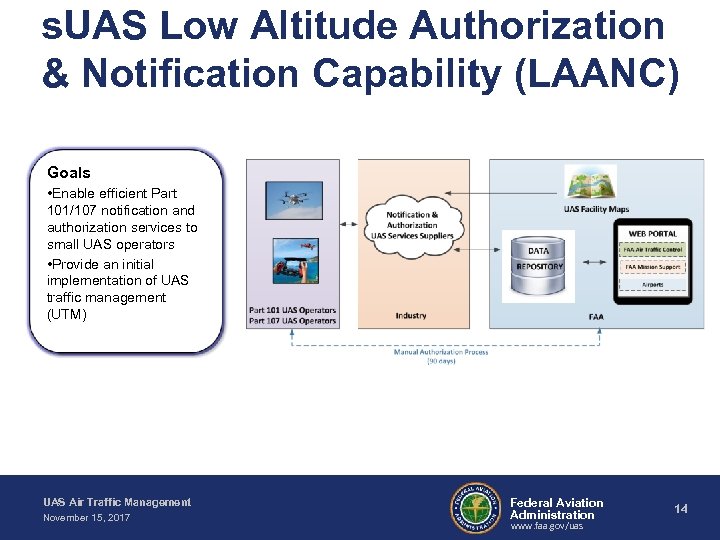 s. UAS Low Altitude Authorization & Notification Capability (LAANC) Goals • Enable efficient Part 101/107 notification and authorization services to small UAS operators • Provide an initial implementation of UAS traffic management (UTM) UAS Air Traffic Management November 15, 2017 Federal Aviation Administration www. faa. gov/uas 14
 ATC Training Considerations • UAS Terminology – Lost Link – Remote Pilot Station – Visual line of sight • UAS Performance Characteristics – Tremendous variability – Operational performance capabilities • Contingency planning UAS Air Traffic Management November 15, 2017 Federal Aviation Administration www. faa. gov/uas 15
 Training for ATC Specialist • Computer based training – During qualification phase of facility training – Available for recurrent training • Training covers areas such as: – – Phraseology and terminology for UAS Characteristics, separation standards, contingency procedures Airspaces UAS may operate in and applicable restrictions What’s different and what’s the same • Will require updating with changing policy/procedures and technology advances UAS Air Traffic Management November 15, 2017 Federal Aviation Administration www. faa. gov/uas 16
 Collaboration - Internationally • A must! • FAA Air Traffic Organization is a part of: – Civil Air Navigation Services Organisation (CANSO), Remotely Piloted Aircraft System & Emerging Technologies Work Group (RPAS & ET WG) • Work Group Co Chairperson • Work Group Member/Subject Matter Expert – ICAO Remotely Piloted Aircraft System Panel • Elected as current Panel Chair Person • Previously held Chair and Vice Person positions • U. S. Member – ICAO APAC UAS Task Force (APAC UAS WG) • U. S. Member UAS Air Traffic Management November 15, 2017 Federal Aviation Administration www. faa. gov/uas 17
 Operational Request Review Process • Different operational types have different processes based on: – Laws – Regulations – Mission Requirements UAS Air Traffic Management November 15, 2017 Federal Aviation Administration www. faa. gov/uas 18
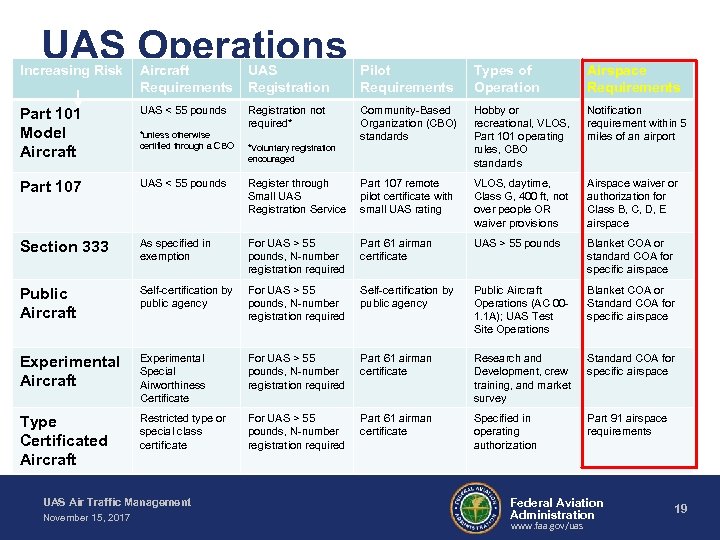 UAS Operations Increasing Risk Aircraft Requirements UAS Registration Pilot Requirements Types of Operation Airspace Requirements Part 101 Model Aircraft UAS < 55 pounds Registration not required* Community-Based Organization (CBO) standards Hobby or recreational, VLOS, Part 101 operating rules, CBO standards Notification requirement within 5 miles of an airport Part 107 UAS < 55 pounds Register through Small UAS Registration Service Part 107 remote pilot certificate with small UAS rating VLOS, daytime, Class G, 400 ft, not over people OR waiver provisions Airspace waiver or authorization for Class B, C, D, E airspace Section 333 As specified in exemption For UAS > 55 pounds, N-number registration required Part 61 airman certificate UAS > 55 pounds Blanket COA or standard COA for specific airspace Public Aircraft Self-certification by public agency For UAS > 55 pounds, N-number registration required Self-certification by public agency Public Aircraft Operations (AC 001. 1 A); UAS Test Site Operations Blanket COA or Standard COA for specific airspace Experimental Aircraft Experimental Special Airworthiness Certificate For UAS > 55 pounds, N-number registration required Part 61 airman certificate Research and Development, crew training, and market survey Standard COA for specific airspace Type Certificated Aircraft Restricted type or special class certificate For UAS > 55 pounds, N-number registration required Part 61 airman certificate Specified in operating authorization Part 91 airspace requirements *unless otherwise certified through a CBO UAS Air Traffic Management November 15, 2017 *Voluntary registration encouraged Federal Aviation Administration www. faa. gov/uas 19
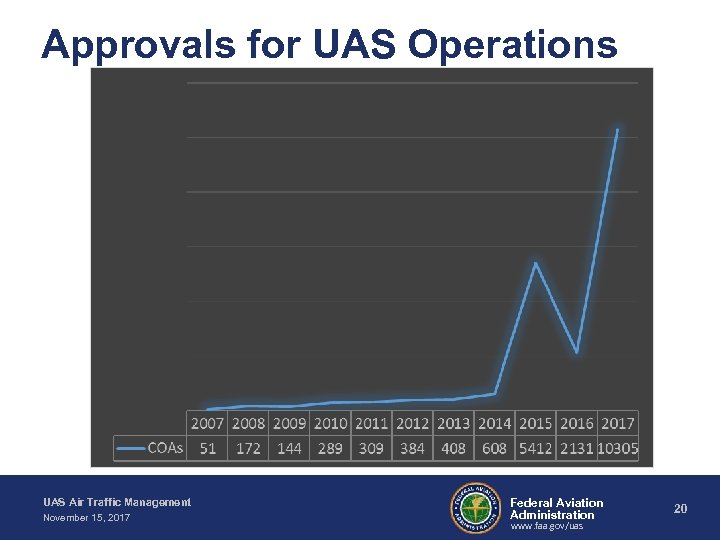 Approvals for UAS Operations UAS Air Traffic Management November 15, 2017 Federal Aviation Administration www. faa. gov/uas 20
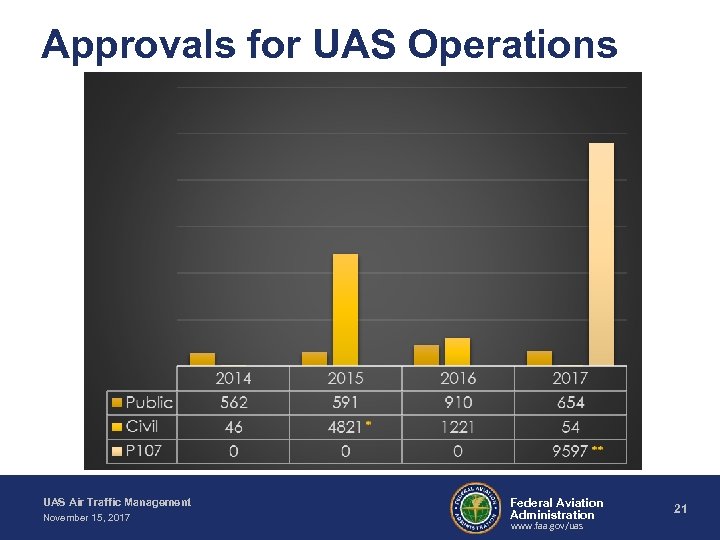 Approvals for UAS Operations UAS Air Traffic Management November 15, 2017 Federal Aviation Administration www. faa. gov/uas 21
 Certificate of Waiver or Authorization (COA) Process (Non Part 107) UAS Air Traffic Management November 15, 2017 Federal Aviation Administration www. faa. gov/uas 22
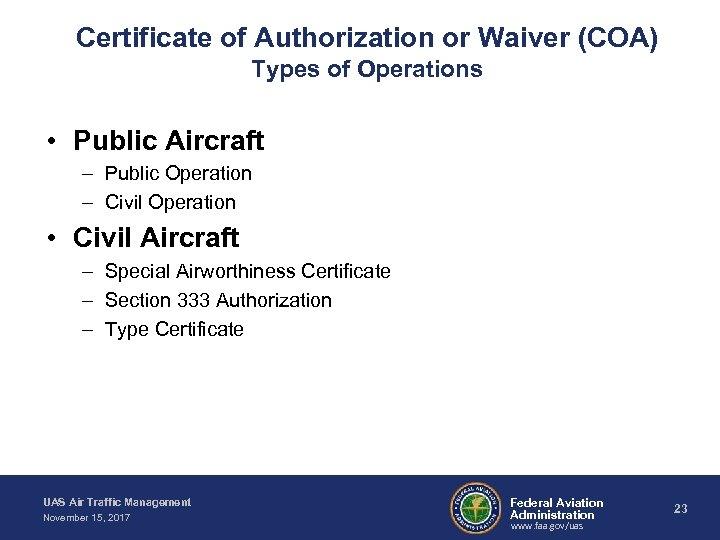 Certificate of Authorization or Waiver (COA) Types of Operations • Public Aircraft – Public Operation – Civil Operation • Civil Aircraft – Special Airworthiness Certificate – Section 333 Authorization – Type Certificate UAS Air Traffic Management November 15, 2017 Federal Aviation Administration www. faa. gov/uas 23
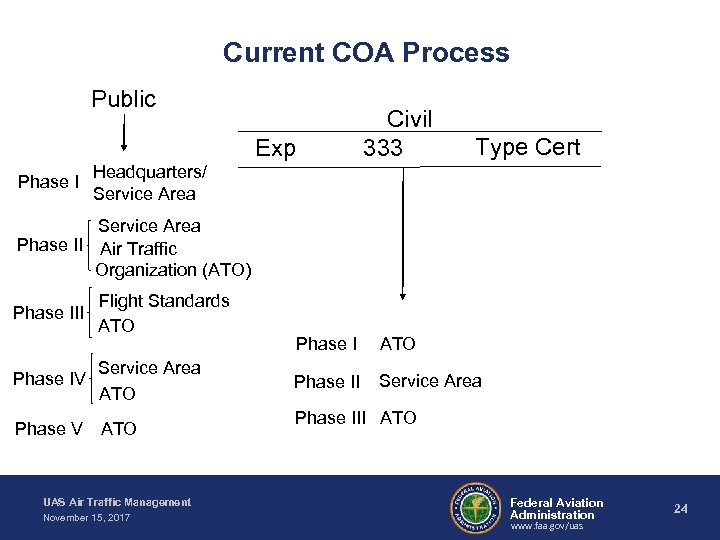 Current COA Process Public Exp Phase I Civil 333 Type Cert Headquarters/ Service Area Phase II Air Traffic Organization (ATO) Phase III Phase IV Flight Standards ATO Service Area ATO Phase V ATO UAS Air Traffic Management November 15, 2017 Phase I ATO Phase II Service Area Phase III ATO Federal Aviation Administration www. faa. gov/uas 24
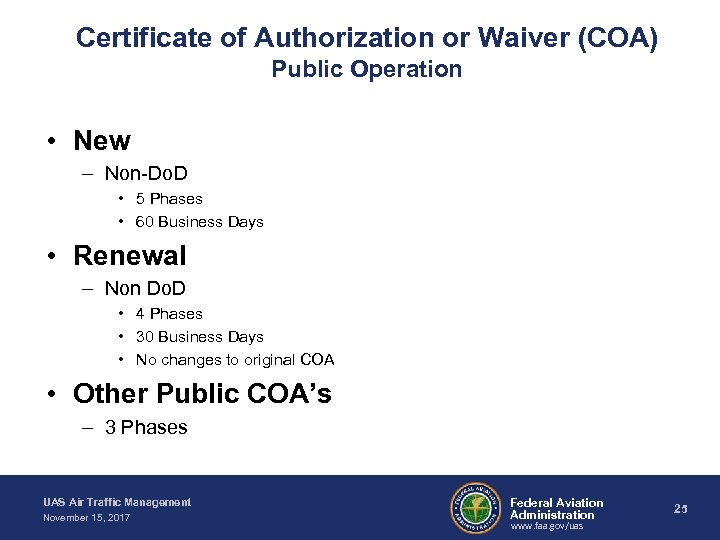 Certificate of Authorization or Waiver (COA) Public Operation • New – Non-Do. D • 5 Phases • 60 Business Days • Renewal – Non Do. D • 4 Phases • 30 Business Days • No changes to original COA • Other Public COA’s – 3 Phases UAS Air Traffic Management November 15, 2017 Federal Aviation Administration www. faa. gov/uas 25
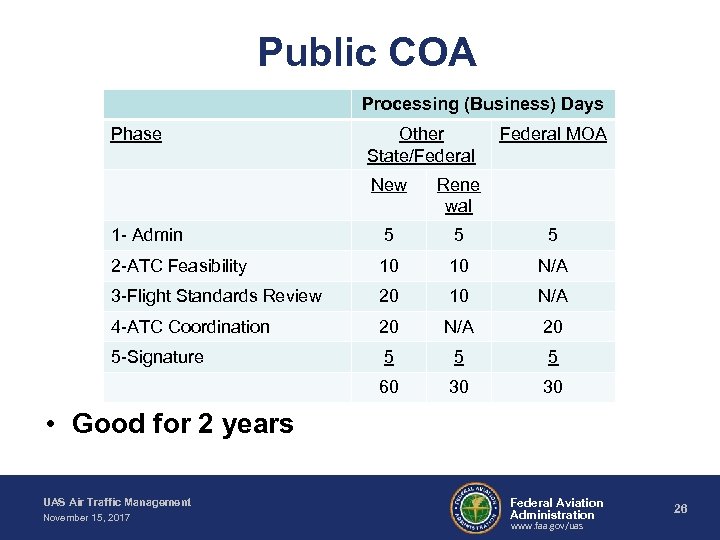 Public COA Processing (Business) Days Phase Other State/Federal MOA New Rene wal 1 - Admin 5 5 5 2 -ATC Feasibility 10 10 N/A 3 -Flight Standards Review 20 10 N/A 4 -ATC Coordination 20 N/A 20 5 -Signature 5 5 5 60 30 30 • Good for 2 years UAS Air Traffic Management November 15, 2017 Federal Aviation Administration www. faa. gov/uas 26
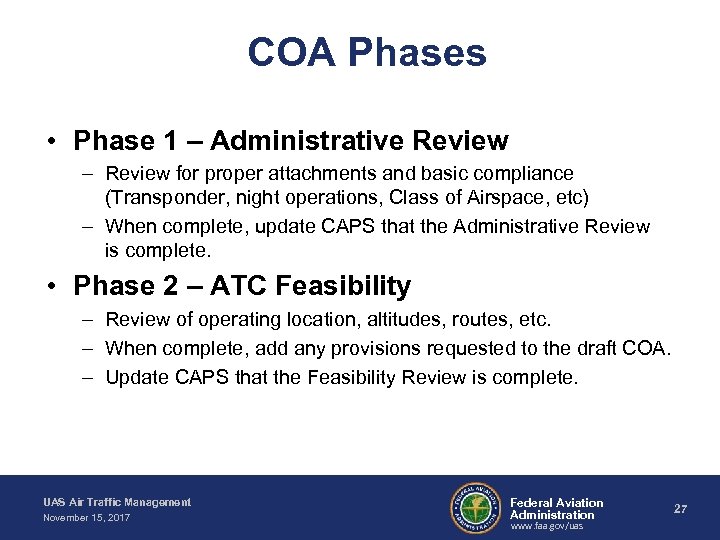 COA Phases • Phase 1 – Administrative Review – Review for proper attachments and basic compliance (Transponder, night operations, Class of Airspace, etc) – When complete, update CAPS that the Administrative Review is complete. • Phase 2 – ATC Feasibility – Review of operating location, altitudes, routes, etc. – When complete, add any provisions requested to the draft COA. – Update CAPS that the Feasibility Review is complete. UAS Air Traffic Management November 15, 2017 Federal Aviation Administration www. faa. gov/uas 27
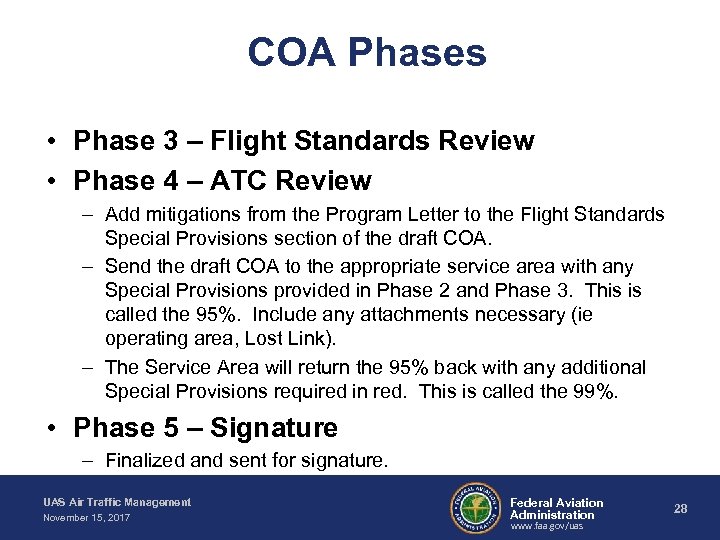 COA Phases • Phase 3 – Flight Standards Review • Phase 4 – ATC Review – Add mitigations from the Program Letter to the Flight Standards Special Provisions section of the draft COA. – Send the draft COA to the appropriate service area with any Special Provisions provided in Phase 2 and Phase 3. This is called the 95%. Include any attachments necessary (ie operating area, Lost Link). – The Service Area will return the 95% back with any additional Special Provisions required in red. This is called the 99%. • Phase 5 – Signature – Finalized and sent for signature. UAS Air Traffic Management November 15, 2017 Federal Aviation Administration www. faa. gov/uas 28
 Authorization or Waiver Process (Civil Operations - Part 107) UAS Air Traffic Management November 15, 2017 Federal Aviation Administration www. faa. gov/uas 29
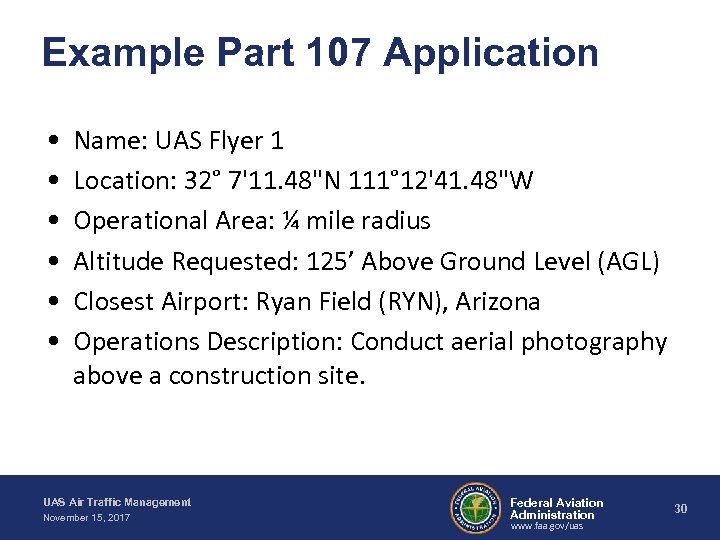 Example Part 107 Application • • • Name: UAS Flyer 1 Location: 32° 7'11. 48"N 111° 12'41. 48"W Operational Area: ¼ mile radius Altitude Requested: 125’ Above Ground Level (AGL) Closest Airport: Ryan Field (RYN), Arizona Operations Description: Conduct aerial photography above a construction site. UAS Air Traffic Management November 15, 2017 Federal Aviation Administration www. faa. gov/uas 30
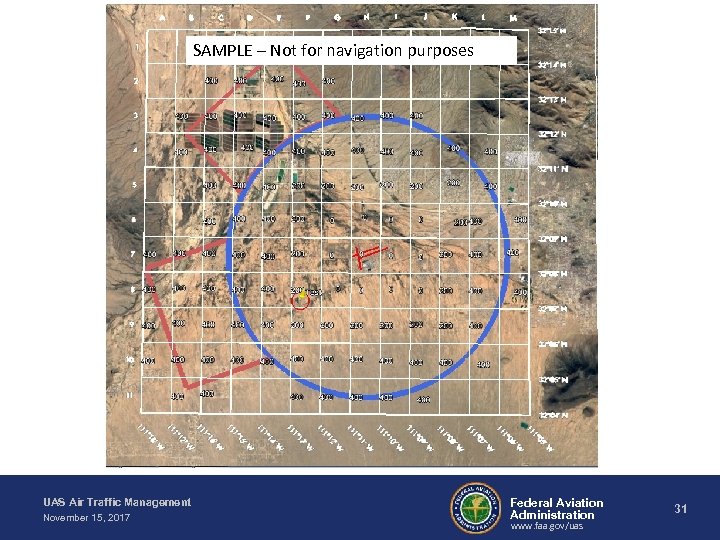 SAMPLE – Not for navigation purposes UAS Air Traffic Management November 15, 2017 Federal Aviation Administration www. faa. gov/uas 31
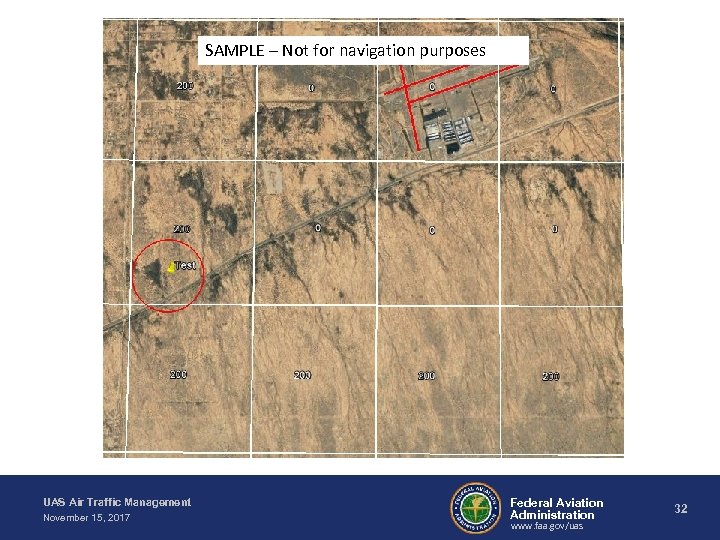 SAMPLE – Not for navigation purposes UAS Air Traffic Management November 15, 2017 Federal Aviation Administration www. faa. gov/uas 32
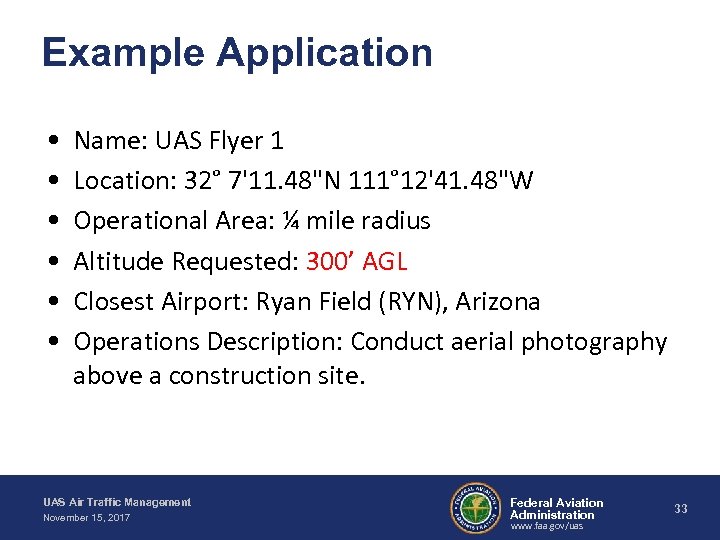 Example Application • • • Name: UAS Flyer 1 Location: 32° 7'11. 48"N 111° 12'41. 48"W Operational Area: ¼ mile radius Altitude Requested: 300’ AGL Closest Airport: Ryan Field (RYN), Arizona Operations Description: Conduct aerial photography above a construction site. UAS Air Traffic Management November 15, 2017 Federal Aviation Administration www. faa. gov/uas 33
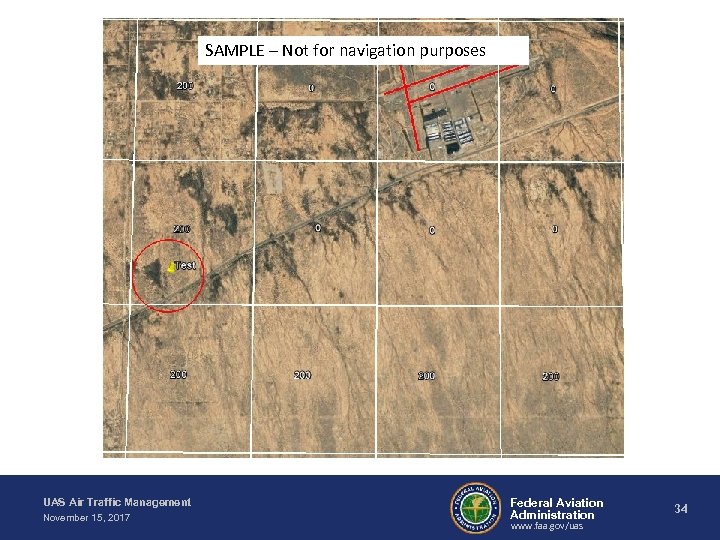 SAMPLE – Not for navigation purposes UAS Air Traffic Management November 15, 2017 Federal Aviation Administration www. faa. gov/uas 34
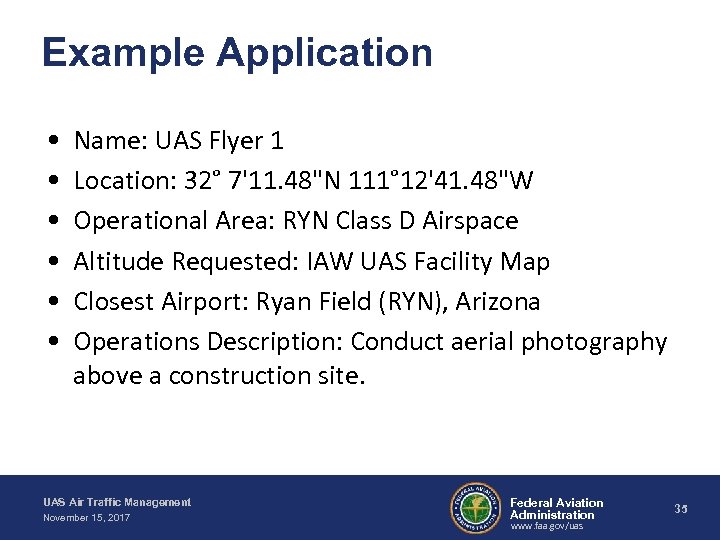 Example Application • • • Name: UAS Flyer 1 Location: 32° 7'11. 48"N 111° 12'41. 48"W Operational Area: RYN Class D Airspace Altitude Requested: IAW UAS Facility Map Closest Airport: Ryan Field (RYN), Arizona Operations Description: Conduct aerial photography above a construction site. UAS Air Traffic Management November 15, 2017 Federal Aviation Administration www. faa. gov/uas 35
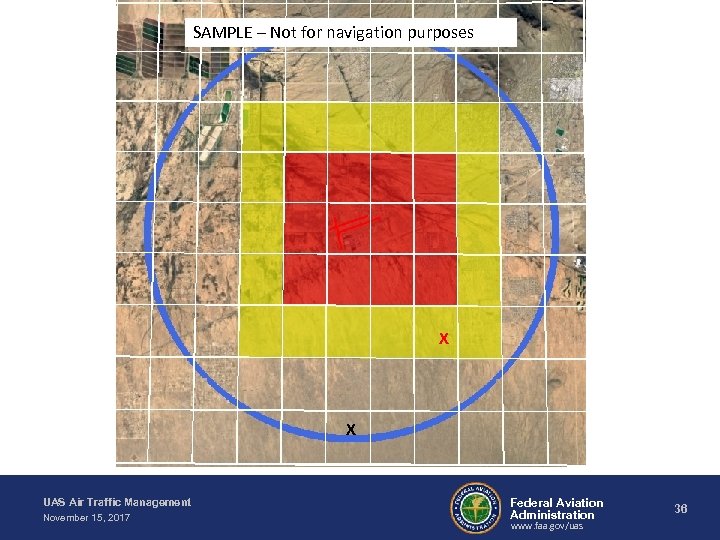 SAMPLE – Not for navigation purposes X X UAS Air Traffic Management November 15, 2017 Federal Aviation Administration www. faa. gov/uas 36
 Moving Forward • How best to support a very fast moving industry? – Nimble policy development that safely supports growth – Conduct appropriate research and development – Collaboration with all stakeholders • Maturation of technology – Enabling UAS to safely integrate with few impediments – Innovation will drive new capability UAS Air Traffic Management November 15, 2017 Federal Aviation Administration www. faa. gov/uas 37