


 Скачать презентацию UAI 2006 report from the 1 st Evaluation
9dae68e1dd022bf070853fbc6e141cff.ppt
- Количество слайдов: 78
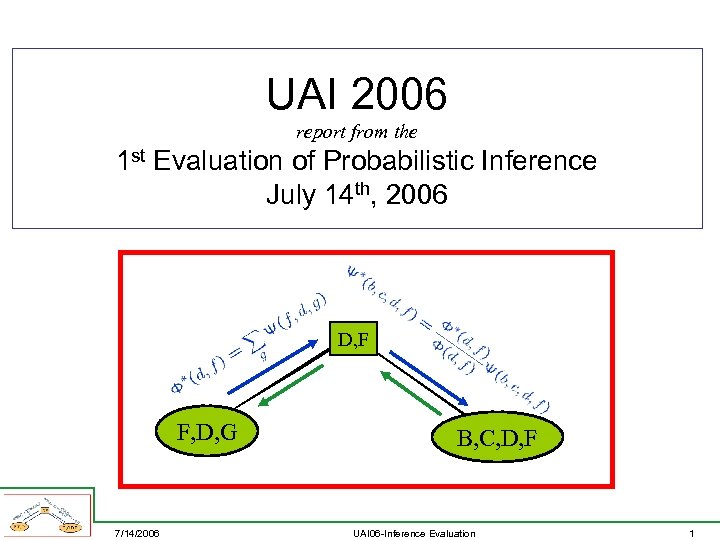 UAI 2006 report from the 1 st Evaluation of Probabilistic Inference July 14 th, 2006 D, F F, D, G 7/14/2006 B, C, D, F UAI 06 -Inference Evaluation 1
 What is this presentation about? • Goal: The purpose of this evaluation is to compare the performance of a variety of different software systems on a single set of Bayesian network (BN) problems. • By creating a friendly evaluation (as is often done in other communities such as SAT, and also in speech recognition and machine translation with their DARPA evaluations), we hope to foster new research in fast inference methods for performing a variety of queries in graphical models. • Over the past few months, the 1 st such an evaluation took place at UAI. • This presentation summarizes the outcome of this evaluation. 7/14/2006 UAI 06 -Inference Evaluation 2
 Who we are • Evaluators – Jeff Bilmes – University of Washington, Seattle – Rina Dechter – University of California, Irvine • Graduate Student Assistance – Chris Bartels – University of Washington, Seattle – Radu Marinescu – University of CA, Irvine – Karim Filali – University of Washington, Seattle • Advisory Council – Dan Geiger -- Technion - Israel Institute of Technology – Faheim Bacchus – University of Toronto – Kevin Murphy – University of British Columbia 7/14/2006 UAI 06 -Inference Evaluation 3
 Outline • Background, goals. • Scope (rational) • Final chosen queries • The UAI 2006 BN benchmark evaluation corpus • Scoring strategies • Participants and team members • Results for PE and MPE • Team presentations – team 1 (UCLA), team 2 (IET), team 3 (UBC), team 4 (U. Pitt/DSL), team 5 (UCI) • Conclusion/Open discussion 7/14/2006 UAI 06 -Inference Evaluation 4
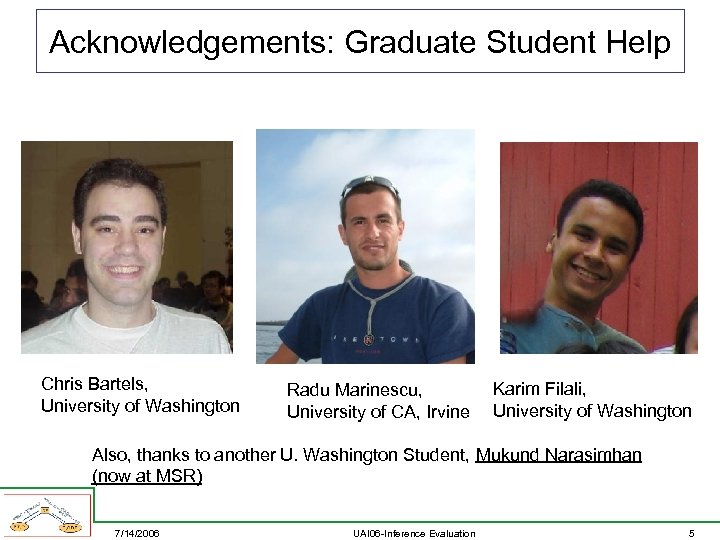 Acknowledgements: Graduate Student Help Chris Bartels, University of Washington Radu Marinescu, University of CA, Irvine Karim Filali, University of Washington Also, thanks to another U. Washington Student, Mukund Narasimhan (now at MSR) 7/14/2006 UAI 06 -Inference Evaluation 5
 Background • Early 2005: Rina Dechter & Dan Geiger decide there should be some form of UAI inference evaluation (like in the SAT community) and discuss the idea (by email) with Adnan Darwiche, Faheim Bacchus, Hector Geffner, Nir Friedman, Thomas Richardson. • I (Jeff Bilmes) take on the task to run it this first time. – Speech recognition and DARPA evaluations • evaluation of ASR systems using error rate as a metric. 7/14/2006 UAI 06 -Inference Evaluation 6
 Scope • Many “queries” could be evaluated including: – – MAP – maximal a posteriori hypothesis MPE – most probable explanation (also called Viterbi assignment) PE – probability of evidence N-best – compute the N-best of the above • Many algorithmic variants – Exact inference – Enforced limited time-bounds and/or space bounds – Approximate inference, and tradeoffs between time/space/accuracy • Classes of models – Static BNs with a generic description (list of CPTs) – More complex description language (e. g. , context specific indep. ) – Static models vs. Dynamic models (e. g. , Dynamic Bayesian Networks, and DGMs) vs. relational models 7/14/2006 UAI 06 -Inference Evaluation 7
 Decisions for this first evaluation. • Emphasis: Keep things simple. • Focus on exact inference – exact inference can still be useful. – “Exact inference is NP-complete, so we perform approximate inference” is often seen in the literature – With smart algorithms, and for fixed (but real-world) problem sizes, exact is quite doable and can be better for applications. • Focus on small number of queries: • Original plan: PE, MPE, and MAP for both static and dynamic models • From final participants list, narrowed this down to: PE and MPE on static Bayesian networks 7/14/2006 UAI 06 -Inference Evaluation 8
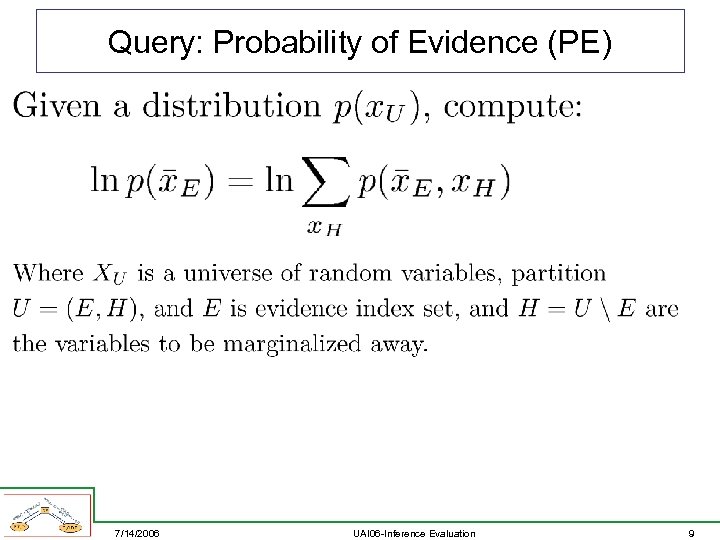 Query: Probability of Evidence (PE) 7/14/2006 UAI 06 -Inference Evaluation 9
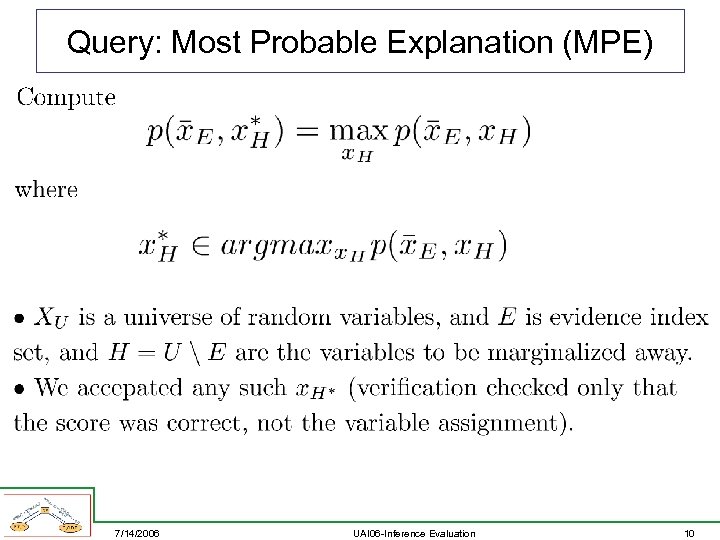 Query: Most Probable Explanation (MPE) 7/14/2006 UAI 06 -Inference Evaluation 10
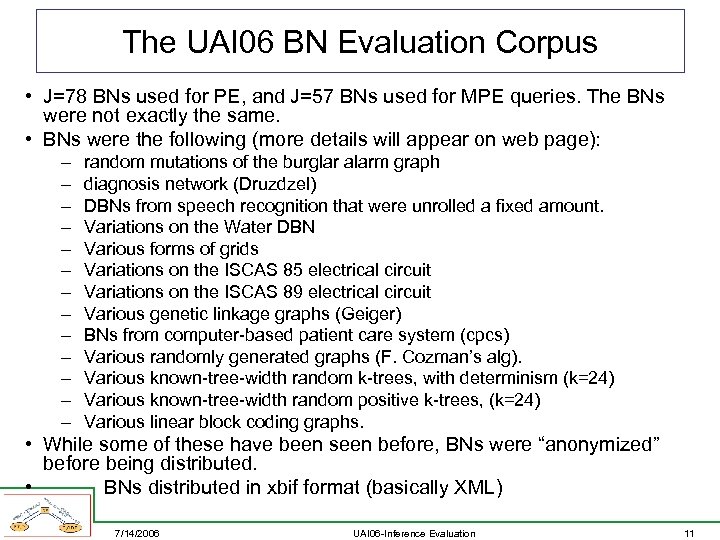 The UAI 06 BN Evaluation Corpus • J=78 BNs used for PE, and J=57 BNs used for MPE queries. The BNs were not exactly the same. • BNs were the following (more details will appear on web page): – – – – random mutations of the burglar alarm graph diagnosis network (Druzdzel) DBNs from speech recognition that were unrolled a fixed amount. Variations on the Water DBN Various forms of grids Variations on the ISCAS 85 electrical circuit Variations on the ISCAS 89 electrical circuit Various genetic linkage graphs (Geiger) BNs from computer-based patient care system (cpcs) Various randomly generated graphs (F. Cozman’s alg). Various known-tree-width random k-trees, with determinism (k=24) Various known-tree-width random positive k-trees, (k=24) Various linear block coding graphs. • While some of these have been seen before, BNs were “anonymized” before being distributed. • BNs distributed in xbif format (basically XML) 7/14/2006 UAI 06 -Inference Evaluation 11
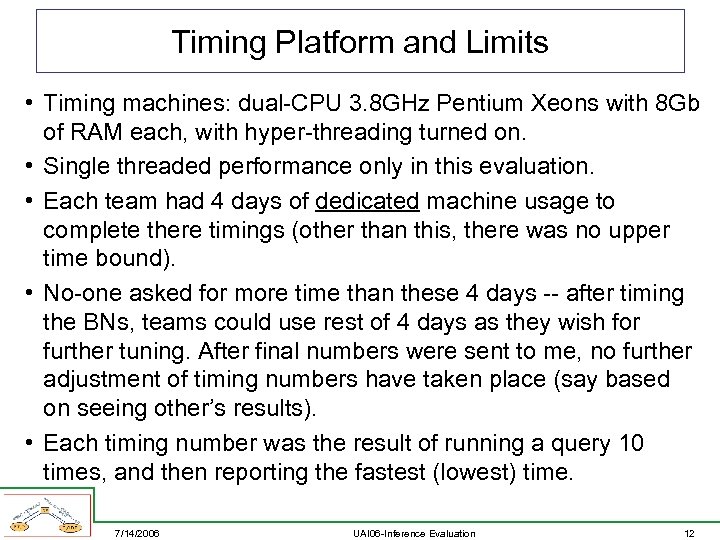 Timing Platform and Limits • Timing machines: dual-CPU 3. 8 GHz Pentium Xeons with 8 Gb of RAM each, with hyper-threading turned on. • Single threaded performance only in this evaluation. • Each team had 4 days of dedicated machine usage to complete there timings (other than this, there was no upper time bound). • No-one asked for more time than these 4 days -- after timing the BNs, teams could use rest of 4 days as they wish for further tuning. After final numbers were sent to me, no further adjustment of timing numbers have taken place (say based on seeing other’s results). • Each timing number was the result of running a query 10 times, and then reporting the fastest (lowest) time. 7/14/2006 UAI 06 -Inference Evaluation 12
 The Teams • Thanks to every member of every team: Each member of every team was crucial to making this a successful event!! 7/14/2006 UAI 06 -Inference Evaluation 13
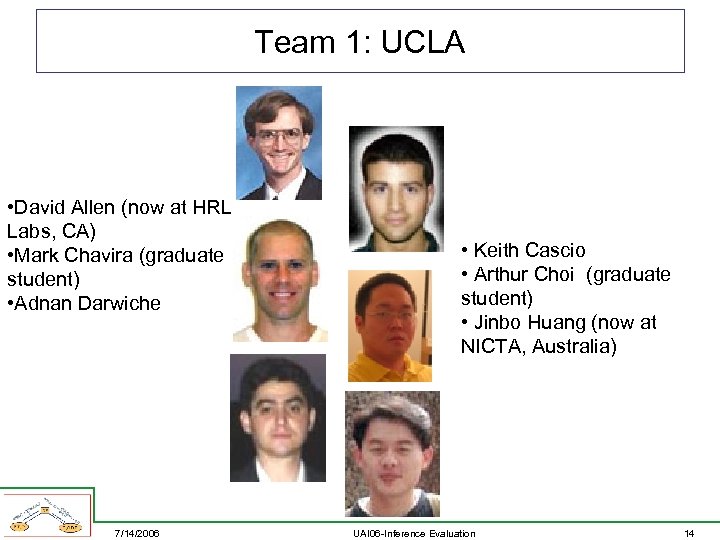 Team 1: UCLA • David Allen (now at HRL Labs, CA) • Mark Chavira (graduate student) • Adnan Darwiche 7/14/2006 • Keith Cascio • Arthur Choi (graduate student) • Jinbo Huang (now at NICTA, Australia) UAI 06 -Inference Evaluation 14
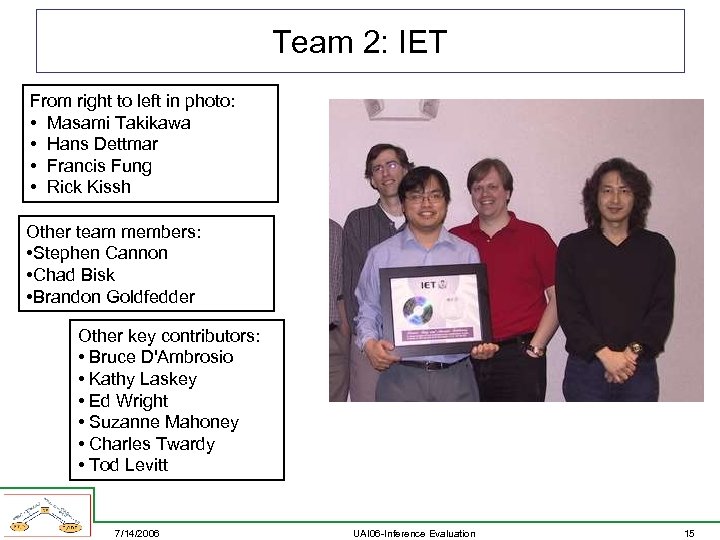 Team 2: IET From right to left in photo: • Masami Takikawa • Hans Dettmar • Francis Fung • Rick Kissh Other team members: • Stephen Cannon • Chad Bisk • Brandon Goldfedder Other key contributors: • Bruce D'Ambrosio • Kathy Laskey • Ed Wright • Suzanne Mahoney • Charles Twardy • Tod Levitt 7/14/2006 UAI 06 -Inference Evaluation 15
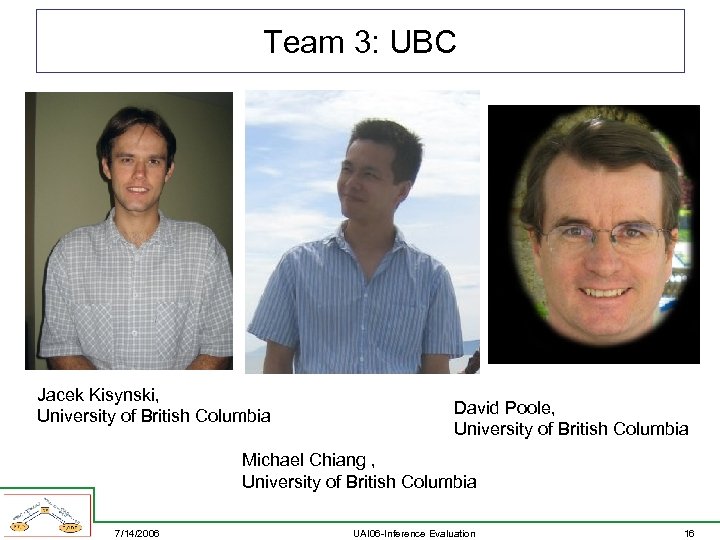 Team 3: UBC Jacek Kisynski, University of British Columbia David Poole, University of British Columbia Michael Chiang , University of British Columbia 7/14/2006 UAI 06 -Inference Evaluation 16
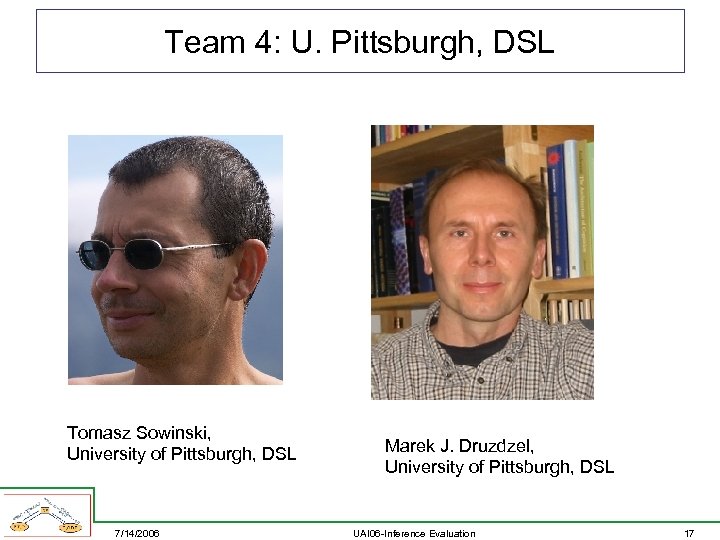 Team 4: U. Pittsburgh, DSL Tomasz Sowinski, University of Pittsburgh, DSL 7/14/2006 Marek J. Druzdzel, University of Pittsburgh, DSL UAI 06 -Inference Evaluation 17
 Team 4: Decision Systems Laboratory UAI Software Competition
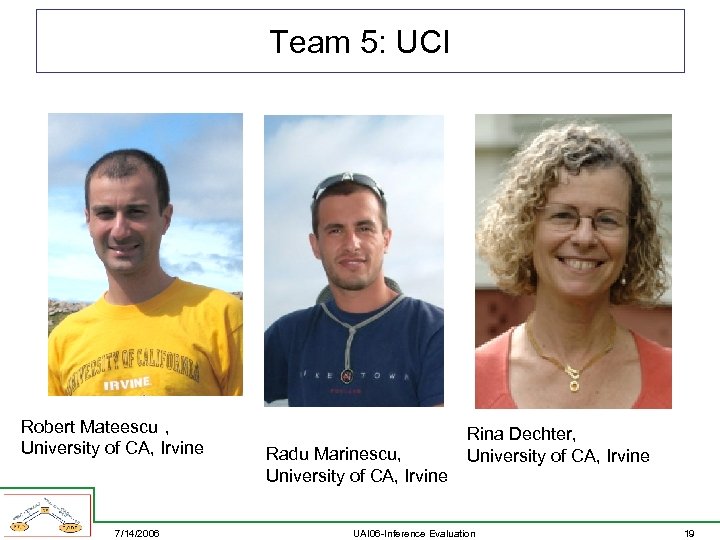 Team 5: UCI Robert Mateescu , University of CA, Irvine 7/14/2006 Radu Marinescu, University of CA, Irvine Rina Dechter, University of CA, Irvine UAI 06 -Inference Evaluation 19
 The Results 7/14/2006 UAI 06 -Inference Evaluation 20
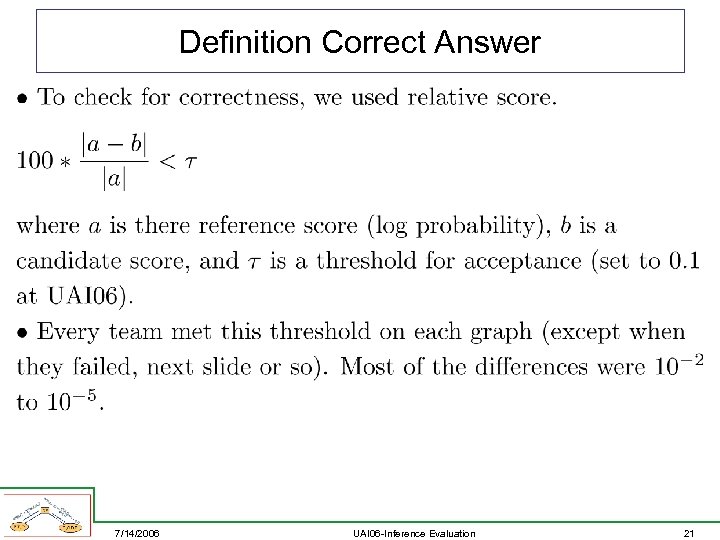 Definition Correct Answer 7/14/2006 UAI 06 -Inference Evaluation 21
 Definition of “FAIL” • Each team had 4 days to complete the evaluation • No time-limit placed on any particular BN. • A “FAILED” score meant that either the system failed to complete the query, or that the system underflowed their own numeric precision. – some of the networks were designed not to fit within IEEE 64 -bit double precision, so either scaling or log-arithmetic needed to be used (which is a speed hit for PE). • Teams had the option to submit multiple separate submissions, none did. • Systems were allowed to “backoff” from no-scaling to, say, a log-arithmetic mode (but that was included in the time charge) 7/14/2006 UAI 06 -Inference Evaluation 22
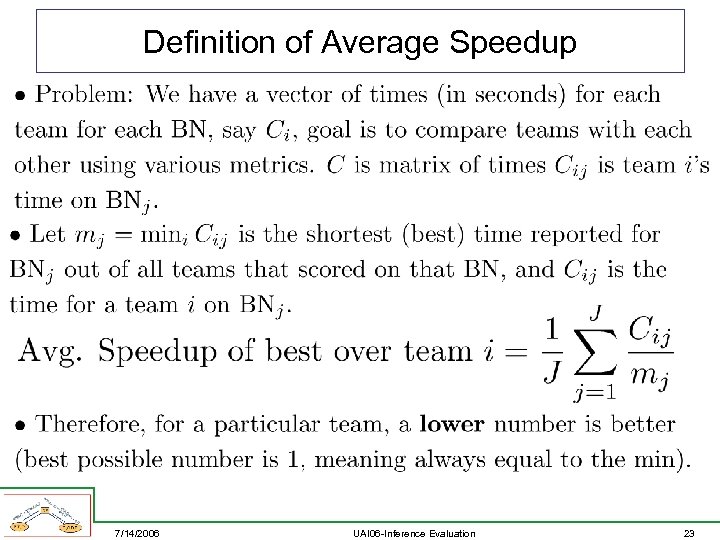 Definition of Average Speedup 7/14/2006 UAI 06 -Inference Evaluation 23
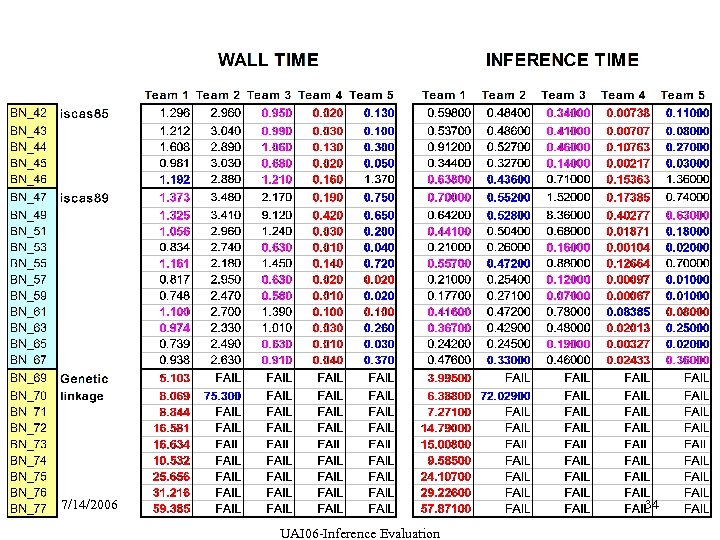
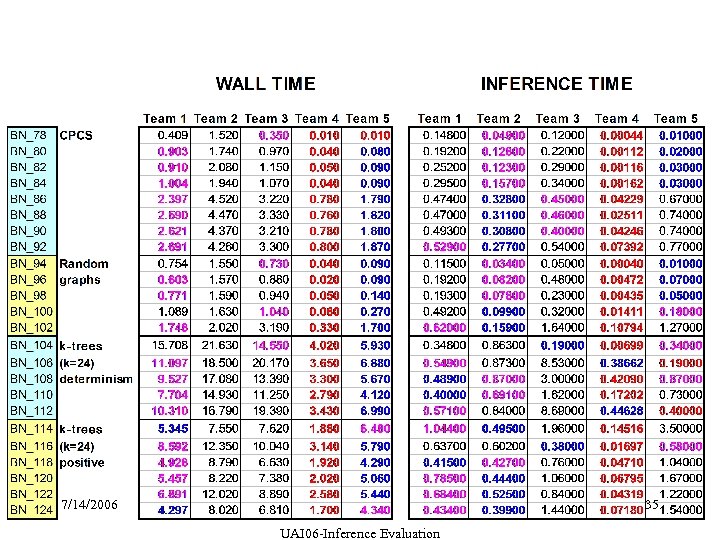
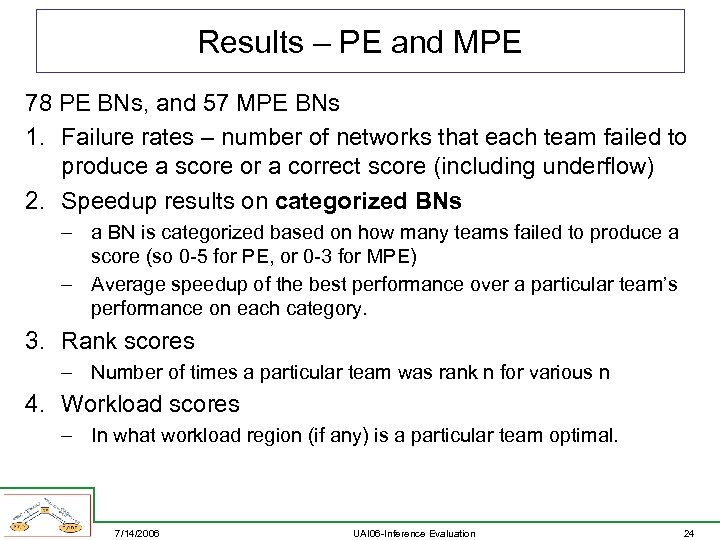 Results – PE and MPE 78 PE BNs, and 57 MPE BNs 1. Failure rates – number of networks that each team failed to produce a score or a correct score (including underflow) 2. Speedup results on categorized BNs – a BN is categorized based on how many teams failed to produce a score (so 0 -5 for PE, or 0 -3 for MPE) – Average speedup of the best performance over a particular team’s performance on each category. 3. Rank scores – Number of times a particular team was rank n for various n 4. Workload scores – In what workload region (if any) is a particular team optimal. 7/14/2006 UAI 06 -Inference Evaluation 24
 PE Results 7/14/2006 UAI 06 -Inference Evaluation 25
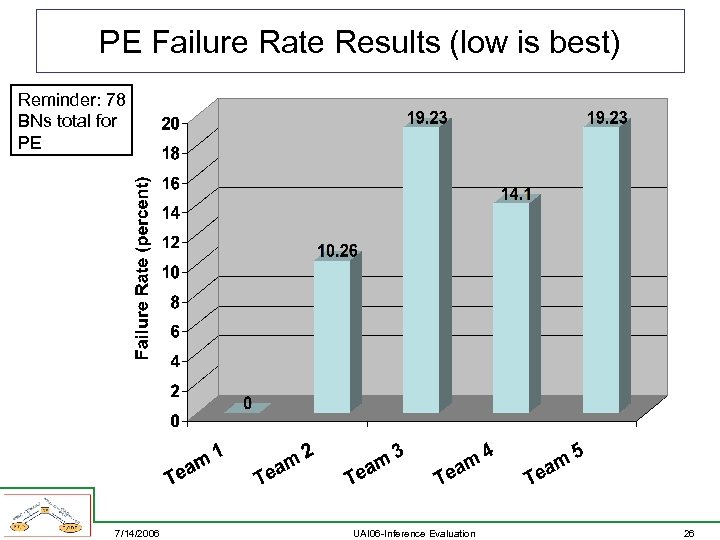 PE Failure Rate Results (low is best) Reminder: 78 BNs total for PE 7/14/2006 UAI 06 -Inference Evaluation 26
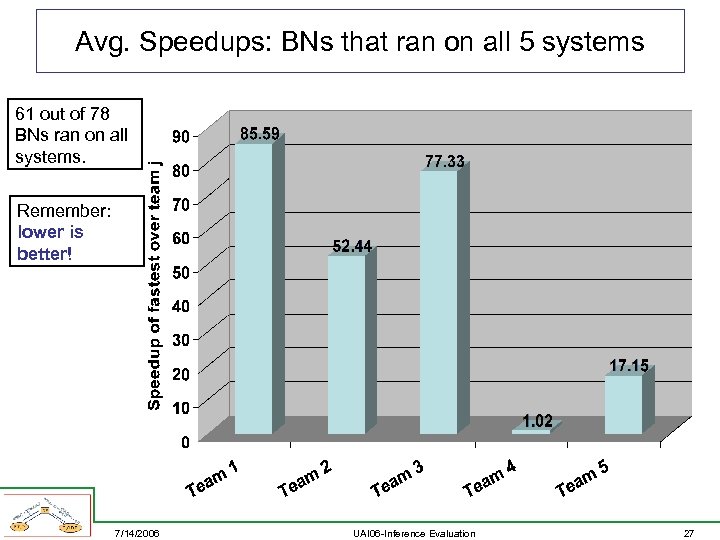 Avg. Speedups: BNs that ran on all 5 systems 61 out of 78 BNs ran on all systems. Remember: lower is better! 7/14/2006 UAI 06 -Inference Evaluation 27
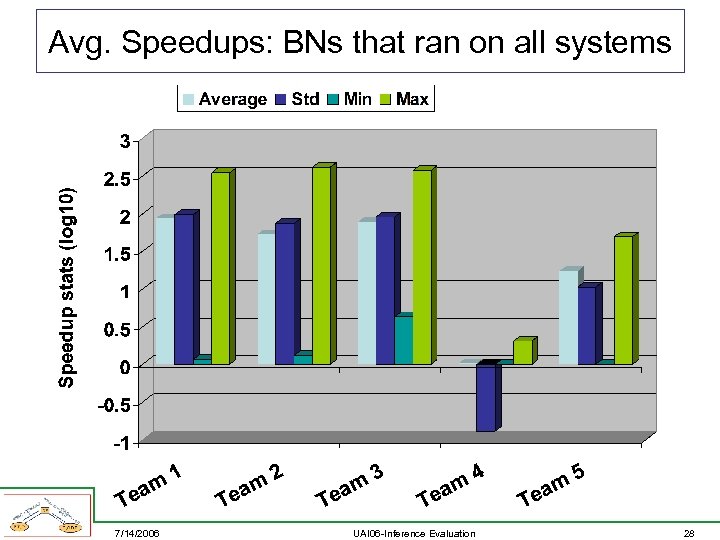 Avg. Speedups: BNs that ran on all systems 7/14/2006 UAI 06 -Inference Evaluation 28
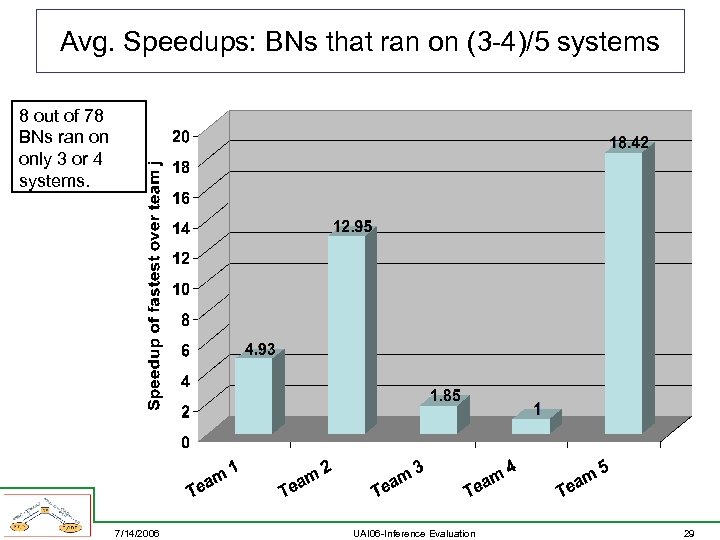 Avg. Speedups: BNs that ran on (3 -4)/5 systems 8 out of 78 BNs ran on only 3 or 4 systems. 7/14/2006 UAI 06 -Inference Evaluation 29
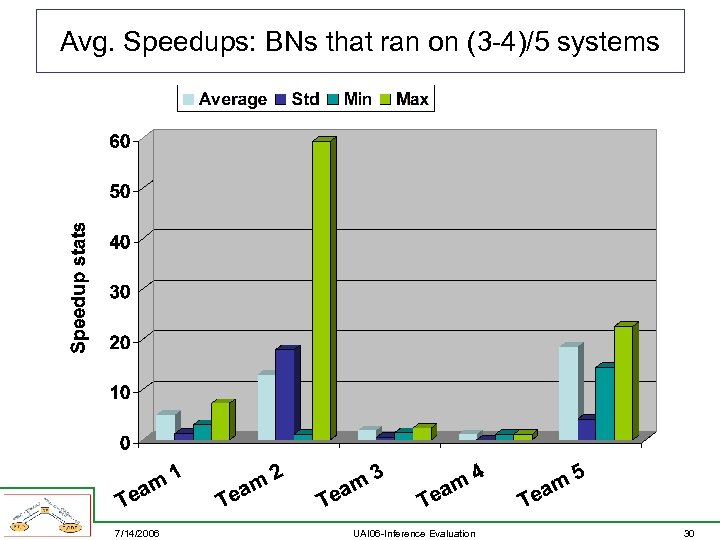 Avg. Speedups: BNs that ran on (3 -4)/5 systems 7/14/2006 UAI 06 -Inference Evaluation 30
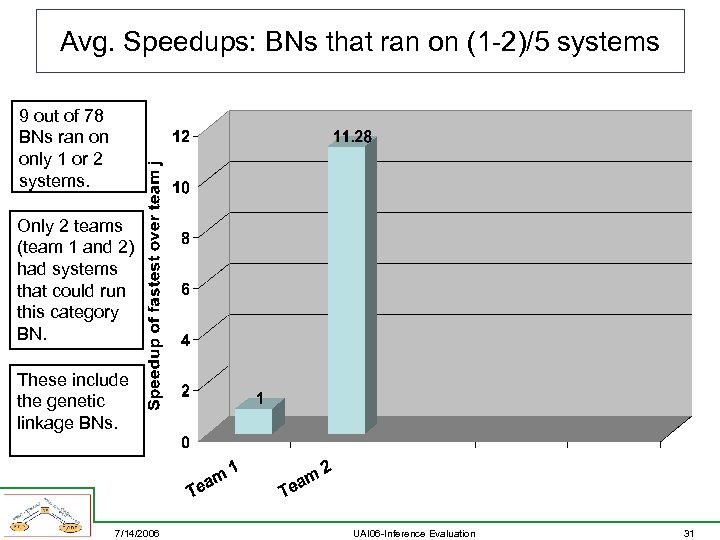 Avg. Speedups: BNs that ran on (1 -2)/5 systems 9 out of 78 BNs ran on only 1 or 2 systems. Only 2 teams (team 1 and 2) had systems that could run this category BN. These include the genetic linkage BNs. 7/14/2006 UAI 06 -Inference Evaluation 31
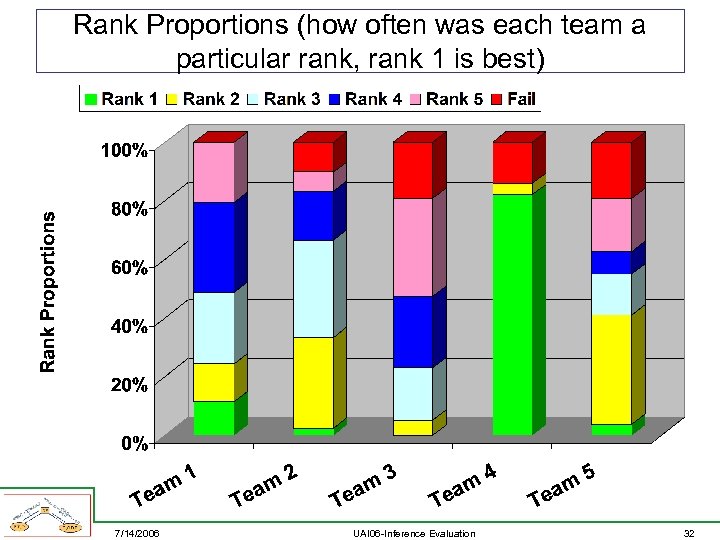 Rank Proportions (how often was each team a particular rank, rank 1 is best) 7/14/2006 UAI 06 -Inference Evaluation 32
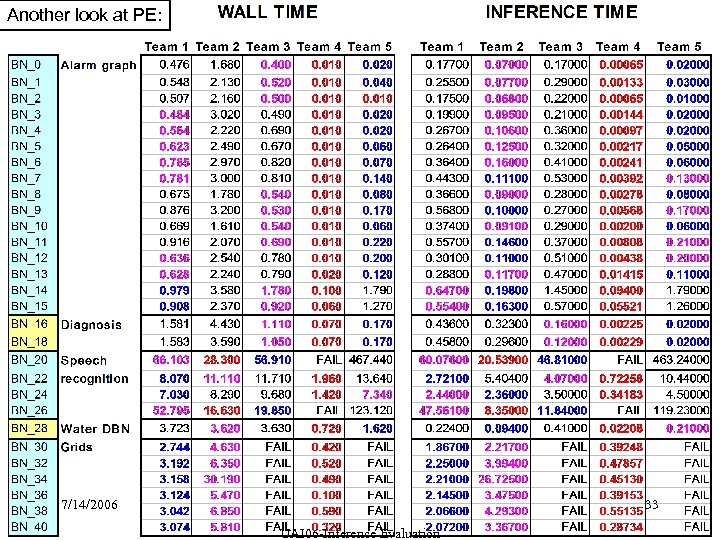 Another look at PE: 7/14/2006 33 UAI 06 -Inference Evaluation
 7/14/2006 34 UAI 06 -Inference Evaluation
 7/14/2006 35 UAI 06 -Inference Evaluation
 MPE Results • Only three teams participated: – Team 1 – Team 2 – Team 5 • 57 BNs, not the same ones, but some are variations of the same original BN. 7/14/2006 UAI 06 -Inference Evaluation 36
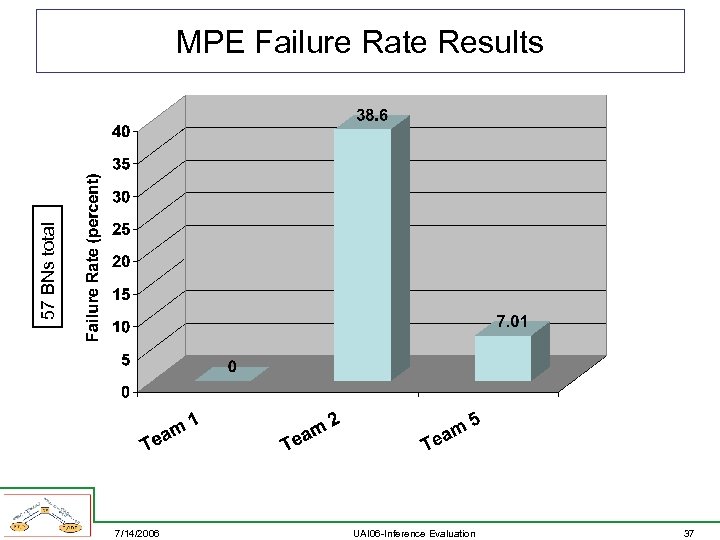 57 BNs total MPE Failure Rate Results 7/14/2006 UAI 06 -Inference Evaluation 37
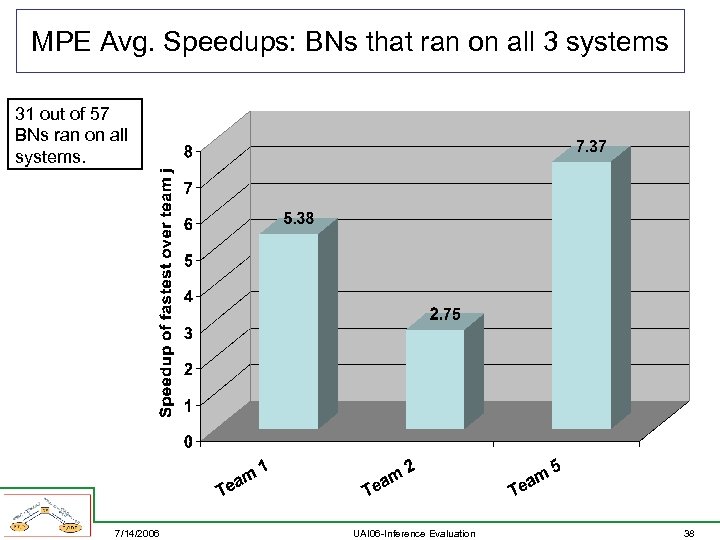 MPE Avg. Speedups: BNs that ran on all 3 systems 31 out of 57 BNs ran on all systems. 7/14/2006 UAI 06 -Inference Evaluation 38
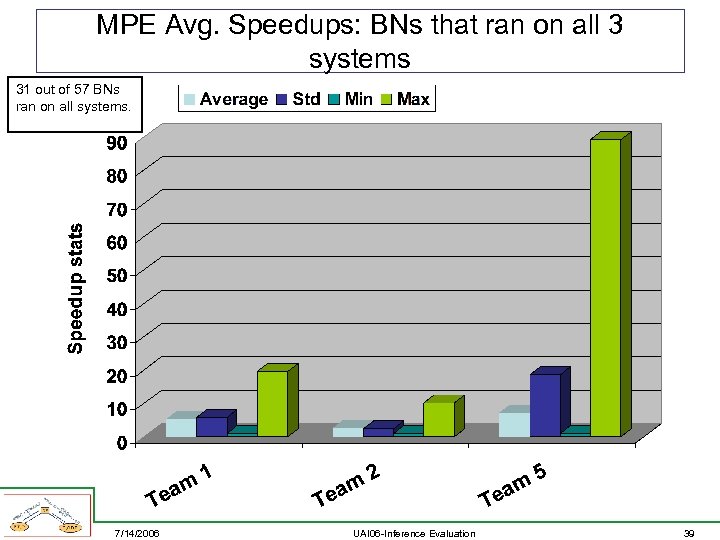 MPE Avg. Speedups: BNs that ran on all 3 systems 31 out of 57 BNs ran on all systems. 7/14/2006 UAI 06 -Inference Evaluation 39
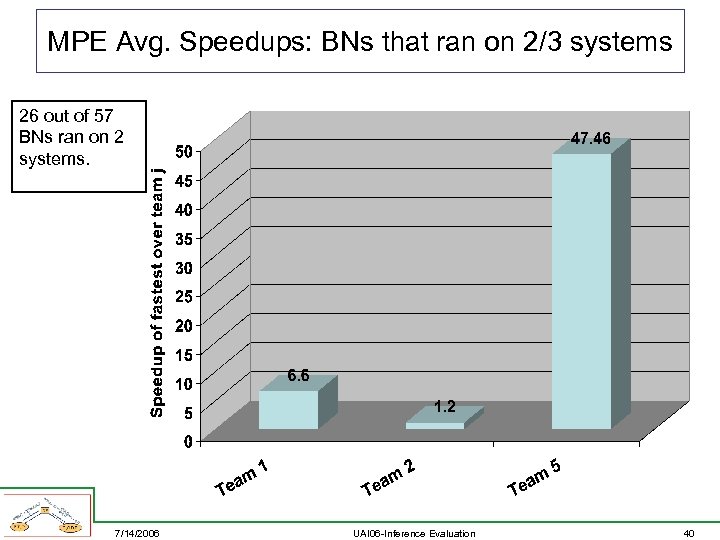 MPE Avg. Speedups: BNs that ran on 2/3 systems 26 out of 57 BNs ran on 2 systems. 7/14/2006 UAI 06 -Inference Evaluation 40
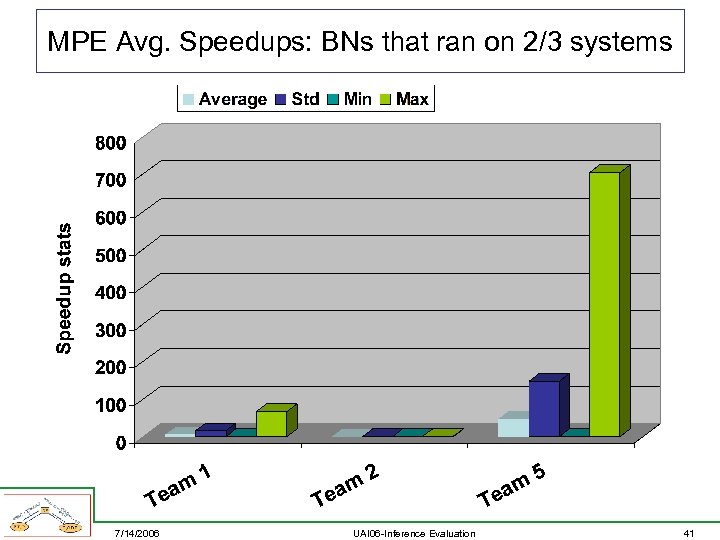 MPE Avg. Speedups: BNs that ran on 2/3 systems 7/14/2006 UAI 06 -Inference Evaluation 41
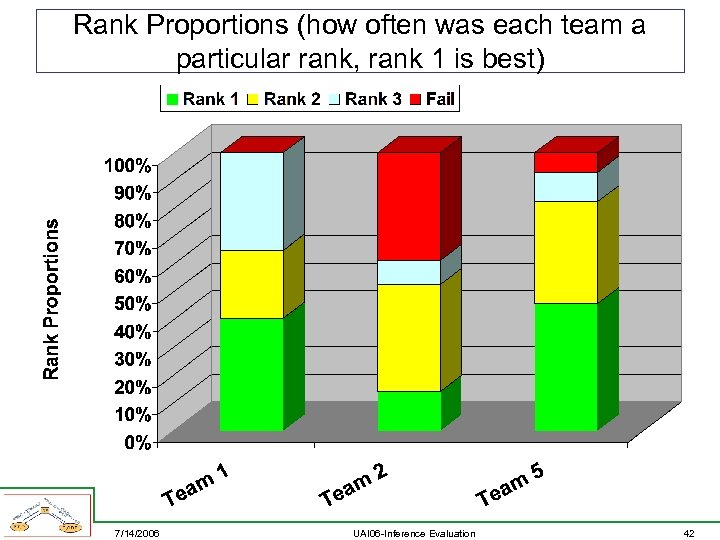 Rank Proportions (how often was each team a particular rank, rank 1 is best) 7/14/2006 UAI 06 -Inference Evaluation 42
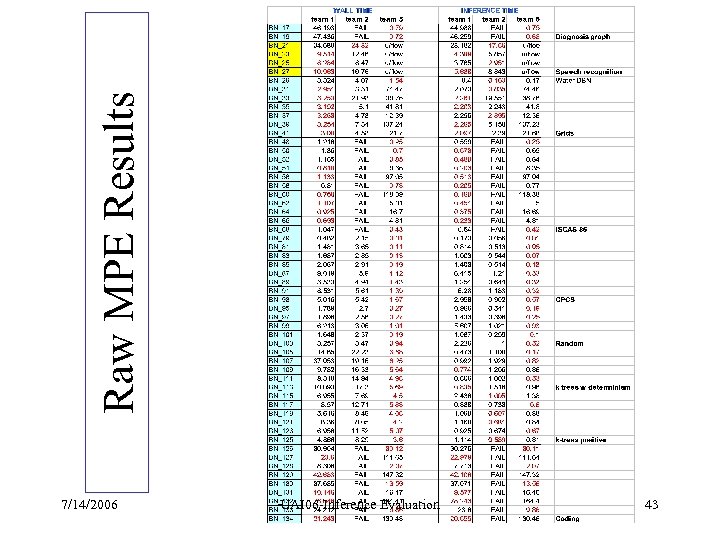 Raw MPE Results 7/14/2006 UAI 06 -Inference Evaluation 43
 PE and MPE Results 7/14/2006 UAI 06 -Inference Evaluation 44
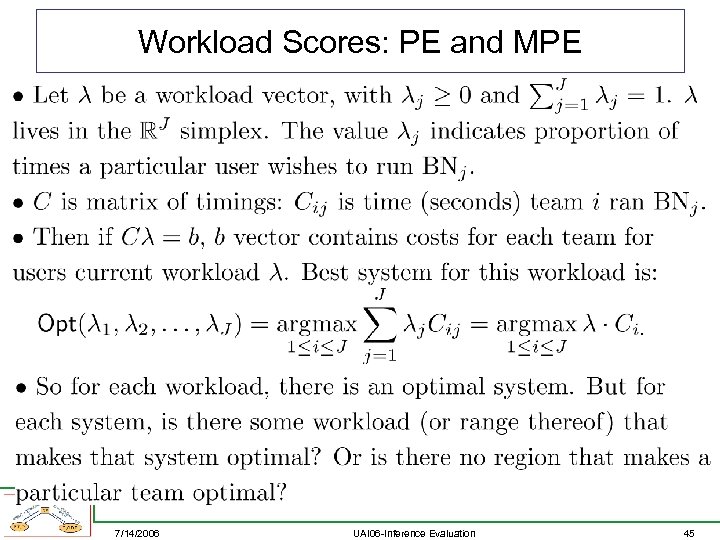 Workload Scores: PE and MPE 7/14/2006 UAI 06 -Inference Evaluation 45
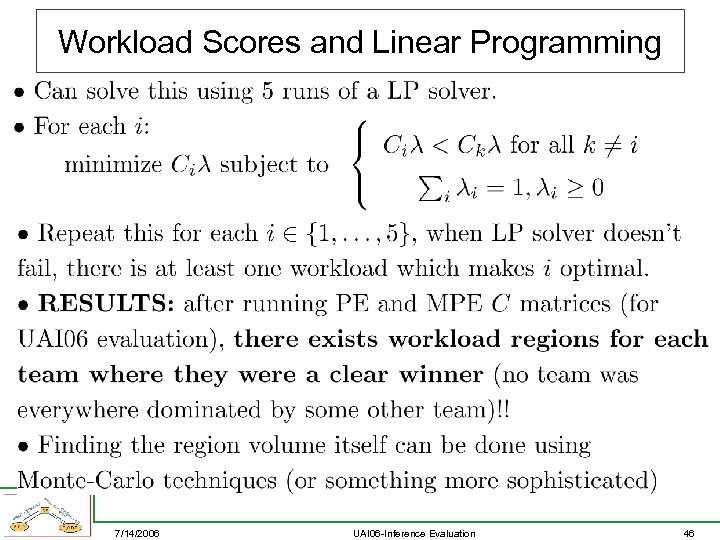 Workload Scores and Linear Programming 7/14/2006 UAI 06 -Inference Evaluation 46
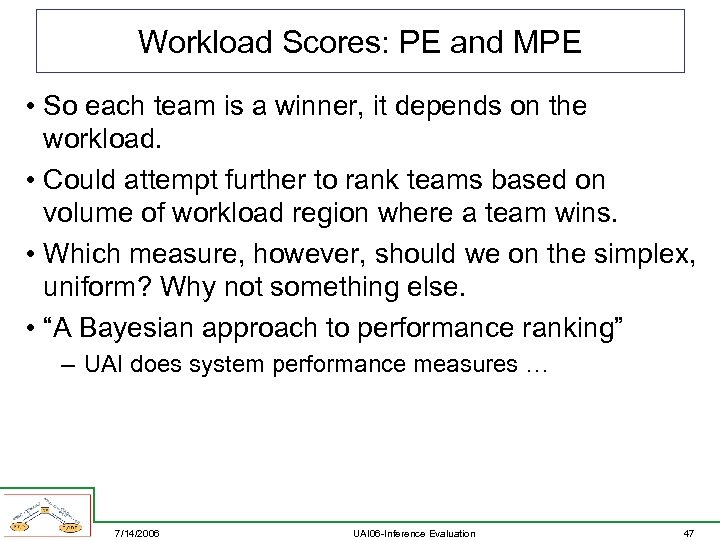 Workload Scores: PE and MPE • So each team is a winner, it depends on the workload. • Could attempt further to rank teams based on volume of workload region where a team wins. • Which measure, however, should we on the simplex, uniform? Why not something else. • “A Bayesian approach to performance ranking” – UAI does system performance measures … 7/14/2006 UAI 06 -Inference Evaluation 47
 Team technical descriptions • 5 minute for each team. • Current plan: more details to ultimately appear on the inference evaluation web site (see main UAI page). 7/14/2006 UAI 06 -Inference Evaluation 48
 Team 1: UCLA Technical Description • presented by Adnan Darwiche 7/14/2006 UAI 06 -Inference Evaluation 49
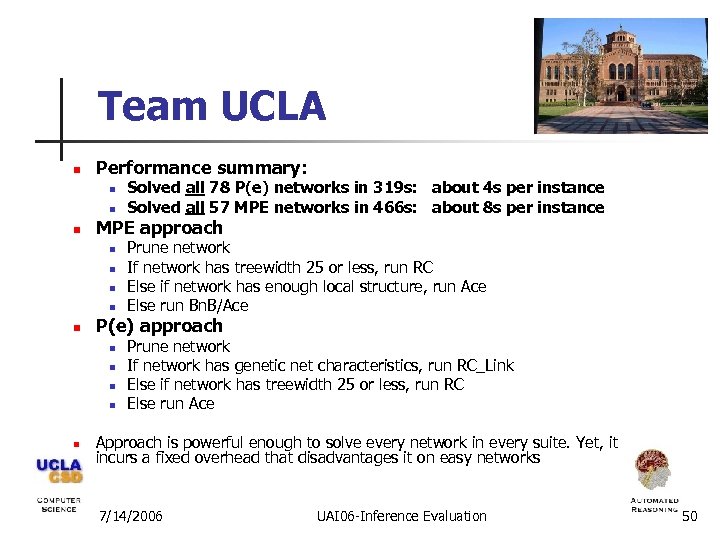 Team UCLA n Performance summary: n n n MPE approach n n n Prune network If network has treewidth 25 or less, run RC Else if network has enough local structure, run Ace Else run Bn. B/Ace P(e) approach n n n Solved all 78 P(e) networks in 319 s: about 4 s per instance Solved all 57 MPE networks in 466 s: about 8 s per instance Prune network If network has genetic net characteristics, run RC_Link Else if network has treewidth 25 or less, run RC Else run Ace Approach is powerful enough to solve every network in every suite. Yet, it incurs a fixed overhead that disadvantages it on easy networks 7/14/2006 UAI 06 -Inference Evaluation 50
 RC and RC Link n Recursive Conditioning n n n Conditioning/Search algorithm Based on decomposing the network Inference exponential in treewidth VE/Jointree could have been used for this! RC Link n n n RC with local structure exploitation Not necessarily exponential in treewith Download: http: //reasoning. cs. ucla. edu/rc_link 7/14/2006 UAI 06 -Inference Evaluation 51
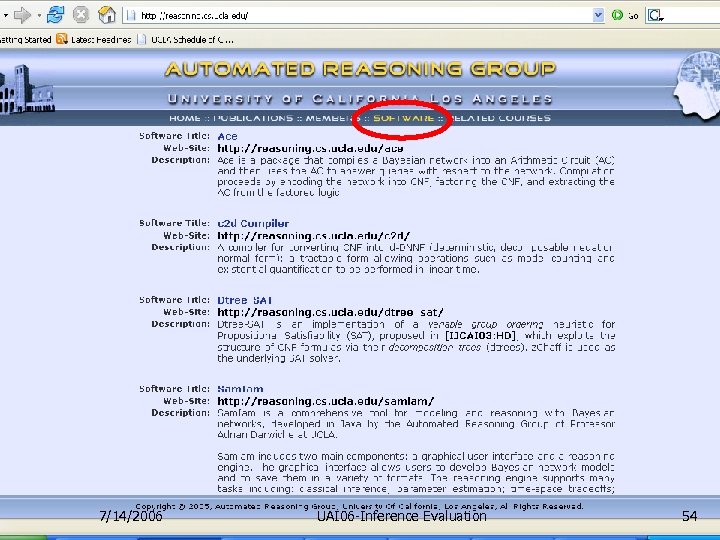
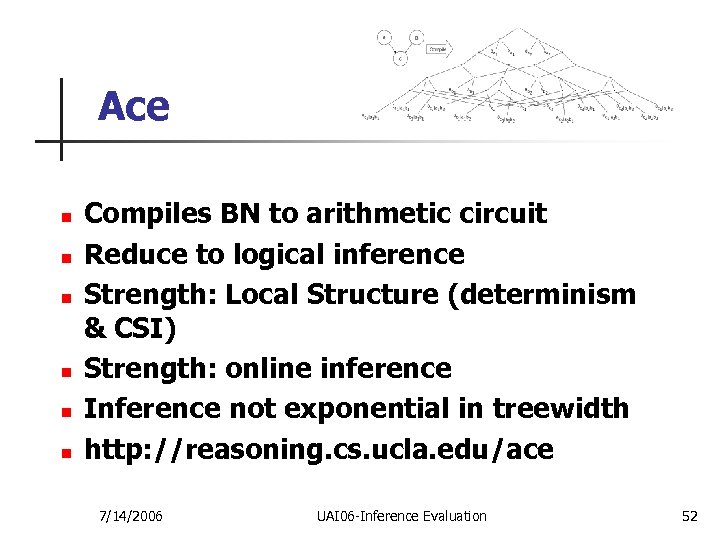 Ace n n n Compiles BN to arithmetic circuit Reduce to logical inference Strength: Local Structure (determinism & CSI) Strength: online inference Inference not exponential in treewidth http: //reasoning. cs. ucla. edu/ace 7/14/2006 UAI 06 -Inference Evaluation 52
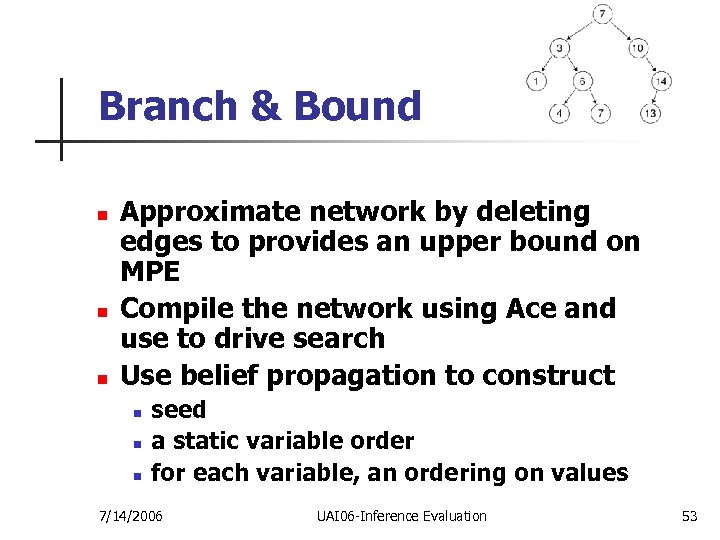 Branch & Bound n n n Approximate network by deleting edges to provides an upper bound on MPE Compile the network using Ace and use to drive search Use belief propagation to construct n n n seed a static variable order for each variable, an ordering on values 7/14/2006 UAI 06 -Inference Evaluation 53
 7/14/2006 UAI 06 -Inference Evaluation 54
 Team 2: IET Technical Description • presented by Masami Takikawa 7/14/2006 UAI 06 -Inference Evaluation 55
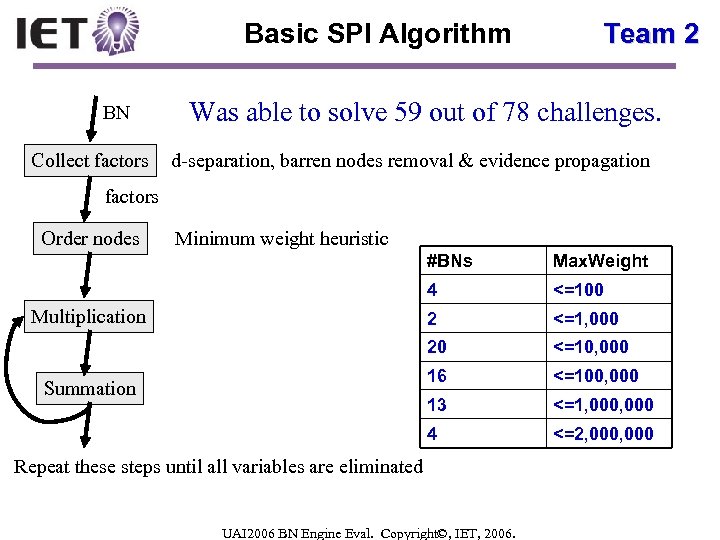 Basic SPI Algorithm BN Collect factors Team 2 Was able to solve 59 out of 78 challenges. d-separation, barren nodes removal & evidence propagation factors Order nodes Minimum weight heuristic #BNs 4 <=1, 000 20 <=10, 000 16 <=100, 000 13 <=1, 000 4 Summation <=100 2 Multiplication Max. Weight <=2, 000 Repeat these steps until all variables are eliminated UAI 2006 BN Engine Eval. Copyright©, IET, 2006.
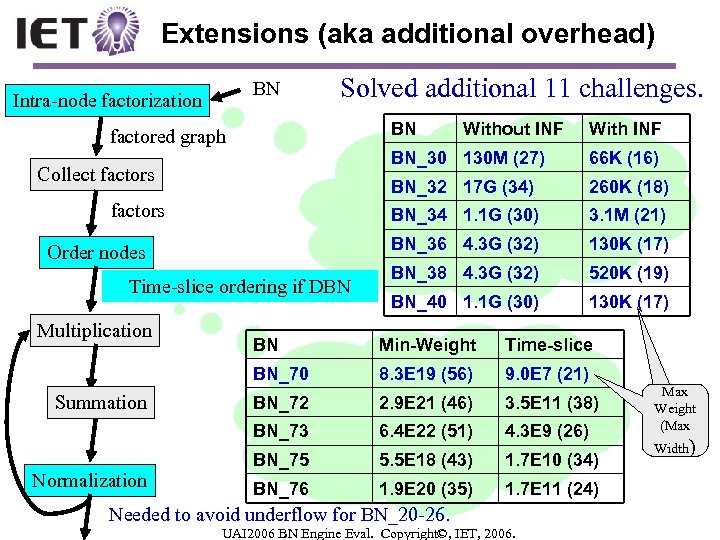 Extensions (aka additional overhead) BN Intra-node factorization Solved additional 11 challenges. BN factored graph With INF BN_30 130 M (27) Time-slice ordering if DBN 3. 1 M (21) BN_36 4. 3 G (32) Order nodes 260 K (18) BN_34 1. 1 G (30) factors 66 K (16) BN_32 17 G (34) Collect factors Multiplication Without INF 130 K (17) BN_38 4. 3 G (32) 520 K (19) BN_40 1. 1 G (30) 130 K (17) Time-slice 8. 3 E 19 (56) 9. 0 E 7 (21) BN_72 2. 9 E 21 (46) 3. 5 E 11 (38) BN_73 Normalization Min-Weight BN_70 Summation BN 6. 4 E 22 (51) 4. 3 E 9 (26) BN_75 5. 5 E 18 (43) 1. 7 E 10 (34) BN_76 1. 9 E 20 (35) 1. 7 E 11 (24) Needed to avoid underflow for BN_20 -26. UAI 2006 BN Engine Eval. Copyright©, IET, 2006. Max Weight (Max Width)
 Team 3: UBC Technical Description • presented by David Poole 7/14/2006 UAI 06 -Inference Evaluation 58
 Variable Elimination Code by David Poole and Jacek Kisyński • This is an implementation of variable elimination in Java 1. 5 (without threads). • We wanted to test how well our base VE system that we were using compared with other systems. • We use the min-fill heuristic for the elimination 7/14/2006 UAI 06 -Inference Evaluation 59
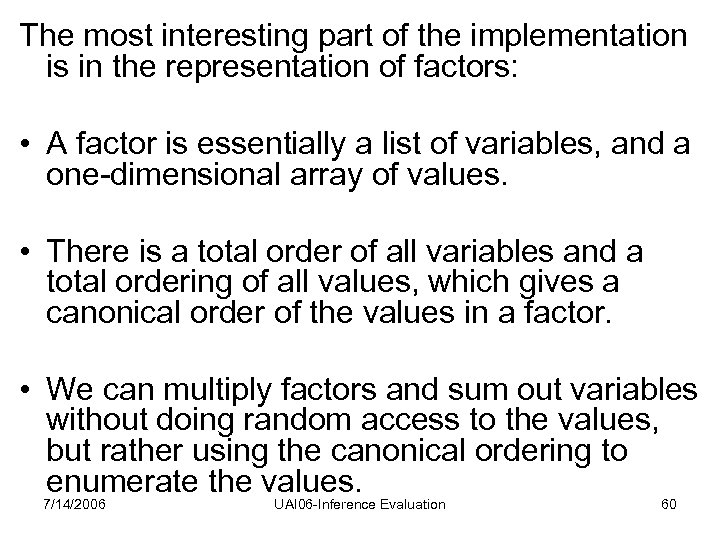 The most interesting part of the implementation is in the representation of factors: • A factor is essentially a list of variables, and a one-dimensional array of values. • There is a total order of all variables and a total ordering of all values, which gives a canonical order of the values in a factor. • We can multiply factors and sum out variables without doing random access to the values, but rather using the canonical ordering to enumerate the values. 7/14/2006 UAI 06 -Inference Evaluation 60
 • This code was written for David Poole and Nevin Lianwen Zhang, ``Exploiting contextual independence in probabilistic inference'', Journal of Artificial Intelligence Research, 18, 263 -313, 2003. http: //www. jair. org/papers/paper 1122. html • This is also the code that is used in the CIspace belief and decision network applet. A new version of the applet will be released in July. See: http: //www. cs. ubc. ca/labs/lci/CIspace/ • We plan to release the VE code as open source. 7/14/2006 UAI 06 -Inference Evaluation 61
 Team 4: U. Pitt/DSL Technical Description • presented by Jeff Bilmes (Marek Druzdzel was unable to attend). 7/14/2006 UAI 06 -Inference Evaluation 62
 Decision Systems Laboratory University of Pittsburgh dsl@sis. pitt. edu http: //dsl. sis. pitt. edu/ UAI Software Competition
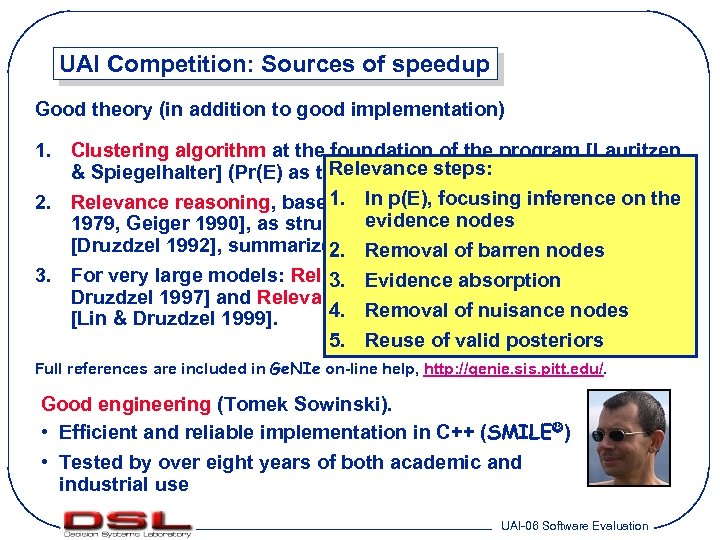 UAI Competition: Sources of speedup Good theory (in addition to good implementation) 1. Clustering algorithm at the foundation of the program [Lauritzen Relevance steps: & Spiegelhalter] (Pr(E) as the normalizing factor). 1. In p(E), focusing inference [Dawid 2. Relevance reasoning, based on conditional independenceon the evidence nodes 1979, Geiger 1990], as structured in [Suermondt 1992] and [Druzdzel 1992], summarized in. Removal of& Suermondt 1994]. 2. [Druzdzel barren nodes 3. For very large models: Relevance-based absorption 3. Evidence Decomposition [Lin & Druzdzel 1997] and Relevance-based Incremental Belief Updating 4. Removal of nuisance nodes [Lin & Druzdzel 1999]. 5. Reuse of valid posteriors Full references are included in Ge. NIe on-line help, http: //genie. sis. pitt. edu/. Good engineering (Tomek Sowinski). • Efficient and reliable implementation in C++ (SMILE ) • Tested by over eight years of both academic and industrial use UAI-06 Software Evaluation
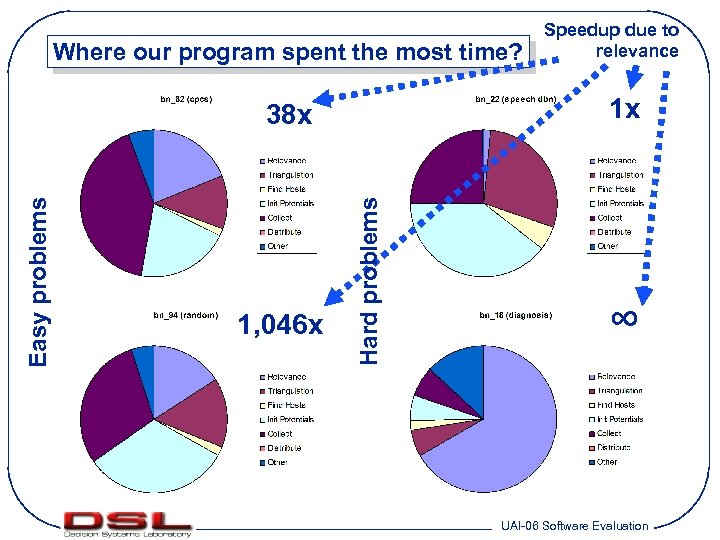 Where our program spent the most time? 1 x Hard problems Easy problems 38 x 1, 046 x Speedup due to relevance ∞ UAI-06 Software Evaluation
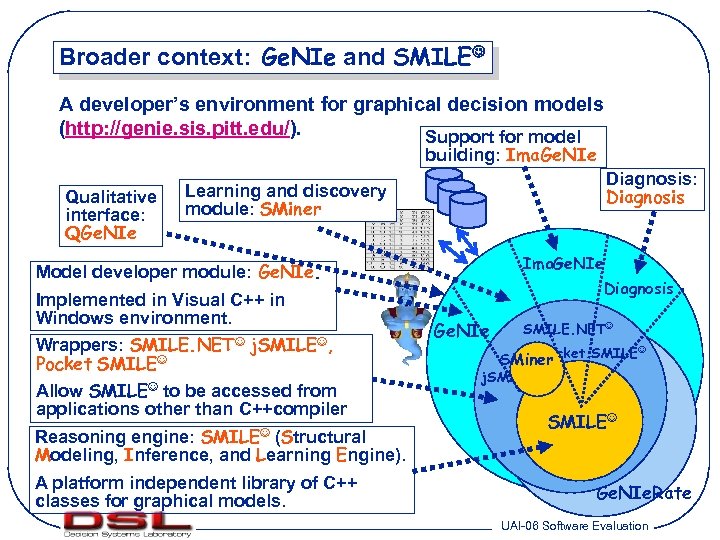 Broader context: Ge. NIe and SMILE A developer’s environment for graphical decision models (http: //genie. sis. pitt. edu/). Support for model building: Ima. Ge. NIe Qualitative interface: QGe. NIe Diagnosis: Diagnosis Learning and discovery module: SMiner Ima. Ge. NIe Model developer module: Ge. NIe. Implemented in Visual C++ in Windows environment. Wrappers: SMILE. NET j. SMILE , Pocket SMILE Allow SMILE to be accessed from applications other than C++compiler Reasoning engine: SMILE (Structural Modeling, Inference, and Learning Engine). A platform independent library of C++ classes for graphical models. Diagnosis Ge. NIe SMILE. NET Pocket SMILE SMiner j. SMILE Ge. NIe. Rate UAI-06 Software Evaluation
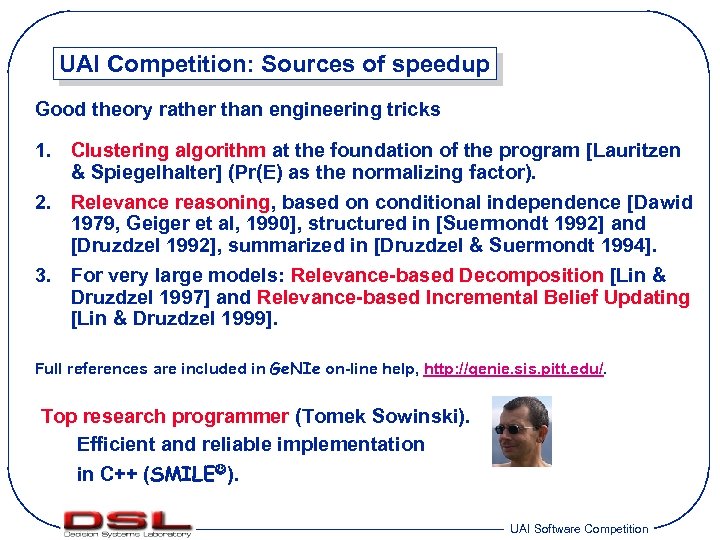 UAI Competition: Sources of speedup Good theory rather than engineering tricks 1. Clustering algorithm at the foundation of the program [Lauritzen & Spiegelhalter] (Pr(E) as the normalizing factor). 2. Relevance reasoning, based on conditional independence [Dawid 1979, Geiger et al, 1990], structured in [Suermondt 1992] and [Druzdzel 1992], summarized in [Druzdzel & Suermondt 1994]. 3. For very large models: Relevance-based Decomposition [Lin & Druzdzel 1997] and Relevance-based Incremental Belief Updating [Lin & Druzdzel 1999]. Full references are included in Ge. NIe on-line help, http: //genie. sis. pitt. edu/. Top research programmer (Tomek Sowinski). Efficient and reliable implementation in C++ (SMILE ). UAI Software Competition
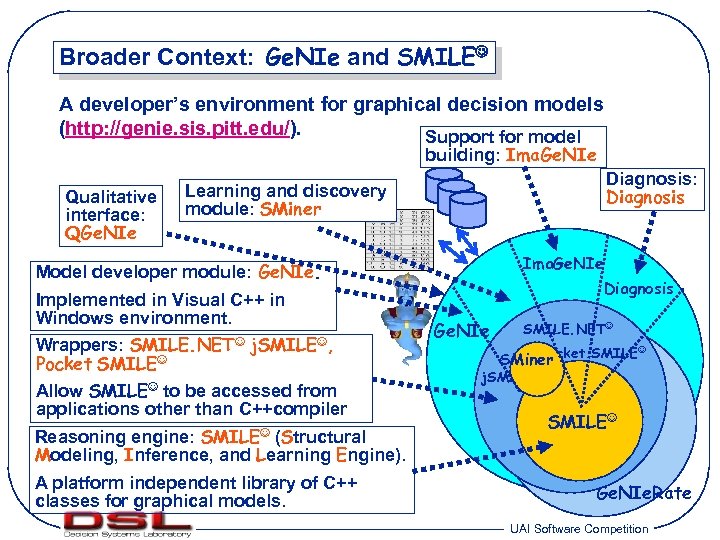 Broader Context: Ge. NIe and SMILE A developer’s environment for graphical decision models (http: //genie. sis. pitt. edu/). Support for model building: Ima. Ge. NIe Qualitative interface: QGe. NIe Diagnosis: Diagnosis Learning and discovery module: SMiner Ima. Ge. NIe Model developer module: Ge. NIe. Implemented in Visual C++ in Windows environment. Wrappers: SMILE. NET j. SMILE , Pocket SMILE Allow SMILE to be accessed from applications other than C++compiler Reasoning engine: SMILE (Structural Modeling, Inference, and Learning Engine). A platform independent library of C++ classes for graphical models. Diagnosis Ge. NIe SMILE. NET Pocket SMILE SMiner j. SMILE Ge. NIe. Rate UAI Software Competition
 Team 5: UCI Technical Description • presented by Rina Dechter 7/14/2006 UAI 06 -Inference Evaluation 69
![PE & MPE – AND/OR Search [] A A B [A] B C [AB]](https://present5.com/presentation/9dae68e1dd022bf070853fbc6e141cff/image-70.jpg "PE & MPE – AND/OR Search [] A A B [A] B C [AB]") PE & MPE – AND/OR Search [] A A B [A] B C [AB] E E [AB] C D [BC] D Bayesian network Pseudo tree A A 0 1 B B 0 E 0 1 1 C E 0 1 D 0 1 0 C E 0 1 D D 0 1 0 1 E C 0 1 1 C 0 E 1 0 C 0 1 E 0 1 1 C 0 1 0 E 1 0 1 D D D 0 1 0 1 0 1 D 0 1 C 0 1 AND/OR search tree Context minimal graph 7/14/2006 70 UAI 06 -Inference Evaluation
PE & MPE – AND/OR Search [] A A B [A] B C [AB] E E [AB] C D [BC] D Bayesian network Pseudo tree A A 0 1 B B 0 E 0 1 1 C E 0 1 D 0 1 0 C E 0 1 D D 0 1 0 1 E C 0 1 1 C 0 E 1 0 C 0 1 E 0 1 1 C 0 1 0 E 1 0 1 D D D 0 1 0 1 0 1 D 0 1 C 0 1 AND/OR search tree Context minimal graph 7/14/2006 70 UAI 06 -Inference Evaluation
![Adaptive caching X 1 XK-i+1 XK XK X X ] i-cache for X is](https://present5.com/presentation/9dae68e1dd022bf070853fbc6e141cff/image-71.jpg "Adaptive caching X 1 XK-i+1 XK XK X X ] i-cache for X is") Adaptive caching X 1 XK-i+1 XK XK X X ] i-cache for X is purged for every new instantiation of Xk-i context(X) = [X 1 X 2… Xk-i+1… Xk] i-context(X) = [Xk-i+1…Xk] i-bound < k in conditioned subproblem 7/14/2006 71 UAI 06 -Inference Evaluation
Adaptive caching X 1 XK-i+1 XK XK X X ] i-cache for X is purged for every new instantiation of Xk-i context(X) = [X 1 X 2… Xk-i+1… Xk] i-context(X) = [Xk-i+1…Xk] i-bound < k in conditioned subproblem 7/14/2006 71 UAI 06 -Inference Evaluation
 PE solver - implementation • C++ implementation • Caching based on context (table caching) – Adaptive caching when contexts are too large • Switch to variable elimination for small and nondeterministic problems • Constraint propagation • No good learning – just caching no goods • Dynamic range support (for very small probabilities) 7/14/2006 72 UAI 06 -Inference Evaluation
 MPE solver - AOMB(i, j) Node value v(n): most probable explanation of the subproblem rooted by n Caching: identical sub-problems rooted at AND nodes (identified by their contexts) are solved once and the results cached j-bound (context size) controls the memory used for caching Heuristics: pruning is based on heuristics estimates which are pre-computed by bounded inference (i. e. minibucket approximation) i-bound (mini-bucket size) controls the accuracy of the heuristic No constraint propagation 7/14/2006 73 UAI 06 -Inference Evaluation
 AOMB(i, j) – Mini-Bucket Heuristics • Each node n has a static heuristic estimate h(n) of v(n) – h(n) is an upper bound on the value v(n) – h(h) is computed based on the augmented bucket structure generated by the mini-bucket approximation MBE(i) • For every node n in the AND/OR search graph: – lb(n) – current best solution cost rooted at n – ub(n) – upper bound on the most probable explanation at n – Prune the search space below current node t if ub(m) < lb(m), where m is an ancestor of t along the current path from the root • During search, merge nodes based on context (caching); maintain cache tables of size O(exp(j)), where j is a bound on the size of the 7/14/2006 context. UAI 06 -Inference Evaluation 74
 AOMB(i, j) – Implementation • C++ implementation • B&B procedure is recursive – Could be a bit faster if we simulate the stack • Cache tables implemented as hash tables • No ASM code or other optimizations • Static variable ordering determined by the min-fill ordering (minimizes the context size) • Choosing (i, j) parameters: – i-bound: choose i such that the augmented bucket structure generated by MBE(i) fits 2 GB of RAM (i < 22) – j-bound: j = i + 0. 75*i (j < 30) • No Constraint propagation 7/14/2006 75 UAI 06 -Inference Evaluation
 References • 1. Rina Dechter and Robert Mateescu. AND/OR Search Spaces for Grahpical Models. In Artificial Intelligence, 2006. To appear. • 2. Rina Dechter and Robert Mateescu. Mixtures of Deterministic-Probabilistic Networks and their AND/OR Search Space. In proceedings of UAI-04, Banff, Canada. • 3. Robert Mateescu and Rina Dechter. AND/OR Cutset Conditioning. In proceedings of IJCAI-05, Edinburgh, Scotland. • 4. Radu Marinescu and Rina Dechter. Memory Intensive Branch-and-Bound Search for Graphical Models. In proceedings of AAAI-06, Boston, USA. • 5. Radu Marinescu and Rina Dechter. AND/OR Branch-and-Bound for Graphical Models“. In proceedings of IJCAI-05, Edinburgh, Scotland 7/14/2006 76 UAI 06 -Inference Evaluation
 Conclusions 7/14/2006 UAI 06 -Inference Evaluation 77
 Conclusions and Discussion • Most teams said they had fun and it was a learning experience – people also became somewhat competitive • Teams that used C++ (teams 4 -5) arguably had faster times than those who used Java (teams 1 -3). • Use harder BNs and or harder queries next year – hard to find real-world BNs that are easily available but that are hard. If you have a BN that is hard, please make it available for next year. – Regardless of who runs it next year, please send candidate networks directly to me for now