


 Скачать презентацию U S SPACESUIT KNOWLEDGE CAPTURE SESSIONS — Apollo
878e2c014e06b438d2212a89a58e045c.ppt
- Количество слайдов: 51
 U. S. SPACESUIT KNOWLEDGE CAPTURE SESSIONS - “Apollo A-7 L Spacesuit Development for Apollo 7 Through 14 Missions” Previous Spacesuit Sessions - “Spacesuit Development and Qualification for Project Mercury, ” November 2012 - “Spacesuit Development and Qualification for Project Gemini, ” December 2012 - “Apollo Block I Spacesuit Development and Apollo Block II Spacesuit Competition, ” January 2013 James W. Mc. Barron II January 21, 2015 Retired NASA JSC jmcbarron 1
 AGENDA • EARLY APOLLO SPACESUIT DEVELOPMENT - Initial EMU contract - Contract Change for Apollo Block II Spacesuit - A-5 L PGA and A-6 L Spacesuit CEI’s contracts development • APOLLO BLOCK II SPACESUIT REQUIREMENTS - Delivery Lunar Landing Mission Environmental Design Interface APOLLO 1 ACCIDENT IMPACT APOLLO BLOCK II SPACESUIT CEI’S REDESIGN jmcbarron 2
 EARLY APOLLO EMU SPACESUIT DEVELOPMENT 1962 -1965 • Initial Apollo Extravehicular Mobility Unit (EMU) contract - NASA competitive procurement. - Hamilton Standard (HS) selected as prime EMU contractor. International Latex Corp. (ILC) selected as spacesuit subcontractor. ILC selection based on NASA proposal evaluation results. HS and ILC were not on same proposal teams. • Joint HS and ILC spacesuit development effort results found unsatisfactory by NASA - Multiple spacesuit prototypes technical performance issues. - Unresolved management issues between HS and ILC. - Resulted in serious NASA Management concerns regarding HS/ILC. capability to meet Apollo Program schedule requirements. jmcbarron 3
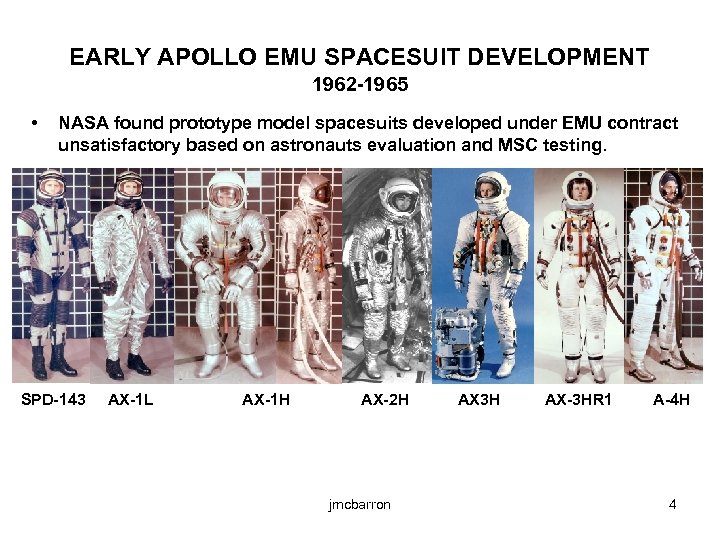 EARLY APOLLO EMU SPACESUIT DEVELOPMENT 1962 -1965 • NASA found prototype model spacesuits developed under EMU contract unsatisfactory based on astronauts evaluation and MSC testing. SPD-143 AX-1 L AX-1 H AX-2 H jmcbarron AX 3 H AX-3 HR 1 A-4 H 4
 APOLLO SPACESUIT SELECTION JUNE 1965 NASA MSC ESTABLISHED AN IN-HOUSE COMPETITIVE TEST PROGRAM TO SELECT A SPACESUIT CONFIGURATION FOR CONTINUED CONTRACTOR DEVELOPMENT. • Test program included evaluation of suit design, function, operation, and man/suit interfaces. • Test conditions controlled to present identical test situations for each contractors submitted prototype spacesuit configuration. Test procedures structured to maximize objectivity. • Evaluation rational emphasized mission requirements. Sixty-five separate test and evaluation situations conducted and scored. • Test details and results reported previously in “Apollo Block I Spacesuit Development and Apollo Block II Spacesuit Competition” knowledge capture briefing conducted in January 2013. jmcbarron 5
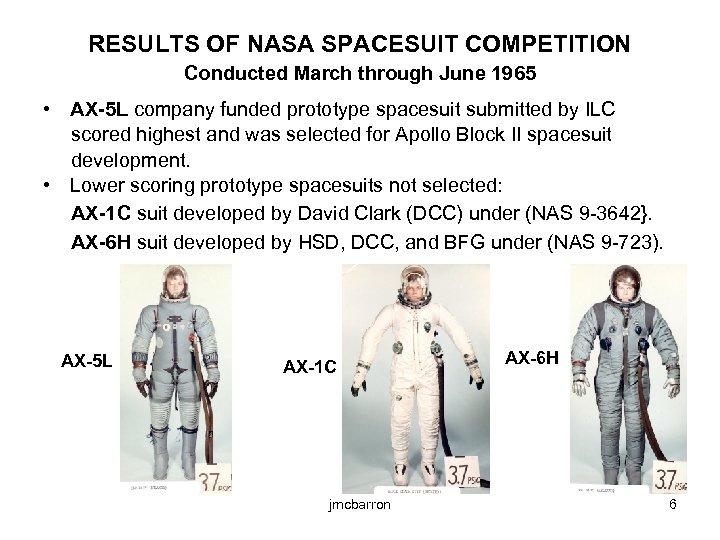 RESULTS OF NASA SPACESUIT COMPETITION Conducted March through June 1965 • AX-5 L company funded prototype spacesuit submitted by ILC scored highest and was selected for Apollo Block II spacesuit development. • Lower scoring prototype spacesuits not selected: AX-1 C suit developed by David Clark (DCC) under (NAS 9 -3642}. AX-6 H suit developed by HSD, DCC, and BFG under (NAS 9 -723). AX-5 L AX-1 C jmcbarron AX-6 H 6
 APOLLO EMU PROGRAM CHANGE September 1965 • Robert R. Gilruth provided details for continued development of Apollo EMU to Dr. George B. Mueller, NASA Hdqrs: - Recommended three changes not consistent with the previous EMU procurement plan approved by NASA Hdqrs: 1. Amend existing HSD EMU contract to provide for development, qualification, and fabrication of only PLSS and associated equipment. for the Apollo Block II program. 2. Award a new separate contract to ILC for development, fabrication, test and delivery of Apollo Block II flight spacesuits and associated equipment. 3. Assign NASA MSC Crew Systems Division responsibility for Apollo Block II EMU Program implementation: - Management - Systems integration - Spacesuit qualification jmcbarron 7
 APOLLO BLOCK II EMU PROGRAM SEPTEMBER 1965 • Basis for decision and recommendation: - Results of the MSC comparative suit evaluation. - Reassessment of capabilities of ILC. - Previous lack of success of HSD in effecting an adequate total system development effort. - Recognize HSD competence in their portable life support systems (PLSS) work. • NASA announced it would negotiate with ILC for a contract to develop and provide Apollo Block II spacesuits. jmcbarron 8
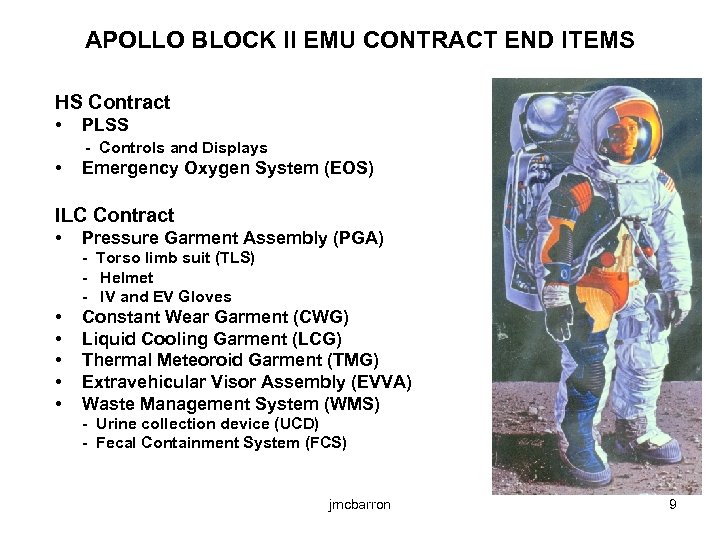 APOLLO BLOCK II EMU CONTRACT END ITEMS HS Contract • PLSS - Controls and Displays • Emergency Oxygen System (EOS) ILC Contract • Pressure Garment Assembly (PGA) - Torso limb suit (TLS) - Helmet - IV and EV Gloves • • • Constant Wear Garment (CWG) Liquid Cooling Garment (LCG) Thermal Meteoroid Garment (TMG) Extravehicular Visor Assembly (EVVA) Waste Management System (WMS) - Urine collection device (UCD) - Fecal Containment System (FCS) jmcbarron 9
 APOLLO BLOCK II ILC SPACESUIT PROGRAM TWO CONTRACTS IMPLEMENTED WITH ILC • NAS-9 -5332: A-5 L engineering model PGA’s incorporating identified configuration changes necessary to support immediate Apollo Program needs for suits. - Letter Cost plus Fixed Fee contract. • NAS-9 -6100: A-6 L spacesuit Contract End Item's development and production of qualification, training, and flight units. - Implement Apollo Program Configuration Management, Quality Assurance, and Reliability requirements. - Provide field support and spares. - Incentive award fee contract based on Schedule, Cost, and Technical Performance. jmcbarron 10
 A-5 L PGA ENGINEERING MODEL DEVELOPMENT 1965 -1966 NAS 9 -5332 CONTRACT CONTENT • Incorporated modifications to the AX-5 L prototype competition suit to establish A-5 L PGA’s design. (See Appendix A) • 10 A-5 L PGA’s were built and delivered to support immediate Apollo Block II Program requirements: - Command Module (CM) mockup interface testing at NAA. - Lunar Module (LM) mockup interface testing at GAEC. - CEI’s development support and design verification testing at ILC - PLSS/OPS development support at HS. - Pressure seal closure reliability testing by U. S. Army Natick Labs. - Astronaut simulators development support at NASA MSC. - Development testing and interfaces verification at MSC CSD. • A-5 L PGA’s were fabricated under Class III engineering control to support immediate Apollo Program interfaces definition and test requirements. jmcbarron 11
 A-6 L FLIGHT SPACESUIT DEVELOPMENT June 1966 to March 1970 NAS 9 -6100 CONTRACT CONTENT • Training and Flight CEI’s development, production, and certification. - Implement Configuration, Quality Assurance, and Reliability controls for production and certification testing. - Incorporate A-5 L PGA modifications to establish A-6 L training and flight CEI’s design configuration. (See Appendix B) • Contract included: - CEI’s manufacture, delivery, and design verification and qualification endurance cycle testing at ILC. - Spare parts, repair materials, and Familiarization and Illustrated parts manuals. - ILC Field support personnel located at NASA MSC and KSC, NAA, GAEC, and HS. jmcbarron 12
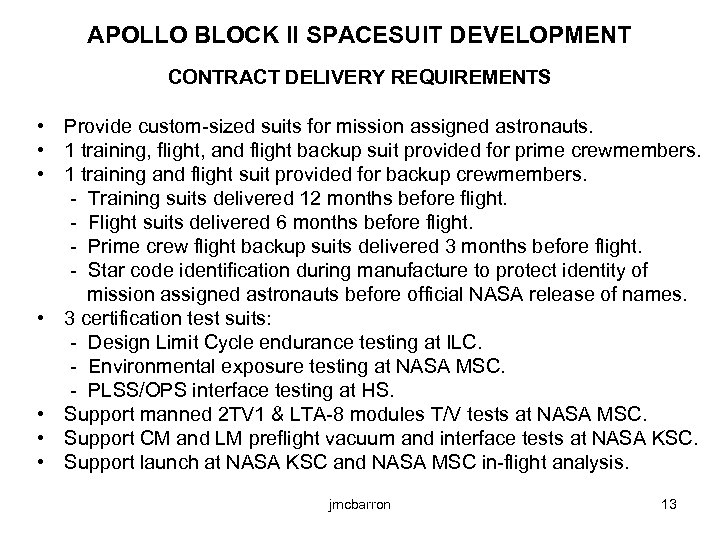 APOLLO BLOCK II SPACESUIT DEVELOPMENT CONTRACT DELIVERY REQUIREMENTS • Provide custom-sized suits for mission assigned astronauts. • 1 training, flight, and flight backup suit provided for prime crewmembers. • 1 training and flight suit provided for backup crewmembers. - Training suits delivered 12 months before flight. - Flight suits delivered 6 months before flight. - Prime crew flight backup suits delivered 3 months before flight. - Star code identification during manufacture to protect identity of mission assigned astronauts before official NASA release of names. • 3 certification test suits: - Design Limit Cycle endurance testing at ILC. - Environmental exposure testing at NASA MSC. - PLSS/OPS interface testing at HS. • Support manned 2 TV 1 & LTA-8 modules T/V tests at NASA MSC. • Support CM and LM preflight vacuum and interface tests at NASA KSC. • Support launch at NASA KSC and NASA MSC in-flight analysis. jmcbarron 13
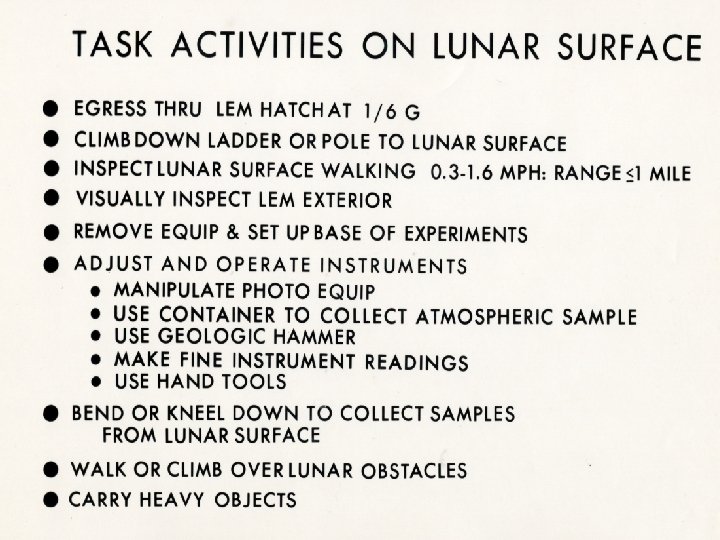
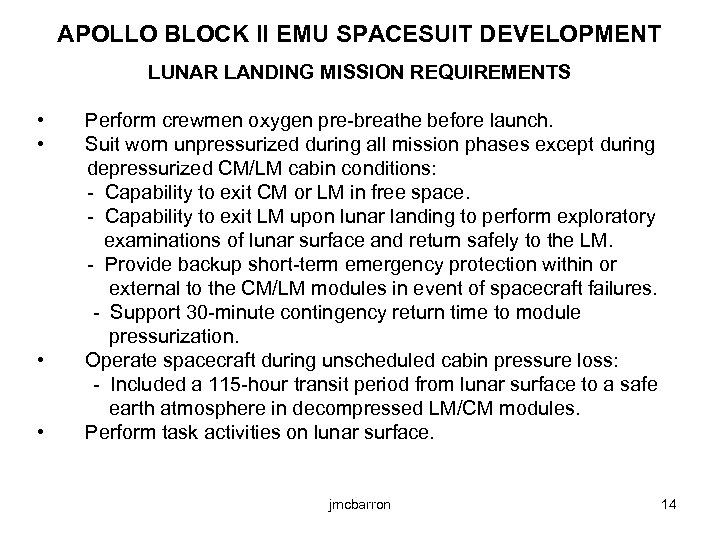 APOLLO BLOCK II EMU SPACESUIT DEVELOPMENT LUNAR LANDING MISSION REQUIREMENTS • • Perform crewmen oxygen pre-breathe before launch. Suit worn unpressurized during all mission phases except during depressurized CM/LM cabin conditions: - Capability to exit CM or LM in free space. - Capability to exit LM upon lunar landing to perform exploratory examinations of lunar surface and return safely to the LM. - Provide backup short-term emergency protection within or external to the CM/LM modules in event of spacecraft failures. - Support 30 -minute contingency return time to module pressurization. Operate spacecraft during unscheduled cabin pressure loss: - Included a 115 -hour transit period from lunar surface to a safe earth atmosphere in decompressed LM/CM modules. Perform task activities on lunar surface. jmcbarron 14
 jmcbarron 15
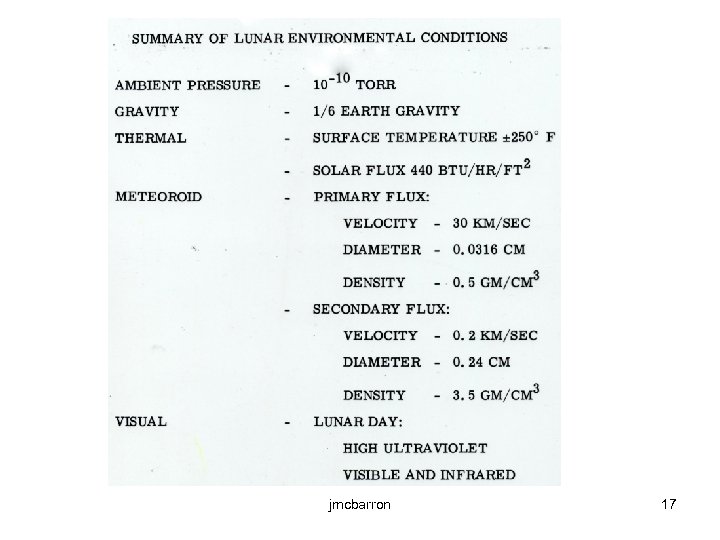
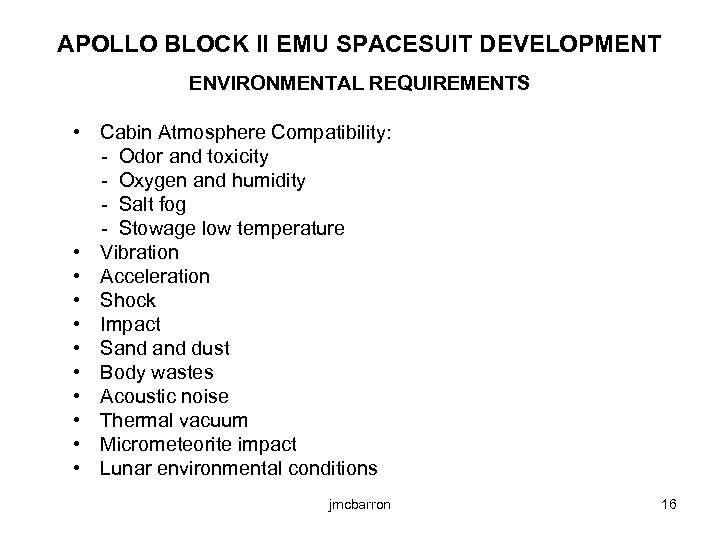 APOLLO BLOCK II EMU SPACESUIT DEVELOPMENT ENVIRONMENTAL REQUIREMENTS • Cabin Atmosphere Compatibility: - Odor and toxicity - Oxygen and humidity - Salt fog - Stowage low temperature • Vibration • Acceleration • Shock • Impact • Sand dust • Body wastes • Acoustic noise • Thermal vacuum • Micrometeorite impact • Lunar environmental conditions jmcbarron 16
 jmcbarron 17
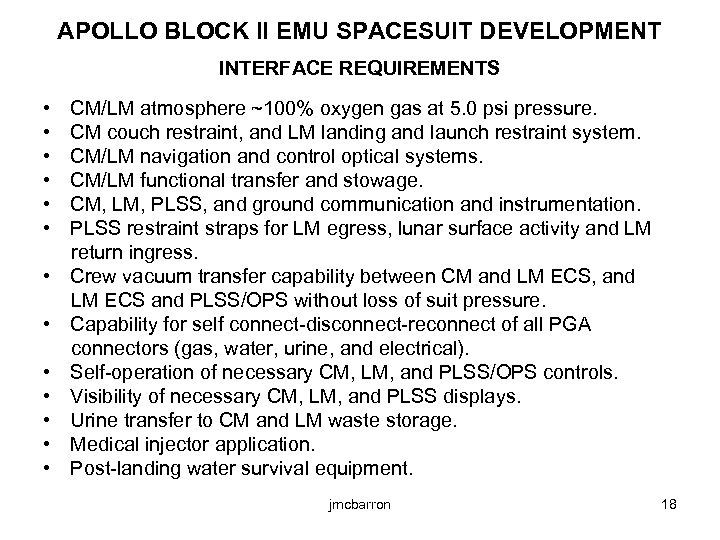 APOLLO BLOCK II EMU SPACESUIT DEVELOPMENT INTERFACE REQUIREMENTS • • • • CM/LM atmosphere ~100% oxygen gas at 5. 0 psi pressure. CM couch restraint, and LM landing and launch restraint system. CM/LM navigation and control optical systems. CM/LM functional transfer and stowage. CM, LM, PLSS, and ground communication and instrumentation. PLSS restraint straps for LM egress, lunar surface activity and LM return ingress. Crew vacuum transfer capability between CM and LM ECS, and LM ECS and PLSS/OPS without loss of suit pressure. Capability for self connect-disconnect-reconnect of all PGA connectors (gas, water, urine, and electrical). Self-operation of necessary CM, LM, and PLSS/OPS controls. Visibility of necessary CM, LM, and PLSS displays. Urine transfer to CM and LM waste storage. Medical injector application. Post-landing water survival equipment. jmcbarron 18
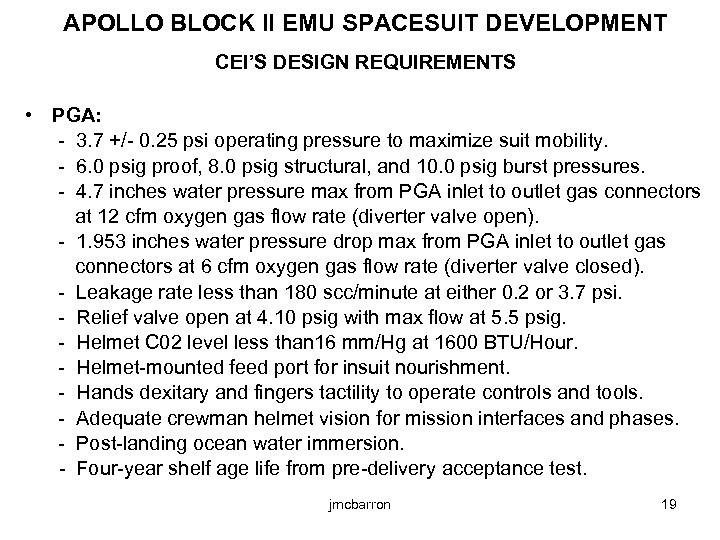 APOLLO BLOCK II EMU SPACESUIT DEVELOPMENT CEI’S DESIGN REQUIREMENTS • PGA: - 3. 7 +/- 0. 25 psi operating pressure to maximize suit mobility. - 6. 0 psig proof, 8. 0 psig structural, and 10. 0 psig burst pressures. - 4. 7 inches water pressure max from PGA inlet to outlet gas connectors at 12 cfm oxygen gas flow rate (diverter valve open). - 1. 953 inches water pressure drop max from PGA inlet to outlet gas connectors at 6 cfm oxygen gas flow rate (diverter valve closed). - Leakage rate less than 180 scc/minute at either 0. 2 or 3. 7 psi. - Relief valve open at 4. 10 psig with max flow at 5. 5 psig. - Helmet C 02 level less than 16 mm/Hg at 1600 BTU/Hour. - Helmet-mounted feed port for insuit nourishment. - Hands dexitary and fingers tactility to operate controls and tools. - Adequate crewman helmet vision for mission interfaces and phases. - Post-landing ocean water immersion. - Four-year shelf age life from pre-delivery acceptance test. jmcbarron 19
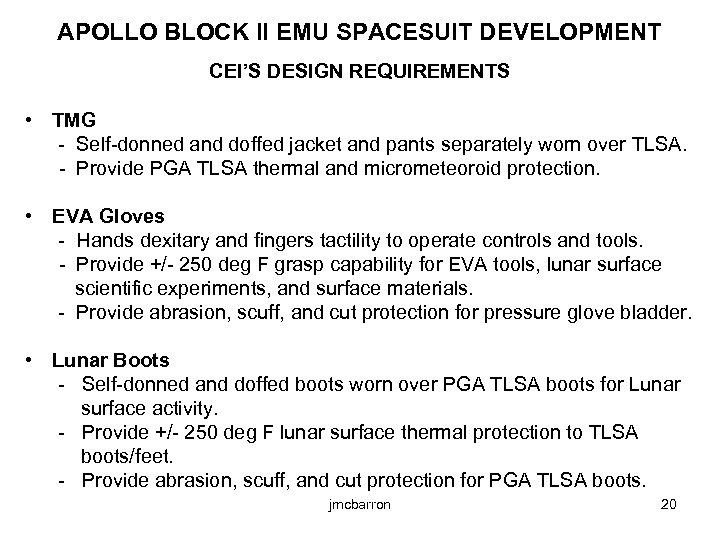 APOLLO BLOCK II EMU SPACESUIT DEVELOPMENT CEI’S DESIGN REQUIREMENTS • TMG - Self-donned and doffed jacket and pants separately worn over TLSA. - Provide PGA TLSA thermal and micrometeoroid protection. • EVA Gloves - Hands dexitary and fingers tactility to operate controls and tools. - Provide +/- 250 deg F grasp capability for EVA tools, lunar surface scientific experiments, and surface materials. - Provide abrasion, scuff, and cut protection for pressure glove bladder. • Lunar Boots - Self-donned and doffed boots worn over PGA TLSA boots for Lunar surface activity. - Provide +/- 250 deg F lunar surface thermal protection to TLSA boots/feet. - Provide abrasion, scuff, and cut protection for PGA TLSA boots. jmcbarron 20
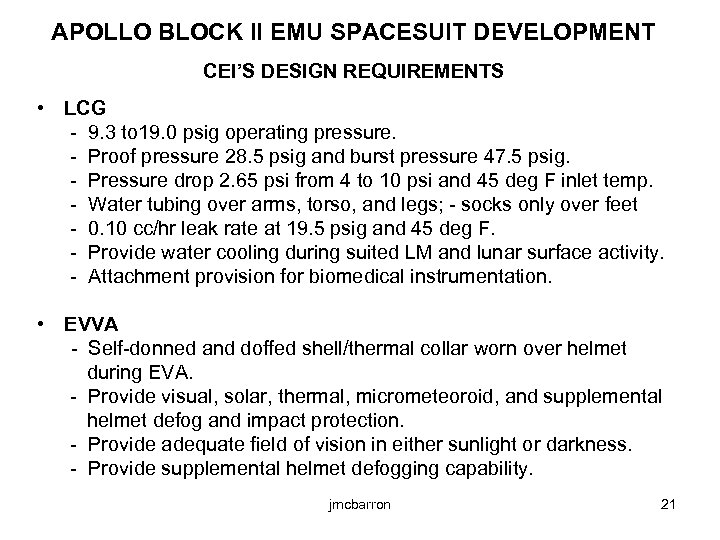 APOLLO BLOCK II EMU SPACESUIT DEVELOPMENT CEI’S DESIGN REQUIREMENTS • LCG - 9. 3 to 19. 0 psig operating pressure. - Proof pressure 28. 5 psig and burst pressure 47. 5 psig. - Pressure drop 2. 65 psi from 4 to 10 psi and 45 deg F inlet temp. - Water tubing over arms, torso, and legs; - socks only over feet - 0. 10 cc/hr leak rate at 19. 5 psig and 45 deg F. - Provide water cooling during suited LM and lunar surface activity. - Attachment provision for biomedical instrumentation. • EVVA - Self-donned and doffed shell/thermal collar worn over helmet during EVA. - Provide visual, solar, thermal, micrometeoroid, and supplemental helmet defog and impact protection. - Provide adequate field of vision in either sunlight or darkness. - Provide supplemental helmet defogging capability. jmcbarron 21
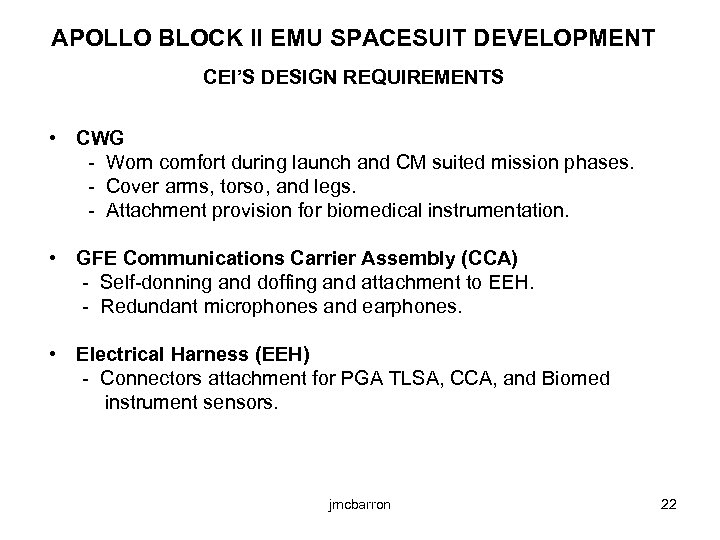 APOLLO BLOCK II EMU SPACESUIT DEVELOPMENT CEI’S DESIGN REQUIREMENTS • CWG - Worn comfort during launch and CM suited mission phases. - Cover arms, torso, and legs. - Attachment provision for biomedical instrumentation. • GFE Communications Carrier Assembly (CCA) - Self-donning and doffing and attachment to EEH. - Redundant microphones and earphones. • Electrical Harness (EEH) - Connectors attachment for PGA TLSA, CCA, and Biomed instrument sensors. jmcbarron 22
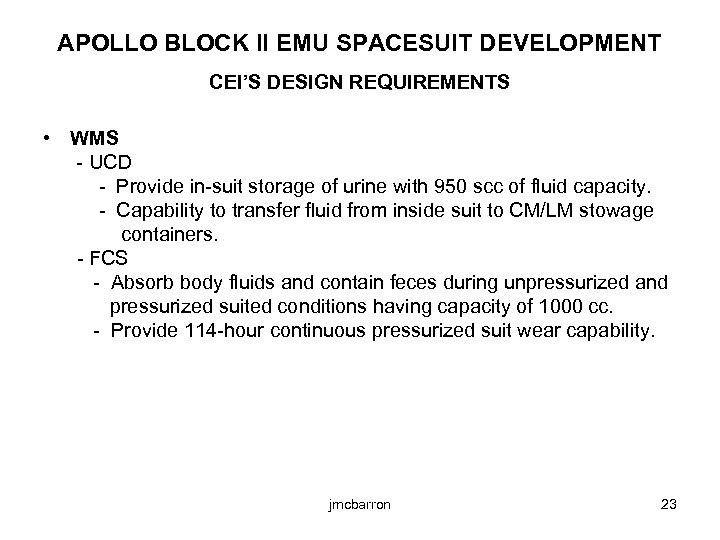 APOLLO BLOCK II EMU SPACESUIT DEVELOPMENT CEI’S DESIGN REQUIREMENTS • WMS - UCD - Provide in-suit storage of urine with 950 scc of fluid capacity. - Capability to transfer fluid from inside suit to CM/LM stowage containers. - FCS - Absorb body fluids and contain feces during unpressurized and pressurized suited conditions having capacity of 1000 cc. - Provide 114 -hour continuous pressurized suit wear capability. jmcbarron 23
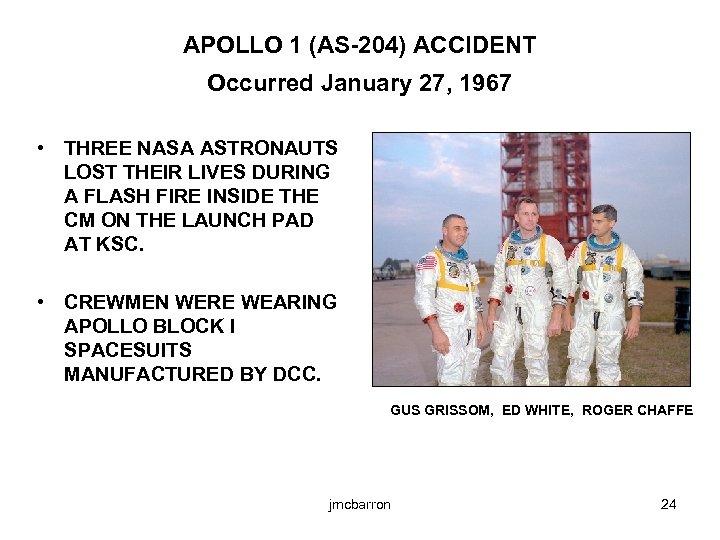 APOLLO 1 (AS-204) ACCIDENT Occurred January 27, 1967 • THREE NASA ASTRONAUTS LOST THEIR LIVES DURING A FLASH FIRE INSIDE THE CM ON THE LAUNCH PAD AT KSC. • CREWMEN WERE WEARING APOLLO BLOCK I SPACESUITS MANUFACTURED BY DCC. GUS GRISSOM, ED WHITE, ROGER CHAFFE jmcbarron 24
 APOLLO PROGRAM MANAGEMENT RESPONSE • • • Immediately cease all oxygen enriched atmosphere operations and testing. No manned testing conducted in an oxygen enriched atmosphere by contractors. All manned testing in an oxygen-enriched atmosphere will be performed at NASA facilities – only after successful completion of an Operational Readiness Inspection (ORI). Identify and eliminate all ignition sources in enriched oxygen atmospheres. Remove all flammable materials from oxygen enriched atmospheres. Exception only when no suitable material replacement is available. - Materials use exceptions documented by Material Use Agreement (MUA) approved by the Apollo Program Change Board. jmcbarron 25
 APOLLO A-6 L CEI’S STATUS February 1967 • CDR’S COMPLETED 1966 - Parts and Material Lists submitted and reviewed. Type 1 CEI’s design drawings approved. Interface control documents identified and reviewed. DVT completed with results and problems reports reviewed. • FACI COMPLETED FEBRUARY 1967 - Documents and Specifications approved. - CEI’s hardware design configuration approved. - Manned demonstration of PGA, TMG, LCG, and FCS. jmcbarron 26
 APOLLO A-6 L CEI’S STATUS February 1967 • PRODUCTION, DELIVERY, AND CERTIFICATION OF A-6 L SUIT CEI’S IN WORK - Certification suits CEI’s delivered. - Manned certification endurance cycle testing underway at ILC. - Manned testing at vacuum being conducted at MSC. - Unmanned environments exposure testing underway at MSC. - Training suit CEI’s in production. jmcbarron 27
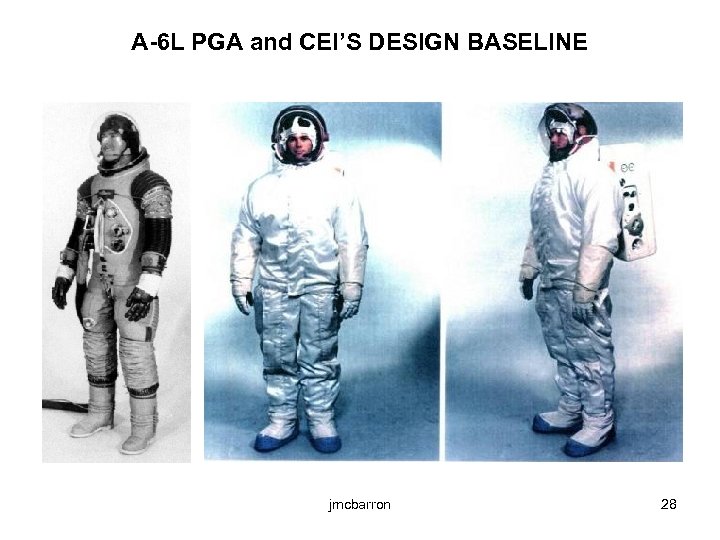 A-6 L PGA and CEI’S DESIGN BASELINE jmcbarron 28
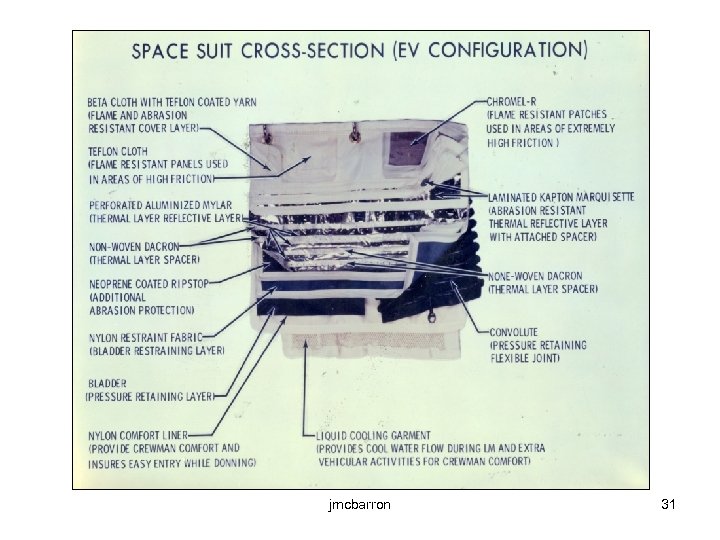
 APOLLO 1 ACCIDENT APOLLO BLOCK II CEI’S DESIGN IMPACTS A-6 L PGA REDESIGN • Torso Limb suit assembly (TLSA) - Former separately donned and doffed TMG jacket and pants integrated over TLSA arms, torso, legs, and boots. - Non-flammable TMG cover-layer materials cross-section incorporated. - Boot soles changed to non-flammable Fluorel material. - Interior TLSA materials approved by MUA. - Rational: No suitable replacement materials. • Helmet - Polyurethane impact vent pad covered with beta cloth material. - Exterior polycarbonate material approved by MUA. - Rational: No suitable replacement for polycarbonate material. • IV and EV Gloves - Integrated cover-layer changed to non-flammable materials cross-section. - Thermal insulation added with Chromyl-R material over EV Glove fingers and palm for abrasion and cut protection. jmcbarron 29
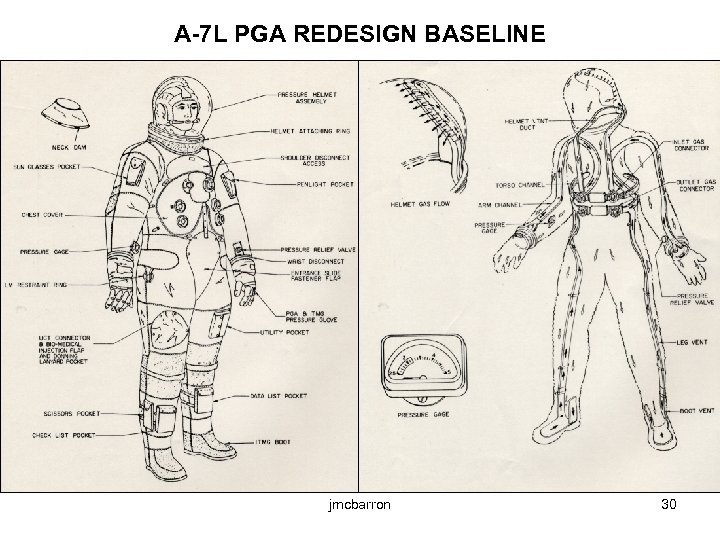 A-7 L PGA REDESIGN BASELINE jmcbarron 30
 jmcbarron 31
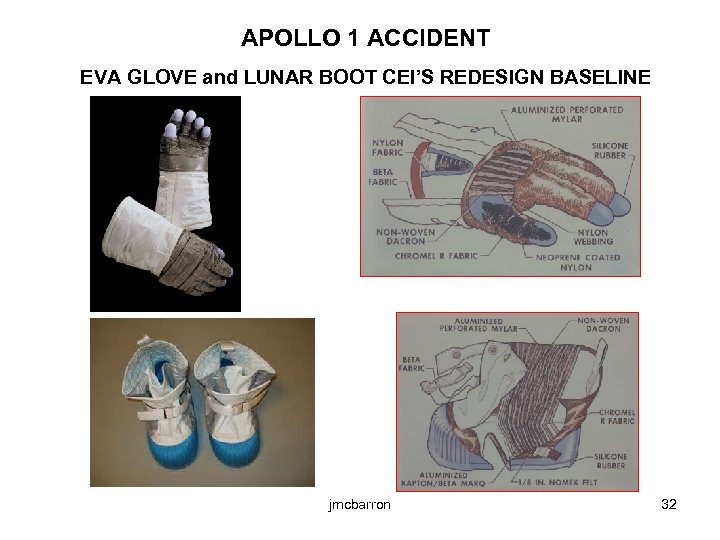 APOLLO 1 ACCIDENT EVA GLOVE and LUNAR BOOT CEI’S REDESIGN BASELINE jmcbarron 32
 APOLLO 1 ACCIDENT SPACESUIT CEI’S REDESIGN • EVVA - Exterior red polycarbonate shell and visors materials approved by MUA. - Rational: No suitable materials replacement for polycarbonate material. Stowed in non-flammable container when not worn. • GFE CCA and EEH - Current limited into PGA atmosphere to eliminate ignition source. Covering changed to non-flammable Teflon material. Earphones, microphones, and wiring approved by MUA. Rational: No suitable replacement for wiring material and ear phones and microphones. Stowed in non-flammable container when not worn. jmcbarron 33
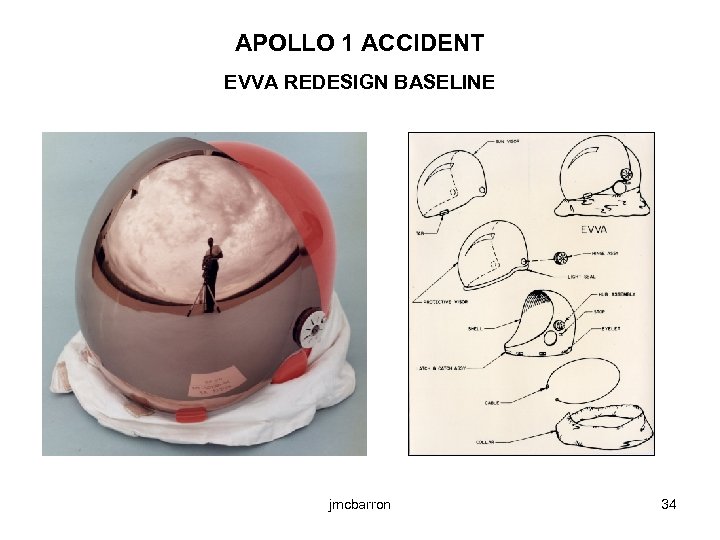 APOLLO 1 ACCIDENT EVVA REDESIGN BASELINE jmcbarron 34
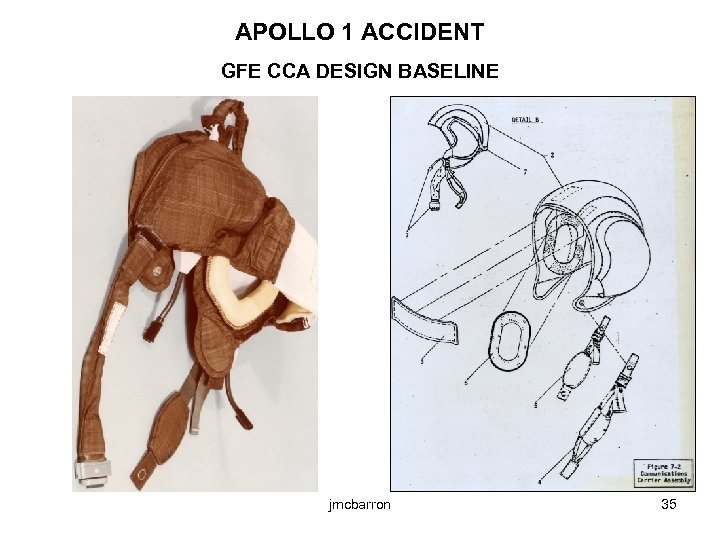 APOLLO 1 ACCIDENT GFE CCA DESIGN BASELINE jmcbarron 35
 APOLLO 1 ACCIDENT A-6 L SUIT CEI’s DESIGN IMPACTS CWG • Materials approved by MUA. - Rational: No suitable replacement materials and worn inside PGA. When not worn, stowed in non-flammable container. LCG • Materials approved by MUA. - Rational: No suitable materials replacement and worn inside PGA. When not worn, stowed in non-flammable container. WMS • UCD and FCS materials approved by MUA. - Rational: No suitable replacement materials and worn inside PGA. When not worn, stowed in non-flammable container. jmcbarron 36
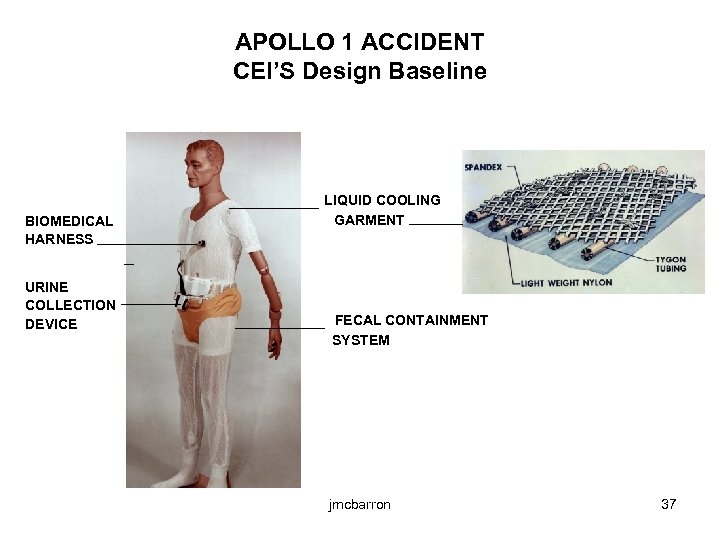 APOLLO 1 ACCIDENT CEI’S Design Baseline _____ LIQUID COOLING GARMENT ______ BIOMEDICAL HARNESS _____ _ URINE COLLECTION DEVICE _________ FECAL CONTAINMENT SYSTEM jmcbarron 37
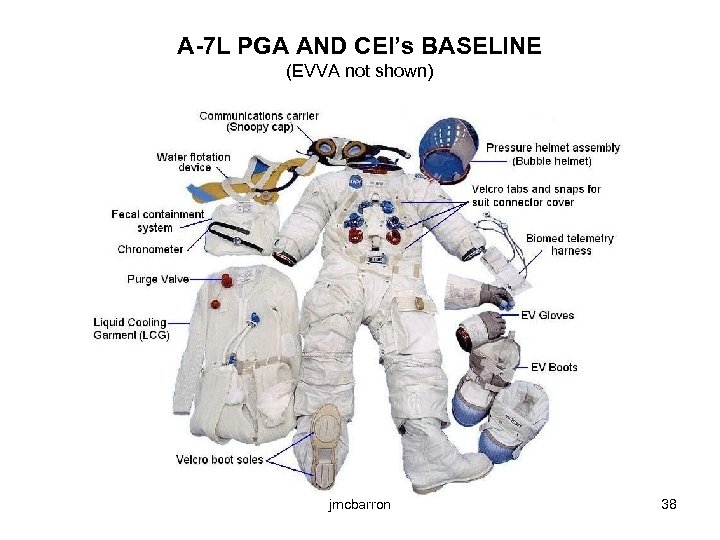 A-7 L PGA AND CEI’s BASELINE (EVVA not shown) jmcbarron 38
 U. S. SPACESUIT KNOWLEDGE CAPTURE SESSIONS Future Spacesuit Sessions In-work: - “Apollo A-7 L Spacesuit Development for Apollo 7 Through 14 Missions” - “Apollo A-7 LB Spacesuit Development for Apollo 15 -17 Missions” - “Apollo Spacesuit Modifications and Development for the Skylab Program” - “Apollo Spacesuit Modifications and Development for the Apollo Soyuz Test Project” - “Space Shuttle EMU Spacesuit Development for Initial Space Shuttle Program Flights” - “Space Shuttle EMU Spacesuit Development for the International Space Station Program” jmcbarron 39
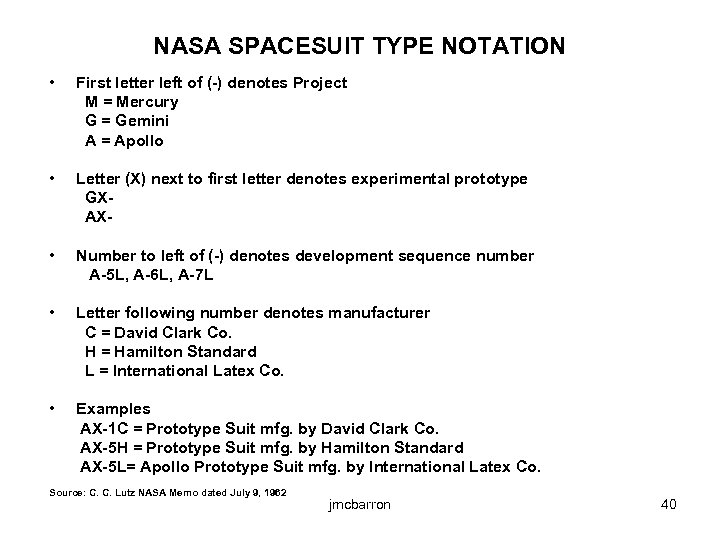 NASA SPACESUIT TYPE NOTATION • First letter left of (-) denotes Project M = Mercury G = Gemini A = Apollo • Letter (X) next to first letter denotes experimental prototype GXAX- • Number to left of (-) denotes development sequence number A-5 L, A-6 L, A-7 L • Letter following number denotes manufacturer C = David Clark Co. H = Hamilton Standard L = International Latex Co. • Examples AX-1 C = Prototype Suit mfg. by David Clark Co. AX-5 H = Prototype Suit mfg. by Hamilton Standard AX-5 L= Apollo Prototype Suit mfg. by International Latex Co. Source: C. C. Lutz NASA Memo dated July 9, 1962 jmcbarron 40
 APPENDIX A A-5 L PGA DEVELOPMENT jmcbarron 41
 A-5 L PGA DEVELOPMENT MODIFICATIONS TO AX-5 L COMPETATION SUIT • • Incorporated detachable TLS inner liner to improve donning capability. - Velcro fasteners with bar tack indexing marks added to facilitate alignment during installation to pressure retention system. TLS boot sizing system design established to accommodate maximum number of crewmen with minimum number of sizes. - Boot heel height reduced to improve wearer balance, walking ease, and load distribution. - Velcro insole added to facilitate bladder attachment to restraint and to increase donning ease. - Donning pull-tab and Velcro strip added vertically up back of boot between bladder and restraint to increase donning ease. jmcbarron 42
 A-5 L PGA DEVELOPMENT MODIFICATIONS TO AX-5 L COMPETATION SUIT • • • Upper TLS thigh cones stability improved - Changed interface angle with knee joints - Eliminated hard-shells in cones - Position of knee mobility joints sized for different leg lengths TLS flange mounted hardware interfaces - Gas connectors provided by Airlock Inc. (AL) - Water and waste connectors provided by HS - Pressure gage provided by Dyna-Magnatics - Pressure relief valve provided by AL - Electrical fitting provided by Micro-Dot Corp - Medical Injection fitting - Pressure transducer and low pressure warning switch provided by HS Structural adequacy verified by testing in AX-5 L suit - 500 pressure cycles from 0 to 8 psig and back to 0 psig in 3 seconds jmcbarron 43
 A-5 L PGA DEVELOPMENT MODIFICATIONS TO AX-5 L COMPETATION SUIT • TLS neck section redesigned for compatibility with CM crewman position requirements, comfort, and to increase shoulder mobility. - Achieved eye to heart angle of less than 16 deg. - Achieved neck ring center line angle of 30 deg. (downward relative to a horizontal plane through mid-point of ring cross-section at back of neck). - Reduced bulk of TLS neck section interface. - Modified design increased wearer comfort by improving load distribution across shoulders. - Modifications Incorporated in AX-5 L suit with adequacy verified by testing to assure no compromise to helmet visual field and/or mobility. jmcbarron 44
 A-5 L PGA DEVELOPMENT MODIFICATIONS TO AX-5 L COMPETATION SUIT • • • Added PLSS pressure transducer and low pressure warning switch attachment to back of TLS neck and EEH. Gemini G-4 C suit pressure seal/restraint closure integrated in TLS - Gussets incorporated at both ends of zipper assembly. - Service cycle life adequacy verified by testing four A-5 L production PGA’s at U. S. Army Natick Laboratory. Nylon fabric protective covers added over TLS knee and elbow convolutes, and lower arm and lower leg lacing size adjustments. - Removable covers provided for field inspection and sizing adjustment. - Adequacy tested in AX-5 L suit to verify lack of joints restriction at 3. 7 and 8 psig. jmcbarron 45
 A-5 L PGA DEVELOPMENT MODIFICATIONS TO AX-5 L COMPETATION SUIT • • • TLS shoulder redesigned to improve wearer comfort in pressurized and unpressurized modes for both CWG and LCG interfaces. TLS shoulder sizing developed for minimum number of sizes accommodate a 5 th to 95 th percentile man. - Each developed size incorporated and adequacy verified by testing in the first four A-5 L production suits. TLS helmet hold-down redundant latch was deleted. jmcbarron 46
 A-5 L PGA DEVELOPMENT MODIFICATIONS TO AX-5 L COMPETATION SUIT • TLS ventilation system development. - Design used in previous suits ventilation systems reviewed with regard to vent ducts size and construction. - Optimum routing of TLS vent ducts established considering comfort, system efficiency, and performance. - Nylon springs tested for use as non-crushable members in vent ducting. - Manned and unmanned tests conducted to verify pressure drop and flow split adequate. jmcbarron 47
 A-5 L PGA DEVELOPMENT MODIFICATIONS TO AX-5 L COMPETATION SUIT • A-5 L glove components development. - Four-point, two-cable restraint system design increased stability, torque uniformity, minimized bulk, and relieved existing AX-5 L glove pressure point at base of thumb. - Fingerless glove gauntlet and improved glove palm restraint with an abrasion resistant coated nylon fabric. - Single restraint cable micrometer adjustment device incorporated to provide wrist joint balance. - Static load testing performed to verify adequacy. jmcbarron 48
 APPENDIX B A-6 L SPACESUIT CEI’s DEVELOPMENT jmcbarron 49
 A-6 L CEI’s DEVELOPMENT AND QUALIFICATION JANUARY 1966 Preliminary Design Review held at ILC for A-6 L PGA • A-5 L PGA design configuration baseline plus following changes: - Addition of TMG jacket and pants using NASA-provided materials crosssection (outside to inside): - One layer of six-ounce Nomex cloth. - Seven layers of H. R. C. super-insulation, starting with 0. 25 mil aluminized Mylar, and alternating with 1. 5 -mil unwoven Dacron spacers. - Two layers of seven-ounce neoprene rip stop nylon (one side coated with neoprene). - Ankle mobility joint incorporated in TLS boot configuration to provide increased walking mobility to perform Lunar surface tasks. jmcbarron 50
 A-6 L CEI’s DEVELOPMENT AND QUALIFICATION • • Dust seal incorporated in TLS suit arm bearings to preclude dust particles greater than 50 microns diameter from entering bearing race and pressure seal area. - Leakage demonstrated less than 5 -cc per min at 3. 7 psig - Arm bearing torque verified greater than wrist disconnect torque from 0 to 3. 7 psi to preclude wrist disconnect from overriding arm bearing. FACI for A-6 L PGA and CEI’s held at ILC during same month as the Apollo 1 Accident. jmcbarron 51