


 Скачать презентацию U S Rotorcraft Accident Data Statistics International
010161ea762ad1bf69ff8b39f52c38b6.ppt
- Количество слайдов: 45
 U. S. Rotorcraft Accident Data & Statistics International Helicopter Safety Team Lee Roskop, FAA Scott Tyrrell, FAA • • • Rotorcraft Standards Staff U. S. JHIMDAT Government Co-Chair January 23, 2013 ihst. org 1
 Overview • • Accident Data and Trends Industry Sector Analysis by NTSB Finding Code Recent Concerns IHST Review SPSs, IRs, Occurrences U. S. JHIMDAT Current Actions Questions and Answers ihst. org 2
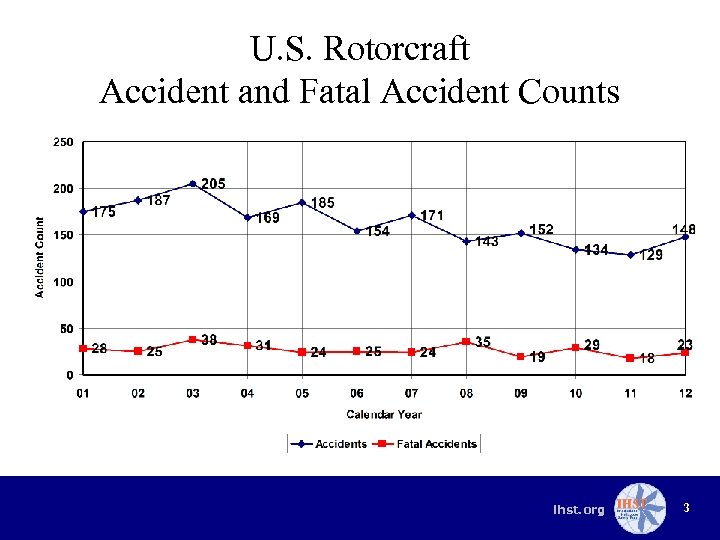 U. S. Rotorcraft Accident and Fatal Accident Counts ihst. org 3
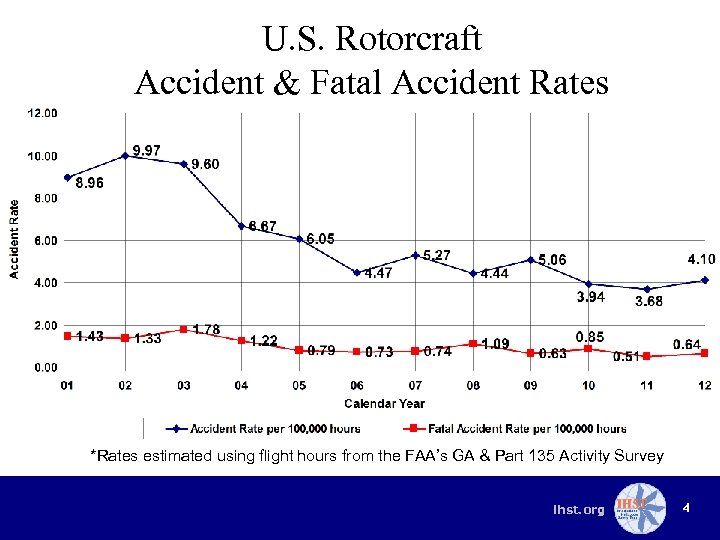 U. S. Rotorcraft Accident & Fatal Accident Rates *Rates estimated using flight hours from the FAA’s GA & Part 135 Activity Survey ihst. org 4
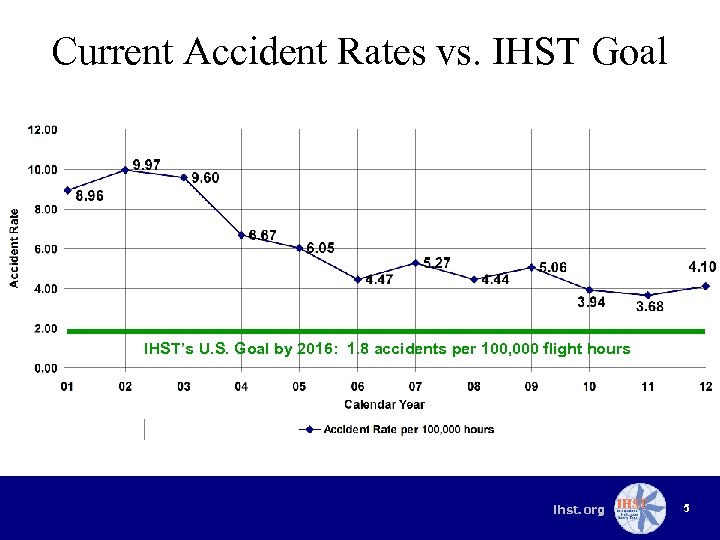 Current Accident Rates vs. IHST Goal IHST’s U. S. Goal by 2016: 1. 8 accidents per 100, 000 flight hours ihst. org 5
 Measuring Significance of Improvements • 5 Year Snapshots by Month – Plotted average accidents by month 2001 -2005 • Superimposed lines for 2 x standard deviation – Observed progress based on 5 year increments • Plotted 2006 -2010 • Plotted 2011 -2015 ihst. org 6
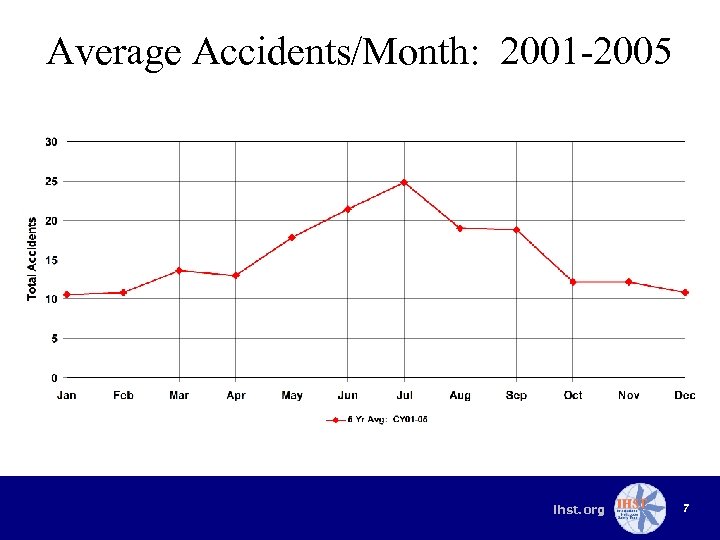 Average Accidents/Month: 2001 -2005 ihst. org 7
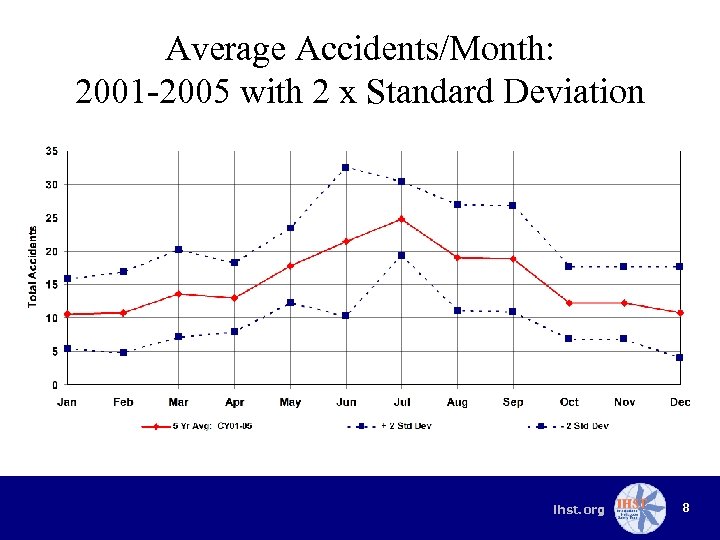 Average Accidents/Month: 2001 -2005 with 2 x Standard Deviation ihst. org 8
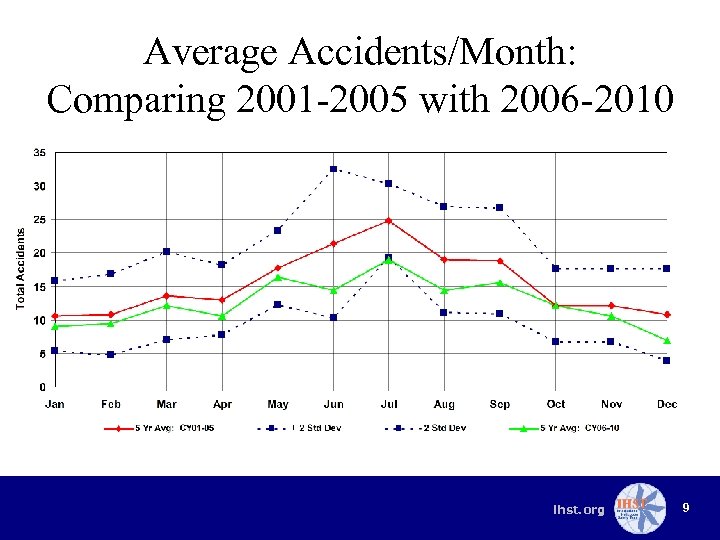 Average Accidents/Month: Comparing 2001 -2005 with 2006 -2010 ihst. org 9
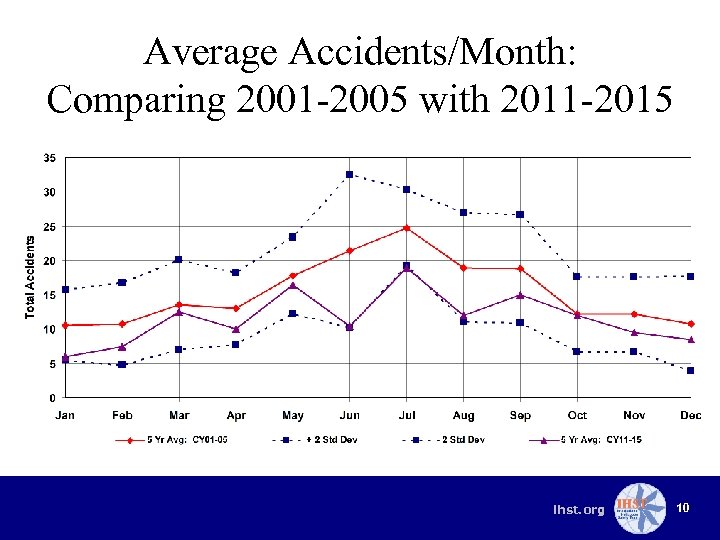 Average Accidents/Month: Comparing 2001 -2005 with 2011 -2015 ihst. org 10
 Industry Sector Analysis ihst. org 11
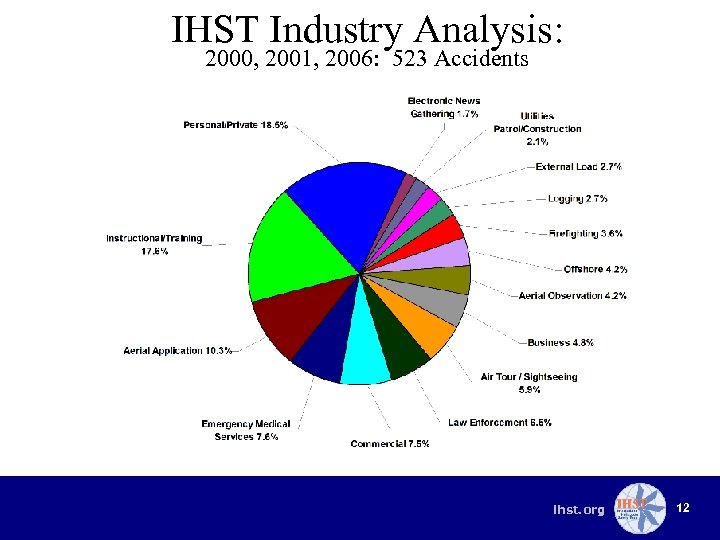 IHST Industry Analysis: 2000, 2001, 2006: 523 Accidents ihst. org 12
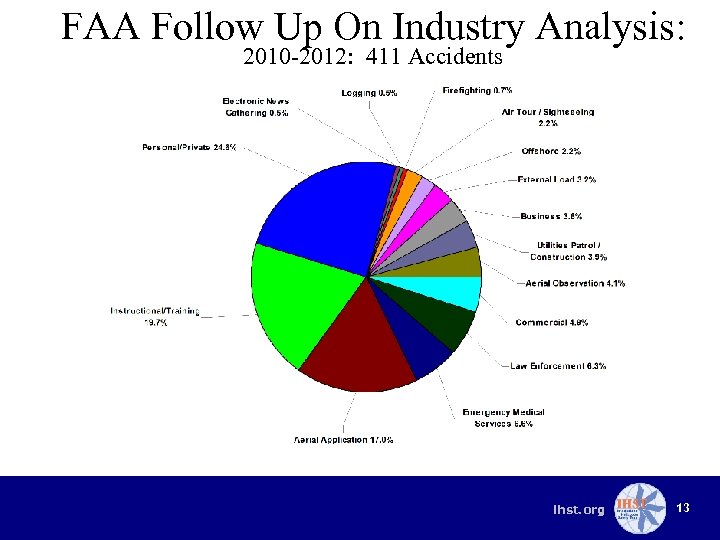 FAA Follow Up On Industry Analysis: 2010 -2012: 411 Accidents ihst. org 13
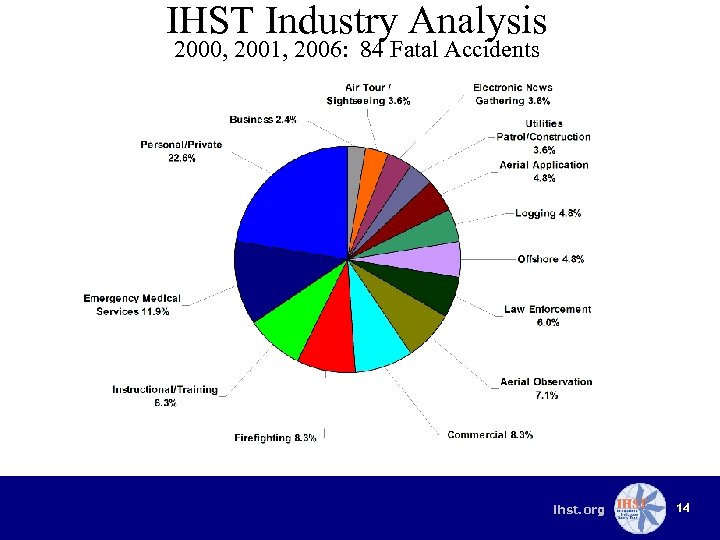 IHST Industry Analysis 2000, 2001, 2006: 84 Fatal Accidents ihst. org 14
 FAA Follow Up On Industry Analysis: 2010 -2012: 69 Fatal Accidents ihst. org 15
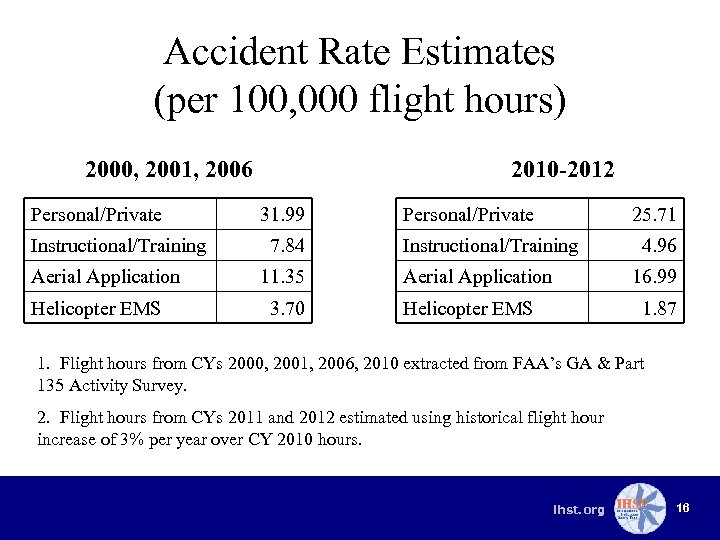 Accident Rate Estimates (per 100, 000 flight hours) 2000, 2001, 2006 Personal/Private Instructional/Training Aerial Application Helicopter EMS 2010 -2012 31. 99 7. 84 11. 35 3. 70 Personal/Private 25. 71 Instructional/Training Aerial Application 4. 96 16. 99 Helicopter EMS 1. 87 1. Flight hours from CYs 2000, 2001, 2006, 2010 extracted from FAA’s GA & Part 135 Activity Survey. 2. Flight hours from CYs 2011 and 2012 estimated using historical flight hour increase of 3% per year over CY 2010 hours. ihst. org 16
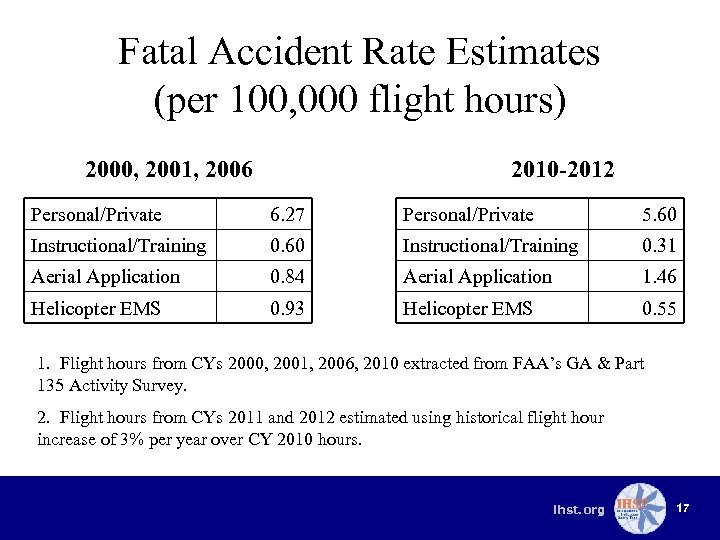 Fatal Accident Rate Estimates (per 100, 000 flight hours) 2000, 2001, 2006 2010 -2012 Personal/Private 6. 27 Personal/Private 5. 60 Instructional/Training 0. 31 Aerial Application 0. 84 Aerial Application 1. 46 Helicopter EMS 0. 93 Helicopter EMS 0. 55 1. Flight hours from CYs 2000, 2001, 2006, 2010 extracted from FAA’s GA & Part 135 Activity Survey. 2. Flight hours from CYs 2011 and 2012 estimated using historical flight hour increase of 3% per year over CY 2010 hours. ihst. org 17
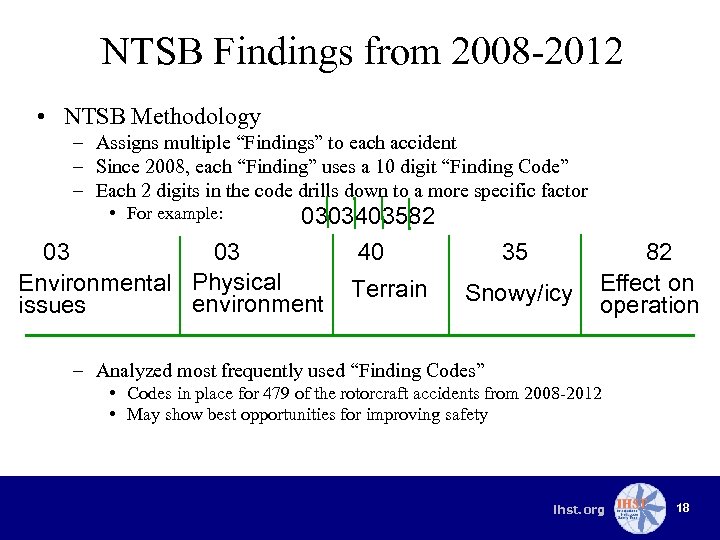 NTSB Findings from 2008 -2012 • NTSB Methodology – Assigns multiple “Findings” to each accident – Since 2008, each “Finding” uses a 10 digit “Finding Code” – Each 2 digits in the code drills down to a more specific factor • For example: 0303403582 40 03 03 Environmental Physical environment issues Terrain 35 Snowy/icy 82 Effect on operation – Analyzed most frequently used “Finding Codes” • Codes in place for 479 of the rotorcraft accidents from 2008 -2012 • May show best opportunities for improving safety ihst. org 18
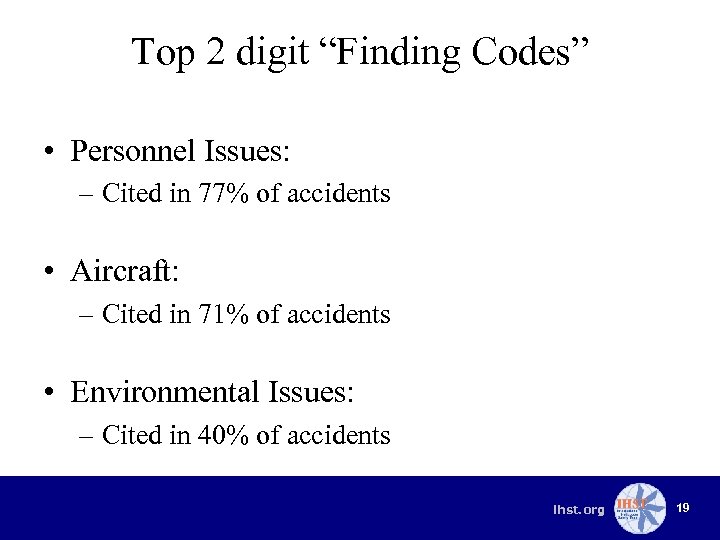 Top 2 digit “Finding Codes” • Personnel Issues: – Cited in 77% of accidents • Aircraft: – Cited in 71% of accidents • Environmental Issues: – Cited in 40% of accidents ihst. org 19
 Top 10: 4 digit “Finding Codes” ihst. org 20
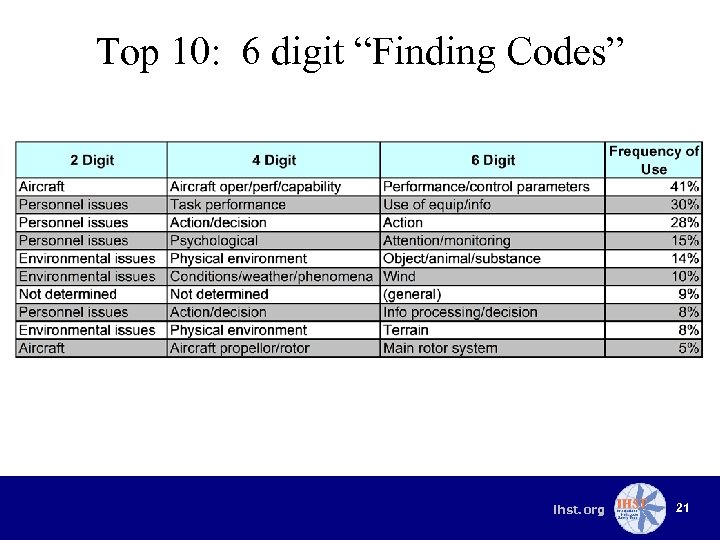 Top 10: 6 digit “Finding Codes” ihst. org 21
 Recent Trends: 2012 closes poorly • Oct-Dec 2012 – Accidents • 60% higher than same period in 2011 • Highest Oct – Dec total in 5 years • Tied, 2 nd highest Oct – Dec total last 10 years – Fatal Accidents • 57% higher than same period in 2011 • Highest Oct – Dec total in 5 years • Tied, highest Oct – Dec total last 10 years – Mitigation efforts by FAA, HAI, AOPA, and IHST • Mass media effort in mid October after 4 fatal accidents in 8 days ihst. org 22
 Recent Trends: 2013 starts poorly • January 2013 – Record setting accident pace during first 9 days • 7 accidents, 3 fatal accidents, 11 fatalities • If sustained, pace was for 24 accidents, 9 fatal accidents, 38 fatalities • Projection would have far exceeded highest total for any January the last 30 years – Accident pace slowed during mid month • Still projected to have a high total, but not record setting ihst. org 23
 What has changed? • 5 years of steady progress – Consistent improvement, despite lagging the IHST’s desired 80% accident rate reduction • 4 consecutive months of regression – Especially concerning since we are in the traditionally “lower accident” months ihst. org 24
 Recent FAA Safety Alert for Operators (SAFO) • Increased manual handling errors for Air Carrier pilots • Effects of modern aircraft technology – Pro: Enables precision, improves workload management – Con: Continuous use can lead to degraded pilot ability to quickly recover the a/c from an undesired state • Recommendations: – More training on when to use automated systems – More exercise of manual flying skills • Lesson: – Technology and Training must compliment each other – Cockpit advances should facilitate (not replace) basic pilot skills/decisions ihst. org 25
 IHST Review ihst. org 26
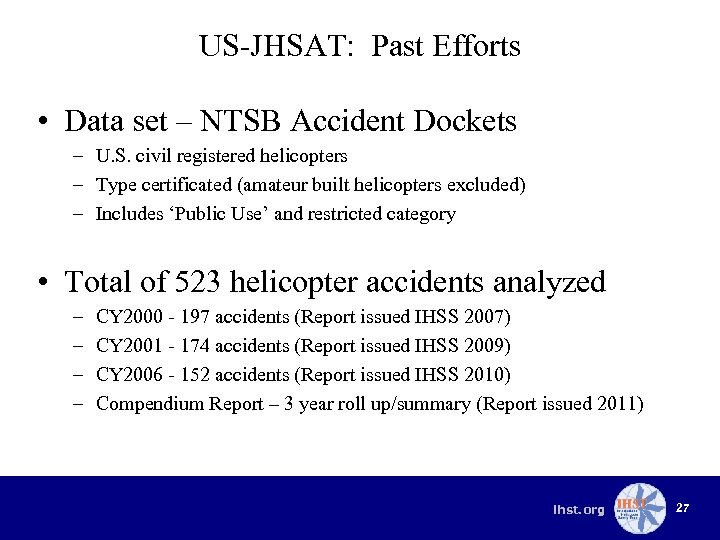 US-JHSAT: Past Efforts • Data set – NTSB Accident Dockets – U. S. civil registered helicopters – Type certificated (amateur built helicopters excluded) – Includes ‘Public Use’ and restricted category • Total of 523 helicopter accidents analyzed – – CY 2000 - 197 accidents (Report issued IHSS 2007) CY 2001 - 174 accidents (Report issued IHSS 2009) CY 2006 - 152 accidents (Report issued IHSS 2010) Compendium Report – 3 year roll up/summary (Report issued 2011) ihst. org 27
 US Accidents by SPS Lvl 1 - Compendium ihst. org 28
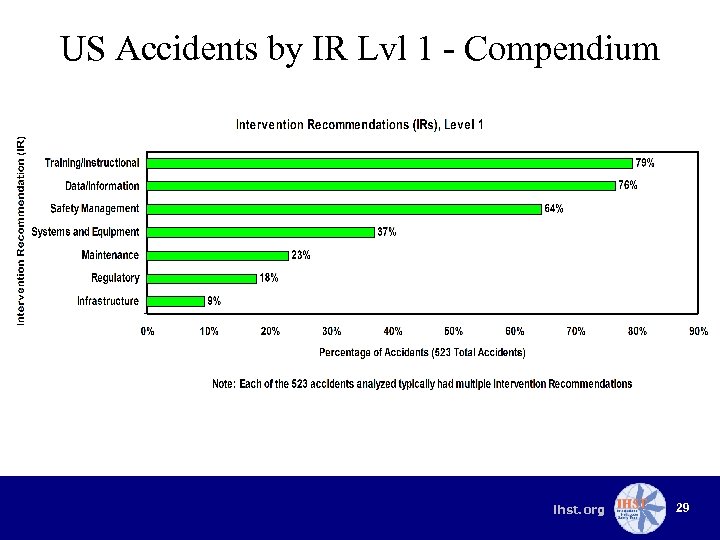 US Accidents by IR Lvl 1 - Compendium ihst. org 29
 US Accidents by Occurrence Types Compendium - ihst. org 30
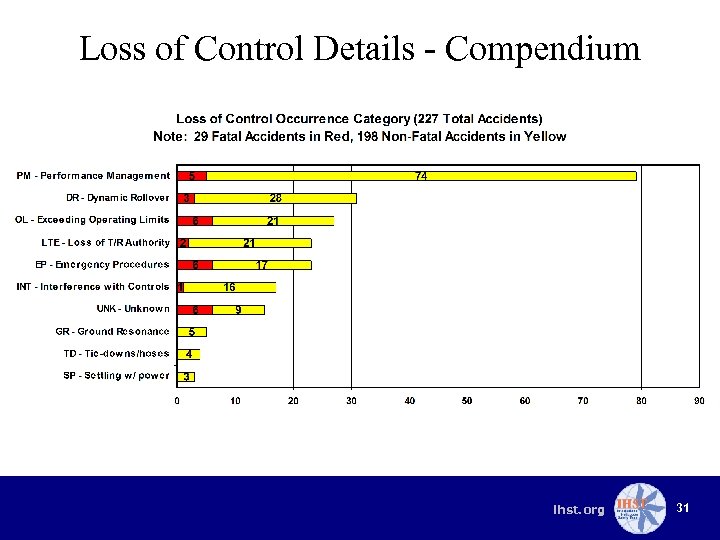 Loss of Control Details - Compendium ihst. org 31
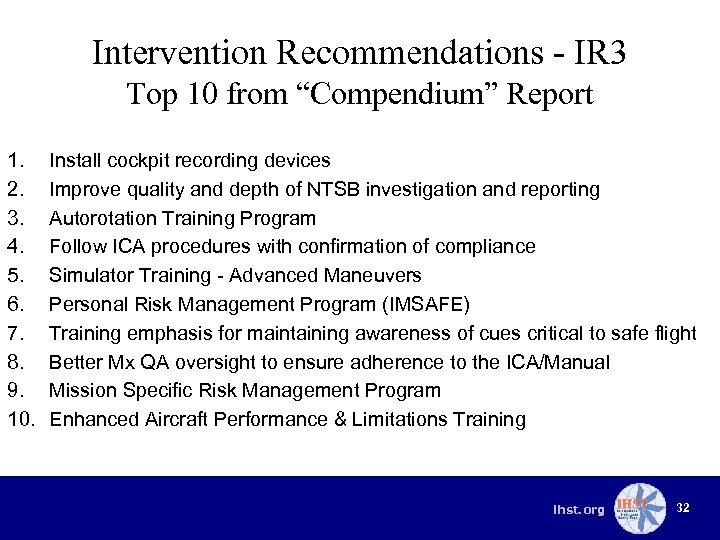 Intervention Recommendations - IR 3 Top 10 from “Compendium” Report 1. 2. 3. 4. 5. 6. 7. 8. 9. 10. Install cockpit recording devices Improve quality and depth of NTSB investigation and reporting Autorotation Training Program Follow ICA procedures with confirmation of compliance Simulator Training - Advanced Maneuvers Personal Risk Management Program (IMSAFE) Training emphasis for maintaining awareness of cues critical to safe flight Better Mx QA oversight to ensure adherence to the ICA/Manual Mission Specific Risk Management Program Enhanced Aircraft Performance & Limitations Training ihst. org 32
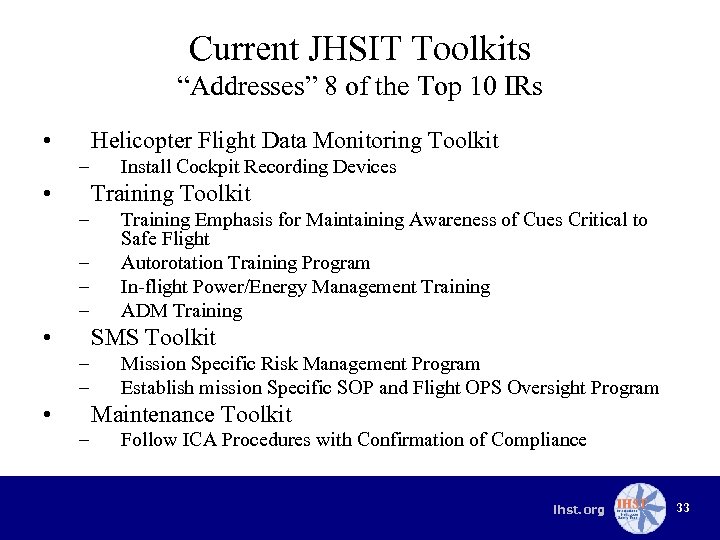 Current JHSIT Toolkits “Addresses” 8 of the Top 10 IRs • Helicopter Flight Data Monitoring Toolkit – • Install Cockpit Recording Devices Training Toolkit – – • Training Emphasis for Maintaining Awareness of Cues Critical to Safe Flight Autorotation Training Program In-flight Power/Energy Management Training ADM Training SMS Toolkit – – • Mission Specific Risk Management Program Establish mission Specific SOP and Flight OPS Oversight Program Maintenance Toolkit – Follow ICA Procedures with Confirmation of Compliance ihst. org 33
 From JHSAT to JHIMDAT • Goals of analysis evolved in 2011 – JHSAT complete: Identified problems and recommended interventions – JHIMDAT initiated: Measure progress of implementation actions • Economic realities = more resource constrained effort – Economic downturn resulted in reduced industry participation – Original meetings of once/month reduced to 3 -4 times annually • Detailed analysis on every accident not performed – Time consuming process not feasible with more limited meeting times – More strategic effort toward specific targeted areas • Industry may need to lead in areas where deeper study is desired ihst. org 34
 Current US JHIMDAT Analysis Efforts • Assess Progress by Analyzing Recent Years – Data set from CY 2009 – 2011 – High level analysis has categorized: • Industry where a/c is used • Activity being performed when accident occurred • Occurrence/Sub-Occurrence Code defined “What Happened? ” – Compare CY 09 -11 results to data in Compendium ihst. org 35
 U. S. JHIMDAT Future Efforts • Targeted Industry Outreach – ALEA – Ag Ops • NTSB Finding Codes – Compare findings from recent accidents to Compendium • Improved tracking of System Component Failures – Classify system failures using established taxonomies • Air Transport (ATA)/Joint Aircraft System/Component (JASC) – Update to Compendium, compare recent accidents ihst. org 36
 IHST Upcoming Action Items • Launch Regional Teams – North America Helicopter Safety Team (NAHEST) ihst. org 37
 Questions? ihst. org
 Back-up IHST Slides ihst. org 39
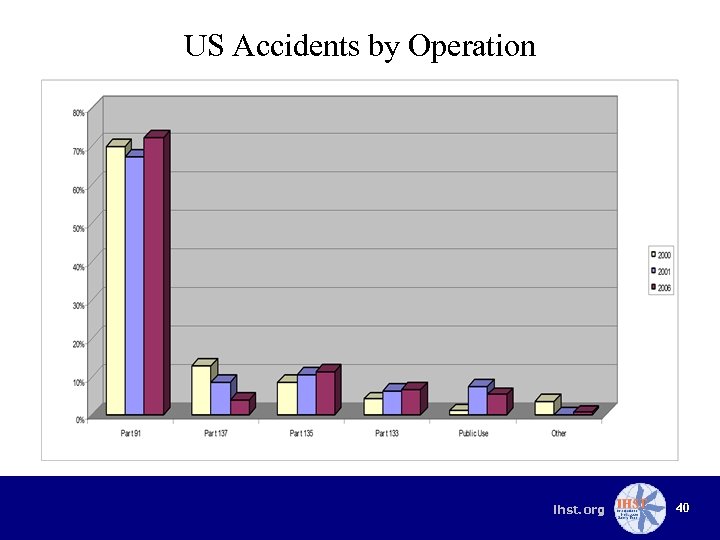 US Accidents by Operation ihst. org 40
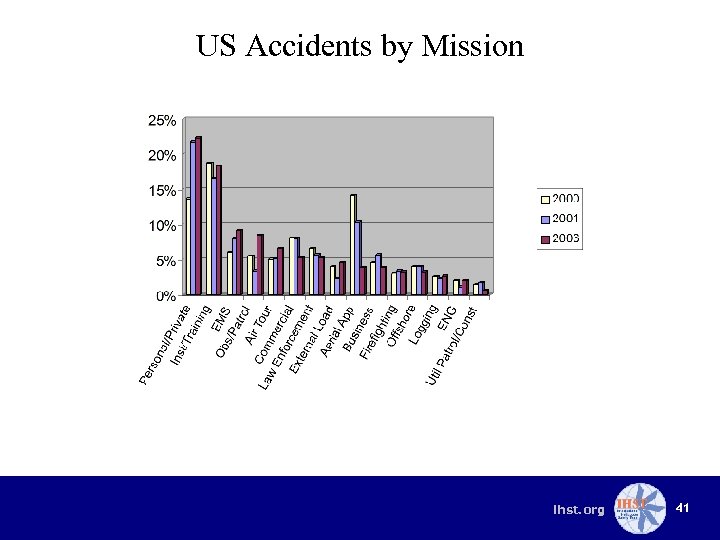 US Accidents by Mission ihst. org 41
 US Accidents by SPS Lvl 1 ihst. org 42
 US Accidents by IR Lvl 1 ihst. org 43
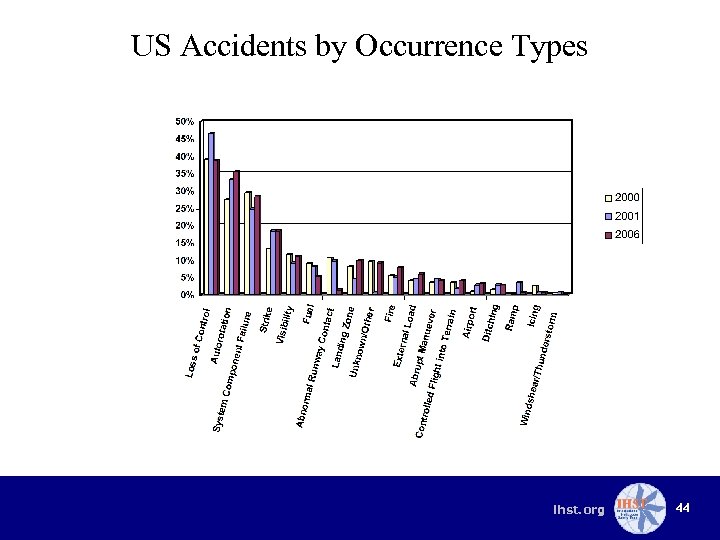 US Accidents by Occurrence Types ihst. org 44
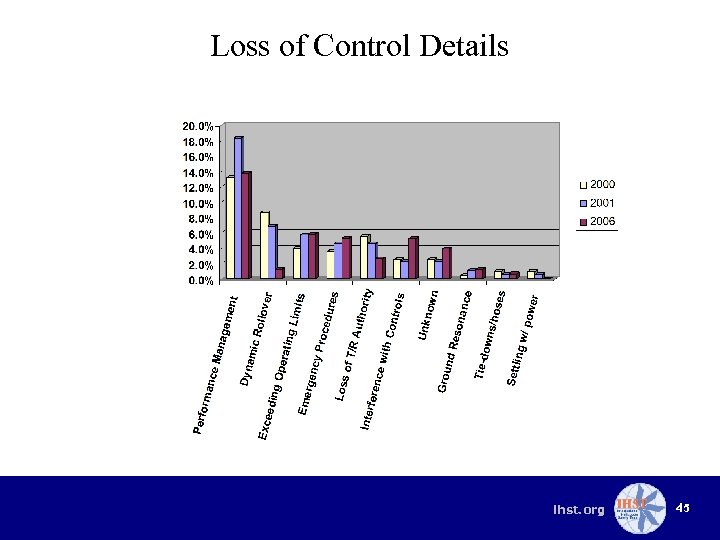 Loss of Control Details ihst. org 45