 Скачать презентацию U S Optical Network Testbeds Status Grant Miller
acd90df7d5e63a87c46b7b135261bd42.ppt
- Количество слайдов: 22



U. S. Optical Network Testbeds Status Grant Miller National Coordination Office July 3, 2004
U. S. Optical Network Testbeds l l l l Ultra. Sciencenet: DOE CHEETAH: NSF DRAGON: NSF STARLight: NSF HOPI: Internet 2 OMNInet: Nortel National Lambda. Rail (NLR): Consortium Also: CALREN, Colorado, Connecticut, Florida, Indiana (I -Light), Illinois (I-Wire), Maryland/DC/ Virginia (MAX), Michigan, Minnesota, NY(NEREN), North Carolina, Ohio, Oregon, Rhode Island, SURA, Texas, Utah, Wisconsin 2
Applications Network Performance l l l Applications requirements are drivers for bandwidth needs DWDM delivers up to 100 Gbps SONET framing delivers up to 40 Gbps TCP/IP delivers about 15 Gbps Site firewalls deliver about 7 Gbps to an application But high-end applications require 40+ Gbps, e. g. : – Terascale Supernova Initiative: Terabyte in days – High Energy Physics: Terabyte data transfers l Therefore, consider optical networking options to: – Bypass firewalls – Carry non-IP frames (e. g. , Fiber Channel over SONET) 3
Ultra. Science. Net Planned Capabilities Sparse, lambda-switched, dedicated, channelprovisioned testbed l Connects hubs close to DOE’s largest science users: Users pay last-mile costs l Provide an evolving matrix of switching capabilities l Separately fund research projects to support applications l – High-performance protocols – Control – Visualization 4
Ultra. Science. Net Resources Off-hours capacity from DOE’s ESnet: Expected 2 x OC 48 between Sunnyvale and Chicago l Dedicated lambdas on NLR l – 2 x 10 G lambdas between Chicago and Sunnyvale – Possibly two more in year 2 or 3 Two dedicated lambdas on the Oak Ridge National Laboratory Chicago-Atlanta Connector l Switching technologies l – Ciena, Cisco or Sycamore (SONET) migrating to – Calient Glimmerglass all-optical or a hybrid – Progression of point-to-point (P 2 P) transport technologies (Fiber channel, Infiniband) l Migrate to the production ESnet environment 5
Ultra. Science. Net Engineering Approach l Network engineering – – – l Connect Atlanta-Chicago via ORNL 16 P 2 P circuits: OC 192, 10 Gig-E Provide the NLR alternate route to close its ring Buy IRUs from Qwest and TVA Light with equipment from Ciena Please see: http: //www. csm. ornl. gov/ultranet 6
CHEETAH: Sponsored by the NSF January 2004 -December 2007 Goal: Develop the infrastructure and networking technologies to support a broad class of escience, and specifically the Terascale Supernova Initiative l Concept: Create a network to provide on-demand end-toend dedicated bandwidth channels to applications as well as an IP path to support: l – – l High throughput file transfers Interactive remote visualization Remote computational steering Multipoint collaborative computation Participation by: – – Oak Ridge National Laboratories University of Virginia North Carolina State University City University of New York 7
CHEETAH Technology Dedicated channel: High-speed Ethernet mapped to Ethernet-over-SONET circuit l Leverage existing technologies l – 100 Mbps/1 Gbps Ethernet in LANs – SONET in MANs/WANs – Availability of Multi-Service Provisioning Platforms (MSPP) class devices that can: l l Map Ethernet to Ethernet over SONET Cross-connect dynamically Rate-control Ethernet ports Provide a 1 Gbps ORNL-Atlanta Channel 8
CHEETAH Implementation l Application tools – File tansfer – Visualization: Ensight or Aspect/Paraview, Custom open GL codes – Computational steering l Transport protocols – File transfers – Control channels: small portion of channel bandwidth Rate-based flow control: 2 x Dell 2. 4 Ghz PCs with 100 Mhz 64 -bit PCI busses l Make it wide-area: e. g. , use NLR, MPLS tunnels through Abilene, or collocated switches at Abilene Po. Ps l 9
DRAGON: Funded by NSF Provide Cyberinfrastructure application support and advanced network services on an experimental infrastructure using emerging standards and technology l Advanced services l – – – Dynamic provisioning of deterministic end-to-end paths Rapid provisioning of application-specific net topologies Reserve resources and topology in advance, instantiate as needed Provide AAA Protocol, format, framing agnostic: direct transmission of any optical signal 10
DRAGON Design All optical transport in the metro core: Edge-toedge wavelength switching. Push OEO demarc to the edge l Standardized GMPLS protocols for dynamic provisioning intra-domain connections l Develop inter-domain protocols to distribute Transport Layer Capability Sets (TLCS) across multiple domains l 11
DRAGON Research Areas l l l Inter-domain routing to advertise the TLCS: Network Aware Resource Broker (NARB) Ability to request deterministic network resources Virtual label switched routers: Translate GMPLS requests into configuration commands to switches via the SNMP protocol Minimize OEO requirements for light-paths Formalized definition language to instantiate complex application topologies 12
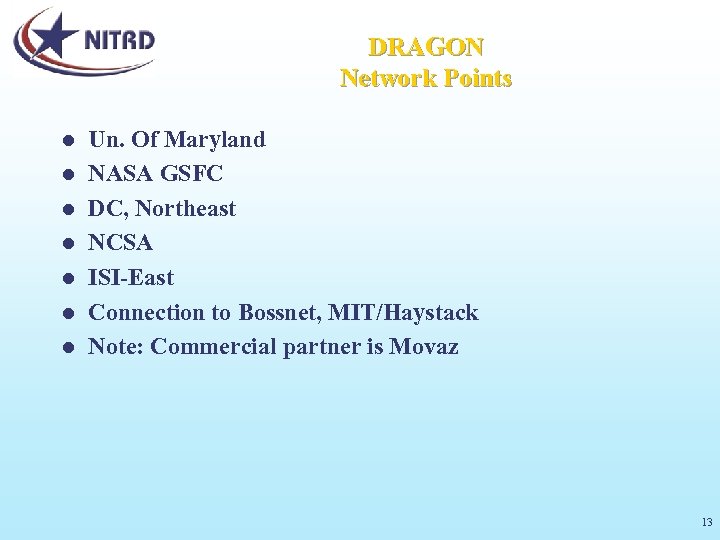
DRAGON Network Points l l l l Un. Of Maryland NASA GSFC DC, Northeast NCSA ISI-East Connection to Bossnet, MIT/Haystack Note: Commercial partner is Movaz 13
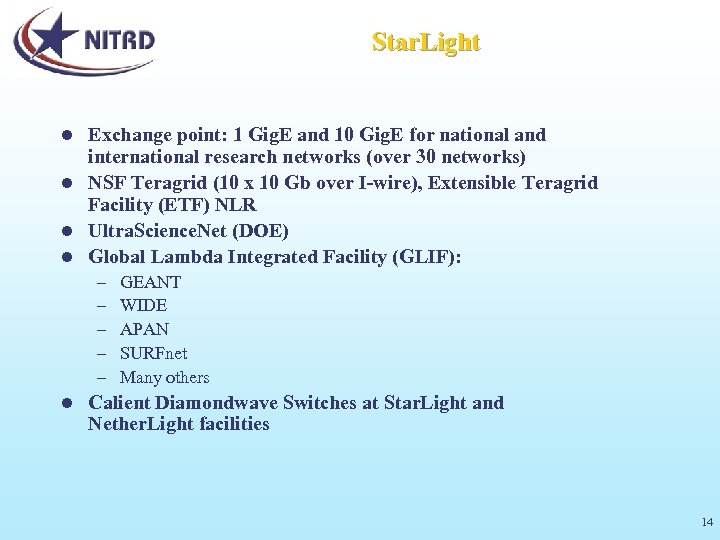
Star. Light Exchange point: 1 Gig. E and 10 Gig. E for national and international research networks (over 30 networks) l NSF Teragrid (10 x 10 Gb over I-wire), Extensible Teragrid Facility (ETF) NLR l Ultra. Science. Net (DOE) l Global Lambda Integrated Facility (GLIF): l – – – l GEANT WIDE APAN SURFnet Many others Calient Diamondwave Switches at Star. Light and Nether. Light facilities 14
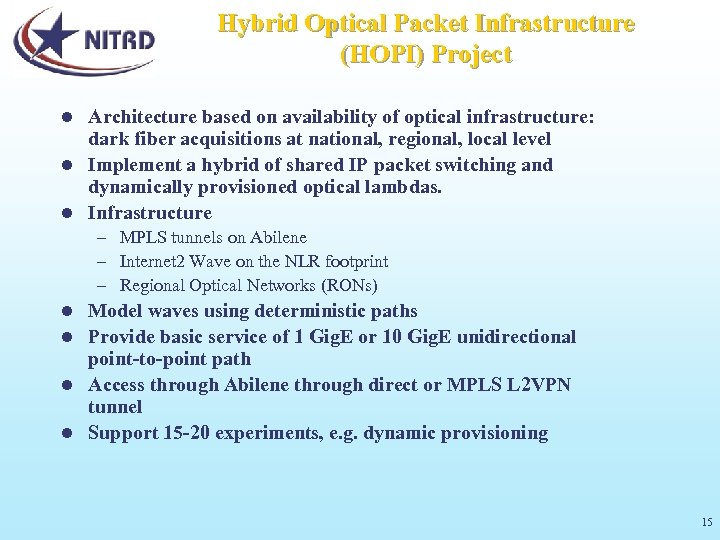
Hybrid Optical Packet Infrastructure (HOPI) Project Architecture based on availability of optical infrastructure: dark fiber acquisitions at national, regional, local level l Implement a hybrid of shared IP packet switching and dynamically provisioned optical lambdas. l Infrastructure l – MPLS tunnels on Abilene – Internet 2 Wave on the NLR footprint – Regional Optical Networks (RONs) Model waves using deterministic paths l Provide basic service of 1 Gig. E or 10 Gig. E unidirectional point-to-point path l Access through Abilene through direct or MPLS L 2 VPN tunnel l Support 15 -20 experiments, e. g. dynamic provisioning l 15
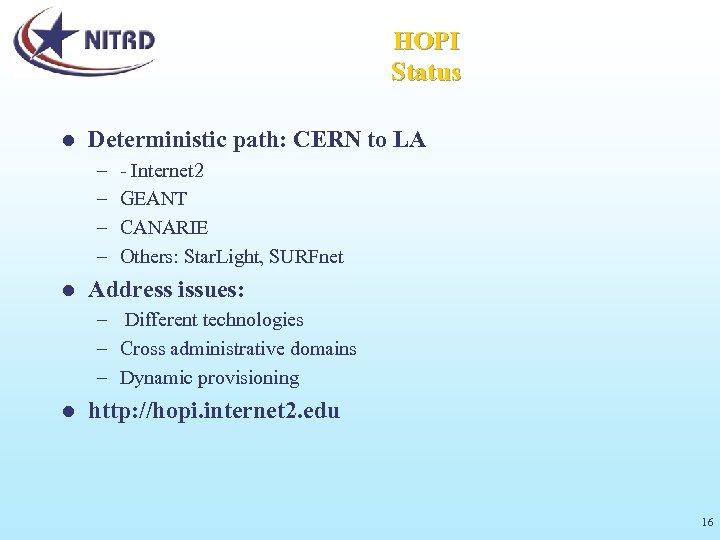
HOPI Status l Deterministic path: CERN to LA – – l - Internet 2 GEANT CANARIE Others: Star. Light, SURFnet Address issues: – Different technologies – Cross administrative domains – Dynamic provisioning l http: //hopi. internet 2. edu 16
Optical Metro Network Initiative (OMNInet) Metropolitan 10 Gbps DWDM WAN and LAN photonic switched network trial l Partnership of Nortel Networks, SBC Communications, International Corporation of Advanced Internet Research (i. CAIR)/Northwestern Un. l Services: O-VPNs, dial-a-lambda service, router bypass l Emerging applications: Optical Grids, storage on-demand, data mining, 3 D teleconferencing, large-science apps, visualization l 17
OMNInet Architecture 4 sites in Chicago l 6 fiber spans l 4 wavelength planes: switching without wavelength translation l DWDM Lightpaths l 18
National Lambda. Rail (NLR) l l l National-scale member-owned/managed optical networking and research facility NLR Objective: Bridge the gap between optical networking research and state-of-the-art applications research NLR is a set of facilities, capabilities, and services supporting multiple experimental and production networks for the U. S. research community Networks exist side-by-side on the same fiber but are physically and operationally distinct Virtuous Circles: Participants dedicated optical capability from campus labs to the NLR network. NLR works with RONs to deliver NLR capabilities to campuses. 19
NLR Characteristics l Experimental platform for research – Optical switching and network layers – 50% of capacity is reserved for research – Experimental Support Center Use high-speed Ethernet for WAN Transport: First national-scale Ethernet deployment l Sparse backbone technology: Members develop local optical networking and performance in their areas l Acceptable Use Policy Free l 20
NLR Planned Capabilities l l l Point-to-point waves: 10 Gig. E LAN PHY, OC 192 Cisco systems Switched Ethernet network using Cisco switches Experimental IP network using Cisco routers Dark fiber for optical layer research Traditional NOC services Dense Wave Division Multiplexing national optical footprint: Capacity of 40 wavelengths per fiber pair deployed on 10, 000 miles of dark fiber 21
NLR Deployment l Initial 4 lambdas – One lambda for national switched Ethernet experimental network – One lambda for national 10 Gbps IP network – One lambda for quick start facility for new research projects – One lambda for Internet 2 HOPI testbed Additional lambdas provisioned as needed l National deployment (California to DC to Florida) by August 2004 l http: //www. nationallambdarail. org l 22
Скачать презентацию U S Optical Network Testbeds Status Grant Miller
acd90df7d5e63a87c46b7b135261bd42.ppt