 Скачать презентацию U S History U S Imperialism Global
f97be5e28366b1b09b59d38dc9e365fd.ppt
- Количество слайдов: 35



U. S. History U. S. Imperialism
Global Imperialism = The policy in which stronger nations extend their economic, political or military control over weaker territories. By the 1880 s imperialism was a global trend. European countries had been establishing colonies for centuries. “The Sun Never Sets on the British Empire”! During the reign of Victoria, the British Empire grew to include 1/4 of the world’s land people.
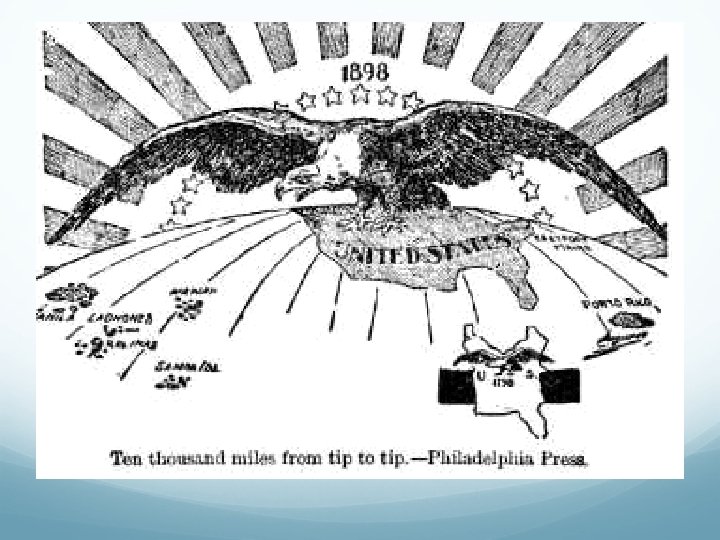
American Imperialism By the late 1800 s American policy makers were convinced that America needed to join the Europeans and begin to establish colonies overseas in places such as Hawaii.
Reasons for American Imperialism Thirst For New Markets As technological improvements in American farm and factories allowed for higher levels of production, the need for new markets to sell goods would develop. Favorable Balance of Trade = Exporting more than you import.
Reasons for American Imperialism Desire For Military Strength The U. S. wanted to build up its military to rival the build up of the European powers. Alfred Mahan argued that a strong navy was needed to defend peacetime shipping lanes that were essential to America’s economy. In order to have that presence, the U. S. would need a number of strategically placed refueling bases, along with a canal across Panama and naval bases in the Caribbean and islands throughout the Pacific, including Hawaii. By 1890 the U. S. was the world’s third largest navel power behind only Great Britain and Germany.
Reasons for American Imperialism Belief In Anglo-Saxon Superiority Some Americans combined the philosophy of Social Darwinism with a belief in the racial superiority in the Anglo-Saxon race. They argued that the U. S. had a responsibility to spread Christianity and civilization to the world’s “inferior” peoples.
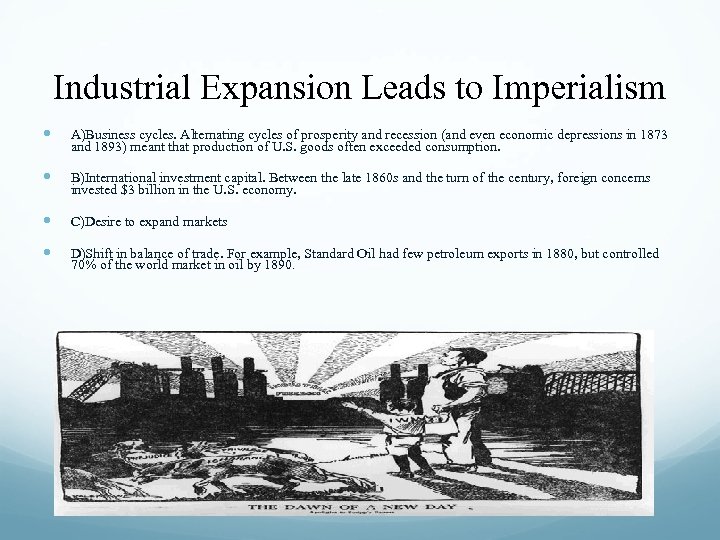
Industrial Expansion Leads to Imperialism A)Business cycles. Alternating cycles of prosperity and recession (and even economic depressions in 1873 and 1893) meant that production of U. S. goods often exceeded consumption. B)International investment capital. Between the late 1860 s and the turn of the century, foreign concerns invested $3 billion in the U. S. economy. C)Desire to expand markets D)Shift in balance of trade. For example, Standard Oil had few petroleum exports in 1880, but controlled 70% of the world market in oil by 1890.
Imperialism Justified B) The "Anglo-Saxon myth" was the dominant intellectual justification for American imperialism. This myth held that the Anglo-Saxons were the final result of cultural evolution. The United States, as the obvious seat of growing Anglo. Saxon power, had a duty to expand its influence throughout the world. Cultural Superiority Social Darwinism Racial Superiority Duty to spread Christianity
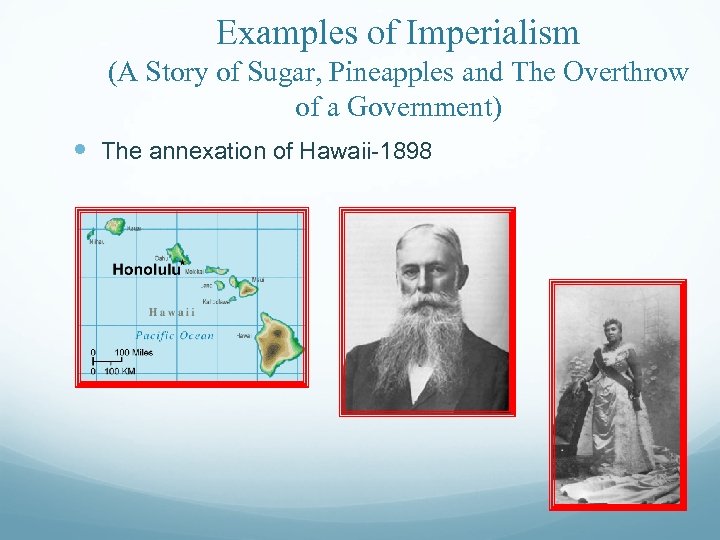
Examples of Imperialism (A Story of Sugar, Pineapples and The Overthrow of a Government) The annexation of Hawaii-1898
American influence had grown in Hawaii since the 1790’s. By the time of the Civil War, American-owned sugar plantations accounted for about 3/4 of the islands wealth. An 1875 treaty allowed the sugar to be sold to the U. S. without a duty. In 1887 wealthy business leaders forced the King (Kalakaua) to change the constitution to allow only wealthy land owners the right to vote - this would give control to the American businessmen. That same year the U. S. and Hawaii would sign a treaty allowing the construction of a naval base at Pearl Harbor.
When the Mc. Kinley tariff re-imposed the duty on sugar, Hawaii sugar faced competition from Cuban sugar. American planters would call for the annexation of Hawaii. This would eliminate the tariff on Hawaiian sugar. With the death of the King in 1891, his sister Liliuokalani became Queen. She proposed a new constitution that would eliminate property ownership qualifications for voting. Business groups would organize a revolt against Queen Lil.
On January 16 the U. S. S. Boston would bring marines in “to protect American lives and property”. At the same time, volunteer troops took over government buildings, imprisoned Queen Lil and set up a provisional government with Sanford Dole as president. The U. S. ambassador, who had helped plan the revolt, immediately recognized the new government and asked that the islands be annexed.
Following an investigation, President Cleveland would call for Queen Lil to be put back on the throne. When Dole refused, Cleveland ended up recognizing the Republic of Hawaii. Following the election of Mc. Kinley in 1898, Congress proclaimed Hawaii and American territory, without asking Hawaiians to vote on the annexation.
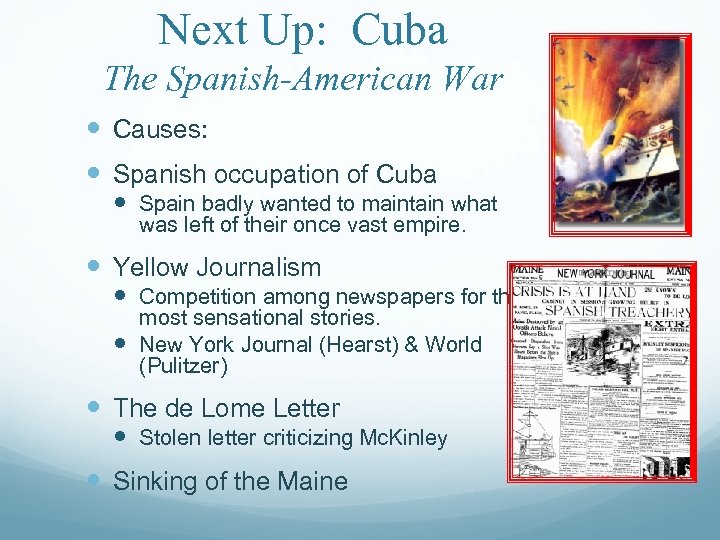
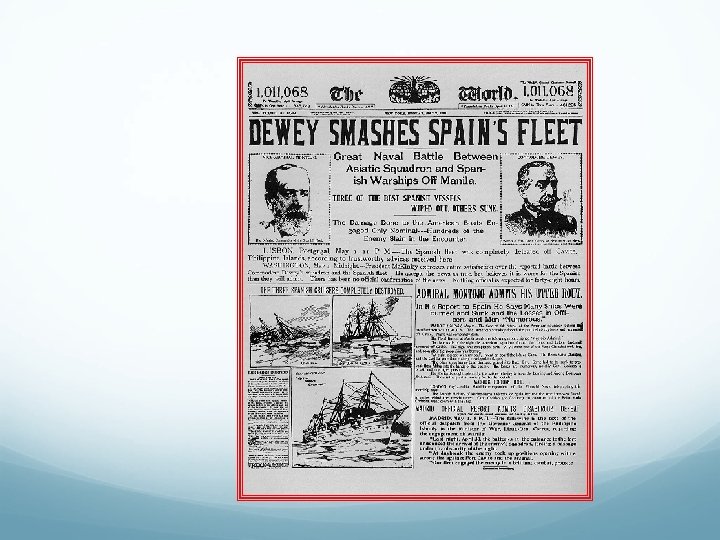
Next Up: Cuba The Spanish-American War Causes: Spanish occupation of Cuba Spain badly wanted to maintain what was left of their once vast empire. Yellow Journalism Competition among newspapers for the most sensational stories. New York Journal (Hearst) & World (Pulitzer) The de Lome Letter Stolen letter criticizing Mc. Kinley Sinking of the Maine
Results of the War The Treaty of Paris of 1898 Cuba became independent. Puerto Rico and Guam became U. S. territories. The U. S. would pay Spain $20 million for the annexation of the Philippines. The annexation of the Philippines would cause a lot of debate about imperialism in the U. S. Mc. Kinley told a group of Methodist ministers that “he had prayed for guidance and concluded that there was nothing left for us to do but to take them all, and to educate the Filipinos, and uplift and Christianize them. ” The “splendid little war” would last 16 weeks and cost 5400 lives - 379 from actual battle.
Puerto Rico & the Foraker Act Many Puerto Ricans wanted either independence or statehood. Congress passed the Foraker Act in 1900: Denied citizenship Gave president power to appoint the governor and upper house of legislature In 1901 U. S. Supreme Court ruled the Constitution did not apply to people in acquired territories. In 1917 Congress granted citizenship to Puerto Ricans
Cuba & the Platt Amendment In 1900 the new Cuban government wrote a constitution, but it did not specify the relationship between Cuba and the U. S. The U. S. insisted that they add the Platt Amendment. Cuba could not make treaties that might limit its independence or permit a foreign power to control any part of its territory. The U. S. reserved the right to intervene in Cuba to preserve independence and maintain order. Cuba was not to go into debt. The U. S. could buy or lease land on the island for naval and coaling stations. This made Cuba a U. S. Protectorate.
The Filipino Rebellion Philippine leaders badly wanted independence and believed that the U. S. had betrayed the Filipinos after helping them win freedom from Spain. Early in 1899 the Philippines proclaimed their independence, drafted a constitution and rose in rebellion against the U. S. Many of the 70, 000 U. S. were African-American, and when A -A newspapers began questioning why blacks were helping spread prejudice to the Philippines, many deserted to the Filipino side. The war would last 3 years and cost 20, 000 Filipino lives, 4, 000 American lives, and some $400, 000 (20 times the cost the U. S. paid Spain for the islands). After suppressing the rebellion a government similar to Puerto Rico was established with Taft as Governor. The Philippines gained independence in 1946.
An Open Door to China U. S. Imperialists saw the Philippines as a gateway to the rest of Asia. While the U. S. did not desire colonies, or want to risk the chance of another war (like with the Philippines), China was seen as a huge potential market for American made goods. As China’s ruling dynasty began to fall, the European powers and Japan demanded trade rights. Under pressure from business groups who feared being left out of the China market, the U. S. decided to take action.
By 1899 France, Germany, Britain, Japan and Russia had established prosperous settlements along the coast, they had also established spheres of influence. This gave them exclusive rights to RR construction and mining in the interior of China. The U. S. did not wish for territory, and we had treaties that protected our rights to trade in ports, but the struggle among countries brought concern that we may lose access to those ports. To protect our interests and also help the Chinese, Sec. of State (John) Hay issues a series of policy statements called the Open Door notes. The powers (see above) reluctantly accepted the proposals, which would remain in effect until after W. W. II.
The Boxer Rebellion Many Chinese resented the influence of the western countries. A secret society known as the Boxers rose in revolt in an attempt to drive out the “foreign devils”. They would kill many missionaries, foreigners and Chinese converts to Christianity. The U. S. and European powers would work together to put down the revolt.
What did the Open Door do for America? The Open Door policy in China reflected three deeply held American beliefs about the U. S. industrial capitalist economy: Belief that the growth of our economy depended on exports. Belief that the U. S. had a right to intervene abroad to keep foreign markets open. The fear that the closing of an area to American products, citizens or ideas was a threat to our survival.
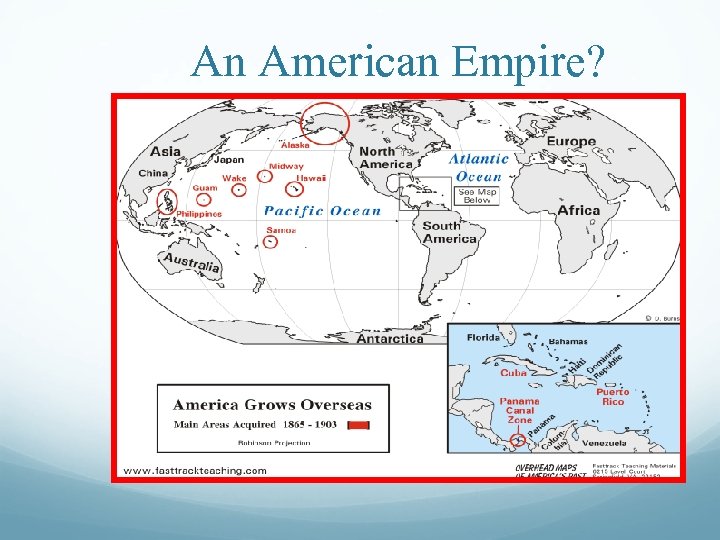
An American Empire?
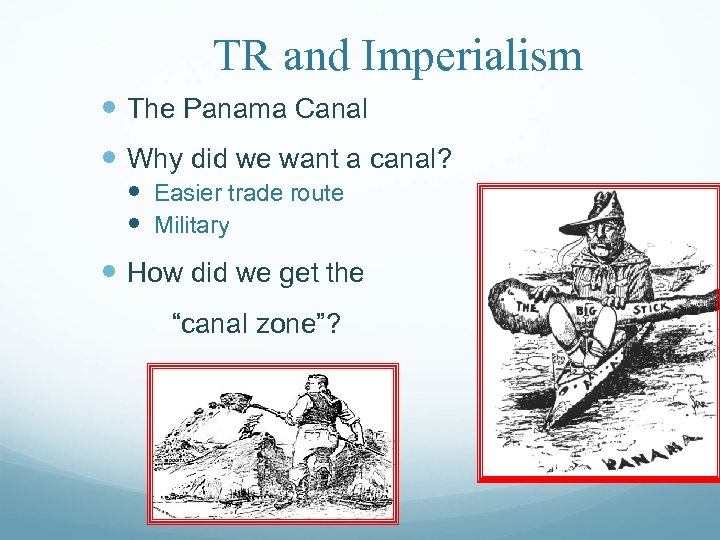
TR and Imperialism The Panama Canal Why did we want a canal? Easier trade route Military How did we get the “canal zone”?
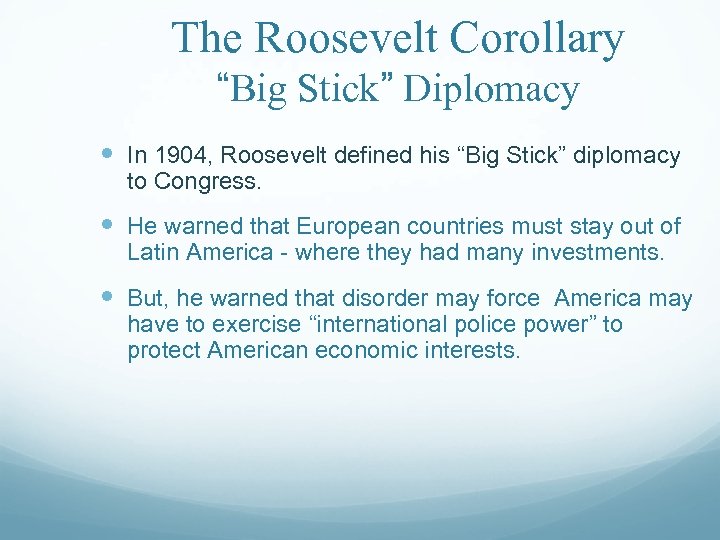
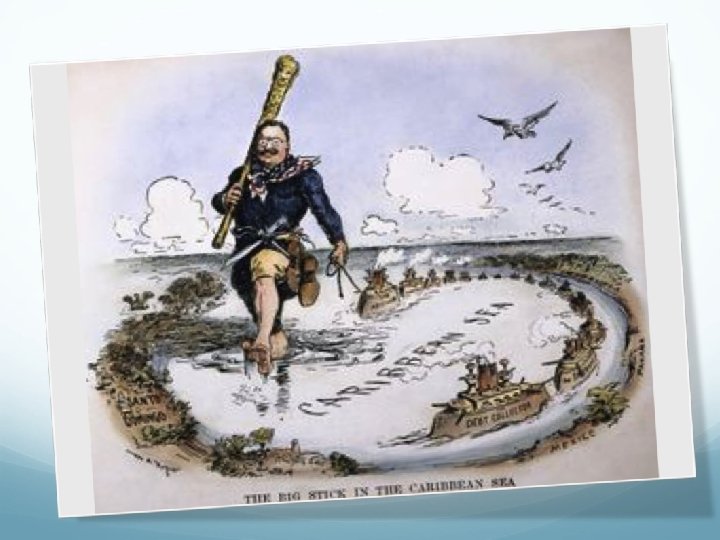
The Roosevelt Corollary “Big Stick” Diplomacy In 1904, Roosevelt defined his “Big Stick” diplomacy to Congress. He warned that European countries must stay out of Latin America - where they had many investments. But, he warned that disorder may force America may have to exercise “international police power” to protect American economic interests.
Taft = $Dollar$ Diplomacy Policy of using the U. S. Government to guarantee loans made to foreign countries by American businesses. Wilson = Missionary Diplomacy The U. S. had a moral responsibility to deny recognition to any Latin American government it viewed as oppressive, undemocratic or hostile to the U. S.
Problems with Mexico For the 30 years that Diaz ruled Mexico, the amount of American investments in the country increased dramatically. When a revolution would force Diaz from office, Wilson’s policies would be put immediately to a test because American business interests would be threatened. .
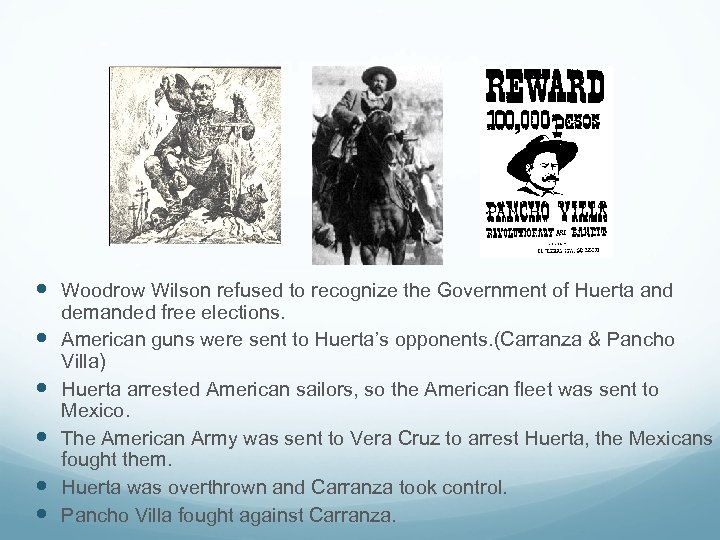
Woodrow Wilson refused to recognize the Government of Huerta and demanded free elections. American guns were sent to Huerta’s opponents. (Carranza & Pancho Villa) Huerta arrested American sailors, so the American fleet was sent to Mexico. The American Army was sent to Vera Cruz to arrest Huerta, the Mexicans fought them. Huerta was overthrown and Carranza took control. Pancho Villa fought against Carranza.
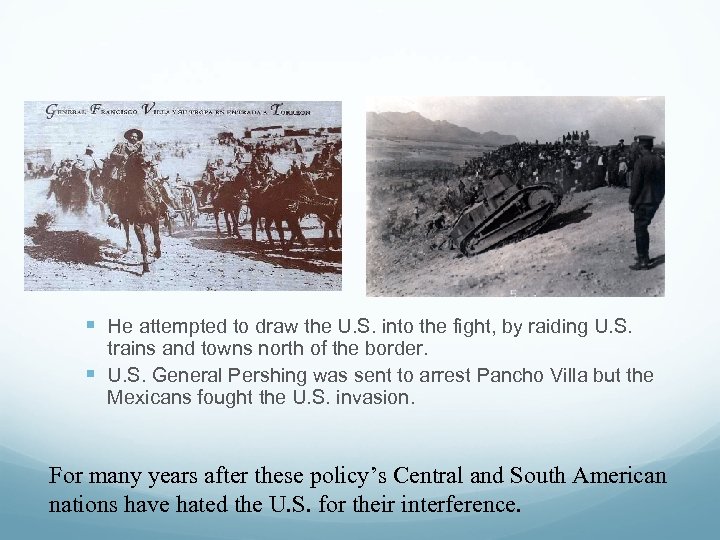
§ He attempted to draw the U. S. into the fight, by raiding U. S. trains and towns north of the border. § U. S. General Pershing was sent to arrest Pancho Villa but the Mexicans fought the U. S. invasion. For many years after these policy’s Central and South American nations have hated the U. S. for their interference.
Arguments Against Imperialism Nothing justifies domination of another country Some objected because claimed territories were not given Constitutional rights Cost of maintaining the military force needed for the program was too much The notion of Anglo-Saxon ethnic superiority was a threat to our country’s heritage “Anti-Imperialism”
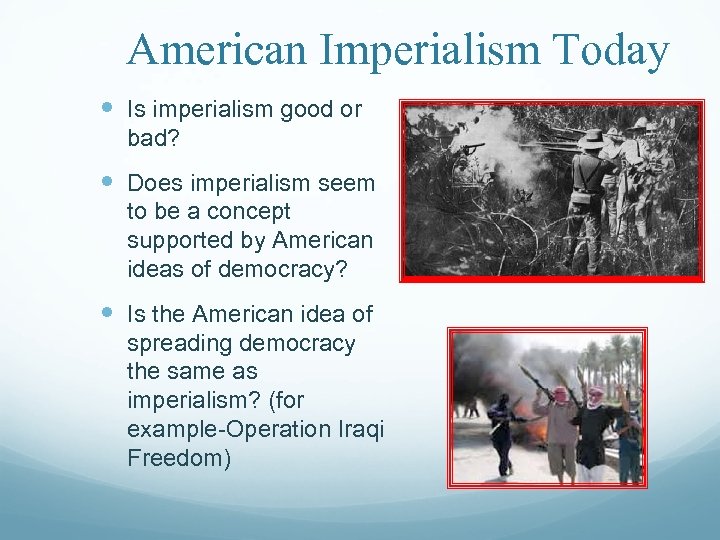
American Imperialism Today Is imperialism good or bad? Does imperialism seem to be a concept supported by American ideas of democracy? Is the American idea of spreading democracy the same as imperialism? (for example-Operation Iraqi Freedom)
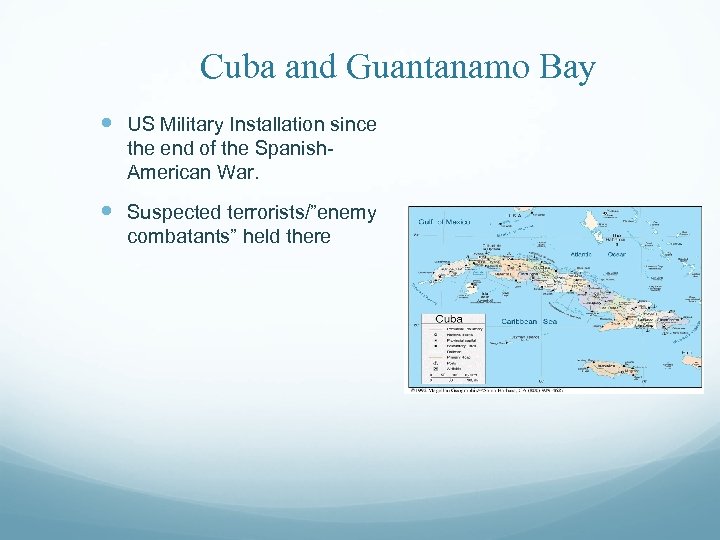
Cuba and Guantanamo Bay US Military Installation since the end of the Spanish. American War. Suspected terrorists/”enemy combatants” held there
Скачать презентацию U S History U S Imperialism Global
f97be5e28366b1b09b59d38dc9e365fd.ppt