 Скачать презентацию U S History January 2016 Warm Up Describe
7ea140ab7943796048eb728a8bd55de6.ppt
- Количество слайдов: 13



U. S. History January 2016 Warm Up: Describe the economic policy of 1920 s Republicans with one term. DOK: 1; S. 2; Learning Target: I can describe people, events, ideas and changes of the “roaring 20 s”, the “Jazz Age. ”
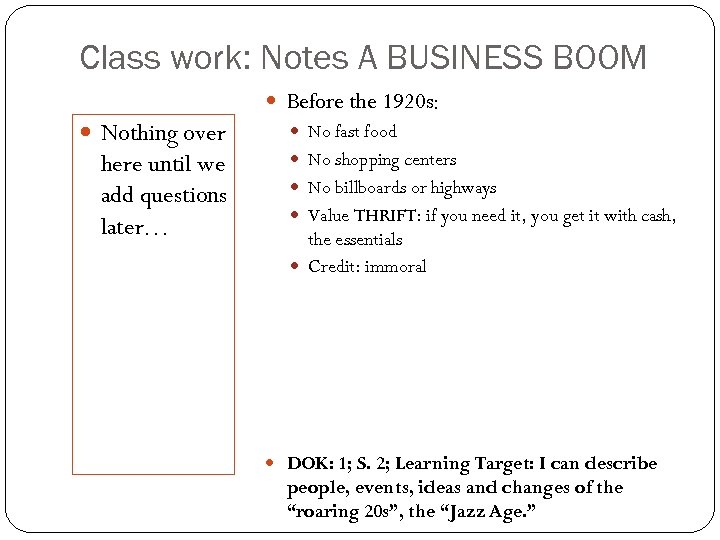
Class work: Notes A BUSINESS BOOM Nothing over here until we add questions later… Before the 1920 s: No fast food No shopping centers No billboards or highways Value THRIFT: if you need it, you get it with cash, the essentials Credit: immoral DOK: 1; S. 2; Learning Target: I can describe people, events, ideas and changes of the “roaring 20 s”, the “Jazz Age. ”
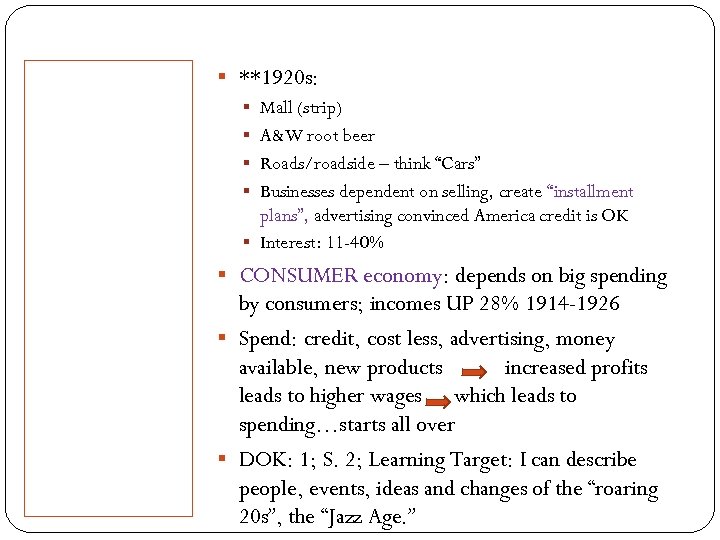
§ **1920 s: § Mall (strip) § A&W root beer § Roads/roadside – think “Cars” § Businesses dependent on selling, create “installment plans”, advertising convinced America credit is OK § Interest: 11 -40% § CONSUMER economy: depends on big spending by consumers; incomes UP 28% 1914 -1926 § Spend: credit, cost less, advertising, money available, new products increased profits leads to higher wages which leads to spending…starts all over § DOK: 1; S. 2; Learning Target: I can describe people, events, ideas and changes of the “roaring 20 s”, the “Jazz Age. ”
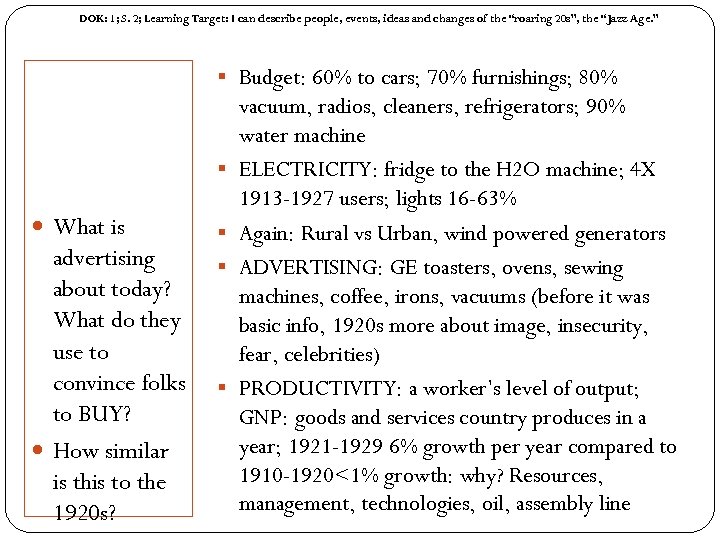
DOK: 1; S. 2; Learning Target: I can describe people, events, ideas and changes of the “roaring 20 s”, the “Jazz Age. ” § Budget: 60% to cars; 70% furnishings; 80% § What is advertising about today? What do they use to convince folks to BUY? How similar is this to the 1920 s? § § § vacuum, radios, cleaners, refrigerators; 90% water machine ELECTRICITY: fridge to the H 2 O machine; 4 X 1913 -1927 users; lights 16 -63% Again: Rural vs Urban, wind powered generators ADVERTISING: GE toasters, ovens, sewing machines, coffee, irons, vacuums (before it was basic info, 1920 s more about image, insecurity, fear, celebrities) PRODUCTIVITY: a worker’s level of output; GNP: goods and services country produces in a year; 1921 -1929 6% growth per year compared to 1910 -1920<1% growth: why? Resources, management, technologies, oil, assembly line
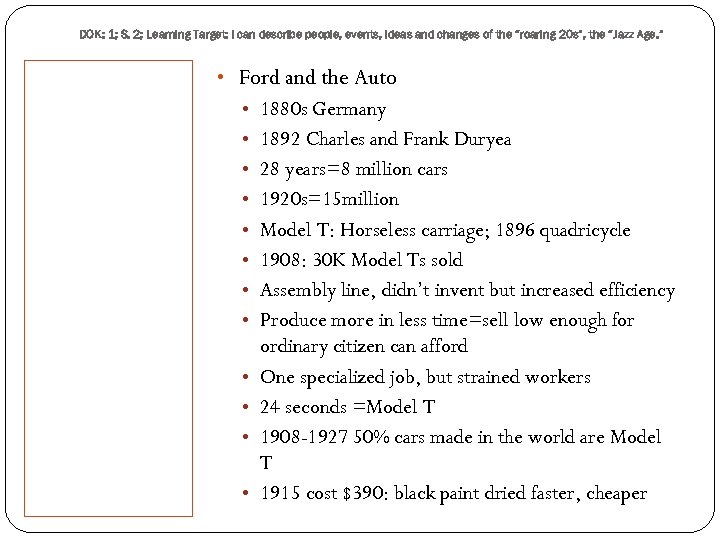
DOK: 1; S. 2; Learning Target: I can describe people, events, ideas and changes of the “roaring 20 s”, the “Jazz Age. ” • Ford and the Auto • 1880 s Germany • 1892 Charles and Frank Duryea • 28 years=8 million cars • 1920 s=15 million • Model T: Horseless carriage; 1896 quadricycle • 1908: 30 K Model Ts sold • Assembly line, didn’t invent but increased efficiency • Produce more in less time=sell low enough for • • ordinary citizen can afford One specialized job, but strained workers 24 seconds =Model T 1908 -1927 50% cars made in the world are Model T 1915 cost $390: black paint dried faster, cheaper
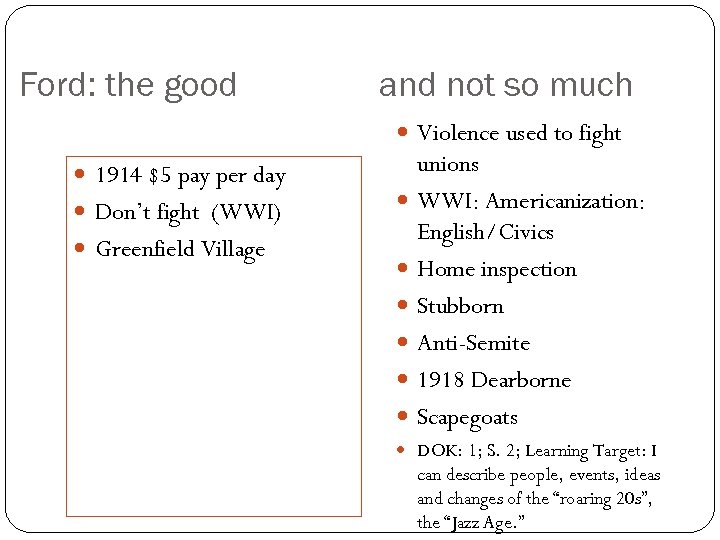
Ford: the good and not so much Violence used to fight 1914 $5 pay per day Don’t fight (WWI) Greenfield Village unions WWI: Americanization: English/Civics Home inspection Stubborn Anti-Semite 1918 Dearborne Scapegoats DOK: 1; S. 2; Learning Target: I can describe people, events, ideas and changes of the “roaring 20 s”, the “Jazz Age. ”
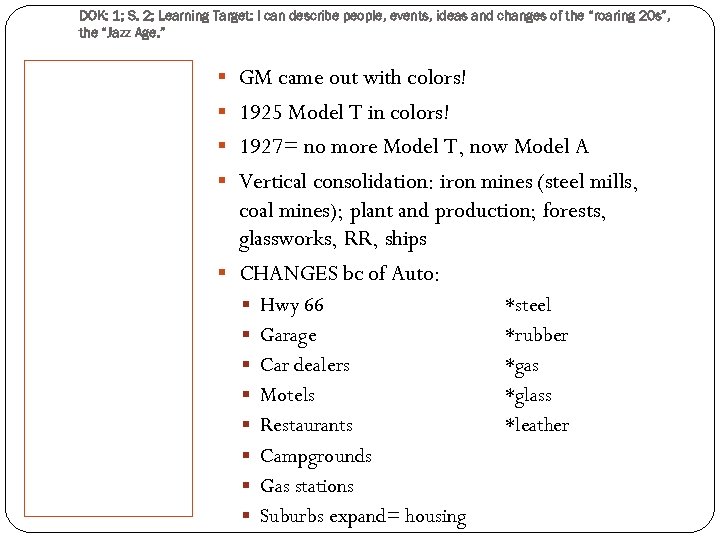
DOK: 1; S. 2; Learning Target: I can describe people, events, ideas and changes of the “roaring 20 s”, the “Jazz Age. ” § GM came out with colors! § 1925 Model T in colors! § 1927= no more Model T, now Model A § Vertical consolidation: iron mines (steel mills, coal mines); plant and production; forests, glassworks, RR, ships § CHANGES bc of Auto: § Hwy 66 § Garage § Car dealers § Motels § Restaurants § Campgrounds § Gas stations § Suburbs expand= housing *steel *rubber *gas *glass *leather
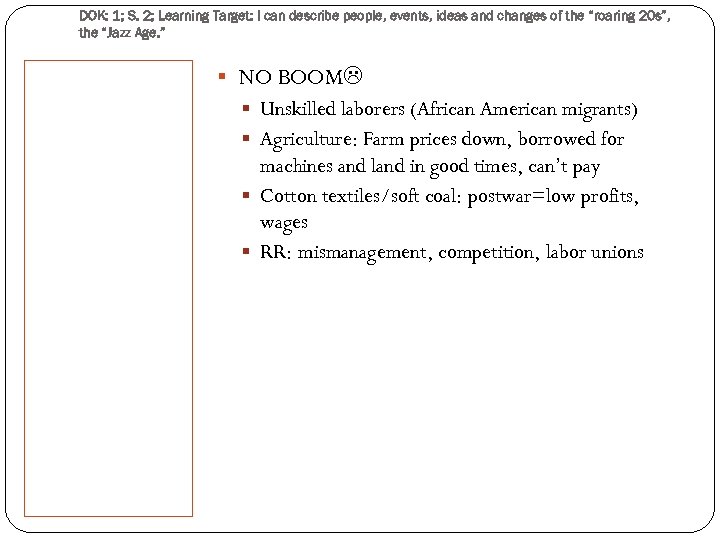
DOK: 1; S. 2; Learning Target: I can describe people, events, ideas and changes of the “roaring 20 s”, the “Jazz Age. ” § NO BOOM § Unskilled laborers (African American migrants) § Agriculture: Farm prices down, borrowed for machines and land in good times, can’t pay § Cotton textiles/soft coal: postwar=low profits, wages § RR: mismanagement, competition, labor unions
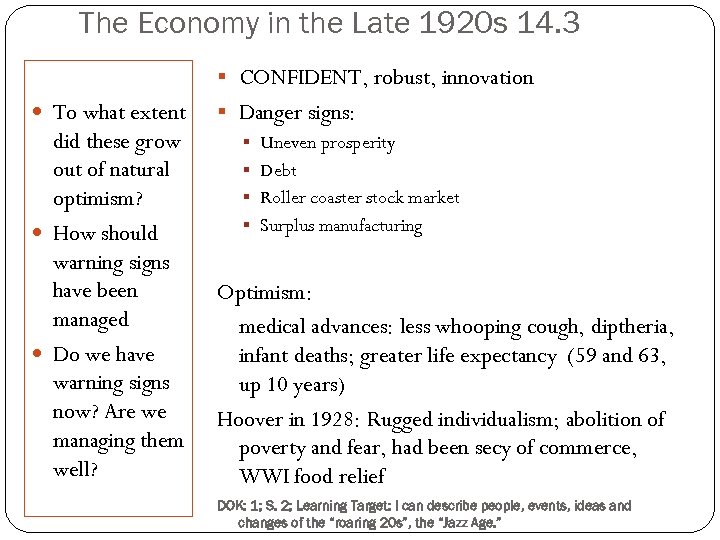
The Economy in the Late 1920 s 14. 3 § CONFIDENT, robust, innovation To what extent did these grow out of natural optimism? How should warning signs have been managed Do we have warning signs now? Are we managing them well? § Danger signs: § Uneven prosperity § Debt § Roller coaster stock market § Surplus manufacturing Optimism: medical advances: less whooping cough, diptheria, infant deaths; greater life expectancy (59 and 63, up 10 years) Hoover in 1928: Rugged individualism; abolition of poverty and fear, had been secy of commerce, WWI food relief DOK: 1; S. 2; Learning Target: I can describe people, events, ideas and changes of the “roaring 20 s”, the “Jazz Age. ”
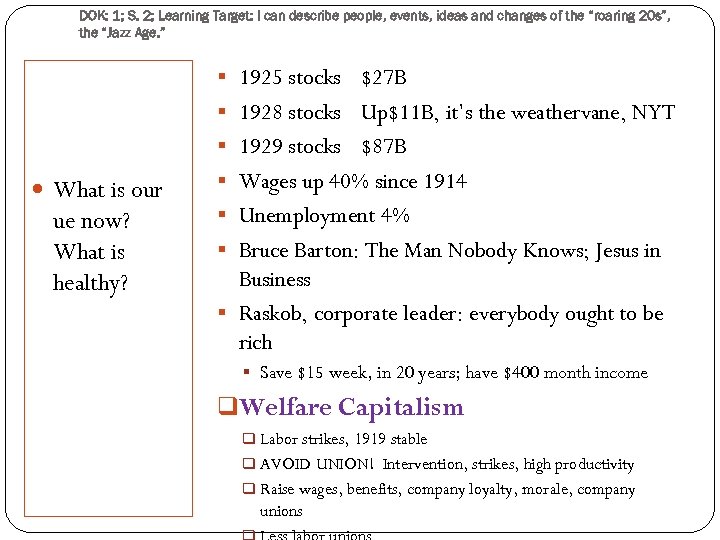
DOK: 1; S. 2; Learning Target: I can describe people, events, ideas and changes of the “roaring 20 s”, the “Jazz Age. ” § 1925 stocks $27 B § 1928 stocks Up$11 B, it’s the weathervane, NYT § 1929 stocks $87 B What is our ue now? What is healthy? § Wages up 40% since 1914 § Unemployment 4% § Bruce Barton: The Man Nobody Knows; Jesus in Business § Raskob, corporate leader: everybody ought to be rich § Save $15 week, in 20 years; have $400 month income q. Welfare Capitalism q Labor strikes, 1919 stable q AVOID UNION! Intervention, strikes, high productivity q Raise wages, benefits, company loyalty, morale, company unions
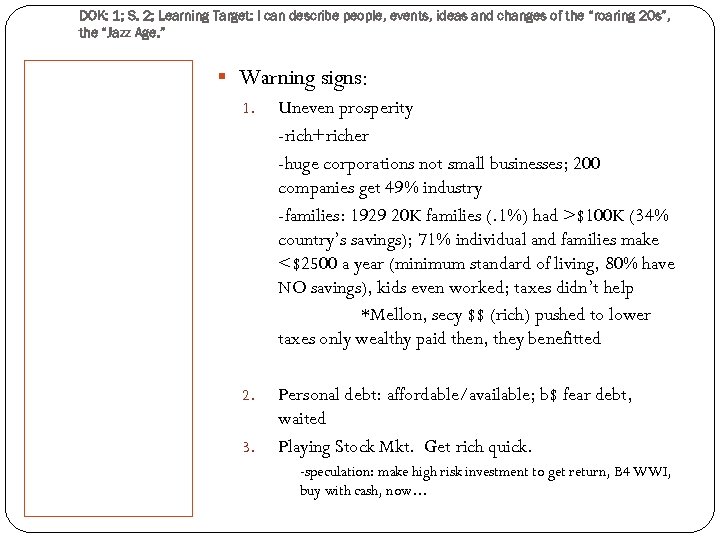
DOK: 1; S. 2; Learning Target: I can describe people, events, ideas and changes of the “roaring 20 s”, the “Jazz Age. ” § Warning signs: 1. Uneven prosperity -rich+richer -huge corporations not small businesses; 200 companies get 49% industry -families: 1929 20 K families (. 1%) had >$100 K (34% country’s savings); 71% individual and families make <$2500 a year (minimum standard of living, 80% have NO savings), kids even worked; taxes didn’t help *Mellon, secy $$ (rich) pushed to lower taxes only wealthy paid then, they benefitted 2. 3. Personal debt: affordable/available; b$ fear debt, waited Playing Stock Mkt. Get rich quick. -speculation: make high risk investment to get return, B 4 WWI, buy with cash, now…
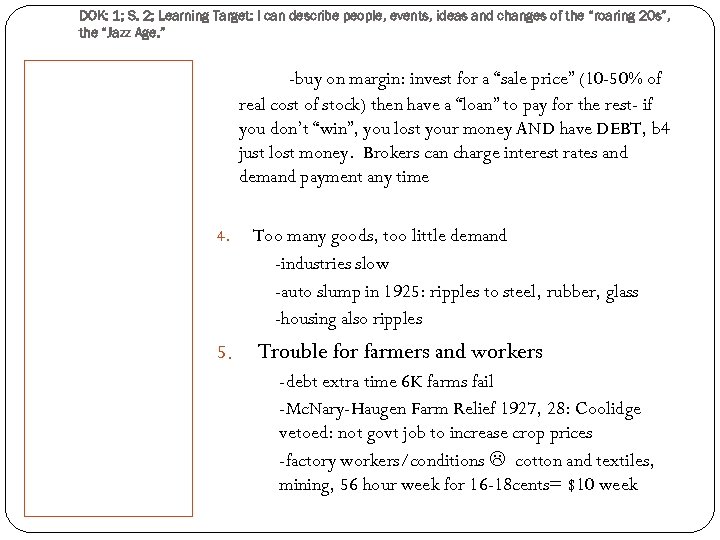
DOK: 1; S. 2; Learning Target: I can describe people, events, ideas and changes of the “roaring 20 s”, the “Jazz Age. ” -buy on margin: invest for a “sale price” (10 -50% of real cost of stock) then have a “loan” to pay for the rest- if you don’t “win”, you lost your money AND have DEBT, b 4 just lost money. Brokers can charge interest rates and demand payment any time 4. Too many goods, too little demand -industries slow -auto slump in 1925: ripples to steel, rubber, glass -housing also ripples 5. Trouble for farmers and workers -debt extra time 6 K farms fail -Mc. Nary-Haugen Farm Relief 1927, 28: Coolidge vetoed: not govt job to increase crop prices -factory workers/conditions cotton and textiles, mining, 56 hour week for 16 -18 cents= $10 week
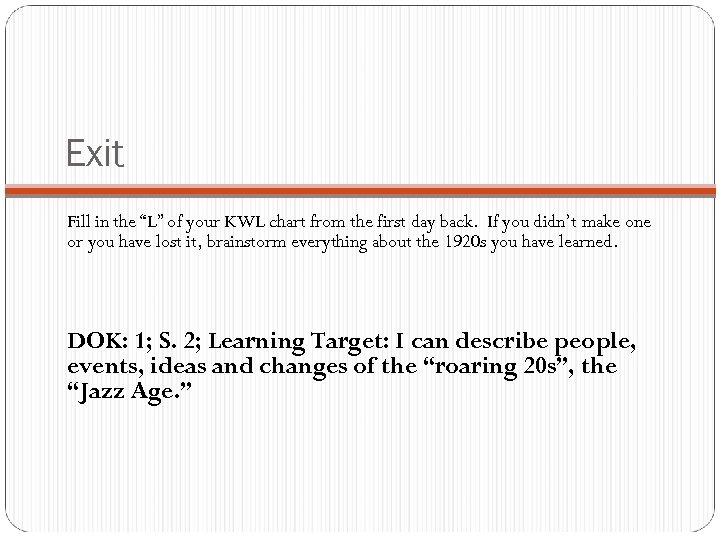
Exit Fill in the “L” of your KWL chart from the first day back. If you didn’t make one or you have lost it, brainstorm everything about the 1920 s you have learned. DOK: 1; S. 2; Learning Target: I can describe people, events, ideas and changes of the “roaring 20 s”, the “Jazz Age. ”
Скачать презентацию U S History January 2016 Warm Up Describe
7ea140ab7943796048eb728a8bd55de6.ppt