


 Скачать презентацию U S History-Honors Unit 3 An Emerging New
68b0f263a4bc76ddfa26b63aac0d1137.ppt
- Количество слайдов: 55
 U. S. History-Honors Unit 3: An Emerging New Nation (1783 -1850) Chapters 7 -9
 Directions: Complete the graphic organizer below indicating American scholars and artists of the late 17 th and early-18 th centuries. (pgs. 240 -241) Person Mercy Otis Warren Benjamin Rush Benjamin Banneker Charles Willson Peale Phillis Wheatley Noah Webster Cultural Importance
 • Republican Virtues – self-reliance, hard work, frugality, harmony, and sacrificing individual needs for the common good. • US population Ø 1780 – 2. 7 million Ø 1830 – 12 million Ø Why? Average birthrate ~5 children • Effects of a Mobile Society Ø Great opportunity to improve your life Ø Improved social skills to deal with new people and settings • Marriage Ø Courtship – longer periods of getting to know potential spouse
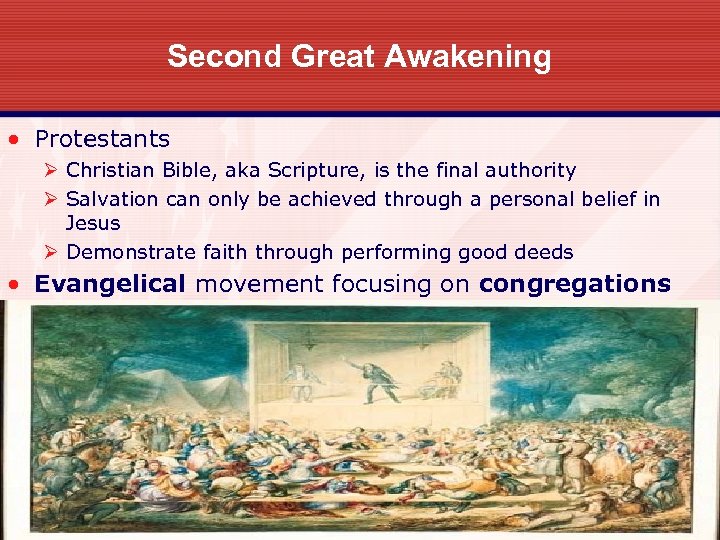 Second Great Awakening • Protestants Ø Christian Bible, aka Scripture, is the final authority Ø Salvation can only be achieved through a personal belief in Jesus Ø Demonstrate faith through performing good deeds • Evangelical movement focusing on congregations
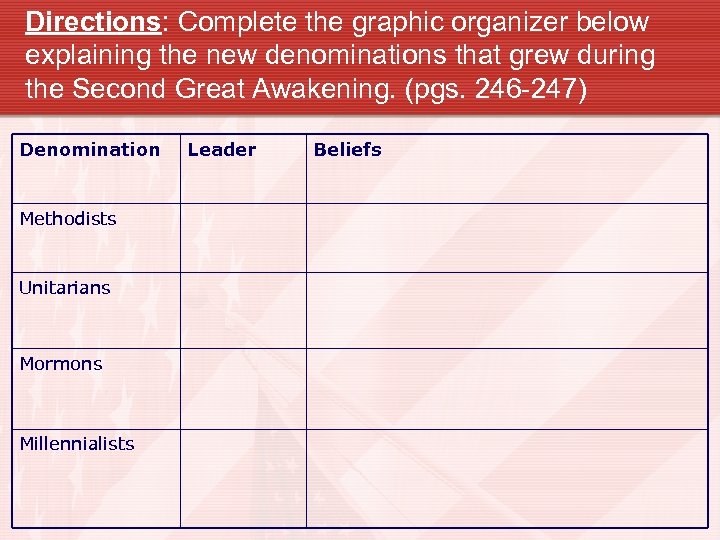 Directions: Complete the graphic organizer below explaining the new denominations that grew during the Second Great Awakening. (pgs. 246 -247) Denomination Methodists Unitarians Mormons Millennialists Leader Beliefs
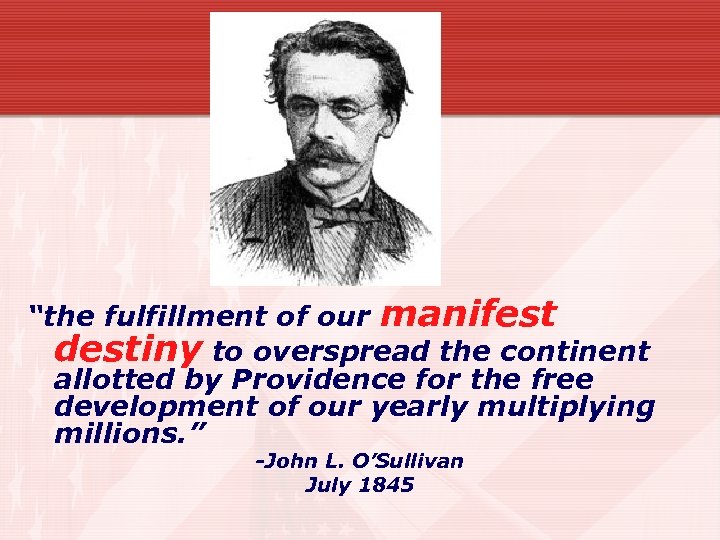 “the fulfillment of our manifest destiny to overspread the continent allotted by Providence for the free development of our yearly multiplying millions. ” -John L. O’Sullivan July 1845
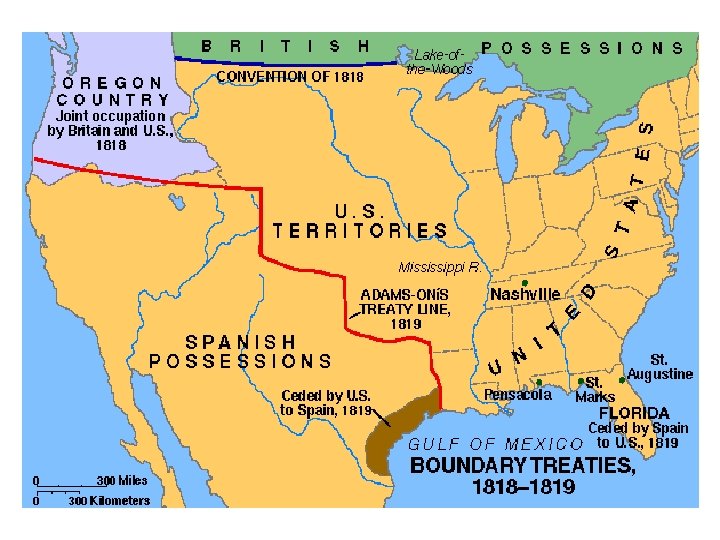
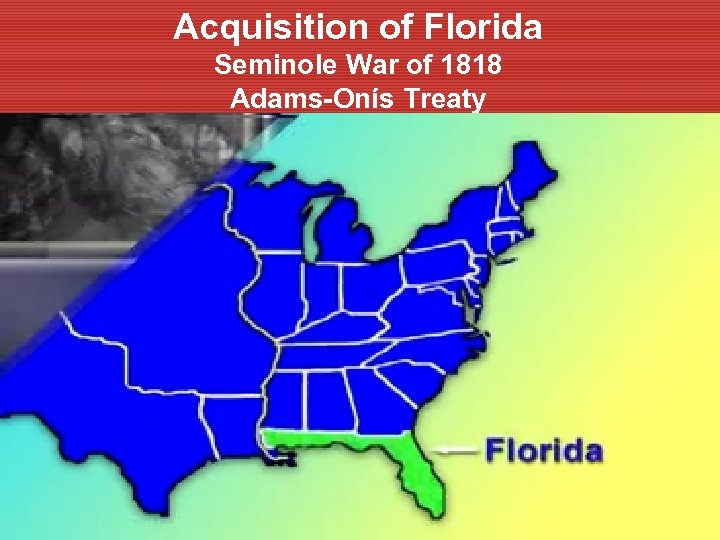 Acquisition of Florida Seminole War of 1818 Adams-Onís Treaty
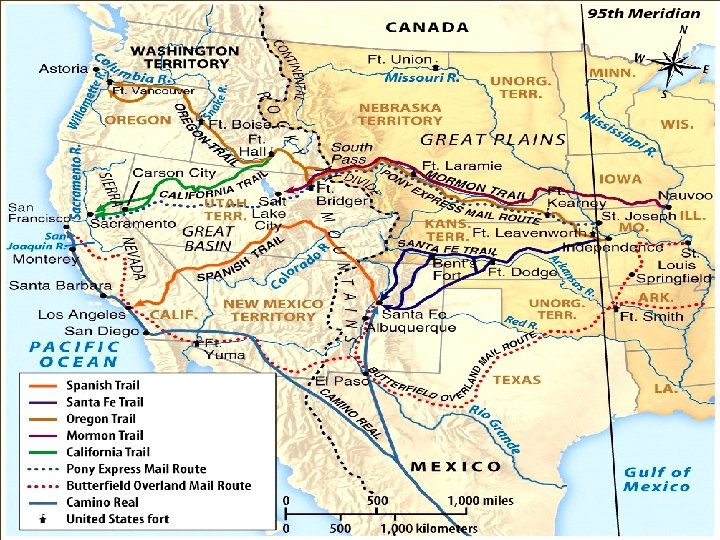
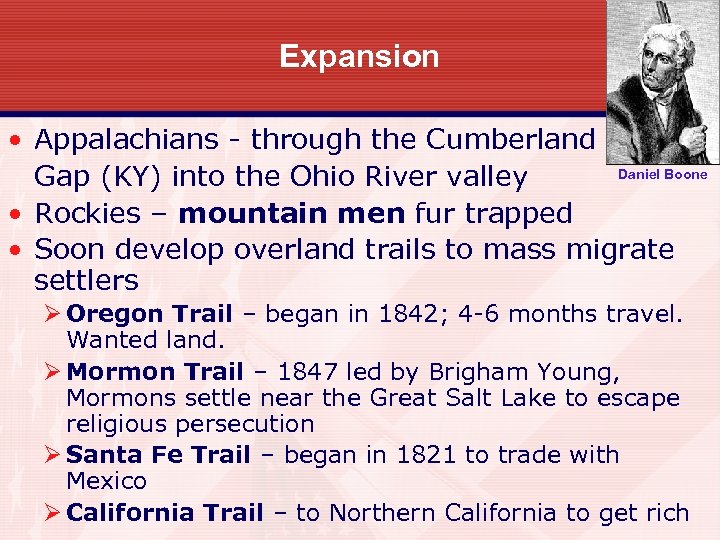 Expansion • Appalachians - through the Cumberland Daniel Boone Gap (KY) into the Ohio River valley • Rockies – mountain men fur trapped • Soon develop overland trails to mass migrate settlers Ø Oregon Trail – began in 1842; 4 -6 months travel. Wanted land. Ø Mormon Trail – 1847 led by Brigham Young, Mormons settle near the Great Salt Lake to escape religious persecution Ø Santa Fe Trail – began in 1821 to trade with Mexico Ø California Trail – to Northern California to get rich
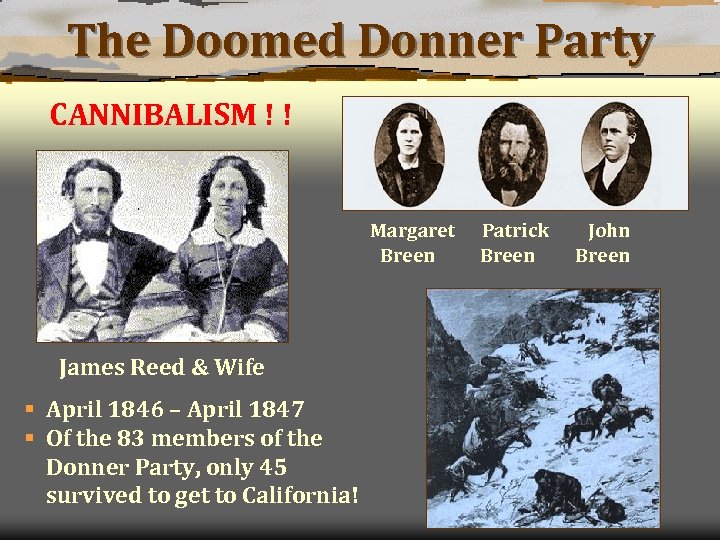 The Doomed Donner Party CANNIBALISM ! ! Margaret Breen James Reed & Wife § April 1846 – April 1847 § Of the 83 members of the Donner Party, only 45 survived to get to California! Patrick Breen John Breen
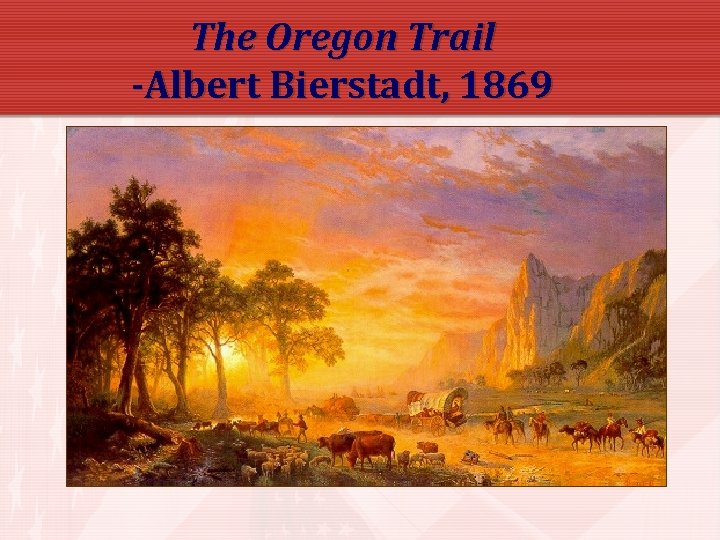 The Oregon Trail -Albert Bierstadt, 1869
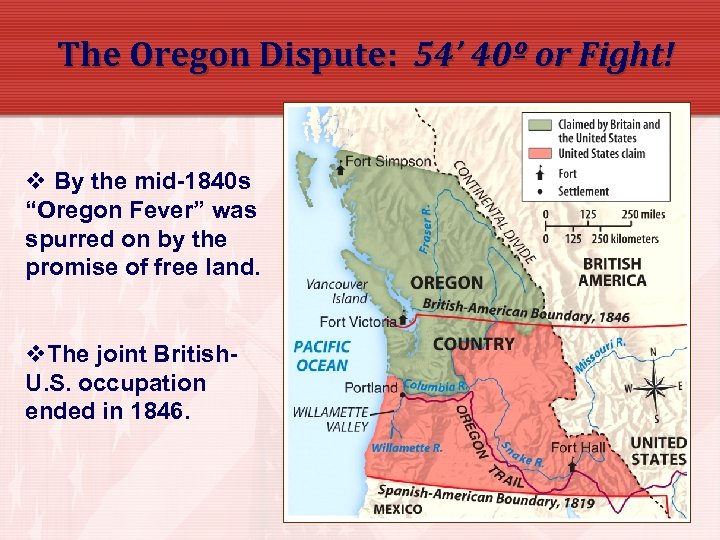 The Oregon Dispute: 54’ 40º or Fight! v By the mid-1840 s “Oregon Fever” was spurred on by the promise of free land. v. The joint British. U. S. occupation ended in 1846.
 California Gold Rush (1849)
 California Gold Rush (1849)
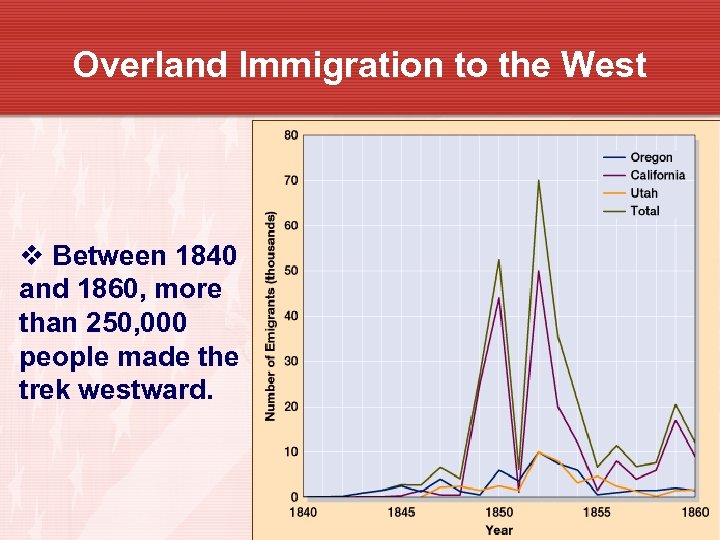 Overland Immigration to the West v Between 1840 and 1860, more than 250, 000 people made the trek westward.
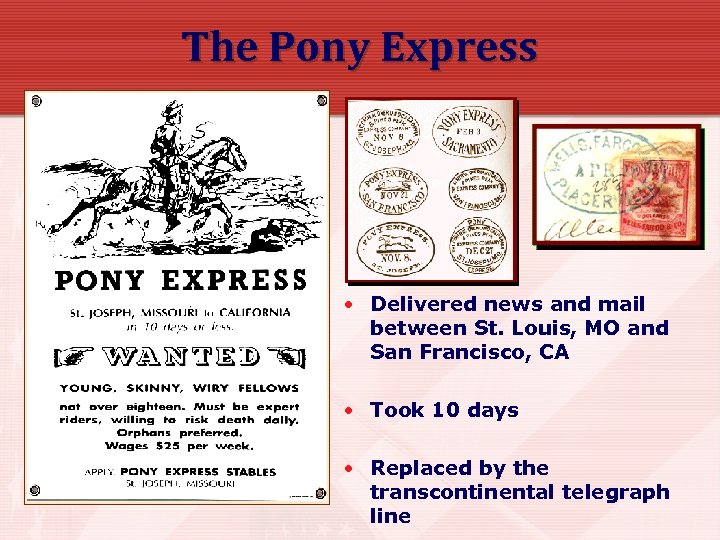 The Pony Express • Delivered news and mail between St. Louis, MO and San Francisco, CA • Took 10 days • Replaced by the transcontinental telegraph line
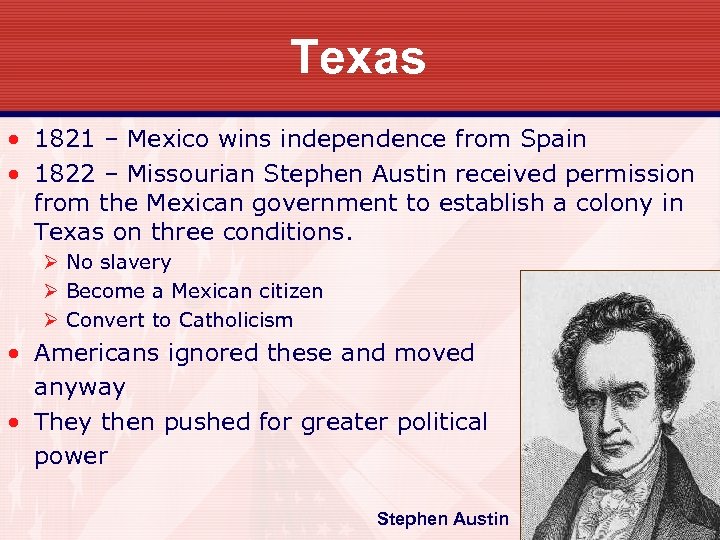 Texas • 1821 – Mexico wins independence from Spain • 1822 – Missourian Stephen Austin received permission from the Mexican government to establish a colony in Texas on three conditions. Ø No slavery Ø Become a Mexican citizen Ø Convert to Catholicism • Americans ignored these and moved anyway • They then pushed for greater political power Stephen Austin
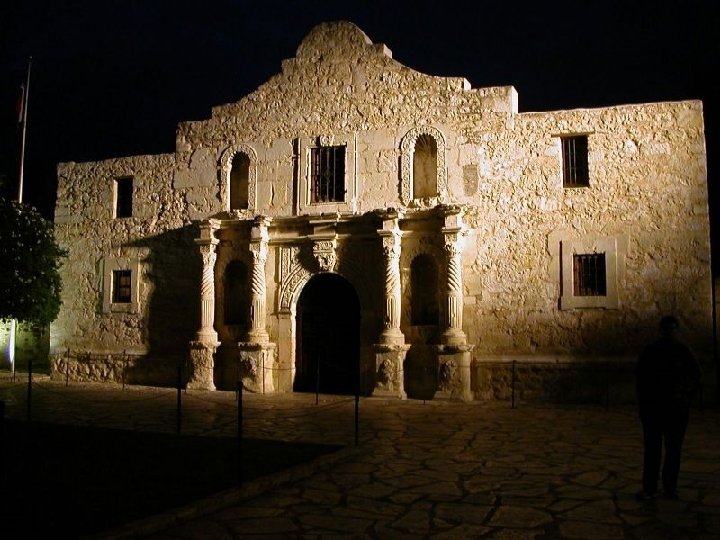
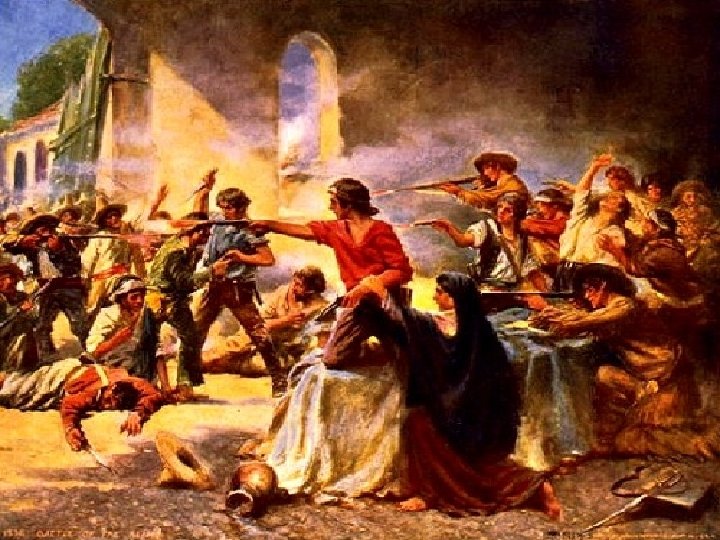
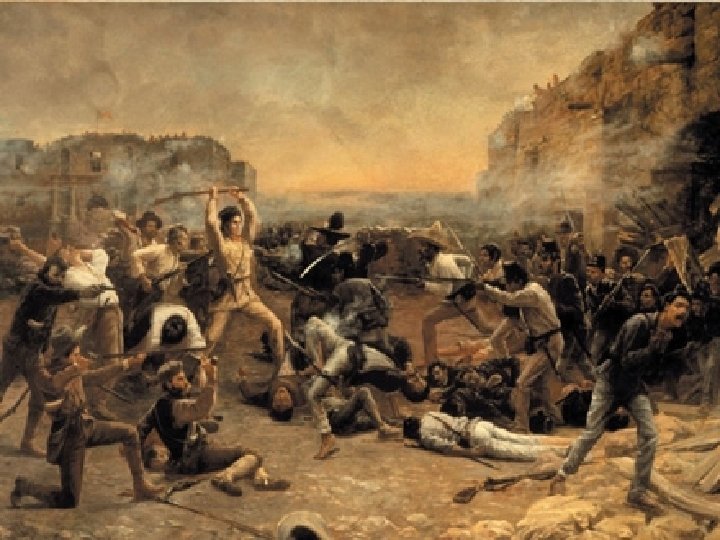
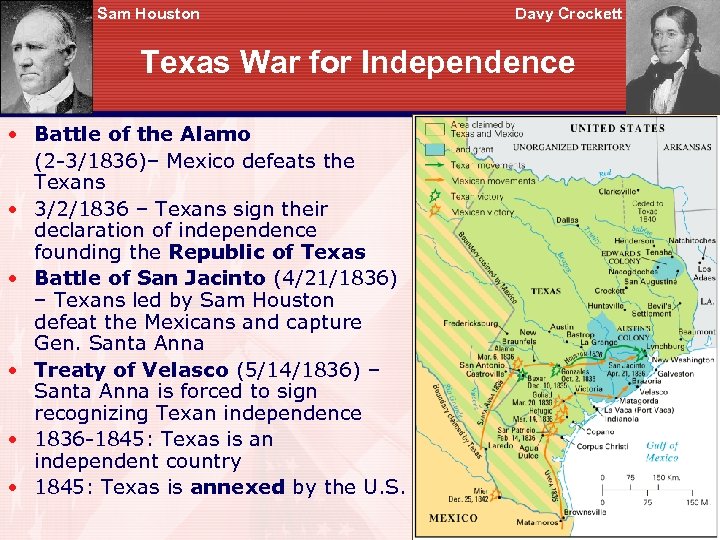 Sam Houston Davy Crockett Texas War for Independence • Battle of the Alamo (2 -3/1836)– Mexico defeats the Texans • 3/2/1836 – Texans sign their declaration of independence founding the Republic of Texas • Battle of San Jacinto (4/21/1836) – Texans led by Sam Houston defeat the Mexicans and capture Gen. Santa Anna • Treaty of Velasco (5/14/1836) – Santa Anna is forced to sign recognizing Texan independence • 1836 -1845: Texas is an independent country • 1845: Texas is annexed by the U. S.
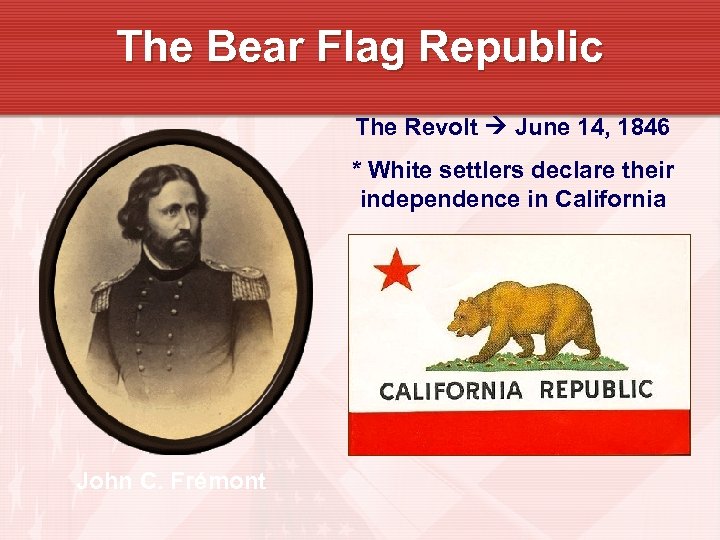 The Bear Flag Republic The Revolt June 14, 1846 * White settlers declare their independence in California John C. Frémont
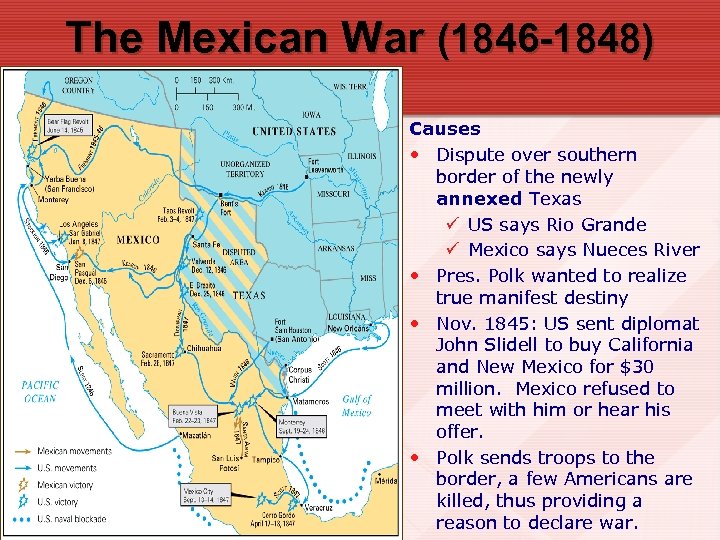 The Mexican War (1846 -1848) Causes • Dispute over southern border of the newly annexed Texas ü US says Rio Grande ü Mexico says Nueces River • Pres. Polk wanted to realize true manifest destiny • Nov. 1845: US sent diplomat John Slidell to buy California and New Mexico for $30 million. Mexico refused to meet with him or hear his offer. • Polk sends troops to the border, a few Americans are killed, thus providing a reason to declare war.
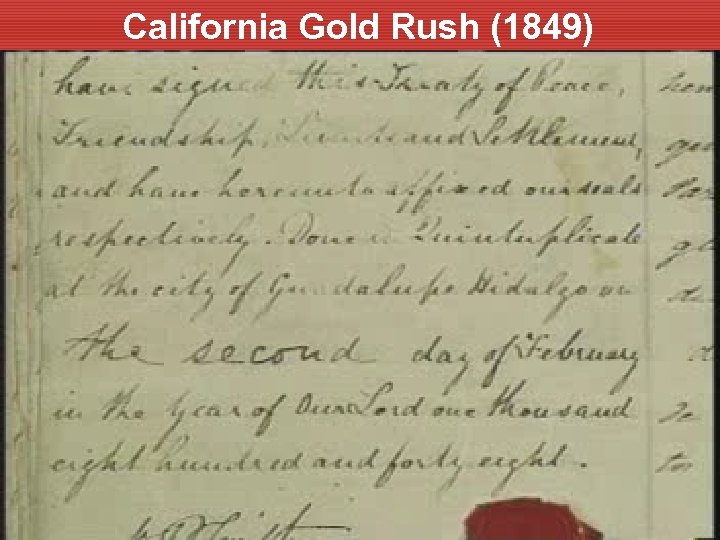
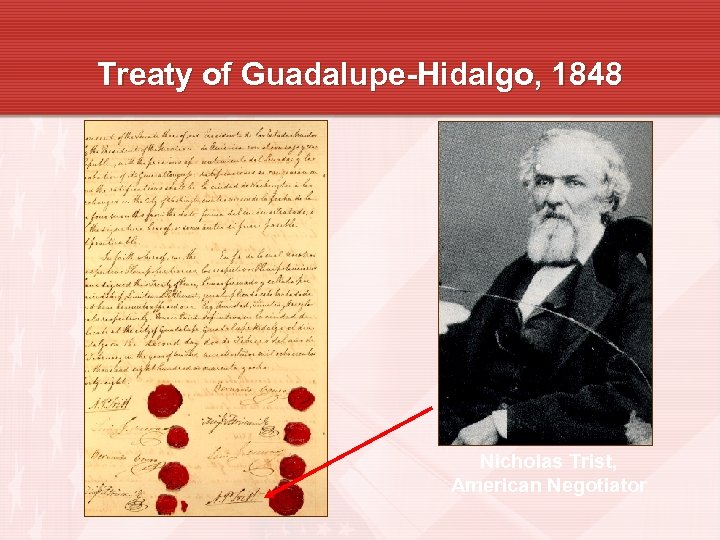 Treaty of Guadalupe-Hidalgo, 1848 Nicholas Trist, American Negotiator
 Treaty of Guadalupe-Hidalgo, 1848 § Mexico gave up claims to Texas north of the Rio Grande. § Mexico gave the U. S. California and New Mexico, plus the modern states of Nevada, Utah, Arizona, and parts of Wyoming & Colorado § U. S. gave Mexico $15, 000 and agreed to pay the claims of American citizens against Mexico (over $3, 500, 000).
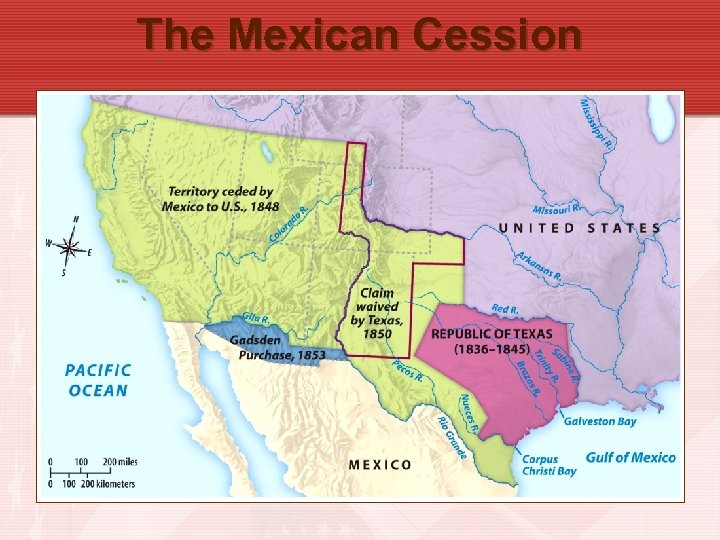 The Mexican Cession
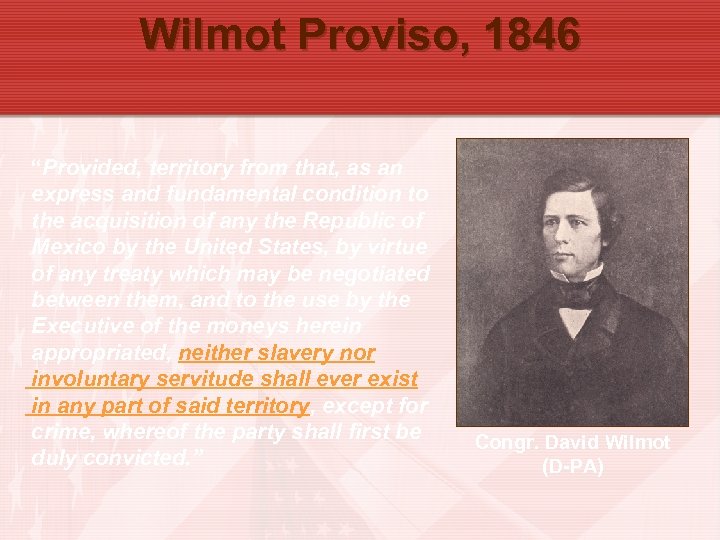 Wilmot Proviso, 1846 “Provided, territory from that, as an express and fundamental condition to the acquisition of any the Republic of Mexico by the United States, by virtue of any treaty which may be negotiated between them, and to the use by the Executive of the moneys herein appropriated, neither slavery nor involuntary servitude shall ever exist in any part of said territory, except for crime, whereof the party shall first be duly convicted. ” Congr. David Wilmot (D-PA)
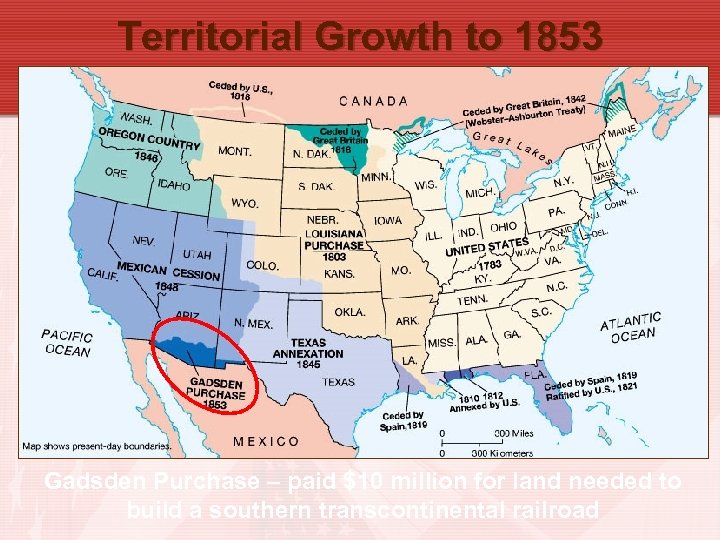 Territorial Growth to 1853 Gadsden Purchase – paid $10 million for land needed to build a southern transcontinental railroad
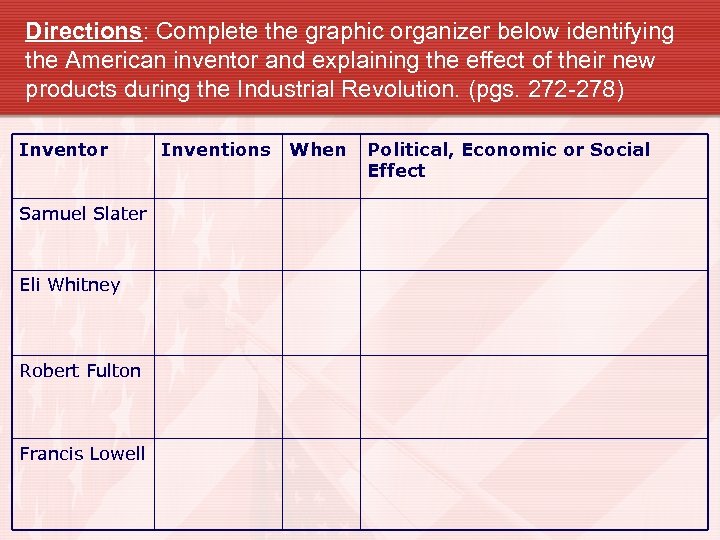 Directions: Complete the graphic organizer below identifying the American inventor and explaining the effect of their new products during the Industrial Revolution. (pgs. 272 -278) Inventor Samuel Slater Eli Whitney Robert Fulton Francis Lowell Inventions When Political, Economic or Social Effect
 Transportation Revolution • Roads – Cumberland (National) Road. Most were privately built for profit (i. e. tolls). • Rivers – acted as transportation themselves or to connect roads. Most important: Ohio and Mississippi • Canals – man-built waterways connecting waterways. Most important: Erie Canal – linked Atlantic Ocean with Great Lakes • Railroads – 1828: first railroad in America is constructed connecting Baltimore to the Ohio River (B&O)
 Market Revolution • America shifts from an agrarian to manufacturing economy, most notably in New England • Growth of the free enterprise system aka capitalism • People work outside of the home in specialized jobs • Less self-sufficiency leads to more shopping • Banking – first appears in the 1780 s Ø Loan people money and charge interest thus making a profit Ø Uncontrolled lending led to economic recessions/depressions called “Panics” in 1819, 1837 & 1839 Ø Banks created bank notes rather than deal in specie
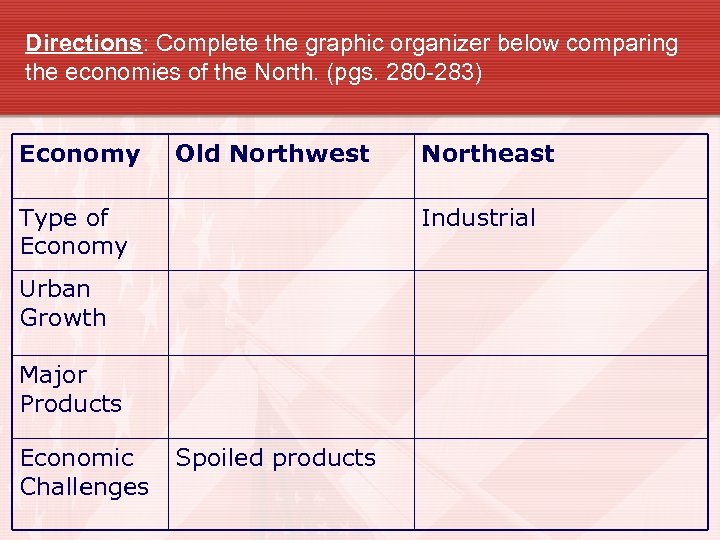 Directions: Complete the graphic organizer below comparing the economies of the North. (pgs. 280 -283) Economy Old Northwest Type of Economy Industrial Urban Growth Major Products Economic Challenges Northeast Spoiled products
 Growth of Northern Cities & Labor • Manufacturing led to migration to cities from rural areas • Standard of living was very poor Ø Unsanitary: no sewage or fresh water Ø Lived in tenements • New factories were designed to make $ • Thus they paid laborers very little and forced them to work long hours (12+ a day) • Led to workers going on strike and forming Labor Unions to protect their interests
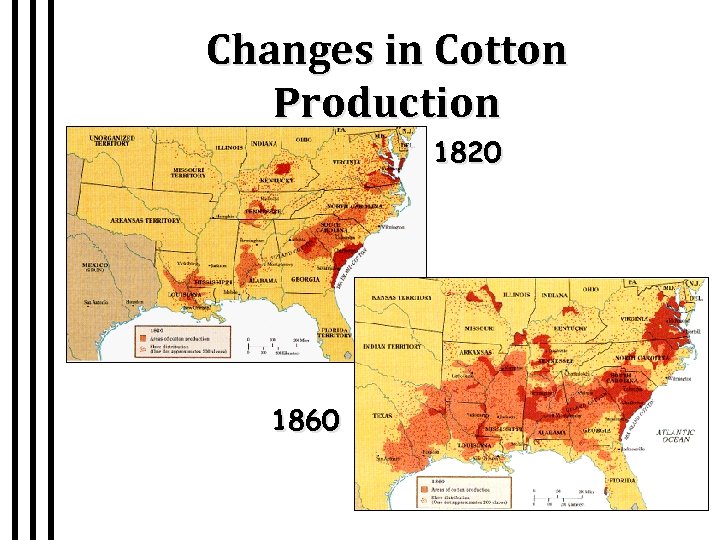 Changes in Cotton Production 1820 1860
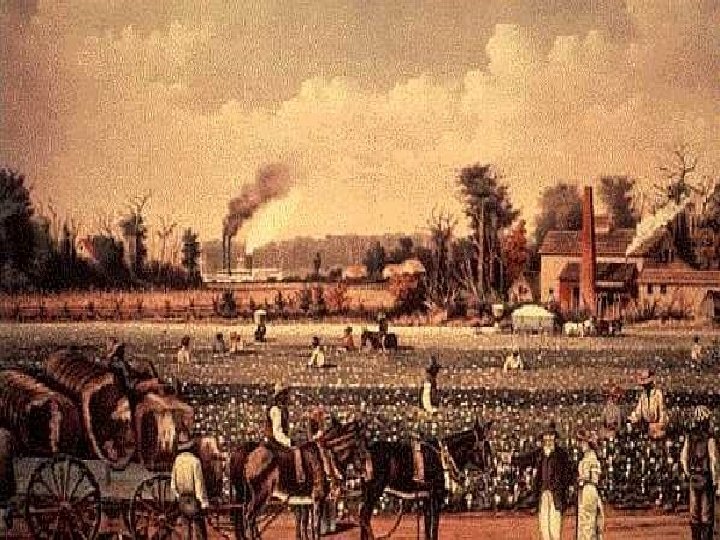
 Southern Economy • “King Cotton” – nearly all southern states were dependent on cotton production Ø Virginia and North Carolina stuck with tobacco • Rural Ø Very few major cities – Richmond, VA; Charleston, SC & New Orleans, LA Ø Very little industry, roads, railroads, or banks üThus dependent on the North and Europe
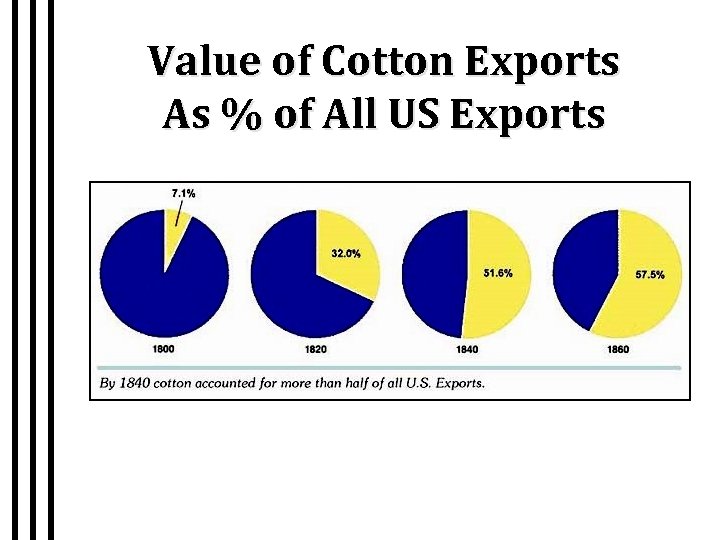 Value of Cotton Exports As % of All US Exports
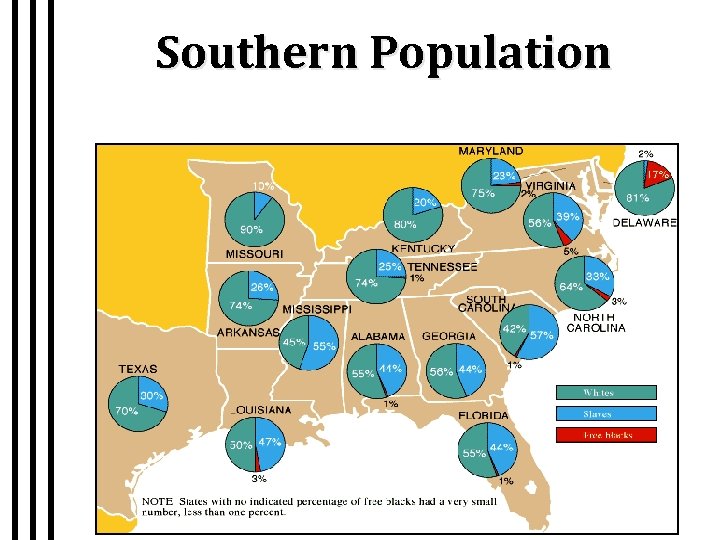 Southern Population
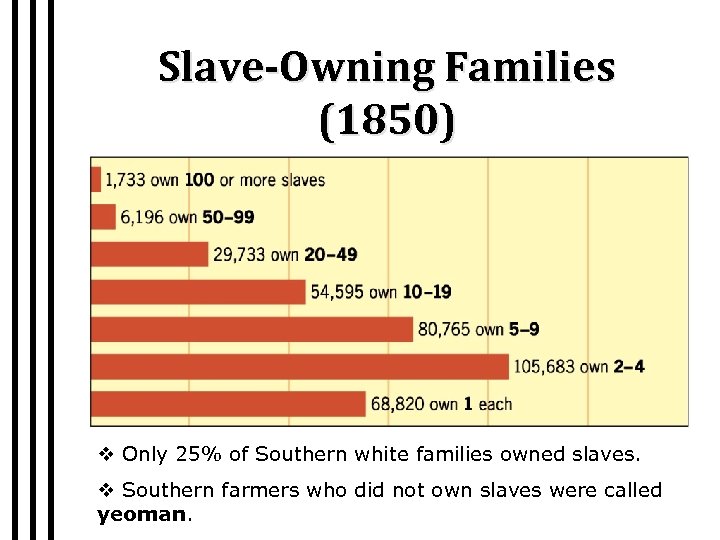 Slave-Owning Families (1850) v Only 25% of Southern white families owned slaves. v Southern farmers who did not own slaves were called yeoman.
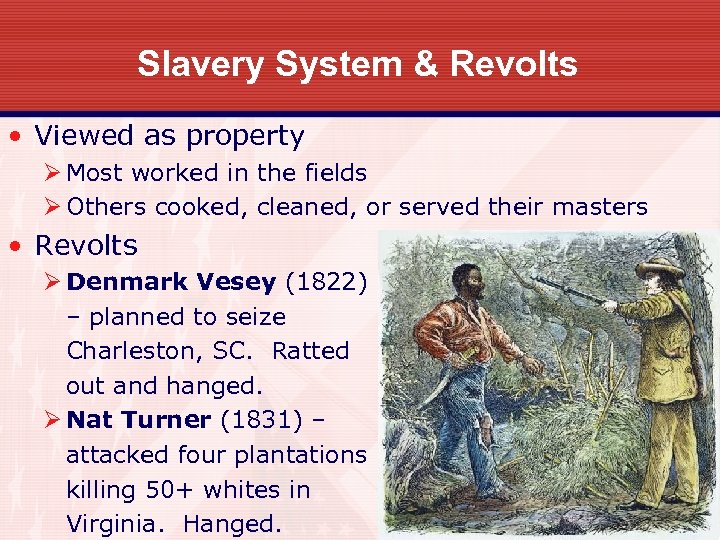 Slavery System & Revolts • Viewed as property Ø Most worked in the fields Ø Others cooked, cleaned, or served their masters • Revolts Ø Denmark Vesey (1822) – planned to seize Charleston, SC. Ratted out and hanged. Ø Nat Turner (1831) – attacked four plantations killing 50+ whites in Virginia. Hanged.
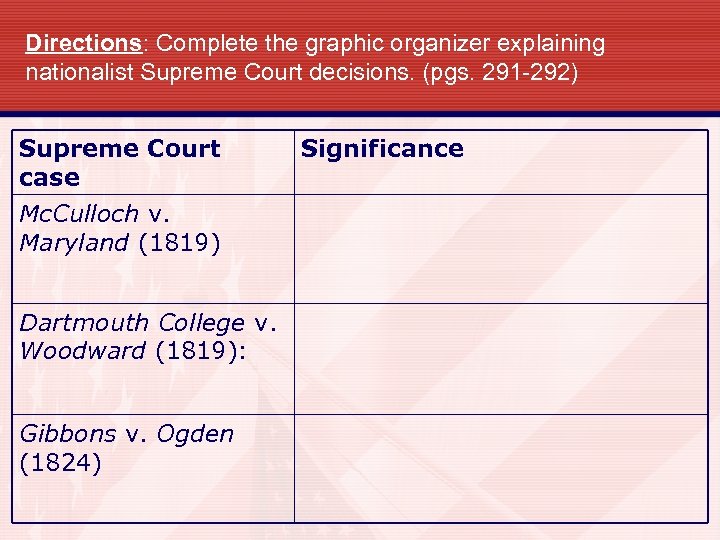 Directions: Complete the graphic organizer explaining nationalist Supreme Court decisions. (pgs. 291 -292) Supreme Court case Mc. Culloch v. Maryland (1819) Dartmouth College v. Woodward (1819): Gibbons v. Ogden (1824) Significance
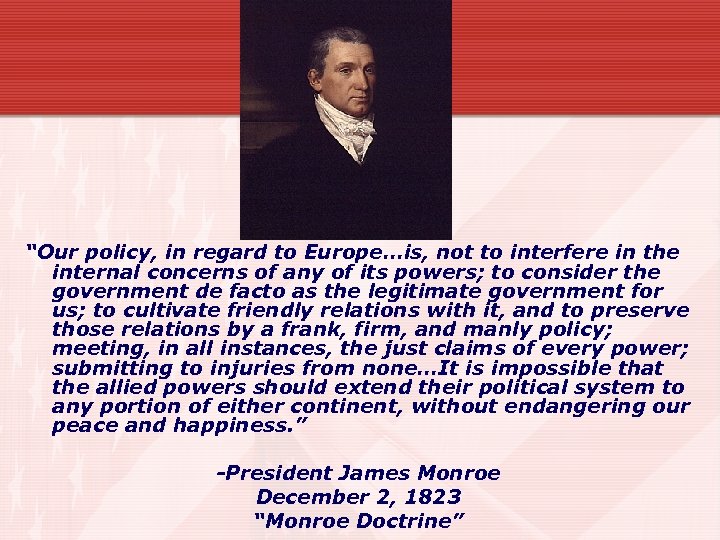 “Our policy, in regard to Europe…is, not to interfere in the internal concerns of any of its powers; to consider the government de facto as the legitimate government for us; to cultivate friendly relations with it, and to preserve those relations by a frank, firm, and manly policy; meeting, in all instances, the just claims of every power; submitting to injuries from none…It is impossible that the allied powers should extend their political system to any portion of either continent, without endangering our peace and happiness. ” -President James Monroe December 2, 1823 “Monroe Doctrine”
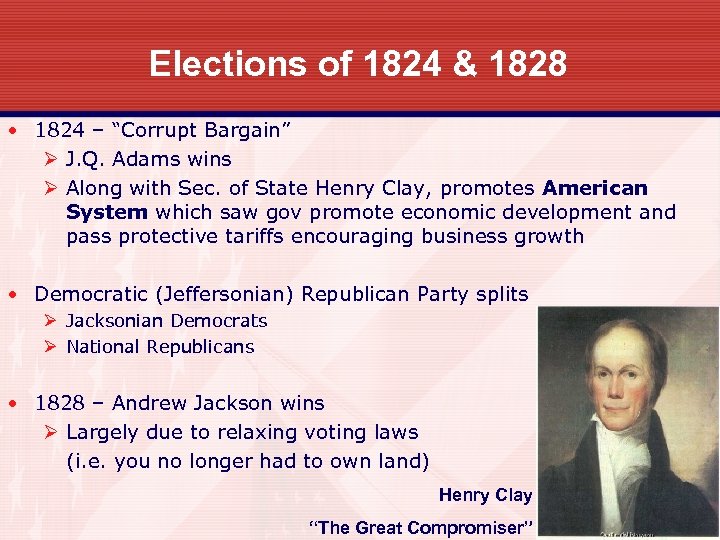 Elections of 1824 & 1828 • 1824 – “Corrupt Bargain” Ø J. Q. Adams wins Ø Along with Sec. of State Henry Clay, promotes American System which saw gov promote economic development and pass protective tariffs encouraging business growth • Democratic (Jeffersonian) Republican Party splits Ø Jacksonian Democrats Ø National Republicans • 1828 – Andrew Jackson wins Ø Largely due to relaxing voting laws (i. e. you no longer had to own land) Henry Clay “The Great Compromiser”
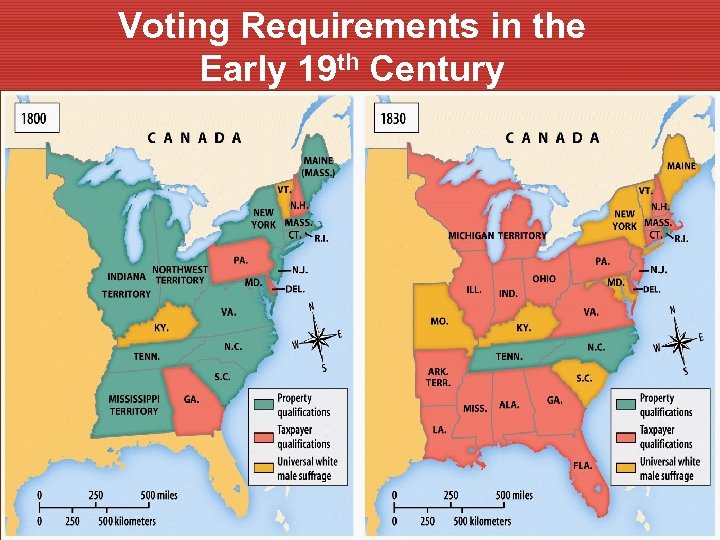 Voting Requirements in the Early 19 th Century
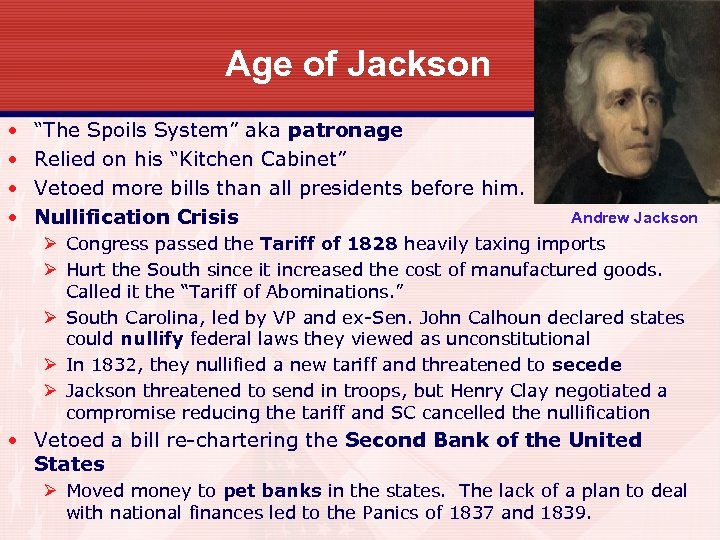 Age of Jackson • • “The Spoils System” aka patronage Relied on his “Kitchen Cabinet” Vetoed more bills than all presidents before him. Nullification Crisis Andrew Jackson Ø Congress passed the Tariff of 1828 heavily taxing imports Ø Hurt the South since it increased the cost of manufactured goods. Called it the “Tariff of Abominations. ” Ø South Carolina, led by VP and ex-Sen. John Calhoun declared states could nullify federal laws they viewed as unconstitutional Ø In 1832, they nullified a new tariff and threatened to secede Ø Jackson threatened to send in troops, but Henry Clay negotiated a compromise reducing the tariff and SC cancelled the nullification • Vetoed a bill re-chartering the Second Bank of the United States Ø Moved money to pet banks in the states. The lack of a plan to deal with national finances led to the Panics of 1837 and 1839.
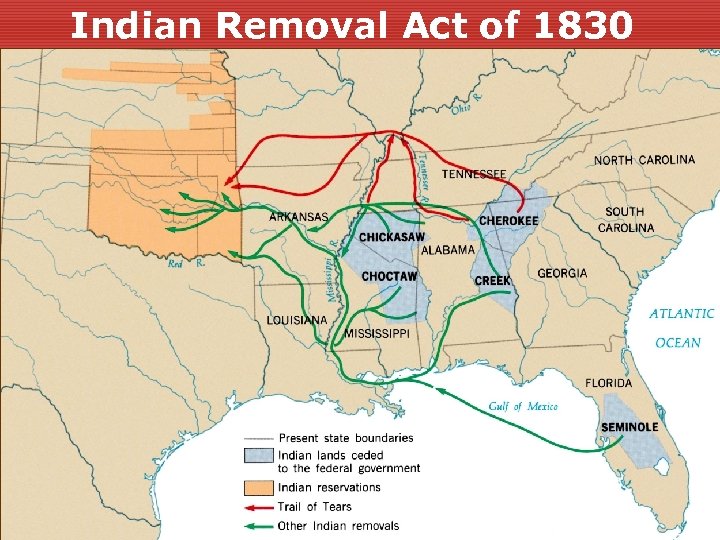 Indian Removal Act of 1830
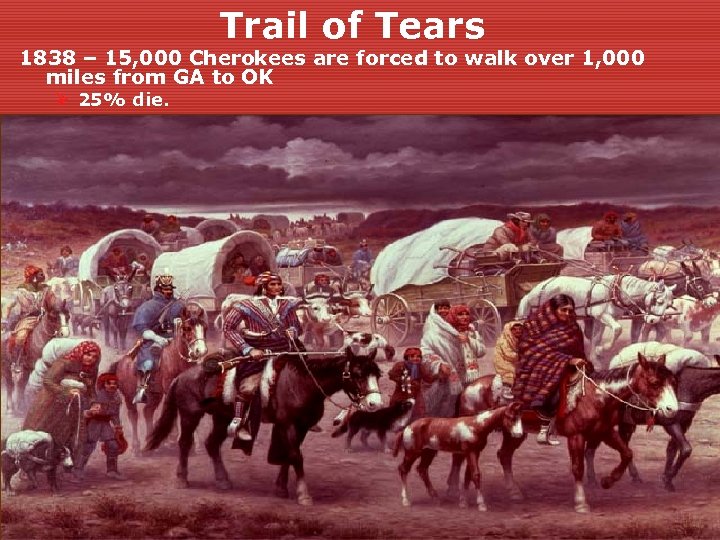 Trail of Tears 1838 – 15, 000 Cherokees are forced to walk over 1, 000 miles from GA to OK Ø 25% die.
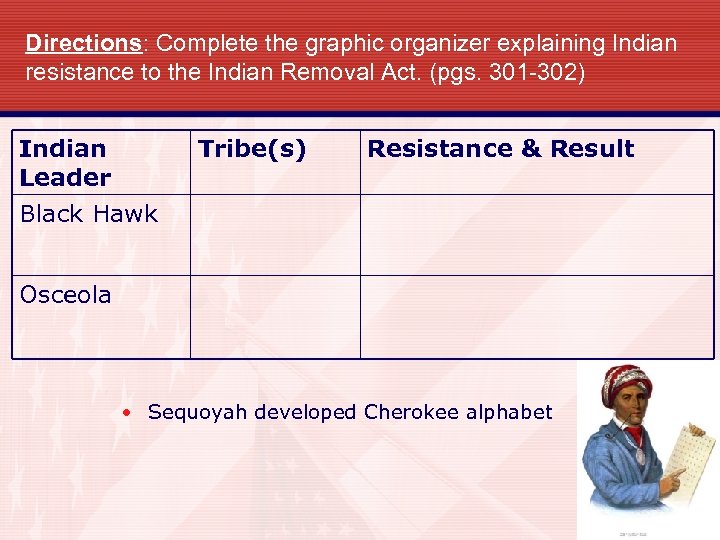 Directions: Complete the graphic organizer explaining Indian resistance to the Indian Removal Act. (pgs. 301 -302) Indian Leader Tribe(s) Resistance & Result Black Hawk Osceola • Sequoyah developed Cherokee alphabet
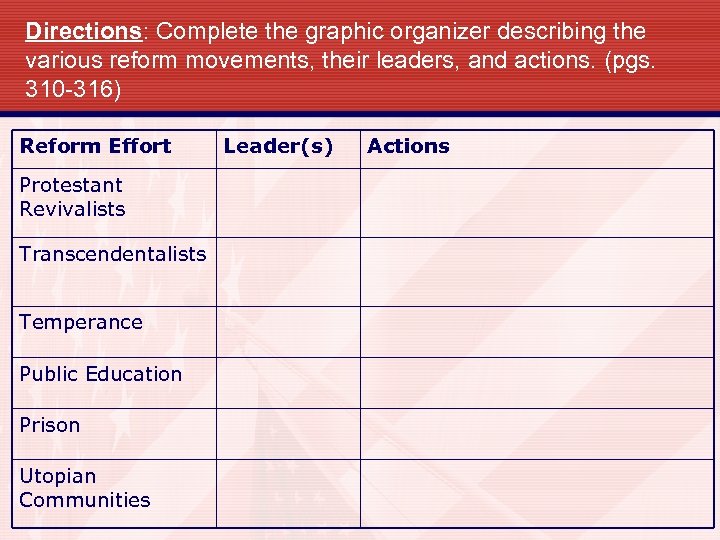 Directions: Complete the graphic organizer describing the various reform movements, their leaders, and actions. (pgs. 310 -316) Reform Effort Protestant Revivalists Transcendentalists Temperance Public Education Prison Utopian Communities Leader(s) Actions
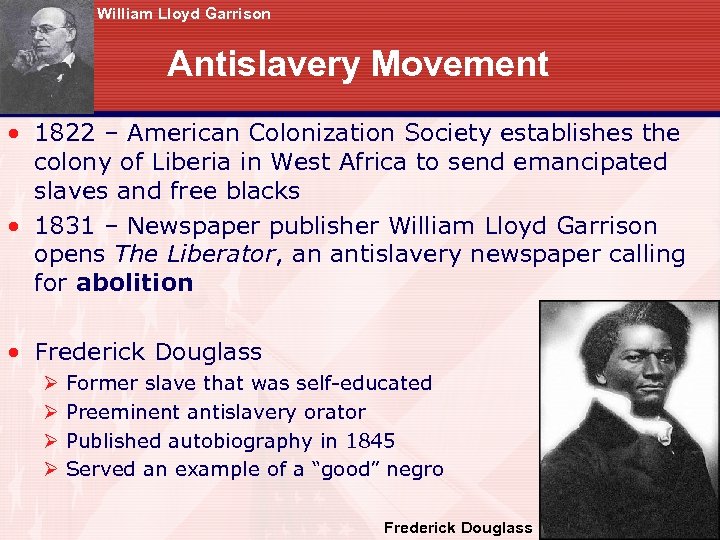 William Lloyd Garrison Antislavery Movement • 1822 – American Colonization Society establishes the colony of Liberia in West Africa to send emancipated slaves and free blacks • 1831 – Newspaper publisher William Lloyd Garrison opens The Liberator, an antislavery newspaper calling for abolition • Frederick Douglass Ø Ø Former slave that was self-educated Preeminent antislavery orator Published autobiography in 1845 Served an example of a “good” negro Frederick Douglass
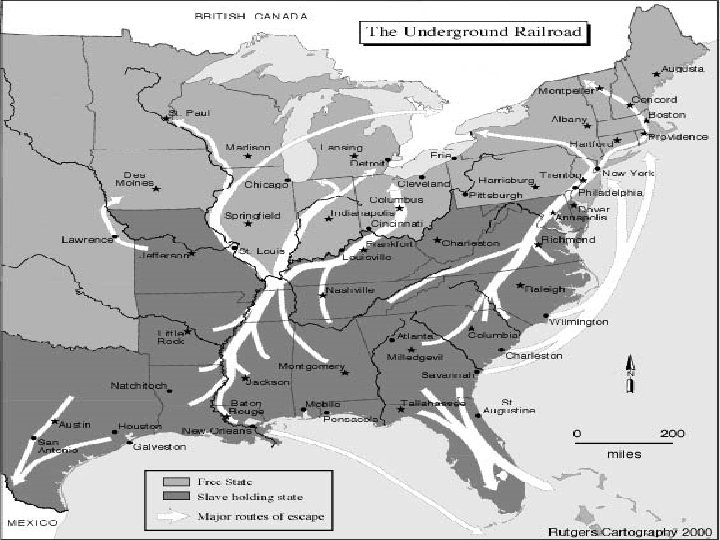
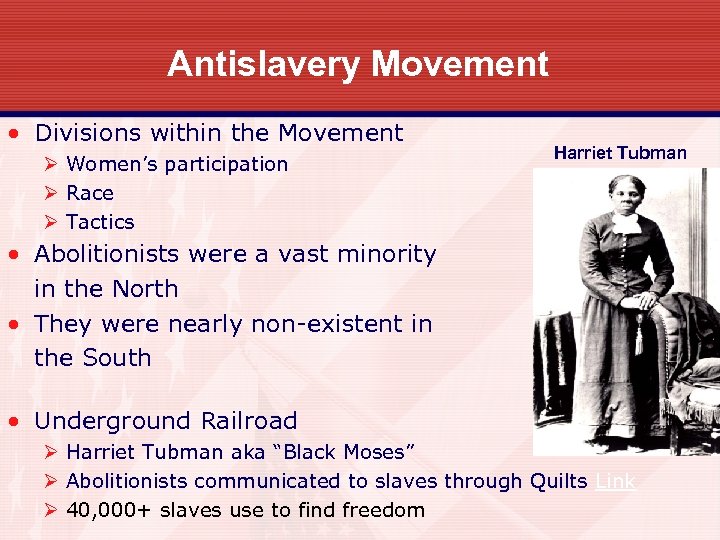 Antislavery Movement • Divisions within the Movement Ø Women’s participation Ø Race Ø Tactics Harriet Tubman • Abolitionists were a vast minority in the North • They were nearly non-existent in the South • Underground Railroad Ø Harriet Tubman aka “Black Moses” Ø Abolitionists communicated to slaves through Quilts Link Ø 40, 000+ slaves use to find freedom
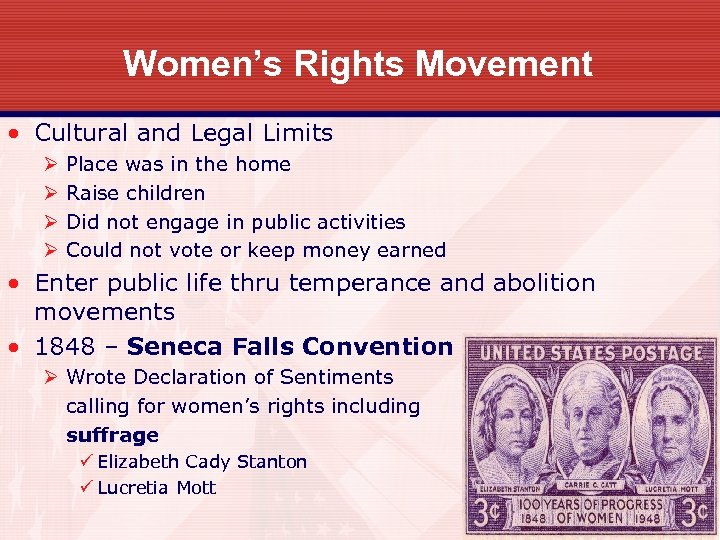 Women’s Rights Movement • Cultural and Legal Limits Ø Ø Place was in the home Raise children Did not engage in public activities Could not vote or keep money earned • Enter public life thru temperance and abolition movements • 1848 – Seneca Falls Convention Ø Wrote Declaration of Sentiments calling for women’s rights including suffrage ü Elizabeth Cady Stanton ü Lucretia Mott
 Rising Immigration • 1820 s – 143, 000 immigrants • 1830 s – 600, 000 immigrants • 1850 s – 2. 6 million immigrants • 1820 s-1860 s – First Great Wave Ø Primarily from Ireland Germany ü Ireland suffered the Irish Potato Famine v Settled in Northeastern cities ü Germany had a series of failed rebellions v Bought farmland in the Midwest