 Скачать презентацию U S Farm Bill Update Chad Hart Center
d9cffa1833cbe959cbf9414e624c6e02.ppt
- Количество слайдов: 31



U. S. Farm Bill Update Chad Hart Center for Agricultural and Rural Development Iowa State University E-mail: chart@iastate. edu April 23, 2008 In-Service Education for Farm and Business Management Extension Ames, Iowa
Farm Bill Progress • The House and Senate have both passed versions • Both proposed farm bills face veto threats • Conference members have been named and meetings have been held • Major work will continue over the next week • Current farm bill has been extended to April 25, 2008
Let’s Start with the House Version • Continues direct payment, counter-cyclical payment, and marketing loan programs • Rebalances target prices and loan rates • Opens up an optional revenue-based countercyclical program • Modifies payments limits for commodity programs • Extends the Milk Income Loss Contract Program until 2012
Now on to the Senate Version • Continues direct payment, counter-cyclical payment, and marketing loan programs • Rebalances target prices and loan rates • Opens up an optional revenue-based countercyclical program • Modifies payments limits for commodity programs • Extends the Milk Income Loss Contract Program until 2012
Latest News • Discussions centering around a farm bill that will spend $10 billion over baseline in a 10 year window – Baseline: $597 billion over 10 years • Negotiations ongoing on how to fund it and how to allocate it among the farm bill titles • Targets for possible spending cuts: – Crop insurance – Commodity programs (direct payments? )
Administration Wish List • Administration would like a farm bill in the $610 billion over baseline range, depending on “reforms” – Payment limitations – Revenue-based counter-cyclical program – No increases in commodity program parameters – Changes to marketing loan program – Elimination of planting restrictions for fruit and vegetables for direct payments
Additional Items • Permanent disaster program is part of the mix – Producers may end up paying for it • Some moves being made outside of farm bill – Amendment to lower payment limits ($250 K) has been submitted to the FY 2009 budget resolution in the Senate
Like a Tennis Match • House made an offer of $6 billion over baseline • Senate countered with $10 billion over baseline • House re-countered with $9. 5 billion over baseline • Let’s look at the last two offers
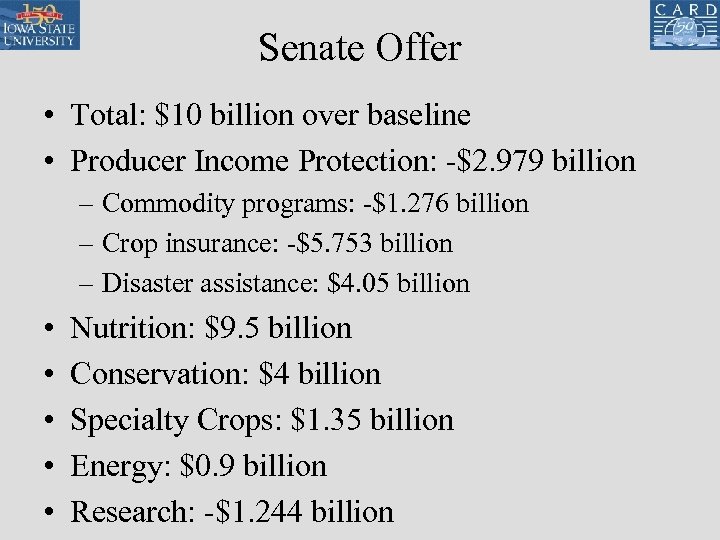
Senate Offer • Total: $10 billion over baseline • Producer Income Protection: -$2. 979 billion – Commodity programs: -$1. 276 billion – Crop insurance: -$5. 753 billion – Disaster assistance: $4. 05 billion • • • Nutrition: $9. 5 billion Conservation: $4 billion Specialty Crops: $1. 35 billion Energy: $0. 9 billion Research: -$1. 244 billion
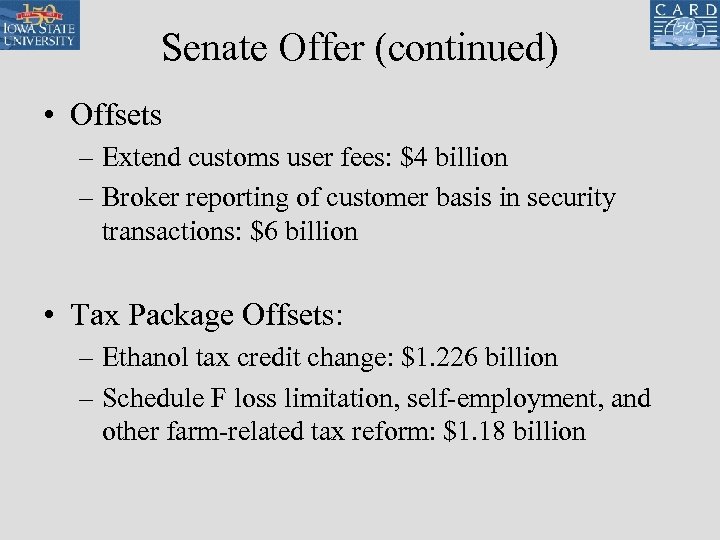
Senate Offer (continued) • Offsets – Extend customs user fees: $4 billion – Broker reporting of customer basis in security transactions: $6 billion • Tax Package Offsets: – Ethanol tax credit change: $1. 226 billion – Schedule F loss limitation, self-employment, and other farm-related tax reform: $1. 18 billion
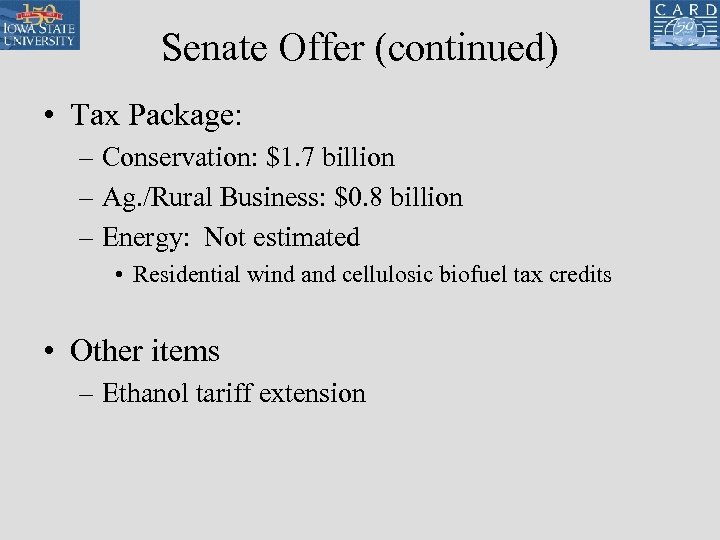
Senate Offer (continued) • Tax Package: – Conservation: $1. 7 billion – Ag. /Rural Business: $0. 8 billion – Energy: Not estimated • Residential wind and cellulosic biofuel tax credits • Other items – Ethanol tariff extension
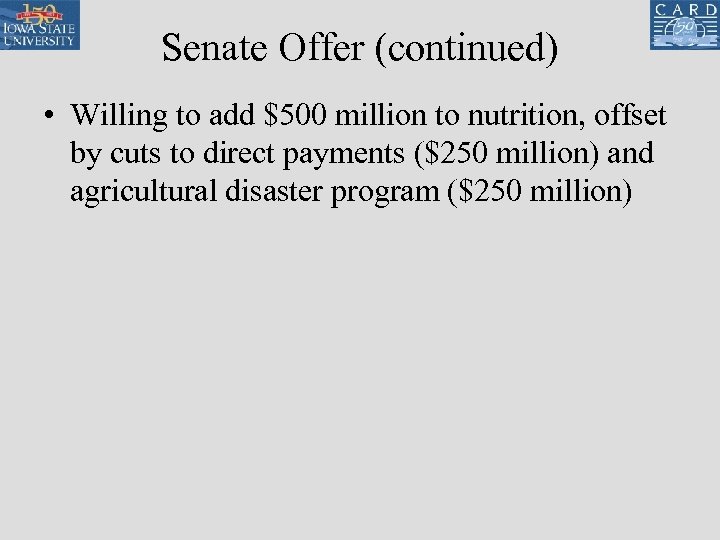
Senate Offer (continued) • Willing to add $500 million to nutrition, offset by cuts to direct payments ($250 million) and agricultural disaster program ($250 million)
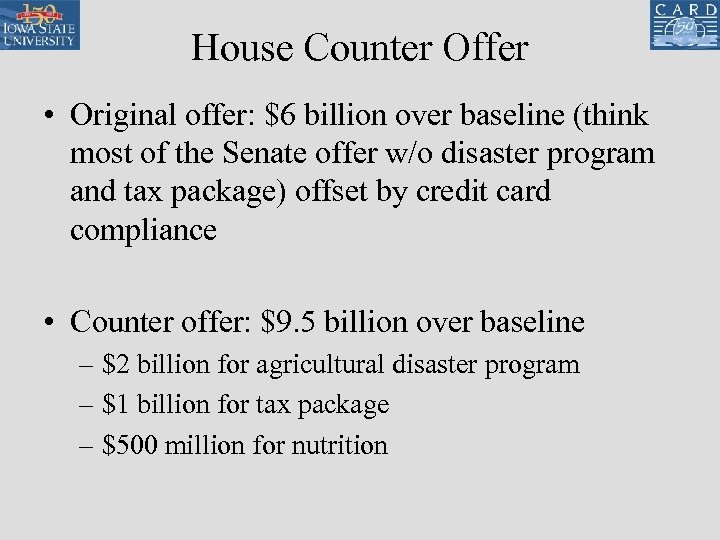
House Counter Offer • Original offer: $6 billion over baseline (think most of the Senate offer w/o disaster program and tax package) offset by credit card compliance • Counter offer: $9. 5 billion over baseline – $2 billion for agricultural disaster program – $1 billion for tax package – $500 million for nutrition
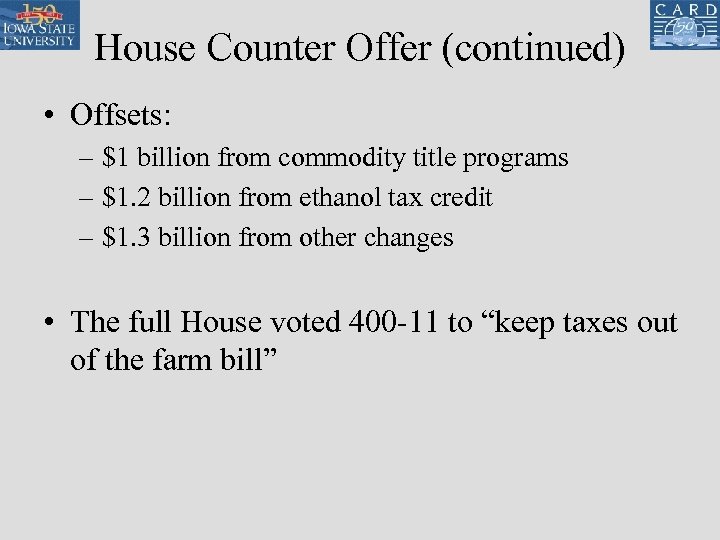
House Counter Offer (continued) • Offsets: – $1 billion from commodity title programs – $1. 2 billion from ethanol tax credit – $1. 3 billion from other changes • The full House voted 400 -11 to “keep taxes out of the farm bill”
Big Differences • Ag. disaster program • Tax package • Offsets for spending • Agreements on funding allocation for nearly everything else
Line in the Sand • Harkin has stated he will call for a vote on the tax package on Tuesday (at the next scheduled meeting) if no agreement can be reached before then
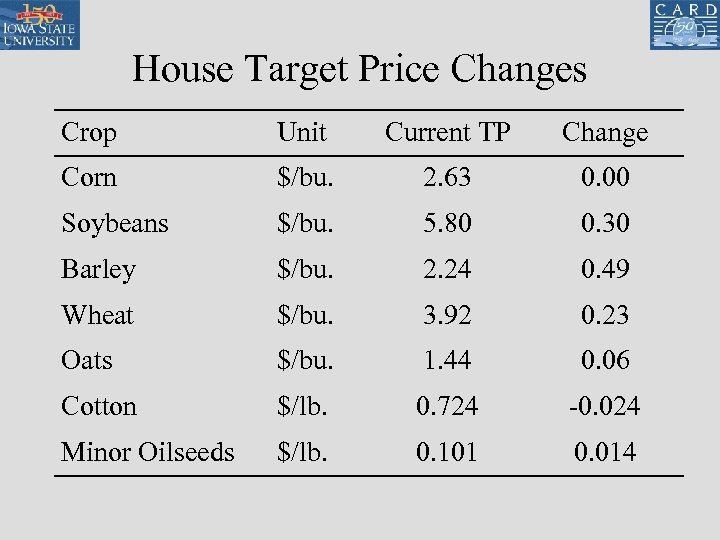
House Target Price Changes Crop Unit Current TP Change Corn $/bu. 2. 63 0. 00 Soybeans $/bu. 5. 80 0. 30 Barley $/bu. 2. 24 0. 49 Wheat $/bu. 3. 92 0. 23 Oats $/bu. 1. 44 0. 06 Cotton $/lb. 0. 724 -0. 024 Minor Oilseeds $/lb. 0. 101 0. 014
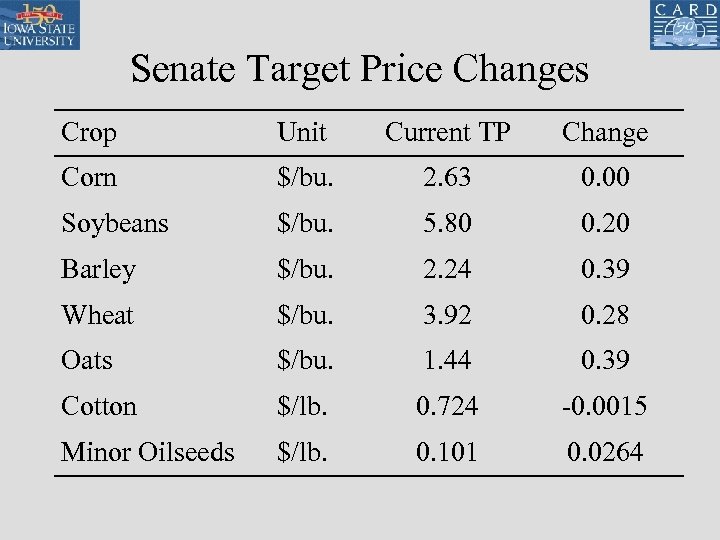
Senate Target Price Changes Crop Unit Current TP Change Corn $/bu. 2. 63 0. 00 Soybeans $/bu. 5. 80 0. 20 Barley $/bu. 2. 24 0. 39 Wheat $/bu. 3. 92 0. 28 Oats $/bu. 1. 44 0. 39 Cotton $/lb. 0. 724 -0. 0015 Minor Oilseeds $/lb. 0. 101 0. 0264
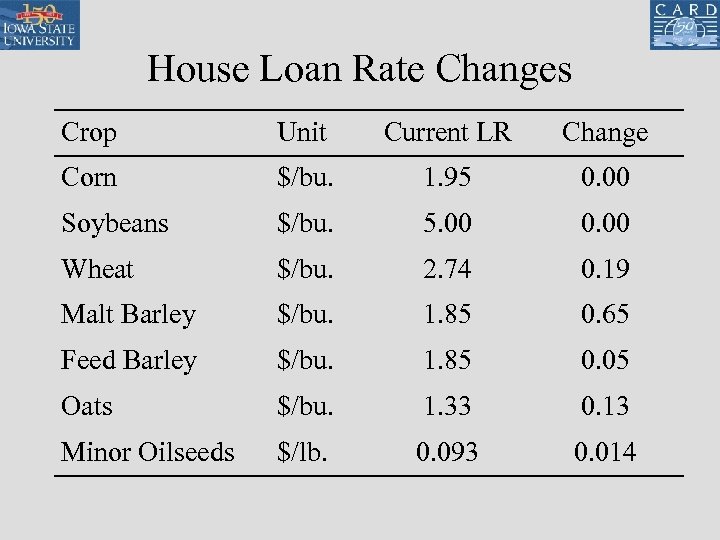
House Loan Rate Changes Crop Unit Current LR Change Corn $/bu. 1. 95 0. 00 Soybeans $/bu. 5. 00 0. 00 Wheat $/bu. 2. 74 0. 19 Malt Barley $/bu. 1. 85 0. 65 Feed Barley $/bu. 1. 85 0. 05 Oats $/bu. 1. 33 0. 13 Minor Oilseeds $/lb. 0. 093 0. 014
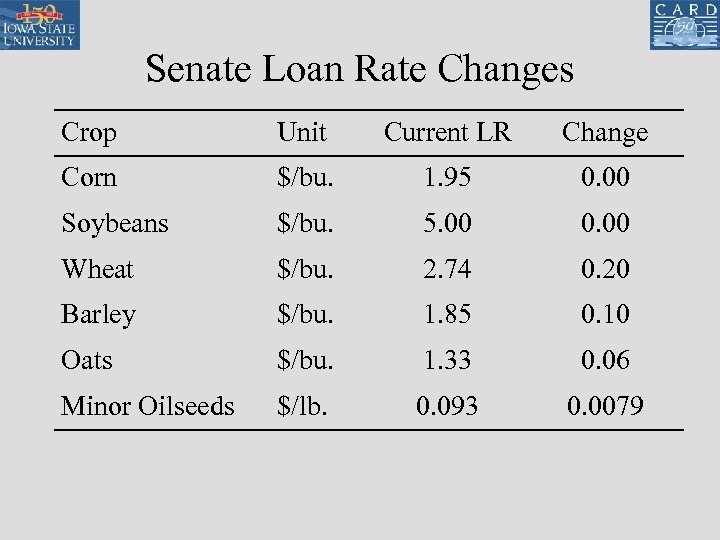
Senate Loan Rate Changes Crop Unit Current LR Change Corn $/bu. 1. 95 0. 00 Soybeans $/bu. 5. 00 0. 00 Wheat $/bu. 2. 74 0. 20 Barley $/bu. 1. 85 0. 10 Oats $/bu. 1. 33 0. 06 Minor Oilseeds $/lb. 0. 093 0. 0079
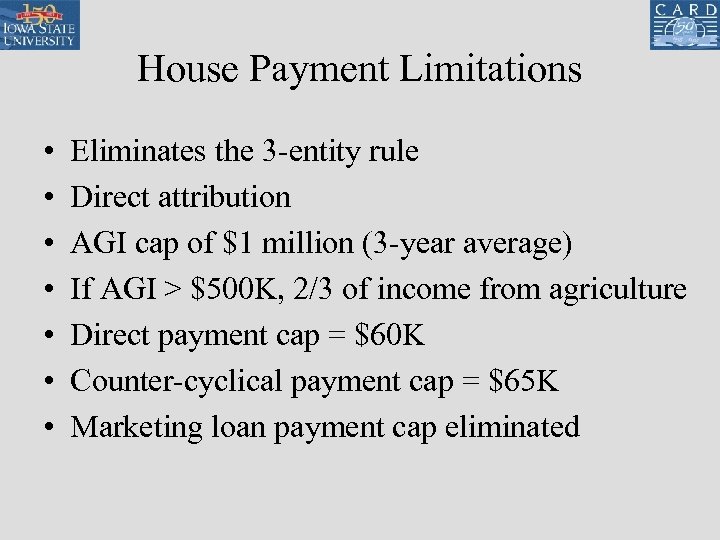
House Payment Limitations • • Eliminates the 3 -entity rule Direct attribution AGI cap of $1 million (3 -year average) If AGI > $500 K, 2/3 of income from agriculture Direct payment cap = $60 K Counter-cyclical payment cap = $65 K Marketing loan payment cap eliminated
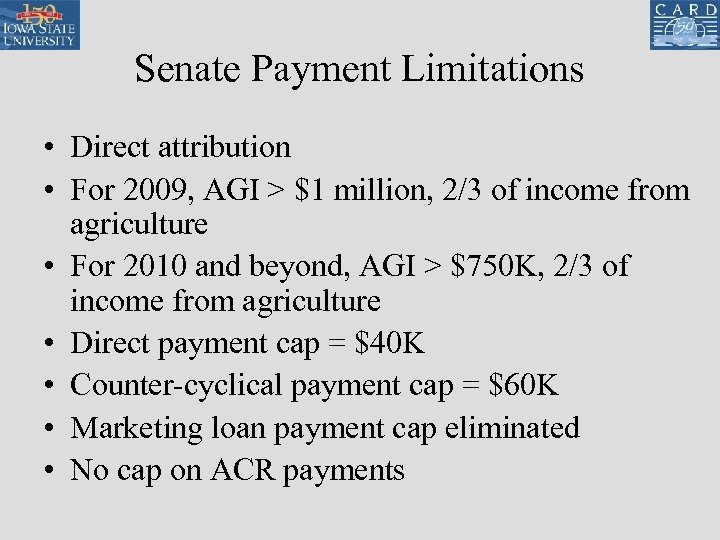
Senate Payment Limitations • Direct attribution • For 2009, AGI > $1 million, 2/3 of income from agriculture • For 2010 and beyond, AGI > $750 K, 2/3 of income from agriculture • Direct payment cap = $40 K • Counter-cyclical payment cap = $60 K • Marketing loan payment cap eliminated • No cap on ACR payments
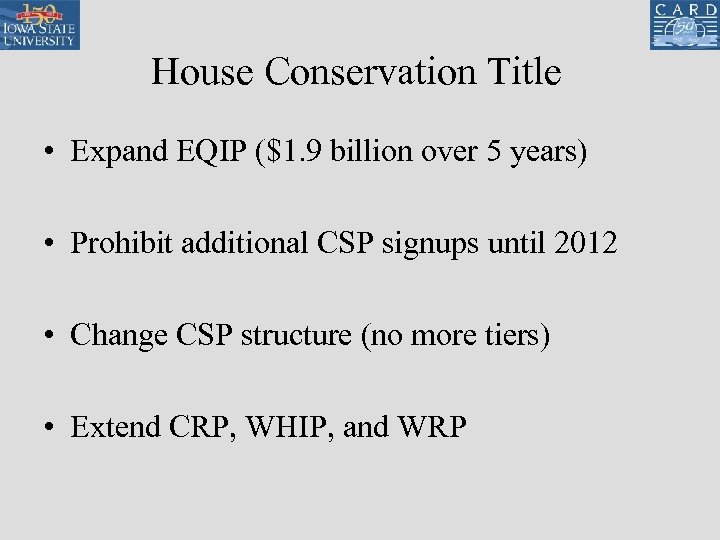
House Conservation Title • Expand EQIP ($1. 9 billion over 5 years) • Prohibit additional CSP signups until 2012 • Change CSP structure (no more tiers) • Extend CRP, WHIP, and WRP
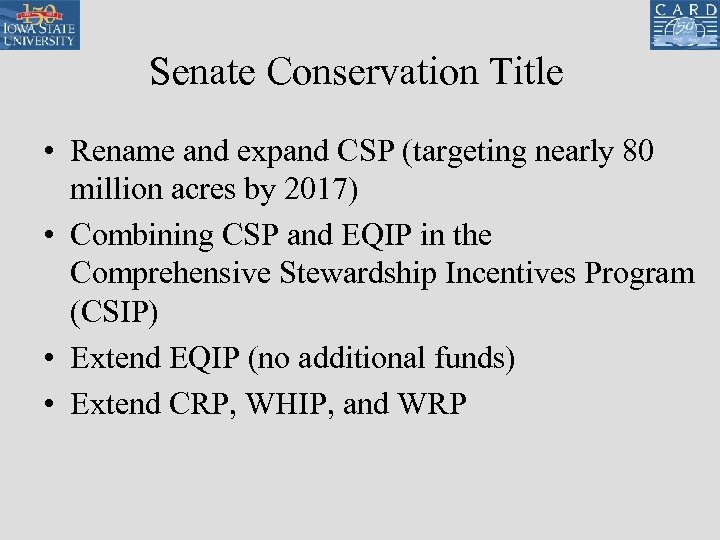
Senate Conservation Title • Rename and expand CSP (targeting nearly 80 million acres by 2017) • Combining CSP and EQIP in the Comprehensive Stewardship Incentives Program (CSIP) • Extend EQIP (no additional funds) • Extend CRP, WHIP, and WRP
House Energy Title • Renews Biobased products program • Extends loan guarantees for biorefineries, along with many of the energy programs in the current farm bill • Research money for alternative feedstocks • Feasibility study of ethanol pipeline • Creation of Biomass Inventory Report and Biomass Energy Reserve
Senate Energy Title • Renews Biobased products program • Extends loan guarantees for biorefineries, along with many of the energy programs in the current farm bill • Research money for alternative feedstocks • Feasibility study of ethanol pipeline
Average Crop Revenue Election (ACRE) • Gives producers a one-time option to choose a revenue-based counter-cyclical payment program, starting in 2009 • Producers choose between the current stable of programs or ACRE • Actual ACRE structure still to be determined
ACRE • Producers choosing ACRE agree to 30% decline in direct payments and loan rates • Program has state and farm trigger levels, both must be met before payments are made • Expected state yield based on 5 year Olympic average yields per planted acre
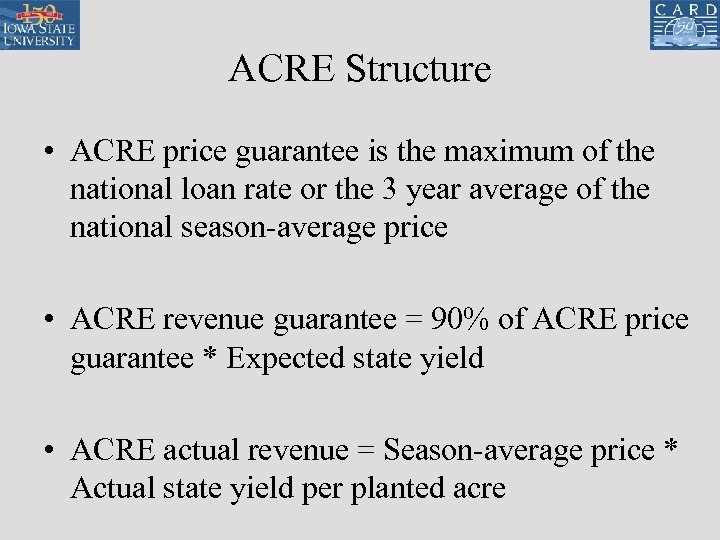
ACRE Structure • ACRE price guarantee is the maximum of the national loan rate or the 3 year average of the national season-average price • ACRE revenue guarantee = 90% of ACRE price guarantee * Expected state yield • ACRE actual revenue = Season-average price * Actual state yield per planted acre
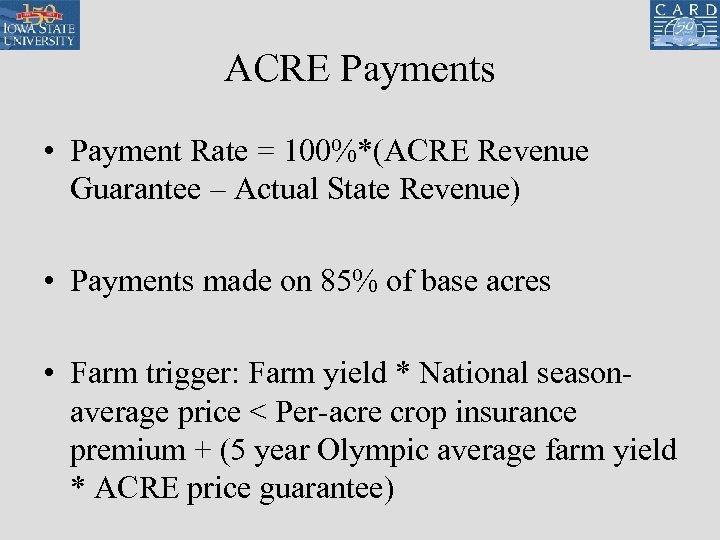
ACRE Payments • Payment Rate = 100%*(ACRE Revenue Guarantee – Actual State Revenue) • Payments made on 85% of base acres • Farm trigger: Farm yield * National seasonaverage price < Per-acre crop insurance premium + (5 year Olympic average farm yield * ACRE price guarantee)

Thanks for your time! Any questions?
Скачать презентацию U S Farm Bill Update Chad Hart Center
d9cffa1833cbe959cbf9414e624c6e02.ppt