


 Скачать презентацию U S Department of Energy s Office of Science
3b8d1abc7c185fc2fc6e0c121eae42f1.ppt
- Количество слайдов: 13
 U. S. Department of Energy’s Office of Science High-Performance Networks for Scientific Applications -- A Perspective -- Network Research Program PI Meeting BNL September 28 -30, 2005 Walt Polansky Advanced Scientific Computing Research Program
 U. S. Department of Energy Advanced Scientific Computing Research Program Office of Science -- Mission -Deliver forefront computational and networking capabilities to scientists nationwide that enable them to extend the frontiers of science, answering critical questions that range from the function of living cells to the power of fusion energy. -- Delivery mechanisms -- - world-class research portfolio - research collaborations and partnerships - high-performance computing and network resources 2
 U. S. Department of Energy Legislative Support Office of Science Energy Policy Act of 2005 (http: //www. ase. org/uploaded_files/policy/Energy_Bill_Final. pdf) “the Secretary of Energy shall conduct and support basic and applied research in highperformance computing and networking to support fundamental research in… and provide computing and networking infrastructure support…” 3
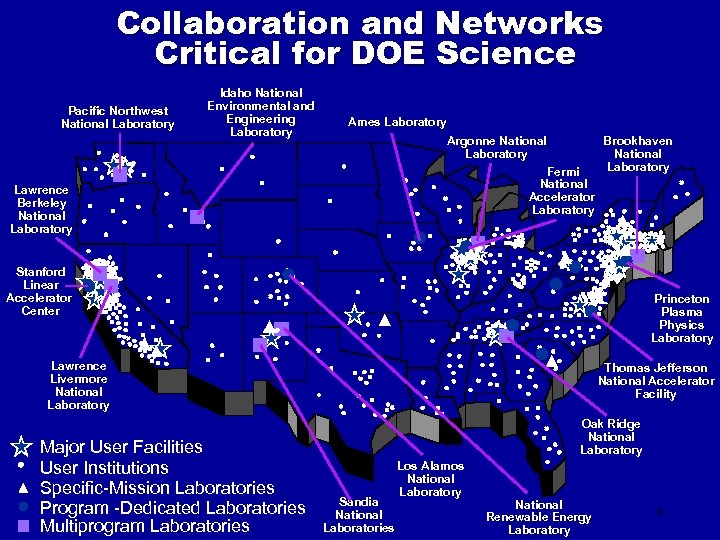 Collaboration and Networks Critical for DOE Science Pacific Northwest National Laboratory Idaho National Environmental and Engineering Laboratory Ames Laboratory Argonne National Brookhaven Laboratory National Laboratory Fermi National Accelerator Laboratory Lawrence Berkeley National Laboratory Stanford Linear Accelerator Center Princeton Plasma Physics Laboratory Lawrence Livermore National Laboratory Major User Facilities User Institutions Specific-Mission Laboratories Program -Dedicated Laboratories Multiprogram Laboratories Thomas Jefferson National Accelerator Facility Oak Ridge National Laboratory Sandia National Laboratories Los Alamos National Laboratory National Renewable Energy Laboratory 4
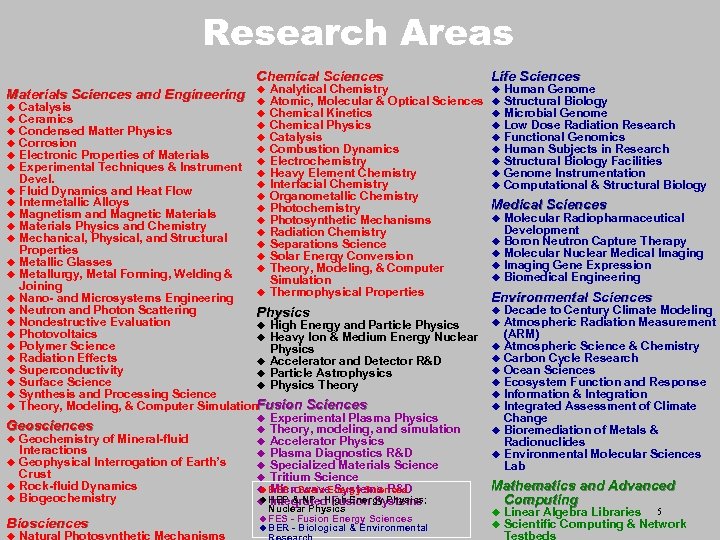 Research Areas Chemical Sciences Life Sciences Analytical Chemistry u Human Genome Materials Sciences and Engineering Atomic, Molecular & Optical Sciences u Structural Biology u Catalysis Chemical Kinetics u Microbial Genome u Ceramics Chemical Physics u Low Dose Radiation Research u Condensed Matter Physics Catalysis u Functional Genomics u Corrosion Combustion Dynamics u Human Subjects in Research u Electronic Properties of Materials Electrochemistry u Structural Biology Facilities u Experimental Techniques & Instrument Heavy Element Chemistry u Genome Instrumentation Devel. Interfacial Chemistry u Computational & Structural Biology u Fluid Dynamics and Heat Flow Organometallic Chemistry u Intermetallic Alloys Medical Sciences Photochemistry u Magnetism and Magnetic Materials u Molecular Radiopharmaceutical Photosynthetic Mechanisms u Materials Physics and Chemistry Development Radiation Chemistry u Mechanical, Physical, and Structural u Boron Neutron Capture Therapy Separations Science Properties u Molecular Nuclear Medical Imaging Solar Energy Conversion u Metallic Glasses u Imaging Gene Expression Theory, Modeling, & Computer u Metallurgy, Metal Forming, Welding & u Biomedical Engineering Simulation Joining u Thermophysical Properties Environmental Sciences u Nano- and Microsystems Engineering u Neutron and Photon Scattering u Decade to Century Climate Modeling Physics u Nondestructive Evaluation u Atmospheric Radiation Measurement u High Energy and Particle Physics u Photovoltaics (ARM) u Heavy Ion & Medium Energy Nuclear u Polymer Science u Atmospheric Science & Chemistry Physics u Radiation Effects u Carbon Cycle Research u Accelerator and Detector R&D u Superconductivity u Ocean Sciences u Particle Astrophysics u Surface Science u Ecosystem Function and Response u Physics Theory u Synthesis and Processing Science u Information & Integration Fusion Sciences u Theory, Modeling, & Computer Simulation u Integrated Assessment of Climate u Experimental Plasma Physics Change Geosciences u Theory, modeling, and simulation u Bioremediation of Metals & u Geochemistry of Mineral-fluid u Accelerator Physics Radionuclides Interactions u Plasma Diagnostics R&D u Environmental Molecular Sciences u Geophysical Interrogation of Earth’s u Specialized Materials Science Lab Crust u Tritium Science Mathematics and Advanced u Rock-fluid Dynamics u Microwave Systems R&D u BES - Basic Energy Sciences u Biogeochemistry u HEP & NP - High Energy Physics; Computing u Integrated Fusion Systems Nuclear Physics 5 u Linear Algebra Libraries u FES - Fusion Energy Sciences Biosciences u Scientific Computing & Network u BER - Biological & Environmental u u u u
 U. S. Department of Energy ESnet Traffic Characterization Office of Science 6
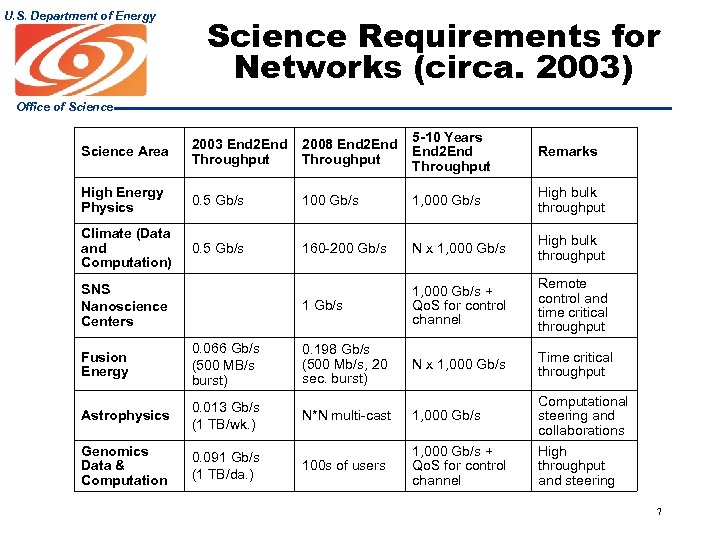 U. S. Department of Energy Science Requirements for Networks (circa. 2003) Office of Science Area 2003 End 2 End Throughput 2008 End 2 End Throughput 5 -10 Years End 2 End Throughput Remarks High Energy Physics 0. 5 Gb/s 100 Gb/s 1, 000 Gb/s High bulk throughput Climate (Data and Computation) 0. 5 Gb/s 160 -200 Gb/s N x 1, 000 Gb/s High bulk throughput 1 Gb/s 1, 000 Gb/s + Qo. S for control channel Remote control and time critical throughput 0. 198 Gb/s (500 Mb/s, 20 sec. burst) N x 1, 000 Gb/s Time critical throughput SNS Nanoscience Centers Fusion Energy 0. 066 Gb/s (500 MB/s burst) Astrophysics 0. 013 Gb/s (1 TB/wk. ) N*N multi-cast 1, 000 Gb/s Computational steering and collaborations Genomics Data & Computation 0. 091 Gb/s (1 TB/da. ) 100 s of users 1, 000 Gb/s + Qo. S for control channel High throughput and steering 7
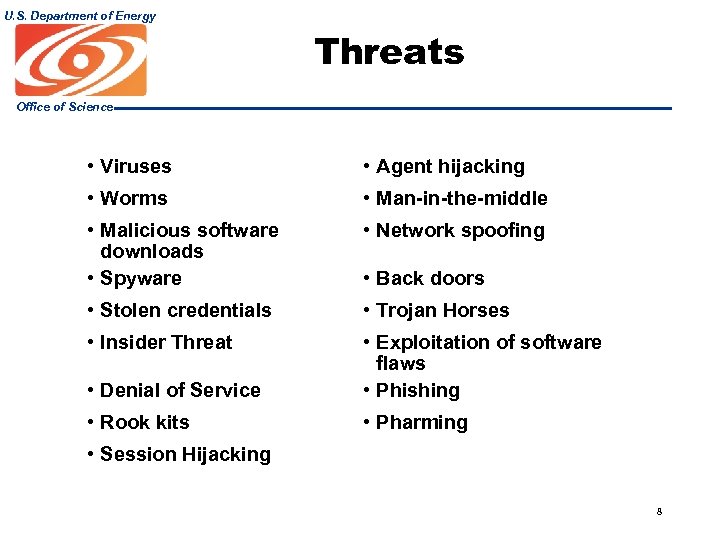 U. S. Department of Energy Threats Office of Science • Viruses • Agent hijacking • Worms • Man-in-the-middle • Malicious software downloads • Spyware • Network spoofing • Stolen credentials • Trojan Horses • Insider Threat • Denial of Service • Exploitation of software flaws • Phishing • Rook kits • Pharming • Back doors • Session Hijacking 8
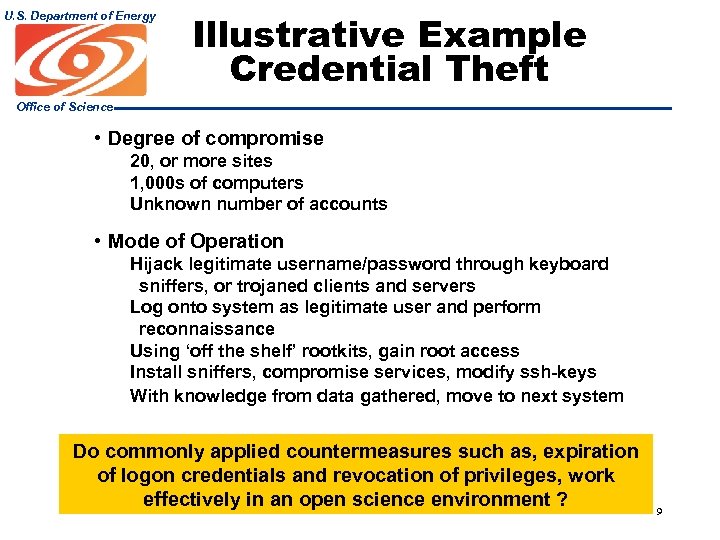 U. S. Department of Energy Illustrative Example Credential Theft Office of Science • Degree of compromise 20, or more sites 1, 000 s of computers Unknown number of accounts • Mode of Operation Hijack legitimate username/password through keyboard sniffers, or trojaned clients and servers Log onto system as legitimate user and perform reconnaissance Using ‘off the shelf’ rootkits, gain root access Install sniffers, compromise services, modify ssh-keys With knowledge from data gathered, move to next system Do commonly applied countermeasures such as, expiration of logon credentials and revocation of privileges, work effectively in an open science environment ? 9
 U. S. Department of Energy Trends in Cybersecurity ? Office of Science • Firewall everything, except vetted applications having strong business needs • All software installed by trained and certified system administrators • Never grant administrator privileges to users • All systems run automated central configuration management and centralized protection management • No access from untrusted networks • Degree of conformance and compliance with regulations to drive best practices • Access to computing and network systems (HSPD 12) is further constrained. 10
 U. S. Department of Energy Network Infrastructure -- Major Considerations -- Office of Science • Preserve Unique Features of DOE Science - Access to national user facilities - Participation in international collaborations - Ability to host scientific data bases and data repositories - Ability to innovate and prototype new capabilities and technologies - Ability to advance science in a global arena • Protect taxpayer investments - Scientific talent High performance computing resources Experimental systems Desktop and laptop systems 11
 U. S. Department of Energy Future ? Office of Science • Leverage the potential of optical networks for science data transport • Robust, secure and cost-effective transmission protocols for science • Collaborative approaches to create and to implement innovative network solutions; partnerships coupling application domain scientists with network researchers, software developers, etc. (Sci. DAC model ? ) • Complete confidence from policy makers that network and the information transmitted over them, although open, are secure 12
 U. S. Department of Energy Workshops and Reports Office of Science - High Performance Network Planning Workshop, August 2002 http: //www. doecollaboratory. org/meetings/hpnpw/ - Blueprint for Future Science Middleware and Grid Research and Infrastructure, August 2002 http: //www. nsf-middleware. org/MAGIC/default. htm - DOE Science Network Meeting, June 2003 http: //gate. hep. anl. gov/may/Science. Networking. Wor kshop/ - Cyberinfrastructure Report http: //www. cise. nsf. gov/evnt/reports/toc. htm - The Office of Science Data-Management Challenge, Report from the DOE Office of Science Data-Management Workshops, November, 2004 http: //www. sc. doe. gov/ascr/Final-report-v 26. pdf 13