


 Скачать презентацию U S Department of Energy Office of Science
a9c6fd38fb0d9eb9d20241786334b671.ppt
- Количество слайдов: 91
 U. S. Department of Energy Office of Science High Energy Physics FY 2007 OMB Presentation Dr. Robin Staffin, Associate Director Office of High Energy Physics Office of Science September 26, 2005
 U. S. Department of Energy High Energy Physics Office of Science § Answering the most basic questions of our quantum universe § What IS the universe? Standing at the door of the third revolution. § First revolution: discovery of the atom on § Chemistry, electronics, biology, medicine, communications, and materials. . . § Second revolution: understanding the nucleus on § The stars, sun’s energy, nuclear weaponry, and medical diagnostics & treatment § Third revolution: the fundamental basis for matter, energy, space and time. (Trillions of electron volts) § Provides answers to how the universe came to be and how it will evolve. A telescope that views the very beginning of the universe and shows how it evolved to the present. 2
 U. S. Department of Energy Particle Physics, Science and Society Office of Science § Big science § International visibility, prestige, Nobels, § Huge international collaborations § Workforce well-prepared for industry and technical careers § About 80% of HEP Ph. Ds end up in industry or government (present company included) § Enabling science § Accelerators: HEP accelerator and detector technology enables many other scientific disciplines and medical applications § High Speed Networking and the Grid § A field which is combined with practical usefulness and intellectual excitement 3
 U. S. Department of Energy Outline (content? ) of Briefing Office of Science § § Compelling Science Objectives Emabling Science and Technology for Society Training the Technological Workforce Budget Impact 4
 U. S. Department of Energy A Critical Time for HEP Office of Science § In the course of the next decade, we may discover a very different universe § The field of High Energy Physics is poised on the threshold of discovery. § HEP can address the important questions: § § § § What is the path to unification (“Einstein’s Dream”)? What is the origin of mass? Are there new dimensions of space & time? What can neutrinos tell us? Why more matter than antimatter? What is Dark Matter? What is Dark Energy (acceleration of the universe)? 5
 U. S. Department of Energy Who will miss this science? Office of Science “To remain near the top, we must continue to look at new discoveries and new information. ” – Speaker of the House, Rep. Dennis Hastert (R-IL) “We can continue down the current path, as other nations continue to narrow the gap, or we can take bold, dramatic steps to ensure U. S. economic leadership in the 21 st century and a rising standard of living for all Americans. ” – Rep. Frank Wolf (R-VA) “…[the U. S. is] unilaterally disarming in high-energy physics at a time which may well be one of the most exciting periods of physics research in history. ” – Newt Gingrich, former Speaker of the House “It looks as though the innovation pipeline is slowly being squeezed dry. . [We] are losing the skills race…[and] are beginning to lose our preeminence in discovery as well. ” – William Brody, President, Johns Hopkins 6
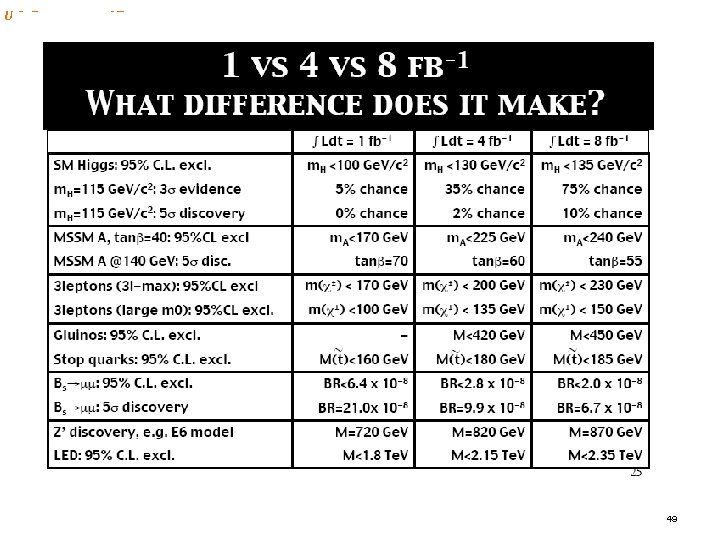
 U. S. Department of Energy Top 5 HEP Results in FY 2005 Office of Science 1. Excellent Tevatron Run II Performance § Factor of 2 increase in peak & integrated luminosity since FY 04 § Closing in on the SM Higgs 2. Nu. MI starts up: the era of precision neutrino physics begins § Smooth turn on and steady operation 3. Babar/Belle results show potential surprise 4. CDMS II data rules out light SUSY particles as dark matter candidates 5. QCD comes of age § Nobel for Gross, Politzer and Wilczek § Lattice QCD now a predictive science 7
 U. S. Department of Energy HEP FY 2005 news “below the fold” Office of Science § SDSS observes acoustic vibrations of matter in the early universe § Initial results from (partially completed) Auger on ultra-high energy cosmic rays § Advances in future accelerator concepts § First photonic bandgap accelerator structure § Beam-driven plasma wakefield acceleration experiment achieves gradient of 45 GV/meter over 30 cm § Laser-driven plasma wakefield achieves similar gradients over few mm with excellent beam quality § Handheld 5 Ge. V accelerators for a variety of applications? § Multi-Te. V accelerators in the future? 8
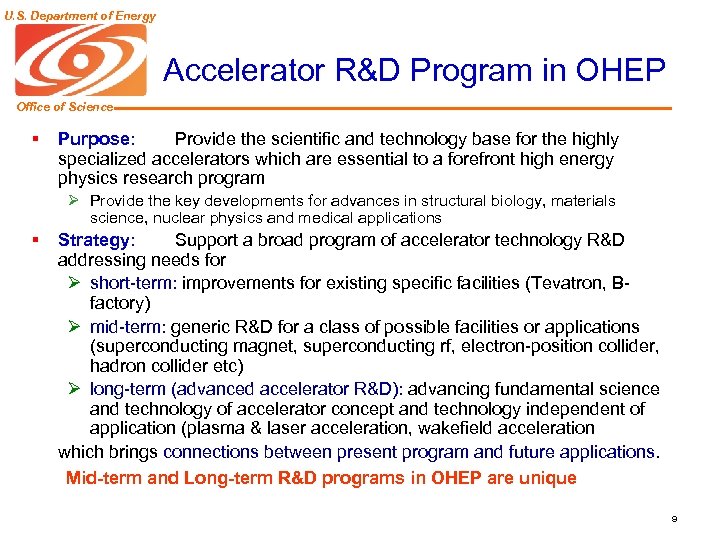 U. S. Department of Energy Accelerator R&D Program in OHEP Office of Science § Purpose: Provide the scientific and technology base for the highly specialized accelerators which are essential to a forefront high energy physics research program Ø Provide the key developments for advances in structural biology, materials science, nuclear physics and medical applications § Strategy: Support a broad program of accelerator technology R&D addressing needs for Ø short-term: improvements for existing specific facilities (Tevatron, Bfactory) Ø mid-term: generic R&D for a class of possible facilities or applications (superconducting magnet, superconducting rf, electron-position collider, hadron collider etc) Ø long-term (advanced accelerator R&D): advancing fundamental science and technology of accelerator concept and technology independent of application (plasma & laser acceleration, wakefield acceleration which brings connections between present program and future applications. Mid-term and Long-term R&D programs in OHEP are unique 9
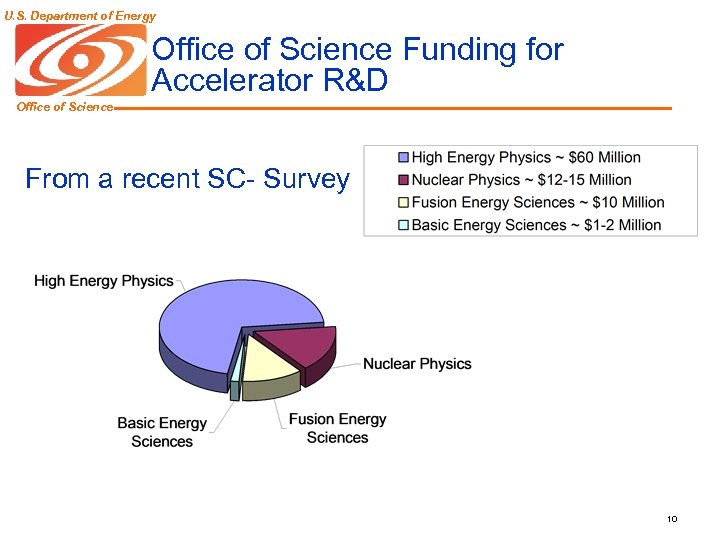 U. S. Department of Energy Office of Science Funding for Accelerator R&D Office of Science From a recent SC- Survey (69%) (17%) (2%) (12%) 10
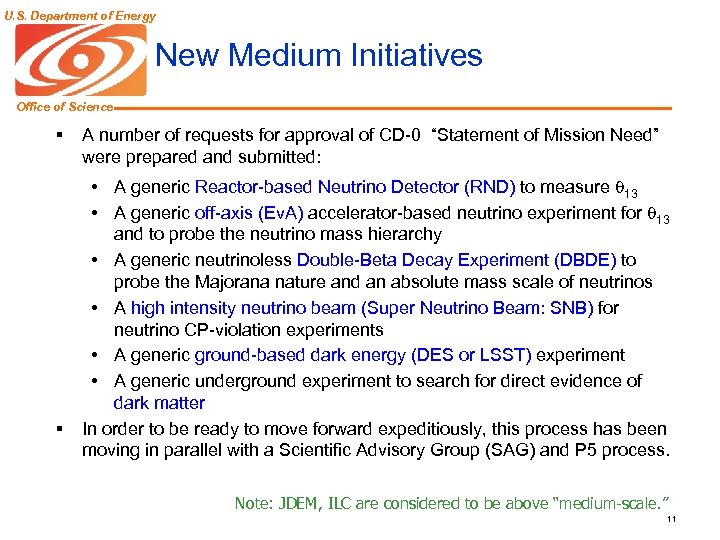 U. S. Department of Energy New Medium Initiatives Office of Science § § A number of requests for approval of CD-0 “Statement of Mission Need” were prepared and submitted: • A generic Reactor-based Neutrino Detector (RND) to measure 13 • A generic off-axis (Ev. A) accelerator-based neutrino experiment for 13 and to probe the neutrino mass hierarchy • A generic neutrinoless Double-Beta Decay Experiment (DBDE) to probe the Majorana nature and an absolute mass scale of neutrinos • A high intensity neutrino beam (Super Neutrino Beam: SNB) for neutrino CP-violation experiments • A generic ground-based dark energy (DES or LSST) experiment • A generic underground experiment to search for direct evidence of dark matter In order to be ready to move forward expeditiously, this process has been moving in parallel with a Scientific Advisory Group (SAG) and P 5 process. Note: JDEM, ILC are considered to be above “medium-scale. ” 11
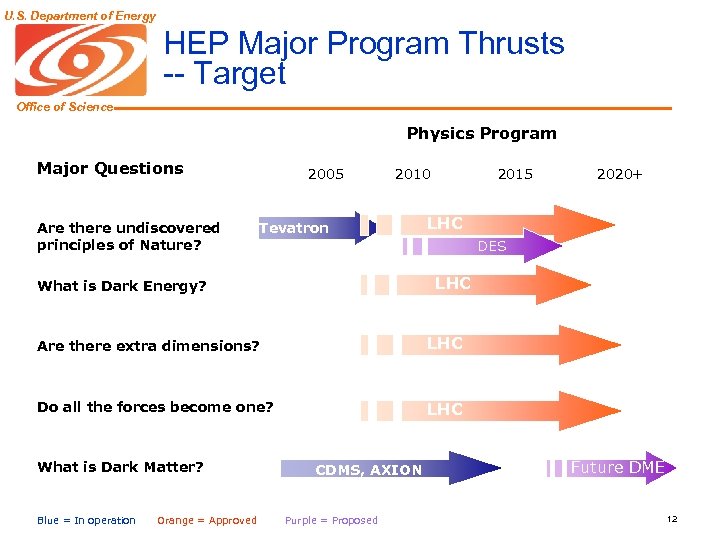 U. S. Department of Energy HEP Major Program Thrusts -- Target Office of Science Physics Program Major Questions Are there undiscovered principles of Nature? 2005 2010 Tevatron 2015 LHC 2020+ ILC DES LHC What is Dark Energy? Are there extra dimensions? LHC Do all the forces become one? LHC What is Dark Matter? Blue = In operation Orange = Approved CDMS, AXION Purple = Proposed ILC Future DME 12
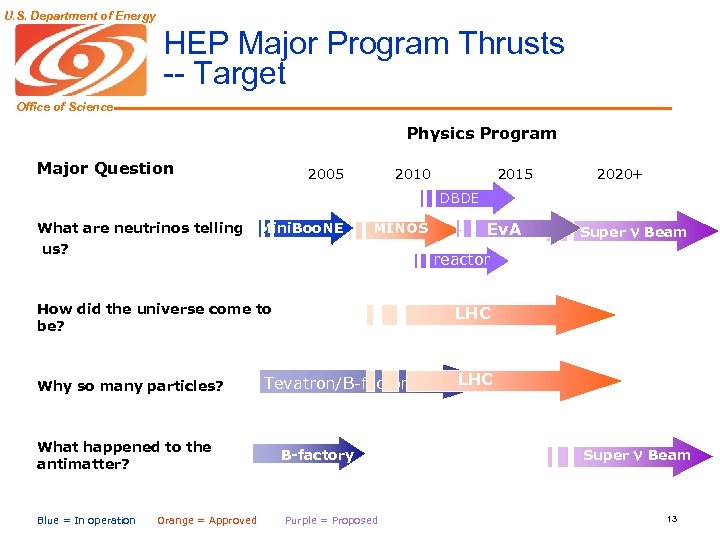 U. S. Department of Energy HEP Major Program Thrusts -- Target Office of Science Physics Program Major Question 2005 2010 2015 2020+ DBDE What are neutrinos telling us? Mini. Boo. NE MINOS What happened to the antimatter? Blue = In operation Orange = Approved Super n Beam reactor How did the universe come to be? Why so many particles? Ev. A LHC Tevatron/B-factory Purple = Proposed LHC LHC 13
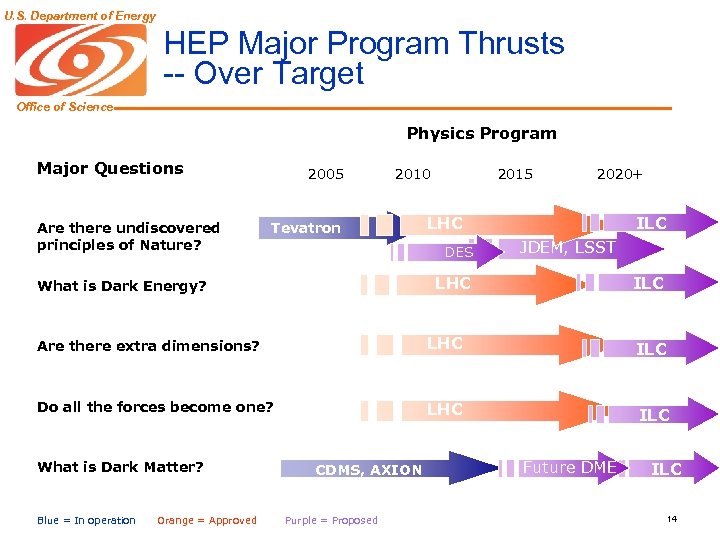 U. S. Department of Energy HEP Major Program Thrusts -- Over Target Office of Science Physics Program Major Questions Are there undiscovered principles of Nature? 2005 2010 Tevatron 2015 2020+ ILC ILC LHC DES JDEM, LSST ILC LHC What is Dark Energy? Are there extra dimensions? LHC ILC Do all the forces become one? LHC ILC What is Dark Matter? Blue = In operation Orange = Approved CDMS, AXION Purple = Proposed ILC Future DME ILC 14
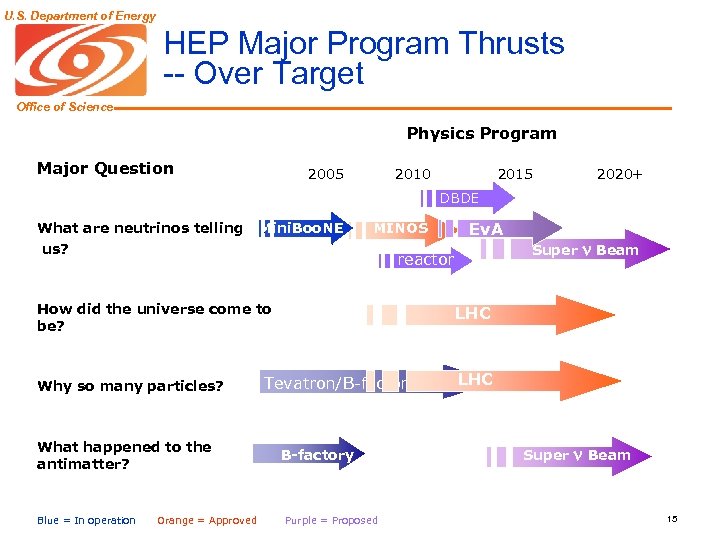 U. S. Department of Energy HEP Major Program Thrusts -- Over Target Office of Science Physics Program Major Question 2005 2010 2015 2020+ DBDE What are neutrinos telling us? Mini. Boo. NE MINOS What happened to the antimatter? Blue = In operation Orange = Approved Super reactor How did the universe come to be? Why so many particles? Ev. A LHC Tevatron/B-factory Purple = Proposed n Beam LHC LHC Super n Beam 15
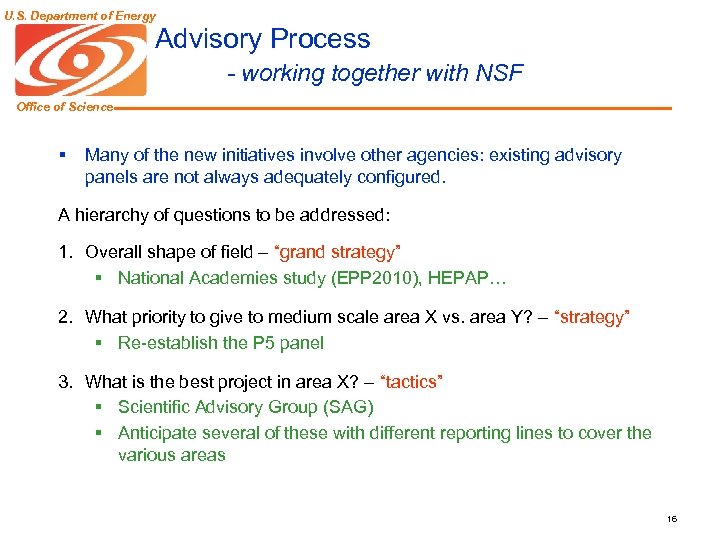 U. S. Department of Energy Advisory Process - working together with NSF Office of Science § Many of the new initiatives involve other agencies: existing advisory panels are not always adequately configured. A hierarchy of questions to be addressed: 1. Overall shape of field – “grand strategy” § National Academies study (EPP 2010), HEPAP… 2. What priority to give to medium scale area X vs. area Y? – “strategy” § Re-establish the P 5 panel 3. What is the best project in area X? – “tactics” § Scientific Advisory Group (SAG) § Anticipate several of these with different reporting lines to cover the various areas 16
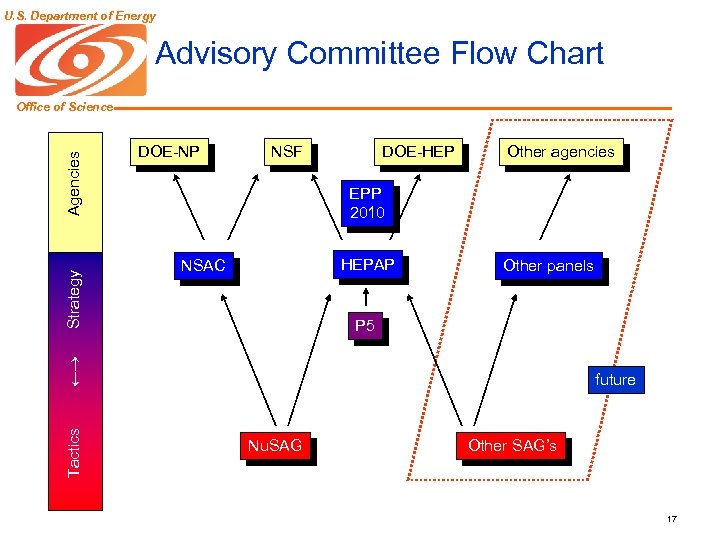 U. S. Department of Energy Advisory Committee Flow Chart DOE-NP NSF DOE-HEP Other agencies EPP 2010 HEPAP NSAC Other panels P 5 Tactics Strategy Agencies Office of Science future Nu. SAG Other SAG’s 17
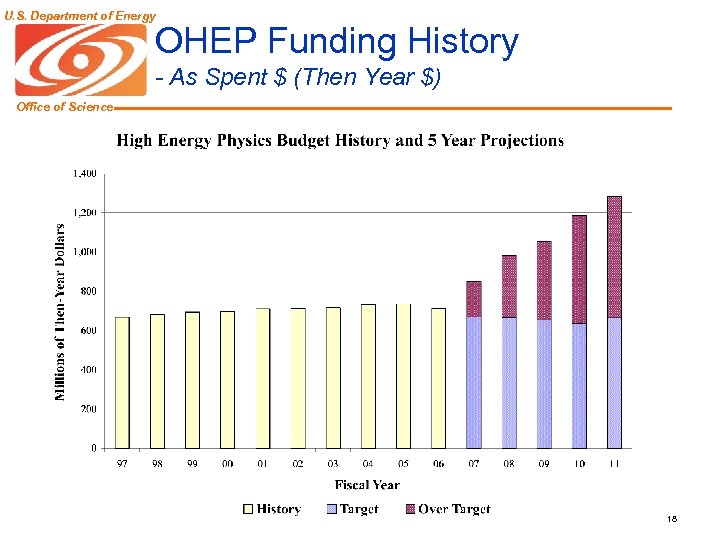 U. S. Department of Energy OHEP Funding History - As Spent $ (Then Year $) Office of Science 18
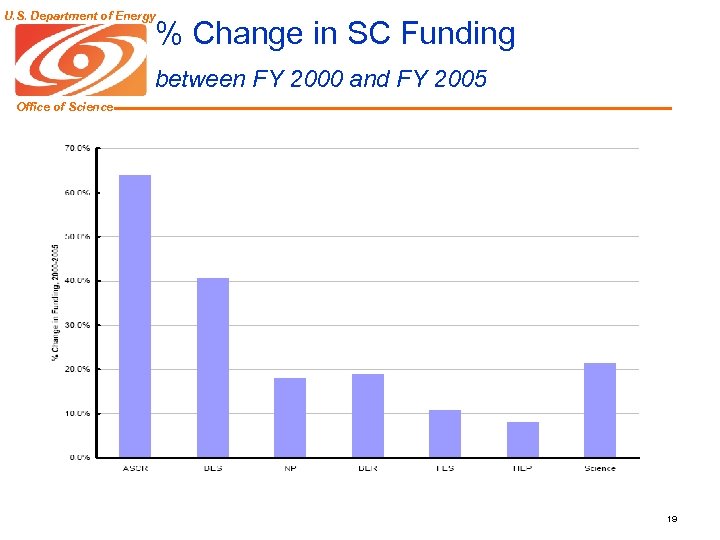 U. S. Department of Energy % Change in SC Funding between FY 2000 and FY 2005 Office of Science 19
 U. S. Department of Energy Planning for the Future - assumptions with recent budget trend Office of Science § § § Current U. S. accelerator-based program is world-leading, but finite in lifetime § Termination of B-factory followed by Tevatron § MINOS will ramp down toward the end of the decade also LHC participation will be a central piece of the program The Linear Collider is our highest priority for a future major facility, § but timescale is uncertain and cannot be done without either an increase in resources or a reduction in cost § Agreements on international partnerships also have to be arranged Hence We are planning for a portfolio of medium scale, medium term experiments to start construction in the period 2007 -10 § § Scientific opportunities are compelling § neutrino physics (APS study); dark matter, dark energy… Resources will become available, through redirection 20
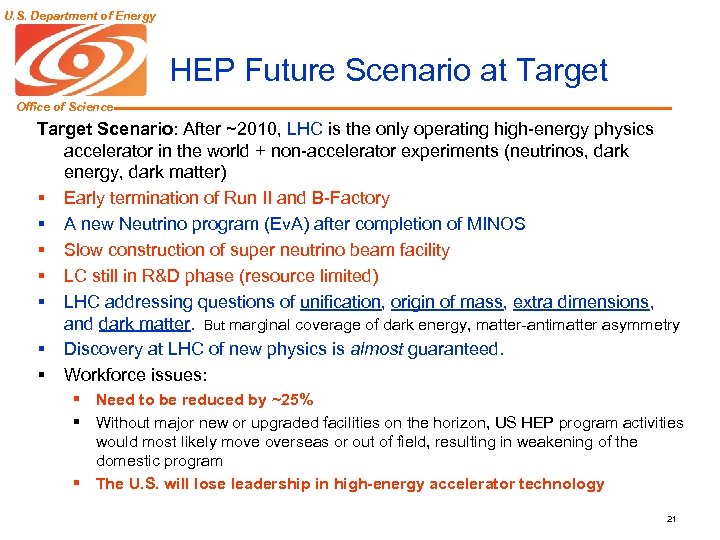 U. S. Department of Energy HEP Future Scenario at Target Office of Science Target Scenario: After ~2010, LHC is the only operating high-energy physics accelerator in the world + non-accelerator experiments (neutrinos, dark energy, dark matter) § Early termination of Run II and B-Factory § A new Neutrino program (Ev. A) after completion of MINOS § Slow construction of super neutrino beam facility § LC still in R&D phase (resource limited) § LHC addressing questions of unification, origin of mass, extra dimensions, and dark matter. But marginal coverage of dark energy, matter-antimatter asymmetry § Discovery at LHC of new physics is almost guaranteed. § Workforce issues: § Need to be reduced by ~25% § Without major new or upgraded facilities on the horizon, US HEP program activities would most likely move overseas or out of field, resulting in weakening of the domestic program § The U. S. will lose leadership in high-energy accelerator technology 21
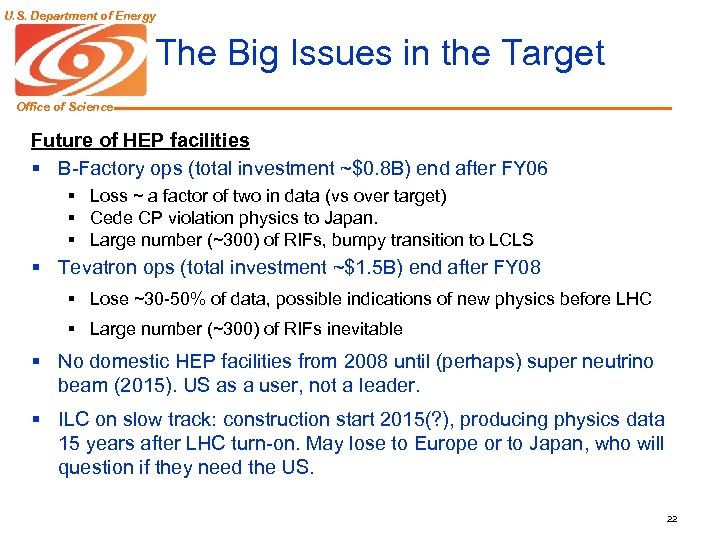 U. S. Department of Energy The Big Issues in the Target Office of Science Future of HEP facilities § B-Factory ops (total investment ~$0. 8 B) end after FY 06 § Loss ~ a factor of two in data (vs over target) § Cede CP violation physics to Japan. § Large number (~300) of RIFs, bumpy transition to LCLS § Tevatron ops (total investment ~$1. 5 B) end after FY 08 § Lose ~30 -50% of data, possible indications of new physics before LHC § Large number (~300) of RIFs inevitable § No domestic HEP facilities from 2008 until (perhaps) super neutrino beam (2015). US as a user, not a leader. § ILC on slow track: construction start 2015(? ), producing physics data 15 years after LHC turn-on. May lose to Europe or to Japan, who will question if they need the US. 22
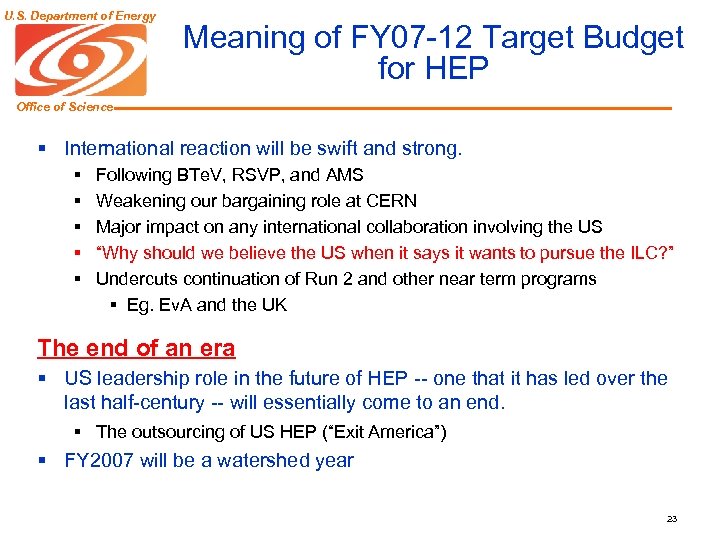 U. S. Department of Energy Meaning of FY 07 -12 Target Budget for HEP Office of Science § International reaction will be swift and strong. § § § Following BTe. V, RSVP, and AMS Weakening our bargaining role at CERN Major impact on any international collaboration involving the US “Why should we believe the US when it says it wants to pursue the ILC? ” Undercuts continuation of Run 2 and other near term programs § Eg. Ev. A and the UK The end of an era § US leadership role in the future of HEP -- one that it has led over the last half-century -- will essentially come to an end. § The outsourcing of US HEP (“Exit America”) § FY 2007 will be a watershed year 23
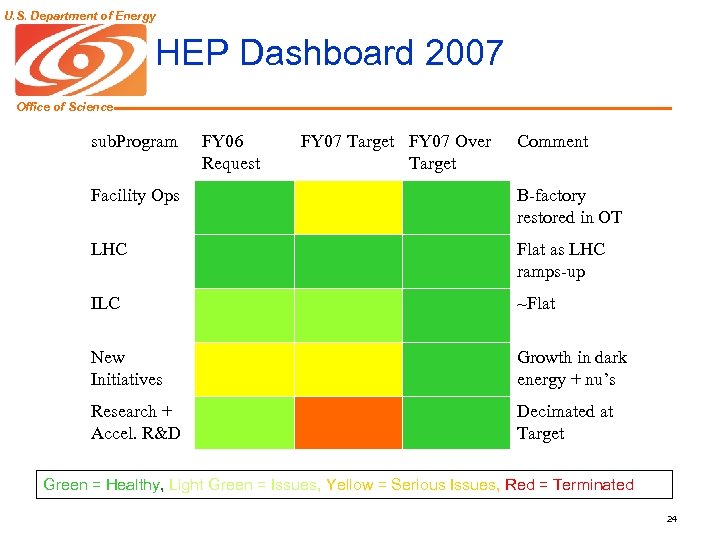 U. S. Department of Energy HEP Dashboard 2007 Office of Science sub. Program FY 06 Request FY 07 Target FY 07 Over Target Comment Facility Ops B-factory restored in OT LHC Flat as LHC ramps-up ILC ~Flat New Initiatives Growth in dark energy + nu’s Research + Accel. R&D Decimated at Target Green = Healthy, Light Green = Issues, Yellow = Serious Issues, Red = Terminated 24
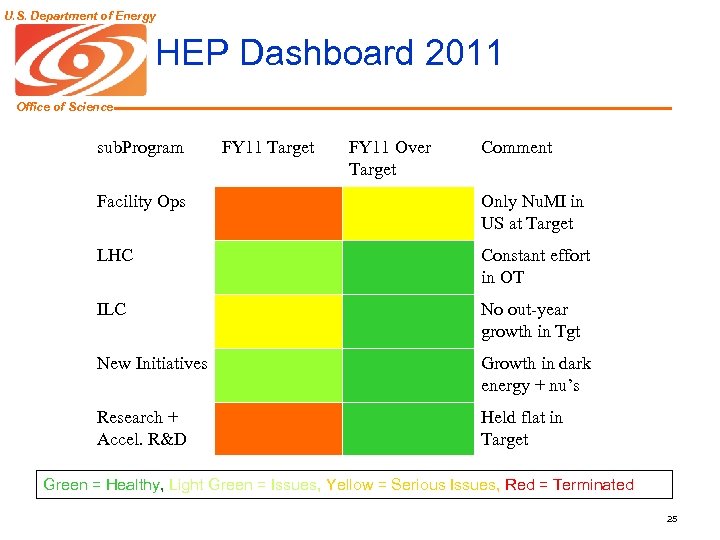 U. S. Department of Energy HEP Dashboard 2011 Office of Science sub. Program FY 11 Target FY 11 Over Target Comment Facility Ops Only Nu. MI in US at Target LHC Constant effort in OT ILC No out-year growth in Tgt New Initiatives Growth in dark energy + nu’s Research + Accel. R&D Held flat in Target Green = Healthy, Light Green = Issues, Yellow = Serious Issues, Red = Terminated 25
 U. S. Department of Energy HEP Future Scenario at Over Target Office of Science Over Target Scenario: After ~2010, LHC is still the only operating high-energy physics accelerator in the world § Run II and B-Factory programs are complete as planned § Super Neutrino Beam will provide a world leadership for US in neutrinos § Neutrino program evolving after MINOS by utilizing super neutrino beam facility which is based on LC technology § JDEM is poised to probe the secrets of Dark Energy § Linear Collider will be ready to exploit LHC discoveries by later part of decade § LC in technically-limited R&D phase until 2009, then engineering design § LHC addressing questions of unification, origin of mass, extra dimensions, and dark matter. And LC will address this and more (see next slide). § Research program strengthened to enhance U. S. impact on LHC § Lattice QCD and Sci. DAC efforts exploit opportunities for U. S. to lead in targeted areas of computation and simulation This is an exciting and highly productive scientific program. 26
 U. S. Department of Energy ILC & LHC Synergy Office of Science § The high energy of the LHC will establish that new phenomena at the Terascale exist. The precision studies of the ILC will enable us to interpret these new discoveries. § In every scenario, the LHC discoveries require the ILC to illuminate their meaning. § The results from the LHC and ILC give a multiplicative (not additive) impact on understanding the new Terascale phenomena. Together, they provide a telescope that peers back to the time when the universe was formed. 27
 U. S. Department of Energy World leading neutrino physics program Office of Science A variety of near and mid term initiatives in a different scales can put the US as the world leader of neutrino physics program § Electron Neutrino Appearance Experiment (Ev. A): Ø MINOS follow-on experiment utilizing Nu. MI beam from Fermilab to Northern Minnesota (maximum use of existing investment) Ø Could obtain world best measurements on mixing angle and mass hierarchy § Reactor Neutrino Detector (RND) Ø Independent measurement on mixing angle Ø Options from $15 M~$80 M (off-shore vs on-shore) § Double Beta Decay Experiment (DBDE) Ø Measure absolute mass scale of neutrinos Ø Options from $10 M~$200 M (off-shore vs on-shore) § Super Neutrino Beam (SNB) Ø Study CP violation in neutrino sector Ø Synergetic relationship with ILC R&D technology Many as Jointly Supported Program with NSF and DOE-NP 28
 U. S. Department of Energy Exciting Dark Energy & Dark Matter Office of Science A variety of near and mid term initiatives in a different scales can put the US as the world leader of dark energy and dark matter physics program § Dark Energy Survey (DES): Ø Ground based dark energy experiment Ø Fabricate new camera for an existing telescope (~$20 M) § Large Synoptic Survey Telescope (LSST) Ø Ground based dark energy experiment as a next generation of DES Ø New telescope, new camera (~$200 M) § Joint Dark Energy Mission (JDEM) Ø Space based joint mission with NASA for a dedicated dark energy survey Ø DOE funds instrumentation ($300~500 M) § Dark Matter Search Ø Detector to search for direct evidence of dark matter Many as Jointly Supported Program with NSF and NASA 29
 U. S. Department of Energy Accelerator R&D with a promising future Office of Science 30
 U. S. Department of Energy Summary Office of Science § International partnerships § Premature end of B-factory, Tevatron programs will set off a crisis for US standing (after cancellation of BTe. V and RSVP) as a “good partner” for int’l HEP projects § Increases difficulty of getting foreign contributions for neutrino and dark energy initiatives, ILC R&D, … § Builds on existing uncertainty in the aftermath of US recent US terminations. 31
 U. S. Department of Energy Tables & Charts Office of Science
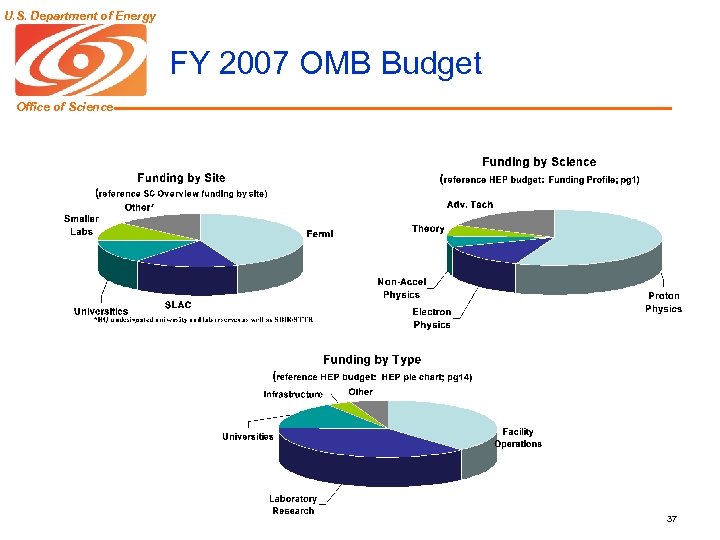
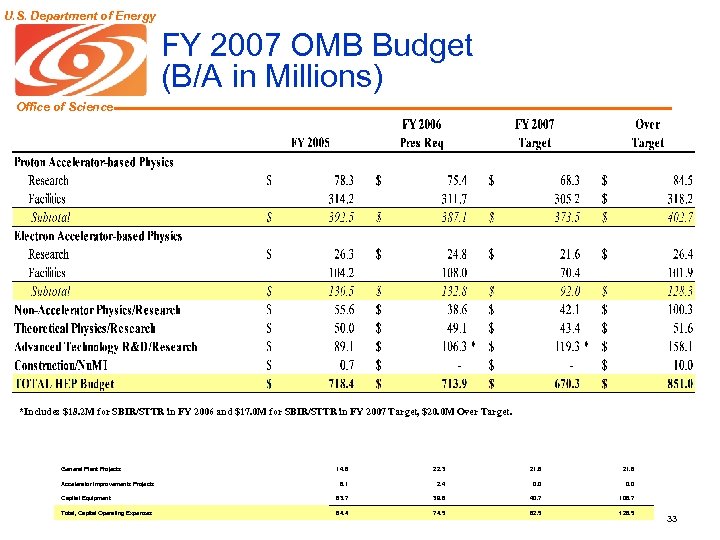 U. S. Department of Energy FY 2007 OMB Budget (B/A in Millions) Office of Science *Includes $18. 2 M for SBIR/STTR in FY 2006 and $17. 0 M for SBIR/STTR in FY 2007 Target, $20. 0 M Over Target. General Plant Projects 14. 6 22. 3 21. 8 6. 1 2. 4 0. 0 Capital Equipment 63. 7 39. 8 40. 7 106. 7 Total, Capital Operating Expenses 84. 4 74. 5 62. 5 128. 5 Accelerator Improvements Projects 33
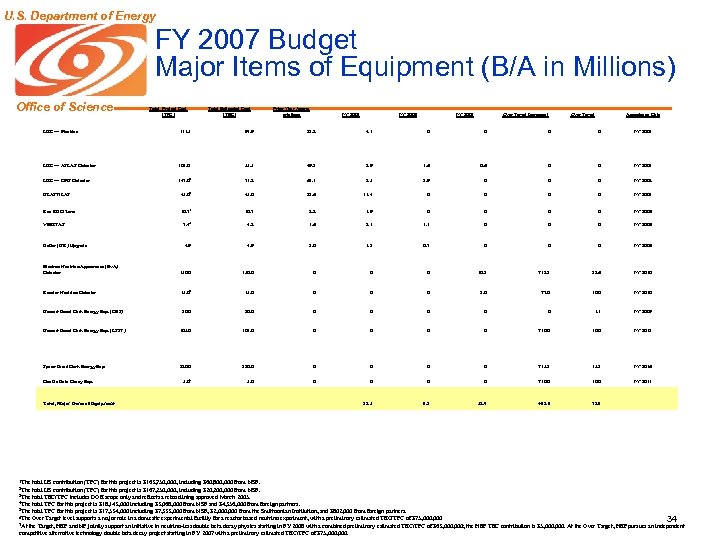 U. S. Department of Energy FY 2007 Budget Major Items of Equipment (B/A in Millions) Office of Science LHC — Machine Total Project Cost (TPC) Total Estimated Cost (TEC) Prior Year Appropriations FY 2005 FY 2006 FY 2007 Over Target Increment Over Target Acceptance Date 111. 5 91. 9 87. 8 4. 1 0 0 FY 2005 LHC — ATLAS Detector 103. 01 55. 5 49. 2 3. 9 1. 6 0 0 FY 2007 LHC — CMS Detector 147. 02 71. 8 64. 1 3. 5 2. 9 0 0 0 FY 2008 GLAST/LAT 45. 03 45. 0 33. 6 11. 4 0 0 FY 2005 Run IIb D-Zero 10. 74 10. 7 8. 8 1. 9 0 0 FY 2006 7. 45 4. 8 1. 6 2. 1 1. 1 0 0 0 FY 2006 4. 9 3. 0 1. 2 0. 7 0 0 0 FY 2006 Electron Neutrino Appearance (Ev. A) Detector 150. 0 0 0 0 10. 3 +12. 3 22. 6 FY 2010 Reactor Neutrino Detector 15. 06 15. 0 0 3. 0 +7. 0 10. 0 FY 2010 Ground-based Dark Energy Exp. (DES) 20. 0 0 0 0 1. 1 FY 2009 Ground-based Dark Energy Exp. (LSST) 105. 0 0 0 +10. 0 FY 2012 Space-based Dark Energy Exp. 280. 0 0 0 +15. 3 FY 2016 5. 07 5. 0 0 0 +10. 0 FY 2011 28. 1 6. 3 15. 4 +62. 6 78. 0 VERITAS Ba. Bar (IFR) Upgrade Double Beta Decay Exp. Total, Major Items of Equipment 1 The total US contribution (TPC) for this project is $163, 750, 000, including $60, 800, 000 from NSF. total US contribution (TPC) for this project is $167, 250, 000, including $20, 200, 000 from NSF. total TEC/TPC includes DOE scope only and reflects a rebaselining approved March 2005. 4 The total TPC for this project is $18, 143, 000 including $3, 068, 000 from NSF and $4, 356, 000 from foreign partners. 5 The total TPC for this project is $17, 534, 000 including $7, 333, 000 from NSF, $2, 000 from the Smithsonian Institution, and $802, 000 from foreign partners. 6 The Over Target level supports a major role in a domestic experimental facility for a reactor based neutrino experiment, with a preliminary estimated TEC/TPC of $75, 000 34 7 At the Target, HEP and NP jointly support an initiative in neutrino-less double beta decay physics starting in FY 2008 with a combined preliminary estimated TEC/TPC of $63, 000; the HEP TEC contribution is $5, 000. At the Over Target, HEP pursues an independent competitive alternative technology double beta decay project starting in FY 2007 with a preliminary estimated TEC/TPC of $75, 000. 2 The 3 The
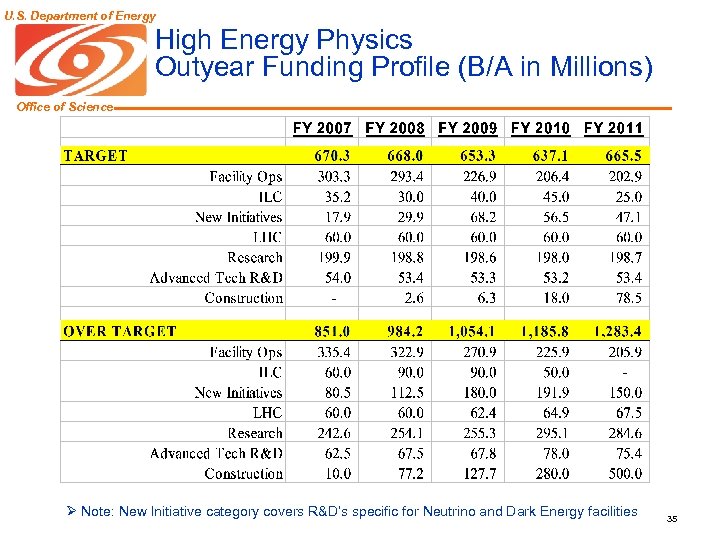 U. S. Department of Energy High Energy Physics Outyear Funding Profile (B/A in Millions) Office of Science Ø Note: New Initiative category covers R&D’s specific for Neutrino and Dark Energy facilities 35
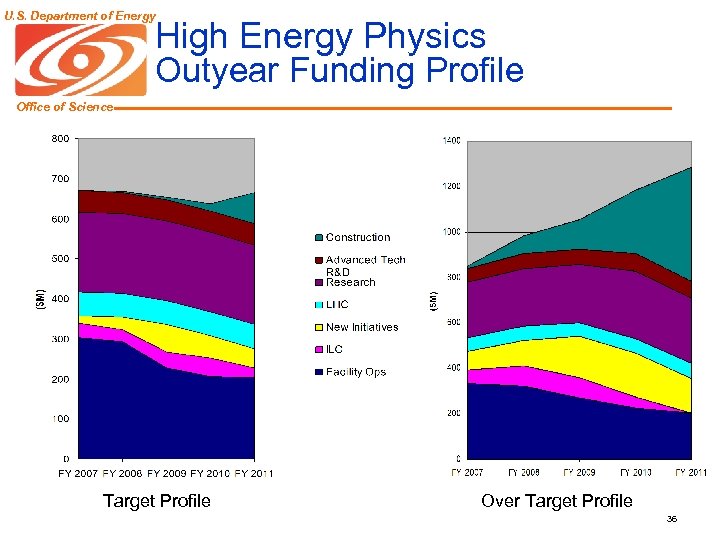 U. S. Department of Energy High Energy Physics Outyear Funding Profile Office of Science Target Profile Over Target Profile 36
 U. S. Department of Energy FY 2007 OMB Budget Office of Science 37
 U. S. Department of Energy BACKUP SLIDES Office of Science
 U. S. Department of Energy Office of Science Questions to be Answered 39
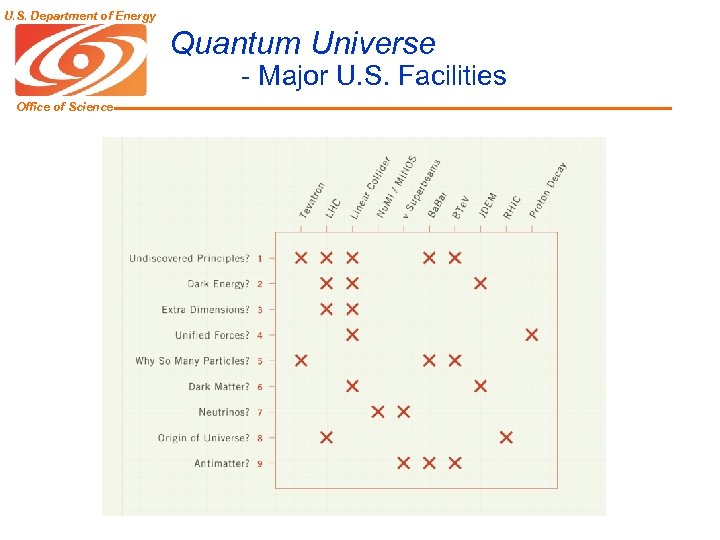
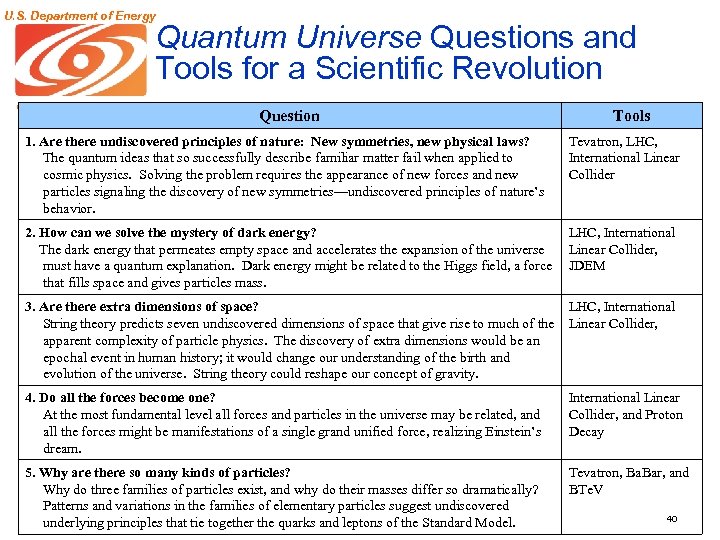 U. S. Department of Energy Quantum Universe Questions and Tools for a Scientific Revolution Office of Science Question Tools 1. Are there undiscovered principles of nature: New symmetries, new physical laws? The quantum ideas that so successfully describe familiar matter fail when applied to cosmic physics. Solving the problem requires the appearance of new forces and new particles signaling the discovery of new symmetries—undiscovered principles of nature’s behavior. Tevatron, LHC, International Linear Collider 2. How can we solve the mystery of dark energy? The dark energy that permeates empty space and accelerates the expansion of the universe must have a quantum explanation. Dark energy might be related to the Higgs field, a force that fills space and gives particles mass. LHC, International Linear Collider, JDEM 3. Are there extra dimensions of space? LHC, International String theory predicts seven undiscovered dimensions of space that give rise to much of the Linear Collider, apparent complexity of particle physics. The discovery of extra dimensions would be an epochal event in human history; it would change our understanding of the birth and evolution of the universe. String theory could reshape our concept of gravity. 4. Do all the forces become one? At the most fundamental level all forces and particles in the universe may be related, and all the forces might be manifestations of a single grand unified force, realizing Einstein’s dream. International Linear Collider, and Proton Decay 5. Why are there so many kinds of particles? Why do three families of particles exist, and why do their masses differ so dramatically? Patterns and variations in the families of elementary particles suggest undiscovered underlying principles that tie together the quarks and leptons of the Standard Model. Tevatron, Ba. Bar, and BTe. V 40
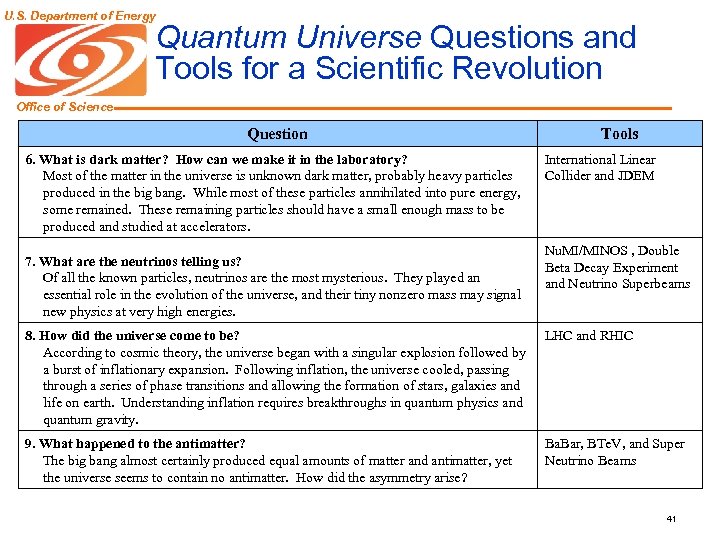 U. S. Department of Energy Quantum Universe Questions and Tools for a Scientific Revolution Office of Science Question 6. What is dark matter? How can we make it in the laboratory? Most of the matter in the universe is unknown dark matter, probably heavy particles produced in the big bang. While most of these particles annihilated into pure energy, some remained. These remaining particles should have a small enough mass to be produced and studied at accelerators. 7. What are the neutrinos telling us? Of all the known particles, neutrinos are the most mysterious. They played an essential role in the evolution of the universe, and their tiny nonzero mass may signal new physics at very high energies. Tools International Linear Collider and JDEM Nu. MI/MINOS , Double Beta Decay Experiment and Neutrino Superbeams 8. How did the universe come to be? According to cosmic theory, the universe began with a singular explosion followed by a burst of inflationary expansion. Following inflation, the universe cooled, passing through a series of phase transitions and allowing the formation of stars, galaxies and life on earth. Understanding inflation requires breakthroughs in quantum physics and quantum gravity. LHC and RHIC 9. What happened to the antimatter? The big bang almost certainly produced equal amounts of matter and antimatter, yet the universe seems to contain no antimatter. How did the asymmetry arise? Ba. Bar, BTe. V, and Super Neutrino Beams 41
 U. S. Department of Energy Quantum Universe - Major U. S. Facilities Office of Science
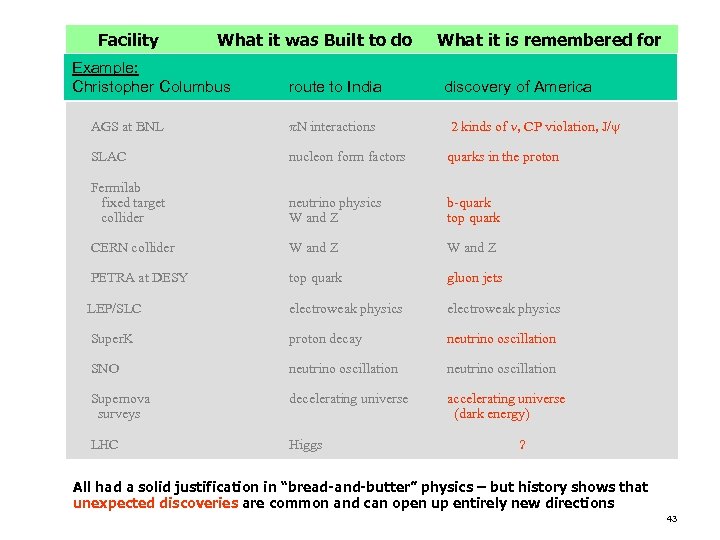 U. S. Department of Energy Facility What it was Built to do Example: Christopher Columbus route to India What it is remembered for discovery of America Office of Science AGS at BNL N interactions 2 kinds of , CP violation, J/ SLAC nucleon form factors quarks in the proton Fermilab fixed target collider neutrino physics W and Z b-quark top quark CERN collider W and Z PETRA at DESY top quark gluon jets LEP/SLC electroweak physics Super. K proton decay neutrino oscillation SNO neutrino oscillation Supernova surveys decelerating universe accelerating universe (dark energy) LHC Higgs ? All had a solid justification in “bread-and-butter” physics – but history shows that unexpected discoveries are common and can open up entirely new directions 43
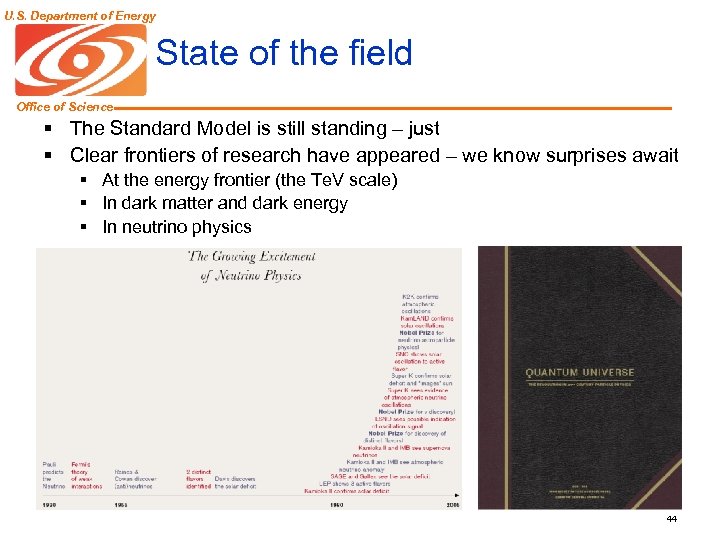 U. S. Department of Energy State of the field Office of Science § The Standard Model is still standing – just § Clear frontiers of research have appeared – we know surprises await § At the energy frontier (the Te. V scale) § In dark matter and dark energy § In neutrino physics 44
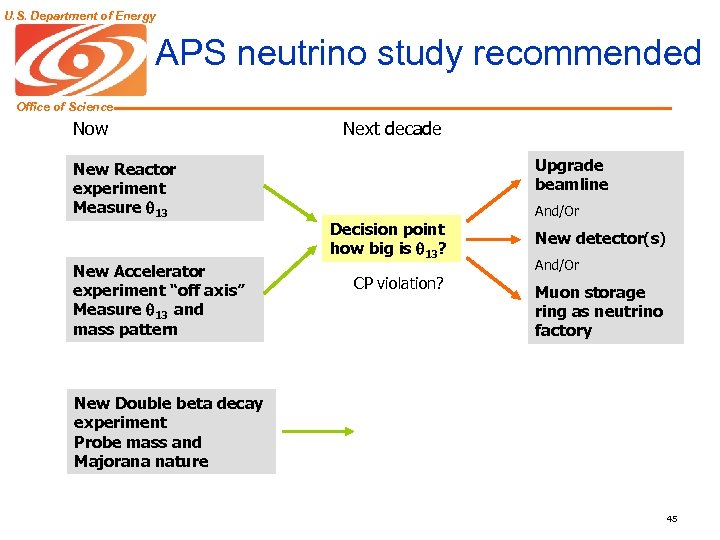 U. S. Department of Energy APS neutrino study recommended Office of Science Now New Reactor experiment Measure 13 New Accelerator experiment “off axis” Measure 13 and mass pattern Next decade Upgrade beamline And/Or Decision point how big is 13? CP violation? New detector(s) And/Or Muon storage ring as neutrino factory New Double beta decay experiment Probe mass and Majorana nature 45
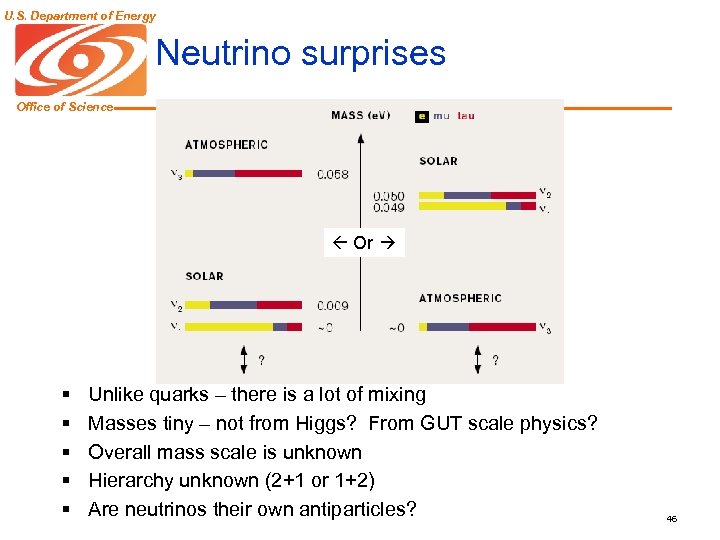 U. S. Department of Energy Neutrino surprises Office of Science Or § § § Unlike quarks – there is a lot of mixing Masses tiny – not from Higgs? From GUT scale physics? Overall mass scale is unknown Hierarchy unknown (2+1 or 1+2) Are neutrinos their own antiparticles? 46
 U. S. Department of Energy Office of Science HEP Results in FY 05 47
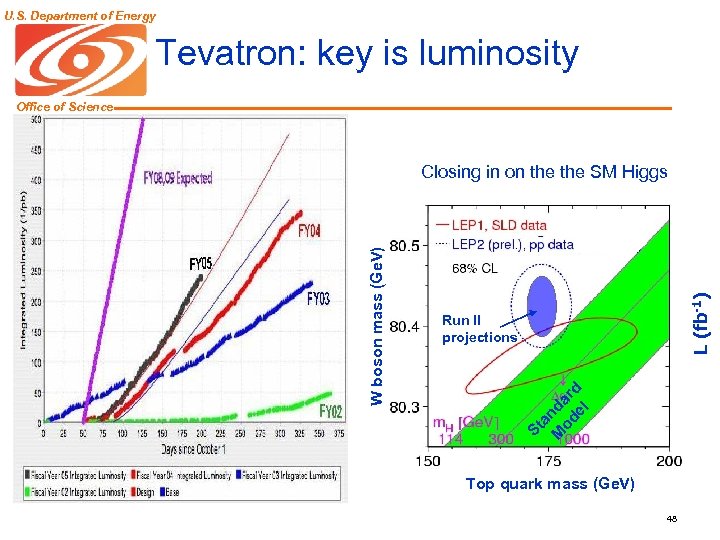 U. S. Department of Energy Tevatron: key is luminosity Office of Science L (fb-1) Run II projections St a M nda od r el d W boson mass (Ge. V) Closing in on the SM Higgs Top quark mass (Ge. V) 48
 U. S. Department of Energy Office of Science 49
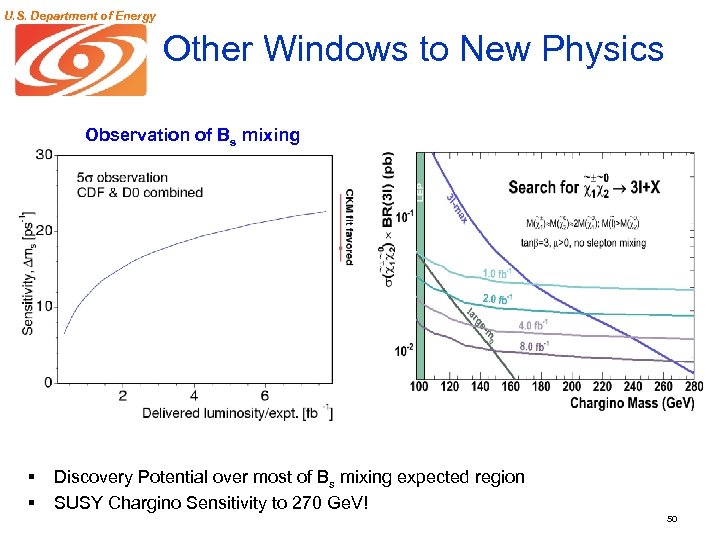 U. S. Department of Energy Other Windows to New Physics Office of Science Observation of Bs mixing § § Discovery Potential over most of Bs mixing expected region SUSY Chargino Sensitivity to 270 Ge. V! 50
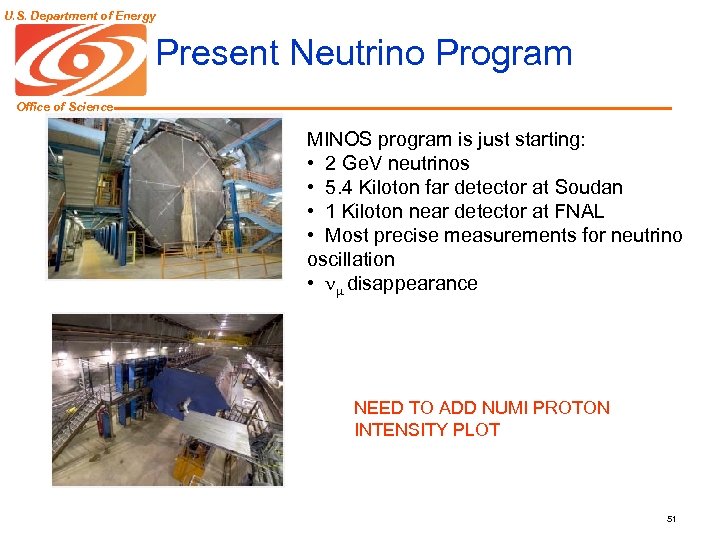 U. S. Department of Energy Present Neutrino Program Office of Science Minos Far detector MINOS program is just starting: • 2 Ge. V neutrinos • 5. 4 Kiloton far detector at Soudan • 1 Kiloton near detector at FNAL • Most precise measurements for neutrino oscillation • m disappearance NEED TO ADD NUMI PROTON INTENSITY PLOT Minos near detector 51
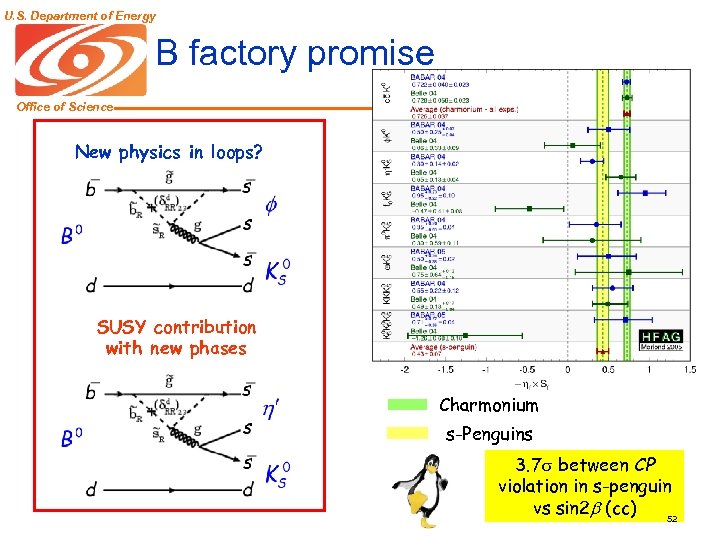 U. S. Department of Energy B factory promise Office of Science New physics in loops? SUSY contribution with new phases Charmonium s-Penguins 3. 7 s between CP violation in s-penguin vs sin 2 b (cc) 52
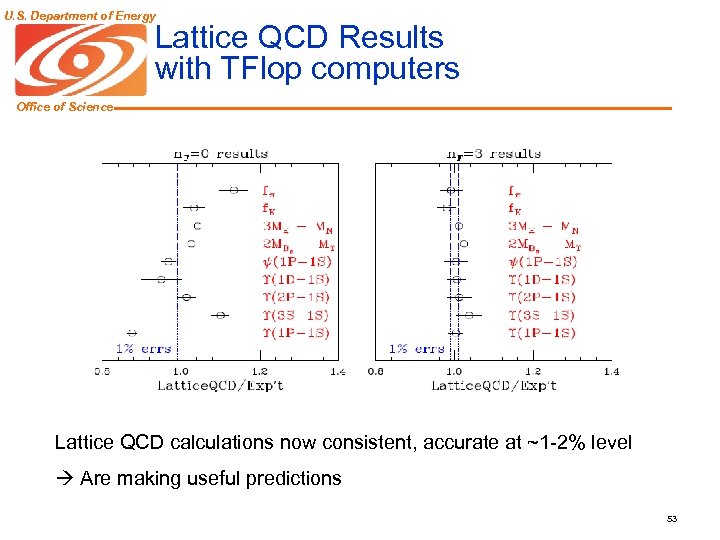 U. S. Department of Energy Lattice QCD Results with TFlop computers Office of Science Lattice QCD calculations now consistent, accurate at ~1 -2% level Are making useful predictions 53
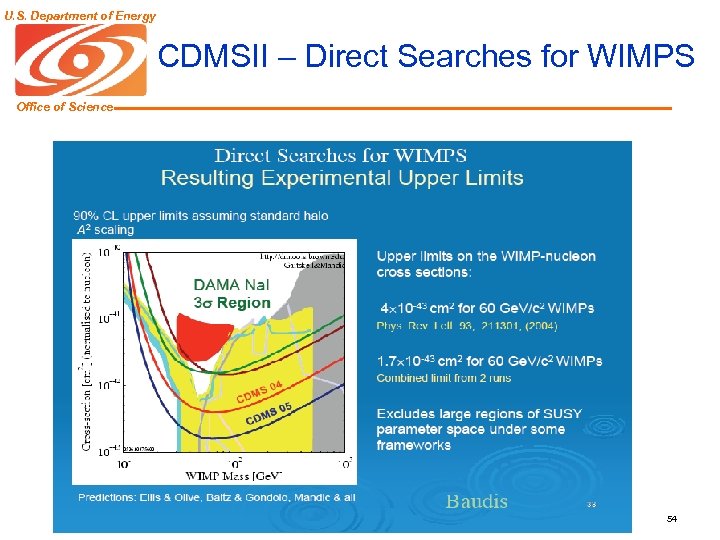 U. S. Department of Energy CDMSII – Direct Searches for WIMPS Office of Science 54
 U. S. Department of Energy Office of Science Advisory Processes 55
 U. S. Department of Energy Advisory Process - Scale of Program Office of Science § § § One can go through a straw-man exercise to see if a reasonable subset of these initiatives could be worked into a realistic portfolio Make reasonable assumptions about § Tevatron and B-factory operations roll-off § ILC R&D ramp-up § US LHC Bottom line is that O($50 -100 M) per year may be available to invest in new initiatives by the end of the decade Complications: § Any $ envelope will depend strongly on facility operations and LC R&D funding in the out-years § Not all projects are equal in science or scope, even within a given physics area Are developing a set of criteria to evaluate projects 56
 U. S. Department of Energy Advisory Process - Suggested Criteria Office of Science § Scientific Potential : to what extent does the project have the ability to change our fundamental view of the universe? § Relevance: is the science important to DOE/HEP’s mission? § Value: does the level of scientific potential match the level of investment? § Alternatives: are there more cost-effective alternatives to get at the same (or most of the same) physics? § Timeliness: will the results come at the right time to have sufficient impact? § International: are similar efforts underway in other countries? Are there potential international partners for this effort? § Infrastructure: Does the project exploit, or help to evolve, existing infrastucture (including human capital) 57
 U. S. Department of Energy National Academies Panel EPP 2010 Office of Science § § § § A new “decadal survey” Lay out the grand questions that are driving our field Describe the opportunities that are ripe for discovery Identify the tools that are necessary to achieve the scientific goals Articulate the connections to other sciences and to society Foster emerging worldwide collaboration Recommend a 15 year implementation plan with realistic, ordered priorities § Not a typical high energy physics advisory panel. It includes § Leaders (non-physicists) in industry, government and academe § Strengthen connections with society § Sharpen the physics questions § Non-particle physicists § Engage other scientific communities § International participants § Place US HEP in the international setting www. nationalacademies. org/bpa/epp 2010. html 58
 U. S. Department of Energy The Role of P 5 Office of Science Recently re-constituted for 2 years § To develop and maintain the roadmap of the field § To address relative priorities of (medium-sized) proposed projects within the program context (Ideally) P 5 would be asked to compare the recommended options from the SAG process and prioritize relative to one another (More realistically) P 5 will be given a nominal (optimistic but not “blue sky”) envelope of available funding for new initiatives and asked to prioritize within that constraint 59
 U. S. Department of Energy Nu. SAG Office of Science § Part of a new advisory process § SAG’s to select “best in class” § P 5 to balance/prioritize areas § A Neutrino Scientific Advisory Group (Nu. SAG) initiated in March § Asked to address § Choice of Reactor neutrino experiment § Choice of Off-axis neutrino experiment § Choice of neutrinoless double beta decay experiment § Also will be asked for recommendation on high intensity neutrino beam(s). § Nu. SAG is a joint subpanel of HEPAP and NSAC § Reports through HEPAP to DOE-HEP and NSF; § through NSAC to DOE-NP and NSF We are considering how to set up an analogous SAG process for other scientific topics such as dark matter, dark energy and particle astrophysics. 60
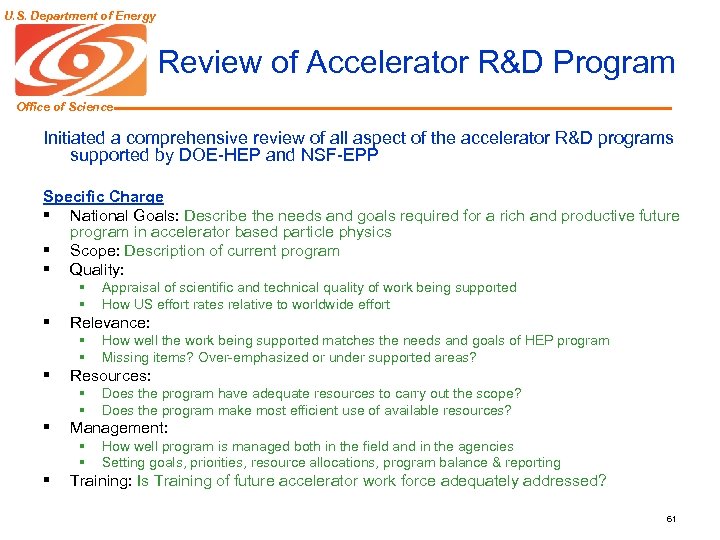 U. S. Department of Energy Review of Accelerator R&D Program Office of Science Initiated a comprehensive review of all aspect of the accelerator R&D programs supported by DOE-HEP and NSF-EPP Specific Charge § National Goals: Describe the needs and goals required for a rich and productive future program in accelerator based particle physics § Scope: Description of current program § Quality: § § § Relevance: § § § Does the program have adequate resources to carry out the scope? Does the program make most efficient use of available resources? Management: § § § How well the work being supported matches the needs and goals of HEP program Missing items? Over-emphasized or under supported areas? Resources: § § § Appraisal of scientific and technical quality of work being supported How US effort rates relative to worldwide effort How well program is managed both in the field and in the agencies Setting goals, priorities, resource allocations, program balance & reporting Training: Is Training of future accelerator work force adequately addressed? 61
 U. S. Department of Energy Office of Science Accelerator R&D Program 62
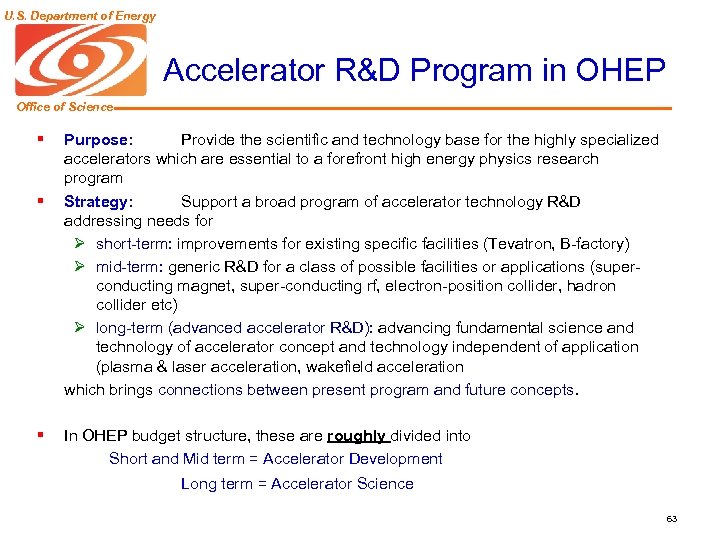 U. S. Department of Energy Accelerator R&D Program in OHEP Office of Science § § § Purpose: Provide the scientific and technology base for the highly specialized accelerators which are essential to a forefront high energy physics research program Strategy: Support a broad program of accelerator technology R&D addressing needs for Ø short-term: improvements for existing specific facilities (Tevatron, B-factory) Ø mid-term: generic R&D for a class of possible facilities or applications (superconducting magnet, super-conducting rf, electron-position collider, hadron collider etc) Ø long-term (advanced accelerator R&D): advancing fundamental science and technology of accelerator concept and technology independent of application (plasma & laser acceleration, wakefield acceleration which brings connections between present program and future concepts. In OHEP budget structure, these are roughly divided into Short and Mid term = Accelerator Development Long term = Accelerator Science 63
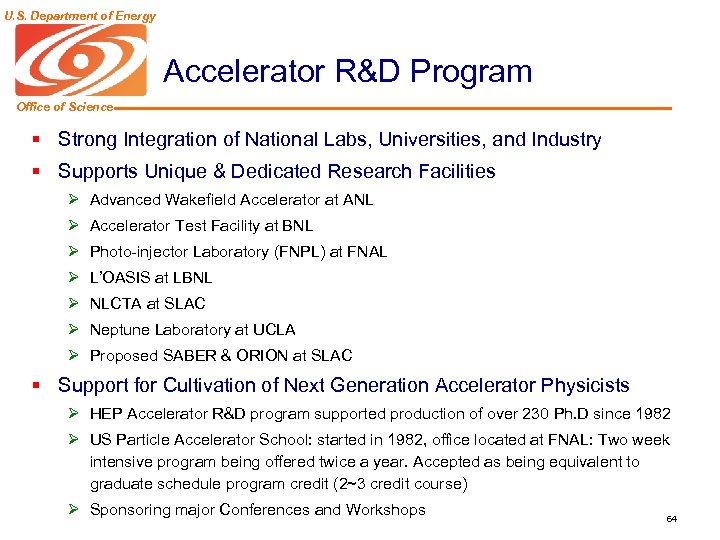 U. S. Department of Energy Accelerator R&D Program Office of Science § Strong Integration of National Labs, Universities, and Industry § Supports Unique & Dedicated Research Facilities Ø Advanced Wakefield Accelerator at ANL Ø Accelerator Test Facility at BNL Ø Photo-injector Laboratory (FNPL) at FNAL Ø L’OASIS at LBNL Ø NLCTA at SLAC Ø Neptune Laboratory at UCLA Ø Proposed SABER & ORION at SLAC § Support for Cultivation of Next Generation Accelerator Physicists Ø HEP Accelerator R&D program supported production of over 230 Ph. D since 1982 Ø US Particle Accelerator School: started in 1982, office located at FNAL: Two week intensive program being offered twice a year. Accepted as being equivalent to graduate schedule program credit (2~3 credit course) Ø Sponsoring major Conferences and Workshops 64
 U. S. Department of Energy Current R&D Topics Office of Science § New accelerator concepts : 13 institutions (16 groups) including 4 national labs (ANL, BNL, LBNL, SLAC) Ø Laser acceleration: 6 groups Ø Plasma acceleration: 9 groups Ø Wakefield acceleration: 2 groups § Super Conducting Magnet Technology & Materials Development: 8 institutions including 3 national labs (BNL, FNAL, LBNL) § High Powered RF Sources & Accelerating Structures (ex: SC rf cavity): program at 9 institutions including 4 national labs (ANL, BNL, FNAL, SLAC) § Code Development: 5 institutions including 2 labs (LANL, LBNL) § Theory: 14 institutions including 1 national lab (LBNL) § Accelerator Experiments: 3 institutions including 1 national lab (SLAC) § Special Facilities: Unique and Dedicated Research Facilities (list in previous slide) 65
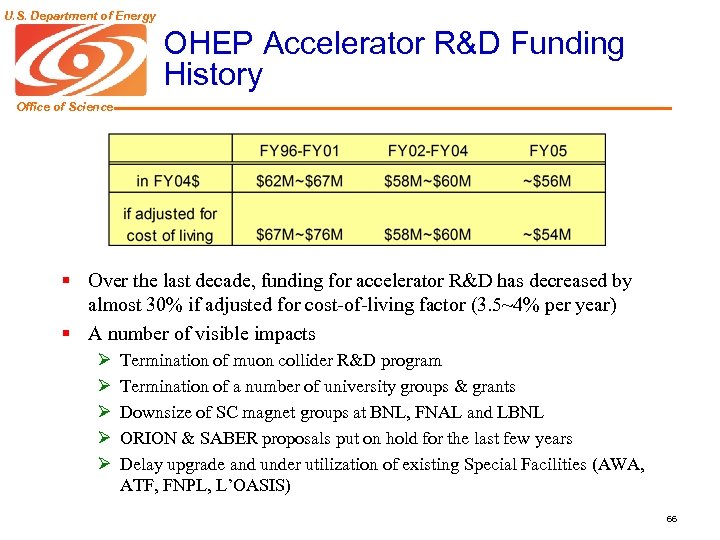 U. S. Department of Energy OHEP Accelerator R&D Funding History Office of Science § Over the last decade, funding for accelerator R&D has decreased by almost 30% if adjusted for cost-of-living factor (3. 5~4% per year) § A number of visible impacts Ø Ø Ø Termination of muon collider R&D program Termination of a number of university groups & grants Downsize of SC magnet groups at BNL, FNAL and LBNL ORION & SABER proposals put on hold for the last few years Delay upgrade and under utilization of existing Special Facilities (AWA, ATF, FNPL, L’OASIS) 66
 U. S. Department of Energy Accelerator R&D in Other Parts of the World Office of Science § § Hard to account for the total size of the efforts and resources Europe: 16 major Advanced Accelerator Facilities Japan: 16 Advanced Accelerator Facilities Also advanced accelerator research labs at Taiwan, Korea, India, China, Israel 67
 U. S. Department of Energy Office of Science International Collaboration 68
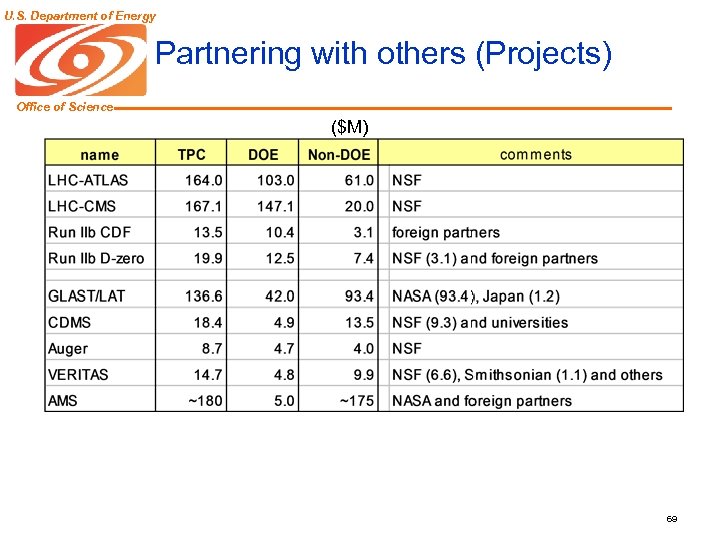 U. S. Department of Energy Partnering with others (Projects) Office of Science ($M) 69
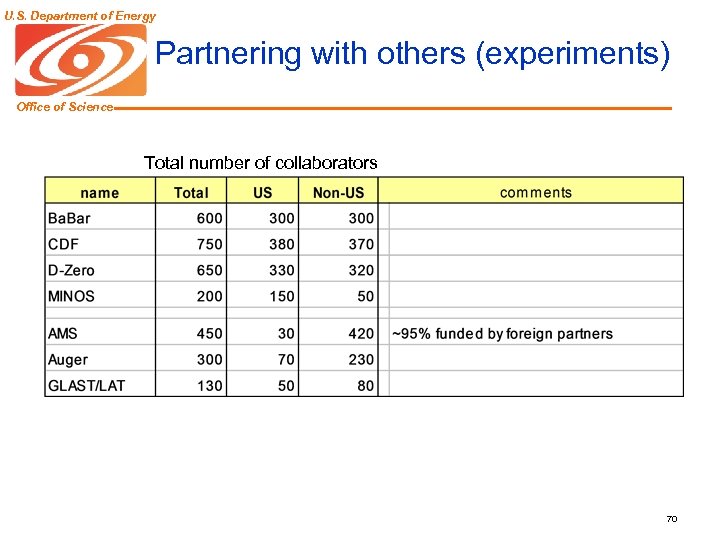 U. S. Department of Energy Partnering with others (experiments) Office of Science Total number of collaborators 70
 U. S. Department of Energy Office of Science FY 07 Target Details 71
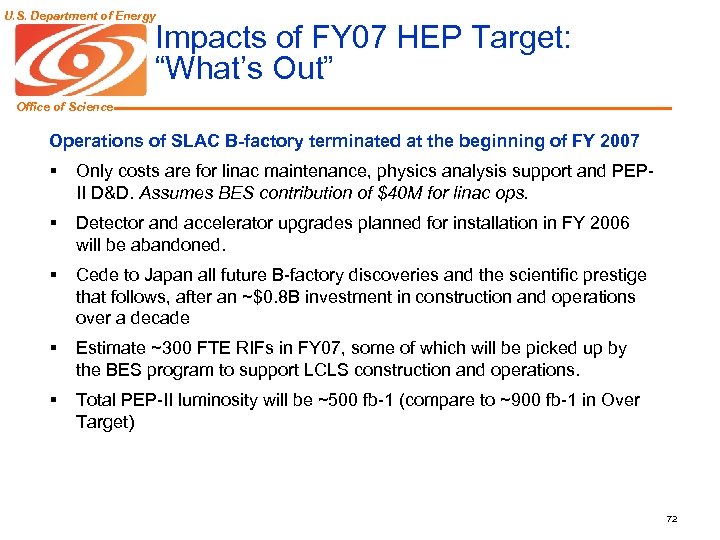 U. S. Department of Energy Impacts of FY 07 HEP Target: “What’s Out” Office of Science Operations of SLAC B-factory terminated at the beginning of FY 2007 § Only costs are for linac maintenance, physics analysis support and PEPII D&D. Assumes BES contribution of $40 M for linac ops. § Detector and accelerator upgrades planned for installation in FY 2006 will be abandoned. § Cede to Japan all future B-factory discoveries and the scientific prestige that follows, after an ~$0. 8 B investment in construction and operations over a decade § Estimate ~300 FTE RIFs in FY 07, some of which will be picked up by the BES program to support LCLS construction and operations. § Total PEP-II luminosity will be ~500 fb-1 (compare to ~900 fb-1 in Over Target) 72
 U. S. Department of Energy Impacts of FY 07 HEP Target: Significant Reductions Office of Science Research Program Significantly Reduced § Overall core research and technology R&D activities in the HEP program will be reduced by ~$19 M in FY 2007 to meet overall budget constraints. § Reductions in these areas will be partially offset (at the ~30 -40% level) by ramp-up of new initiatives § Rapid ramp-down of B-factory research and major program realignment will begin. § 40 universities, 3 DOE labs (LBNL, LLNL and SLAC) and ~300 foreign researchers currently participate in this program § Estimate an elimination of ~100 university research FTEs and ~70 laboratory research FTEs in FY 2007, not including potential offsets from new initiatives 73
 U. S. Department of Energy Impacts of FY 07 HEP Target: “What’s In” Office of Science Facility Operations § Tevatron Collider and Nu. MI: Both the Tevatron Collider and the Nu. MI beam line will continue to run a technically-limited schedule in FY 2007. § Maintains U. S. leadership in energy frontier research and acceleratorbased neutrino physics. § Overall effort reduced due to completion of Run II upgrades and operations-related R&D 74
 U. S. Department of Energy Impacts of FY 07 HEP Target: “What’s In” Office of Science Research § LHC: Support final installation, commissioning, and initial operations of the U. S. -supplied components of the LHC. § Facilitate remote participation by U. S. physicists in the start-up activities of the LHC § Support the software and computing infrastructure needed to provide U. S. scientists rapid and easy access to LHC data. § Note that the success of this program relies on ASCR providing an upgraded ESNet to access enormous LHC datasets. This upgrade is not funded in the ASCR Target. § ILC R&D: Pre-conceptual design of Linear Collider systems. § A reference design and preliminary cost is to be competed by the end of 2006, and this will identify key areas for aggressive R&D to reduce costs and/or improve operational reliability. 75
 U. S. Department of Energy Impacts of FY 07 HEP Target: “What’s In” Office of Science New Initiatives § SNAP R&D: Develop new space-based experimental tools to study the mysterious dark energy § The SNAP R&D effort will be terminated in FY 2007 in the absence of additional resources in the outyears and an interagency agreement on how to proceed. (does this belong here? ? ? ) § Neutrinos: The R&D effort begun in FY 2006 to develop new accelerator and detector technologies to enhance future neutrino physics program will continue, including: § Dedicated electron neutrino appearance exp’t w/ Nu. MI beam § Reactor-based experiment to precisely measure nu mixing § Neutrinoless double-beta decay exp’t (joint with NP) § R&D for super neutrino beam facility ramps up 76
 U. S. Department of Energy Office of Science FY 07 Over Target Details 77
 U. S. Department of Energy Impacts of FY 07 HEP Over Target: “What’s In” Office of Science Facility Operations § Full operations of SLAC B-factory will be restored. Assumes BES contribution of $40 M for linac ops. § Detector and accelerator upgrades planned for installation in FY 2006 to provide increased luminosity and cope with higher data rates will proceed as planned. § FY 2007 PEP-II luminosity will be ~150 fb-1. § Resolve whether current intriguing discrepancies in physics results between the SLAC B-factory and the Japanese B-factory are signs of new physics § Estimate ~80 FTE RIFs from SLAC HEP program in FY 2007 due to overall budget constraints, some of which will be picked up by BES to support LCLS construction. 78
 U. S. Department of Energy Impacts of FY 07 HEP Over Target: “What’s In” Office of Science Research § ILC R&D: Expanded R&D and engineering that can support a 2011 construction start (see details) § Accelerated schedule for ILC construction positions the U. S. to regain world-leadership in HEP research in the next decade. § Restore core research and technology R&D: Overall core research activities in the HEP program will be restored to FY 2005 level-ofeffort. § No RIFs in research activities. § The physics output of the B-factory and Tevatron Collider research programs will be maintained. 79
 U. S. Department of Energy Impacts of FY 07 HEP Over Target: “What’s In” Office of Science Research § ESNet Upgrade: § This upgrade is funded in the ASCR Over Target budget but scientific impacts to the HEP program are described here. § This effort will implement a new architecture to serve the networking needs of all of the Office of Science, enabling programs to meet their future scientific goals which rely on data-intensive research. § SC networking requirements are driven by analysis of LHC data in FY 07; other programs (nanotech, GTL) in later years. § Enable US researchers to fully analyze LHC data, maximize physics payoff and take a leading role in LHC discoveries 80
 U. S. Department of Energy Impacts of FY 07 HEP Over Target: “What’s In” Office of Science New Initiatives § Neutrino Experiments: Neutrino physics experiments begun in the FY 2007 Target will be expanded to provide: § Optimized utilization of the Nu. MI facility, via an accelerated schedule for the electron neutrino appearance experiment (Ev. A) that allows completion of the detector one year earlier. § Domestic experimental facilities (reactor-based neutrino experiment) § New MIE project for neutrino physics experiment complementary to and independent of the double beta decay experiment funded by NP. § Super Neutrino Beam Facility: Engineering design on this nextgeneration neutrino facility would begin in FY 2007, with a construction start in FY 2009. § This facility will allow comprehensive studies of neutrino properties by providing a neutrino beam 10 times more intense than those available with current accelerators. 81
 U. S. Department of Energy Impacts of FY 07 HEP Over Target: “What’s In” Office of Science New Initiatives § Dark Energy: Proceed with new experimental tools to study the mysterious dark energy § JDEM mission concept will be completed in FY 2007; start eng. design in 2009 and fabrication in 2011. § Ground-based dark energy camera (DES) begins fabrication in 2007 § A new ground-based dark energy telescope (LSST) begins advanced engineering design in 2007, with a fabrication start in 2009. § This is a multipurpose telescope with unique capabilities for studying dark energy and other phenomena, and would likely be a joint effort with the National Science Foundation (NSF). 82
 U. S. Department of Energy Office of Science ILC – LHC Synergy 83
 U. S. Department of Energy Examples of ILC – LHC Synergy Office of Science q The LHC can observe that new massive particles exist; the ILC will pinpoint which new force created them. q The Higgs boson is responsible for giving mass to particles. If it exists, the LHC will observe it. The ILC will tell us if it is the standard model Higgs, or is more complex. q The LHC can measure a combination of the number of extra spatial dimensions and their size; the ILC allows disentanglement of the number and size separately. 84
 U. S. Department of Energy Examples of ILC – LHC Synergy Office of Science q Supersymmetry provides the leading candidate for dark matter in the universe. The ILC can isolate it and measure its mass, in turn allowing the LHC to refine its measurements. Combining with cosmic background radiation probes in space, we can tell if this particle is the only dark matter particle. q The LHC and ILC are both needed to determine if the fundamental forces are unified – Einstein’s dream. 85
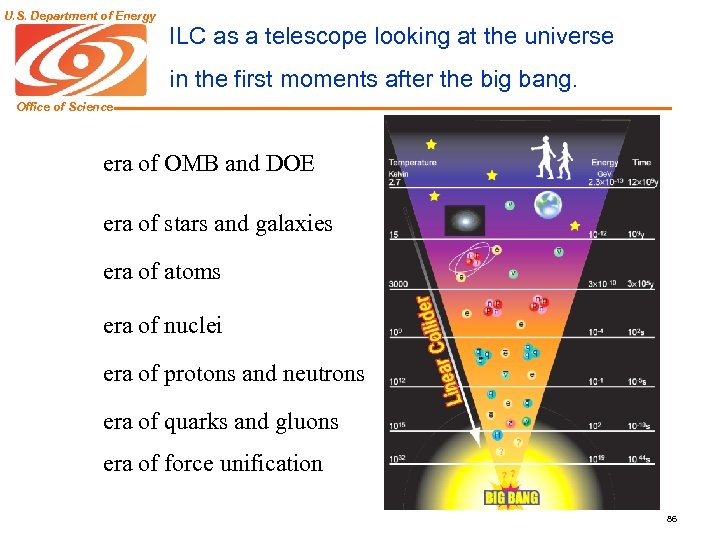 U. S. Department of Energy ILC as a telescope looking at the universe in the first moments after the big bang. Office of Science era of OMB and DOE era of stars and galaxies era of atoms era of nuclei era of protons and neutrons era of quarks and gluons era of force unification 86
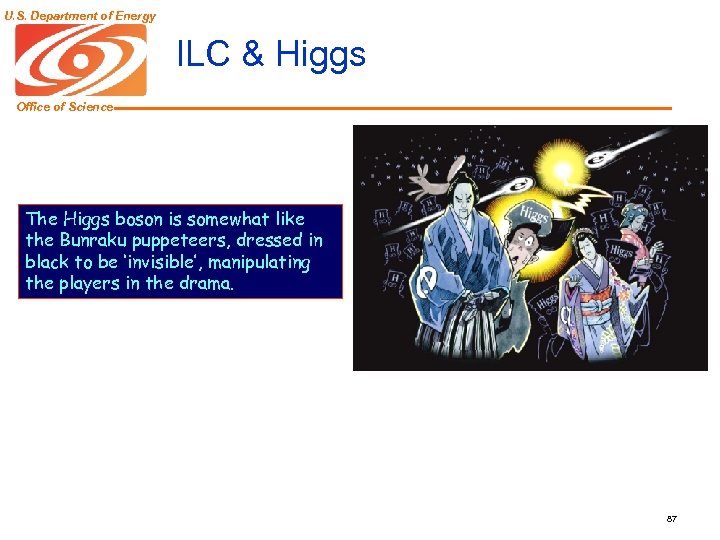 U. S. Department of Energy ILC & Higgs Office of Science The Higgs boson is somewhat like the Bunraku puppeteers, dressed in black to be ‘invisible’, manipulating the players in the drama. 87
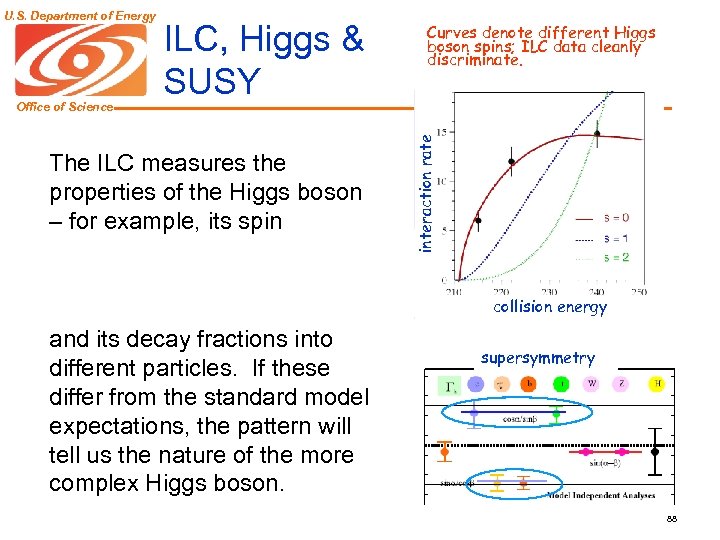 Office of Science ILC, Higgs & SUSY The ILC measures the properties of the Higgs boson – for example, its spin Curves denote different Higgs boson spins; ILC data cleanly discriminate. interaction rate U. S. Department of Energy collision energy and its decay fractions into different particles. If these differ from the standard model expectations, the pattern will tell us the nature of the more complex Higgs boson. supersymmetry 88
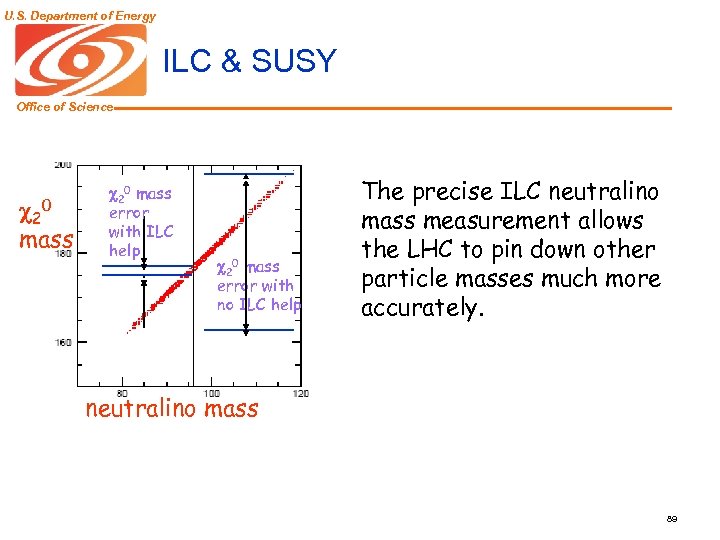 U. S. Department of Energy ILC & SUSY Office of Science 0 c 2 mass c 20 mass error with ILC help c 20 mass error with no ILC help The precise ILC neutralino mass measurement allows the LHC to pin down other particle masses much more accurately. neutralino mass 89
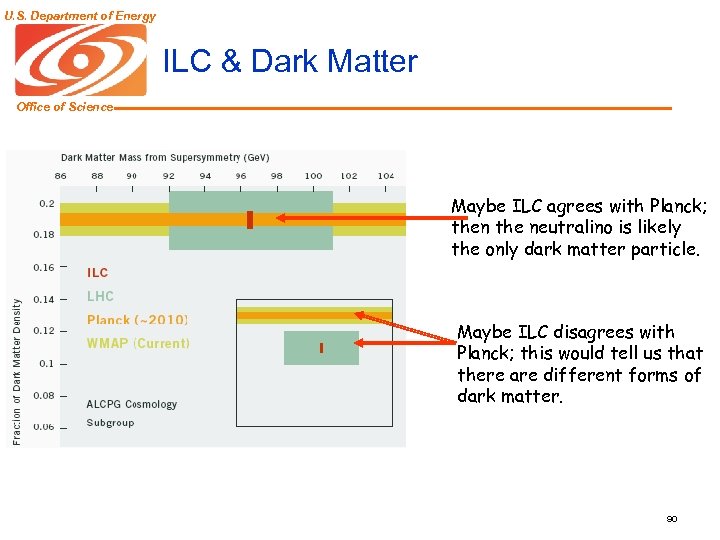 U. S. Department of Energy ILC & Dark Matter Office of Science Maybe ILC agrees with Planck; then the neutralino is likely the only dark matter particle. Maybe ILC disagrees with Planck; this would tell us that there are different forms of dark matter. 90
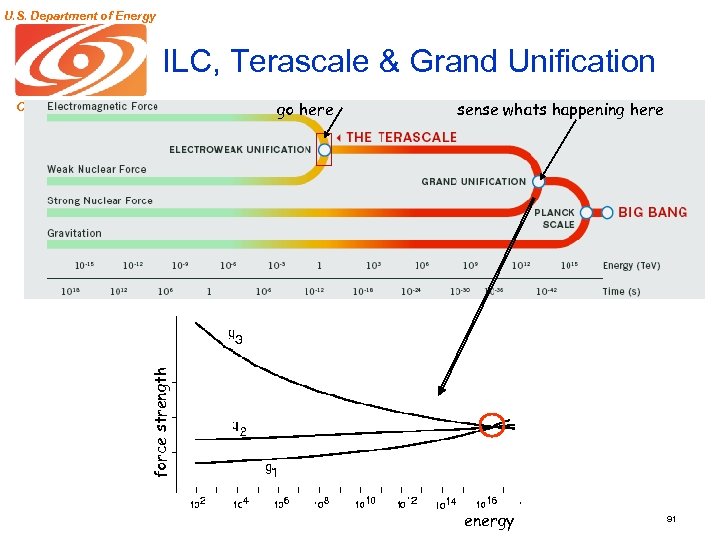 U. S. Department of Energy ILC, Terascale & Grand Unification go here sense whats happening here force strength Office of Science energy 91