


 Скачать презентацию U S Department of Energy Office of Science
b6d10a8976aebb006a6bf27d23f1bc54.ppt
- Количество слайдов: 30
 U. S. Department of Energy Office of Science Driven System Architectures (and a few words about benchmarking) John Shalf NERSC Users Group Meeting Princeton Plasma Physics Laboratory June 2006
 U. S. Department of Energy Overview Office of Science § § Overview of the SSP for procurement benchmarks Recent Benchmarking Activities Workload Characterization Wild Ideas
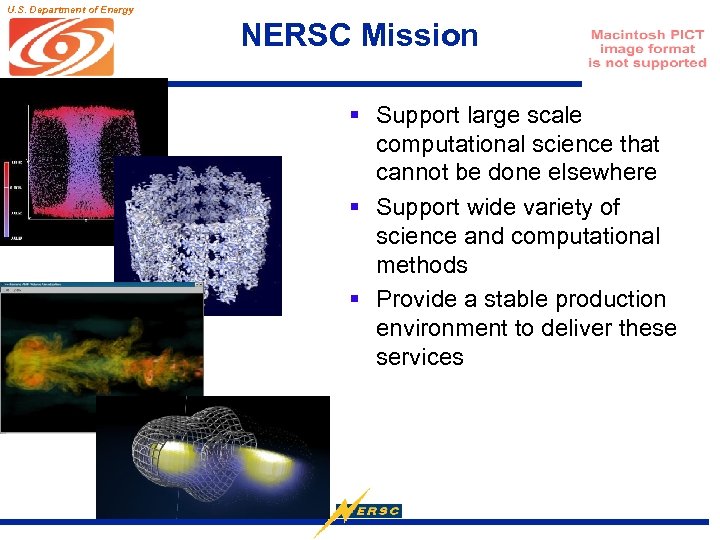 U. S. Department of Energy NERSC Mission Office of Science § Support large scale computational science that cannot be done elsewhere § Support wide variety of science and computational methods § Provide a stable production environment to deliver these services
 U. S. Department of Energy NERSC’s Diverse Workload Office of Science
 U. S. Department of Energy Office of Science § § § Benchmarking for NERSC System Procurements Require a uniform/scientific metric for system “value” over the lifetime of the system that; § Assesses effective/delivered system performance § Representative of NERSC workload § Takes into account system availability and delivery time § Focus on the total value of the system to the DOE science community! Full Application based benchmark methodology § SSP: Sustained System Performance § ESP: Effective System Performance Same methodology (SSP/ESP) employed for “validation” of the delivered system § Factory testing § Acceptance testing § Continuing testing through the lifetime of the system to assess impact of all system upgrades
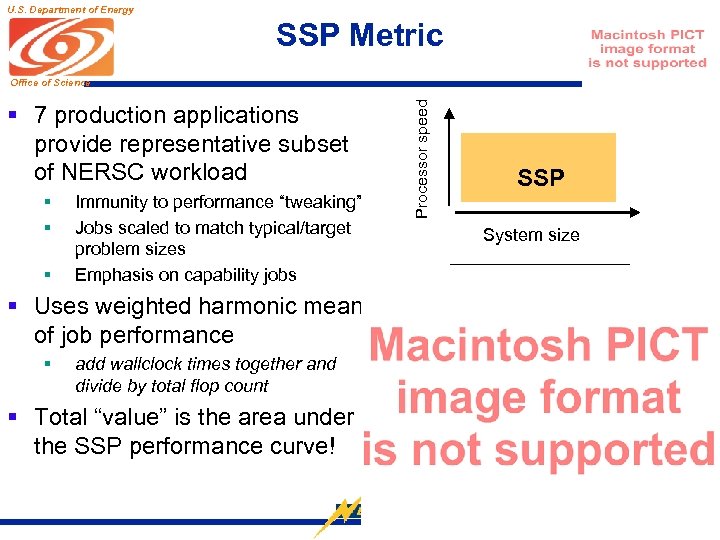 U. S. Department of Energy SSP Metric § 7 production applications provide representative subset of NERSC workload § § § Immunity to performance “tweaking” Jobs scaled to match typical/target problem sizes Emphasis on capability jobs § Uses weighted harmonic mean of job performance § add wallclock times together and divide by total flop count § Total “value” is the area under the SSP performance curve! Processor speed Office of Science SSP System size
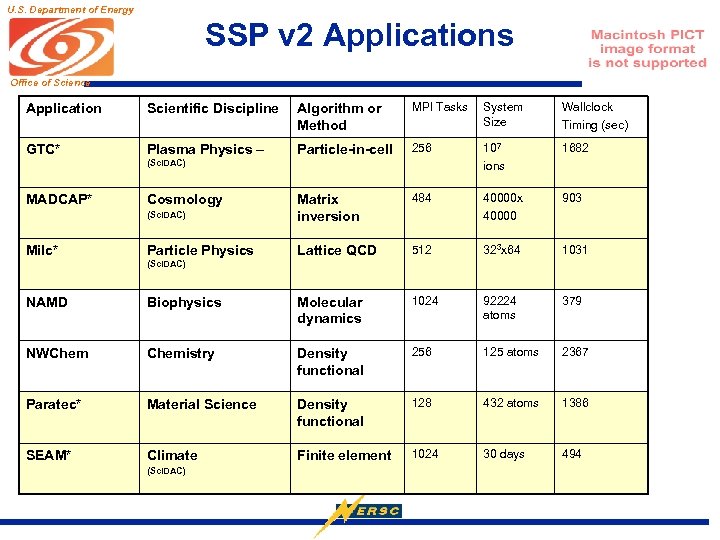 U. S. Department of Energy SSP v 2 Applications Office of Science Application Scientific Discipline Algorithm or Method MPI Tasks System Size Wallclock Timing (sec) GTC* Plasma Physics – Particle-in-cell 256 107 ions 1682 484 40000 x 40000 903 (Sci. DAC) Matrix inversion Particle Physics Lattice QCD 512 323 x 64 1031 (Sci. DAC) MADCAP* Milc* Cosmology (Sci. DAC) NAMD Biophysics Molecular dynamics 1024 92224 atoms 379 NWChemistry Density functional 256 125 atoms 2367 Paratec* Material Science Density functional 128 432 atoms 1386 SEAM* Climate Finite element 1024 30 days 494 (Sci. DAC)
 U. S. Department of Energy ESP Office of Science § Throughput of system under normal operating conditions (nontrivial) § Batch Scheduler efficiency and validation § Job Launcher efficiency § Effect of job fragmentation on system performance § Issues with < full bisection interconnects § Even fat-trees suffer from fragmentation issues § Job migration overhead (remediation)
 U. S. Department of Energy Application Selection Issues Office of Science § It is difficult to get good coverage § Some scientists will not part with “crown jewels” § Hopelessly un-portable codes § Huge time investment for porting and packaging § Tuning requirements for novel/unique architectures § Difficult for vendors to find test systems of appropriate scale § Must test applications at reasonable/native scale § § Rotation of benchmarks to prevent “performance islands” Rotation of benchmarks to follow workload trends § SSP applications will have turn-over as science evolves § Vendor “non-compliance” during bidding process § Motivates us to simplify benchmarking procedures and methods § Perhaps we need a persistent effort to manage the SSP?
 U. S. Department of Energy Emerging Concerns (apps not in SSP/ESP) Office of Science § Some good science doesn’t scale to thousands of processors § AMR § Load balancing § Locality constraints for prolongation and restriction § Pointer chasing (and lots of it!) (Little’s Law limitations) § Sparse Matrix / Super. LU § Domain decomp limits strong scaling efficiency § Emerging issues with existing applications § Implicit Methods § Vector inner product required by Krylov subspace algorithms is hampered by latency-bound fast global reductions at massive parallelism § Climate Models § When science that depends on parameter studies and ensemble runs, capacity and capability are intimately linked! (capacity vs. capability is a bogus metric) § Growth in experimental and sensor data processing requires more attention to I/O performance and global filesystems
 U. S. Department of Energy Science Driven System Architecture (SDSA) Office of Science § Stewardship of NERSC SSP Benchmark suite (Harvey Wasserman, Lenny Oliker) § § Development of New Benchmark Areas (Mike Welcome, Hongzhang Shan) § § Develop microbenchmarks that act as proxies to full application code Develop performance predictive performance models that enable us to predict performance of systems that do not yet exist Use predictive performance models to answer “what-if” architectural questions. Algorithm Tracking and Computer Architecture Evaluation (Lin-Wang, Esmond Ng) § § § I/O Benchmarking AMR Benchmarks Performance Modeling (Erich Strohmaier, Andrew Canning) § § § Workload characterization (benchmarks only sensible in context of the workload they are intended to model: Selection and packaging of benchmarks + collaboration with other govt. agencies Benchmarking and data collection on available systems (no surprises) What are current resource requirements for current algorithms and how will they affect future computer system architectures? How will future system architecture choices affect the development of future numerical algorithms? Vendor Engagement (everyone) § § § Vendor development cycle 18 -24 months! Provide detailed performance analysis & discussion w/vendors to effect changes early in the development cycle (when it really matters)! Bring feedback from vendors back to application groups (vendor code tuning assistance)
 U. S. Department of Energy Multicore? (Or not? ) Office of Science Bassi SSP on Power 5+ showed only 8. 27% performance degradation when run using dual-core mode.
 U. S. Department of Energy Multicore? (Or not? ) Office of Science However, AMD Opteron X 2 shows >50% degradation for many NAS benchmarks compared to single-core? ? ? • 100% would be perfect speedup • 50% means each core runs 50% as fast as single core case • <50% means performance degrades more than memory bandwidth alone can explain!!!
 U. S. Department of Energy Understanding Interconnects Office of Science § CPU clock scaling bonanza has ended § Heat density § New physics below 90 nm (departure from bulk material properties) § Yet, by end of decade mission critical applications expected to have 100 X computational demands of current levels (PITAC Report, Feb 1999) § The path forward for high end computing is increasingly reliant on massive parallelism § Petascale platforms will likely have hundreds of thousands of processors § System costs and performance may soon be dominated by interconnect § What kind of an interconnect is required for a >100 k processor system? § What topological requirements? (fully connected, mesh) § Bandwidth/Latency characteristics? § Specialized support for collective communications?
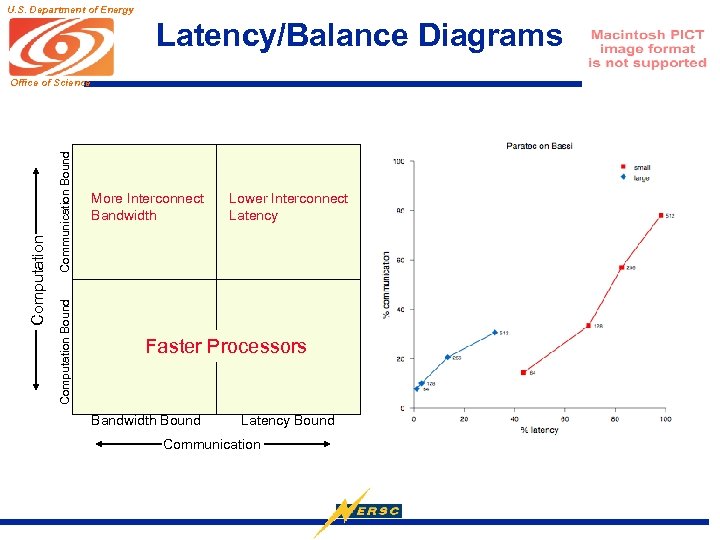
 U. S. Department of Energy Questions (How do we determine appropriate interconnect requirements? ) Office of Science § Topology: will the apps inform us what kind of topology to use? § Crossbars: Not scalable § Fat-Trees: Cost scales superlinearly with number of processors § Lower Degree Interconnects: (n-Dim Mesh, Torus, Hypercube, Cayley) § Costs scale linearly with number of processors § Problems with application mapping/scheduling fault tolerance § Bandwidth/Latency/Overhead § Which is most important? (trick question: they are intimately connected) § Requirements for a “balanced” machine? (eg. performance is not dominated by communication costs) § Collectives § How important/what type? § Do they deserve a dedicated interconnect? § Should we put floating point hardware into the NIC?
 U. S. Department of Energy Approach Office of Science § Identify candidate set of “Ultrascale Applications” that span scientific disciplines § Applications demanding enough to require Ultrascale computing resources § Applications that are capable of scaling up to hundreds of thousands of processors § Not every application is “Ultrascale!” (not all good science is Ultrascale) § Find communication profiling methodology that is § Scalable: Need to be able to run for a long time with many processors. Traces are too large § Non-invasive: Some of these codes are large and can be difficult to instrument even using automated tools § Low-impact on performance: Full scale apps… not proxies!
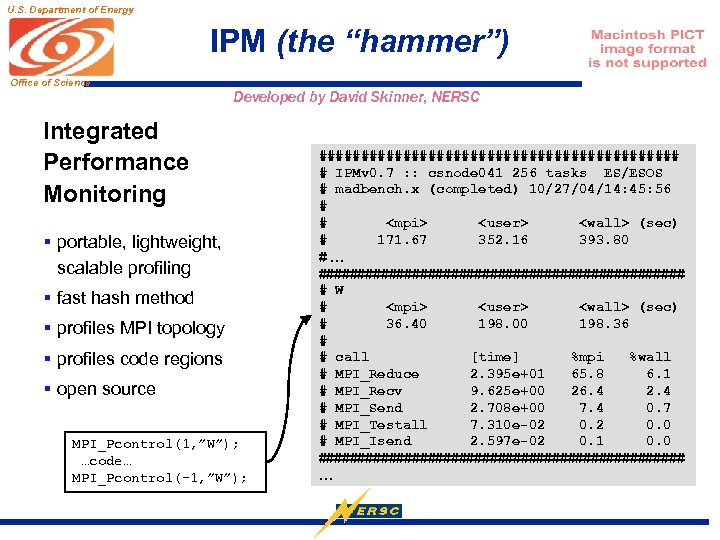 U. S. Department of Energy IPM (the “hammer”) Office of Science Developed by David Skinner, NERSC Integrated Performance Monitoring § portable, lightweight, scalable profiling § fast hash method § profiles MPI topology § profiles code regions § open source MPI_Pcontrol(1, ”W”); …code… MPI_Pcontrol(-1, ”W”); ###################### # IPMv 0. 7 : : csnode 041 256 tasks ES/ESOS # madbench. x (completed) 10/27/04/14: 45: 56 # #
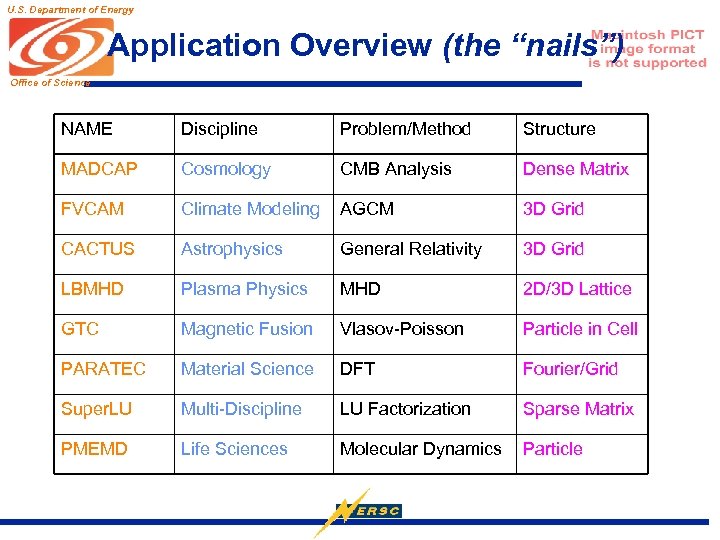 U. S. Department of Energy Application Overview (the “nails”) Office of Science NAME Discipline Problem/Method Structure MADCAP Cosmology CMB Analysis Dense Matrix FVCAM Climate Modeling AGCM 3 D Grid CACTUS Astrophysics General Relativity 3 D Grid LBMHD Plasma Physics MHD 2 D/3 D Lattice GTC Magnetic Fusion Vlasov-Poisson Particle in Cell PARATEC Material Science DFT Fourier/Grid Super. LU Multi-Discipline LU Factorization Sparse Matrix PMEMD Life Sciences Molecular Dynamics Particle
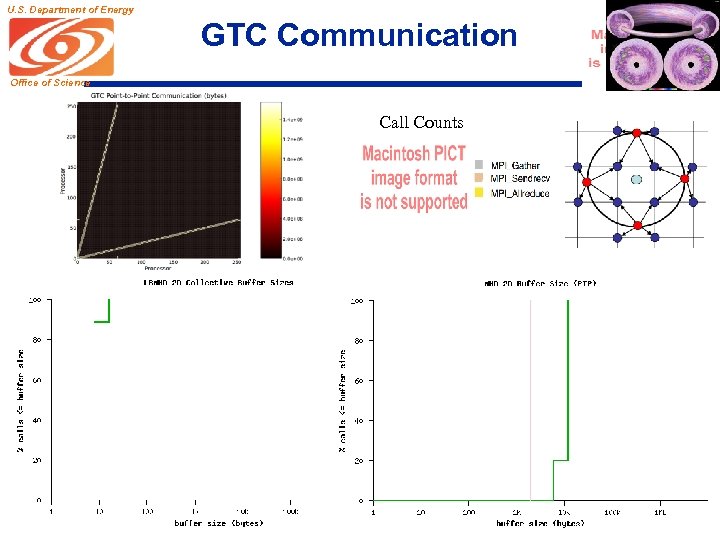
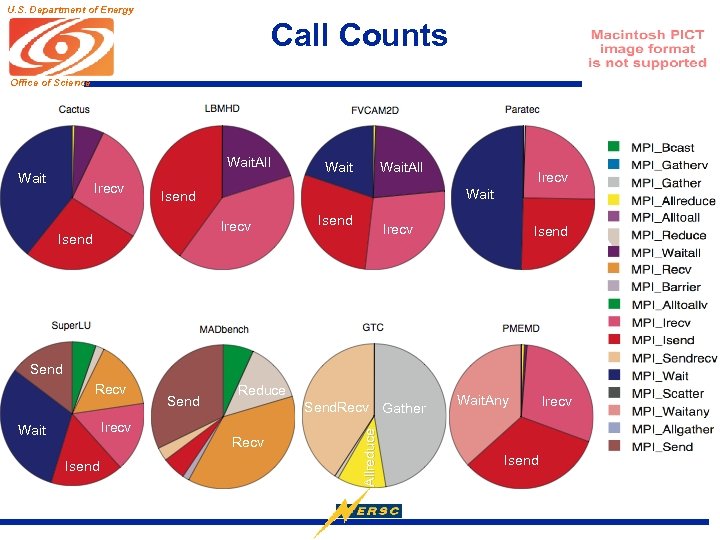 U. S. Department of Energy Call Counts Office of Science Wait. All Wait Irecv Wait. All Wait Isend Irecv Isend Send Irecv Wait Isend Send Reduce Send. Recv Gather Recv Allreduce Recv Wait. Any Isend Irecv
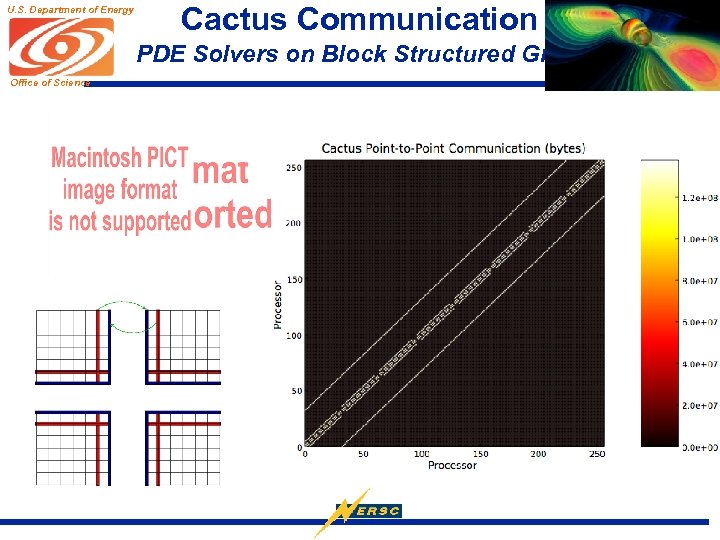
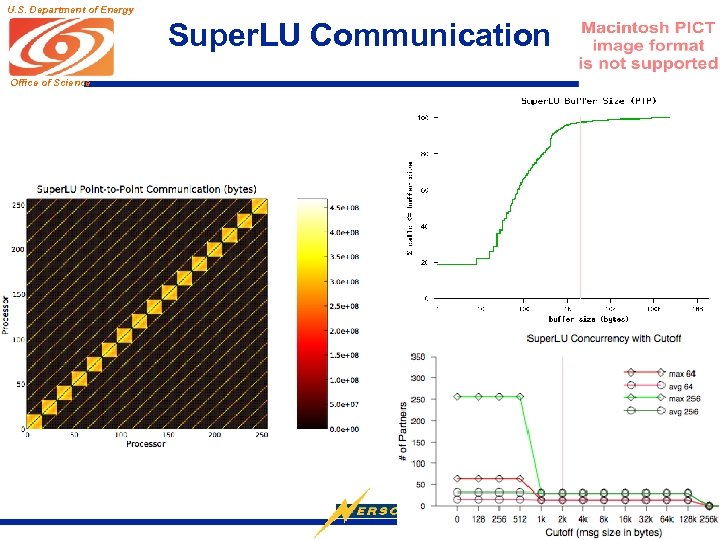
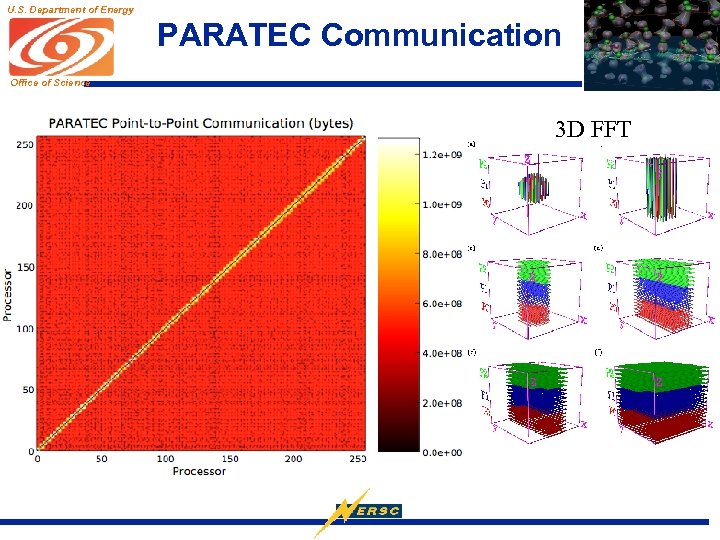
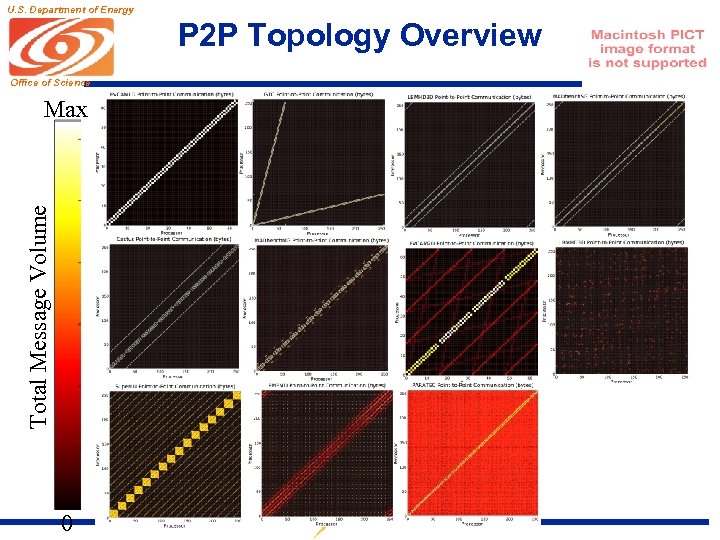 U. S. Department of Energy P 2 P Topology Overview Office of Science Total Message Volume Max 0
 U. S. Department of Energy Cactus Communication PDE Solvers on Block Structured Grids Office of Science
 U. S. Department of Energy GTC Communication Office of Science Call Counts
 U. S. Department of Energy Super. LU Communication Office of Science
 U. S. Department of Energy PARATEC Communication Office of Science 3 D FFT
 U. S. Department of Energy Collective Buffer Sizes Office of Science 95% Latency Bound!!!
 U. S. Department of Energy Latency/Balance Diagrams Communication Bound Computation Office of Science More Interconnect Bandwidth Lower Interconnect Latency Faster Processors Bandwidth Bound Latency Bound Communication
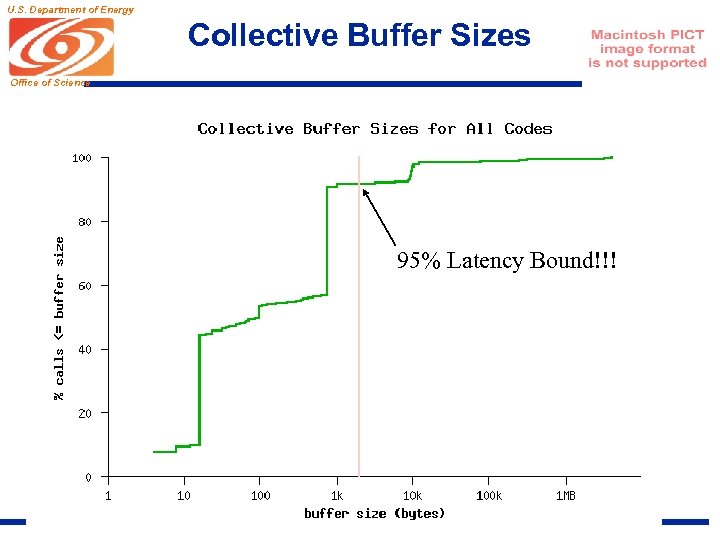
 U. S. Department of Energy Revisiting Original Questions Office of Science § Topology § Most codes require far less than full connectivity § § PARATEC is the only code requiring full connectivity § Many require low degree (<12 neighbors) Codes with low topological degree of communication not necessarily isomorphic to a mesh! § Non-isotropic communication pattern § Non-uniform requirements § Bandwidth/Delay/Overhead requirements § Scalable codes primarily bandwidth-bound messages § Average message sizes several Kbytes § Collectives § Most payloads less than 1 k (8 -100 bytes!) § § § Well below the bandwidth delay product § Primarily latency-bound (requires different kind of interconnect) Math operations limited primarily to reductions involving sum, max, and min operations. Deserves a dedicated network (significantly different reqs. )
 U. S. Department of Energy Algorithm Tracking Office of Science § Can’t track an algorithm until you define what constitutes an algorithm that is worth tracking § Which algorithms or libraries are important? § Workload analysis precedes drill-down into algorithm
 U. S. Department of Energy Materials Science Workload Office of Science
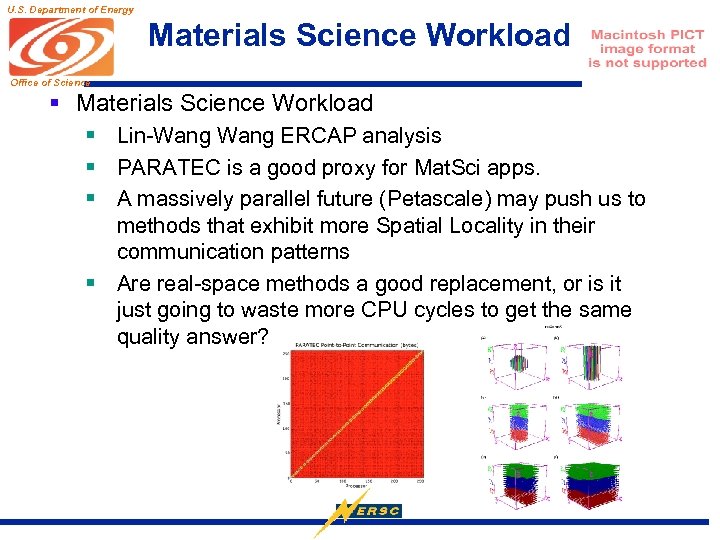 U. S. Department of Energy Materials Science Workload Office of Science § Materials Science Workload § Lin-Wang ERCAP analysis § PARATEC is a good proxy for Mat. Sci apps. § A massively parallel future (Petascale) may push us to methods that exhibit more Spatial Locality in their communication patterns § Are real-space methods a good replacement, or is it just going to waste more CPU cycles to get the same quality answer?