


 Скачать презентацию U S Department of Energy Hydrogen Fuel
78ba0345832a6c5d61e74efda0e2daee.ppt
- Количество слайдов: 18
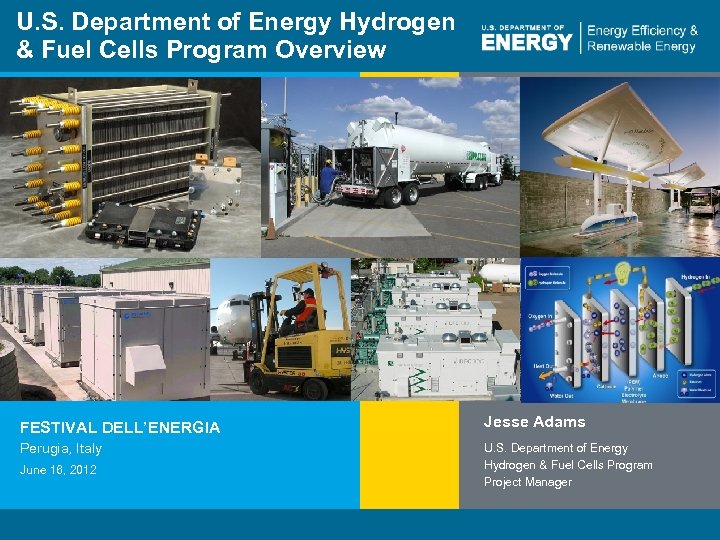 U. S. Department of Energy Hydrogen & Fuel Cells Program Overview FESTIVAL DELL’ENERGIA Jesse Adams Perugia, Italy U. S. Department of Energy Hydrogen & Fuel Cells Program Project Manager June 16, 2012 1 | Fuel Cell Technologies Program Source: US DOE 3/16/2018 eere. energy. gov
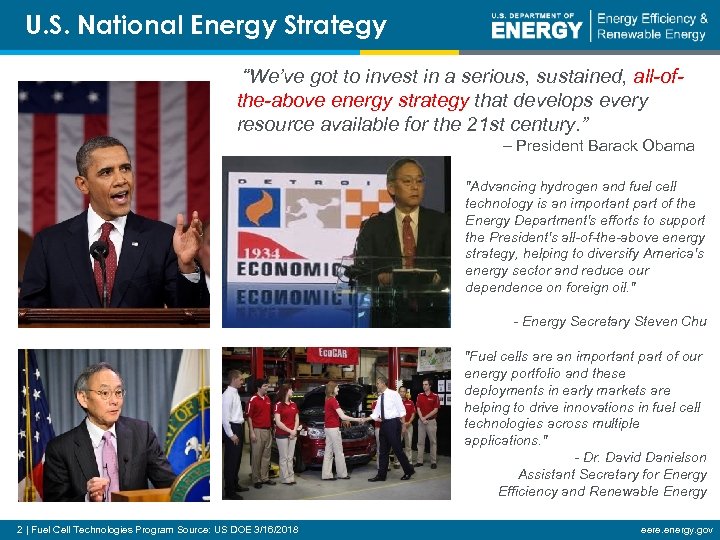 U. S. National Energy Strategy “We’ve got to invest in a serious, sustained, all-ofthe-above energy strategy that develops every resource available for the 21 st century. ” – President Barack Obama "Advancing hydrogen and fuel cell technology is an important part of the Energy Department's efforts to support the President's all-of-the-above energy strategy, helping to diversify America's energy sector and reduce our dependence on foreign oil. " - Energy Secretary Steven Chu "Fuel cells are an important part of our energy portfolio and these deployments in early markets are helping to drive innovations in fuel cell technologies across multiple applications. " - Dr. David Danielson Assistant Secretary for Energy Efficiency and Renewable Energy 2 | Fuel Cell Technologies Program Source: US DOE 3/16/2018 eere. energy. gov
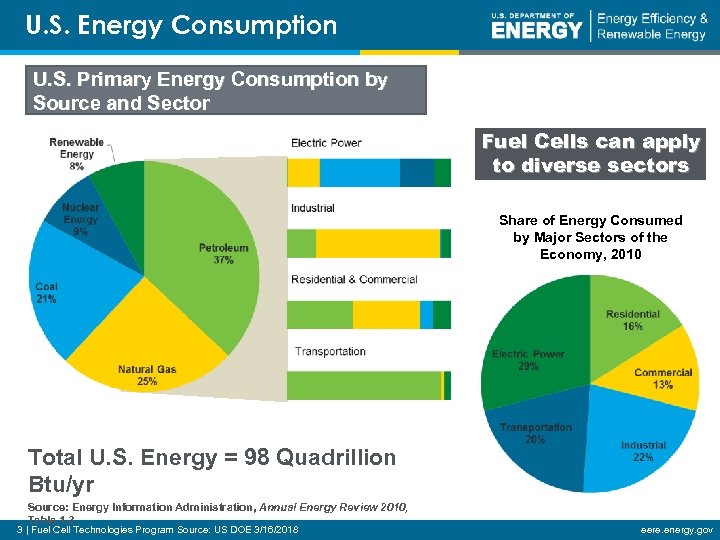 U. S. Energy Consumption U. S. Primary Energy Consumption by Source and Sector Fuel Cells can apply to diverse sectors Share of Energy Consumed by Major Sectors of the Economy, 2010 Total U. S. Energy = 98 Quadrillion Btu/yr Source: Energy Information Administration, Annual Energy Review 2010, Table 1. 3 3 | Fuel Cell Technologies Program Source: US DOE 3/16/2018 eere. energy. gov
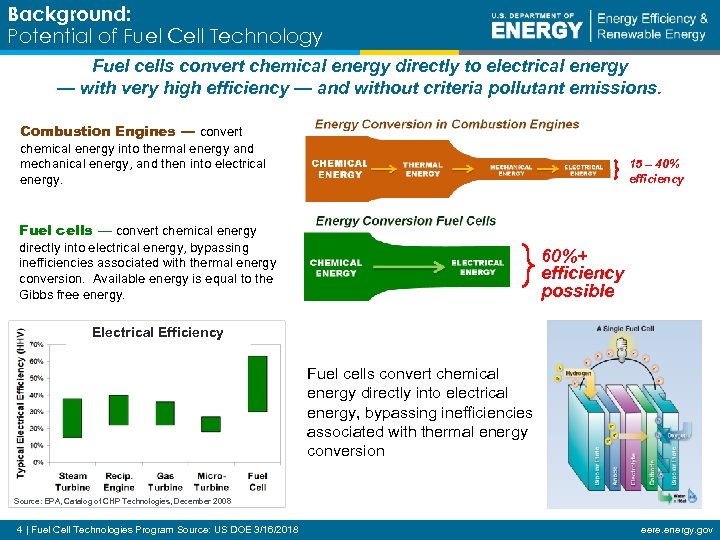 Background: Potential of Fuel Cell Technology Fuel cells convert chemical energy directly to electrical energy — with very high efficiency — and without criteria pollutant emissions. Combustion Engines — convert chemical energy into thermal energy and mechanical energy, and then into electrical energy. 15 – 40% efficiency Fuel cells — convert chemical energy directly into electrical energy, bypassing inefficiencies associated with thermal energy conversion. Available energy is equal to the Gibbs free energy. 60%+ efficiency possible Electrical Efficiency Fuel cells convert chemical energy directly into electrical energy, bypassing inefficiencies associated with thermal energy conversion Source: EPA, Catalog of CHP Technologies, December 2008 4 | Fuel Cell Technologies Program Source: US DOE 3/16/2018 eere. energy. gov
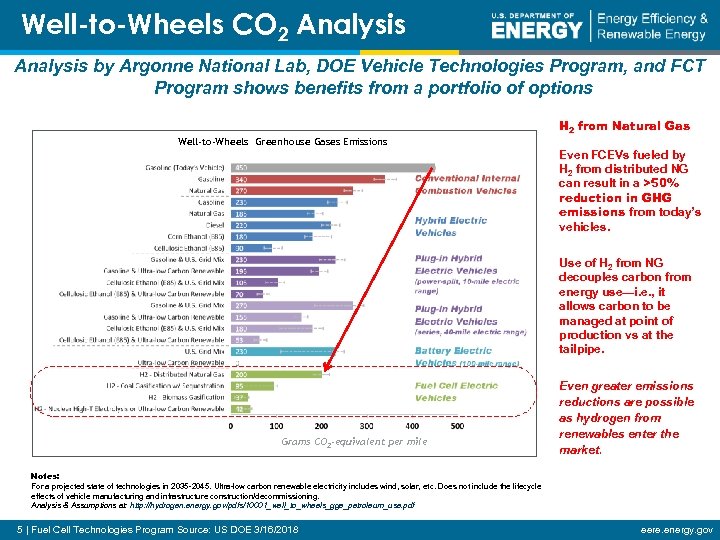 Well-to-Wheels CO 2 Analysis by Argonne National Lab, DOE Vehicle Technologies Program, and FCT Program shows benefits from a portfolio of options H 2 from Natural Gas Well-to-Wheels Greenhouse Gases Emissions Even FCEVs fueled by H 2 from distributed NG can result in a >50% reduction in GHG emissions from today’s vehicles. Use of H 2 from NG decouples carbon from energy use—i. e. , it allows carbon to be managed at point of production vs at the tailpipe. Grams CO 2 -equivalent per mile Even greater emissions reductions are possible as hydrogen from renewables enter the market. Notes: For a projected state of technologies in 2035 -2045. Ultra-low carbon renewable electricity includes wind, solar, etc. Does not include the lifecycle effects of vehicle manufacturing and infrastructure construction/decommissioning. Analysis & Assumptions at: http: //hydrogen. energy. gov/pdfs/10001_well_to_wheels_gge_petroleum_use. pdf 5 | Fuel Cell Technologies Program Source: US DOE 3/16/2018 eere. energy. gov
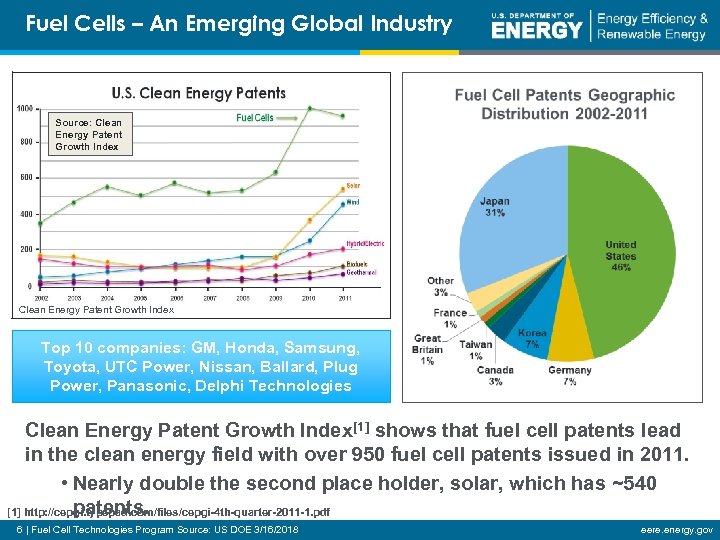 Fuel Cells – An Emerging Global Industry Source: Clean Energy Patent Growth Index Top 10 companies: GM, Honda, Samsung, Toyota, UTC Power, Nissan, Ballard, Plug Power, Panasonic, Delphi Technologies Clean Energy Patent Growth Index[1] shows that fuel cell patents lead in the clean energy field with over 950 fuel cell patents issued in 2011. • Nearly double the second place holder, solar, which has ~540 patents. [1] http: //cepgi. typepad. com/files/cepgi-4 th-quarter-2011 -1. pdf 6 | Fuel Cell Technologies Program Source: US DOE 3/16/2018 eere. energy. gov
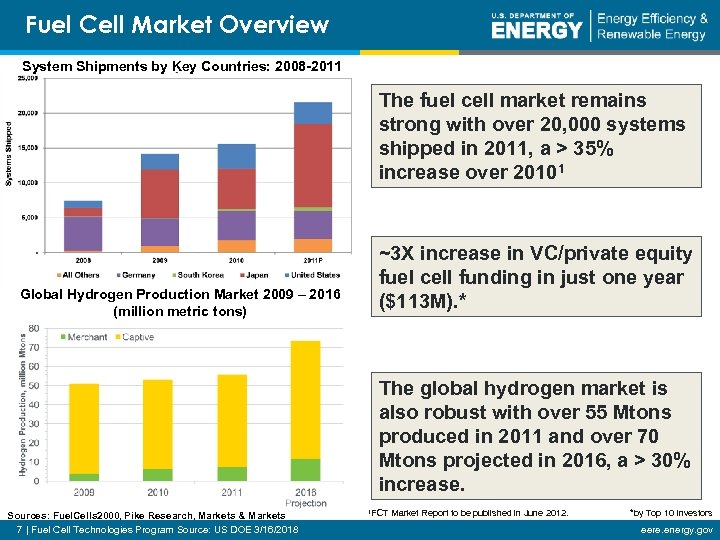 Fuel Cell Market Overview System Shipments by Key Countries: 2008 -2011 The fuel cell market remains strong with over 20, 000 systems shipped in 2011, a > 35% increase over 20101 Global Hydrogen Production Market 2009 – 2016 (million metric tons) ~3 X increase in VC/private equity fuel cell funding in just one year ($113 M). * The global hydrogen market is also robust with over 55 Mtons produced in 2011 and over 70 Mtons projected in 2016, a > 30% increase. Sources: Fuel. Cells 2000, Pike Research, Markets & Markets 7 | Fuel Cell Technologies Program Source: US DOE 3/16/2018 1 FCT Market Report to be published in June 2012. *by Top 10 Investors eere. energy. gov
 U. S. DOE Program Mission The mission of the Hydrogen and Fuel Cells Program is to enable the widespread commercialization of hydrogen and fuel cell technologies through: • • • basic and applied research technology development and demonstration Addressing institutional and market challenges Key Goals: Develop hydrogen and fuel cell technologies for: 1. Early markets (e. g. , stationary power, forklifts, portable power) 2. Mid-term markets (e. g. , residential CHP, auxiliary power, buses and fleet vehicles ) 3. Longer-term markets, 2015 -2020 (including mainstream transportation, with focus on passenger cars) 8 | Fuel Cell Technologies Program Source: US DOE 3/16/2018 An integrated strategic plan for the research, development, and demonstration activities of DOE’s Hydrogen and Fuel Cells Program http: //hydrogen. energy. gov/roadmaps_vision. html eere. energy. gov
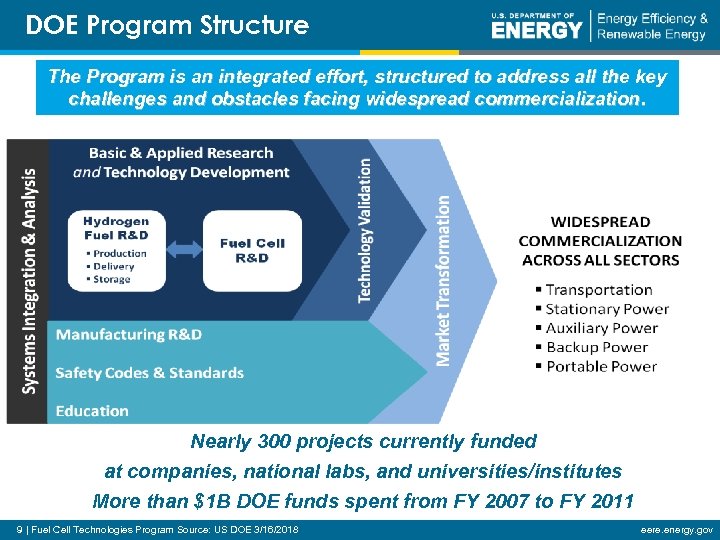 DOE Program Structure The Program is an integrated effort, structured to address all the key challenges and obstacles facing widespread commercialization. Nearly 300 projects currently funded at companies, national labs, and universities/institutes More than $1 B DOE funds spent from FY 2007 to FY 2011 9 | Fuel Cell Technologies Program Source: US DOE 3/16/2018 eere. energy. gov
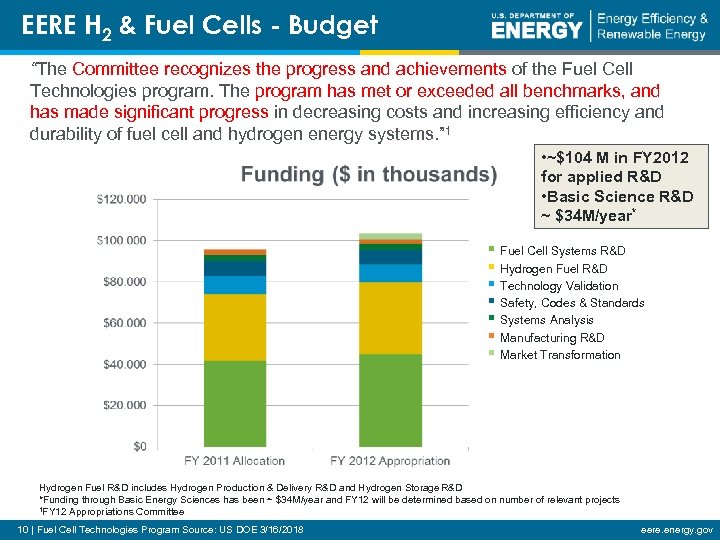 EERE H 2 & Fuel Cells - Budget “The Committee recognizes the progress and achievements of the Fuel Cell Technologies program. The program has met or exceeded all benchmarks, and has made significant progress in decreasing costs and increasing efficiency and durability of fuel cell and hydrogen energy systems. ” 1 • ~$104 M in FY 2012 for applied R&D • Basic Science R&D ~ $34 M/year* § Fuel Cell Systems R&D § Hydrogen Fuel R&D § Technology Validation § Safety, Codes & Standards § Systems Analysis § Manufacturing R&D § Market Transformation Hydrogen Fuel R&D includes Hydrogen Production & Delivery R&D and Hydrogen Storage R&D *Funding through Basic Energy Sciences has been ~ $34 M/year and FY 12 will be determined based on number of relevant projects 1 FY 12 Appropriations Committee 10 | Fuel Cell Technologies Program Source: US DOE 3/16/2018 eere. energy. gov
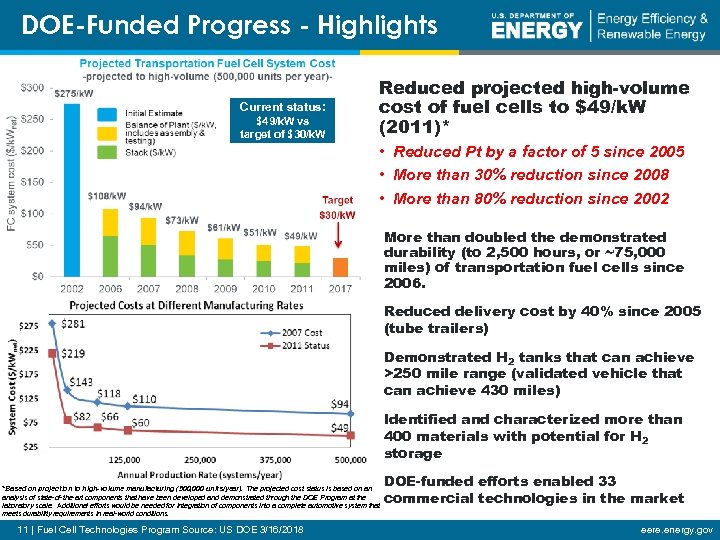 DOE-Funded Progress - Highlights Current status: $49/k. W vs target of $30/k. W Reduced projected high-volume cost of fuel cells to $49/k. W (2011)* • Reduced Pt by a factor of 5 since 2005 • More than 30% reduction since 2008 • More than 80% reduction since 2002 More than doubled the demonstrated durability (to 2, 500 hours, or ~75, 000 miles) of transportation fuel cells since 2006. Reduced delivery cost by 40% since 2005 (tube trailers) Demonstrated H 2 tanks that can achieve >250 mile range (validated vehicle that can achieve 430 miles) Identified and characterized more than 400 materials with potential for H 2 storage *Based on projection to high-volume manufacturing (500, 000 units/year). The projected cost status is based on an analysis of state-of-the-art components that have been developed and demonstrated through the DOE Program at the laboratory scale. Additional efforts would be needed for integration of components into a complete automotive system that meets durability requirements in real-world conditions. 11 | Fuel Cell Technologies Program Source: US DOE 3/16/2018 DOE-funded efforts enabled 33 commercial technologies in the market eere. energy. gov
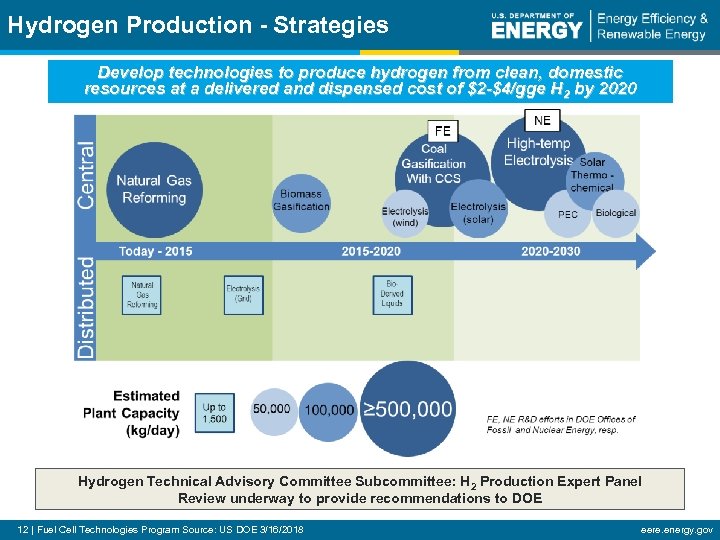 Hydrogen Production - Strategies Develop technologies to produce hydrogen from clean, domestic resources at a delivered and dispensed cost of $2 -$4/gge H 2 by 2020 Hydrogen Technical Advisory Committee Subcommittee: H 2 Production Expert Panel Review underway to provide recommendations to DOE 12 | Fuel Cell Technologies Program Source: US DOE 3/16/2018 eere. energy. gov
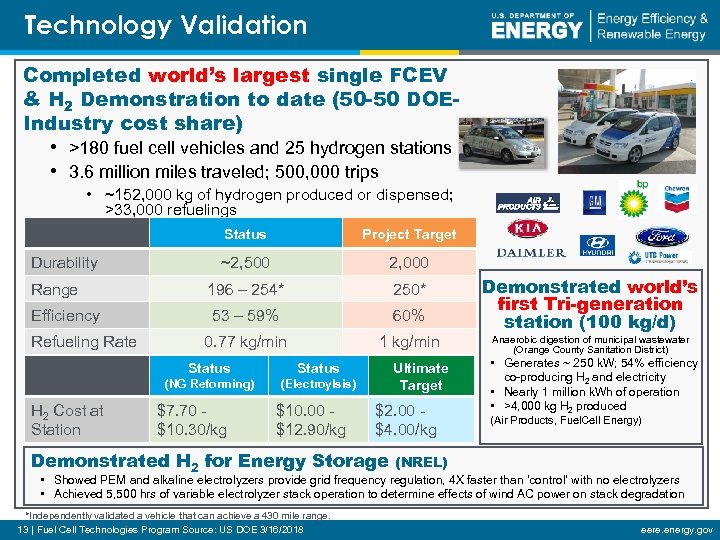 Technology Validation Completed world’s largest single FCEV & H 2 Demonstration to date (50 -50 DOEIndustry cost share) • >180 fuel cell vehicles and 25 hydrogen stations • 3. 6 million miles traveled; 500, 000 trips • ~152, 000 kg of hydrogen produced or dispensed; >33, 000 refuelings Status Durability Range Efficiency Refueling Rate Project Target ~2, 500 2, 000 196 – 254* 250* 53 – 59% 60% 0. 77 kg/min 1 kg/min Status (NG Reforming) H 2 Cost at Station Status (Electroylsis) $7. 70 $10. 30/kg $10. 00 $12. 90/kg Ultimate Target $2. 00 $4. 00/kg Demonstrated H 2 for Energy Storage Demonstrated world’s first Tri-generation station (100 kg/d) Anaerobic digestion of municipal wastewater (Orange County Sanitation District) • Generates ~ 250 k. W; 54% efficiency co-producing H 2 and electricity • Nearly 1 million k. Wh of operation • >4, 000 kg H 2 produced (Air Products, Fuel. Cell Energy) (NREL) • Showed PEM and alkaline electrolyzers provide grid frequency regulation, 4 X faster than ‘control’ with no electrolyzers • Achieved 5, 500 hrs of variable electrolyzer stack operation to determine effects of wind AC power on stack degradation *Independently validated a vehicle that can achieve a 430 mile range. 13 | Fuel Cell Technologies Program Source: US DOE 3/16/2018 eere. energy. gov
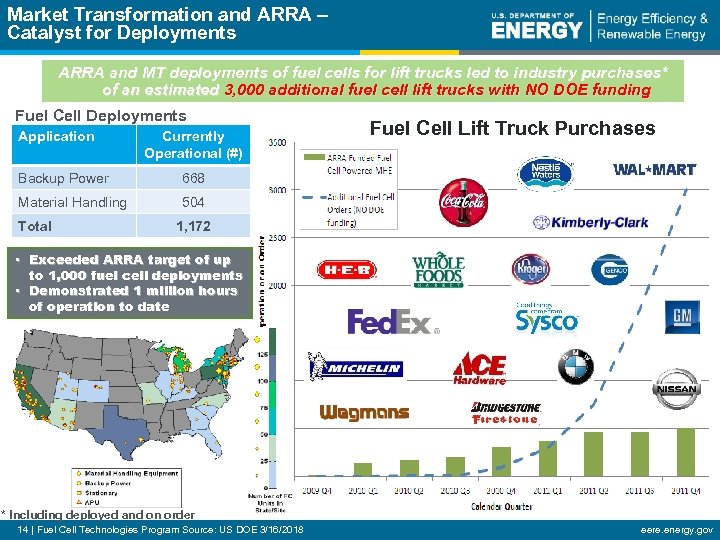 Market Transformation and ARRA – Catalyst for Deployments ARRA and MT deployments of fuel cells for lift trucks led to industry purchases* of an estimated 3, 000 additional fuel cell lift trucks with NO DOE funding Fuel Cell Deployments Application Currently Operational (#) Backup Power 668 Material Handling Fuel Cell Lift Truck Purchases 504 Total 1, 172 • Exceeded ARRA target of up to 1, 000 fuel cell deployments • Demonstrated 1 million hours of operation to date * Including deployed and on order 14 | Fuel Cell Technologies Program Source: US DOE 3/16/2018 eere. energy. gov
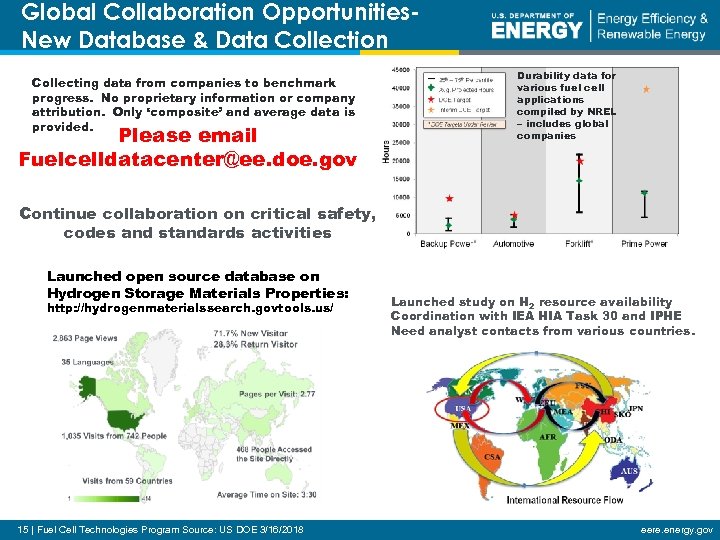 Global Collaboration Opportunities. New Database & Data Collection Collecting data from companies to benchmark progress. No proprietary information or company attribution. Only ‘composite’ and average data is provided. Please email Fuelcelldatacenter@ee. doe. gov Durability data for various fuel cell applications compiled by NREL – includes global companies Continue collaboration on critical safety, codes and standards activities Launched open source database on Hydrogen Storage Materials Properties: http: //hydrogenmaterialssearch. govtools. us/ 15 | Fuel Cell Technologies Program Source: US DOE 3/16/2018 Launched study on H 2 resource availability Coordination with IEA HIA Task 30 and IPHE Need analyst contacts from various countries. eere. energy. gov
 Future Directions Continue and strengthen critical R&D Hydrogen, fuel cells, safety, codes and standards, etc. Conduct strategic, selective demonstrations of innovative technologies Continue to conduct key analysis to guide RD&D and path forward, determine infrastructure needs Leverage activities to maximize impact Continue and strengthen communication and outreach 16 | Fuel Cell Technologies Program Source: US DOE 3/16/2018 eere. energy. gov
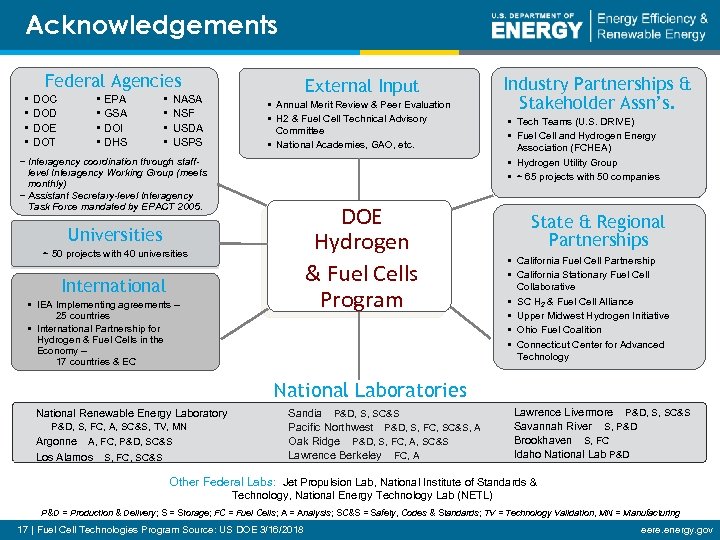 Acknowledgements Federal Agencies • • DOC DOD DOE DOT EPA GSA DOI DHS • • NASA NSF USDA USPS External Input • Annual Merit Review & Peer Evaluation • H 2 & Fuel Cell Technical Advisory Committee • National Academies, GAO, etc. − Interagency coordination through stafflevel Interagency Working Group (meets monthly) − Assistant Secretary-level Interagency Task Force mandated by EPACT 2005. DOE Hydrogen & Fuel Cells Program Universities ~ 50 projects with 40 universities International • IEA Implementing agreements – 25 countries • International Partnership for Hydrogen & Fuel Cells in the Economy – 17 countries & EC Industry Partnerships & Stakeholder Assn’s. • Tech Teams (U. S. DRIVE) • Fuel Cell and Hydrogen Energy Association (FCHEA) • Hydrogen Utility Group • ~ 65 projects with 50 companies State & Regional Partnerships • California Fuel Cell Partnership • California Stationary Fuel Cell Collaborative • SC H 2 & Fuel Cell Alliance • Upper Midwest Hydrogen Initiative • Ohio Fuel Coalition • Connecticut Center for Advanced Technology National Laboratories National Renewable Energy Laboratory P&D, S, FC, A, SC&S, TV, MN Argonne A, FC, P&D, SC&S Los Alamos S, FC, SC&S Sandia P&D, S, SC&S Pacific Northwest P&D, S, FC, SC&S, A Oak Ridge P&D, S, FC, A, SC&S Lawrence Berkeley FC, A Lawrence Livermore P&D, S, SC&S Savannah River S, P&D Brookhaven S, FC Idaho National Lab P&D Other Federal Labs: Jet Propulsion Lab, National Institute of Standards & Technology, National Energy Technology Lab (NETL) P&D = Production & Delivery; S = Storage; FC = Fuel Cells; A = Analysis; SC&S = Safety, Codes & Standards; TV = Technology Validation, MN = Manufacturing 17 | Fuel Cell Technologies Program Source: US DOE 3/16/2018 eere. energy. gov
 Thank you Jesse Adams Project Manager Jesse. Adams@go. doe. gov Sunita Satyapal Program Manager Sunita. Satyapal@ee. doe. gov Hydrogen and Fuel Cells Program U. S. Department of Energy Additional Information www. hydrogen. energy. gov 18 | Fuel Cell Technologies Program Source: US DOE 3/16/2018 eere. energy. gov