


 Скачать презентацию U S Department of Education Office of Inspector
413e78c9f6dc57dac597c879c89a2b1d.ppt
- Количество слайдов: 30
 U. S. Department of Education Office of Inspector General ACICS Conference in Puerto Rico Title IV Fraud Issues February 24, 2015 Presented by Robert A. Wolfe Resident Agent in Charge OIG Investigation Services Puerto Rico Office
 AGENDA • • OIG Organization and Mission Sources of Allegations Fraud Indicators Examples of Title IV Fraud Schemes Title IV Cases in PR Contact Information Question and Answer
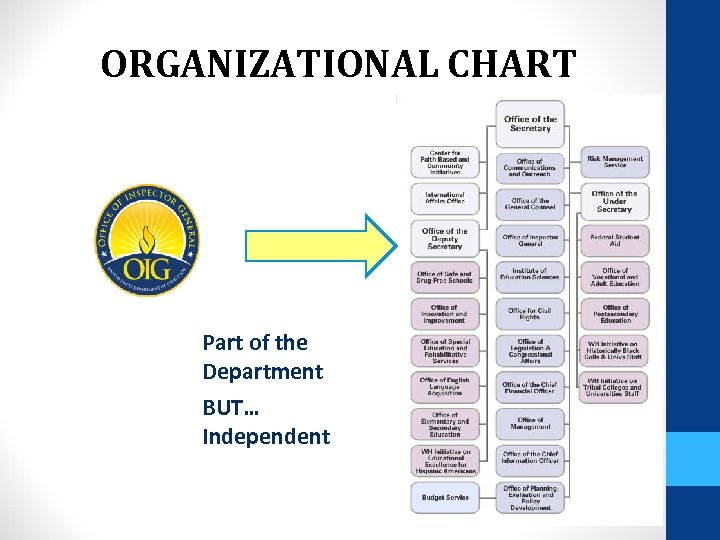 ORGANIZATIONAL CHART Part of the Department BUT… Independent
 Inspector General Act of 1978 …to prevent and detect fraud, waste and abuse and improve the economy, efficiency and effectiveness of Education Department programs and operations.
 OIG Mission Statement To promote the efficiency, effectiveness, and integrity of the Department's programs and operations, we conduct independent and objective audits, investigations, inspections, and other activities.
 OIG Components • Investigation Services • Audit Services • Evaluation, Inspection and Management Services • Information Technology Audits and Computer Crime Investigations • Immediate Office/Counsel/Public Affairs
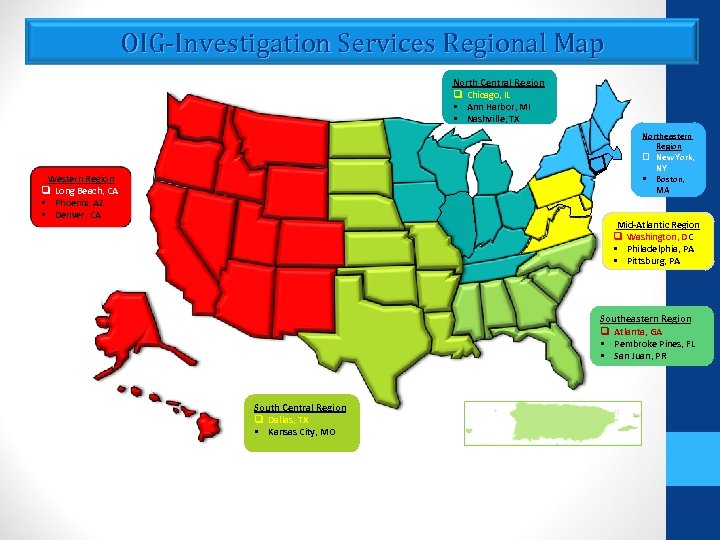 OIG-Investigation Services Regional Map North Central Region q Chicago, IL § Ann Harbor, MI § Nashville, TX Northeastern Region q New York, NY § Boston, MA Western Region q Long Beach, CA § Phoenix, AZ § Denver, CA Mid-Atlantic Region q Washington, DC § Philadelphia, PA § Pittsburg, PA Southeastern Region q Atlanta, GA § Pembroke Pines, FL § San Juan, PR South Central Region q Dallas, TX § Kansas City, MO
 OIG Investigations • Federal Law Enforcement Officers • Conduct Criminal & Civil Investigations • Execute Arrests and Search Warrants • Serve Federal Grand Jury and Administrative Subpoenas • Present criminal investigation results-findings to Federal Grand Juries & Prosecutors
 Sources of Allegations • OIG Hotline • Department Program Offices • School Employees and Officials • Contractors and Sub-contractors • Grantees and Sub-grantees • Citizens and Students • Competing Vendors/Schools • Other Federal and State Agencies • Qui Tam Actions
 Evidence Gathering ü Statutory and Regulatory Access to Records ü Consensual Search/Access ü Search Warrant ü Court Order ü Subpoenas ü Interviews
 34 CFR § 668. 16 Standards of Administrative Capability The Secretary considers an institution to have administrative capability if the institution: (f) Develops and applies an adequate system to identify and resolve discrepancies in the information that the institution receives from different sources with respect to a student’s application for financial aid under Title IV. (g) Refers to the Office of Inspector General…any credible information indicating that an applicant for Title IV, HEA program assistance may have engaged in fraud or other criminal misconduct in connection with his or her application. Schools must also refer to the OIG any third-party servicer who may have engaged in fraud, breach of fiduciary responsibility, or other illegal conduct involving the FSA Programs.
 Statutory and Regulatory Access to Records • Under the Inspector General Act of 1978, as amended, OIG can access any records available to the Department of Education in order to perform audits, investigations and inspections of Department programs and operations. • The Family Educational Rights and Privacy Act (FERPA) requires schools receiving funding from the Department of Education to protect the privacy of student education records. In many cases consent must be received from a parent or student before records can be disclosed. • FERPA provides that consent is not required in order to disclose student records to the Office of Inspector General. The regulations provide that representatives of the Secretary, which include OIG, may have access without prior consent in connection with an audit, evaluation, or enforcement of legal requirements related to the Department’s programs. FERPA regulations can be found at 34 C. F. R. Part 99, http: //www 2. ed. gov/policy/gen/guid/fpco/index. html
 Fraud Defined A deliberate distortion of the truth in an attempt to obtain something of value. or Lying and cheating.
 Fraud Risks • • • • One person in control No separation of duties Lack of internal controls/ignoring controls No prior audits Repeat audit findings High turnover of personnel Unexplained entries in records Unusually large amounts of payments for cash Inadequate or missing documentation Inability to answer or respond to basic questions Altered records Non-serial number transactions Inventories and financial records not reconciled Unauthorized transactions
 • FAFSA Fraud: • Social Security Number • Alien Registration Status • Dependency Status • Income and Assets • Number of Family Members in College • Falsification of GEDs/HS Diplomas Identity Theft Distance Fraud Schemes • • 15 Examples of Title IV Fraud Schemes Related to Students
 Examples of Title IV Fraud Schemes Related to Schools l Ghost students l Leasing of eligibility l Default rate fraud l 90/10 Rule manipulation scheme l Financial statement falsification l Falsified last date of attendance l Obstruction of a federal audit or program review. l Fraud/Theft by School Employees l l l FAFSA fraud- enrollment Falsification of GEDs/HS Diplomas Falsification of attendance and Satisfactory Academic Progress Falsification of grades Failure to make refunds Loan theft/ forgeries
 Criminal Penalties Education Fraud Title 20 U. S. C. § 1097 (a) • Any person who knowingly and willfully embezzles, misapplies, steals, obtains by fraud, false statement, or forgery, or fails to refund any funds, assets, or property provided or insured under this subchapter and part C of subchapter I of chapter 34 of Title 42, or attempts to embezzle, …. • Persons convicted of a felony shall be fined not more than $20, 000 or imprisoned for not more than 5 years, or both. • Attempt is defined as, “an undertaking to do an act that entails more than mere preparation but does not result in the successful completion of the act. ”
 Other Criminal Statutes Used in Connection with OIG cases: • 18 USC § 371 CONSPIRACY • 18 USC § 1001 FALSE STATEMENTS • 18 USC § 1341 MAIL FRAUD • 18 USC § 1343 WIRE FRAUD • 18 USC § 1014 BANK FRAUD • 18 USC § 641 THEFT OF GOVERNMENT FUNDS • 18 USC § 666 THEFT CONCERNING FEDERAL PROGRAMS • 18 USC § 1030 COMPUTER FRAUD/EXCEEDING ACCESS
 Civil False Claims Act 31 U. S. C. § 3729 • Knowingly presents, or causes to be presented, to the United States Government a false or fraudulent claim for payment or approval • …or makes, uses, or causes to be made or used, a false record or statement to get a false or fraudulent claim paid or to conceal, avoid, or decrease an obligation to the Government. • Burden of Proof – “Preponderance of the Evidence” (More likely than not). • Specific Intent to Defraud the Government not an Element. • Liable for Civil Penalties of between $5. 5 K and $11 K per count plus 3 times the amount of actual damages.
 • • • Statutory and regulatory requirements. Ethical responsibility. To deter others from committing fraud and abuse. To protect the integrity of the Title IV Programs. To avoid being part of a fraud scheme. To avoid administrative action. To avoid civil penalties. To avoid criminal prosecution. To avoid incarceration. 20 Why Report Fraud To the OIG?
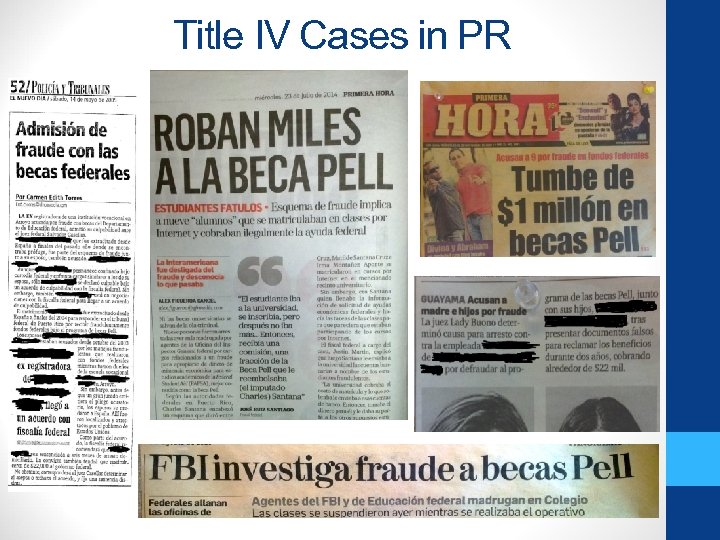 Title IV Cases in PR
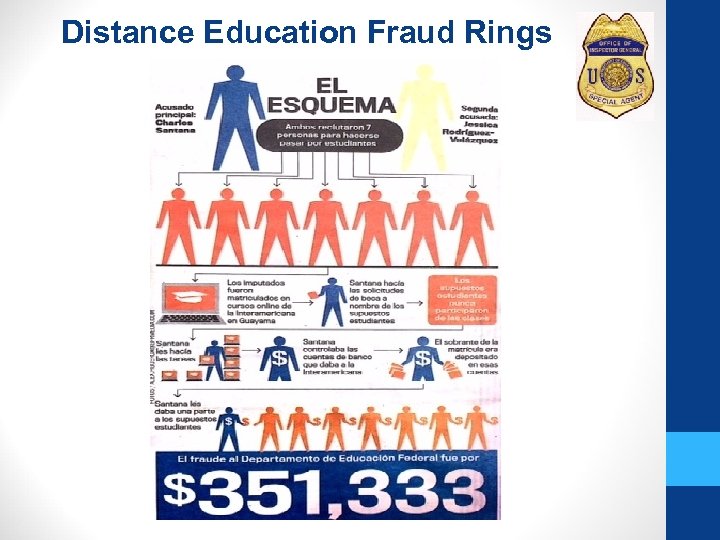
 Distance Education Fraud Rings • Generally are comprised of one or more ringleaders who facilitate enrolling “straw students” in distance education programs in exchange for receiving a portion of the Title IV funds that the institution disburses to the straw students. • Straw students willingly provide their identities to fraudulently obtain Title IV funds and enroll in on-line programs at eligible institutions. • Title IV funds go to both the ring leaders and the straw students for their personal use.
 Distance Education Fraud Rings
 Detecting/Preventing Distance Education Fraud Detecting fraud before funds have been disbursed is the best way to combat this crime. Some recommended procedures include implementing automated protocols that monitor information in your student information data system to identify instances where a number of students: • Use the same Internet Protocol (l. P) address to complete and submit an admissions application. • Use the same IP address to participate in the on-line academic program. • Use the same e-mail address to submit an admissions application. • Use the same e -mail address to participate in the on-line academic program. • Appear to reside in a geographic location that is anomalous to the locations of most students in the program. Schools can modify disbursement rules for students participating exclusively in distance learning programs, which would immediately reduce the amount that fraud ring participants can receive. Schools have the authority to: • Delay disbursement of Title IV funds until the student has participated in the distance education program for a longer and more substantiated period of time. • Make more frequent disbursements of Title IV funds so that not all of the payment period's award is disbursed at the beginning of the period. OIG Proactive Efforts-E Fraud Tool, Management Information Reports
 School cases/Most common schemes § Falsification of student documentation to obtain and retain Title IV funds – Student Attendance Records – Withdrawal Forms § Fraudulent high school diplomas and General Equivalency Diplomas (GED) to enroll and obtain federal student aid on behalf of ineligible students. § Enroll students in unauthorized/unlicensed programs in order to obtain Title IV funds
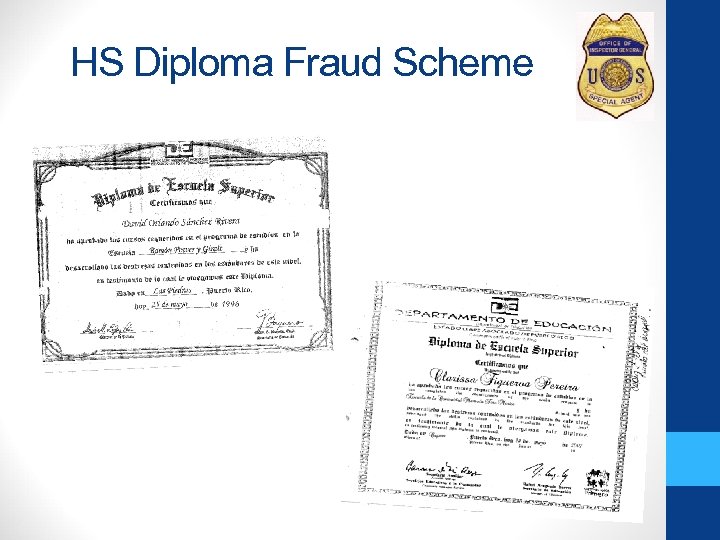 HS Diploma Fraud Scheme
 Links to OIG Reports and DC Letter Distance Education Fraud Ring Investigative Program Advisory Report (IPAR) • http: //www 2. ed. gov/about/offices/list/oig/invtreports/l 42 l 0001. pdf Dear Colleague Letter GEN-11 -17: • http: //www. ifap. ed. gov/dpcletters/GEN 1117. html Additional Safeguards Needed to Help Mitigate the Risks in the Distance Education Environment (OIG Audit) • http: //www 2. ed. gov/about/offices/list/oig/auditreports/fy 2014/a 07 l 0001. pdf PIN Security Vulnerabilities MIR report • http: //www 2. ed. gov/about/offices/list/oig/auditreports/fy 2013/x 21 l 0002. pdf
 How You Can Help • • Ensure that staff receive necessary Title IV training. Review documents thoroughly. Question documents/Verify authenticity. Request additional information from the students or parents. • Compare information on different documents. • Contact the OIG if you suspect fraud. • Cooperate with the OIG in connection with an audit or investigation.
 Inspector General’s Hotline 1 -800 -MIS-USED http: //www 2. ed. gov/about/offices/list/oig/hotline. html
 QUESTIONS? Robert A. Wolfe, Resident Agent in Charge Puerto Rico Office E-MAIL: robert. wolfe@ed. gov Phone: (787) 773 -2747