Скачать презентацию U S Capitol U S Capitol House
b441c481d2d32bddc4aec8dbfea3559d.ppt
- Количество слайдов: 87
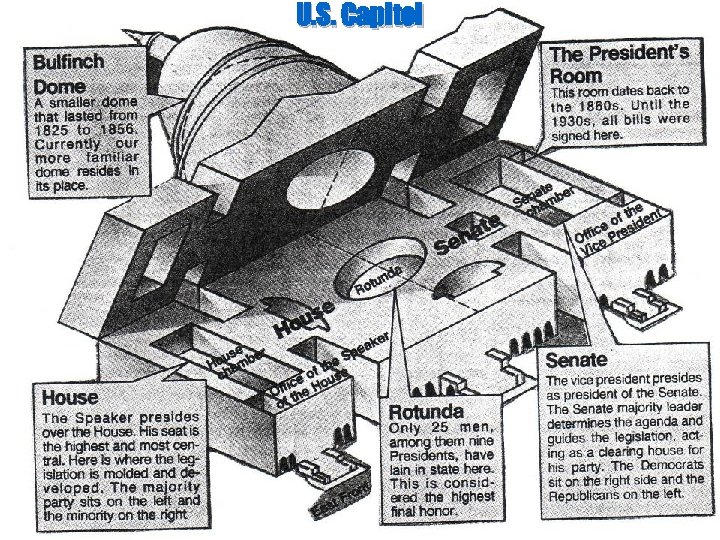 U. S. Capitol
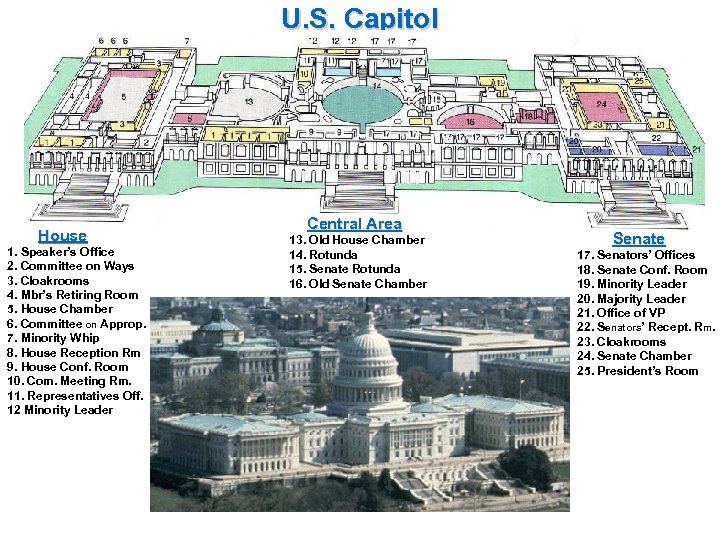 U. S. Capitol House 1. Speaker’s Office 2. Committee on Ways 3. Cloakrooms 4. Mbr’s Retiring Room 5. House Chamber 6. Committee on Approp. 7. Minority Whip 8. House Reception Rm 9. House Conf. Room 10. Com. Meeting Rm. 11. Representatives Off. 12 Minority Leader Central Area 13. Old House Chamber 14. Rotunda 15. Senate Rotunda 16. Old Senate Chamber Senate 17. Senators’ Offices 18. Senate Conf. Room 19. Minority Leader 20. Majority Leader 21. Office of VP 22. Senators’ Recept. Rm. 23. Cloakrooms 24. Senate Chamber 25. President’s Room
![• • 1. Bicameralism – two chambers [House and Senate]. Bicameralism 2. Terms](https://present5.com/presentation/b441c481d2d32bddc4aec8dbfea3559d/image-4.jpg "• • 1. Bicameralism – two chambers [House and Senate]. Bicameralism 2. Terms") • • 1. Bicameralism – two chambers [House and Senate]. Bicameralism 2. Terms of Congress – two years. Congress 3. Sessions of Congress – one year. Congress 4. Reapportionment – Congress reapportions the House of Reapportionment Representatives seats after each 10 year census. It used census to be one seat per 37, 000. Now it is one seat per 650, 000. 37, 000 650, 000 If we still had one per 37, 000, we would have more than 30, 000 representatives. The first Congress had 65 representatives and 106 by the 3 rd. There were 26 senators. • 5. Gerrymandering – altering district lines for partisan Gerrymandering advantage. Odd shaped districts that have been drawn to the advantage of the party in power. • 6. Censure – Congress can reprimand only its own members for Censure such misconduct as abuse of privileges, financial corruption, or misuse of public funds. In 1983, house members Daniel Crane Crane and Gerry Studds were censured. Crane lost the next election Studds but Studds kept his seat. Both were guilty of “affirmative action” action” with the pages. Crane
• • 1. Bicameralism – two chambers [House and Senate]. Bicameralism 2. Terms of Congress – two years. Congress 3. Sessions of Congress – one year. Congress 4. Reapportionment – Congress reapportions the House of Reapportionment Representatives seats after each 10 year census. It used census to be one seat per 37, 000. Now it is one seat per 650, 000. 37, 000 650, 000 If we still had one per 37, 000, we would have more than 30, 000 representatives. The first Congress had 65 representatives and 106 by the 3 rd. There were 26 senators. • 5. Gerrymandering – altering district lines for partisan Gerrymandering advantage. Odd shaped districts that have been drawn to the advantage of the party in power. • 6. Censure – Congress can reprimand only its own members for Censure such misconduct as abuse of privileges, financial corruption, or misuse of public funds. In 1983, house members Daniel Crane Crane and Gerry Studds were censured. Crane lost the next election Studds but Studds kept his seat. Both were guilty of “affirmative action” action” with the pages. Crane
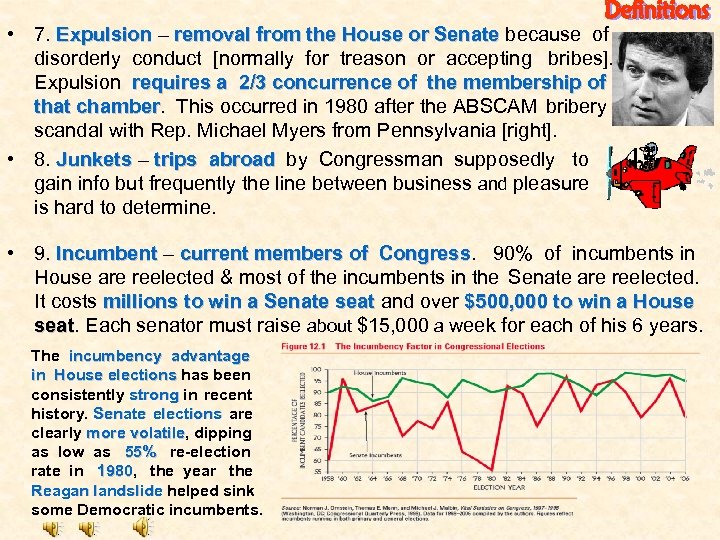 • 7. Expulsion – removal from the House or Senate because of Expulsion Senate disorderly conduct [normally for treason or accepting bribes]. Expulsion requires a 2/3 concurrence of the membership of that chamber. This occurred in 1980 after the ABSCAM bribery chamber scandal with Rep. Michael Myers from Pennsylvania [right]. • 8. Junkets – trips abroad by Congressman supposedly to Junkets gain info but frequently the line between business and pleasure is hard to determine. • 9. Incumbent – current members of Congress. 90% of incumbents in Congress House are reelected & most of the incumbents in the Senate are reelected. It costs millions to win a Senate seat and over $500, 000 to win a House seat. Each senator must raise about $15, 000 a week for each of his 6 years. seat The incumbency advantage in House elections has been consistently strong in recent history. Senate elections are clearly more volatile, dipping volatile as low as 55% re-election rate in 1980, the year the 1980 Reagan landslide helped sink some Democratic incumbents.
![10. Quorum – minimum number [51 in House and 218 in Senate] Quorum number](https://present5.com/presentation/b441c481d2d32bddc4aec8dbfea3559d/image-6.jpg "10. Quorum – minimum number [51 in House and 218 in Senate] Quorum number") 10. Quorum – minimum number [51 in House and 218 in Senate] Quorum number House Senate required for a chamber to conduct business 11. Filibuster – “talking a bill to death” in an attempt to get the Filibuster death” Senate to abandon or at least modify a bill. In 1947, Idaho’s abandon bill Glen Taylor spoke 8 & ½ hours on fishing, baptism, Wall Street, and his children. The record is over 24 hours by Strom Thurman. 12. Cloture – a filibuster may be stopped in the Senate when 3/5 Cloture when [60 members of the senators vote for cloture [this is usually hard to do]. cloture A petition signed by 16 senators is necessary to initiate a cloture vote. vote By historical tradition, the Senate gives its members unlimited debate 13. Caucus – meeting of the majority party in the House. Caucus party House 14. Seniority – how long a member has served in Congress. Seniority served Seniority increases your clout. 15. Veto – when the president disapproves of a bill. It can be sent back to Veto back Congress for revision. Can be overridden with a 2/3 vote in each chamber. vote 16. Pocket Veto – If Congress adjourns within 10 days, Veto days the president can let the bill die by not signing it. die 17. Whips – assistants to the majority and minority leaders. Whips leaders originated in the British House of Commons. They were named after the “whipper in, ” the rider who keeps the hounds together in a fox hunt, in, ” together because their job is to keep party members in line with the party’s positions.
10. Quorum – minimum number [51 in House and 218 in Senate] Quorum number House Senate required for a chamber to conduct business 11. Filibuster – “talking a bill to death” in an attempt to get the Filibuster death” Senate to abandon or at least modify a bill. In 1947, Idaho’s abandon bill Glen Taylor spoke 8 & ½ hours on fishing, baptism, Wall Street, and his children. The record is over 24 hours by Strom Thurman. 12. Cloture – a filibuster may be stopped in the Senate when 3/5 Cloture when [60 members of the senators vote for cloture [this is usually hard to do]. cloture A petition signed by 16 senators is necessary to initiate a cloture vote. vote By historical tradition, the Senate gives its members unlimited debate 13. Caucus – meeting of the majority party in the House. Caucus party House 14. Seniority – how long a member has served in Congress. Seniority served Seniority increases your clout. 15. Veto – when the president disapproves of a bill. It can be sent back to Veto back Congress for revision. Can be overridden with a 2/3 vote in each chamber. vote 16. Pocket Veto – If Congress adjourns within 10 days, Veto days the president can let the bill die by not signing it. die 17. Whips – assistants to the majority and minority leaders. Whips leaders originated in the British House of Commons. They were named after the “whipper in, ” the rider who keeps the hounds together in a fox hunt, in, ” together because their job is to keep party members in line with the party’s positions.
 The first page was 9 -year old Graftin Hanson, sponsored in the 1830 s by page Hanson senators Daniel Webster and Henry Clay. Older boys became “riding pages” and delivered messages by horse. Back then many pages were pages” orphans or children of poor families whose plight had come to the orphans attention of a congressman. Today any high school student with good grades [including an “A” in economics] can apply to his or representative. There are economics 71 in the House and 30 in the Senate. Must be 16, a junior, with a 3. 0 GPA. House Senate A year in Washington is a big plus on a college application, especially in the Ivy application League. Sexual equality came to the page system in 1971, when Senator Jacob equality 1971 Javits – who had sponsored the first black page in 1965 – brought in the first girl. 1965 girl Now about 50% of the pages are females. The page schedule calls for school, females work, study and sleep – leaving little time for mischief. Although they rotate among a variety of jobs, most work as messengers. After their first week – which can mean covering between 50 and 75 miles – most pages suffer from blisters and swollen miles feet. The workday ends when Congress adjourns – usually in the late afternoon or feet early evening. Homework & laundry fill the time until curfew at 10 p. m. laundry The dress requirements for males is a navy blazer, long sleeved white shirt, dark gray requirements blazer shirt slacks, dark socks, dark shoes, and a standard issue tie. For females, the dress requirement slacks socks shoes tie females is a navy blazer, a long sleeved white blouse, dark gray skirt or dark gray pants, dark shoes, blazer blouse skirt pants shoes appropriate hose, and a standard issue tie that is provided during orientation. Shoes should be hose tie solid black non-canvas low cut athletic shoes or comfortable black dress shoes. Pages are expected to maintain a neat appearance and conservative hairstyle at all time and adhere to the above dress code while working on the Capitol complex during business hours. Their pay is $1, 568 a month
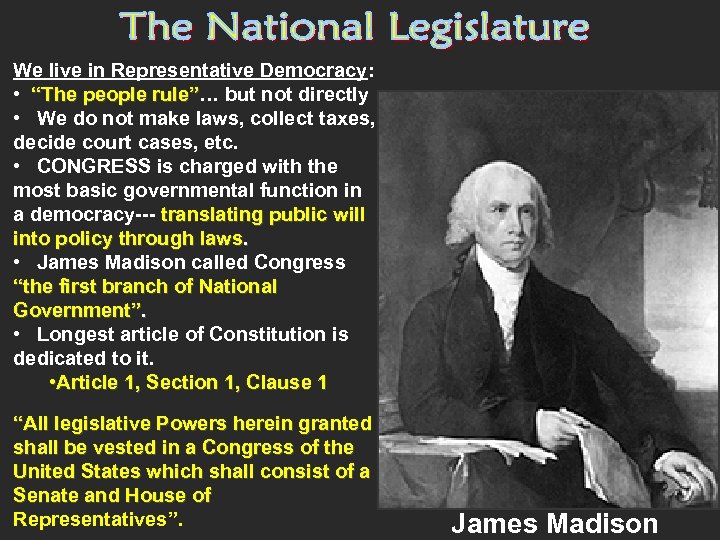 We live in Representative Democracy: • “The people rule”… but not directly rule” • We do not make laws, collect taxes, decide court cases, etc. • CONGRESS is charged with the most basic governmental function in a democracy--- translating public will into policy through laws. • James Madison called Congress “the first branch of National Government”. • Longest article of Constitution is dedicated to it. • Article 1, Section 1, Clause 1 “All legislative Powers herein granted shall be vested in a Congress of the United States which shall consist of a Senate and House of Representatives”. James Madison
 • Although the province of Congress has fluctuated over time, it has been the true center of power in Washington. • The movement of legislation has become more difficult with each year, and finding time to debate is increasingly difficult. • Many charge Congress with being the source of government expansion.
 • 1 Congress is the legislative branch of the government. Congress 2 Its major function is to make the law. It is charged with law the basic function of translating the public will into public policy in the form of law. public policy • 3 Constitution establishes a Bicameral Legislature – 2 houses. Legislature 2 houses • Bicameralism is a reflection of federalism. Each State is equally reflection of federalism represented in the Senate and by its population in the House. • The Framers favored a bicameral Congress in order that one house might act as a check on the other • Some people think the equal representation of the States in the 4 Senate should be scrapped as undemocratic. Alaska has only 500, 000 residents. California, has more than 33 million. Yet residents California million each has two senators

 It is hard work! • The typical House member serves on about 6 committees and subcommittees • The typical Senator serves on about 10 committees and subcommittees • Often, they are scheduled to be in more than one place at a time (compact schedules)
 • 5 Each term lasts for two years and is numbered from the first two term, which began on March 4, 1789. The date for the start of each term is [20 th Amendment – 1933] 6 at noon on the 3 rd day of January, of every odd-numbered year. January • There are 2 sessions to each term of Congress – one each year which includes breaks for holidays and vacations. • Congress adjourns as it sees fit but normally remains in session most of the year through November or December. • Neither house may adjourn without the consent of the other. Neither house may adjourn for more than three days without the consent of the other.
 • 7 Only the President may call a special session of Congress. Only the Congress Senate has been called into special session on 46 occasions, but not since 1933. Both houses have been called 26 times, the last time in 1948, by Truman, to consider anti-inflation and welfare measures. • The fact that Congress meets almost year-round cuts down the need for special sessions. The 109 th congress met from 2005 -2007. House Senate Larger [435 members] Shorter term of office [2 years] Less flexible rules Smaller constituencies Power less evenly distributed Less prestige Less press and media coverage Policy specialists More committees Acts more quickly Smaller [100 members] Longer term of office [6 years] More flexible rules Larger constituencies Power more evenly distributed More prestige More press and media coverage Policy generalists Fewer committees Acts more slowly
 Focus 1. What are the terms, election, and qualifications of the members of the house? 2. How reapportionment [redistribution of seats] affects the make-up of the House? What a congressional district is and how it is formed. What effect the “one-man, one-vote” rule has had on the House and on electoral politics.
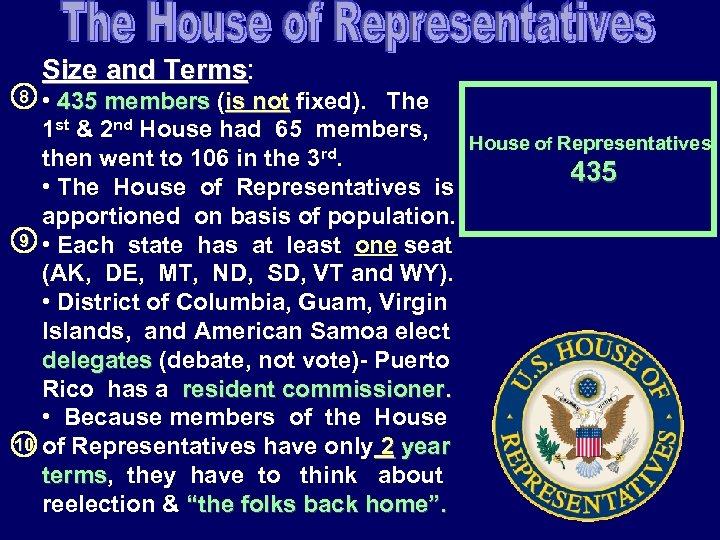 Size and Terms: Terms • 435 members (is not fixed). The 1 st & 2 nd House had 65 members, House of Representatives rd. then went to 106 in the 3 435 • The House of Representatives is apportioned on basis of population. 9 • Each state has at least one seat (AK, DE, MT, ND, SD, VT and WY). • District of Columbia, Guam, Virgin Islands, and American Samoa elect delegates (debate, not vote)- Puerto Rico has a resident commissioner. • Because members of the House 10 of Representatives have only 2 year terms, they have to think about terms reelection & “the folks back home”. 8
![11 ØCongress reapportions [redistributes the seats] after each 10 -year census. 10 Since 1912,](https://present5.com/presentation/b441c481d2d32bddc4aec8dbfea3559d/image-17.jpg "11 ØCongress reapportions [redistributes the seats] after each 10 -year census. 10 Since 1912,") 11 ØCongress reapportions [redistributes the seats] after each 10 -year census. 10 Since 1912, the House has had 435 seats. [437 temporarily when Alaska and Hawaii were admitted but went back to 435 in 1961]. ØThe “permanent” size of 435 is permanent as long as they vote not to “permanent” 435 change it. ØEach seat in the House represents an average of seat 12 650, 000 persons. 650, 000 ØElections are held on the Tuesday following the first 12 Monday in November of each even-numbered year. November • 435 members • 2 year terms • membership based on population • all states have at least 1 representative Requirements • Must be at least 25 years old Citizen of U. S. for at least 7 years • Resident of state in which elected
11 ØCongress reapportions [redistributes the seats] after each 10 -year census. 10 Since 1912, the House has had 435 seats. [437 temporarily when Alaska and Hawaii were admitted but went back to 435 in 1961]. ØThe “permanent” size of 435 is permanent as long as they vote not to “permanent” 435 change it. ØEach seat in the House represents an average of seat 12 650, 000 persons. 650, 000 ØElections are held on the Tuesday following the first 12 Monday in November of each even-numbered year. November • 435 members • 2 year terms • membership based on population • all states have at least 1 representative Requirements • Must be at least 25 years old Citizen of U. S. for at least 7 years • Resident of state in which elected
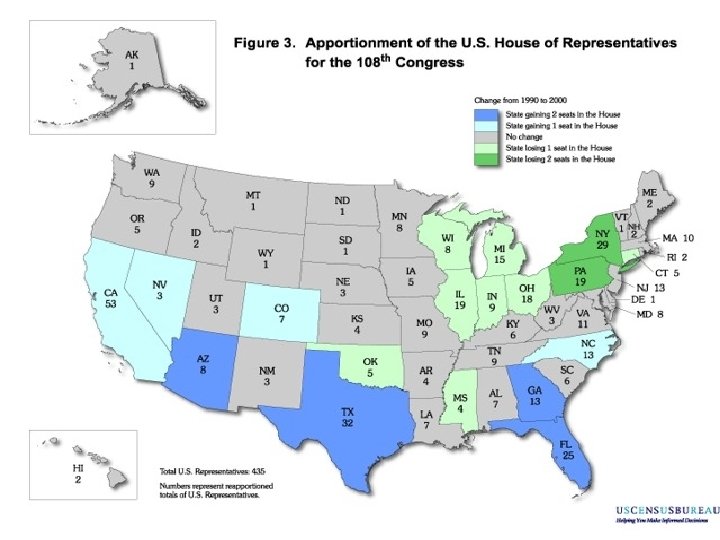
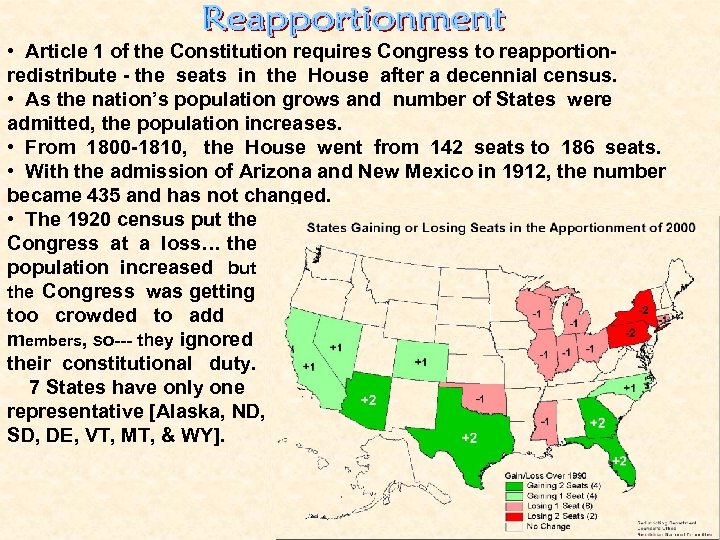 • Article 1 of the Constitution requires Congress to reapportionredistribute - the seats in the House after a decennial census. • As the nation’s population grows and number of States were admitted, the population increases. • From 1800 -1810, the House went from 142 seats to 186 seats. • With the admission of Arizona and New Mexico in 1912, the number became 435 and has not changed. • The 1920 census put the Congress at a loss… the population increased but the Congress was getting too crowded to add members, so--- they ignored their constitutional duty. 7 States have only one representative [Alaska, ND, SD, DE, VT, MT, & WY].
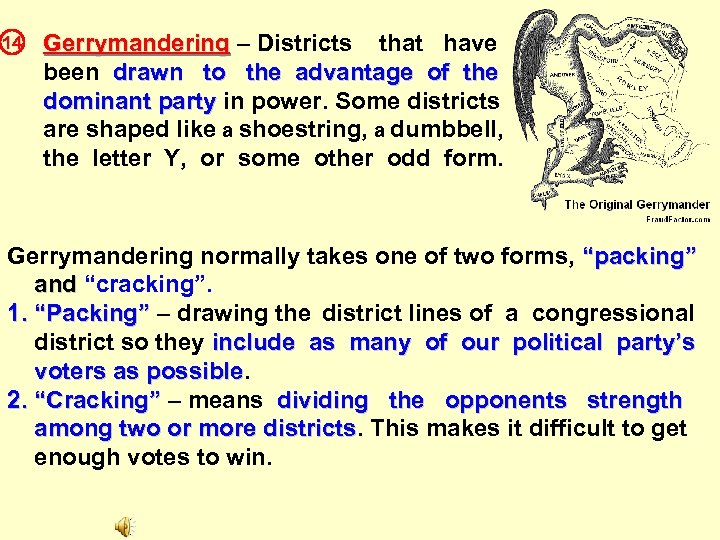 14 Gerrymandering – Districts that have been drawn to the advantage of the dominant party in power. Some districts are shaped like a shoestring, a dumbbell, the letter Y, or some other odd form. Gerrymandering normally takes one of two forms, “packing” and “cracking”. 1. “Packing” – drawing the district lines of a congressional district so they include as many of our political party’s voters as possible 2. “Cracking” – means dividing the opponents strength among two or more districts. This makes it difficult to get districts enough votes to win.
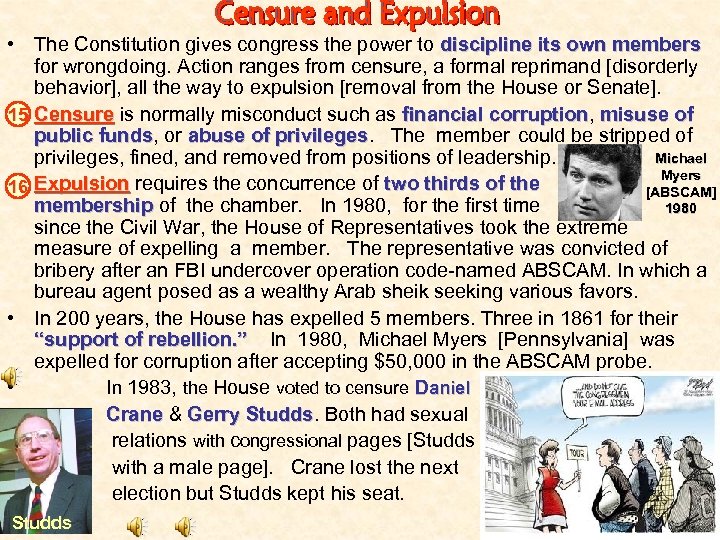 • The Constitution gives congress the power to discipline its own members for wrongdoing. Action ranges from censure, a formal reprimand [disorderly behavior], all the way to expulsion [removal from the House or Senate]. 15 Censure • Censure is normally misconduct such as financial corruption, misuse of corruption public funds, or abuse of privileges. The member could be stripped of funds privileges Michael privileges, fined, and removed from positions of leadership. Myers • Expulsion requires the concurrence of two thirds of the Expulsion 16 [ABSCAM] membership of the chamber. In 1980, for the first time membership 1980 since the Civil War, the House of Representatives took the extreme measure of expelling a member. The representative was convicted of bribery after an FBI undercover operation code-named ABSCAM. In which a bureau agent posed as a wealthy Arab sheik seeking various favors. • In 200 years, the House has expelled 5 members. Three in 1861 for their “support of rebellion. ” In 1980, Michael Myers [Pennsylvania] was expelled for corruption after accepting $50, 000 in the ABSCAM probe. • In 1983, the House voted to censure Daniel • Crane & Gerry Studds. Both had sexual Crane Studds • relations with congressional pages [Studds • with a male page]. Crane lost the next • election but Studds kept his seat. Studds
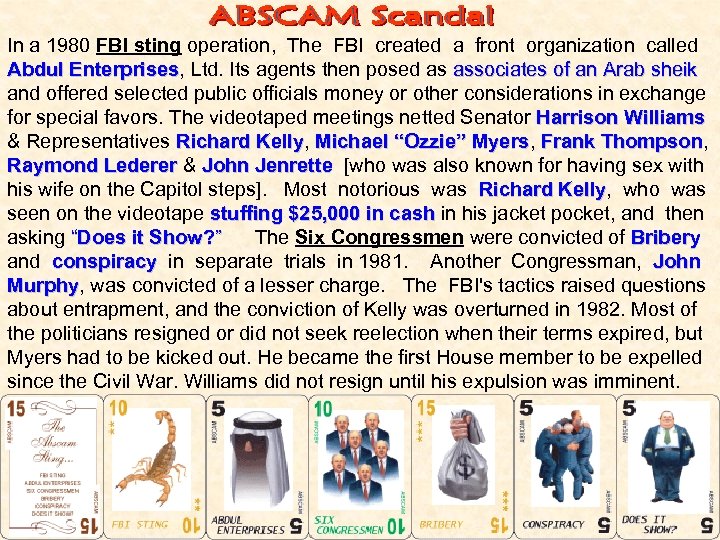 In a 1980 FBI sting operation, The FBI created a front organization called Abdul Enterprises, Ltd. Its agents then posed as associates of an Arab sheik Enterprises associates of an Arab sheik and offered selected public officials money or other considerations in exchange for special favors. The videotaped meetings netted Senator Harrison Williams & Representatives Richard Kelly, Michael “Ozzie” Myers, Frank Thompson, Kelly Myers Thompson Raymond Lederer & John Jenrette [who was also known for having sex with Lederer his wife on the Capitol steps]. Most notorious was Richard Kelly, who was Kelly seen on the videotape stuffing $25, 000 in cash in his jacket pocket, and then cash asking “Does it Show? ” The Six Congressmen were convicted of Bribery and conspiracy in separate trials in 1981. Another Congressman, John Murphy, was convicted of a lesser charge. The FBI's tactics raised questions Murphy about entrapment, and the conviction of Kelly was overturned in 1982. Most of the politicians resigned or did not seek reelection when their terms expired, but Myers had to be kicked out. He became the first House member to be expelled since the Civil War. Williams did not resign until his expulsion was imminent.
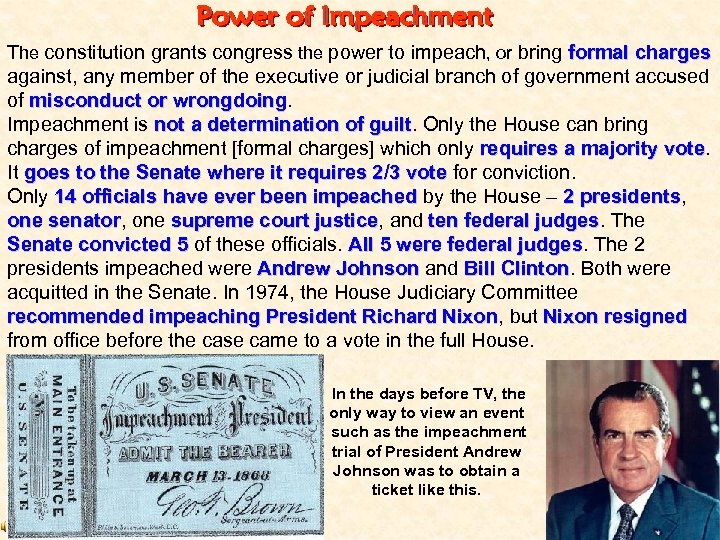 The constitution grants congress the power to impeach, or bring formal charges against, any member of the executive or judicial branch of government accused of misconduct or wrongdoing Impeachment is not a determination of guilt. Only the House can bring guilt charges of impeachment [formal charges] which only requires a majority vote It goes to the Senate where it requires 2/3 vote for conviction. vote Only 14 officials have ever been impeached by the House – 2 presidents, impeached presidents one senator, one supreme court justice, and ten federal judges. The senator justice judges Senate convicted 5 of these officials. All 5 were federal judges. The 2 5 judges presidents impeached were Andrew Johnson and Bill Clinton. Both were Johnson Clinton acquitted in the Senate. In 1974, the House Judiciary Committee recommended impeaching President Richard Nixon, but Nixon resigned from office before the case came to a vote in the full House. In the days before TV, the only way to view an event such as the impeachment trial of President Andrew Johnson was to obtain a ticket like this.
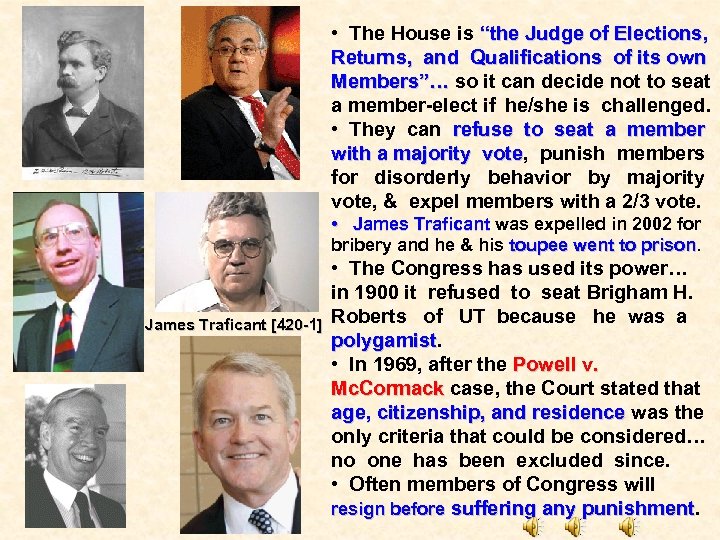 • The House is “the Judge of Elections, Returns, and Qualifications of its own Members”… so it can decide not to seat a member-elect if he/she is challenged. • They can refuse to seat a member with a majority vote, punish members vote for disorderly behavior by majority vote, & expel members with a 2/3 vote. • James Traficant was expelled in 2002 for bribery and he & his toupee went to prison James Traficant [420 -1] • The Congress has used its power… in 1900 it refused to seat Brigham H. Roberts of UT because he was a polygamist • In 1969, after the Powell v. Mc. Cormack case, the Court stated that age, citizenship, and residence was the only criteria that could be considered… no one has been excluded since. • Often members of Congress will resign before suffering any punishment
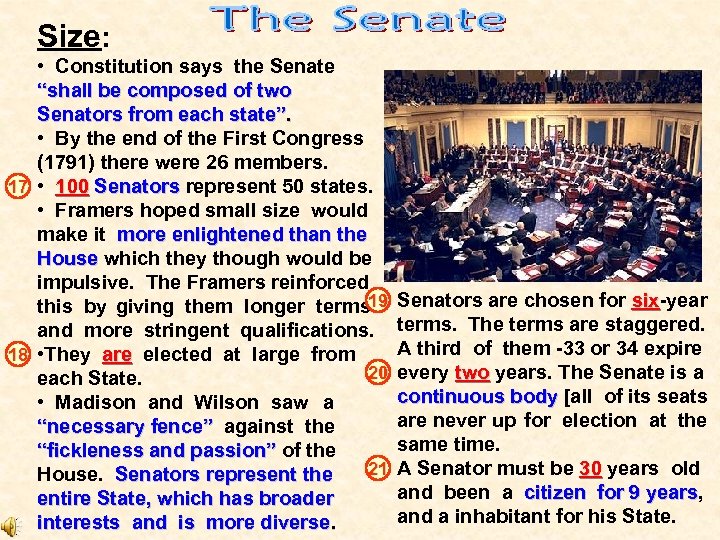 Size: • Constitution says the Senate “shall be composed of two Senators from each state”. • By the end of the First Congress (1791) there were 26 members. 17 • 100 Senators represent 50 states. • Framers hoped small size would make it more enlightened than the House which they though would be impulsive. The Framers reinforced this by giving them longer terms 19 and more stringent qualifications. 18 • They are elected at large from 20 each State. • Madison and Wilson saw a “necessary fence” against the “fickleness and passion” of the 21 House. Senators represent the entire State, which has broader interests and is more diverse. Senators are chosen for six-year six terms. The terms are staggered. A third of them -33 or 34 expire every two years. The Senate is a continuous body [all of its seats are never up for election at the same time. A Senator must be 30 years old and been a citizen for 9 years, years and a inhabitant for his State.
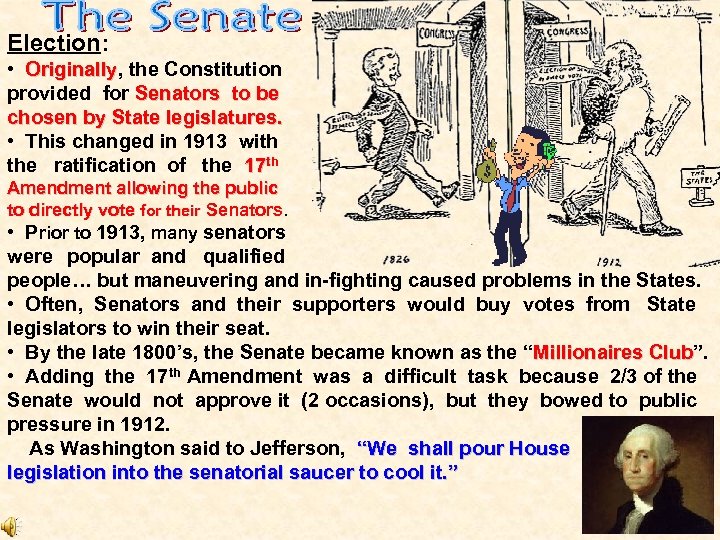 Election: • Originally, the Constitution Originally provided for Senators to be chosen by State legislatures. • This changed in 1913 with the ratification of the 17 th Amendment allowing the public to directly vote for their Senators • Prior to 1913, many senators were popular and qualified people… but maneuvering and in-fighting caused problems in the States. • Often, Senators and their supporters would buy votes from State legislators to win their seat. • By the late 1800’s, the Senate became known as the “Millionaires Club”. Club • Adding the 17 th Amendment was a difficult task because 2/3 of the Senate would not approve it (2 occasions), but they bowed to public pressure in 1912. As Washington said to Jefferson, “We shall pour House legislation into the senatorial saucer to cool it. ”
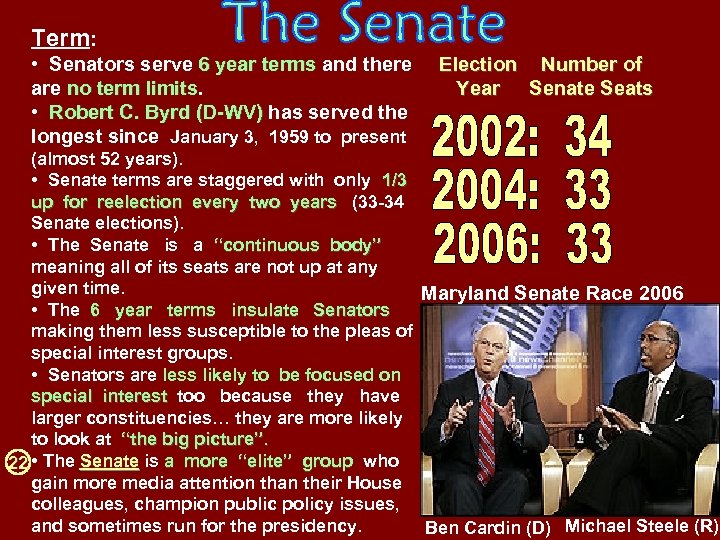 Term: • Senators serve 6 year terms and there are no term limits • Robert C. Byrd (D-WV) has served the longest since January 3, 1959 to present Election Number of Year Senate Seats (almost 52 years). • Senate terms are staggered with only 1/3 up for reelection every two years (33 -34 Senate elections). • The Senate is a “continuous body” meaning all of its seats are not up at any given time. Maryland Senate Race 2006 • The 6 year terms insulate Senators making them less susceptible to the pleas of special interest groups. • Senators are less likely to be focused on special interest too because they have larger constituencies… they are more likely to look at “the big picture”. 22 • The Senate is a more “elite” group who gain more media attention than their House colleagues, champion public policy issues, and sometimes run for the presidency. Ben Cardin (D) Michael Steele (R)
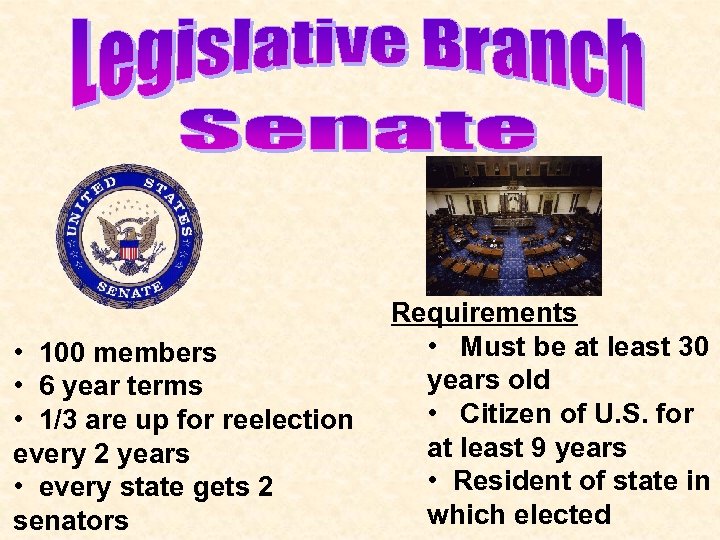 • 100 members • 6 year terms • 1/3 are up for reelection every 2 years • every state gets 2 senators Requirements • Must be at least 30 years old • Citizen of U. S. for at least 9 years • Resident of state in which elected
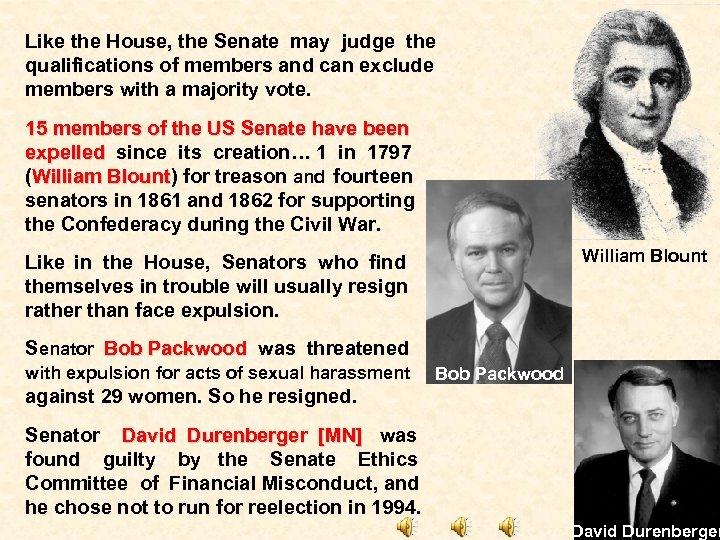 Like the House, the Senate may judge the qualifications of members and can exclude members with a majority vote. 15 members of the US Senate have been expelled since its creation… 1 in 1797 (William Blount) for treason and fourteen Blount senators in 1861 and 1862 for supporting the Confederacy during the Civil War. William Blount Like in the House, Senators who find themselves in trouble will usually resign rather than face expulsion. Senator Bob Packwood was threatened with expulsion for acts of sexual harassment Bob Packwood against 29 women. So he resigned. Senator David Durenberger [MN] was found guilty by the Senate Ethics Committee of Financial Misconduct, and he chose not to run for reelection in 1994. David Durenberger
 • Almost all members are married, a few married are divorced, on average two children. • 60% Protestant, 25% Catholic, 8% Jewish. • Lawyers: 1/3 in House, 1/2 in Senate Lawyers • Over 80% have college degrees, some degrees with advanced degrees. • Only small number born outside of US • There are several millionaires… but others who rely on their congressional paychecks. • Average senator is in his second term, average House member has served four terms. • 1/3 of senators once served in the House. Again--- Congress is made up of mostly white, upper middle-class Americans.
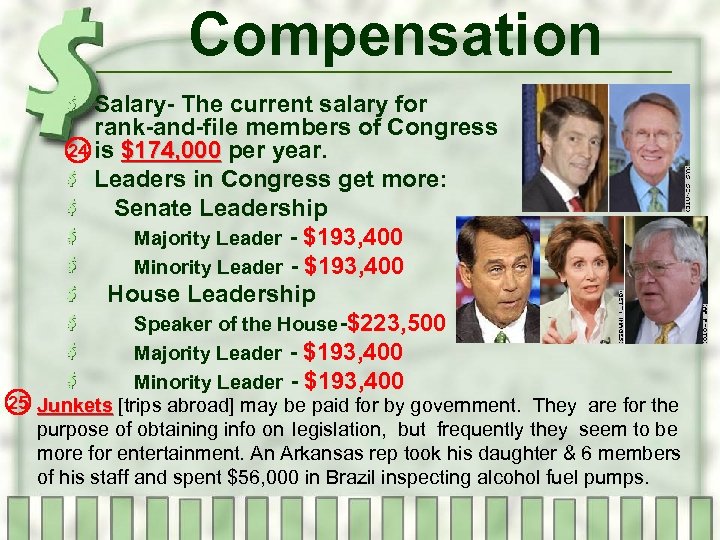 Compensation Salary- The current salary for rank-and-file members of Congress 24 is $174, 000 per year. Leaders in Congress get more: Senate Leadership Majority Leader - $193, 400 Minority Leader - $193, 400 House Leadership Speaker of the House-$223, 500 Majority Leader - $193, 400 Minority Leader - $193, 400 25 Junkets [trips abroad] may be paid for by government. They are for the Junkets purpose of obtaining info on legislation, but frequently they seem to be more for entertainment. An Arkansas rep took his daughter & 6 members of his staff and spent $56, 000 in Brazil inspecting alcohol fuel pumps.
 Compensation 26 They are free from arrest in all cases, except treason, felony, and breach of the peace, when they are attending Congress or on their way to and from Congress. Non-salary compensation- “Fringe Benefits” Tax deduction to maintain residence at home and in the DC area Travel allowances to and from home to DC and back Life and health insurance at low rates Very generous retirement plan Members who have participated in the congressional pension system are vested after 5 years of service. A full pension is available to Members 62 years of age with 5 years of service; 50 years or older with 20 years of service; or 25 years of service at any age. Provided with an office and funds to pay for staff Granted “franking privileges” (ability to send mail privileges and other materials postage free. 41 Also… free printing, restaurants in capital, gyms, swimming pools, free parking, services of Library of Congress… and more
 Politics of Pay Two Limits on Level of Congressional Pay 1. The President may veto congressional pay raises. 2. The Congress may show disapproval by voting against their incumbents in the next election. 3. 27 th Amendment (Do not get raise until reelected). Congress has tried to avoid issue through… Special tax breaks Liberal pension plans increased travel and office funds Other perks… Issue will not disappear soon It is important to pay members decent salaries. Otherwise qualified members will not run for office, or only the wealthy will…

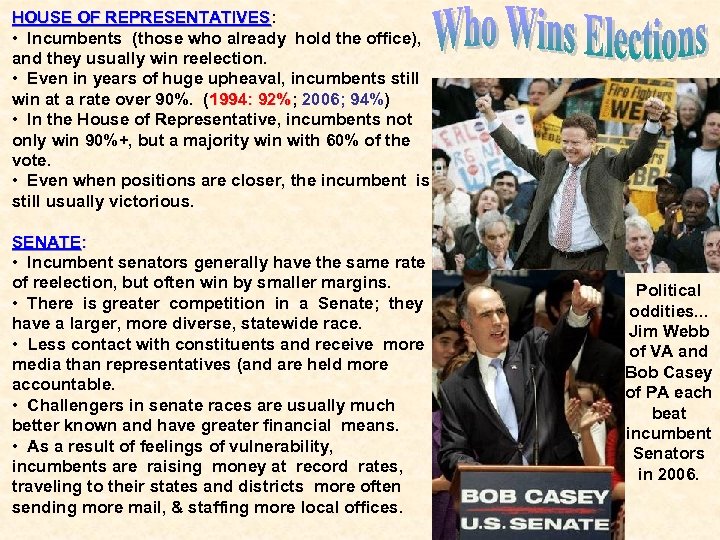 HOUSE OF REPRESENTATIVES: REPRESENTATIVES • Incumbents (those who already hold the office), and they usually win reelection. • Even in years of huge upheaval, incumbents still win at a rate over 90%. (1994: 92%; 2006; 94%) • In the House of Representative, incumbents not only win 90%+, but a majority win with 60% of the vote. • Even when positions are closer, the incumbent is still usually victorious. SENATE: • Incumbent senators generally have the same rate of reelection, but often win by smaller margins. • There is greater competition in a Senate; they have a larger, more diverse, statewide race. • Less contact with constituents and receive more media than representatives (and are held more accountable. • Challengers in senate races are usually much better known and have greater financial means. • As a result of feelings of vulnerability, incumbents are raising money at record rates, traveling to their states and districts more often sending more mail, & staffing more local offices. Political oddities. . . Jim Webb of VA and Bob Casey of PA each beat incumbent Senators in 2006.
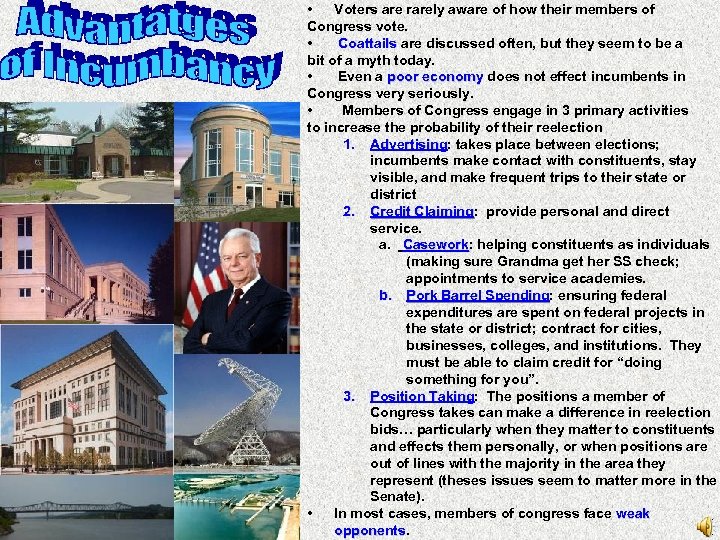 • Voters are rarely aware of how their members of Congress vote. • Coattails are discussed often, but they seem to be a bit of a myth today. • Even a poor economy does not effect incumbents in Congress very seriously. • Members of Congress engage in 3 primary activities to increase the probability of their reelection 1. Advertising: takes place between elections; dvertising incumbents make contact with constituents, stay visible, and make frequent trips to their state or district 2. Credit Claiming: provide personal and direct Claiming service. a. Casework: helping constituents as individuals Casework (making sure Grandma get her SS check; appointments to service academies. b. Pork Barrel Spending: ensuring federal Spending expenditures are spent on federal projects in the state or district; contract for cities, businesses, colleges, and institutions. They must be able to claim credit for “doing something for you”. 3. Position Taking: The positions a member of Taking Congress takes can make a difference in reelection bids… particularly when they matter to constituents and effects them personally, or when positions are out of lines with the majority in the area they represent (theses issues seem to matter more in the Senate). • In most cases, members of congress face weak opponents
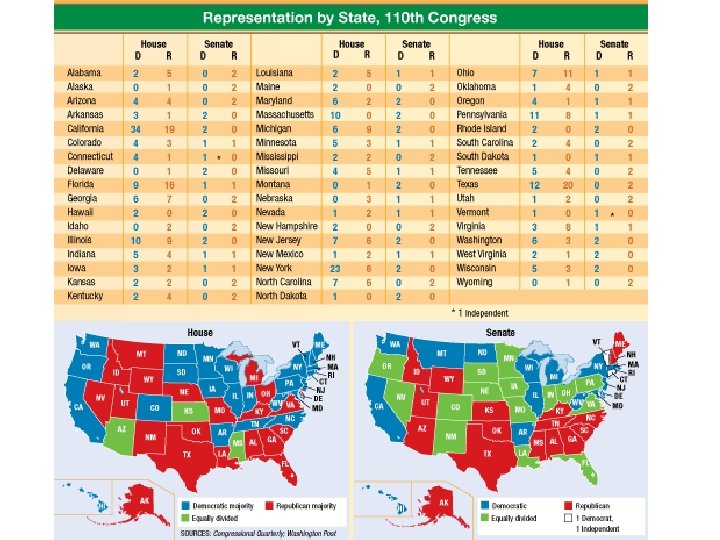
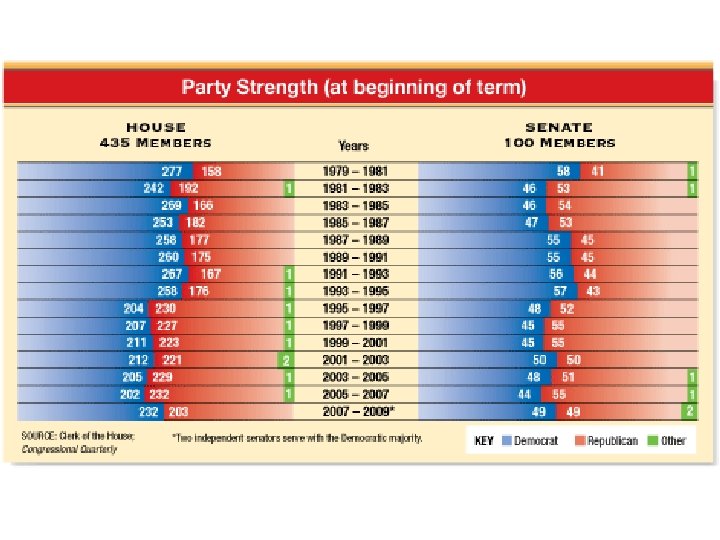
 • Party loyalty is not as strong as it once was, but it is still a good predictor of voting behavior • Most members of Congress represent constituencies in which their party is in the majority. Defeating Incumbents: • An incumbents tarnished by scandal or corruption become vulnerable… voters do take out anger at the polls. • Reapportionment can also play a role in the defeat of incumbents (ala TX after 2000 census). • In 1994, the republican revolution defeated 35 incumbents in the House and 9 in the Senate… In 2006, Democrats picked up 30 house seats and 5 in the Senate.
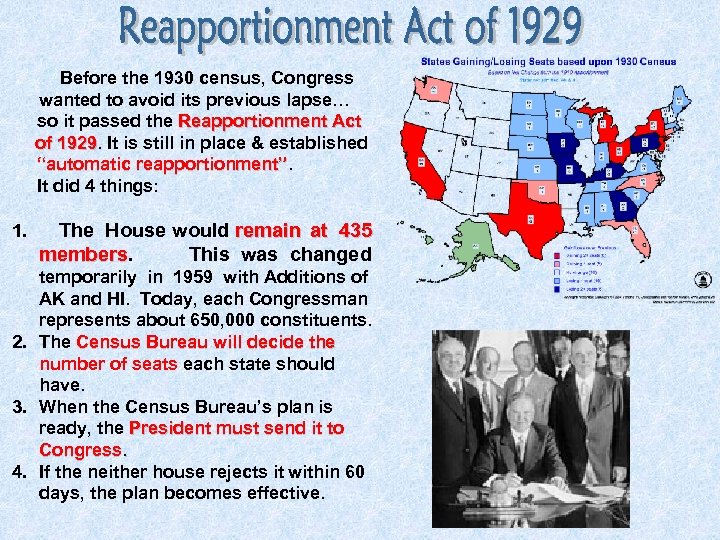 Before the 1930 census, Congress wanted to avoid its previous lapse… so it passed the Reapportionment Act of 1929. It is still in place & established 1929 “automatic reapportionment” It did 4 things: 1. The House would remain at 435 members. This was changed members temporarily in 1959 with Additions of AK and HI. Today, each Congressman represents about 650, 000 constituents. 2. The Census Bureau will decide the number of seats each state should have. 3. When the Census Bureau’s plan is ready, the President must send it to Congress. 4. If the neither house rejects it within 60 days, the plan becomes effective.
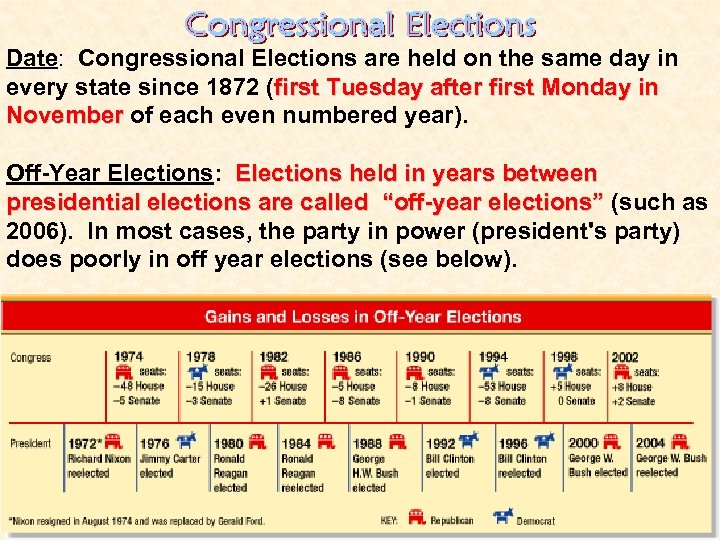 Date: Congressional Elections are held on the same day in every state since 1872 (first Tuesday after first Monday in November of each even numbered year). Off-Year Elections: Elections held in years between presidential elections are called “off-year elections” (such as 2006). In most cases, the party in power (president's party) does poorly in off year elections (see below).
 • 435 members of the House are chosen by voters in 435 separate congressional districts. • These members are chosen in “single-member districts”, meaning voter districts pick one candidate from that district to represent them rather than an “a large” candidate (elected by state as a whole). • Congress did away with the at large general ticket system in 1842 du to its lack of fairness. • The 1842 law required state legislatures to draw congressional districts and required that they be continuous • In 1872, Congress ordered that Districts have “as nearly as practicable an equal number of inhabitants. ” • In 1901, Congress added that districts of “compact area” (comparatively small). • Many of the requirements have been ignored by States.
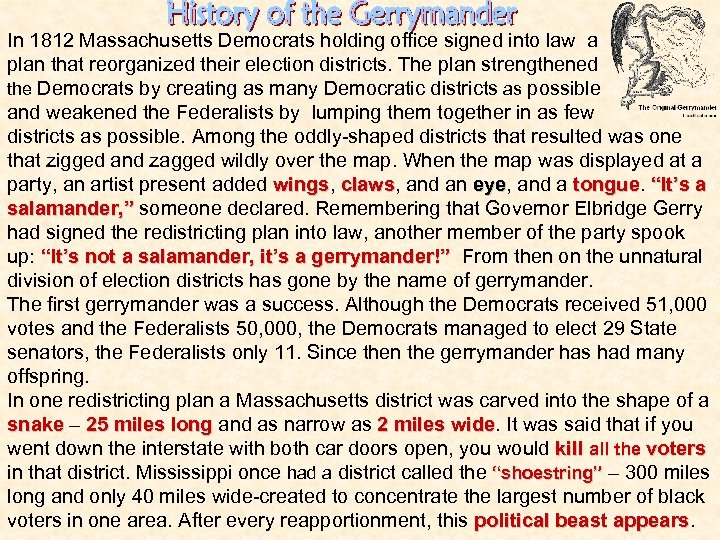 In 1812 Massachusetts Democrats holding office signed into law a plan that reorganized their election districts. The plan strengthened the Democrats by creating as many Democratic districts as possible and weakened the Federalists by lumping them together in as few districts as possible. Among the oddly-shaped districts that resulted was one that zigged and zagged wildly over the map. When the map was displayed at a party, an artist present added wings, claws, and an eye, and a tongue. “It’s a wings claws eye tongue salamander, ” someone declared. Remembering that Governor Elbridge Gerry salamander, ” had signed the redistricting plan into law, another member of the party spook up: “It’s not a salamander, it’s a gerrymander!” From then on the unnatural division of election districts has gone by the name of gerrymander. The first gerrymander was a success. Although the Democrats received 51, 000 votes and the Federalists 50, 000, the Democrats managed to elect 29 State senators, the Federalists only 11. Since then the gerrymander has had many offspring. In one redistricting plan a Massachusetts district was carved into the shape of a snake – 25 miles long and as narrow as 2 miles wide. It was said that if you snake long wide went down the interstate with both car doors open, you would kill all the voters in that district. Mississippi once had a district called the “shoestring” – 300 miles long and only 40 miles wide-created to concentrate the largest number of black voters in one area. After every reapportionment, this political beast appears
 • Longstanding patterns of wide population variations among House districts and rural dominance in state legislatures came to an end with the Wesberry v. Sanders case in 1964 • The Court held that Georgia’s Congressional districts population differences were so great they violated the Constitution • Ultimately they held that each mans vote needed to count the same and didn’t if an area was not apportioned properly (Known as “one person, one vote”). Now cities have a much greater voice in congress and state legislatures. • This did not end gerrymandering, though. The only real restriction on gerrymandering is when it is purely racial (Gomillion v. Lightfoot… violation Lightfoot of 15 th Amendment). • But, minority-majority districts were still drawn after the 1990 and 2000 censuses. The Supreme Court struck down race-based districts in many cases including Bush v. Vera. • Yet, the Court recently held that race can be part of the process in drawing district lines (Hunt v Cromartie, 2001)
 Other Privileges: • Also afforded ability to avoid arrest during sessions of Congress (unless they committed treason, a felony or “a breach of the peace”). • This dates back to when Kings harassed members of parliament who would not fall in line. • They also may not be “questioned in any other place” other than their chamber of place 26 Congress. They can not be sued for “libel or slander” in their capacity as members of Congress (legislative immunity). • This protects legislative debate. . But it does not give members of Congress unbridled freedom to attack others verbally or in print.
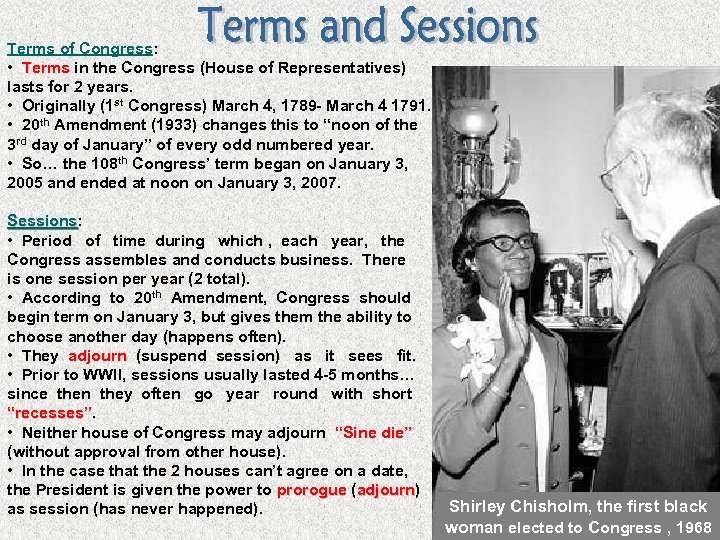 Terms of Congress: • Terms in the Congress (House of Representatives) lasts for 2 years. • Originally (1 st Congress) March 4, 1789 - March 4 1791. • 20 th Amendment (1933) changes this to “noon of the 3 rd day of January” of every odd numbered year. • So… the 108 th Congress’ term began on January 3, 2005 and ended at noon on January 3, 2007. Sessions: Sessions • Period of time during which , each year, the Congress assembles and conducts business. There is one session per year (2 total). • According to 20 th Amendment, Congress should begin term on January 3, but gives them the ability to choose another day (happens often). • They adjourn (suspend session) as it sees fit. • Prior to WWII, sessions usually lasted 4 -5 months… since then they often go year round with short “recesses”. • Neither house of Congress may adjourn “Sine die” (without approval from other house). • In the case that the 2 houses can’t agree on a date, the President is given the power to prorogue (adjourn) adjourn as session (has never happened). Shirley Chisholm, the first black woman elected to Congress , 1968
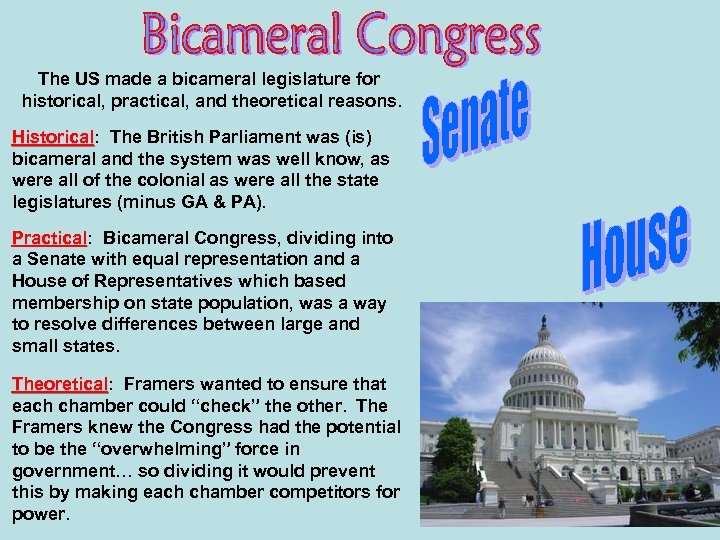 The US made a bicameral legislature for historical, practical, and theoretical reasons. Historical: The British Parliament was (is) Historical bicameral and the system was well know, as were all of the colonial as were all the state legislatures (minus GA & PA). Practical: Bicameral Congress, dividing into Practical a Senate with equal representation and a House of Representatives which based membership on state population, was a way to resolve differences between large and small states. Theoretical: Framers wanted to ensure that Theoretical each chamber could “check” the other. The Framers knew the Congress had the potential to be the “overwhelming” force in government… so dividing it would prevent this by making each chamber competitors for power.
 Senate: Protect elite interests, ratify treaties, confirm presidential nominations, try impeached officials House: (closest to masses) initiate revenue bills, impeach officials House of Representatives Agenda: Agenda • House is bigger and more institutionalized than Senate. • Party loyalty/voting are more common. • Debate can be ended with simple majority vote • Has the unique House Rules Committee: • Bill coming from House committees are reviewed before they go to floor. • Bill is given a “rule” (scheduled bill, allots time for debate, sometimes specifies what amendments can be made. • All members are appointed by the Speaker.
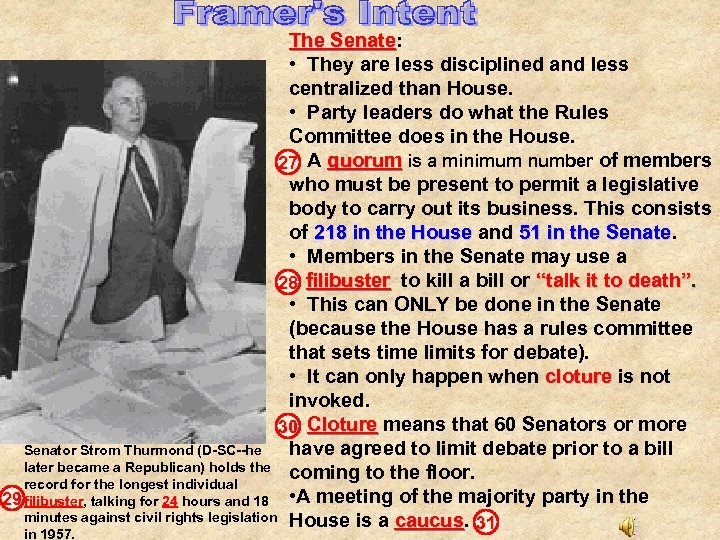 The Senate: Senate • They are less disciplined and less centralized than House. • Party leaders do what the Rules Committee does in the House. • 27 A quorum is a minimum number of members who must be present to permit a legislative body to carry out its business. This consists of 218 in the House and 51 in the Senate • Members in the Senate may use a 28 filibuster to kill a bill or “talk it to death”. • This can ONLY be done in the Senate (because the House has a rules committee that sets time limits for debate). • It can only happen when cloture is not invoked. • 30 Cloture means that 60 Senators or more have agreed to limit debate prior to a bill Senator Strom Thurmond (D-SC--he later became a Republican) holds the coming to the floor. record for the longest individual 29 filibuster, talking for 24 hours and 18 • A meeting of the majority party in the filibuster minutes against civil rights legislation House is a caucus. 31 caucus in 1957.
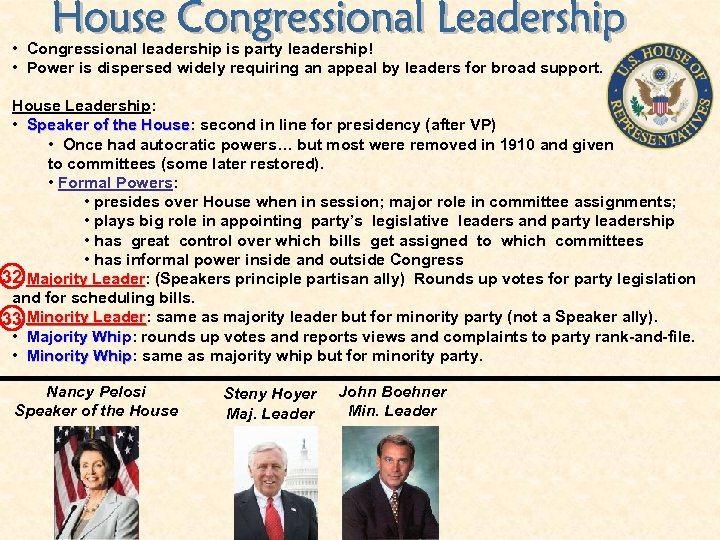 • Congressional leadership is party leadership! • Power is dispersed widely requiring an appeal by leaders for broad support. House Leadership: • Speaker of the House: second in line for presidency (after VP) House • Once had autocratic powers… but most were removed in 1910 and given to committees (some later restored). • Formal Powers: • presides over House when in session; major role in committee assignments; • plays big role in appointing party’s legislative leaders and party leadership • has great control over which bills get assigned to which committees • has informal power inside and outside Congress 32 Majority Leader: (Speakers principle partisan ally) Rounds up votes for party legislation • Leader and for scheduling bills. • Leader 33 Minority Leader: same as majority leader but for minority party (not a Speaker ally). • Majority Whip: rounds up votes and reports views and complaints to party rank-and-file. Whip • Minority Whip: same as majority whip but for minority party. Whip Nancy Pelosi Speaker of the House Steny Hoyer Maj. Leader John Boehner Min. Leader
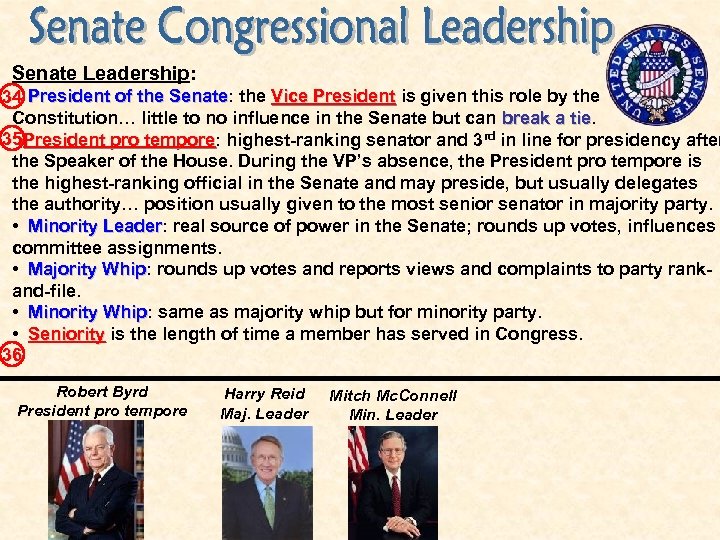 Senate Leadership: • 34 President of the Senate: the Vice President is given this role by the Senate Constitution… little to no influence in the Senate but can break a tie 35 President pro tempore: highest-ranking senator and 3 rd in line for presidency after • tempore the Speaker of the House. During the VP’s absence, the President pro tempore is the highest-ranking official in the Senate and may preside, but usually delegates the authority… position usually given to the most senior senator in majority party. • Minority Leader: real source of power in the Senate; rounds up votes, influences Leader committee assignments. • Majority Whip: rounds up votes and reports views and complaints to party rank. Whip and-file. • Minority Whip: same as majority whip but for minority party. Whip • Seniority is the length of time a member has served in Congress. 36 Robert Byrd President pro tempore Harry Reid Maj. Leader Mitch Mc. Connell Min. Leader
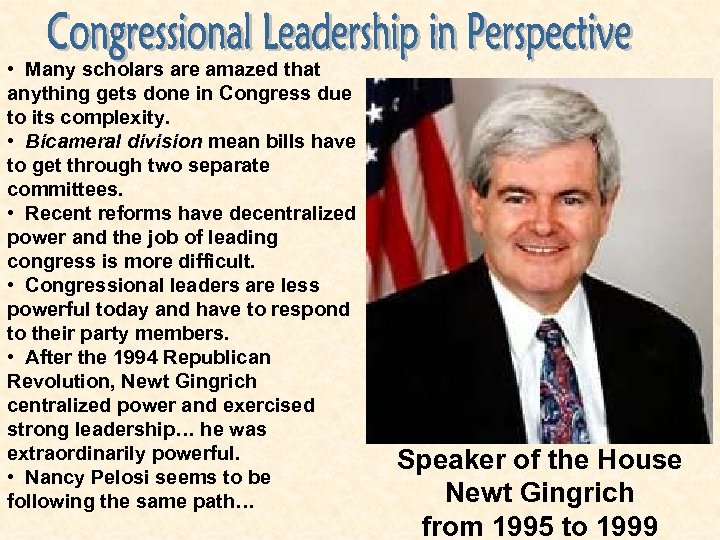 • Many scholars are amazed that anything gets done in Congress due to its complexity. • Bicameral division mean bills have to get through two separate committees. • Recent reforms have decentralized power and the job of leading congress is more difficult. • Congressional leaders are less powerful today and have to respond to their party members. • After the 1994 Republican Revolution, Newt Gingrich centralized power and exercised strong leadership… he was extraordinarily powerful. • Nancy Pelosi seems to be following the same path… Speaker of the House Newt Gingrich from 1995 to 1999
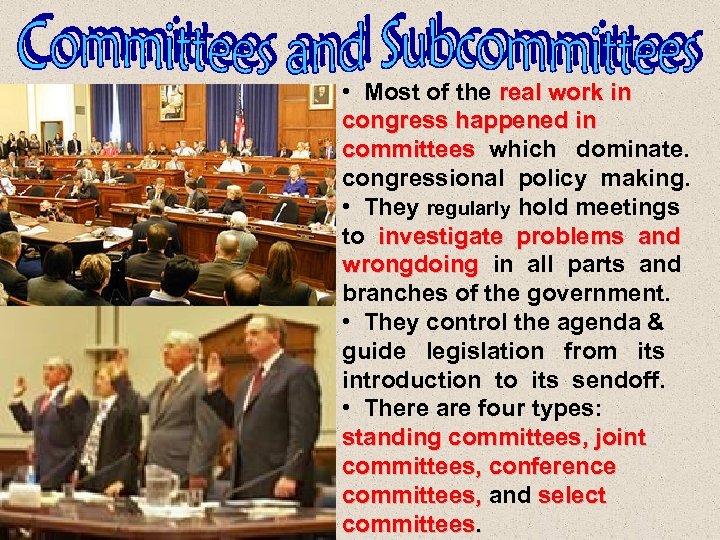 • Most of the real work in congress happened in committees which dominate. congressional policy making. • They regularly hold meetings to investigate problems and wrongdoing in all parts and branches of the government. • They control the agenda & guide legislation from its introduction to its sendoff. • There are four types: standing committees, joint committees, conference committees, and select committees.
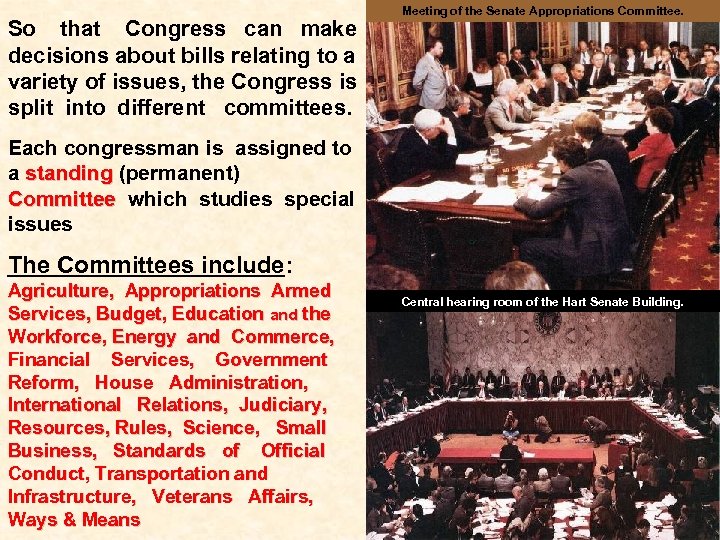 So that Congress can make decisions about bills relating to a variety of issues, the Congress is split into different committees. Meeting of the Senate Appropriations Committee. Each congressman is assigned to a standing (permanent) Committee which studies special issues The Committees include: Agriculture, Appropriations Armed Services, Budget, Education and the Workforce, Energy and Commerce, Financial Services, Government Reform, House Administration, International Relations, Judiciary, Resources, Rules, Science, Small Business, Standards of Official Conduct, Transportation and Infrastructure, Veterans Affairs, Ways & Means Central hearing room of the Hart Senate Building.
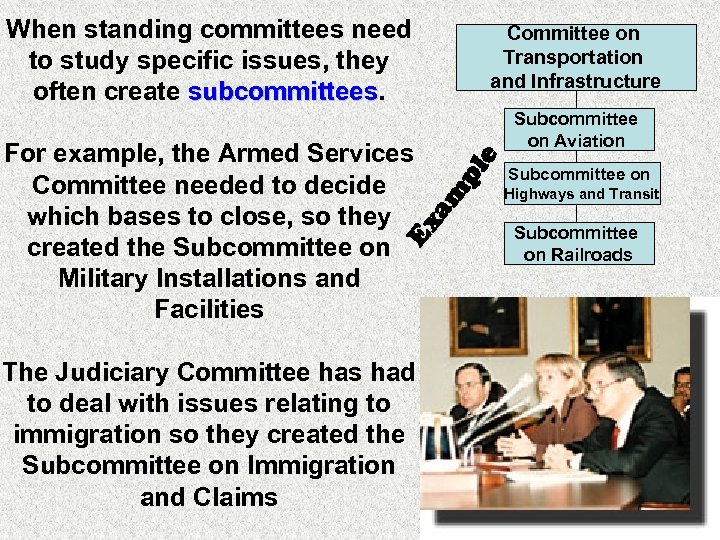 When standing committees need to study specific issues, they often create subcommittees am pl e Subcommittee on Aviation Ex For example, the Armed Services Committee needed to decide which bases to close, so they created the Subcommittee on Military Installations and Facilities Committee on Transportation and Infrastructure The Judiciary Committee has had to deal with issues relating to immigration so they created the Subcommittee on Immigration and Claims Subcommittee on Highways and Transit Subcommittee on Railroads
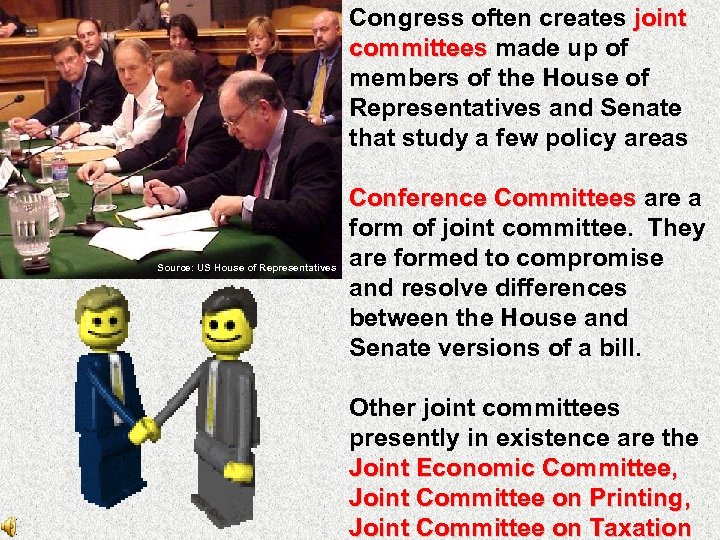 Congress often creates joint committees made up of members of the House of Representatives and Senate that study a few policy areas Source: US House of Representatives Conference Committees are a form of joint committee. They are formed to compromise and resolve differences between the House and Senate versions of a bill. Other joint committees presently in existence are the Joint Economic Committee, Joint Committee on Printing, Joint Committee on Taxation
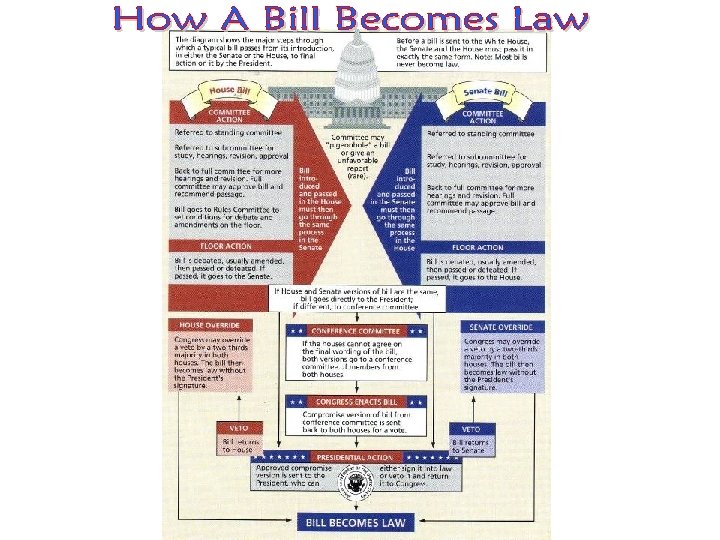
 LL BI 37 38 39 40 A proposed law is called a bill A schedule that lists the order in which bills are to be considered by the House is a calendar Most bills that are introduced do not become law. Amazingly, less than 10% of the bills that make it out of committee successfully become laws… there about 5, 500 introduced each year. As the framers intended, law making is a difficult task.
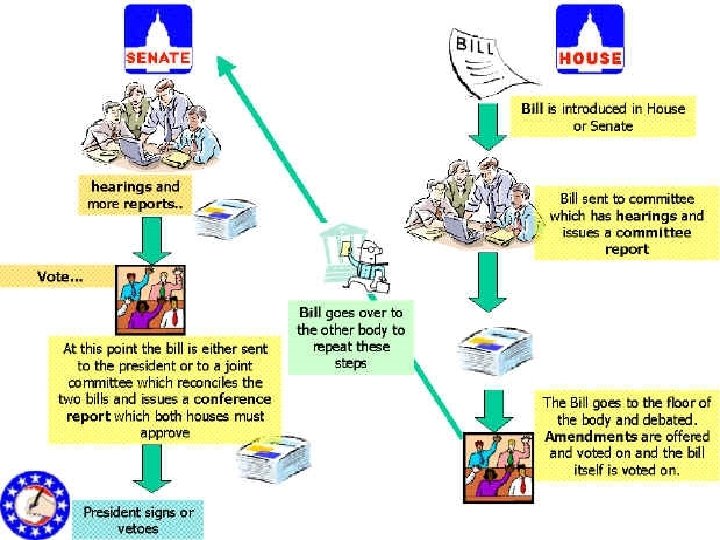
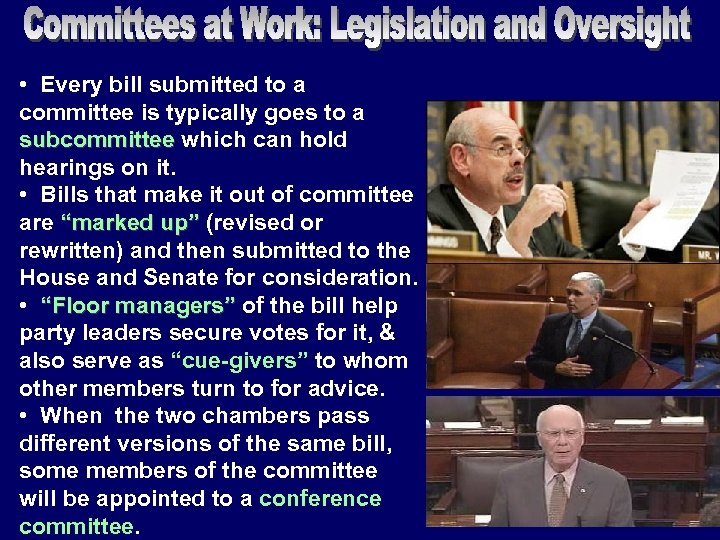 • Every bill submitted to a committee is typically goes to a subcommittee which can hold hearings on it. • Bills that make it out of committee are “marked up” (revised or rewritten) and then submitted to the House and Senate for consideration. • “Floor managers” of the bill help party leaders secure votes for it, & also serve as “cue-givers” to whom other members turn to for advice. • When the two chambers pass different versions of the same bill, some members of the committee will be appointed to a conference committee.
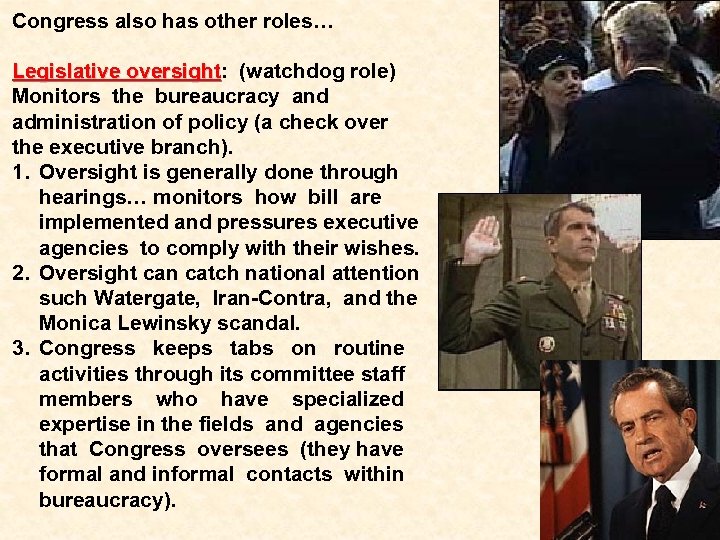 Congress also has other roles… Legislative oversight: (watchdog role) oversight Monitors the bureaucracy and administration of policy (a check over the executive branch). 1. Oversight is generally done through hearings… monitors how bill are implemented and pressures executive agencies to comply with their wishes. 2. Oversight can catch national attention such Watergate, Iran-Contra, and the Monica Lewinsky scandal. 3. Congress keeps tabs on routine activities through its committee staff members who have specialized expertise in the fields and agencies that Congress oversees (they have formal and informal contacts within bureaucracy).
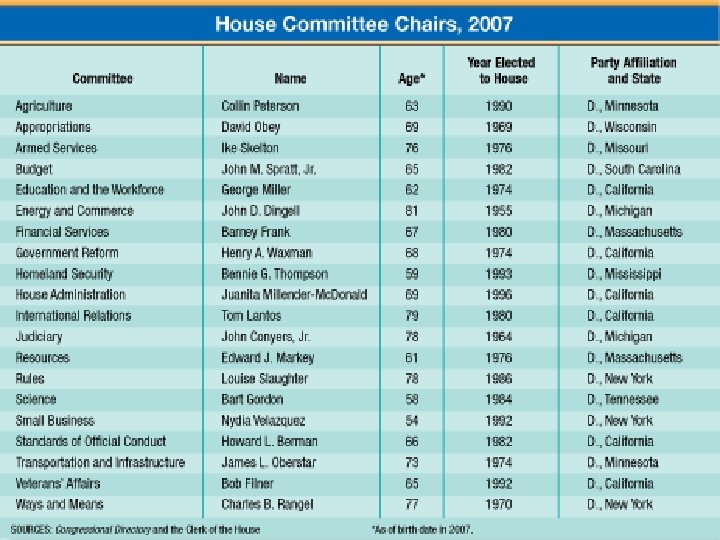
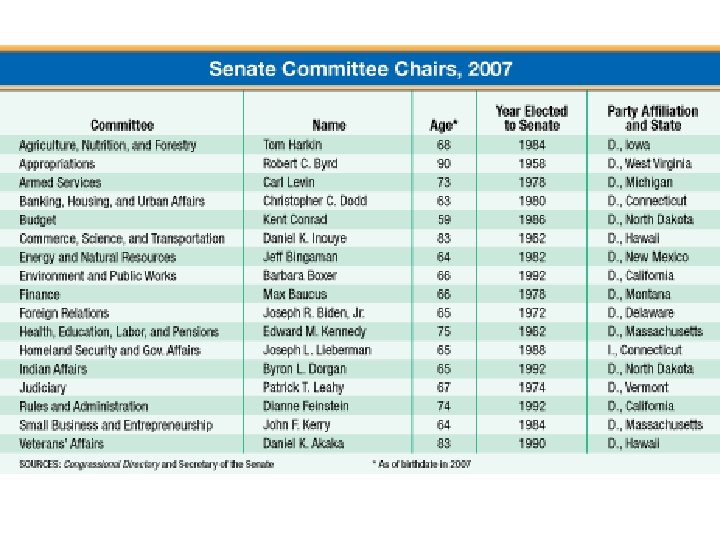
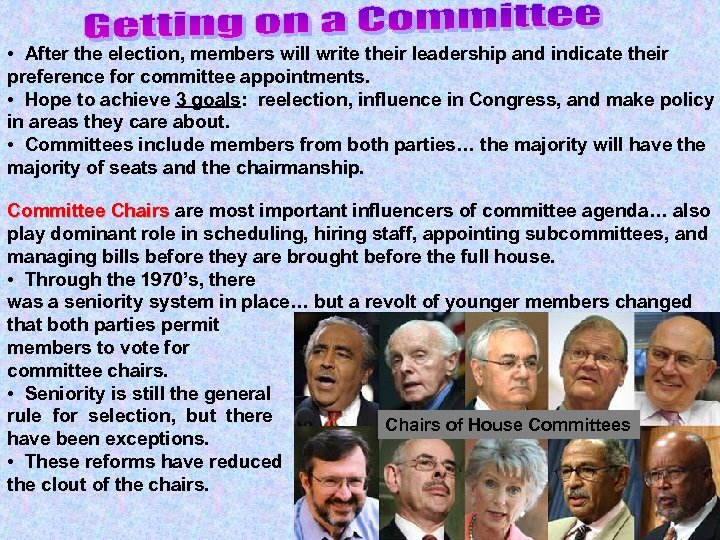 • After the election, members will write their leadership and indicate their preference for committee appointments. • Hope to achieve 3 goals: reelection, influence in Congress, and make policy in areas they care about. • Committees include members from both parties… the majority will have the majority of seats and the chairmanship. Committee Chairs are most important influencers of committee agenda… also play dominant role in scheduling, hiring staff, appointing subcommittees, and managing bills before they are brought before the full house. • Through the 1970’s, there was a seniority system in place… but a revolt of younger members changed that both parties permit members to vote for committee chairs. • Seniority is still the general rule for selection, but there Chairs of House Committees have been exceptions. • These reforms have reduced the clout of the chairs.
![• The advent of caucuses [meeting of the majority party] in Congress has](https://present5.com/presentation/b441c481d2d32bddc4aec8dbfea3559d/image-64.jpg "• The advent of caucuses [meeting of the majority party] in Congress has") • The advent of caucuses [meeting of the majority party] in Congress has made the party representation of interests in Congress a more direct process. • There a series of caucuses in Congress based on race, region, ideology, and economics. Examples: • Blue Dog Coalition • Congressional Black Caucus • Congressional Caucus for Women's Issues • Congressional Hispanic Caucus • Congressional Horse Caucus • Congressional Internet Caucus • Congressional Second Amendment Caucus • Congressional Victim's Rights Caucus • Congressional Western Caucus • Flat Tax Caucus • U. S. -Mongolia Friendship Caucus • Victory in Iraq Caucus • … and LOTS more
• The advent of caucuses [meeting of the majority party] in Congress has made the party representation of interests in Congress a more direct process. • There a series of caucuses in Congress based on race, region, ideology, and economics. Examples: • Blue Dog Coalition • Congressional Black Caucus • Congressional Caucus for Women's Issues • Congressional Hispanic Caucus • Congressional Horse Caucus • Congressional Internet Caucus • Congressional Second Amendment Caucus • Congressional Victim's Rights Caucus • Congressional Western Caucus • Flat Tax Caucus • U. S. -Mongolia Friendship Caucus • Victory in Iraq Caucus • … and LOTS more
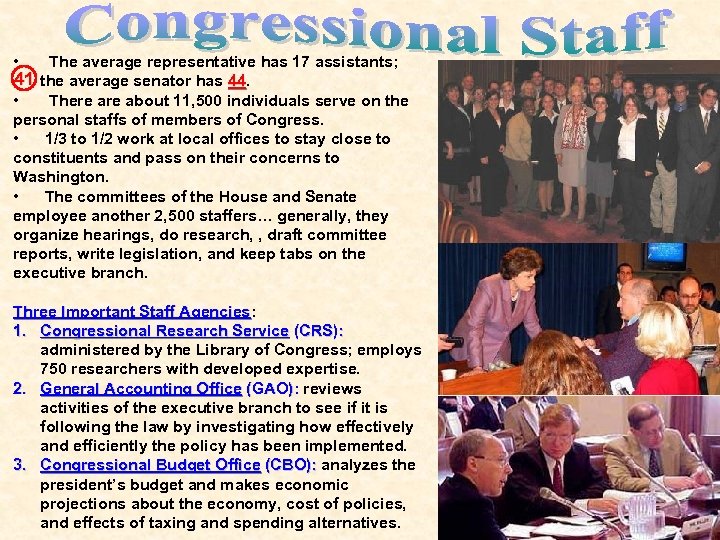 • The average representative has 17 assistants; 41 the average senator has 44. 44 • There about 11, 500 individuals serve on the personal staffs of members of Congress. • 1/3 to 1/2 work at local offices to stay close to constituents and pass on their concerns to Washington. • The committees of the House and Senate employee another 2, 500 staffers… generally, they organize hearings, do research, , draft committee reports, write legislation, and keep tabs on the executive branch. Three Important Staff Agencies: Agencies 1. Congressional Research Service (CRS): administered by the Library of Congress; employs 750 researchers with developed expertise. 2. General Accounting Office (GAO): reviews activities of the executive branch to see if it is following the law by investigating how effectively and efficiently the policy has been implemented. 3. Congressional Budget Office (CBO): analyzes the president’s budget and makes economic projections about the economy, cost of policies, and effects of taxing and spending alternatives.

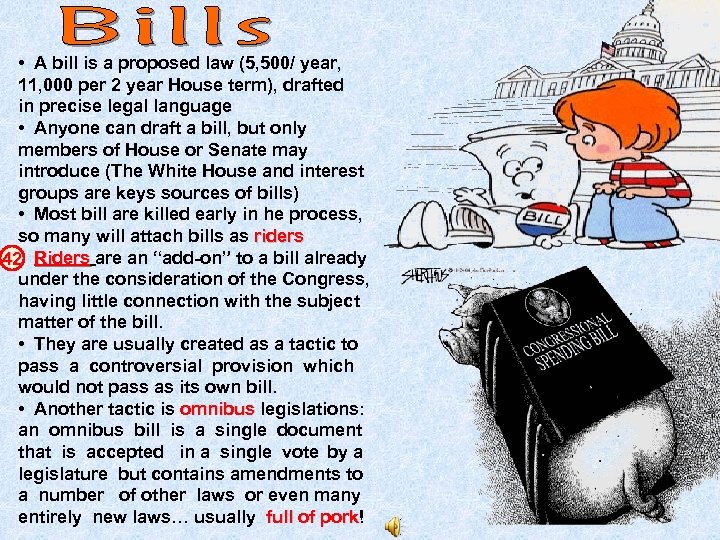 • A bill is a proposed law (5, 500/ year, 11, 000 per 2 year House term), drafted in precise legal language • Anyone can draft a bill, but only members of House or Senate may introduce (The White House and interest groups are keys sources of bills) • Most bill are killed early in he process, so many will attach bills as riders • 42 Riders are an “add-on” to a bill already under the consideration of the Congress, having little connection with the subject matter of the bill. • They are usually created as a tactic to pass a controversial provision which would not pass as its own bill. • Another tactic is omnibus legislations: an omnibus bill is a single document that is accepted in a single vote by a legislature but contains amendments to a number of other laws or even many entirely new laws… usually full of pork! pork
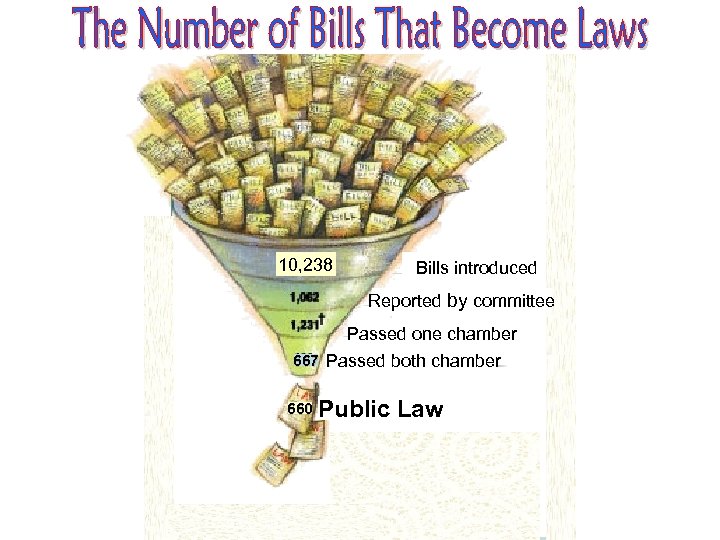 10, 238 Bills introduced Reported by committee Passed one chamber 667 Passed both chamber 660 Public Law
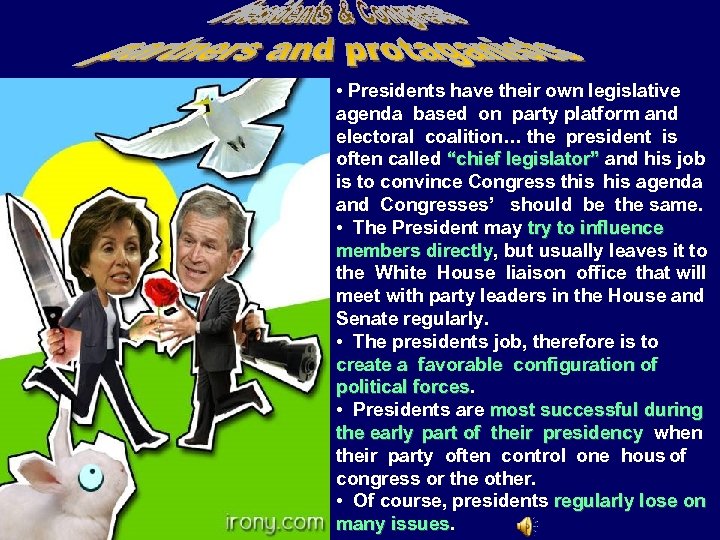 • Presidents have their own legislative agenda based on party platform and electoral coalition… the president is often called “chief legislator” and his job is to convince Congress this agenda and Congresses’ should be the same. • The President may try to influence members directly, but usually leaves it to directly the White House liaison office that will meet with party leaders in the House and Senate regularly. • The presidents job, therefore is to create a favorable configuration of political forces • Presidents are most successful during the early part of their presidency when their party often control one hous of congress or the other. • Of course, presidents regularly lose on many issues
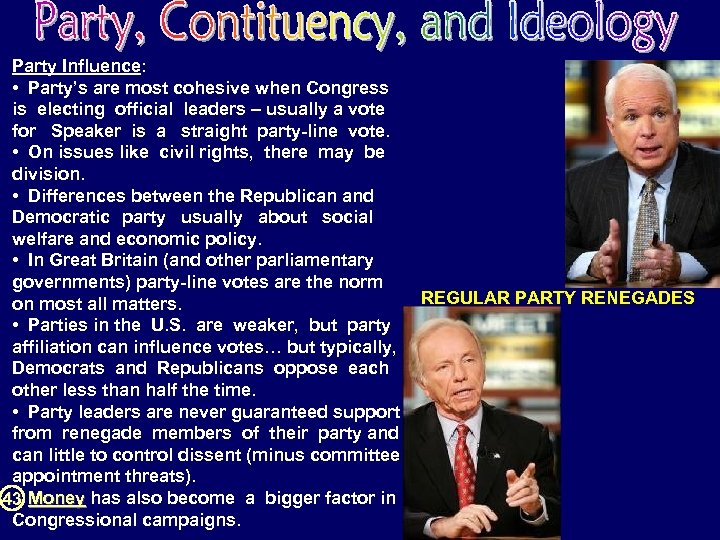 Party Influence: • Party’s are most cohesive when Congress is electing official leaders – usually a vote for Speaker is a straight party-line vote. • On issues like civil rights, there may be division. • Differences between the Republican and Democratic party usually about social welfare and economic policy. • In Great Britain (and other parliamentary governments) party-line votes are the norm on most all matters. • Parties in the U. S. are weaker, but party affiliation can influence votes… but typically, Democrats and Republicans oppose each other less than half the time. • Party leaders are never guaranteed support from renegade members of their party and can little to control dissent (minus committee appointment threats). • 43 Money has also become a bigger factor in Congressional campaigns. REGULAR PARTY RENEGADES
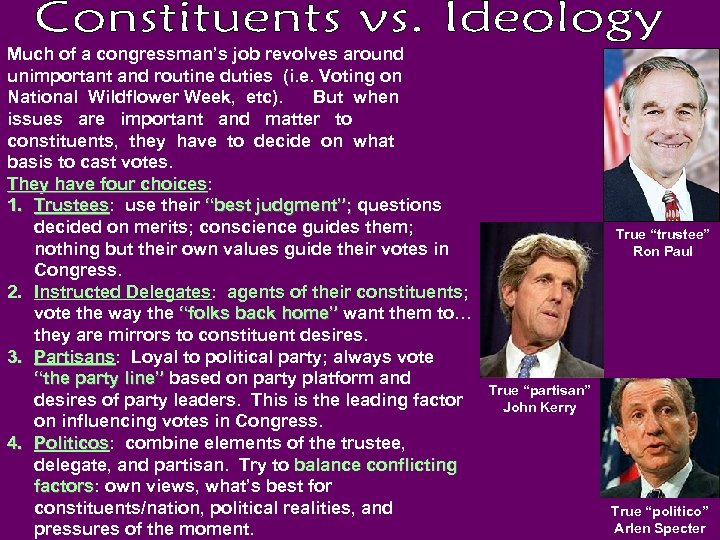 Much of a congressman’s job revolves around unimportant and routine duties (i. e. Voting on National Wildflower Week, etc). But when issues are important and matter to constituents, they have to decide on what basis to cast votes. They have four choices: choices 1. Trustees: use their “best judgment”; questions Trustees decided on merits; conscience guides them; nothing but their own values guide their votes in Congress. 2. Instructed Delegates: agents of their constituents; vote the way the “folks back home” want them to… they are mirrors to constituent desires. 3. Partisans: Loyal to political party; always vote Partisans “the party line” based on party platform and desires of party leaders. This is the leading factor on influencing votes in Congress. 4. Politicos: combine elements of the trustee, Politicos delegate, and partisan. Try to balance conflicting factors: own views, what’s best for factors constituents/nation, political realities, and pressures of the moment. True “trustee” Ron Paul True “partisan” John Kerry True “politico” Arlen Specter
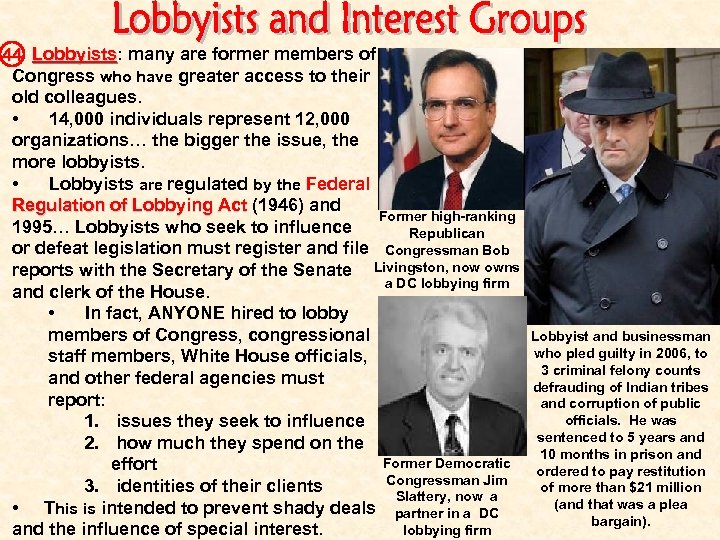 44 Lobbyists: many are former members of Lobbyists Congress who have greater access to their old colleagues. • 14, 000 individuals represent 12, 000 organizations… the bigger the issue, the more lobbyists. • Lobbyists are regulated by the Federal Regulation of Lobbying Act (1946) and Former high-ranking 1995… Lobbyists who seek to influence Republican or defeat legislation must register and file Congressman Bob reports with the Secretary of the Senate Livingston, now owns a DC lobbying firm and clerk of the House. • In fact, ANYONE hired to lobby members of Congress, congressional staff members, White House officials, and other federal agencies must report: 1. issues they seek to influence 2. how much they spend on the Former Democratic effort Congressman Jim 3. identities of their clients Slattery, now a • This is intended to prevent shady deals partner in a DC lobbying firm and the influence of special interest. Lobbyist and businessman who pled guilty in 2006, to 3 criminal felony counts defrauding of Indian tribes and corruption of public officials. He was sentenced to 5 years and 10 months in prison and ordered to pay restitution of more than $21 million (and that was a plea bargain).

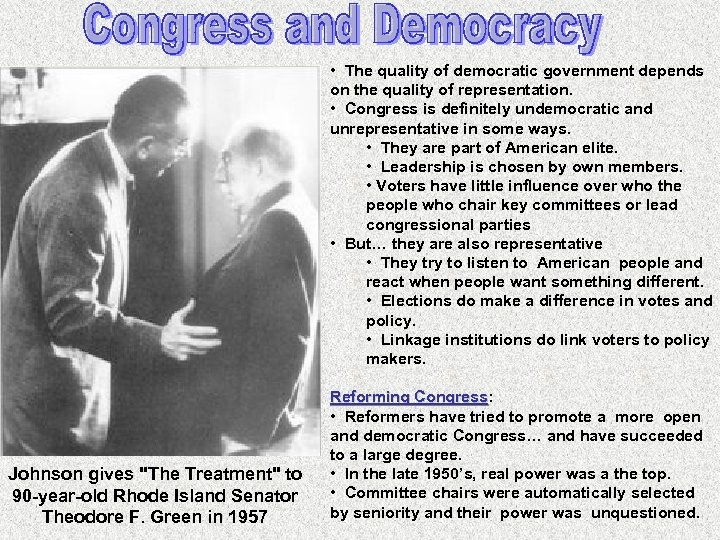 • The quality of democratic government depends on the quality of representation. • Congress is definitely undemocratic and unrepresentative in some ways. • They are part of American elite. • Leadership is chosen by own members. • Voters have little influence over who the people who chair key committees or lead congressional parties • But… they are also representative • They try to listen to American people and react when people want something different. • Elections do make a difference in votes and policy. • Linkage institutions do link voters to policy makers. Johnson gives "The Treatment" to 90 -year-old Rhode Island Senator Theodore F. Green in 1957 Reforming Congress: Congress • Reformers have tried to promote a more open and democratic Congress… and have succeeded to a large degree. • In the late 1950’s, real power was a the top. • Committee chairs were automatically selected by seniority and their power was unquestioned.
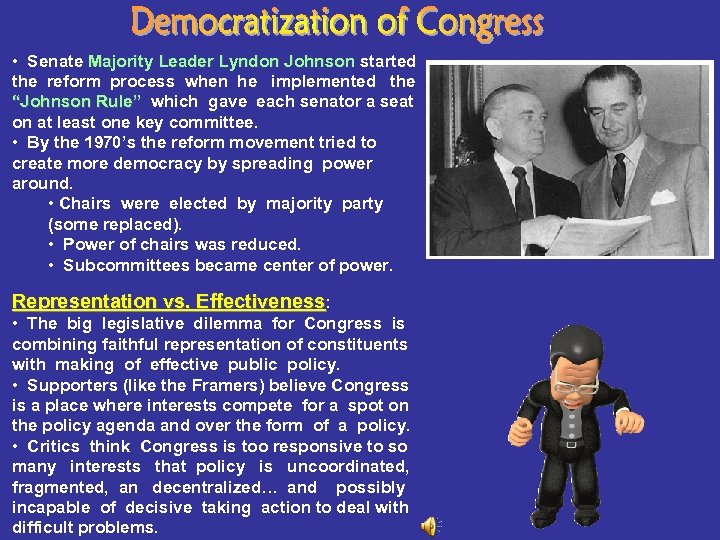 • Senate Majority Leader Lyndon Johnson started the reform process when he implemented the “Johnson Rule” which gave each senator a seat on at least one key committee. • By the 1970’s the reform movement tried to create more democracy by spreading power around. • Chairs were elected by majority party (some replaced). • Power of chairs was reduced. • Subcommittees became center of power. Representation vs. Effectiveness: • The big legislative dilemma for Congress is combining faithful representation of constituents with making of effective public policy. • Supporters (like the Framers) believe Congress is a place where interests compete for a spot on the policy agenda and over the form of a policy. • Critics think Congress is too responsive to so many interests that policy is uncoordinated, fragmented, an decentralized… and possibly incapable of decisive taking action to deal with difficult problems.
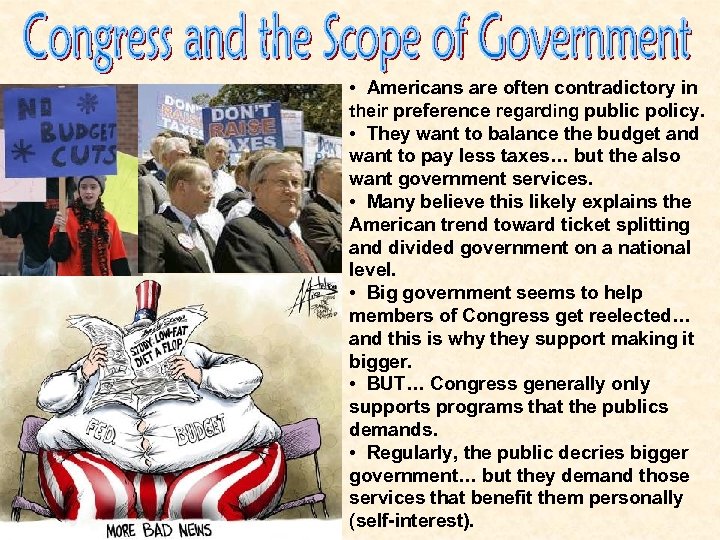 • Americans are often contradictory in their preference regarding public policy. • They want to balance the budget and want to pay less taxes… but the also want government services. • Many believe this likely explains the American trend toward ticket splitting and divided government on a national level. • Big government seems to help members of Congress get reelected… and this is why they support making it bigger. • BUT… Congress generally only supports programs that the publics demands. • Regularly, the public decries bigger government… but they demand those services that benefit them personally (self-interest).
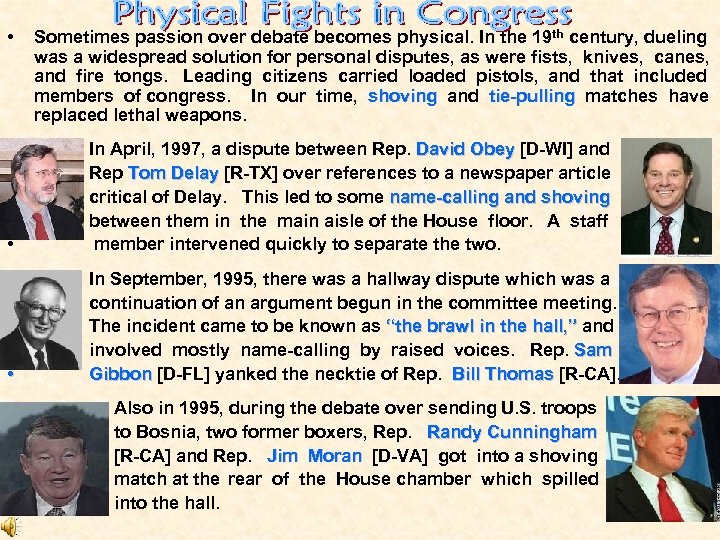 • Sometimes passion over debate becomes physical. In the 19 th century, dueling was a widespread solution for personal disputes, as were fists, knives, canes, and fire tongs. Leading citizens carried loaded pistols, and that included members of congress. In our time, shoving and tie-pulling matches have replaced lethal weapons. • • • In April, 1997, a dispute between Rep. David Obey [D-WI] and Rep Tom Delay [R-TX] over references to a newspaper article critical of Delay. This led to some name-calling and shoving between them in the main aisle of the House floor. A staff member intervened quickly to separate the two. • • • In September, 1995, there was a hallway dispute which was a continuation of an argument begun in the committee meeting. The incident came to be known as “the brawl in the hall, ” and involved mostly name-calling by raised voices. Rep. Sam Gibbon [D-FL] yanked the necktie of Rep. Bill Thomas [R-CA]. • • • Also in 1995, during the debate over sending U. S. troops to Bosnia, two former boxers, Rep. Randy Cunningham [R-CA] and Rep. Jim Moran [D-VA] got into a shoving match at the rear of the House chamber which spilled into the hall.
![• In 1985, a physical altercation between former Rep. Tom Downey [D-NY] and](https://present5.com/presentation/b441c481d2d32bddc4aec8dbfea3559d/image-81.jpg "• In 1985, a physical altercation between former Rep. Tom Downey [D-NY] and") • In 1985, a physical altercation between former Rep. Tom Downey [D-NY] and former Rep. Bob Dornan [R-CA] erupted during a debate on defense issues. At the rear of the chamber, after some name calling, Downey shoved Dornan, who responded by yanking the necktie of Downey. • In June of 1985, Majority Leader Jim Wright [D-TX] was presiding over the House. Wright left the rostrum, grabbed former Rep. Bob Walker [R-PA] by the arm and threatened to punch him in the mouth; this led to an extended and heated mouth debate that evening during the special order speech period. • In 1789, two members brawled on the House floor using a cane and fire tong. In 1793, a House Member responded to a tong lingering dispute with a former Member by challenging him to a duel outside of the Capitol and killing him. In 1832, Rep. Sam him Houston was formally reprimanded by the House for attacking Rep. William Stanbery with his cane. Stanbery’s response was cane to shoot at Houston, but his pistol misfired. A duel between Houston misfired two freshmen Congressmen in 1838 ended in the death of one. • In 1838, Rep. Abram Maury and Rep. William Campbell came to blows behind the Speaker’s chair. Campbell beat Maury bloody. In 1840 Rep. Jesse Bynum attacked Rep. Rice Garland bloody with a cane, while Rep. Ken Rayner and William Montgomery cane broke canes over each other’s heads
• In 1985, a physical altercation between former Rep. Tom Downey [D-NY] and former Rep. Bob Dornan [R-CA] erupted during a debate on defense issues. At the rear of the chamber, after some name calling, Downey shoved Dornan, who responded by yanking the necktie of Downey. • In June of 1985, Majority Leader Jim Wright [D-TX] was presiding over the House. Wright left the rostrum, grabbed former Rep. Bob Walker [R-PA] by the arm and threatened to punch him in the mouth; this led to an extended and heated mouth debate that evening during the special order speech period. • In 1789, two members brawled on the House floor using a cane and fire tong. In 1793, a House Member responded to a tong lingering dispute with a former Member by challenging him to a duel outside of the Capitol and killing him. In 1832, Rep. Sam him Houston was formally reprimanded by the House for attacking Rep. William Stanbery with his cane. Stanbery’s response was cane to shoot at Houston, but his pistol misfired. A duel between Houston misfired two freshmen Congressmen in 1838 ended in the death of one. • In 1838, Rep. Abram Maury and Rep. William Campbell came to blows behind the Speaker’s chair. Campbell beat Maury bloody. In 1840 Rep. Jesse Bynum attacked Rep. Rice Garland bloody with a cane, while Rep. Ken Rayner and William Montgomery cane broke canes over each other’s heads
![• • In 1856, Sen. Charles Sumner [MA] took to the Senate floor](https://present5.com/presentation/b441c481d2d32bddc4aec8dbfea3559d/image-82.jpg "• • In 1856, Sen. Charles Sumner [MA] took to the Senate floor") • • In 1856, Sen. Charles Sumner [MA] took to the Senate floor to deliver a much-anticipated address entitled “The Crime Against Kansas. ” At issue was the 1854 Kansas-Nebraska Act. Sumner once said “Nothing against slavery can be unconstitutional. ” Preston Brooks of SC, was known for his “obliging disposition and his conciliatory temper. ” A friend gave him a gutta-percha walking stick as a gift. This would become a weapon. Sumner took the floor and was giving a memorable speech on abolition. Sumner said that Andrew Butler of SC [Brooks’ uncle who was away from the floor] had chosen “the harlot, Slavery” for his mistress and also made fun of Butler’s speech impediment. Stephen Douglas, pacing the floor in the rear impediment of the Senate chamber, shook his head at Summer’s words and muttered, “That damn fool will get himself killed by some other damn fool. ” Sumner took his seat at the conclusion of his address. Lewis Cass called the speech “the most un-American and unpatriotic that ever grated on the ears. ” Preston Brooks felt that Sumner had dishonored several members and decided that a proper response was in order. A good thrashing with a cane was the only order fitting penalty. He headed toward Sumner with his solid, gold-headed guttapurcha walking stick. “Mr. Sumner, you have libeled my state, and slandered my relation, who is absent, and I feel it to be my duty to punish you for it. ” As he finished his introduction, Brooks brought his cane down upon Sumner’s head. The light chastisement he had intended to administer quickly turned into a severe beating
• • In 1856, Sen. Charles Sumner [MA] took to the Senate floor to deliver a much-anticipated address entitled “The Crime Against Kansas. ” At issue was the 1854 Kansas-Nebraska Act. Sumner once said “Nothing against slavery can be unconstitutional. ” Preston Brooks of SC, was known for his “obliging disposition and his conciliatory temper. ” A friend gave him a gutta-percha walking stick as a gift. This would become a weapon. Sumner took the floor and was giving a memorable speech on abolition. Sumner said that Andrew Butler of SC [Brooks’ uncle who was away from the floor] had chosen “the harlot, Slavery” for his mistress and also made fun of Butler’s speech impediment. Stephen Douglas, pacing the floor in the rear impediment of the Senate chamber, shook his head at Summer’s words and muttered, “That damn fool will get himself killed by some other damn fool. ” Sumner took his seat at the conclusion of his address. Lewis Cass called the speech “the most un-American and unpatriotic that ever grated on the ears. ” Preston Brooks felt that Sumner had dishonored several members and decided that a proper response was in order. A good thrashing with a cane was the only order fitting penalty. He headed toward Sumner with his solid, gold-headed guttapurcha walking stick. “Mr. Sumner, you have libeled my state, and slandered my relation, who is absent, and I feel it to be my duty to punish you for it. ” As he finished his introduction, Brooks brought his cane down upon Sumner’s head. The light chastisement he had intended to administer quickly turned into a severe beating
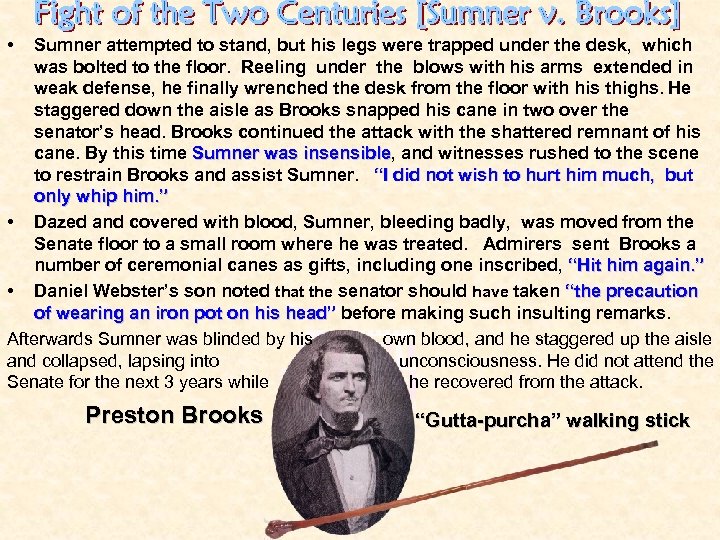 • Sumner attempted to stand, but his legs were trapped under the desk, which was bolted to the floor. Reeling under the blows with his arms extended in weak defense, he finally wrenched the desk from the floor with his thighs. He staggered down the aisle as Brooks snapped his cane in two over the senator’s head. Brooks continued the attack with the shattered remnant of his cane. By this time Sumner was insensible, and witnesses rushed to the scene insensible to restrain Brooks and assist Sumner. “I did not wish to hurt him much, but only whip him. ” • Dazed and covered with blood, Sumner, bleeding badly, was moved from the Senate floor to a small room where he was treated. Admirers sent Brooks a number of ceremonial canes as gifts, including one inscribed, “Hit him again. ” • Daniel Webster’s son noted that the senator should have taken “the precaution of wearing an iron pot on his head” before making such insulting remarks. Afterwards Sumner was blinded by his own blood, and he staggered up the aisle and collapsed, lapsing into unconsciousness. He did not attend the Senate for the next 3 years while he recovered from the attack. Preston Brooks “Gutta-purcha” walking stick
![1. The (Supreme Court/Presidency/Congress) is the legislative [law-making] branch. 2. The major function of](https://present5.com/presentation/b441c481d2d32bddc4aec8dbfea3559d/image-84.jpg "1. The (Supreme Court/Presidency/Congress) is the legislative [law-making] branch. 2. The major function of") 1. The (Supreme Court/Presidency/Congress) is the legislative [law-making] branch. 2. The major function of Congress is to (interpret the law/carry out the law/make the law). 3. The word for two houses is (filibuster/quorum/bicameral). 4. The largest State in population is (California/Texas/New York). The smallest is (Arkansas/Alaska/New Mexico). 5. A term of Congress is for (two/four/six) years. The date for the start of each term is the 3 rd day of (January/March/November) of every odd-numbered year. 6. Sessions of Congress last for (one/two/four/six) year(s). There are (one/two/four/six) sessions each term of Congress. 7. Only the (President/Supreme Court Chief Justice) can call a special session of Congress. 8. The 435 members of the House (is/is not) fixed by the House. 9. Each State is guaranteed at least (one/two/four) seat(s) in the House. 10. Representatives are elected to (two/four/six/eight) year terms. 11. Congress reapportions after each (five/ten/twenty) year census. 12. Each seat in the House represents about (350, 000/650, 000/950, 000) persons. 13. Congressional elections are held on the Tuesday following the first Monday in (July/November/January) of each even-numbered year. 14. (Censure/Expulsion/Gerrymandering) is when districts have been drawn to the advantage of the dominant party in power in the legislature. 15. A (censure/expulsion/gerrymander) is a formal reprimand of a congressman for such misdeeds as misuse of public funds or abuse of privileges.
1. The (Supreme Court/Presidency/Congress) is the legislative [law-making] branch. 2. The major function of Congress is to (interpret the law/carry out the law/make the law). 3. The word for two houses is (filibuster/quorum/bicameral). 4. The largest State in population is (California/Texas/New York). The smallest is (Arkansas/Alaska/New Mexico). 5. A term of Congress is for (two/four/six) years. The date for the start of each term is the 3 rd day of (January/March/November) of every odd-numbered year. 6. Sessions of Congress last for (one/two/four/six) year(s). There are (one/two/four/six) sessions each term of Congress. 7. Only the (President/Supreme Court Chief Justice) can call a special session of Congress. 8. The 435 members of the House (is/is not) fixed by the House. 9. Each State is guaranteed at least (one/two/four) seat(s) in the House. 10. Representatives are elected to (two/four/six/eight) year terms. 11. Congress reapportions after each (five/ten/twenty) year census. 12. Each seat in the House represents about (350, 000/650, 000/950, 000) persons. 13. Congressional elections are held on the Tuesday following the first Monday in (July/November/January) of each even-numbered year. 14. (Censure/Expulsion/Gerrymandering) is when districts have been drawn to the advantage of the dominant party in power in the legislature. 15. A (censure/expulsion/gerrymander) is a formal reprimand of a congressman for such misdeeds as misuse of public funds or abuse of privileges.
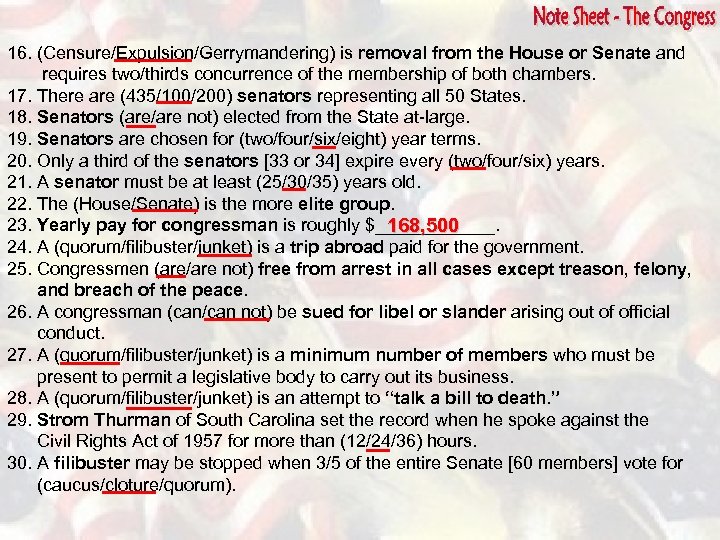 16. (Censure/Expulsion/Gerrymandering) is removal from the House or Senate and requires two/thirds concurrence of the membership of both chambers. 17. There are (435/100/200) senators representing all 50 States. 18. Senators (are/are not) elected from the State at-large. 19. Senators are chosen for (two/four/six/eight) year terms. 20. Only a third of the senators [33 or 34] expire every (two/four/six) years. 21. A senator must be at least (25/30/35) years old. 22. The (House/Senate) is the more elite group. 23. Yearly pay for congressman is roughly $______. 168, 500 24. A (quorum/filibuster/junket) is a trip abroad paid for the government. 25. Congressmen (are/are not) free from arrest in all cases except treason, felony, and breach of the peace. 26. A congressman (can/can not) be sued for libel or slander arising out of official conduct. 27. A (quorum/filibuster/junket) is a minimum number of members who must be present to permit a legislative body to carry out its business. 28. A (quorum/filibuster/junket) is an attempt to “talk a bill to death. ” 29. Strom Thurman of South Carolina set the record when he spoke against the Civil Rights Act of 1957 for more than (12/24/36) hours. 30. A filibuster may be stopped when 3/5 of the entire Senate [60 members] vote for (caucus/cloture/quorum).
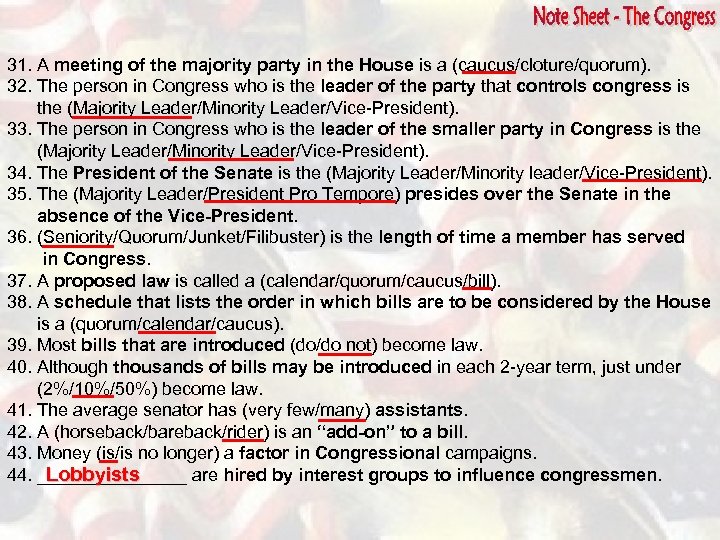 31. A meeting of the majority party in the House is a (caucus/cloture/quorum). 32. The person in Congress who is the leader of the party that controls congress is the (Majority Leader/Minority Leader/Vice-President). 33. The person in Congress who is the leader of the smaller party in Congress is the (Majority Leader/Minority Leader/Vice-President). 34. The President of the Senate is the (Majority Leader/Minority leader/Vice-President). 35. The (Majority Leader/President Pro Tempore) presides over the Senate in the absence of the Vice-President. 36. (Seniority/Quorum/Junket/Filibuster) is the length of time a member has served in Congress. 37. A proposed law is called a (calendar/quorum/caucus/bill). 38. A schedule that lists the order in which bills are to be considered by the House is a (quorum/calendar/caucus). 39. Most bills that are introduced (do/do not) become law. 40. Although thousands of bills may be introduced in each 2 -year term, just under (2%/10%/50%) become law. 41. The average senator has (very few/many) assistants. 42. A (horseback/bareback/rider) is an “add-on” to a bill. 43. Money (is/is no longer) a factor in Congressional campaigns. 44. ________ are hired by interest groups to influence congressmen. Lobbyists