


 Скачать презентацию U S A F A Space Systems Research
385616c578e984bfbffbda7b1f558f6b.ppt
- Количество слайдов: 22
 U S A F A Space Systems Research Center The Falcon. SAT Program at the Air Force Academy Space Science and Engineering Dr. Geoff Mc. Harg, Lt Col Tim Lawrence National Science Foundation Small Satellite Workshop. May 2007
 Overview • Falcon. SAT Program Overview • Small satellite engineering—pulling it all together • “Good enough” small science philosophy • Lessons learned and suggestions • Final thoughts U S A F A Space Systems Research Center
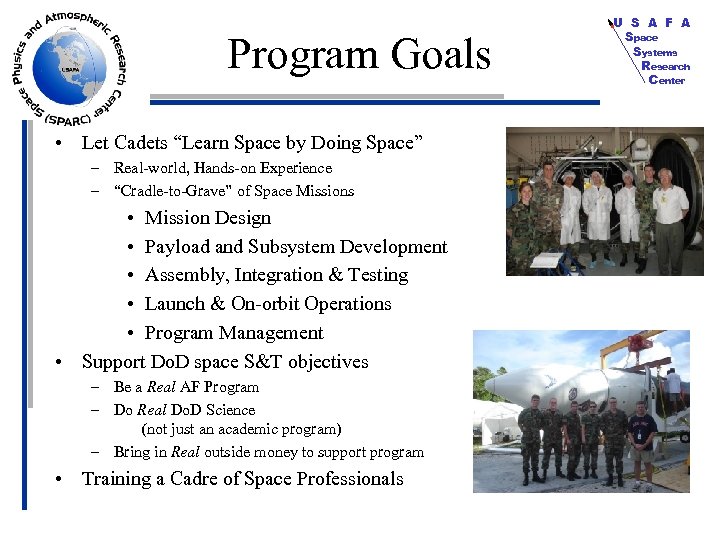 Program Goals • Let Cadets “Learn Space by Doing Space” – Real-world, Hands-on Experience – “Cradle-to-Grave” of Space Missions • Mission Design • Payload and Subsystem Development • Assembly, Integration & Testing • Launch & On-orbit Operations • Program Management • Support Do. D space S&T objectives – Be a Real AF Program – Do Real Do. D Science (not just an academic program) – Bring in Real outside money to support program • Training a Cadre of Space Professionals U S A F A Space Systems Research Center
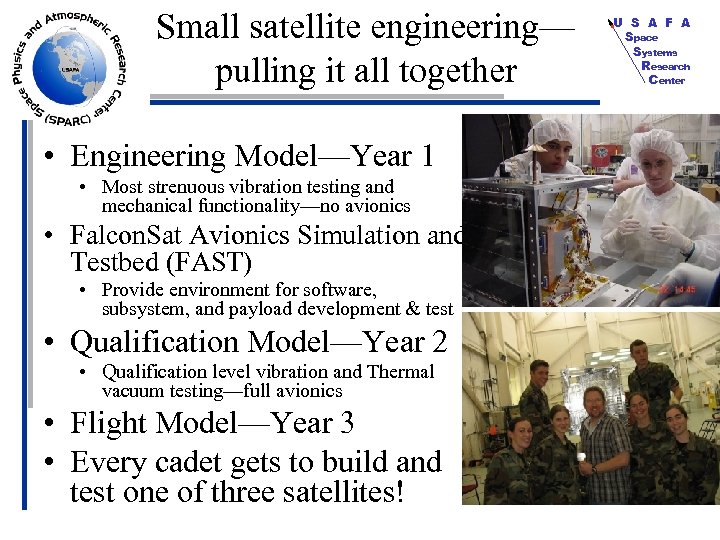 Small satellite engineering— pulling it all together • Engineering Model—Year 1 • Most strenuous vibration testing and mechanical functionality—no avionics • Falcon. Sat Avionics Simulation and Testbed (FAST) • Provide environment for software, subsystem, and payload development & test • Qualification Model—Year 2 • Qualification level vibration and Thermal vacuum testing—full avionics • Flight Model—Year 3 • Every cadet gets to build and test one of three satellites! U S A F A Space Systems Research Center
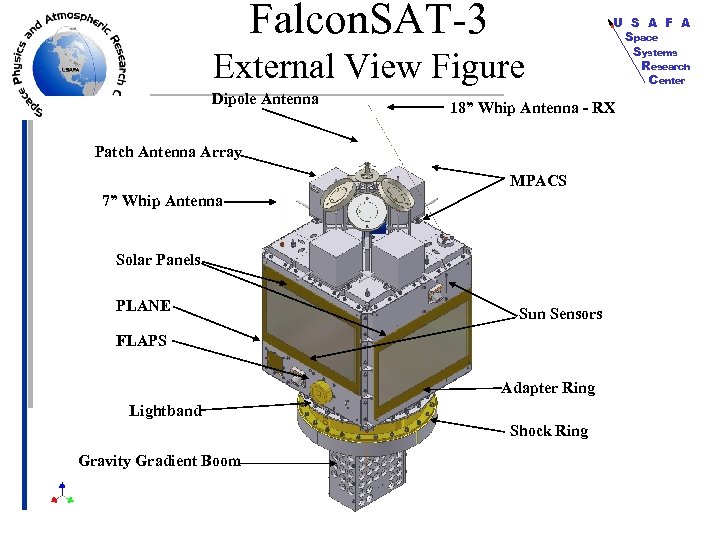 Falcon. SAT-3 External View Figure Dipole Antenna 18” Whip Antenna - RX Patch Antenna Array MPACS 7” Whip Antenna Solar Panels PLANE Sun Sensors FLAPS Adapter Ring Lightband Shock Ring Gravity Gradient Boom U S A F A Space Systems Research Center
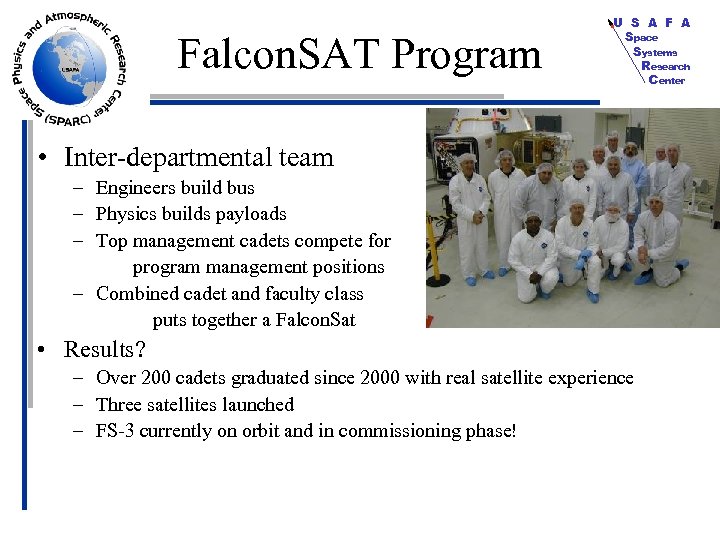 Falcon. SAT Program U S A F A Space Systems Research Center • Inter-departmental team – Engineers build bus – Physics builds payloads – Top management cadets compete for program management positions – Combined cadet and faculty class puts together a Falcon. Sat • Results? – Over 200 cadets graduated since 2000 with real satellite experience – Three satellites launched – FS-3 currently on orbit and in commissioning phase!
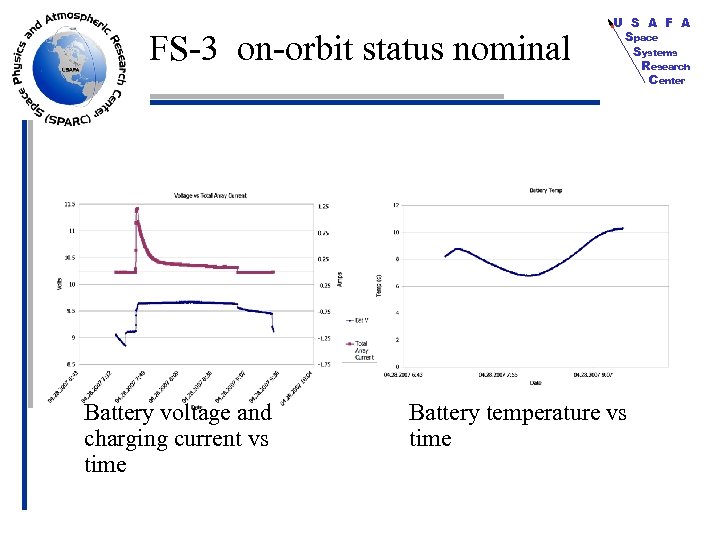 FS-3 on-orbit status nominal Battery voltage and charging current vs time U S A F A Space Systems Research Center Battery temperature vs time
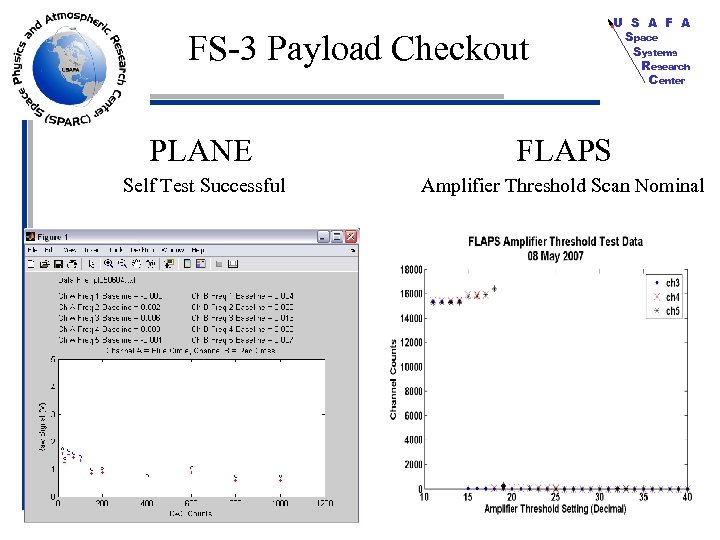 FS-3 Payload Checkout U S A F A Space Systems Research Center PLANE FLAPS Self Test Successful Amplifier Threshold Scan Nominal
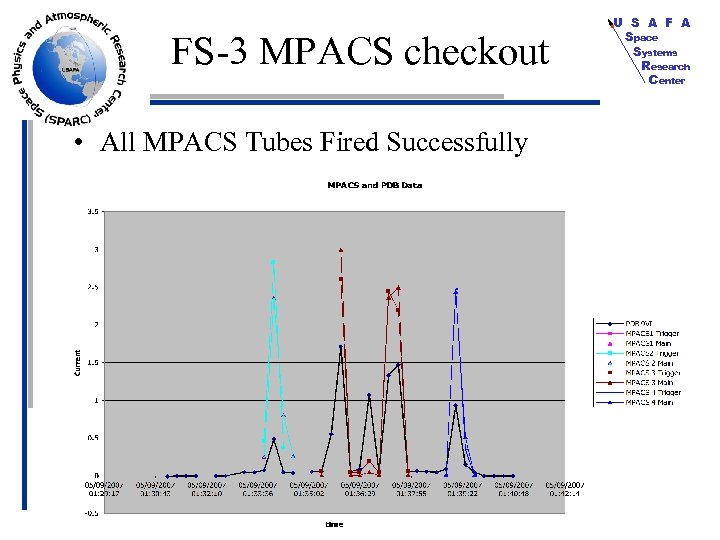 FS-3 MPACS checkout • All MPACS Tubes Fired Successfully U S A F A Space Systems Research Center
 Space Professionals—A dying breed? U S A F A Space Systems Research Center • Universities with hardware programs are rare— and getting more so • Hiring a post-doc with hardware experience and permanent residence status 6 months and counting • Why? No educational opportunities for spaceflight • Impact? – Industry professionals approaching retirement – Designing for spaceflight is a “learned” skill, do we really want to train on the job with a mission like NPOESS?
 Small Satellite Science Philosophy U S A F A Space Systems Research Center • Small sats are NOT big satellites—“but littler” • Big satellite mentality won’t work—reduce requirements • Figure out minimums you need to measure – Complexity ~ # payloads. X • Measure the minimums “Good enough” – Cost ~ Complexity. Y (Y>X => 2) • Plan on making it cheap—but plentiful – For some science lots of little satellites are better than a few big ones!
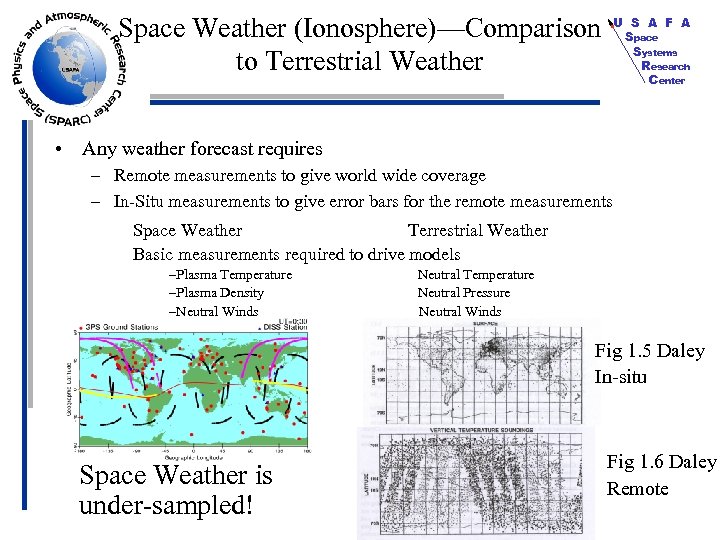 Space Weather (Ionosphere)—Comparison to Terrestrial Weather U S A F A Space Systems Research Center • Any weather forecast requires – Remote measurements to give world wide coverage – In-Situ measurements to give error bars for the remote measurements Space Weather Terrestrial Weather Basic measurements required to drive models –Plasma Temperature –Plasma Density –Neutral Winds Neutral Temperature Neutral Pressure Neutral Winds Fig 1. 5 Daley In-situ Space Weather is under-sampled! Fig 1. 6 Daley Remote
 Space Weather (Ionosphere)—Small satellites as an enabler U S A F A Space Systems Research Center • Ground based—remote measurements – Density, temperature and drifts versus altitude and time • Big satellites – Remote—Density (or TEC), maybe temperature and neutral winds – In-situ—Density, temperature, drifts and constituents at a very few locations and local times • Are remote measurements cheap enough for small sats? – Maybe so—COSMIC is a step along the path (~$100 M) • What should small satellites measure? – In-situ density, temperature and neutral winds – In a dense enough network to make a difference • “Smart-skin sensors” on all LEO satellites can make that difference!
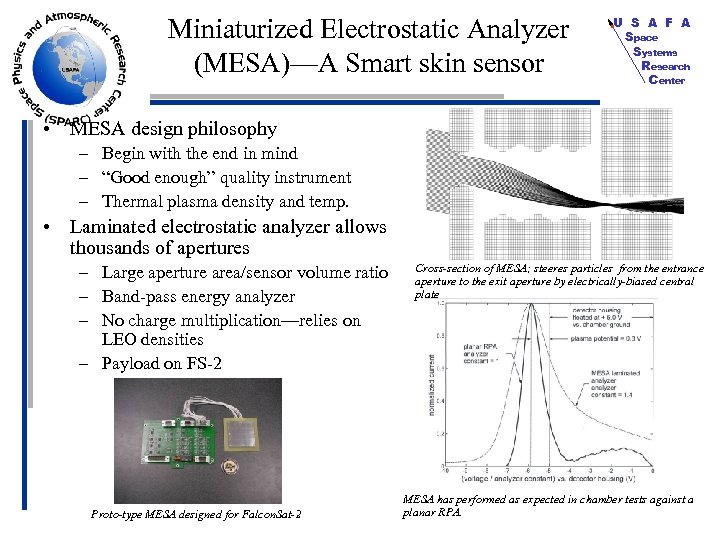 Miniaturized Electrostatic Analyzer (MESA)—A Smart skin sensor U S A F A Space Systems Research Center • MESA design philosophy – Begin with the end in mind – “Good enough” quality instrument – Thermal plasma density and temp. • Laminated electrostatic analyzer allows thousands of apertures – Large aperture area/sensor volume ratio – Band-pass energy analyzer – No charge multiplication—relies on LEO densities – Payload on FS-2 Proto-type MESA designed for Falcon. Sat-2 Cross-section of MESA; steeres particles from the entrance aperture to the exit aperture by electrically-biased central plate MESA has performed as expected in chamber tests against a planar RPA.
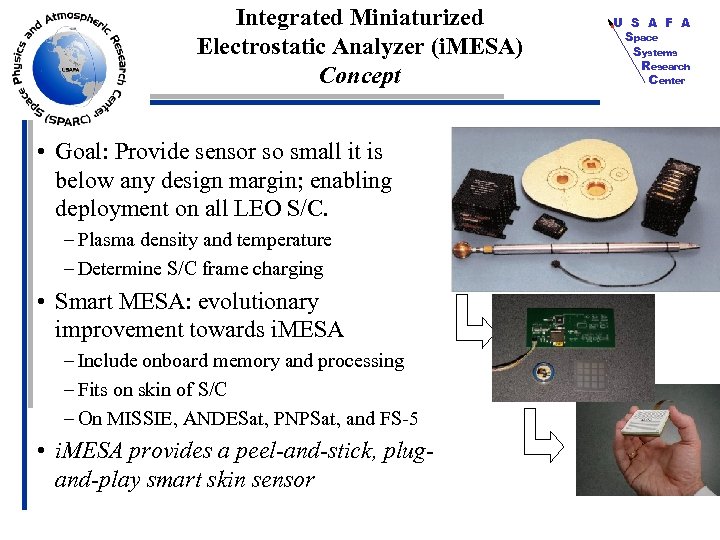 Integrated Miniaturized Electrostatic Analyzer (i. MESA) Concept • Goal: Provide sensor so small it is below any design margin; enabling deployment on all LEO S/C. – Plasma density and temperature – Determine S/C frame charging • Smart MESA: evolutionary improvement towards i. MESA – Include onboard memory and processing – Fits on skin of S/C – On MISSIE, ANDESat, PNPSat, and FS-5 • i. MESA provides a peel-and-stick, plugand-play smart skin sensor U S A F A Space Systems Research Center
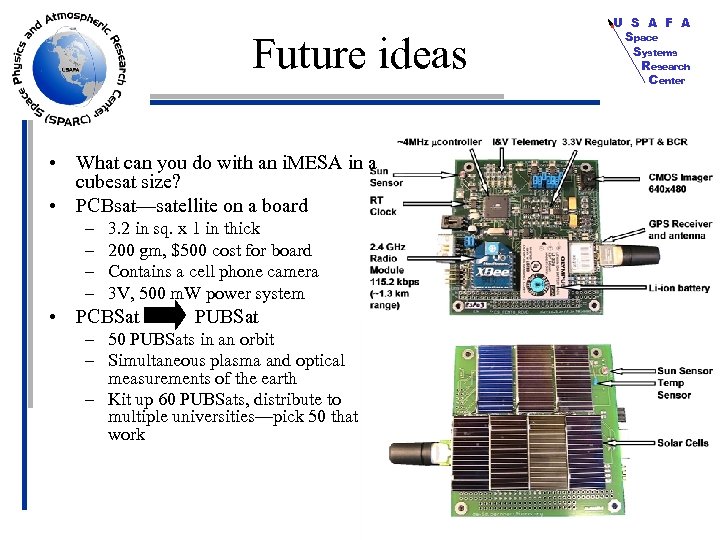 Future ideas • What can you do with an i. MESA in a cubesat size? • PCBsat—satellite on a board – – 3. 2 in sq. x 1 in thick 200 gm, $500 cost for board Contains a cell phone camera 3 V, 500 m. W power system • PCBSat PUBSat – 50 PUBSats in an orbit – Simultaneous plasma and optical measurements of the earth – Kit up 60 PUBSats, distribute to multiple universities—pick 50 that work U S A F A Space Systems Research Center
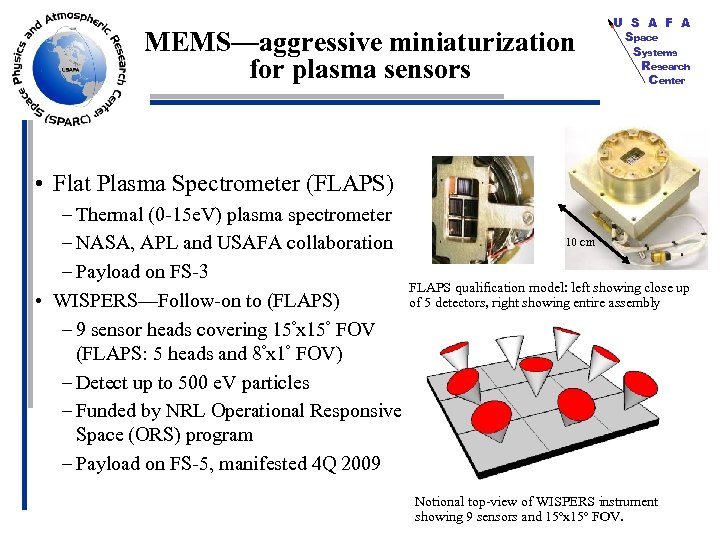 MEMS—aggressive miniaturization for plasma sensors U S A F A Space Systems Research Center • Flat Plasma Spectrometer (FLAPS) – Thermal (0 -15 e. V) plasma spectrometer – NASA, APL and USAFA collaboration – Payload on FS-3 • WISPERS—Follow-on to (FLAPS) – 9 sensor heads covering 15ºx 15º FOV (FLAPS: 5 heads and 8ºx 1º FOV) – Detect up to 500 e. V particles – Funded by NRL Operational Responsive Space (ORS) program – Payload on FS-5, manifested 4 Q 2009 10 cm FLAPS qualification model: left showing close up of 5 detectors, right showing entire assembly Notional top-view of WISPERS instrument showing 9 sensors and 15ºx 15º FOV.
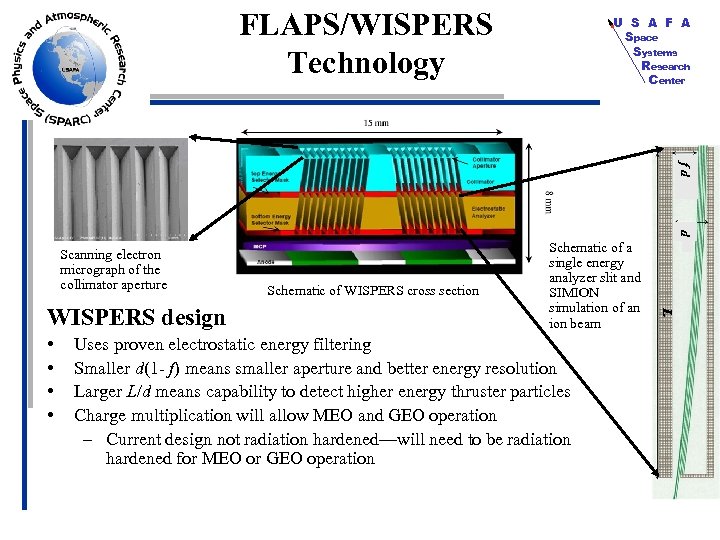 FLAPS/WISPERS Technology U S A F A Space Systems Research Center fd d Scanning electron micrograph of the collimator aperture • • Uses proven electrostatic energy filtering Smaller d(1 - f) means smaller aperture and better energy resolution Larger L/d means capability to detect higher energy thruster particles Charge multiplication will allow MEO and GEO operation – Current design not radiation hardened—will need to be radiation hardened for MEO or GEO operation L WISPERS design Schematic of WISPERS cross section Schematic of a single energy analyzer slit and SIMION simulation of an ion beam
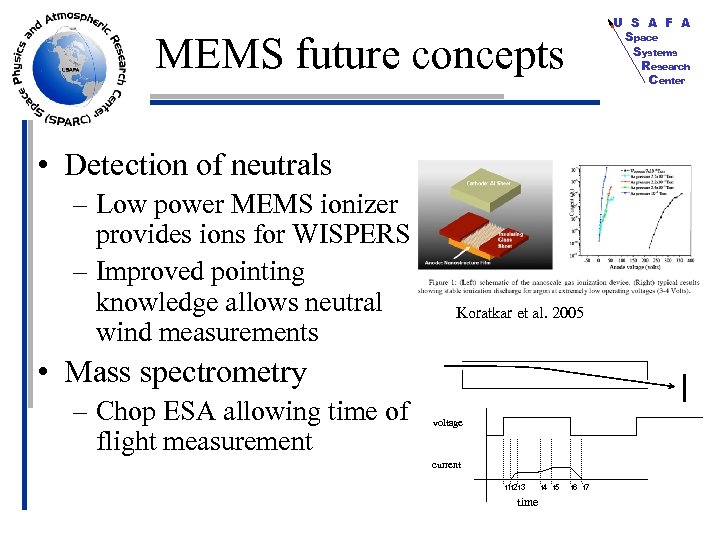 U S A F A Space Systems Research Center MEMS future concepts • Detection of neutrals – Low power MEMS ionizer provides ions for WISPERS – Improved pointing knowledge allows neutral wind measurements Koratkar et al. 2005 • Mass spectrometry – Chop ESA allowing time of flight measurement voltage current t 1 t 2 t 3 time t 4 t 5 t 6 t 7
 Lessons Learned U S A F A Space Systems Research Center • Power subsystems fail – FS-1 power failed— 80% of failures are EPS related – Schedule too aggressive— 1 year left out cadets • Rides to space are hard – FS-2 launch failure – FS-3 integration costs can exceed cost of secondary payload! • Software is “the driver” – FS-3 on-orbit hardware/software anomaly resolved after 3 week “nightmare” • Keep it simple—the details of “simple” will still bury you and your team – Use COTS if possible—low radiation tolerance
 Falcon. SAT Suggestions • • U S A F A Space Systems Research Center Get a team—never try in one department Make a course—credit students and faculty Get institutional buy in—this is not cheap! Team up with other small satellite programs – Multiple schools on one satellite require clear constraints – Hardware and software open development – AFRL designing “plug-and-play” satellite concept • Rides to space are biggest hurdle – Secondary payloads have to be flexible in orbit – Make cost of ride commensurate with cost of S/C
 Final thoughts U S A F A Space Systems Research Center • Real science can be done with small satellites • Even failures are educational successes! • Nothing excites students like actually being a part of a small satellite program • NSF can and should lead in small sats.