


 Скачать презентацию U 4 who we are Operational since
e123b78a71e8819566478ef49ba44fa4.ppt
- Количество слайдов: 12
 U 4 – who we are Operational since 2003 as a web-based resource centre funded by:
 Rationale • Existing ACA-literature shows little detail on UNCAC • Often focussing on specialised agencies • Need to identify institutional functions and mandates required in article 6 • and what this means for states
 General point for clarification Article 6 is intimately linked to article 5: Article 6, 1: “Each State Party shall, in accordance with the fundamental principles of its legal system, ensure the existence of a body or bodies, as appropriate, that prevent corruption by such means as: a) Implementing the policies referred to in article 5 of this Convention and, where appropriate, overseeing and coordinating the implementation of those policies; b) Increasing and disseminating knowledge about the prevention of corruption. ” Article 5, 1: “Each State Party shall, in accordance with the fundamental principles of its legal system, develop and implement or maintain effective, coordinated anti-corruption policies. . . ”
 Functions in Technical Guide • Requiring public sector institutions to produce action plans • Guiding/reviewing their implementation • Evaluating/inspecting institutions • Receiving/reviewing complaints • Receiving audit, investigative and parliamentary reports • Research in legislation and admin. procedure • Undertaking public opinion surveys and developing other sources of information
 Context of ac-policy making Ø But AC-policies can take place in different forms at different levels Ø and will have to include preventive functions of UNCAC chapter 2: – Public sector (Art. 7) – Codes of conduct for public officials (Art. 8) – Public procurement and management of public finances (Art. 9) – Public Reporting (Art. 10) – Measures relating to the judiciary and prosecution services (Art. 11) – Private Sector (Art. 12) – Participation of society (Art. 13) – Measures to prevent money laundering (Art. 14)
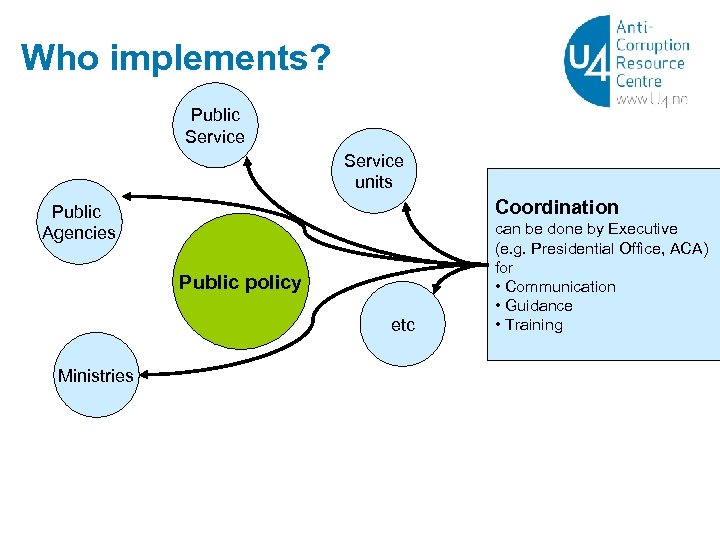 Who implements? Public Service units Coordination Public Agencies Public policy etc Ministries can be done by Executive (e. g. Presidential Office, ACA) for • Communication • Guidance • Training
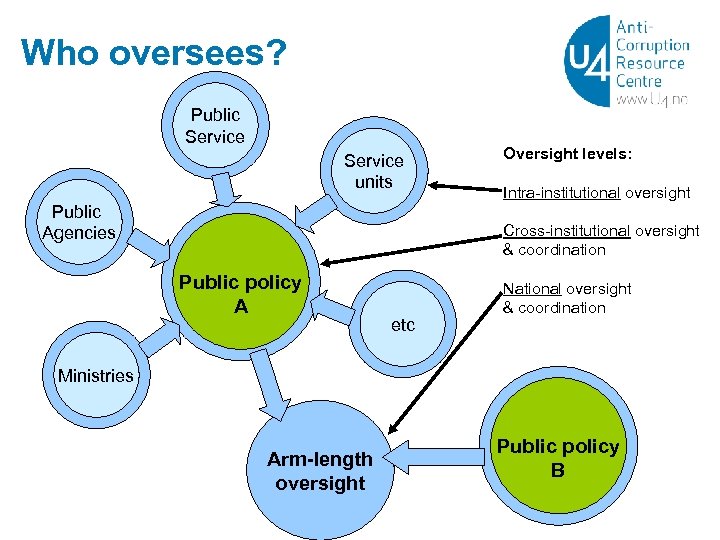 Who oversees? Public Service units Public Agencies Oversight levels: Intra-institutional oversight Cross-institutional oversight & coordination Public policy A etc National oversight & coordination Ministries Arm-length oversight Public policy B
 Knowledge management Different objectives to increase knowledge about corruption prevention: • knowledge required for policy making, implementation, oversight and monitoring • knowledge to be used in trainings and staff specialisation • knowledge to generate public support for anti-corruption reform This knowledge can be aimed at different audiences: • governmental policy and decision-makers • public officials for their day-to-day work • the general public. Knowledge can be increased through research, monitoring reports, and take many different forms: baseline studies, perception surveys, sector studies, political economy studies, stakeholder analysis, indicator mapping, report cards, etc. Ø Many actors potentially involved, depending on purpose
 Required independence UNCAC stipulates that • body or bodies are to be granted necessary independence • and the necessary material resources and specialized staff Ø to enable them to carry out its or their functions effectively and free from any undue influence
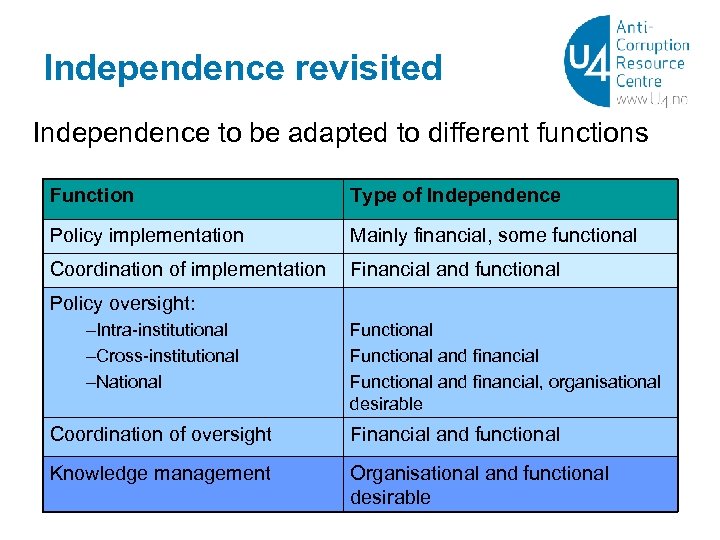 Independence revisited Independence to be adapted to different functions Function Type of Independence Policy implementation Mainly financial, some functional Coordination of implementation Financial and functional Policy oversight: –Intra-institutional –Cross-institutional –National Functional and financial, organisational desirable Coordination of oversight Financial and functional Knowledge management Organisational and functional desirable
 Consequences for institutional arrangements • Need to broaden anti-corruption understanding • Institutional arrangements need to fit national context • Where ACA present, it should not be overburdened • ACA should take over functions as to their comparative advantage • Different institutions will have to be involved in the different functions • Full independence hardly ever needed for preventive functions described in article 5 and 6
 Thank you! Hannes Hechler U 4 Anti-Corruption Resource Centre hannes. hechler@cmi. no www. u 4. no