


 Скачать презентацию U-057 Tanıl Kocagöz 1 Sema Tiryaki 2 Thomas
52db8586fee71c21823d9986f67bfed6.ppt
- Количество слайдов: 1
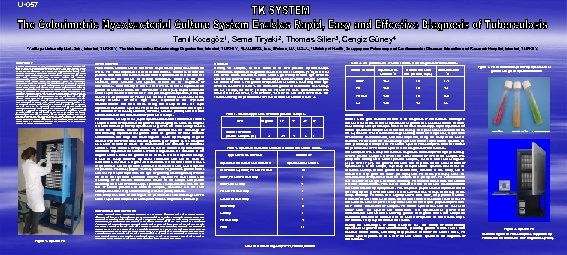 U-057 Tanıl Kocagöz 1, Sema Tiryaki 2, Thomas Silier 3, Cengiz Güney 4 1 Yeditepe University Med. Sch. , Istanbul, TURKEY, 2 Turkish Innovative Biotechnology Organization, Istanbul, TURKEY, 3 SALUBRIS, Inc. , Woburn, MA, U. S. A. , 4 Ministry of Health, Sureyyapasa Pulmonary and Cardiovascular Diseases Education and Research Hospital, Istanbul, TURKEY. ABSTRACT Isolation of mycobacteria from clinical samples is the most sensitive and definite way of tuberculosis diagnosis. When classical mycobacterial culture media like Löwenstein Jensen (LJ) are used, it is required 3 to 6 weeks for the detection of growth. All previously developed rapid mycobacterial culture systems use selective Middlebrook broth and suffer from not being ready-to-use, since this medium requires the addition of oleic acid, albumin, dextrose, catalase (OADC) and selective antimicrobials, before inoculation. They also can not differentiate mycobacterial growth from contamination prior to microscopic examination since it is not possible to understand what causes turbidity when there is growth in a liquid medium. We have previously developed TK (Salubris, Inc. ), a ready-to-use rapid culture medium which indicates Salubris, mycobacterial growth by changing its original red color to yellow and growth of contaminating organisms by a color change to green. We have tested the efficiency of TK and its selective type TK SLC, which contains selective antimicrobials, in the isolation of mycobacteria from clinical samples and compared it to Löwenstein Jensen and BACTEC MGIT 960 (Becton Dickinson). After decontamination and concentration of 261 samples by Na. OH-NALC method using Mycoprosafe (Salubris, Inc. ) we Na. OH-NALC Salubris, have inoculated them to LJ, MGIT, TK and TK SLC. While the growth in LJ was followed visually, MGIT tubes were followed in MGIT 960 instrument, TK and TK SLC in automated incubator reader MYCOLOR TK. Mycobacterial growth was detected in 71 samples (27%) in at least one of the media inoculated. Contamination was observed in 1. 53% of LJ, 1. 15% of MGIT, 2. 68% of TK and 0. 77% of TK SLC. The median for growth detection time was 23 days for LJ, 10 days for MGIT, 14 days for TK and TK SLC. Having the advantages of being ready to use, the ability of differentiating mycobacterial growth from contamination and providing growth results in average 40% earlier than LJ medium, TK culture system proves to be a new effective culture system especially for laboratories processing large number of samples. INTRODUCTION Tuberculosis continues to be one of the major health problems around the world. The most important element in tuberculosis control is to find out patients who have tuberculosis bacilli in their sputum and treat them before they transmit the disease to healthy individuals. Culture is the gold standard, most sensitive and specific method for the diagnosis of tuberculosis. Unfortunately it takes 3 to 6 weeks to detect mycobacterial growth in classical media like Löwenstein Jensen (LJ). Rapid automated culture systems like BACTEC MGIT 960 (BD Diagnostic Systems, USA) and Bac. T/Alert 3 D (Biomerieux, France) are not used widely as classical media, mainly because of their high cost, requirement for expensive instrumentation and their media being not ready to use. All rapid mycobacterial culture systems except TK use Middlebrook broth that require the addition of oleic acid, albumin, dextrose, catalase (OADC) and selective antimicrobials before inoculation of processed sample. TK Medium is a ready to use, rapid mycobacterial culture medium. It enables early detection of mycobacterial growth by changing its color. Its original red color turns to yellow by mycobacterial growth. The color change occurs before the colonies become visible. TK Medium has the advantage of differentiating mycobacterial growth from the growth of most common contaminants like fungi and Gram negative bacilli by changing to green instead of yellow when these microorganisms grow (Figure 1). It is designed as a solid medium to enable the visualization and isolation of individual colonies. Pure cultures of mycobacteria can be obtained by subculturing individual mycobacterial colonies if mixed organisms are obtained in the original culture. Since the growth in TK Media is detected by color change, it can be easily followed by visual evaluation and can be used in laboratories that have a regular 37°C incubator. On the other hand it has a very eloborate and inexpensive automated incubator reader, called Mycolor TK (Salubris Technica) (Figure 2 and 3). Mycolor TK, provides growth curves and its expert system predicts the type of growing microorganism, without the need for expensive additional software. Mycolor TK also enables the recording of all detailed information related to the sample and patient including the result of microscopy. It provides easily statistical data like the rate of culture positives in different samples, resistance rate for each antimycobacterial drug and multi-drug resistant (MDR) isolates. This study was done to investigate the performance and advantages of TK culture system in daily use in a busy tuberculosis diagnostic laboratory. RESULTS Among 261 samples, 40 were found to be AFB positive by microscopic examination. Mycobacterial growth was detected in 71 samples (27%), in at least one of the media inoculated. Some isolates grew only in some type of media and did not grow in others. The microscopy results of culture positive samples are shown in table 1. The growth of mycobacterial isolates according to the type of media is shown in table 2. The median for growth detection time was 23 days for LJ, 10 days for MGIT, 14 days for TK and TK SLC. Contamination was observed in 1. 5% of LJ, 1. 2% of MGIT, 2. 7% of TK and 0. 8% of TK SLC. The results showing the performance of each medium are shown in table 3. MATERIALS AND METHODS Figure 2. Mycolor TK Culture Medium Mycobacteria isolation % Growth detection time (median, days) Contamination % Table 1. Microscopy results of culture positive samples. AFB Negative Number of culture positive samples (71) 31 1+ 2+ 3+ 4+ 32 2 5 1 Table 2. Mycobacterial isolates obtained in different culture media. Types of Media in which Number of mycobacterial isolates are obtained mycobacterial isolates Growth on LJ, MGIT, TK and TK SLC 59 MGIT, TK and TK SLC only 1 MGIT and LJ only 2 TK and TK SLC only 1 LJ and TK SLC only 1 4 LJ only 1 TK SLC only Total 2 71 ASM General Meeting. May 21 -24, Toronto, Canada MGIT 25. 3 10 TK 23. 0 14 TK SLC 23. 8 14 23. 8 23 Figure 1. TK Medium turns yellow by mycobacterial growth and green by contamination 0. 8 LJ MGIT only Samples submitted to the microbiology laboratory of Süreyyapaşa Pulmonary and Cardiovascular Diseases Education and Research Hospital, İstanbul, Turkey were included in the study. A total of 261 sputum samples were processed by Na. OH-NALC decontamination and concentration method, using the ready to use kit Mycoprosafe (Salubris Inc. , USA). MGIT tubes were prepared by the addition of OADC and PANTA as suggested by the producer. From processed samples 0. 5 ml was inoculated to MGIT and LJ tubes and 0. 2 ml to TK Medium and TK SLC. MGIT tubes were incubated in BACTEC MGIT 960 instrument. TK Media were followed by automated incubator reader Mycolor TK. LJ tubes were incubated in a regular 37°C incubator. LJ tubes were checked three times a week for mycobacterial colonies. As soon as colonies were visible, this was recorded as growth detection time for LJ. The growth detection time for MGIT and TK Media were recorded as indicated by the automated instruments. Smears were prepared from any type of media that indicated growth, stained by Ziehl Neelsen method and checked by microscopy for the presence of acid fast bacilli (AFB) and other contaminating organisms. Table 3. The performance of culture media in the diagnosis of tuberculosis. 1. 2 1. 5 2. 7 DISCUSSION Culture is the gold standard method in the diagnosis of tuberculosis. Although it takes several weeks to detect mycobacterial growth in a classical culture medium, its sensitivity and specificity is much better than microscopy. Rapid mycobacterial culture systems developed so far did not manage to replace classical culture media like LJ, because of several disadvantages among which their high cost, requirement of additional instrumentation, and most important, being not ready to use can be included. To overcome the disadvantages present in other rapid culture systems, we have previously developed the TK culture system. This study was done to evaluate the performance of TK culture system in the diagnosis of tuberculosis. Our study site was a busy tuberculosis diagnostic laboratory with high percentage of AFB positive samples. However the concentration of AFB in the samples was pretty low. Among all 71 culture positive samples, 63 were either smear negative (31) or AFB 1+ (32). The growth detection time depends on the concentration of mycobacteria in the sample, especially in rapid culture systems that detect the metabolic activity. Median growth detection time, obtained in this study, can be considered very good for MGIT (10 days) and TK Media (14 days) since the concentration of mycobacteria in the samples were pretty low. The contamination rate was low in all types of media including TK Medium which does not contain selective antimicrobials. This can be considered due to effective decontamination and concentration by Mycoprosafe. This may have played also an important role in speeding up the growth detection even in LJ which was 23 days in average in this study. Although TK Media were slightly slower than MGIT, they provided culture results 40% earlier than LJ medium. On the other hand it was much easier to use TK and LJ media since they were ready to use and did not require preparatory work like MGIT before inoculation of samples. TK culture system was also the easiest to follow since the system can differentiate real mycobacterial growth from contamination and all tubes showing growth or negative tubes that completed incubation duration are indicated on the screen of Mycolor TK and it takes only a few minutes every day to evaluate the results. Having the advantages of being ready to use, the ability of differentiating mycobacterial growth from contamination, providing growth results earlier than classical culture media, and being very practical to follow the culture tubes, TK culture system proves to be a new effective culture system in the diagnosis of tuberculosis. TK MEDİUM MYCOBACTERIA CONTAMINATION Figure 3. Mycolor TK Acknowledgement: This study was supported by Foundation for Innovative New Diagnostics (FIND).