


 Скачать презентацию TYUMEN STATE UNIVERSITY INSTITUTE OF PHILOLOGY AND JOURNALISM
Word meaning.pptx
- Количество слайдов: 22
 TYUMEN STATE UNIVERSITY INSTITUTE OF PHILOLOGY AND JOURNALISM WORD MEANING Polina Sokolova, student of group 27 L 1212, III year
 Semantics 1. the study of linguistic development by classifying and examining changes in meaning and form [Webster’s Unabriged Dictionary]. 2. the branch of linguistics which specialises in the study of meaning [Antrushina, 130]. Semasiology 1. the branch of linguistics that is concerned with the meaning of words and word equivalents [Arnold, 31]. 2. the branch of lexicology that is devoted to the study of meaning [Ginzburg, 13].
 Word meaning 1. a certain reflection in our mind of objects, phenomena or relations that makes part of a linguistic sign. 2. relationship between symbols (words, signs) and what they refer to (called ‘referents’) [Babich, 58]. 3. establishment of the interindependence between words and the things or concepts they denote [Ginzburg, 13]. 4. the relation between the object or notion named and the name itself [F. de Saussure].
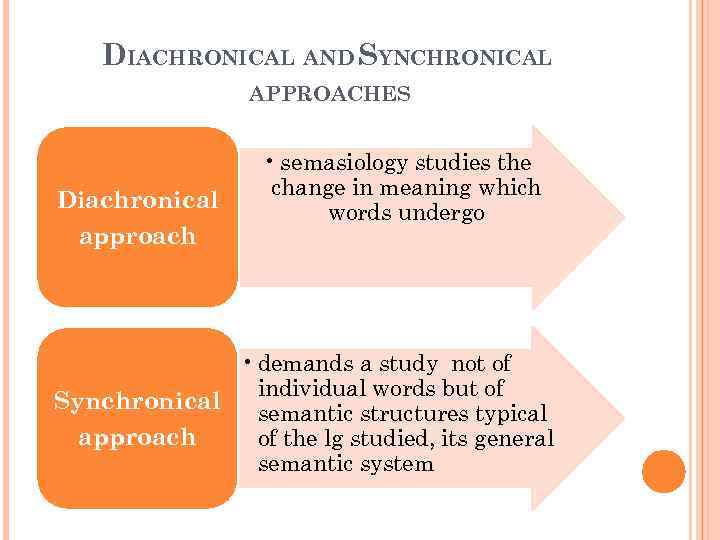 DIACHRONICAL AND SYNCHRONICAL APPROACHES Diachronical approach • semasiology studies the change in meaning which words undergo • demands a study not of individual words but of Synchronical semantic structures typical approach of the lg studied, its general semantic system
 REFERENTIAL AND FUNCTIONAL APPROACHES Referential / Structural / Denotational approach seeks to formulate the essence of meaning by establishing the interindependence between words and things pr concepts they denote; Functional / Relative approach studies functions of a word in speech and is less concerned with what meaning is than and how it works [Ginzburg, 13].
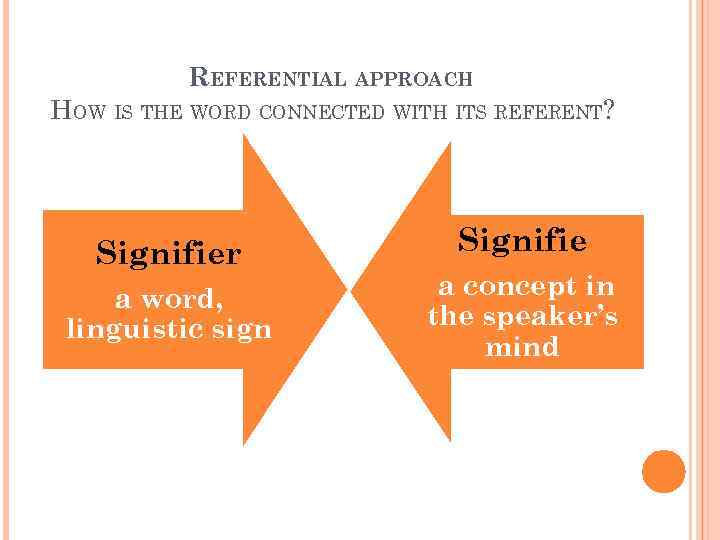 REFERENTIAL APPROACH HOW IS THE WORD CONNECTED WITH ITS REFERENT? Signifier a word, linguistic sign Signifie a concept in the speaker’s mind
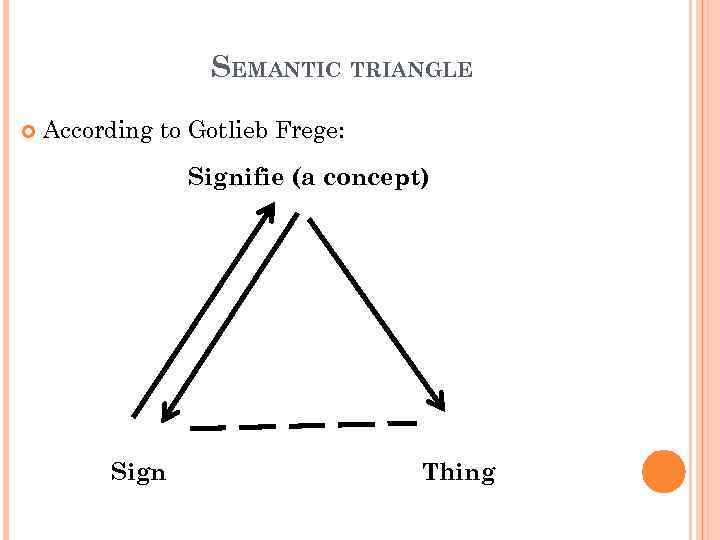 SEMANTIC TRIANGLE According to Gotlieb Frege: Signifie (a concept) Sign Thing
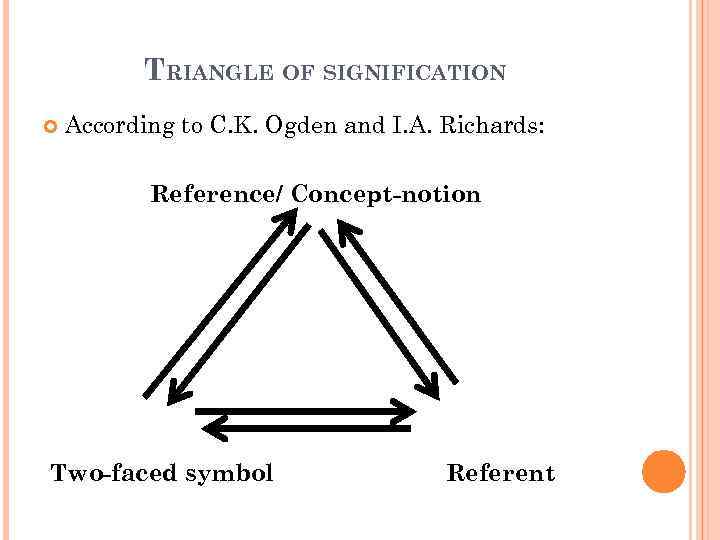 TRIANGLE OF SIGNIFICATION According to C. K. Ogden and I. A. Richards: Reference/ Concept-notion Two-faced symbol Referent
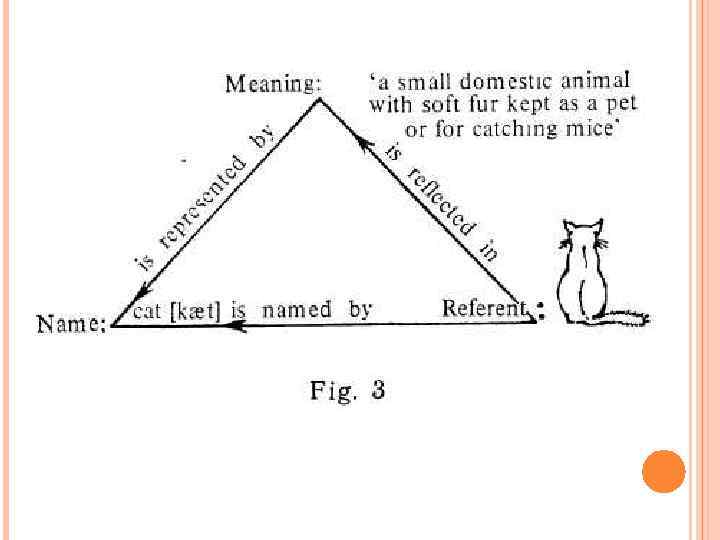
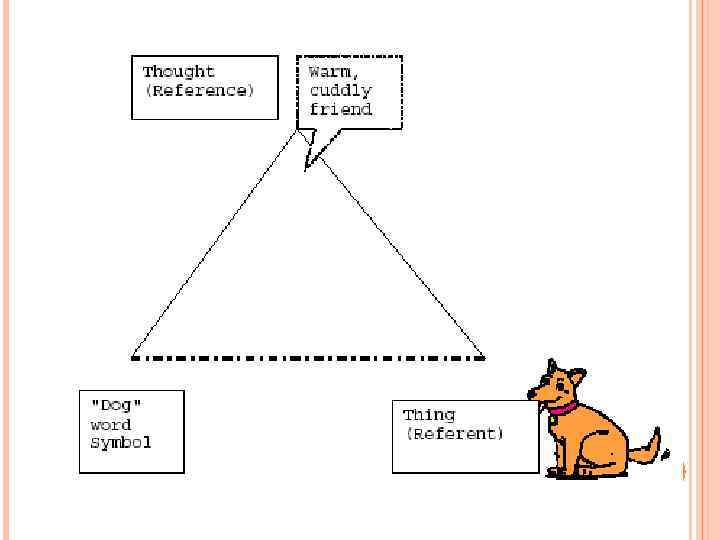
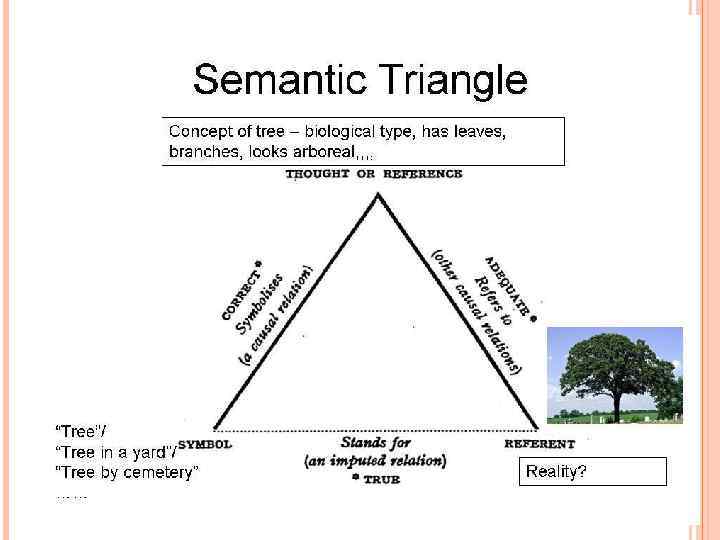
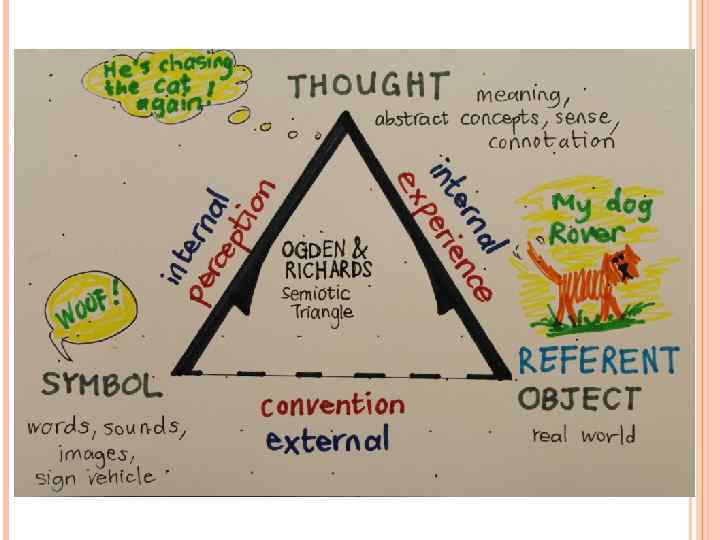
 FUNCTIONAL APPROACH In the functional approach 1. semantic investigation is confined to the analysis of the difference or sameness of meaning; 2. meaning is understood essentially as the function of the use of linguistic units [Ginzburg, 17]. 3. each sigh achieves a meaning only in comparison with other signs, its neighbours, meaning can be studied only through context [Babich, 58].
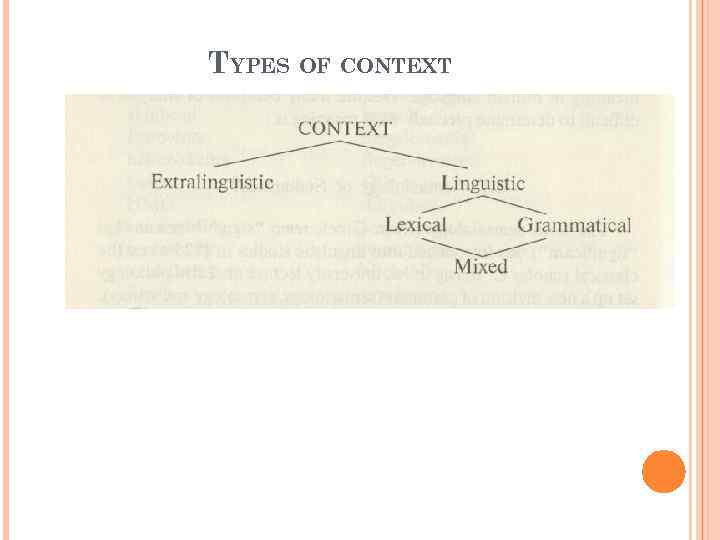 TYPES OF CONTEXT
 Context – the minimal stretch of speech determining each individual meaning of word; Lexical context – the groups of lexical items combined with the polysemantic word under consideration are of main importance; Grammatical context - the grammatical (mainly the syntactic) structure of the context that serves to determine various individual meanings of a polysemantic word; Extralinguistic context - the meaning of the word is ultimately determined not by these linguistic factors, but by the actual speech situation in which this word is used [Ginzburg, 47].
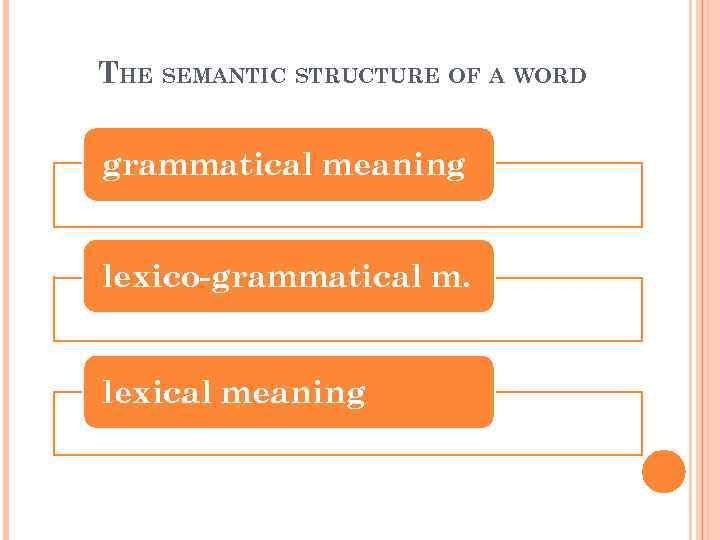 THE SEMANTIC STRUCTURE OF A WORD grammatical meaning lexico-grammatical m. lexical meaning
 Grammatical meaning – an expression in speech of relations between words based on contrastive features of arrangements in which they occur (speaks, reads, writes); Lexico-grammatical meaning – the common denominator of all the meanings of words belonging to a lexico-grammatical class of words, the feature according to which they are grouped together (generic terms); Lexical meaning – the realization of concept or emotion by means of a definite language system (concept of relation) [Arnold, 39 -41].
 DENOTATIONAL AND CONNOTATIONAL COMPONENTS OF LEXICAL MEANING Denotational meaning – that component of the lexical meaning which makes communication possible [Ginzburg, 20]. It expresses the conceptual content of a word [Arnold, 40]. - significative (if the referent/denotatum is a concept) - demonstrative (if it is an individual object) – are often met in colloquial speech.
 Connotational meaning - the emotive charge and the stylistic value of the word [Ginzburg, 20]; complex associations originating in habitual verbal or situational contexts, of which the speaker and the listener are aware [Arnold, 40]. Connotation can be referred to the speaker’s attitude to the social circumstances and the appropriate functional style, his approval or disapproval of the object spoken of, about the speaker’s emotions. - stylistic; - emotive; - evaluative; - expressive/intensifying [Babich, 60].
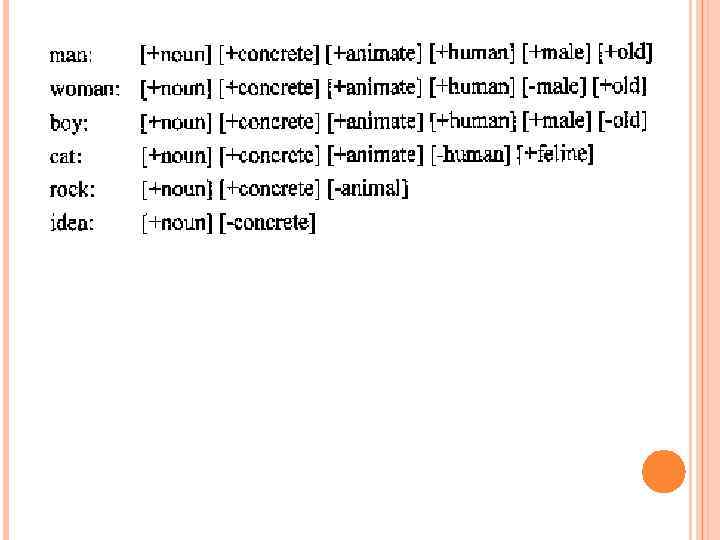
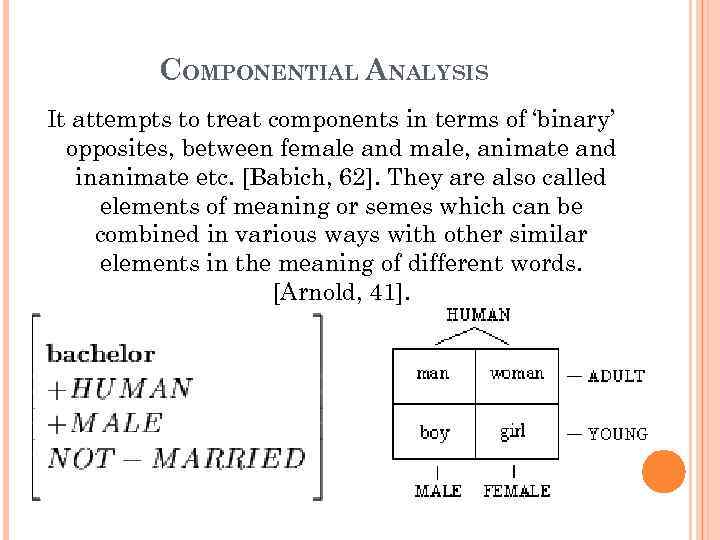 COMPONENTIAL ANALYSIS It attempts to treat components in terms of ‘binary’ opposites, between female and male, animate and inanimate etc. [Babich, 62]. They are also called elements of meaning or semes which can be combined in various ways with other similar elements in the meaning of different words. [Arnold, 41].
 LITERATURE: Г. Б. Антрушина, О. В. Афанасьева, Н. Н. Морозова. English Lexicology. M. 2000. I. V. Arnold. The English Word. M. , 1986. G. N. Babich. Lexicology: A Current Guide. E. – M. , 2005. E. M. Mednicova. Seminars in English Lexicology. M. , 1978 R. S. Ginsburg, S. S. Khidekel, etc. A Course in Modern English Lexicology, M. , 1979. Seminars, Lectures and Complements Support on Lexicology. Part I-II (Учебно-методическое пособие: В. Д. Табанакова, Л. Г. Федюченко, Е. Г. Сеченова), 2006. – 125 с.