


 Скачать презентацию Typology of the Negation in Welsh ICCS 2003
e8a0b39eaba07e4c59dd35296f845bbf.ppt
- Количество слайдов: 22
 Typology of the Negation in Welsh ICCS 2003 Dydd Iau 28 ydd Awst 2003 Johannes Heinecke Lannion, Brittanny, France johannes(dot)heinecke(at)wanadoo(dot)fr
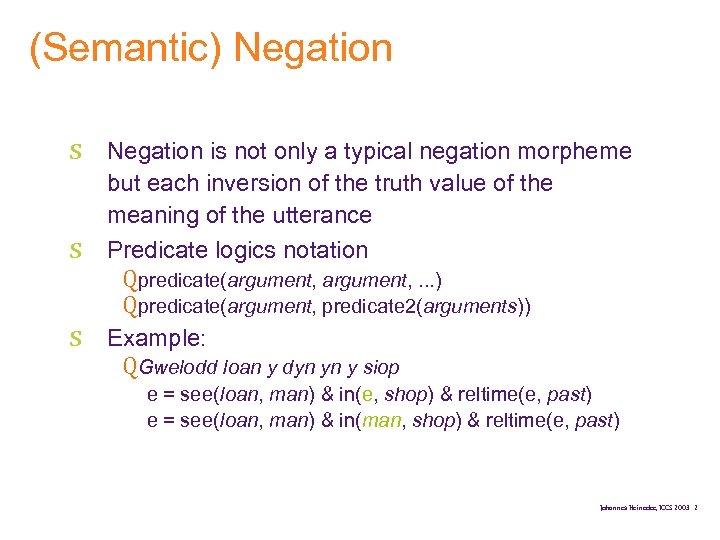 (Semantic) Negation s s s Negation is not only a typical negation morpheme but each inversion of the truth value of the meaning of the utterance Predicate logics notation Qpredicate(argument, . . . ) Qpredicate(argument, predicate 2(arguments)) Example: QGwelodd Ioan y dyn yn y siop e = see(Ioan, man) & in(e, shop) & reltime(e, past) e = see(Ioan, man) & in(man, shop) & reltime(e, past) Johannes Heinecke, ICCS 2003 2
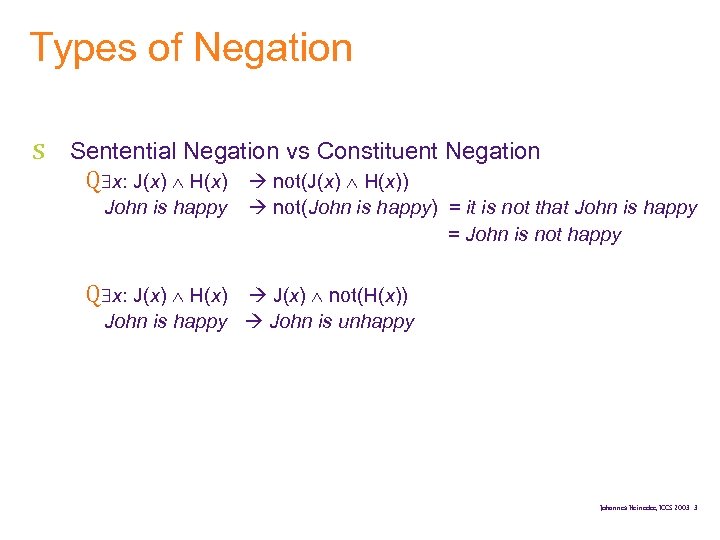 Types of Negation s Sentential Negation vs Constituent Negation Q$x: J(x) H(x) not(J(x) H(x)) John is happy not(John is happy) = it is not that John is happy = John is not happy Q$x: J(x) H(x) J(x) not(H(x)) John is happy John is unhappy Johannes Heinecke, ICCS 2003 3
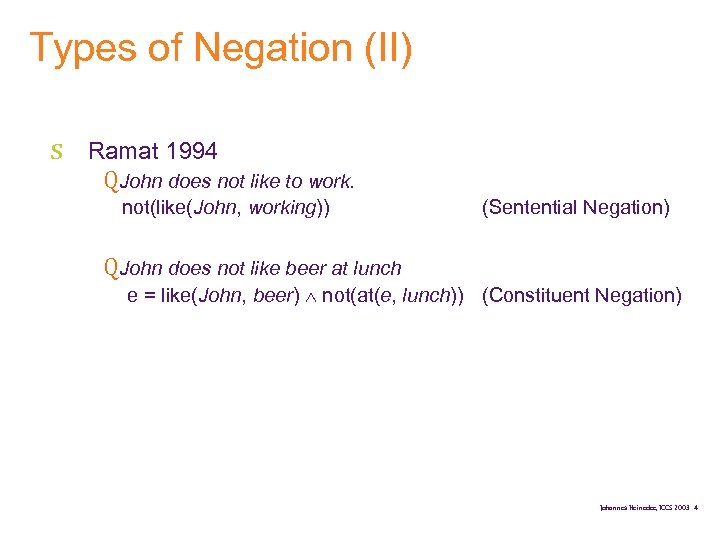 Types of Negation (II) s Ramat 1994 QJohn does not like to work. not(like(John, working)) (Sentential Negation) QJohn does not like beer at lunch e = like(John, beer) not(at(e, lunch)) (Constituent Negation) Johannes Heinecke, ICCS 2003 4
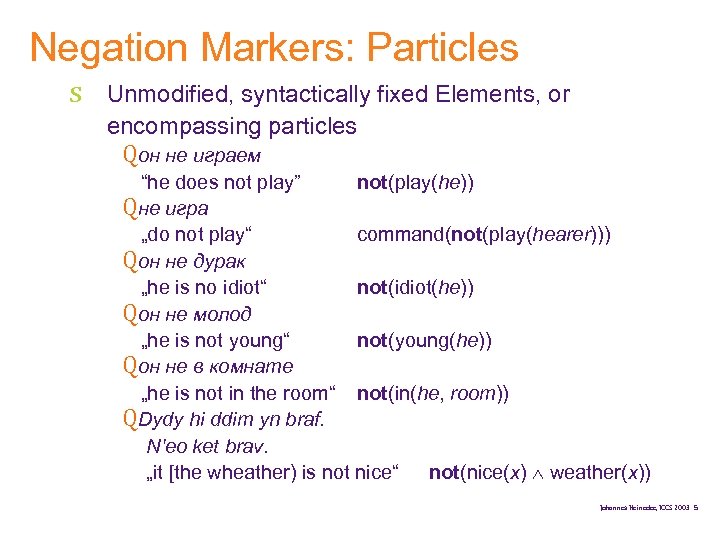 Negation Markers: Particles s Unmodified, syntactically fixed Elements, or encompassing particles Qон не играем “he does not play” not(play(he)) Qне игра „do not play“ command(not(play(hearer))) Qон не дурак „he is no idiot“ not(idiot(he)) Qон не молод „he is not young“ not(young(he)) Qон не в комнате „he is not in the room“ not(in(he, room)) QDydy hi ddim yn braf. N'eo ket brav. „it [the wheather) is not nice“ not(nice(x) weather(x)) Johannes Heinecke, ICCS 2003 5
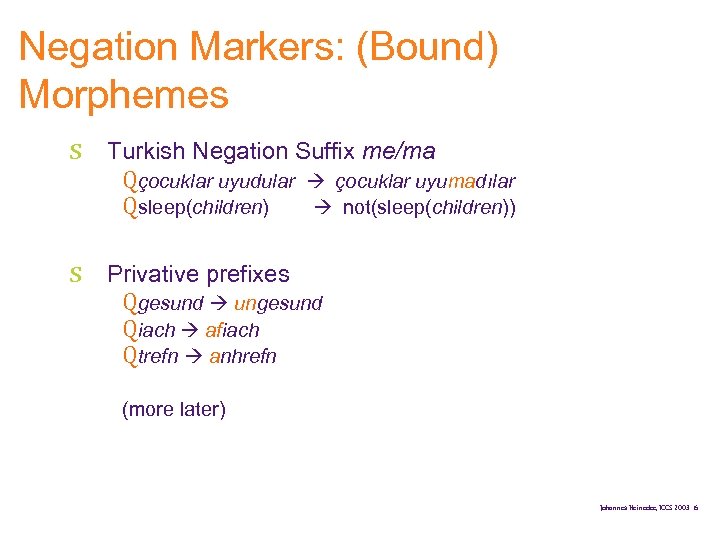 Negation Markers: (Bound) Morphemes s Turkish Negation Suffix me/ma Qçocuklar uyudular çocuklar uyumadılar Qsleep(children) not(sleep(children)) s Privative prefixes Qgesund ungesund Qiach afiach Qtrefn anhrefn (more later) Johannes Heinecke, ICCS 2003 6
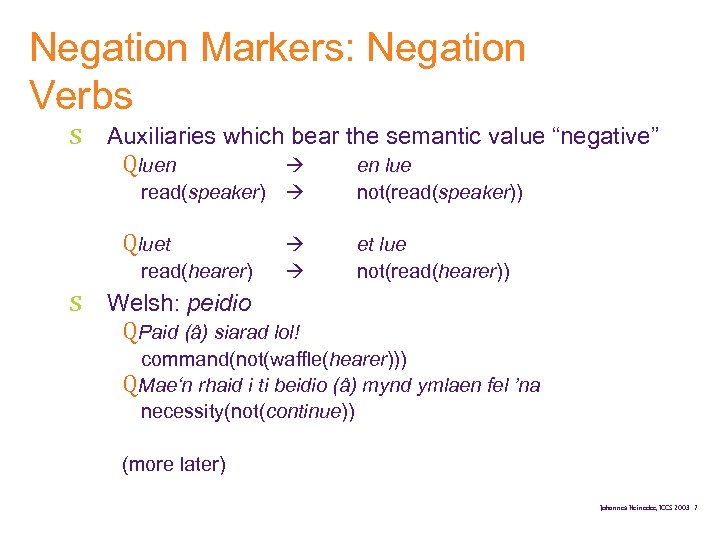 Negation Markers: Negation Verbs s Auxiliaries which bear the semantic value “negative” Qluen en lue read(speaker) Qluet s read(hearer) not(read(speaker)) et lue not(read(hearer)) Welsh: peidio QPaid (â) siarad lol! command(not(waffle(hearer))) QMae‘n rhaid i ti beidio (â) mynd ymlaen fel ’na necessity(not(continue)) (more later) Johannes Heinecke, ICCS 2003 7
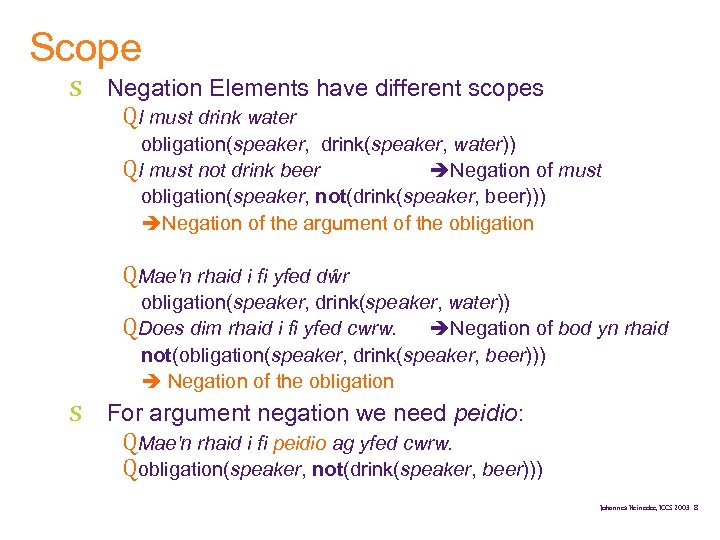 Scope s Negation Elements have different scopes QI must drink water obligation(speaker, drink(speaker, water)) QI must not drink beer Negation of must obligation(speaker, not(drink(speaker, beer))) Negation of the argument of the obligation QMae'n rhaid i fi yfed dŵr s obligation(speaker, drink(speaker, water)) QDoes dim rhaid i fi yfed cwrw. Negation of bod yn rhaid not(obligation(speaker, drink(speaker, beer))) Negation of the obligation For argument negation we need peidio: QMae'n rhaid i fi peidio ag yfed cwrw. Qobligation(speaker, not(drink(speaker, beer))) Johannes Heinecke, ICCS 2003 8
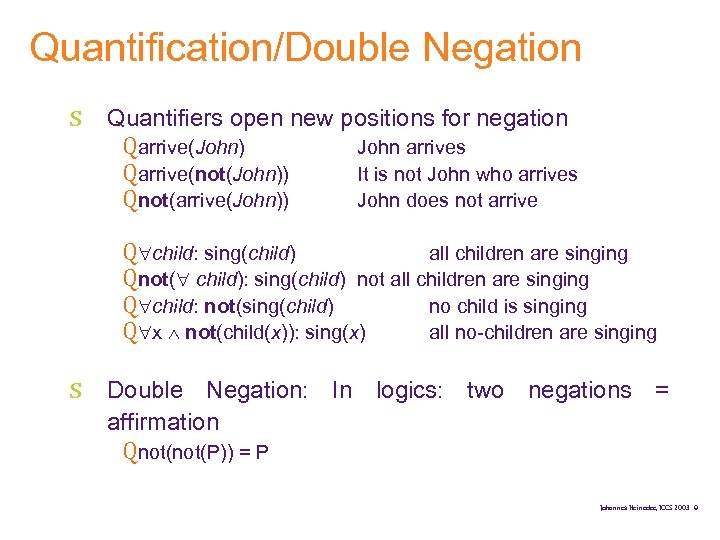 Quantification/Double Negation s Quantifiers open new positions for negation Qarrive(John) John arrives Qarrive(not(John)) It is not John who arrives Qnot(arrive(John)) John does not arrive Q child: sing(child) all children are singing Qnot( child): sing(child) not all children are singing Q child: not(sing(child) no child is singing Q x not(child(x)): sing(x) all no-children are singing s Double Negation: In logics: two negations = affirmation Qnot(P)) = P Johannes Heinecke, ICCS 2003 9
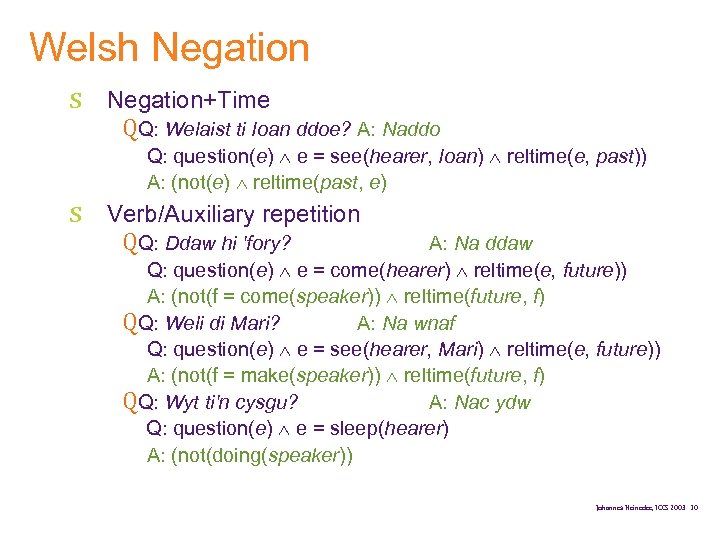 Welsh Negation s s Negation+Time QQ: Welaist ti Ioan ddoe? A: Naddo Q: question(e) e = see(hearer, Ioan) reltime(e, past)) A: (not(e) reltime(past, e) Verb/Auxiliary repetition QQ: Ddaw hi 'fory? A: Na ddaw Q: question(e) e = come(hearer) reltime(e, future)) A: (not(f = come(speaker)) reltime(future, f) QQ: Weli di Mari? A: Na wnaf Q: question(e) e = see(hearer, Mari) reltime(e, future)) A: (not(f = make(speaker)) reltime(future, f) QQ: Wyt ti'n cysgu? A: Nac ydw Q: question(e) e = sleep(hearer) A: (not(doing(speaker)) Johannes Heinecke, ICCS 2003 10
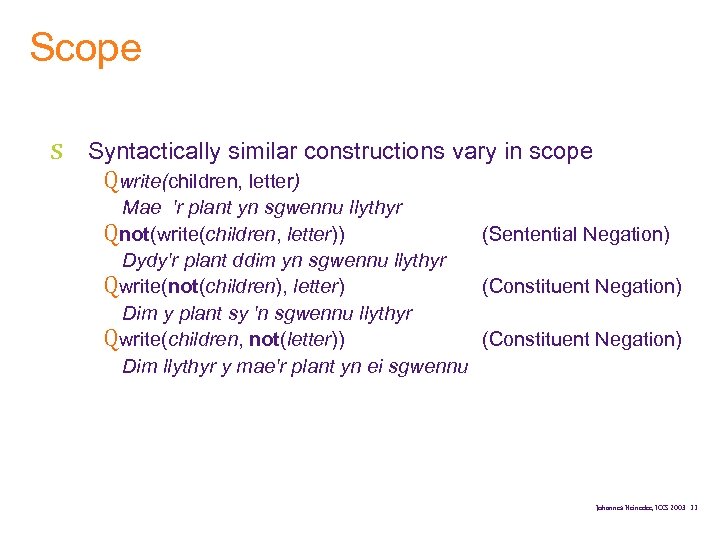 Scope s Syntactically similar constructions vary in scope Qwrite(children, letter) Mae 'r plant yn sgwennu llythyr Qnot(write(children, letter)) (Sentential Negation) Dydy'r plant ddim yn sgwennu llythyr Qwrite(not(children), letter) (Constituent Negation) Dim y plant sy 'n sgwennu llythyr Qwrite(children, not(letter)) (Constituent Negation) Dim llythyr y mae'r plant yn ei sgwennu Johannes Heinecke, ICCS 2003 11
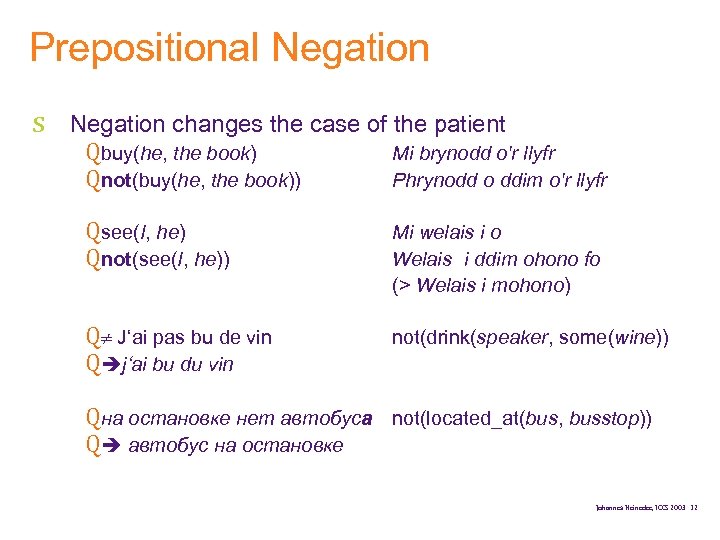 Prepositional Negation s Negation changes the case of the patient Qbuy(he, the book) Mi brynodd o'r llyfr Qnot(buy(he, the book)) Phrynodd o ddim o'r llyfr Qsee(I, he) Qnot(see(I, he)) Mi welais i o Welais i ddim ohono fo (> Welais i mohono) Q J‘ai pas bu de vin Q j‘ai bu du vin not(drink(speaker, some(wine)) Qна остановке нет автобуса not(located_at(bus, busstop)) Q автобус на остановке Johannes Heinecke, ICCS 2003 12
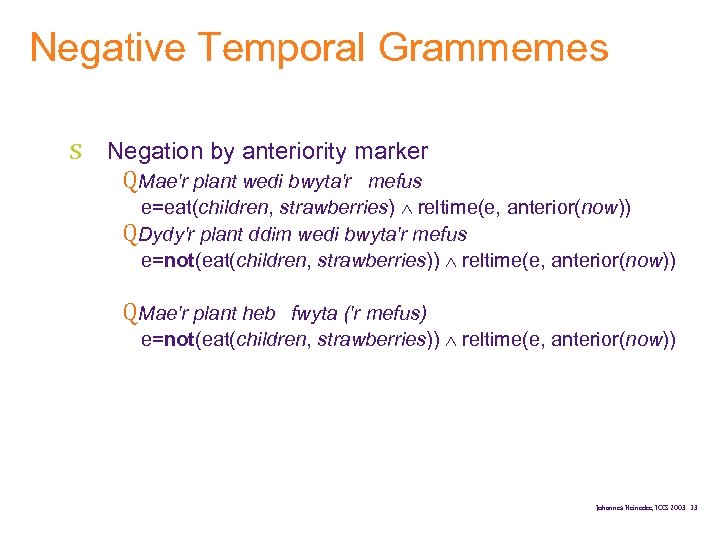 Negative Temporal Grammemes s Negation by anteriority marker QMae'r plant wedi bwyta'r mefus e=eat(children, strawberries) reltime(e, anterior(now)) QDydy'r plant ddim wedi bwyta'r mefus e=not(eat(children, strawberries)) reltime(e, anterior(now)) QMae'r plant heb fwyta ('r mefus) e=not(eat(children, strawberries)) reltime(e, anterior(now)) Johannes Heinecke, ICCS 2003 13
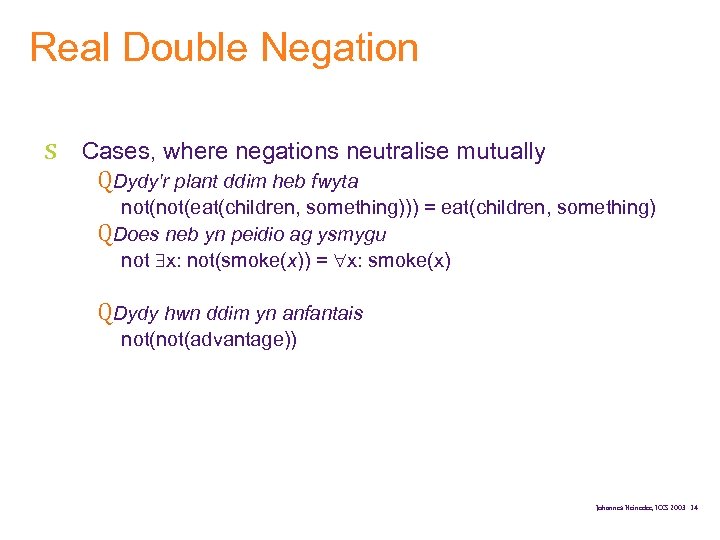 Real Double Negation s Cases, where negations neutralise mutually QDydy'r plant ddim heb fwyta not(eat(children, something))) = eat(children, something) QDoes neb yn peidio ag ysmygu not $x: not(smoke(x)) = x: smoke(x) QDydy hwn ddim yn anfantais not(advantage)) Johannes Heinecke, ICCS 2003 14
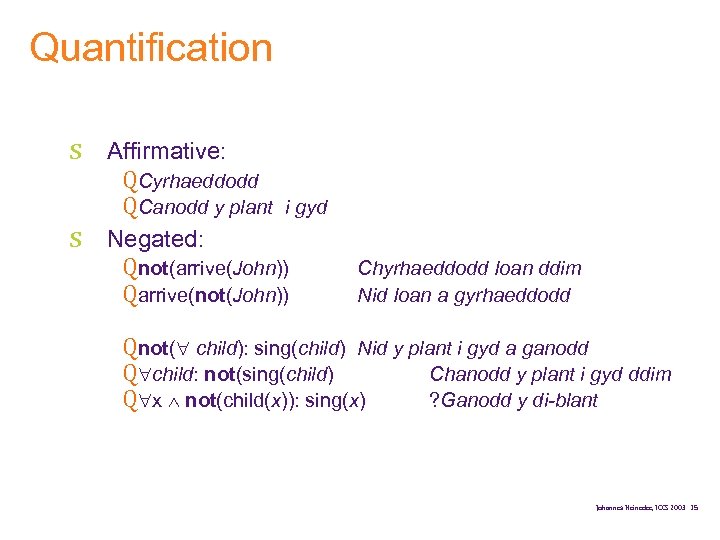 Quantification s s Affirmative: QCyrhaeddodd QCanodd y plant i gyd Negated: Qnot(arrive(John)) Qarrive(not(John)) Chyrhaeddodd Ioan ddim Nid Ioan a gyrhaeddodd Qnot( child): sing(child) Nid y plant i gyd a ganodd Q child: not(sing(child) Chanodd y plant i gyd ddim Q x not(child(x)): sing(x) ? Ganodd y di-blant Johannes Heinecke, ICCS 2003 15
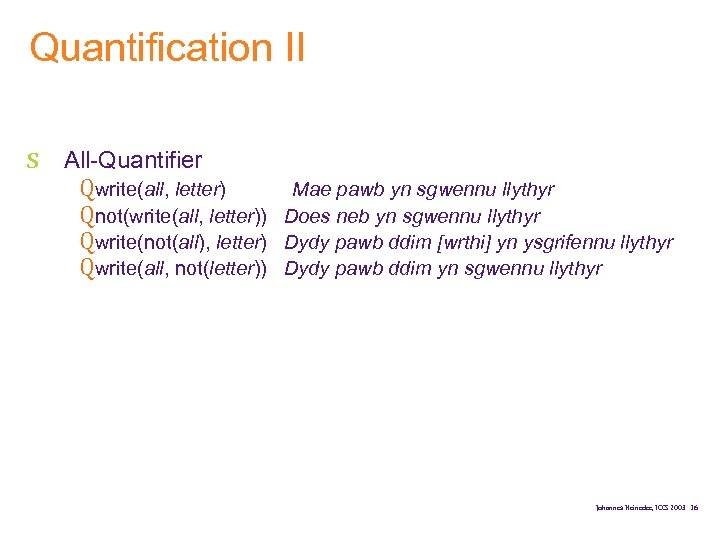 Quantification II s All-Quantifier Qwrite(all, letter) Mae pawb yn sgwennu llythyr Qnot(write(all, letter)) Does neb yn sgwennu llythyr Qwrite(not(all), letter) Dydy pawb ddim [wrthi] yn ysgrifennu llythyr Qwrite(all, not(letter)) Dydy pawb ddim yn sgwennu llythyr Johannes Heinecke, ICCS 2003 16
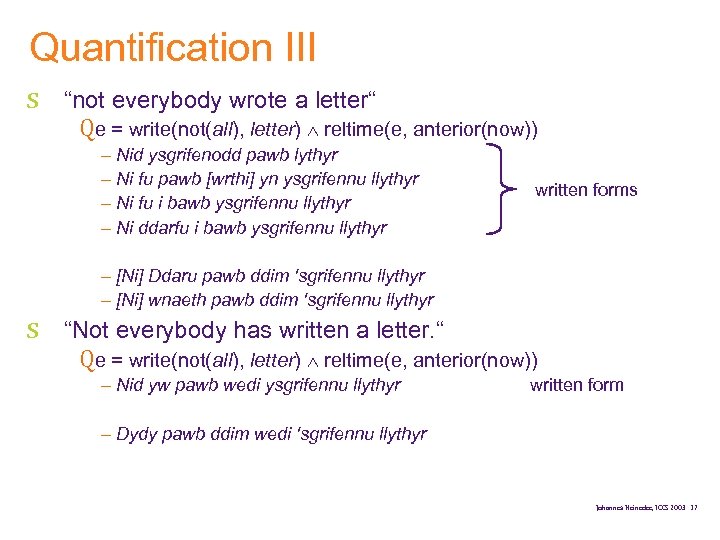 Quantification III s “not everybody wrote a letter“ Qe = write(not(all), letter) reltime(e, anterior(now)) – Nid ysgrifenodd pawb lythyr – Ni fu pawb [wrthi] yn ysgrifennu llythyr – Ni fu i bawb ysgrifennu llythyr – Ni ddarfu i bawb ysgrifennu llythyr s written forms – [Ni] Ddaru pawb ddim 'sgrifennu llythyr – [Ni] wnaeth pawb ddim 'sgrifennu llythyr “Not everybody has written a letter. “ Qe = write(not(all), letter) reltime(e, anterior(now)) – Nid yw pawb wedi ysgrifennu llythyr written form – Dydy pawb ddim wedi 'sgrifennu llythyr Johannes Heinecke, ICCS 2003 17
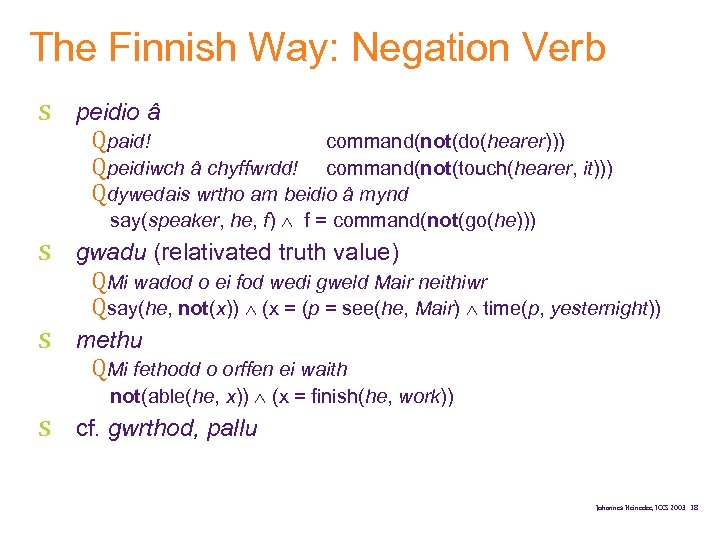 The Finnish Way: Negation Verb s s peidio â Qpaid! command(not(do(hearer))) Qpeidiwch â chyffwrdd! command(not(touch(hearer, it))) Qdywedais wrtho am beidio â mynd say(speaker, he, f) f = command(not(go(he))) gwadu (relativated truth value) QMi wadod o ei fod wedi gweld Mair neithiwr Qsay(he, not(x)) (x = (p = see(he, Mair) time(p, yesternight)) methu QMi fethodd o orffen ei waith not(able(he, x)) (x = finish(he, work)) cf. gwrthod, pallu Johannes Heinecke, ICCS 2003 18
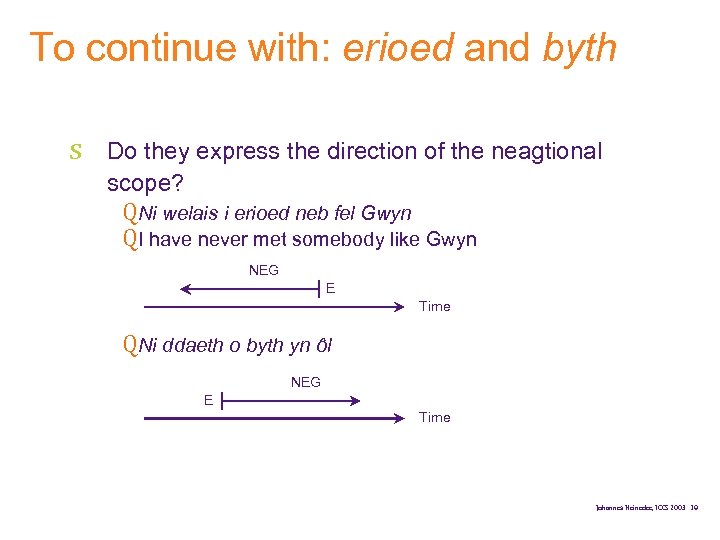 To continue with: erioed and byth s Do they express the direction of the neagtional scope? QNi welais i erioed neb fel Gwyn QI have never met somebody like Gwyn NEG E Time QNi ddaeth o byth yn ôl NEG E Time Johannes Heinecke, ICCS 2003 19
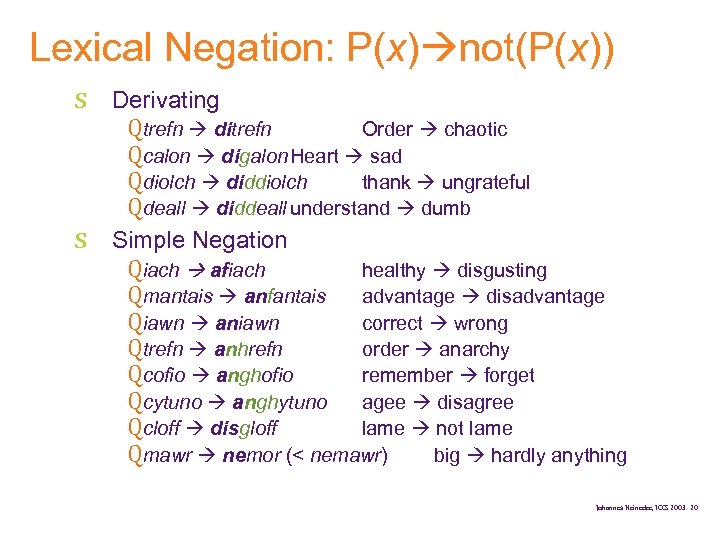 Lexical Negation: P(x) not(P(x)) s s Derivating Qtrefn ditrefn Order chaotic Qcalon digalon. Heart sad Qdiolch diddiolch thank ungrateful Qdeall diddeall understand dumb Simple Negation Qiach afiach healthy disgusting Qmantais anfantais advantage disadvantage Qiawn aniawn correct wrong Qtrefn anhrefn order anarchy Qcofio anghofio remember forget Qcytuno anghytuno agee disagree Qcloff disgloff lame not lame Qmawr nemor (< nemawr) big hardly anything Johannes Heinecke, ICCS 2003 20
 References Borsley, Robert D. und Jones, Bob Morris: 2000. „The syntax of Welsh negation“. Transactions of the Philological Society. 98 -1: 15 -47. Dahl, Östen: 1979. „Typologie of sentence negation“. Linguistics. 17 -1: 79 -106. Dahl, Östen: 1993. „Negation“. Syntax. Hrsg. v. Joachim Jacobs, Joachim, Arnim von Stechow, Arnim, Wolfgang Sternefeld und Theo Vennemann. Berlin. Mouton de Gruyter. 914 -923. Heinecke, Johannes: 1999. Temporal Deixis in Welsh and Breton. Heidelberg. Winter. (Anglistische Forschungen 272). Jones, Morris: 1970. „The items ‘byth’ and ‘erioed’“. Studia Celtica. 7: 93 -119. Jones, Robert M. : 1966. „Tympau'r Modd Mynegol“. Bulletin of the Board of Celtic Studies. 22 -I: 1 -9. Klima, Edward L. : 1964. „Negation in English“. The Structure of Language: Readings in the Philosophy of Language Hrsg. v. Jerry A. Fodor und Jerrold Jacob Katz. Englewood Cliffs. Prentice Hall. 246323. Mc. Cawley, James D. : 1981. Everything that linguists have always wanted to know about logic, but were ashamed to ask. Chicago. University of Chicago Press. 2 nd edition. Payne, John R. : 1985. „Negation“. Language Typology and Syntactic Description. Hrsg. v. Timothy Shopen. Cambridge University Press. 197 -242. Ramat, Paolo: 1994. „Negation“. The Encyclopedia of Language and Linguistics. Hrsg. v. Ronald E. Asher. Oxford. Pergamon Press. 2769 -2774. Reichenbach, Hans: 1940. Elements of Symbolic Logic. New York. Mac. Millan, The Free Press. Johannes Heinecke, ICCS 2003 21
 Diolch yn fawr! johannes. heinecke@wanadoo. fr Johannes Heinecke, ICCS 2003 22