


 Скачать презентацию TYPOLOGY OF THE LEXICAL SYSTEMS The principal
lexicon.ppt
- Количество слайдов: 64
 TYPOLOGY OF THE LEXICAL SYSTEMS
 The principal constants of this language level are the following: 1. Words, their semantic classes and word-forming means as well as their structural models and stylistic peculiarities of use. 2. The lexico-semantic groups (LSGs) of words which are pertained to the contrasted languages. 3. Stable and idiomatic expressions which are also of universal nature, though they always have some national peculiarities in every single language.
 Different words and stable expressions are systemically arranged. The systemic organization of lexicon is conditioned in all languages by lingual as well as by extra lingual factors which are of universal nature. Among the extra lingual factors the following should be pointed out as most important: a) the physical and mental factors; b) the environmental factors; c) the social (суспільні) factors.
 Lexical units denoting the physical needs of human beings: • actions designated by such verbs as live, eat, drink, think, sleep, wake, walk, run, jump, love, merry, die, etc. • mental activity of man designated by such words as speak, think, ask, answer, decide, realize, imagine, understand many others.
 Lexical units denoting natural environment common notions designated by words which reflect the multitudes of objects and phenomena surrounding every human being on the globe such as the sun, the moon, the stars, the wind, the sky, thunder, lightning, rain, as well as various species of plants, trees, fruits, colours, and living beings like fish, insects, mice, etc.
 Lexical units denoting social phenomena relationships and activities of man: mother, father, child, sister, brother, aunt, uncle, grandmother, grandfather, etc.
 Universal lexicon All words and combinations of words designating the many notions, which appear due to the above mentioned principles, constitute a large typologically common class of words referred to as universal lexicon.
 other common layers of lexicon: • dialectal, • professional, • poetic, • archaic, • slang, • International, Etc. lexicons.
 • Each of them has its distinctive typologically characteristic features of isomorphic nature in common. Thus, the functioning of dialectal lexicons in any language is restricted to a definite historically destined territory (cf. the Scottish dialect, London cockney or the Western Ukrainian dialect).
 International Lexicon split into two typologically distinct subgroups: 1. genuine internationalisms having a common linguistic form, a common source of origin and identical lexical meaning (cf. : parliament, poet, theatre, molecule, theorem, forum, history, waltz, sword of Damocles, to pass the Rubicon, Pandora's box, etc. );
 International Lexicon 2. lexical loan internationalisms which have the same lexical meaning but exist only in national lingual forms. These are usually terms like specific gravity/weight питома вага, the law of gravitation закон земного тяжіння, agreement (gram. ) узгодження, the composite sentence складне речення, case відмінок, addition додавання, subtraction віднімання, division ділення, etc.
 Units of Nationally Specific Lexicon (culturally biased elements) • English: farthing, shilling, dollar, Chartist, Yorkshire pudding, to cut off with a shilling, etc. ). • Ukrainian: кутя, вареники, бандурист, кобзар, запорожець, ставати на рушник, "Ще не вмерла Украі на ", козацькому роду нема переводу, героі Крутів, etc.
 Kids language in Ukrainian • Nouns: биць/биця (male, calf), киця (cat or kitten), бася (goat), кося (horse or foal, colt), куця/паця (pig or piglet), гав-гав/цюця (dog, puppy), ґуля/гулі (pigeon(s)), гуся (goose), тася (duck or duckling), etc. • Members of family: неня/мама (mummy), тато (daddy), буня/бабуня (grannie), дядя (uncle), діда (grandfather), няня (nurse), доця (daughter);
 Kids language in Ukrainian • Parts of human body: вусьо (ear), нозя (legfoot), руця (hand), оцьо/оці (eye, eyes). • Other nouns denoting different objects or phenomena: буцьо (apple), лозя (spoon), кика (meat), кетя (sweety), моня (milk), льоля (shirt, dress), дюдя (cold weather), люля (cot, cradle) ляля (kid, doll), квітя (flower), цяця (any toy), сося (soothe, baby's dummy), пуся (comforter), коко (egg), вува (wolf or anything to scare the child), цьомати (to kiss) etc.
 The linguistic principles of typological classification of lexicon are based in all languages on the following features of words: • on their common lexico-grammatical nature; • on their belonging to a common lexicosemantic group; • on their peculiar stylistic function and meaning; • on their denotative or connotative (or both) meanings, etc.
 In accordance with their general implicit lexicogrammatical meaning all words are grouped into a) notionals (they constitute the bulk of words in languages), b) functionals.
 Both contrasted languages have an isomorphic or even a universal peculiarity of expressing the most general implicit meanings of substantivity, verbiality, deictic properties, adverbiality, etc. thus representing nouns, adjectives, pronouns, numerals, verbs, adverbs and statives that are parts of speech performing the same functions in English and Ukrainian sentences. The notion of the parts of speech, therefore, belongs to the universal ones.
 Functionals They are common in English and Ukrainian with the exception of the articles the and a/аn. Namely: prepositions /прии менники, conjunctions/ сполучники, particles частки, interjections/ вигуки, modal words and modal phrases /модальні слова та модальні вирази. Common are 12 lexico-grammatical classes of words each of which has mostly the same properties in the contrasted languages.
 Lexico-semantic groups of words (the LSGs) Words of a LSG may often have a regular synonymic relationship in English and Ukrainian. For example, the notion of "dwelling" unites the following row of nouns denoting different kinds of shelter: dug-out (печера, землянка), shanty (халупа), mud-house (глинянка), cabin (хатина), house, cottage, bungalow, villa, palace, apartment, etc.
 Common lexico-semantic groups • adjectives denoting dimension : big, large, great, huge, gigantic, enormous, small, tiny, etc. ). Similarly in Ukrainian: великии , здоровии , гігантськии , малии , невеликии , дрібнии , манюнькии , манюсінькии , манюпусінькии , • adjectives denoting beauty: beautiful, nice, handsome, pretty, smart, good-looking, etc. ). In Ukrainian: гарнии , красивии , вродливии , миловиднии , фаи нии (діал. ). • adjectives denoting colours: red, yellow, green, blue, pink, brown, azure, orange, violet, white, black, gray, hazel, etc. In Ukrainian: червонии , жовтии , зелении , синіи , голубии , бурии , коричневии , оранжевии , etc.
 • verbs of saying: say, tell, converse, talk, speak, retort and in Ukrainian: говорити, розмовляти, балакати, відмовляти, шептатися, заперечувати, etc. • verbs denoting mental or physical perceptions: comprehend, understand, know, like, think; see, hear, taste, feel, touch. In Ukrainian: розуміти, знати, думати, вважати, гадати, бачити, чути, відчувати, смакувати, etc.
 Separate LSGs are formed by functionals. among prepositional LSGs there may be local prepositions (on, in, at, over, above, under, below, behind, на, під, коло, поруч, позад, біля, etc. ); prepositions denoting direction (to, into, from, towards, up, down, у, в, з, вгору, вниз, від, до etc. ).
 Semiotic classification of Lexicon by E. Nida • Class 1. Concrete, countable life nouns denoting non-persons: parrot, fox, pig, swine, rat, and лисиця/лис, собака, кабанюра, бицюра, etc. • Class 2. Concrete, countable life nouns denoting persons. Their number is estimated to be in English and Ukrainian over 6, 000. leader, chairman, robber, керівник/вождь, головуючий, грабіжник, обманщик
 Class 3. - concrete, countable, non-person, inanimate nouns: • plant names: cabbage, beetroot, капуста, буряк; • names of celestial bodies and atmospheric masses: comet, moon, sun, stars, комета, місяць, сонце, зорі; • parts of human body: hand, head, arm, рука, нога, голова; • names of arts: dancing, singing, танці, співи; • means of communication: internet, telegraph, телефон, etc; • names of unique unreal bodies: dickens/genius, gnome, nymph, чорт, домовик, гном; • metaphorical names: stick ("дубина", "колода"), block ("довбешка/ довбня"), the heart (серденько), the sun (сонце), сонечко/ серденько ти
 Class 4. - concrete life nouns, non-person, represented by different common collective nouns: e. g. nation, race, family, crew, staff, gang, company, police, militia, forces, troops, etc. родина, раса, нація, екіпаж, штаб, etc.
 Class 5. - collective life nouns: • species of animals (cattle, sheep or poultry, худоба/товар, вівці, домашня птиця); • fish (school offish косяк риби); • a mass of some living beings (swarm of bees, рій бджіл, pack of dogs/wolves, зграя/тічка собак/вовків, flock of sheep/herd of cattle отара овець/череда корів)
 Class 6. Concrete, inanimate, uncountable nonperson nouns that include all singularia tantum group: e. g. butter, bread, sugar, oil, snow, sand, silver; залізо, срібло, повітря, молоко, білизна, листя, збіжжя, тремтіння, etc.
 Class 7. - abstract nouns business, information, news, feudalism, thought, thinking, significance, tolerance, гадка, думка, значимість, погляд, вміння, знання, мислення, безробіття, намагання, завзяття, ентузіазм, etc.
 identifying subclasses of words All nonsubstantive words constitute five large semiotic subclasses of lexemes, each presenting a separate part of speech. Subclass 1. Verbal words. Subclass 2. The adjectives. Subclass 3. Pronouns. Subclass 4. Numerals. Subclass 5. Adverbs.
 Subclass 1. Verbal words - various classes of notional and functional verbs. Notional verbs - different LSGs characterised by their general implicit grammatical meaning as transitivity or intransitivity, perfective or non-perfective (or any other aspect), reflexiveness or non-reflexiveness, etc. Isomorphism is observed, for instance, in English and Ukrainian in the existence of transitivity and nontransitivity of verbs and consequently in their ability to take the direct and indirect object (cf. send her a letter послати їй листа) and consequently to be used in active and passive voice (cf. To build - to be built будувати бути збудованим).
 Subclass 2. - adjectives These words split in all languages into two subclasses : the qualitative and the relative adjectives, a universal typological feature. Qualitative adjectives in all languages have degrees of comparison (also a universal feature), e. g. long - longer - the longest довгий -довший - найдовший. Isomorphic are the syntactic functions of adjectives in most languages.
 Subclass 3 embraces pronouns that have in most languages both isomorphic and allomorphic features with nouns or numerals and functionally with adjectives (cf. Peter - he, love - she, the four - they, something/nothing - it воно, the first перший, the third третій, etc. ). Universal are practically all the main classes of pronouns, though their number may be different in various languages.
 In English, Ukrainian there exist personal pronouns (I, you, he, she, we, they я, ти/ви, він, вона, ми, вони), demonstrative pronouns (this, that, such, those, etc. цей, той, такий, ті), possessive pronouns (his, her, our, their його, її, наш, їхній). In English, however, there exist possessive absolute pronouns (mine, hers, ours, yours)
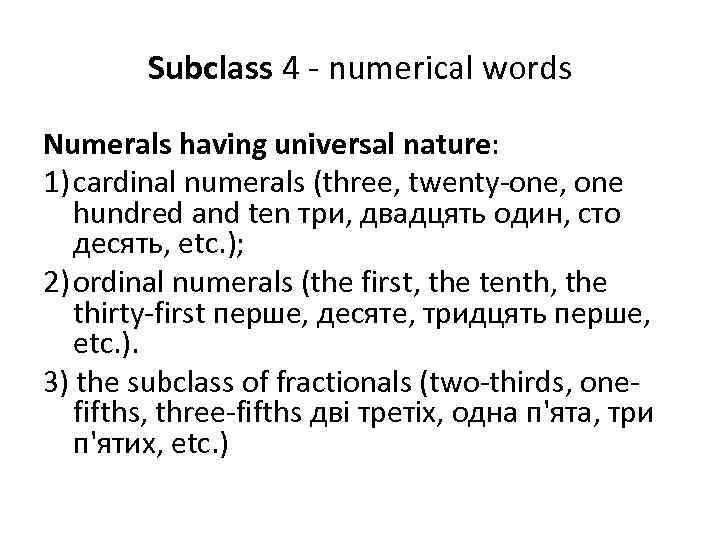 Subclass 4 - numerical words Numerals having universal nature: 1) cardinal numerals (three, twenty-one, one hundred and ten три, двадцять один, сто десять, etc. ); 2) ordinal numerals (the first, the tenth, the thirty-first перше, десяте, тридцять перше, etc. ). 3) the subclass of fractionals (two-thirds, onefifths, three-fifths дві третіх, одна п'ята, три п'ятих, etc. )
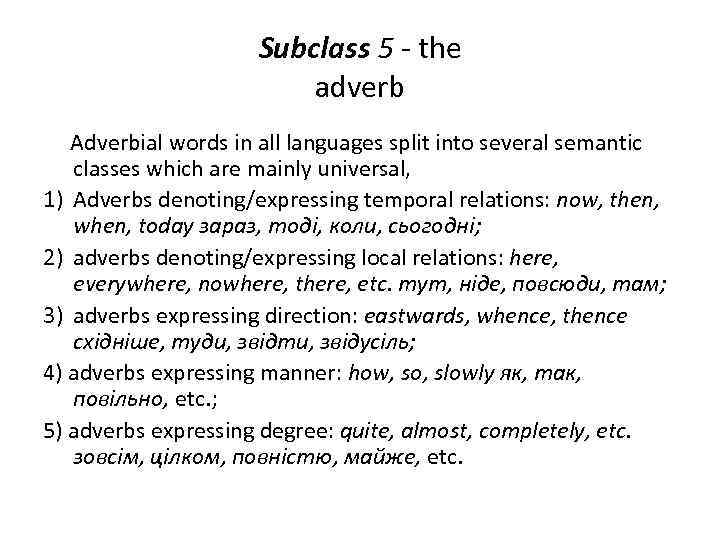 Subclass 5 - the adverb Adverbial words in all languages split into several semantic classes which are mainly universal, 1) Adverbs denoting/expressing temporal relations: now, then, when, today зараз, тоді, коли, сьогодні; 2) adverbs denoting/expressing local relations: here, everywhere, nowhere, there, etc. тут, ніде, повсюди, там; 3) adverbs expressing direction: eastwards, whence, thence східніше, туди, звідти, звідусіль; 4) adverbs expressing manner: how, so, slowly як, так, повільно, etc. ; 5) adverbs expressing degree: quite, almost, completely, etc. зовсім, цілком, повністю, майже, etc.
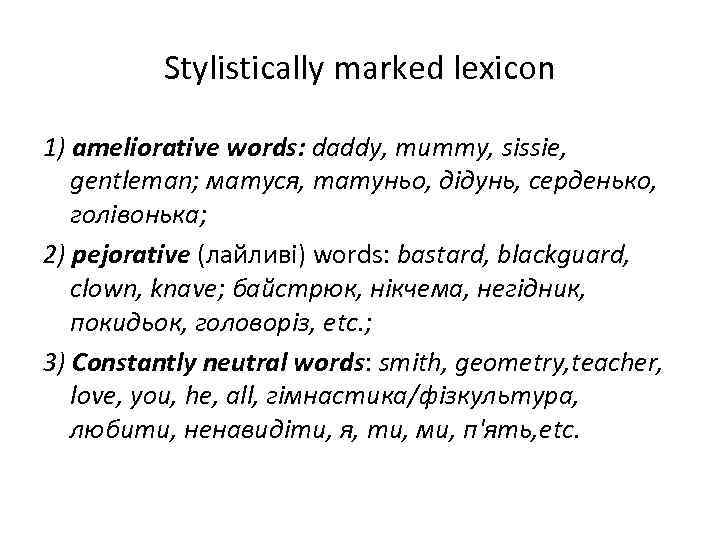 Stylistically marked lexicon 1) ameliorative words: daddy, mummy, sissie, gentleman; матуся, татуньо, дідунь, серденько, голівонька; 2) pejorative (лайливі) words: bastard, blackguard, clown, knave; байстрюк, нікчема, негідник, покидьок, головоріз, etc. ; 3) Constantly neutral words: smith, geometry, teacher, love, you, he, all, гімнастика/фізкультура, любити, ненавидіти, я, ти, ми, п'ять, etc.
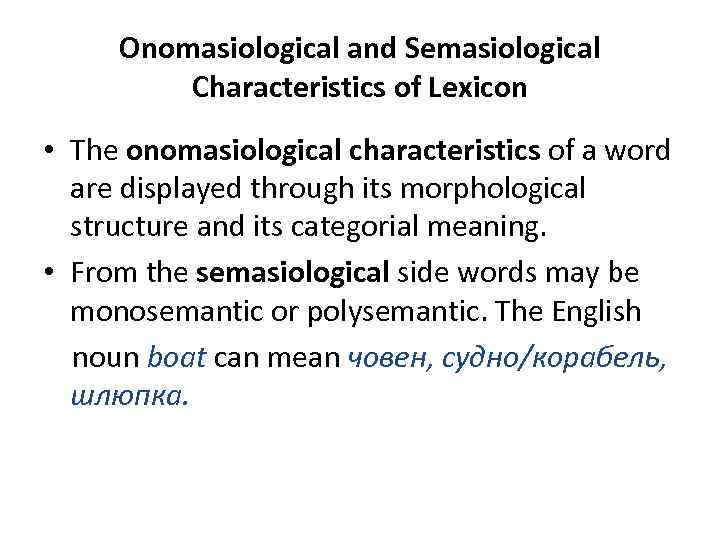 Onomasiological and Semasiological Characteristics of Lexicon • The onomasiological characteristics of a word are displayed through its morphological structure and its categorial meaning. • From the semasiological side words may be monosemantic or polysemantic. The English noun boat can mean човен, судно/корабель, шлюпка.
 Monosemantic words pronouns, numerals, conjunctions and various nomenclature words (terms). For example: we, she, nobody, ten, thirty, and, or, atom, oxygen, sugar, today; він, вони, десять, перший, і/та, чи, кисень, цукор, сьогодні, торік, etc.
 Common types of motivation 1. All phonetically motivated words have their sounding structure somewhat similar to the sounds which they convey: to cade - кудкудакати, cockadoodle- doo — кукуріку, bang — бух/бухнути, bark - гав/гавкати, buzz - дзижчати, chirp/chirrup - цвірінькати, cuckoo - кукукати/кукувати, crack — трісь/тріщати, gagle - ґелґотати, hey! - гей!, hiss - шипіти/сичати, hoop - 'гукати (сигналити), howl - ви-ти, smack (one's lips) цмокати, moo мукати, mewl - нявкати, etc.
 2. The morphological motivation in the contrasted languages remains the major one. It is characteristic of numerous notional words, in which it is clearly indicated by the affixal morphemes. For example, • by suffixes: doer one who does smth; flyer one who flies; detainee one who is detained; examinee one who is examined; changable that which is subjected to change/can be changed; movable smth. that can be moved, etc.
 Similarly in Ukrainian: оповідач той, хто оповідає/розповідає; писар той, хто пише; співець той, хто співає; смажений якого (що) смажили; читаючий який читає; митець той, хто творить якийсь вид мистецтва (швидко чи дуже якісно/майстерно) малює, будує, співає, танцює, etc.
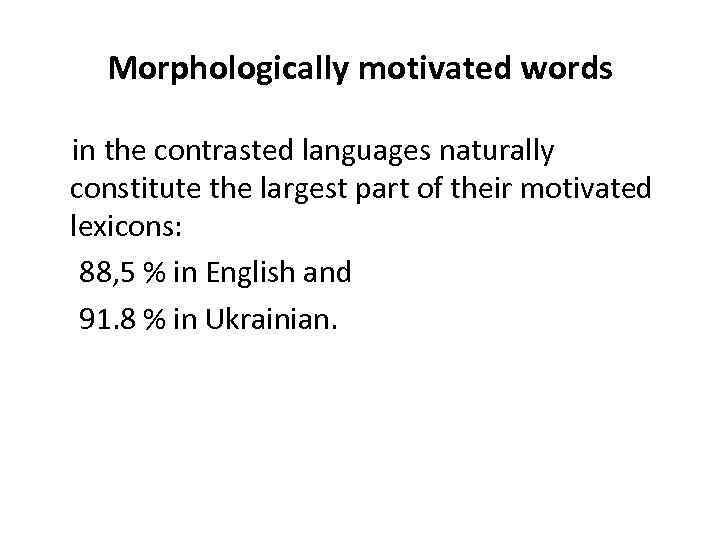 Morphologically motivated words in the contrasted languages naturally constitute the largest part of their motivated lexicons: 88, 5 % in English and 91. 8 % in Ukrainian.
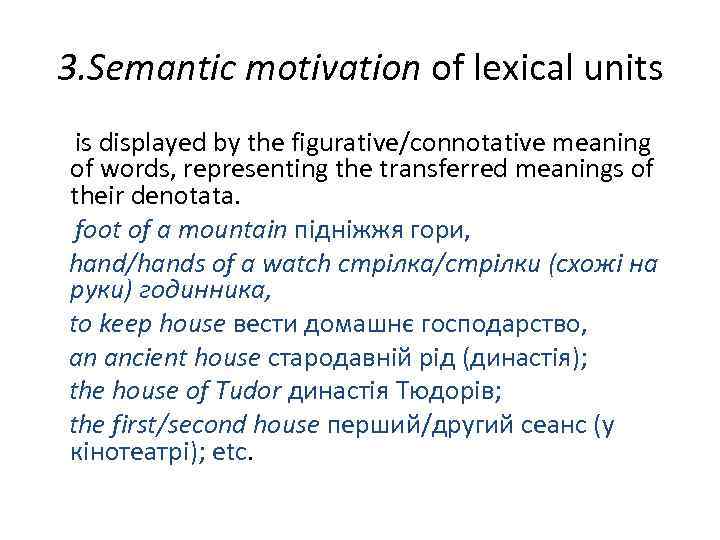 3. Semantic motivation of lexical units is displayed by the figurative/connotative meaning of words, representing the transferred meanings of their denotata. foot of a mountain підніжжя гори, hand/hands of a watch стрілка/стрілки (схожі на руки) годинника, to keep house вести домашнє господарство, an ancient house стародавній рід (династія); the house of Tudor династія Тюдорів; the first/second house перший/другий сеанс (у кінотеатрі); etc.
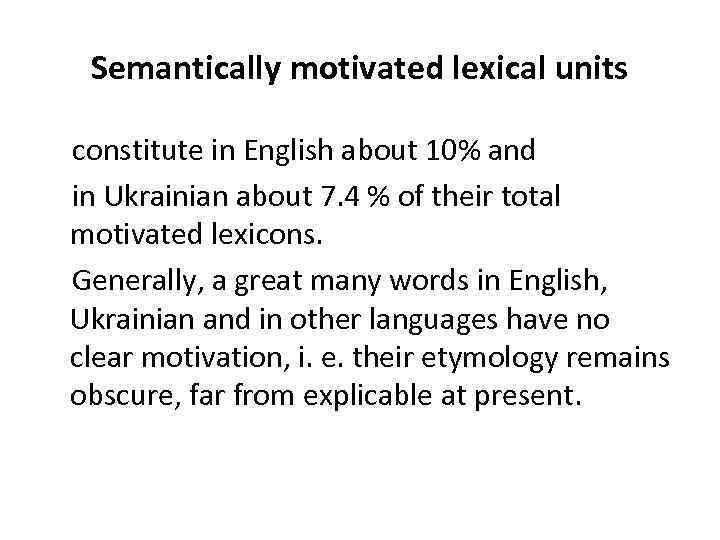 Semanticallу motivated lexical units constitute in English about 10% and in Ukrainian about 7. 4 % of their total motivated lexicons. Generally, a great many words in English, Ukrainian and in other languages have no clear motivation, i. e. their etymology remains obscure, far from explicable at present.
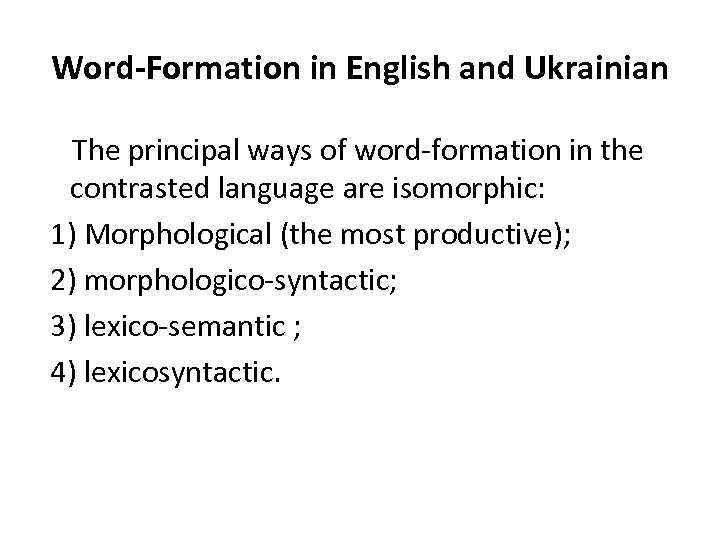 Word-Formation in English and Ukrainian The principal ways of word-formation in the contrasted language are isomorphic: 1) Morphological (the most productive); 2) morphologico-syntactic; 3) lexico-semantic ; 4) lexicosyntactic.
 The morphological way I. Affixal or derivational word-formation: e. g. Agent suffixes (суфікси, що означають діяча): -ist/-icт, -ист: analyst, motorist, journalist, пацифіст, журналіст, артист, тракторист; -ant, -ent (-ант/-ент): irritant, servant, student, solvent, комерсант, лаборант, кореспондент, студент; -аг (-ар/-яр): burglar, scholar, байкар, володар, муляр, дояр, зброяр; -er -or (-ер/-ор): teacher, farmer, coster, singer, milker, actor, director, inspector, інженер, міліціонер, актор, директор, конструктор, etc.
 Compounding Common features: two main ways of forming compounds in English and Ukrainian: 1) by the juxtaposition (placement) of the parts; 2) with the help of the linking/ interfixal o, e, s in English and о, е / є, у in Ukrainian.
 The typological difference between the composite words of the two languages • lies in their much larger variety of types in Ukrainian than in English. • Wholophrasing in English. It represents an occasional incorporation of word-groups or sentences into compounds, such as a never-to -be-forgotten event (from: an event never to be forgotten) or a to-be-or-not-to-be question, etc.
 Abbreviation • it represents a generally common type of word-formation in the contrasted languages. • Common and equally productive in both contrasted languages are the following types: 1. The so-called initial abbreviation: USA, UNO, BBC, CNN, TV, UK, VAT and other acronyms. Similarly in Ukrainian: США, OOH, ЮНЕСКО, АФП-КПП, СОЇ, СНІД, МВФ,
 2. Partial abbreviation of words (rare in English): Colo (Colorado), Indi (Indiana), Okla (Oklahoma), Canwood (Canadian Woods), держстрах, Донбас, Кривбас, головбух, завгосп, ботсад, кербуд, сільбуд, комунгосп,
 3. Combined abbreviation (less productive and less widespread in English than in Ukrainian): CONUS (Continental US), COSPAR (Committee on Space Research), INTERPOL (International Criminal Police Organisation), міськвно (міський відділ народної освіти), облсу (обласне статистичнеуправління), etc.
 Blending • a rather productive type of compounding in English. Blends or "telescoped" words are formed by confrontation of two (in Ukrainian) or even more truncated (усічених) words or roots of words, for example: avia(tion) + (electr)onics > avionics, fan(tasy) + (maga)zine > fanzine, mo(torist) + (ho)tel > motel, sm(ock) + (f)og > smog, ETC.
 All Ukrainian blends are generally restricted to similar contaminations in which truncated are initial elements of the initial words and the initial/final elements of the succeeding words as in пірам(ідон) + (кофе)їн — пірамеїн, ас(пірін) + кофе(ї)н - аскофен
 Back-formation (reversion) is a rather productive type of word formation in English, where many short words are inferred from longer words. It is in this way that verbs are derived from nouns: own < owning, beg < beggar, brag < bragging, broke < broker, edit < editor, hawk < hawker, kittle < kittling, infract < infraction, etc.
 Back-formation in Ukrainian is restricted only to nouns which are formed from verbal (or rather from their infinitival) stems. For example: біг < бігати, брід < бродити, піт < пітніти, крик < кричати, галас < галасувати, шамкіт < шамкотіти, говір < говорити.
 Reduplication is a common means of compounding in the contrasted languages, but it is more productive in English than in Ukrainian. • fifty-fifty, goody-goody, hush-hush (secret), pooh-pooh, so-so. • Similarly in Ukrainian: де-де, ні-ні, ледве, так-так, ось-ось, от-от, тільки, тихо-тихо.
 Specifically English Types of Word. Formation • Conversion: nouns into verbs or verbs into nouns, adjectives into nouns or nouns into adjectives: N>V: a chairman > to chairman, a butcher > to butcher, a boss > to boss, an X-ray > to X-ray V>N: to catch > the catch to look > a look to ride > a ride to know how > (the) know-how
 • The sound interchange (i. e. short vs. long): bit - beat, cot - court, kin - keen, live - life, prove - proof, rid read, sit - seat, etc. • Lexicalisation of some plural forms of nouns like colour — colours (military banner), glass — glasses (eye-glasses, opera-glasses), line - lines (poetic works), etc. • The phonomorphological word-formation which is closely connected with the abbreviation proper. Cf. Mr. for mister, Mrs. (misess), govt. (government), Sgt. (sergeant), memo (memorandum), demo (demonstration), D (Lady D) princess Diana, etc.
 FOREIGN ELEMENTS IN THE CONTRASTED LANGUAGES • The vocabulary of the contrasted languages consists of two layers – the native stock and borrowed words. • A native word is a word which belongs to the original stock, known from the earliest available manuscripts. • A loan word (borrowed, a borrowing) is a word taken over from another language and modified in phonemic shape, spelling, paradigm or meaning according to the standards of the recipient language.
 Native words Words belonging to the subsets of the native word stock are characterized by: a wide range of lexical and grammatical valency, high frequency and a developed polysemy. They often are monosyllabic, show great word-building power and enter a number of set expressions.
 FOREIGN ELEMENTS IN THE CONTRASTED LANGUAGES • Approximately 70 % of the total number of English words are borrowed. In Ukrainian the percentage of borrowings is 30%. • Christianity led to adoption of Latin borrowings in English and Greek ones in Ukrainian. • Sources and ways of borrowings are different: in Ukrainian they are mostly Turkic, Arabic and Slavonic; in English they are mostly Latin and French (Roman). • Lexical correlations are lexical units from different languages which are phonetically and semantically related. The number of Ukrainian-English correlations is 6870.
 ASSIMILATION OF BORROWINGS Assimilation of a loan word demotes a partial or total confirmation to the phonetic, graphic, morphological standards of the receiving language and its semantic system. • Phonetic assimilation comprises changes in stress and sound form: e. g. regime, machine).
 • Grammatical adaptation of a loan word consists in a complete change of its grammatical paradigm. E. g. пальто - пальта, метро - в метрі; datum - data, phenomenon - phenomena. • Semantic assimilation is an adjustment to the system of meanings of the vocabulary. E. g. : In M. E. the word “girl” meant a child of either sex, “nice” meant “silly” in French and was borrowed in this meaning.
 ASSIMILATION OF BORROWINGS • According to the degree of assimilation borrowings fall into such groups: a) completely assimilated; b) partially assimilated, c) unassimilated loan words. • Partially assimilated loan words can be subdivided into 4 subgroups: • a) words not assimilated semantically; • b) words not assimilated grammatically; • c) words not completely assimilated phonetically; • d) words not completely assimilated graphically.