 Скачать презентацию Typology of Dictionaries A Brief
Typology of Dictionaries.ppt
- Количество слайдов: 37



Typology of Dictionaries
• A Brief History of English Lexicography
(1) Latin and French Glossaries • The work of nameless scholars, poring over Latin manuscripts. • As they read, they wrote in the margins easier Latin or English synonyms for some of the more difficult Latin words on the page, just as some students do today when they translate passages from a foreign language.
(1) Latin and French Glossaries • Later for the sake of convenience these words and definitions were collected into lists called “glosses”. In turn several glosses were combined into a book called a “glossarium”, which was in effect, a short Latin-English or English-Latin dictionary of selected words.
![(1) Latin and French Glossaries • 1440 Promptorium Parvulorum, sivre Clericorum ("Storehouse [of words]](https://present5.com/presentation/3208_131456560/image-5.jpg "(1) Latin and French Glossaries • 1440 Promptorium Parvulorum, sivre Clericorum (\"Storehouse [of words]")
(1) Latin and French Glossaries • 1440 Promptorium Parvulorum, sivre Clericorum ("Storehouse [of words] for children or clerics") English-Latin • Why first dictionaries were half-Latin? – Latin was international language of scholars – It was the language of church, the most important institution of the Middle Ages.
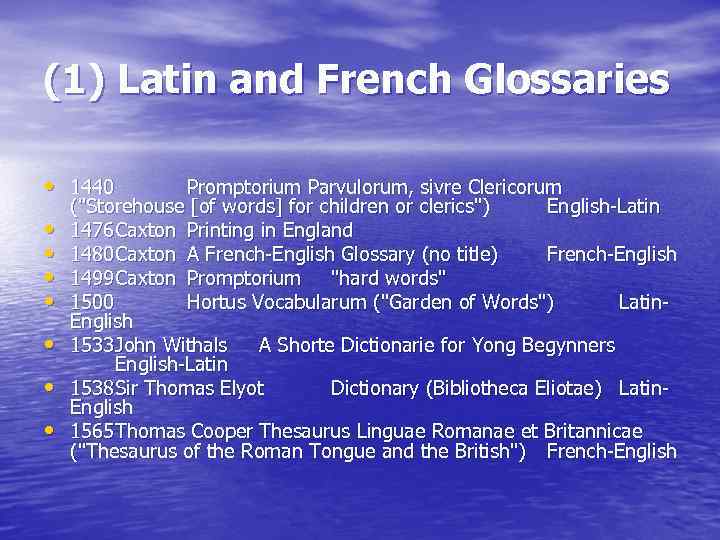
(1) Latin and French Glossaries • 1440 • • Promptorium Parvulorum, sivre Clericorum ("Storehouse [of words] for children or clerics") English-Latin 1476 Caxton Printing in England 1480 Caxton A French-English Glossary (no title) French-English 1499 Caxton Promptorium "hard words" 1500 Hortus Vocabularum ("Garden of Words") Latin. English 1533 John Withals A Shorte Dictionarie for Yong Begynners English-Latin 1538 Sir Thomas Elyot Dictionary (Bibliotheca Eliotae) Latin. English 1565 Thomas Cooper Thesaurus Linguae Romanae et Britannicae ("Thesaurus of the Roman Tongue and the British") French-English
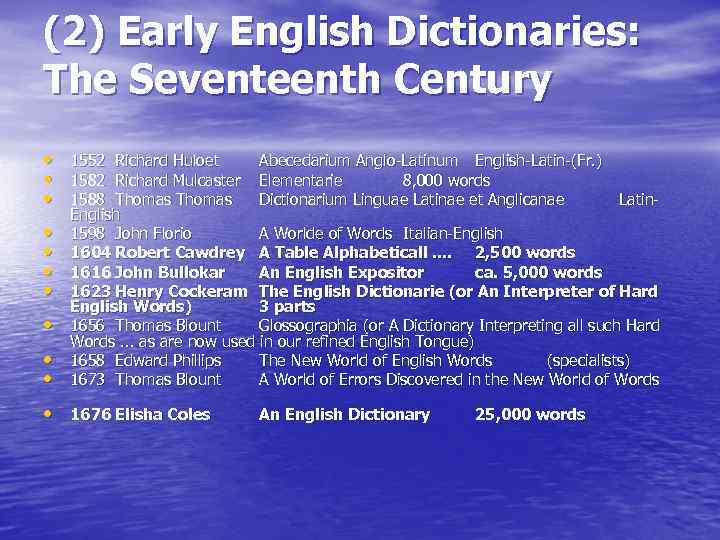
(2) Early English Dictionaries: The Seventeenth Century • 1552 Richard Huloet Abecedarium Anglo-Latinum English-Latin-(Fr. ) • 1582 Richard Mulcaster Elementarie 8, 000 words • 1588 Thomas Dictionarium Linguae Latinae et Anglicanae Latin • • English 1598 John Florio A Worlde of Words Italian-English 1604 Robert Cawdrey A Table Alphabeticall. . 2, 500 words 1616 John Bullokar An English Expositor ca. 5, 000 words 1623 Henry Cockeram The English Dictionarie (or An Interpreter of Hard English Words) 3 parts 1656 Thomas Blount Glossographia (or A Dictionary Interpreting all such Hard Words. . . as are now used in our refined English Tongue) 1658 Edward Phillips The New World of English Words (specialists) 1673 Thomas Blount A World of Errors Discovered in the New World of Words • 1676 Elisha Coles An English Dictionary 25, 000 words
(2) Early English Dictionaries: The Seventeenth Century • These dictionaries defined English words in terms of other English words, and in this respect resembled the dictionaries of today.
Early English Dictionaries: The Seventeenth Century • What’s the difference from modern dicitonaries? – They defined only “hard words” – They gave very little information about a word, and what was given might very well be wrong. – They were written by amateurs.
Early English Dictionaries: The Seventeenth Century • - If the lexicographer liked the word, in it went. • - Some words in the older dictionaries were merely Latin words which had been given a slight “face lifting” to change their appearance. • - The lexicographers borrowed extensively from previous Latin-English dictionaries.
Early English Dictionaries: The Seventeenth Century • What was in? – A hard word section and sections made up of special categories of words, such as those found in mythology, law or science. ’ – Later on more encyclopedic material was added, mostly geographical and biographical information.
Early English Dictionaries: The Seventeenth Century • 1604 Robert Cawdrey Table Alphabeticall • Gathered for the benefit and helpe of Ladies, Gentlewomen, or any other unskillfull persons
Early English Dictionaries: The Seventeenth Century • 1623 Henry Cockeram The English Dictionarie (or An Interpreter of Hard English Words) 3 parts – Cockeram’s book was the first in English to use the word “dictionary” in the title
Early English Dictionaries: The Seventeenth Century • 1676 Elisha Coles “An English Dictionary” • This dictionary had a special section which listed and defined some of the jargon of the criminal underworld. • “Tis no disparagement to understand the Canting Terms. It may chance to save your throat from being cut, or (at least) your pocket from being pickt”.
(3) The Beginning of Modern Dictionary Practice: The Eighteenth Century • • 1702 John Kersey • 1704 John Harris • • • A New English Dictionary 28, 000 words (70 years) Lexicon Technicum (or An Universal English Dictionary of Arts and Sciences. . . ) 1706 John Kersey, ed. Philips's New World of English Words 38, 000 words 1721 Nathan Bailey An Universal Etymological English Dictionary 40, 000 words (30 editions 1721 -1802), etymology, word stress (1740) 1727 Nathan Bailey Volume II supplementary volume: 2 parts, 1731 ed. 1728 Ephraim Chambers Cyclopaedia (or An Universal Dictionary of Arts and Sciences) 1730 Nathan Bailey Dictionarium Britannicum 48, 000 words 1747 Samuel Johnson Plan of a Dictionary of the English Language "to fix the language" 1749 Benjamin Martin Lingua Britannica Reformata 1755 Samuel Johnson Dictionary 40, 000 words (2 vls. ) 1755 Scott et al. eds. A New Universal English Dictionary
(3) The Beginning of Modern Dictionary Practice: The Eighteenth Century • 1702 John Kersey A New English Dictionary 28, 000 words (70 years) • The first attempt to make a universal dictionary of the language
(3) The Beginning of Modern Dictionary Practice: The Eighteenth Century • 1721 Nathan Bailey An Universal Etymological English Dictionary 40, 000 words (30 editions 17211802), etymology, word stress (1740)
(3) The Beginning of Modern Dictionary Practice: The Eighteenth Century • How would you define the following words? • Cow • Horse • Dog
(3) The Beginning of Modern Dictionary Practice: The Eighteenth Century • The following are complete entries from a dictionary published in 1721 • Cow: a beast well-known • Horse: a beast well-known • Dog: a quadruped, well-known
(3) The Beginning of Modern Dictionary Practice: The Eighteenth Century • What can you say about these definitions?
(3) The Beginning of Modern Dictionary Practice: The Eighteenth Century – Not very informative – Yet entries like these were a step beyond the principle of dictionary making illustrated by the hard word books. – They attempted to make the dictionary a record of the English language, rather than merely a helpful guide to definitions of hard words.
(3) The Beginning of Modern Dictionary Practice: The Eighteenth Century • Bailey “Any fool knows what a cow is!”
(3) The Beginning of Modern Dictionary Practice: The Eighteenth Century – Bailey tried to draw his words from current usage – He occasionally discussed the etymology, or history of the words (the information was often incorrect, however). – He divided words into syllables. – He tried to indicate correct pronunciation by marking the accent. – His dictionary served as a model for many to come.
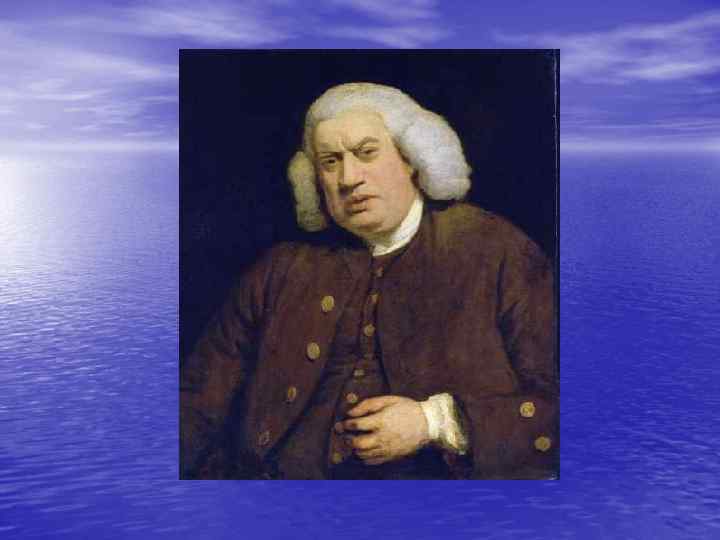
• Samuel Johnson • Born 18 September 1709 • (O. S. 7 September) • Lichfield, Staffordshire, Great Britain • Died 13 December 1784 (aged 75) • London, Great Britain • Occupation essayist, lexicographer, biographer, poet
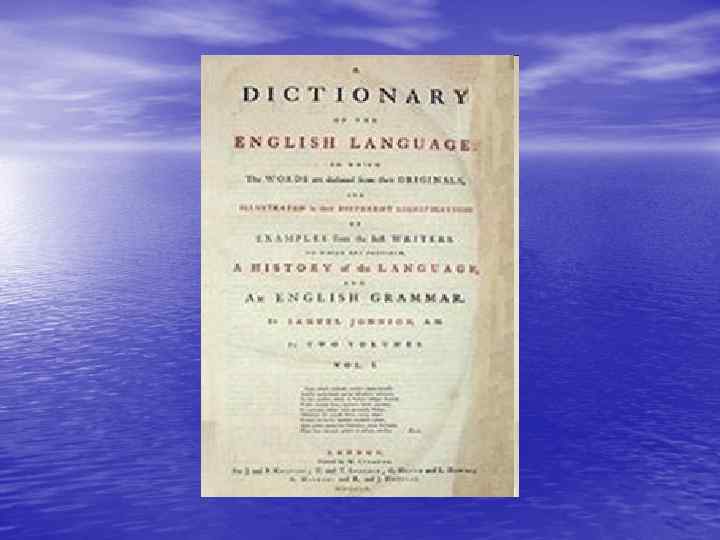
(3) The Beginning of Modern Dictionary Practice: The Eighteenth Century • • • 1755 Samuel Johnson It was the most comprehensive dictionary of English It had extensive etymologies, or word histories. The definitions generally were both complete and clear. The various senses or meanings of the same word were numbered and distinguished. Definitions were followed by quotations from reputable authors in order to illustrate the use of the word, thus adding another, most important dimension to definition.
(3) The Beginning of Modern Dictionary Practice: The Eighteenth Century • Not perfect, sometimes there were errors. • “Ignorance, Madam, pure ignorance” • Reflected a personal bias • Attempts at fixing the language • A strong prescriptive approach
(3) The Beginning of Modern Dictionary Practice: The Eighteenth Century • Some difficult to understand definitions: • Net • Cough
(3) The Beginning of Modern Dictionary Practice: The Eighteenth Century • Net – anything reticulated or decussated at equal distances, with interstices between the intersections • Cough – a convulsion of the lungs, vellicated by some sharp serosity
(3) The Beginning of Modern Dictionary Practice: The Eighteenth Century • Personal prejudices • Exercise • Pension • Lexicographer • Personal tone • Dogbolt • Fraischeur • Dissever • Spick and span`
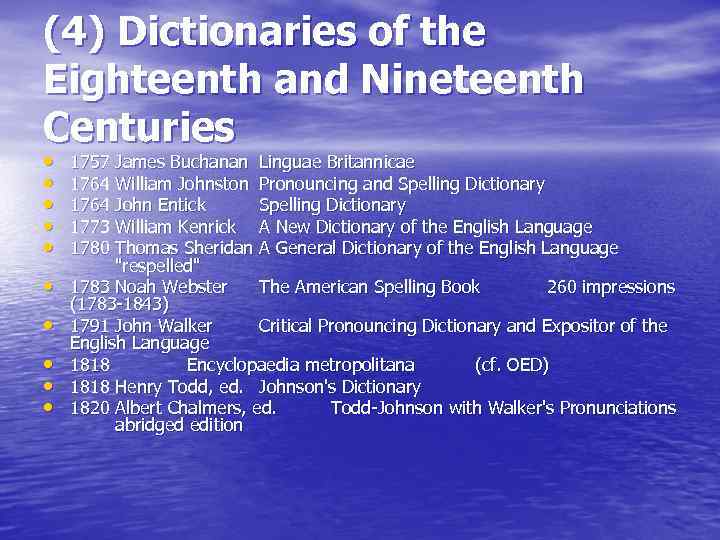
(4) Dictionaries of the Eighteenth and Nineteenth Centuries • • • 1757 James Buchanan Linguae Britannicae 1764 William Johnston Pronouncing and Spelling Dictionary 1764 John Entick Spelling Dictionary 1773 William Kenrick A New Dictionary of the English Language 1780 Thomas Sheridan A General Dictionary of the English Language "respelled" 1783 Noah Webster The American Spelling Book 260 impressions (1783 -1843) 1791 John Walker Critical Pronouncing Dictionary and Expositor of the English Language 1818 Encyclopaedia metropolitana (cf. OED) 1818 Henry Todd, ed. Johnson's Dictionary 1820 Albert Chalmers, ed. Todd-Johnson with Walker's Pronunciations abridged edition
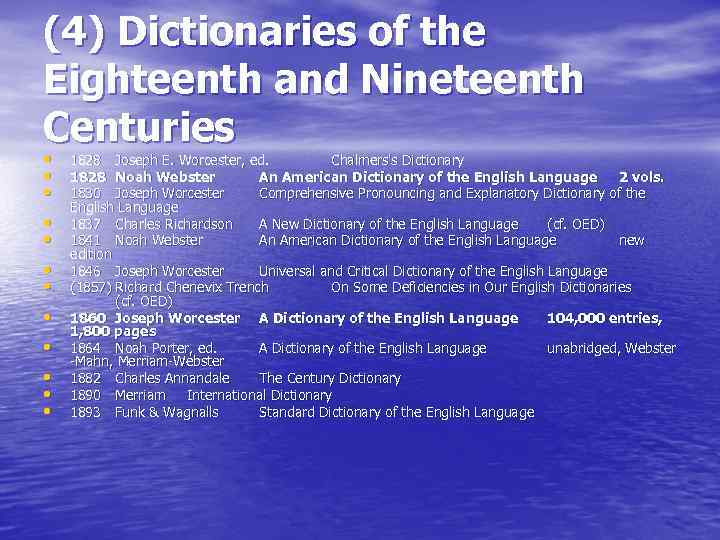
(4) Dictionaries of the Eighteenth and Nineteenth Centuries • • • 1828 Joseph E. Worcester, ed. Chalmers's Dictionary 1828 Noah Webster An American Dictionary of the English Language 2 vols. 1830 Joseph Worcester Comprehensive Pronouncing and Explanatory Dictionary of the English Language 1837 Charles Richardson A New Dictionary of the English Language (cf. OED) 1841 Noah Webster An American Dictionary of the English Language new edition 1846 Joseph Worcester Universal and Critical Dictionary of the English Language (1857) Richard Chenevix Trench On Some Deficiencies in Our English Dictionaries (cf. OED) 1860 Joseph Worcester A Dictionary of the English Language 104, 000 entries, 1, 800 pages 1864 Noah Porter, ed. A Dictionary of the English Language unabridged, Webster -Mahn, Merriam-Webster 1882 Charles Annandale The Century Dictionary 1890 Merriam International Dictionary 1893 Funk & Wagnalls Standard Dictionary of the English Language
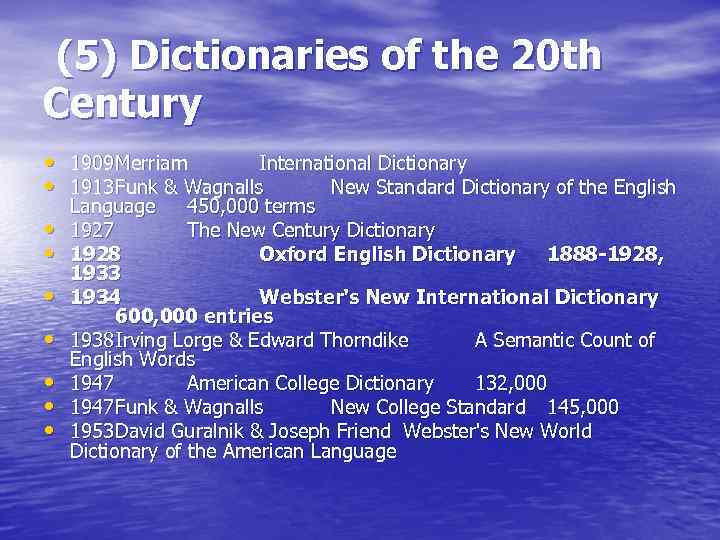
(5) Dictionaries of the 20 th Century • 1909 Merriam International Dictionary • 1913 Funk & Wagnalls New Standard Dictionary of the English • • Language 450, 000 terms 1927 The New Century Dictionary 1928 Oxford English Dictionary 1888 -1928, 1933 1934 Webster's New International Dictionary 600, 000 entries 1938 Irving Lorge & Edward Thorndike A Semantic Count of English Words 1947 American College Dictionary 132, 000 1947 Funk & Wagnalls New College Standard 145, 000 1953 David Guralnik & Joseph Friend Webster's New World Dictionary of the American Language
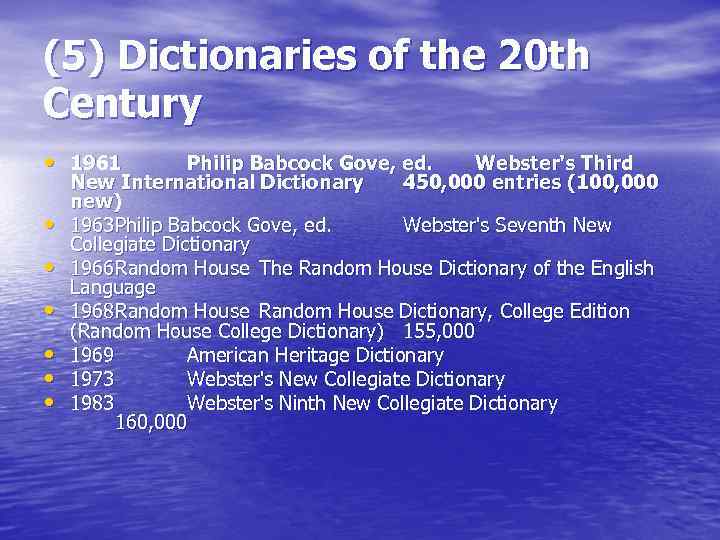
(5) Dictionaries of the 20 th Century • 1961 • • • Philip Babcock Gove, ed. Webster's Third New International Dictionary 450, 000 entries (100, 000 new) 1963 Philip Babcock Gove, ed. Webster's Seventh New Collegiate Dictionary 1966 Random House The Random House Dictionary of the English Language 1968 Random House Dictionary, College Edition (Random House College Dictionary) 155, 000 1969 American Heritage Dictionary 1973 Webster's New Collegiate Dictionary 1983 Webster's Ninth New Collegiate Dictionary 160, 000
(5) Dictionaries of the 20 th Century • 1961 Philip Gove Webster’s Third • Descriptive approach • Accommodating the real language – Dictionaries should reflect the language, not set its style – The dictionary is the mirror of the language
Cowie. The Oxford History of English Lexicography. Green. Chasing the Sun.
Скачать презентацию Typology of Dictionaries A Brief
Typology of Dictionaries.ppt