 Скачать презентацию Typical Aspects of Ruth J Sidow Baxter Explore the
7d0ac731d66b92b3bacf17e07fe53f60.ppt
- Количество слайдов: 4



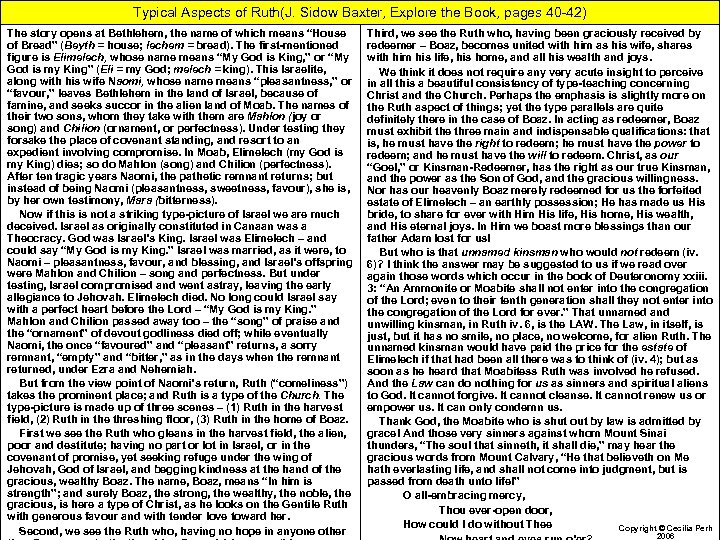
Typical Aspects of Ruth(J. Sidow Baxter, Explore the Book, pages 40 -42) The story opens at Bethlehem, the name of which means “House of Bread” (Beyth = house; lechem = bread). The first-mentioned figure is Elimelech, whose name means “My God is King, ” or “My God is my King” (Eli = my God; melech = king). This Israelite, along with his wife Naomi, whose name means “pleasantness, ” or “favour, ” leaves Bethlehem in the land of Israel, because of famine, and seeks succor in the alien land of Moab. The names of their two sons, whom they take with them are Mahlon (joy or song) and Chilion (ornament, or perfectness). Under testing they forsake the place of covenant standing, and resort to an expedient involving compromise. In Moab, Elimelech (my God is my King) dies; so do Mahlon (song) and Chilion (perfectness). After ten tragic years Naomi, the pathetic remnant returns; but instead of being Naomi (pleasantness, sweetness, favour), she is, by her own testimony, Mara (bitterness). Now if this is not a striking type-picture of Israel we are much deceived. Israel as originally constituted in Canaan was a Theocracy. God was Israel’s King. Israel was Elimelech – and could say “My God is my King. ” Israel was married, as it were, to Naomi – pleasantness, favour, and blessing, and Israel’s offspring were Mahlon and Chilion – song and perfectness. But under testing, Israel compromised and went astray, leaving the early allegiance to Jehovah. Elimelech died. No long could Israel say with a perfect heart before the Lord – “My God is my King. ” Mahlon and Chilion passed away too – the “song” of praise and the “ornament” of devout godliness died off; while eventually Naomi, the once “favoured” and “pleasant” returns, a sorry remnant, “empty” and “bitter, ” as in the days when the remnant returned, under Ezra and Nehemiah. But from the view point of Naomi’s return, Ruth (“comeliness”) takes the prominent place; and Ruth is a type of the Church. The type-picture is made up of three scenes – (1) Ruth in the harvest field, (2) Ruth in the threshing floor, (3) Ruth in the home of Boaz. First we see the Ruth who gleans in the harvest field, the alien, poor and destitute; having no part or lot in Israel, or in the covenant of promise, yet seeking refuge under the wing of Jehovah, God of Israel, and begging kindness at the hand of the gracious, wealthy Boaz. The name, Boaz, means “In him is strength”; and surely Boaz, the strong, the wealthy, the noble, the gracious, is here a type of Christ, as he looks on the Gentile Ruth with generous favour and with tender love toward her. Second, we see the Ruth who, having no hope in anyone other Third, we see the Ruth who, having been graciously received by redeemer – Boaz, becomes united with him as his wife, shares with him his life, his home, and all his wealth and joys. We think it does not require any very acute insight to perceive in all this a beautiful consistency of type-teaching concerning Christ and the Church. Perhaps the emphasis is slightly more on the Ruth aspect of things; yet the type parallels are quite definitely there in the case of Boaz. In acting as redeemer, Boaz must exhibit the three main and indispensable qualifications: that is, he must have the right to redeem; he must have the power to redeem; and he must have the will to redeem. Christ, as our “Goel, ” or Kinsman-Redeemer, has the right as our true Kinsman, and the power as the Son of God, and the gracious willingness. Nor has our heavenly Boaz merely redeemed for us the forfeited estate of Elimelech – an earthly possession; He has made us His bride, to share for ever with Him His life, His home, His wealth, and His eternal joys. In Him we boast more blessings than our father Adam lost for us! But who is that unnamed kinsman who would not redeem (iv. 6)? I think the answer may be suggested to us if we read over again those words which occur in the book of Deuteronomy xxiii. 3: “An Ammonite or Moabite shall not enter into the congregation of the Lord; even to their tenth generation shall they not enter into the congregation of the Lord for ever. ” That unnamed and unwilling kinsman, in Ruth iv. 6, is the LAW. The Law, in itself, is just, but it has no smile, no place, no welcome, for alien Ruth. The unnamed kinsman would have paid the price for the estate of Elimelech if that had been all there was to think of (iv. 4); but as soon as he heard that Moabitess Ruth was involved he refused. And the Law can do nothing for us as sinners and spiritual aliens to God. It cannot forgive. It cannot cleanse. It cannot renew us or empower us. It can only condemn us. Thank God, the Moabite who is shut out by law is admitted by grace! And those very sinners against whom Mount Sinai thunders, “The soul that sinneth, it shall die, ” may hear the gracious words from Mount Calvary, “He that believeth on Me hath everlasting life, and shall not come into judgment, but is passed from death unto life!” O all-embracing mercy, Thou ever-open door, How could I do without Thee Copyright © Cecilia Perh 2006
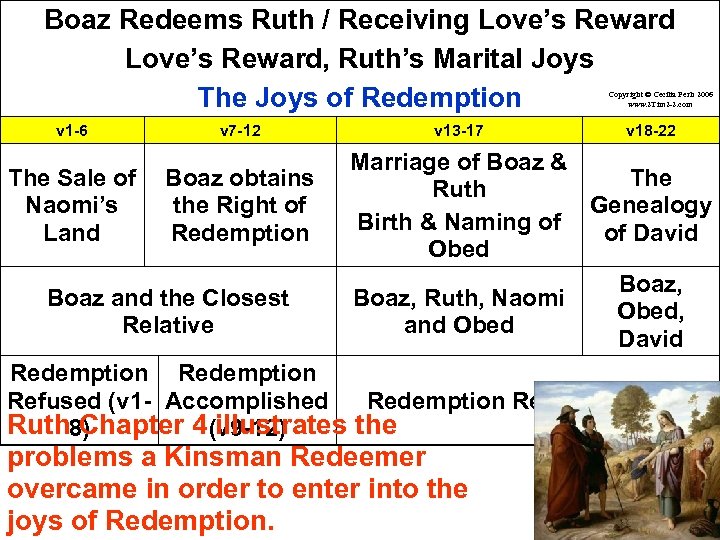
Boaz Redeems Ruth / Receiving Love’s Reward, Ruth’s Marital Joys The Joys of Redemption Copyright © Cecilia Perh 2006 www. 2 Tim 2 -2. com v 1 -6 The Sale of Naomi’s Land v 7 -12 Boaz obtains the Right of Redemption Boaz and the Closest Relative v 13 -17 v 18 -22 Marriage of Boaz & The Ruth Genealogy Birth & Naming of of David Obed Boaz, Ruth, Naomi Obed, and Obed David Redemption Refused (v 1 - Accomplished Redemption Rewarded (v 13) Ruth 8) Chapter 4(v 9 -12) illustrates the problems a Kinsman Redeemer overcame in order to enter into the joys of Redemption.
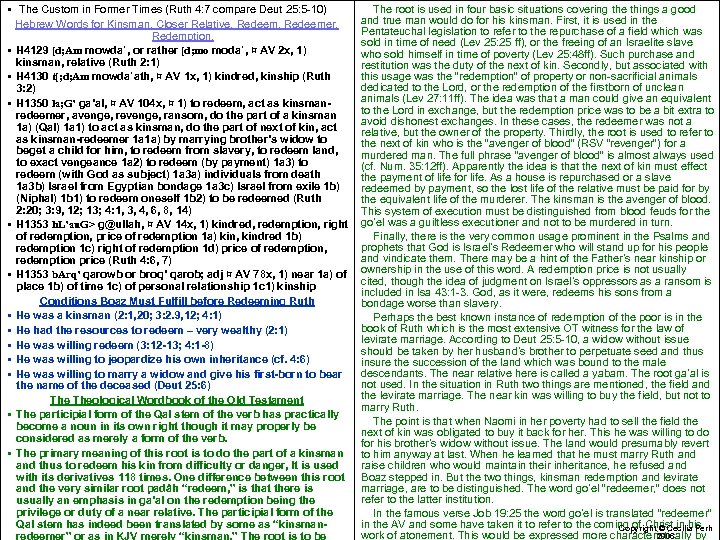
• The Custom in Former Times (Ruth 4: 7 compare Deut 25: 5 -10) Hebrew Words for Kinsman, Closer Relative, Redeemer, Redemption. • H 4129 [d; Am mowda`, or rather [d; mo moda`, ¤ AV 2 x, 1) kinsman, relative (Ruth 2: 1) • H 4130 t[; d; Am mowda`ath, ¤ AV 1 x, 1) kindred, kinship (Ruth 3: 2) • H 1350 la; G’ ga’al, ¤ AV 104 x, ¤ 1) to redeem, act as kinsmanredeemer, avenge, revenge, ransom, do the part of a kinsman 1 a) (Qal) 1 a 1) to act as kinsman, do the part of next of kin, act as kinsman-redeemer 1 a 1 a) by marrying brother’s widow to beget a child for him, to redeem from slavery, to redeem land, to exact vengeance 1 a 2) to redeem (by payment) 1 a 3) to redeem (with God as subject) 1 a 3 a) individuals from death 1 a 3 b) Israel from Egyptian bondage 1 a 3 c) Israel from exile 1 b) (Niphal) 1 b 1) to redeem oneself 1 b 2) to be redeemed (Ruth 2: 20; 3: 9, 12; 13; 4: 1, 3, 4, 6, 8, 14) • H 1353 h. L’au. G> g@ullah, ¤ AV 14 x, 1) kindred, redemption, right of redemption, price of redemption 1 a) kin, kindred 1 b) redemption 1 c) right of redemption 1 d) price of redemption, redemption price (Ruth 4: 6, 7) • H 1353 b. Arq’ qarowb or broq’ qarob; adj ¤ AV 78 x, 1) near 1 a) of place 1 b) of time 1 c) of personal relationship 1 c 1) kinship Conditions Boaz Must Fulfill before Redeeming Ruth • He was a kinsman (2: 1, 20; 3: 2. 9, 12; 4: 1) • He had the resources to redeem – very wealthy (2: 1) • He was willing redeem (3: 12 -13; 4: 1 -8) • He was willing to jeopardize his own inheritance (cf. 4: 6) • He was willing to marry a widow and give his first-born to bear the name of the deceased (Deut 25: 6) Theological Wordbook of the Old Testament • The participial form of the Qal stem of the verb has practically become a noun in its own right though it may properly be considered as merely a form of the verb. • The primary meaning of this root is to do the part of a kinsman and thus to redeem his kin from difficulty or danger, It is used with its derivatives 118 times. One difference between this root and the very similar root padâh “redeem, ” is that there is usually an emphasis in ga’al on the redemption being the privilege or duty of a near relative. The participial form of the Qal stem has indeed been translated by some as “kinsmanredeemer” or as in KJV merely “kinsman. ” The root is to be The root is used in four basic situations covering the things a good and true man would do for his kinsman. First, it is used in the Pentateuchal legislation to refer to the repurchase of a field which was sold in time of need (Lev 25: 25 ff), or the freeing of an Israelite slave who sold himself in time of poverty (Lev 25: 48 ff). Such purchase and restitution was the duty of the next of kin. Secondly, but associated with this usage was the “redemption” of property or non-sacrificial animals dedicated to the Lord, or the redemption of the firstborn of unclean animals (Lev 27: 11 ff). The idea was that a man could give an equivalent to the Lord in exchange, but the redemption price was to be a bit extra to avoid dishonest exchanges. In these cases, the redeemer was not a relative, but the owner of the property. Thirdly, the root is used to refer to the next of kin who is the “avenger of blood” (RSV “revenger”) for a murdered man. The full phrase “avenger of blood” is almost always used (cf. Num. 35: 12 ff). Apparently the idea is that the next of kin must effect the payment of life for life. As a house is repurchased or a slave redeemed by payment, so the lost life of the relative must be paid for by the equivalent life of the murderer. The kinsman is the avenger of blood. This system of execution must be distinguished from blood feuds for the go’el was a guiltless executioner and not to be murdered in turn. Finally, there is the very common usage prominent in the Psalms and prophets that God is Israel’s Redeemer who will stand up for his people and vindicate them. There may be a hint of the Father’s near kinship or ownership in the use of this word. A redemption price is not usually cited, though the idea of judgment on Israel’s oppressors as a ransom is included in Isa 43: 1 -3. God, as it were, redeems his sons from a bondage worse than slavery. Perhaps the best known instance of redemption of the poor is in the book of Ruth which is the most extensive OT witness for the law of levirate marriage. According to Deut 25: 5 -10, a widow without issue should be taken by her husband’s brother to perpetuate seed and thus insure the succession of the land which was bound to the male descendants. The near relative here is called a yabam. The root ga’al is not used. In the situation in Ruth two things are mentioned, the field and the levirate marriage. The near kin was willing to buy the field, but not to marry Ruth. The point is that when Naomi in her poverty had to sell the field the next of kin was obligated to buy it back for her. This he was willing to do for his brother’s widow without issue. The land would presumably revert to him anyway at last. When he learned that he must marry Ruth and raise children who would maintain their inheritance, he refused and Boaz stepped in. But the two things, kinsman redemption and levirate marriage, are to be distinguished. The word go’el “redeemer, ” does not refer to the latter institution. In the famous verse Job 19: 25 the word go’el is translated “redeemer” in the AV and some have taken it to refer to the coming of Christ in his Copyright © Cecilia Perh 2006 work of atonement. This would be expressed more characteristically by
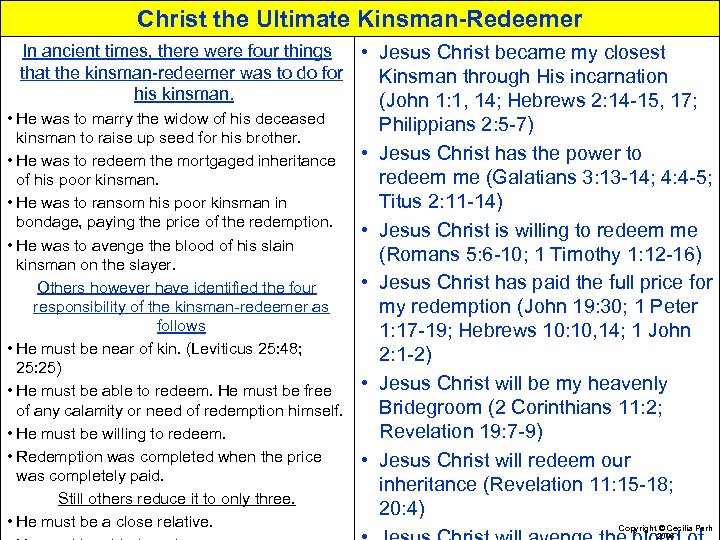
Christ the Ultimate Kinsman-Redeemer In ancient times, there were four things that the kinsman-redeemer was to do for his kinsman. • He was to marry the widow of his deceased kinsman to raise up seed for his brother. • He was to redeem the mortgaged inheritance of his poor kinsman. • He was to ransom his poor kinsman in bondage, paying the price of the redemption. • He was to avenge the blood of his slain kinsman on the slayer. Others however have identified the four responsibility of the kinsman-redeemer as follows • He must be near of kin. (Leviticus 25: 48; 25: 25) • He must be able to redeem. He must be free of any calamity or need of redemption himself. • He must be willing to redeem. • Redemption was completed when the price was completely paid. Still others reduce it to only three. • He must be a close relative. • Jesus Christ became my closest Kinsman through His incarnation (John 1: 1, 14; Hebrews 2: 14 -15, 17; Philippians 2: 5 -7) • Jesus Christ has the power to redeem me (Galatians 3: 13 -14; 4: 4 -5; Titus 2: 11 -14) • Jesus Christ is willing to redeem me (Romans 5: 6 -10; 1 Timothy 1: 12 -16) • Jesus Christ has paid the full price for my redemption (John 19: 30; 1 Peter 1: 17 -19; Hebrews 10: 10, 14; 1 John 2: 1 -2) • Jesus Christ will be my heavenly Bridegroom (2 Corinthians 11: 2; Revelation 19: 7 -9) • Jesus Christ will redeem our inheritance (Revelation 11: 15 -18; 20: 4) Copyright © Cecilia Perh 2006
Скачать презентацию Typical Aspects of Ruth J Sidow Baxter Explore the
7d0ac731d66b92b3bacf17e07fe53f60.ppt