 Скачать презентацию TYPES OF UNIVERSITIES FOR UNDERGRAD BACHELOR DEGREE COLLEGE
Types of Universities.pptx
- Количество слайдов: 29




TYPES OF UNIVERSITIES FOR UNDERGRAD (BACHELOR DEGREE; COLLEGE) CHOOSING A RIGHT SCHOOL FOR YOU.
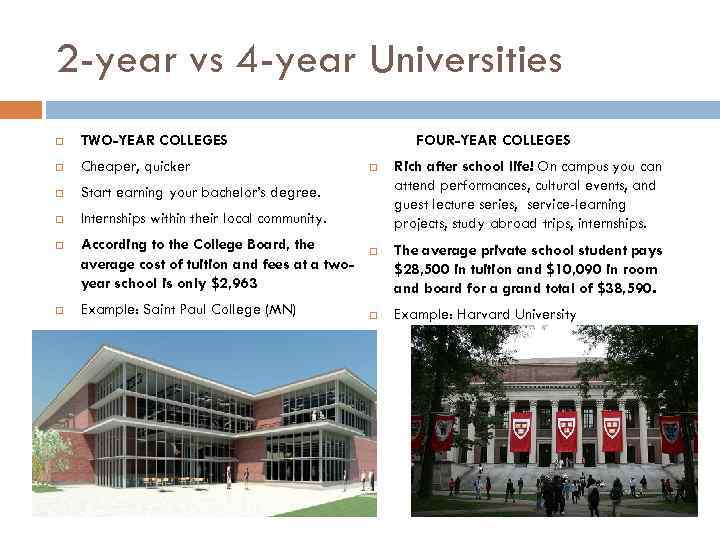
2 -year vs 4 -year Universities Cheaper, quicker Start earning your bachelor’s degree. Internships within their local community. According to the College Board, the average cost of tuition and fees at a twoyear school is only $2, 963 Example: Saint Paul College (MN) FOUR-YEAR COLLEGES TWO-YEAR COLLEGES Rich after school life! On campus you can attend performances, cultural events, and guest lecture series, service-learning projects, study abroad trips, internships. The average private school student pays $28, 500 in tuition and $10, 090 in room and board for a grand total of $38, 590. Example: Harvard University
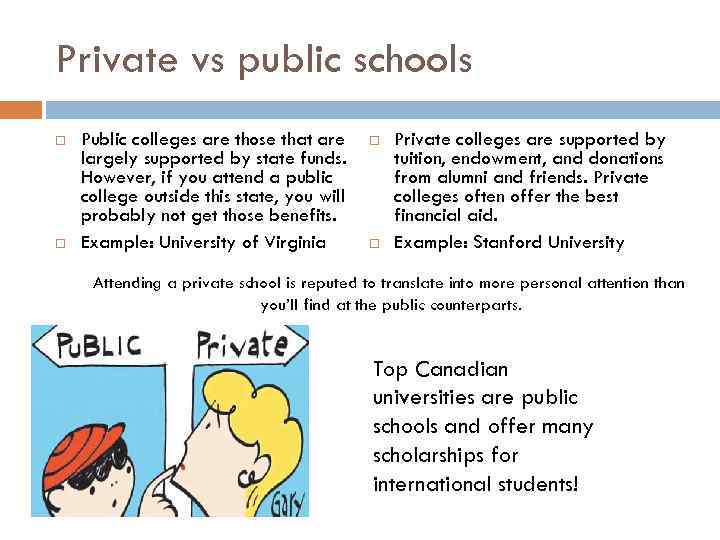
Private vs public schools Public colleges are those that are largely supported by state funds. However, if you attend a public college outside this state, you will probably not get those benefits. Example: University of Virginia Private colleges are supported by tuition, endowment, and donations from alumni and friends. Private colleges often offer the best financial aid. Example: Stanford University Attending a private school is reputed to translate into more personal attention than you’ll find at the public counterparts. Top Canadian universities are public schools and offer many scholarships for international students!
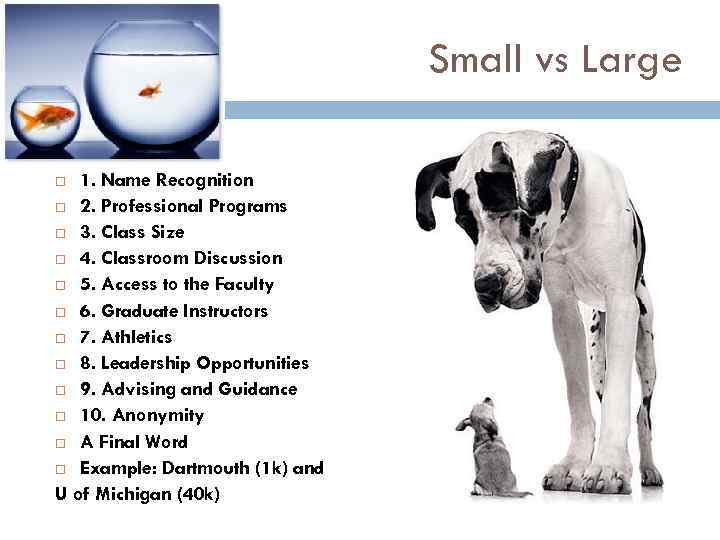
Small vs Large 1. Name Recognition 2. Professional Programs 3. Class Size 4. Classroom Discussion 5. Access to the Faculty 6. Graduate Instructors 7. Athletics 8. Leadership Opportunities 9. Advising and Guidance 10. Anonymity A Final Word Example: Dartmouth (1 k) and U of Michigan (40 k)
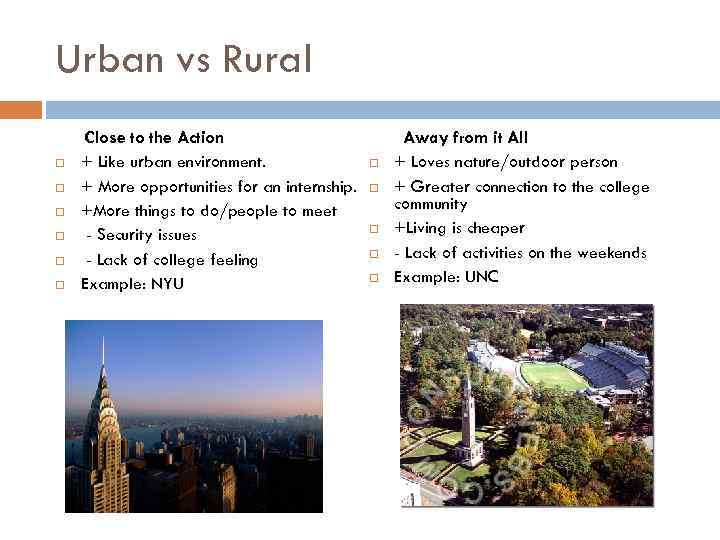
Urban vs Rural Close to the Action + Like urban environment. + More opportunities for an internship. +More things to do/people to meet - Security issues - Lack of college feeling Example: NYU Away from it All + Loves nature/outdoor person + Greater connection to the college community +Living is cheaper - Lack of activities on the weekends Example: UNC
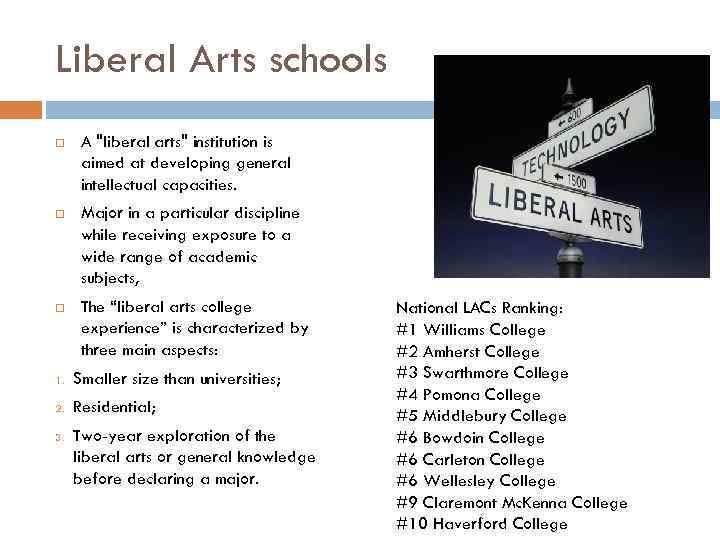
Liberal Arts schools A "liberal arts" institution is aimed at developing general intellectual capacities. Major in a particular discipline while receiving exposure to a wide range of academic subjects, The “liberal arts college experience” is characterized by three main aspects: 1. Smaller size than universities; 2. Residential; 3. Two-year exploration of the liberal arts or general knowledge before declaring a major. National LACs Ranking: #1 Williams College #2 Amherst College #3 Swarthmore College #4 Pomona College #5 Middlebury College #6 Bowdoin College #6 Carleton College #6 Wellesley College #9 Claremont Mc. Kenna College #10 Haverford College
Colleges that change lives (ctcl. org) Low student-to-faculty ratios. Classes are taught by professors. Faculty are dedicated and passionate about what they do. Emphasis on Liberal Arts. Environment that emphasizes the benefits of community, personal growth, and involvement. Smaller schools. Out-of-classroom learning opportunities that provide students with an added perspective about themselves, their interests, and the global community. Holistic admission policies including "testoptional" applications for admission. Strong Alumni networks An ideal living and learning environment
Ivy League The Ivy League is a group of 8 private institutions of higher education. The term Ivy League also has connotations of academic excellence, selectivity in admissions, and social elitism. The eight institutions are: Brown University Columbia University Cornell University Dartmouth College Harvard University Princeton University of Pennsylvania Yale University.
How to choose? No national ranking can tell you which college or university is the best match for you, however you should still pay attention to the rankings (THE, ARWU, US news). There are 15 factors that can differentiate your dream school.
High graduation rate If the majority of students at a college don't graduate in four years, then the majority of students are spending a lot of money for a goal that will evade them. The most selective colleges enroll students who are extremely well prepared for college-level work. These students are likely to succeed and, in the process, boost the college's four-year graduation rate. Professional programs in fields such as engineering, nursing and education are more likely to take five years. Look for 60 -100% graduation rate
Student/faculty ratio The student / faculty ratio is an important figure to consider when looking at colleges, but it is also a piece of data that is easy to misinterpret. As a result, the faculty tend to teach fewer courses than at schools where research is valued less and teaching is valued more. The lower the ratio, the more likely it is that your professors will be able to give you personal attention. A healthy ratio to be 15 to 1 or lower. Different schools will calculate the number somewhat differently. A related and more meaningful piece of data is the average class size.
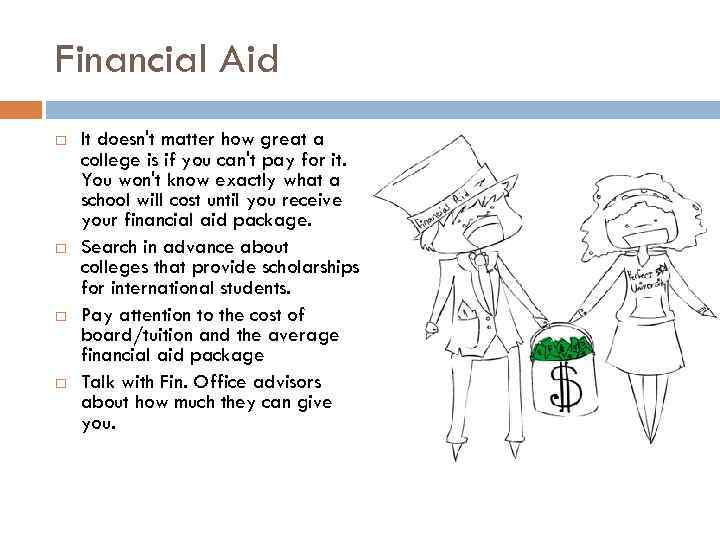
Financial Aid It doesn't matter how great a college is if you can't pay for it. You won't know exactly what a school will cost until you receive your financial aid package. Search in advance about colleges that provide scholarships for international students. Pay attention to the cost of board/tuition and the average financial aid package Talk with Fin. Office advisors about how much they can give you.
Internships and research opportunities When senior year of college rolls around and you start applying for jobs, nothing helps more than having some hands-on, practical experiences listed on your resume. Does the college support students to assist professors with their research? Does the college have funds to support independent undergraduate research? Has the college fostered relationships with companies and organizations to help students get meaningful summer internships? Does the college have a strong alumni network to help students get summer work in their fields of study?
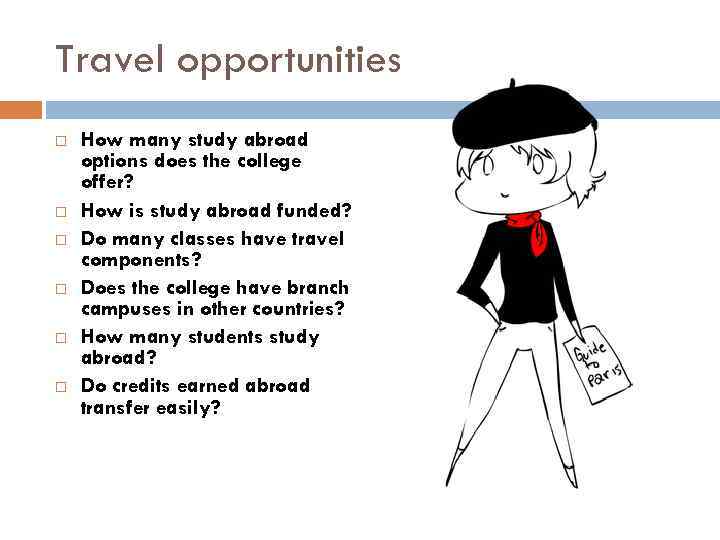
Travel opportunities How many study abroad options does the college offer? How is study abroad funded? Do many classes have travel components? Does the college have branch campuses in other countries? How many students study abroad? Do credits earned abroad transfer easily?
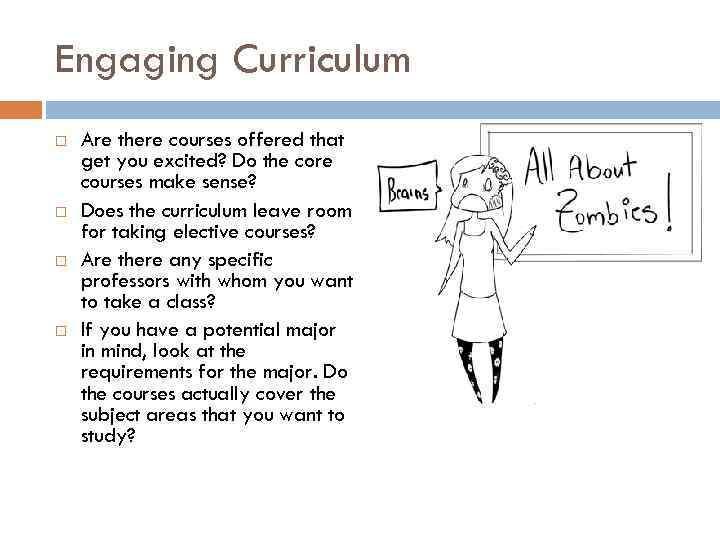
Engaging Curriculum Are there courses offered that get you excited? Do the core courses make sense? Does the curriculum leave room for taking elective courses? Are there any specific professors with whom you want to take a class? If you have a potential major in mind, look at the requirements for the major. Do the courses actually cover the subject areas that you want to study?
Club and activities to match your interests Before choosing a college, make sure the school has your extracurricular interests covered. If debate is your thing, make sure the colleges you consider actually have a debate team. You'll find schools that place a lot of emphasis on the performing arts, outdoor activities, intramural sports, volunteerism, or Greek life. Find schools that complement your interests. While the curriculum may be the most important feature of a college, you'll be miserable if you don't have a stimulating life outside of academics.
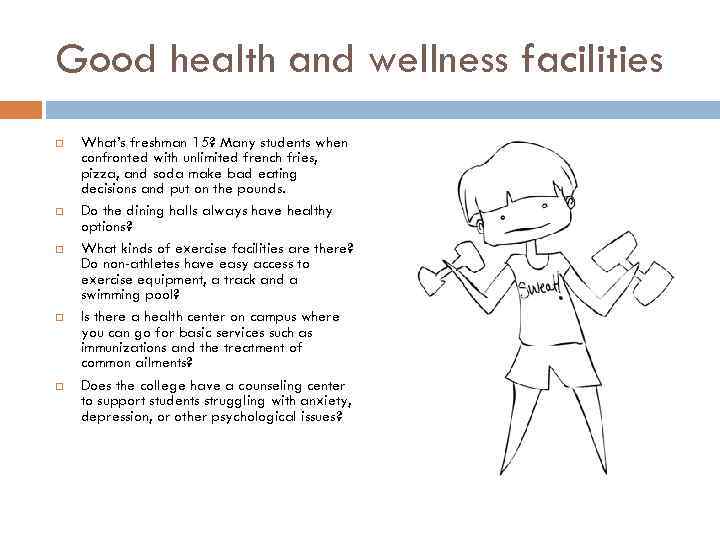
Good health and wellness facilities What’s freshman 15? Many students when confronted with unlimited french fries, pizza, and soda make bad eating decisions and put on the pounds. Do the dining halls always have healthy options? What kinds of exercise facilities are there? Do non-athletes have easy access to exercise equipment, a track and a swimming pool? Is there a health center on campus where you can go for basic services such as immunizations and the treatment of common ailments? Does the college have a counseling center to support students struggling with anxiety, depression, or other psychological issues?
Campus safety Most colleges are extremely safe, and even urban campuses tend to be more safe than the surrounding neighborhoods. Students can be tempting targets for petty thieves, and bicycle and car theft are not unusual on many campuses, especially in cities. As you research different colleges, ask about campus crime. Are there many incidents? Does the college have its own police force? To learn about the reported crime statistics for a specific campus, visit The Campus Safety and Security Data Analysis Cutting Tool created by the U. S. Department of Education.

Good academic support services Does the college have a writing center? Can you get an individual tutor for a class? Are the faculty members required to hold weekly office hours? Do first-year classes have upper-class mentors affiliated with them? Do most classes have review and study sessions before major exams? Students must be offered reasonable accommodations such as extended time on exams, separate testing locations, and whatever else may be needed to help a student perform up to his or her potential.
Strong Career Services Most students go to college with the hope of either getting into a good graduate program or landing an appealing job upon graduation. What help and guidance does the school provide as you apply for jobs, internships and graduate study? Does the college bring job fairs and graduate school fairs to campus? What is the college's job placement rate? What percentage of students go on to graduate school, and what programs are accepting them? Does the college have a program for helping students find meaningful summer work? Does the college help students write and develop their resumes? Does the college conduct mock interviews to help students prepare for the real thing? Does the college have an involved alumni base to help students get leads on jobs? Does the college have resources to help students prepare for graduate entrance exams such as the GRE, MCAT, and LSAT? Does the college have services for providing feedback on graduate school applications and personal statements?
Technology How many public computing labs are available for students, and what are their hours? Are there any dead spots in the campus wireless network? Are most classes taught in "smart classrooms"? Are the professors taking advantage of emerging technologies? Are laptops, projectors, cameras, and other equipment available for students to borrow? Does the college have a hardwired internet connection for every residence hall student?
Leadership Opportunities When you are applying for jobs or graduate programs, you'll want to be able to demonstrate strong leadership skills. Does the college have a leadership program? Does the college offer public speaking workshops or classes? How easy or difficult is it to become an officer of a student club or activity? Are there opportunities for upper-class students to become tutors, peer mentors, or peer leaders for introductory-level classes? Can undergraduates start new clubs or activities on campus? What is the procedure? Does the college offer courses to teach leadership skills?
Alumni Network When you enroll at a college, you immediately link yourself to every person who ever attended that college. Does the campus career center take advantage of the alumni network for internships and job opportunities? Who are the alumni? Finally, an active alumni network says something positive about a college. If the alumni care enough about their alma mater to continue donating their time and money long after graduation, they must have had a positive college experience.
Collegeboard. org What to look for: Major ACT/TOEFL scores GPA Acceptance rate Financial Aid
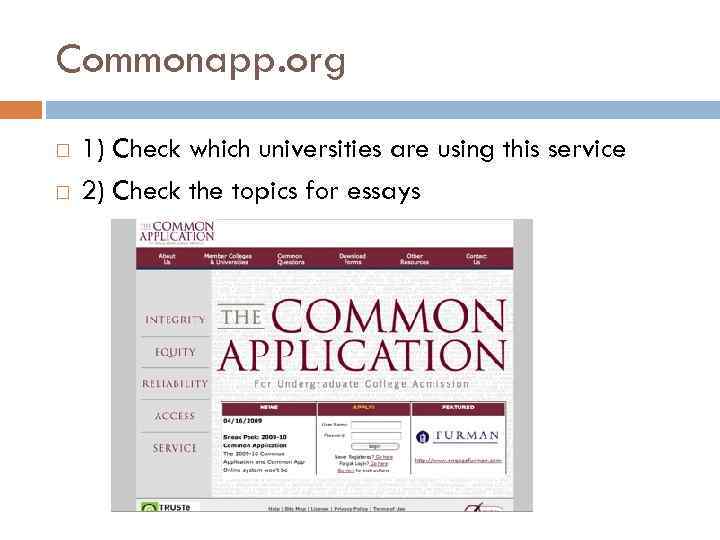
Commonapp. org 1) Check which universities are using this service 2) Check the topics for essays
How many colleges do you need to apply to? Begin with 15 or so possible choices and narrow down your list after carefully researching schools, visiting their campuses and talking with students. 3 Reach Schools These are schools with highly selective admissions. Your grades and scores are below the averages for these schools. When you study the admissions data, you find that there's a possibility you'll get in, but it's a bit of a long shot. 3 Match Schools When you look at the profiles for these colleges, your academic record and test scores are right in line with the averages. You feel that you measure up favorably with typical applicants for the school and that you have a decent chance of being admitted. 2 Safety Schools These are schools where your academic record and scores are measurably above the average of admitted students. Realize that highly selective schools are never safety schools, even If your scores are above the averages.
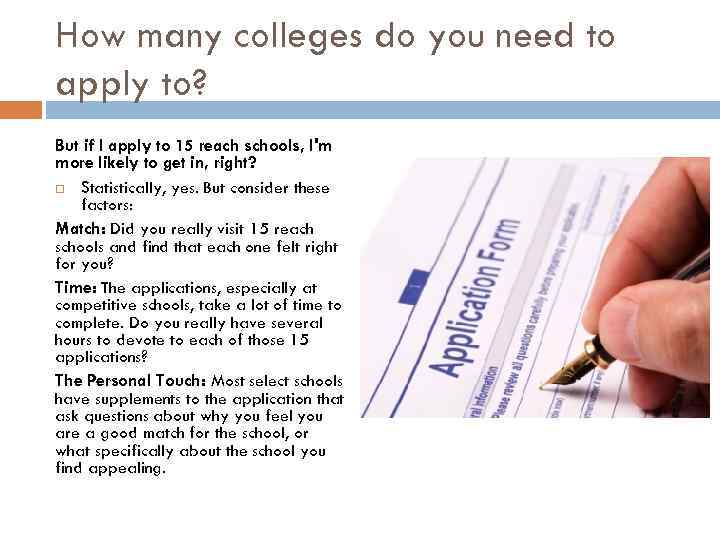
How many colleges do you need to apply to? But if I apply to 15 reach schools, I'm more likely to get in, right? Statistically, yes. But consider these factors: Match: Did you really visit 15 reach schools and find that each one felt right for you? Time: The applications, especially at competitive schools, take a lot of time to complete. Do you really have several hours to devote to each of those 15 applications? The Personal Touch: Most select schools have supplements to the application that ask questions about why you feel you are a good match for the school, or what specifically about the school you find appealing.
Homework Fill in the forms with 3 Reach schools/3 Match schools/2 safety ones. Bring it on Thursday Use collegeboard. org to find the colleges.
Next session TOEFL preparation Thursday, 10 am, American Center What to bring: 1) Flash drive 2) Pencils/notebook 3) Homework Thank you for coming!
Скачать презентацию TYPES OF UNIVERSITIES FOR UNDERGRAD BACHELOR DEGREE COLLEGE
Types of Universities.pptx