


 Скачать презентацию TYPES OF SERVICES AND CENTRAL PLACE THEORY
73e199e93f770a4a7aa62ff17e38cfe3.ppt
- Количество слайдов: 14
 TYPES OF SERVICES AND CENTRAL PLACE THEORY
 TYPES OF SERVICES Which sector of the economy generates more than 2/3 of GDP in developed countries? Consumer Services § Provide services to individuals who desire them and can afford to pay for them § Examples? Business Services § Facilitate the activities of other businesses § Professional, Financial and Transportation and Information Services § Examples? Public Services § Provide security and protection for citizens and businesses § Most public service jobs are with the government § Examples?
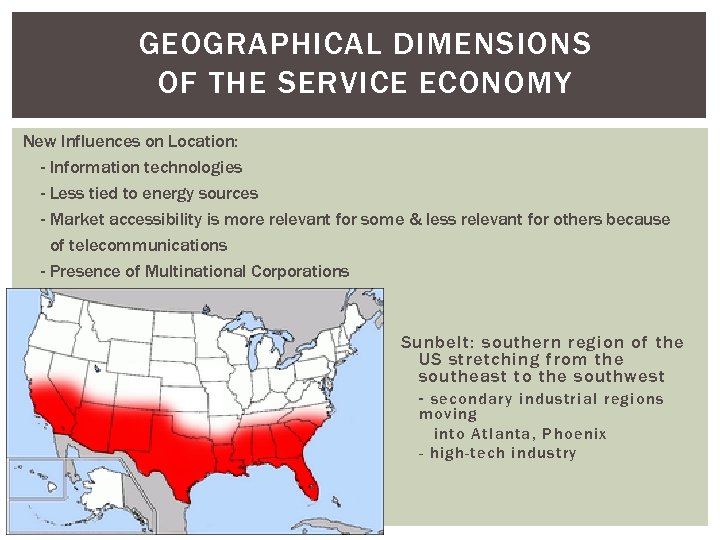 GEOGRAPHICAL DIMENSIONS OF THE SERVICE ECONOMY New Influences on Location: - Information technologies - Less tied to energy sources - Market accessibility is more relevant for some & less relevant for others because of telecommunications - Presence of Multinational Corporations Sunbelt: southern region of the US stretching from the southeast to the southwest - secondary industrial regions moving into Atlanta, Phoenix - high-tech industry
 CENTRAL PLACE THEORY Selecting the right location for a new shop is probably the single most important factor in the profitability of a consumer service How far would you travel if you wanted… § § § § Groceries? Good Italian food? A college/university? A new car? Professional sports team? An amusement park? An art museum? An airport? Would you travel farther to buy a new car or a week’s groceries? Would you travel farther to see your family physician or a heart specialist? Would you travel farther to go to elementary school or to go to high school?
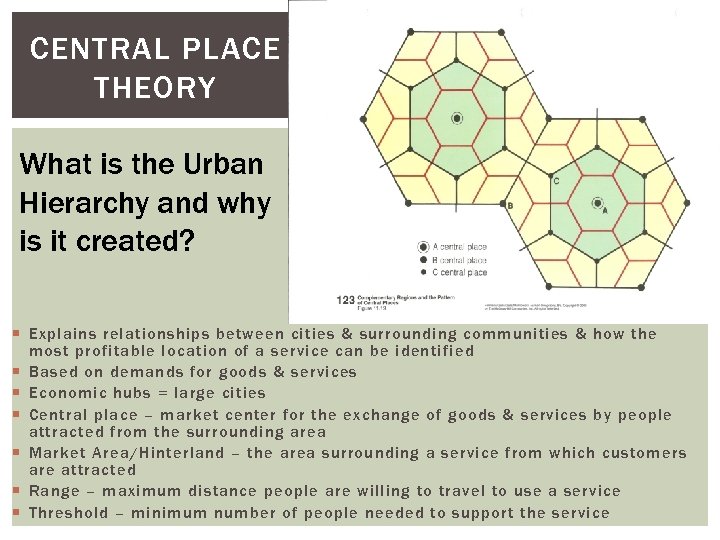 CENTRAL PLACE THEORY What is the Urban Hierarchy and why is it created? Explains relationships between cities & surrounding communities & how the most profitable location of a service can be identified Based on demands for goods & services Economic hubs = large cities Central place – market center for the exchange of goods & services by people attracted from the surrounding area Market Area/Hinterland – the area surrounding a service from which customers are attracted Range – maximum distance people are willing to travel to use a service Threshold – minimum number of people needed to support the service
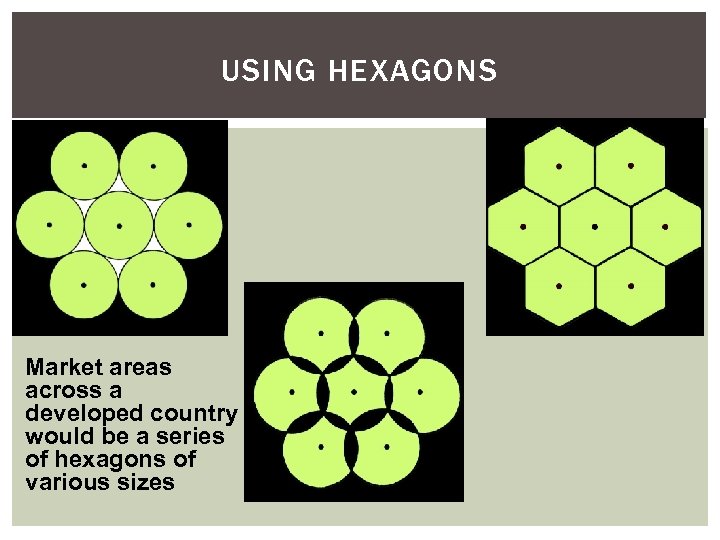 USING HEXAGONS Market areas across a developed country would be a series of hexagons of various sizes
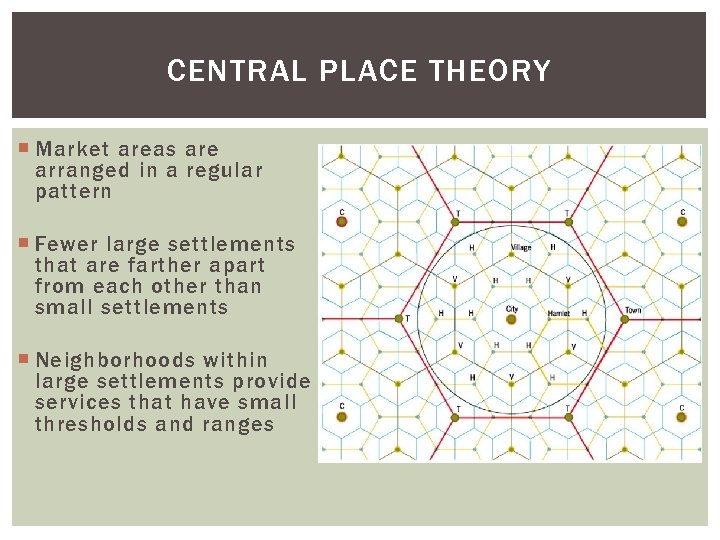 CENTRAL PLACE THEORY Market areas are arranged in a regular pattern Fewer large settlements that are farther apart from each other than small settlements Neighborhoods within large settlements provide services that have small thresholds and ranges
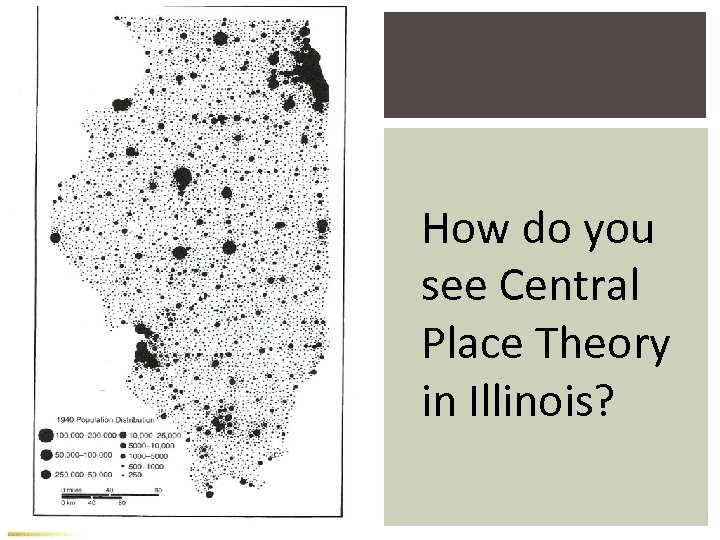 How do you see Central Place Theory in Illinois?
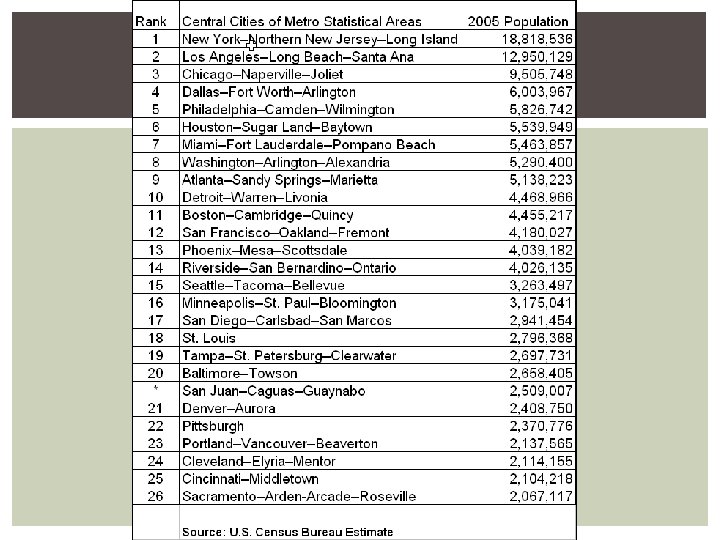
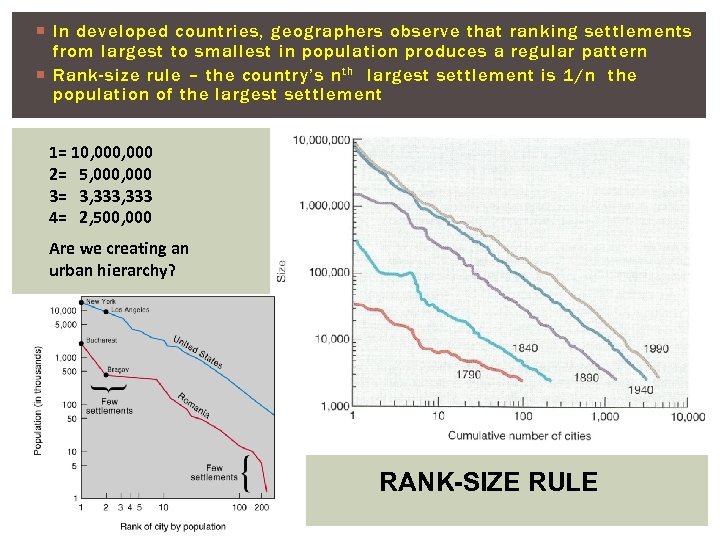 In developed countries, geographers observe that ranking settlements from largest to smallest in population produces a regular pattern Rank-size rule – the country’s n t h largest settlement is 1/n the population of the largest settlement 1= 10, 000 2= 5, 000 3= 3, 333 4= 2, 500, 000 Are we creating an urban hierarchy? RANK-SIZE RULE
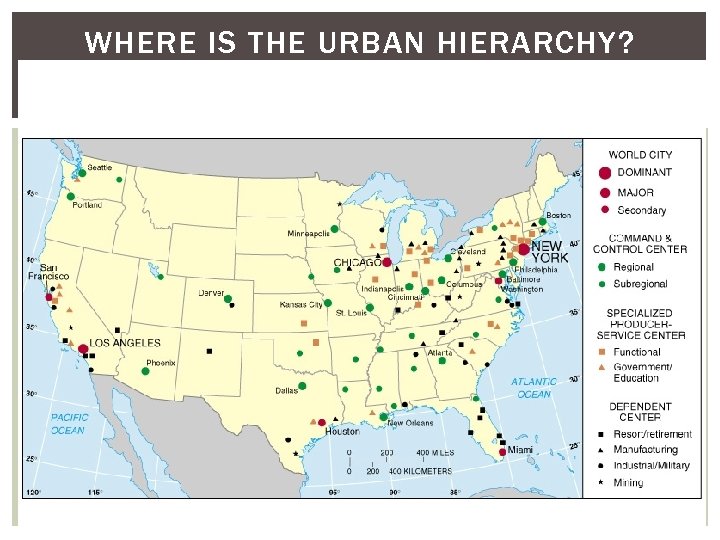 WHERE IS THE URBAN HIERARCHY?
 PRIMATE CITY Countries that do not follow the rank-size rule may follow the primate city rule § The largest settlement has more than twice as many people as the second-ranking settlement § Largest city - primate city § Mexico City – primate city § Guadalajara - 2 nd largest country, 5 times smaller than Mexico City Rank-size rule indicates that society is sufficiently wealthy to justify the provision of goods and services to consumers throughout the country Absence of rule indicates a hardship for people who must travel long distances to reach an urban settlement with shops and services
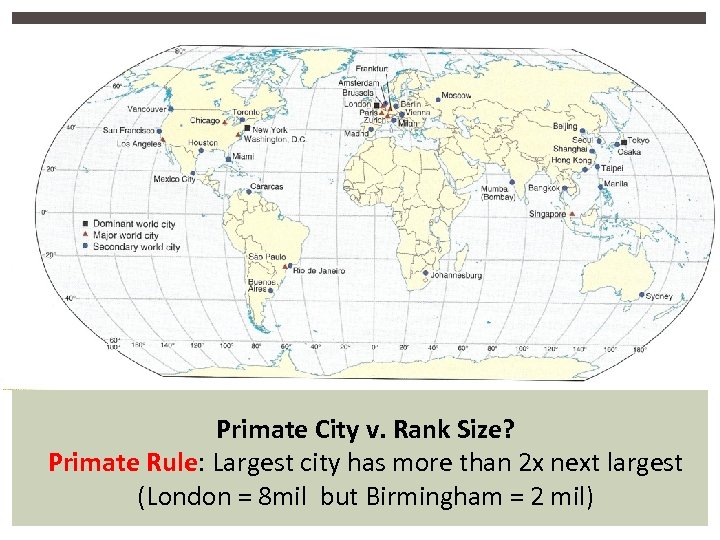 Primate City v. Rank Size? Primate Rule: Largest city has more than 2 x next largest (London = 8 mil but Birmingham = 2 mil)
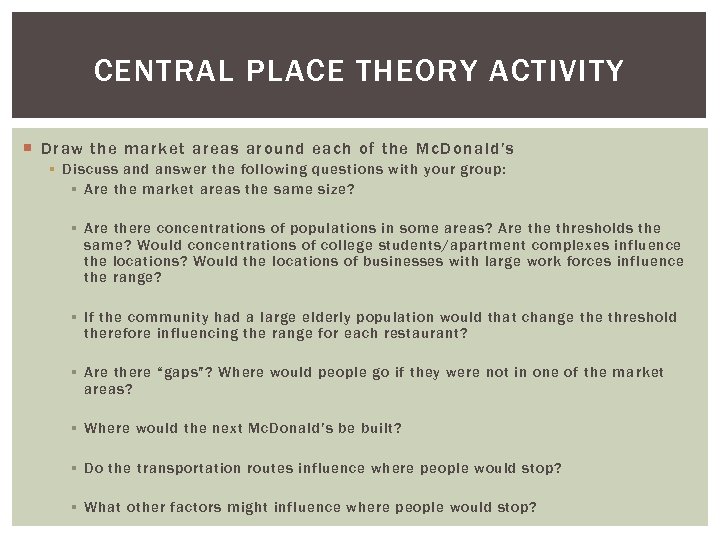 CENTRAL PLACE THEORY ACTIVITY Draw the market areas around each of the Mc. Donald’s § Discuss and answer the following questions with your group: § Are the market areas the same size? § Are there concentrations of populations in some areas? Are thresholds the same? Would concentrations of college students/apartment complexes influence the locations? Would the locations of businesses with large work forces influence the range? § If the community had a large elderly population would that change threshold therefore influencing the range for each restaurant? § Are there “gaps”? Where would people go if they were not in one of the market areas? § Where would the next Mc. Donald’s be built? § Do the transportation routes influence where people would stop? § What other factors might influence where people would stop?