


 Скачать презентацию Types of Investments Investments Investments —
793d4b33e0efb4e9d01c731fc48fbc59.ppt
- Количество слайдов: 48
 Types of Investments
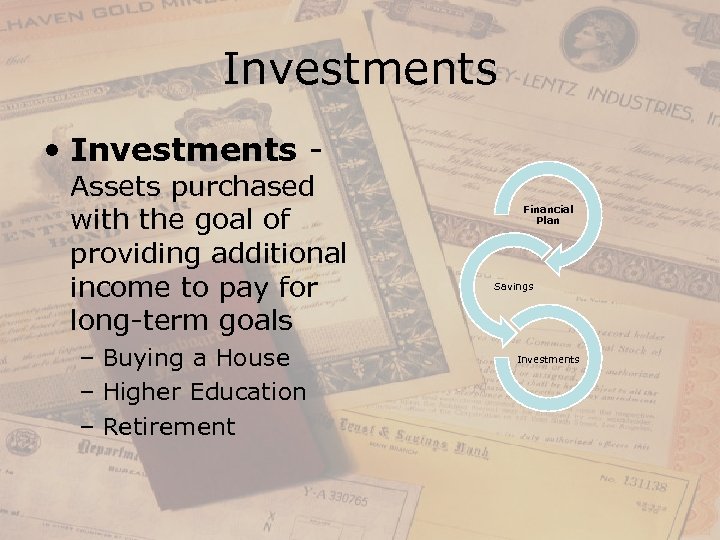 Investments • Investments - Assets purchased with the goal of providing additional income to pay for long-term goals – Buying a House – Higher Education – Retirement Financial Plan Savings Investments
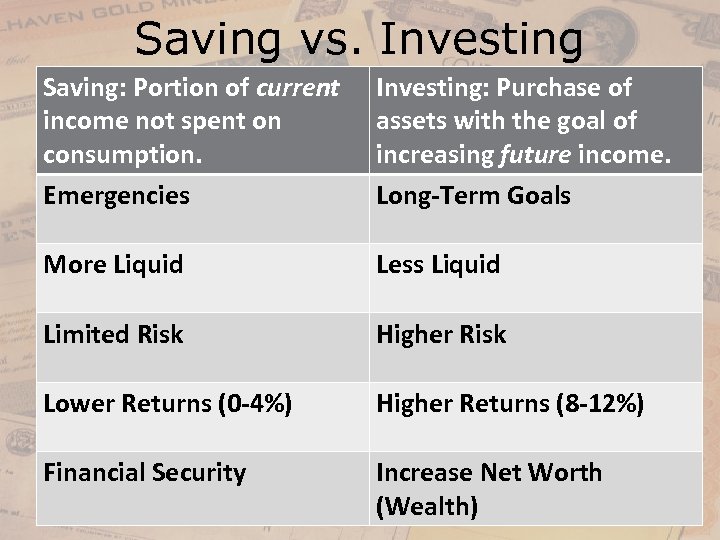 Saving vs. Investing Saving: Portion of current income not spent on consumption. Emergencies Investing: Purchase of assets with the goal of increasing future income. Long-Term Goals More Liquid Less Liquid Limited Risk Higher Risk Lower Returns (0 -4%) Higher Returns (8 -12%) Financial Security Increase Net Worth (Wealth)
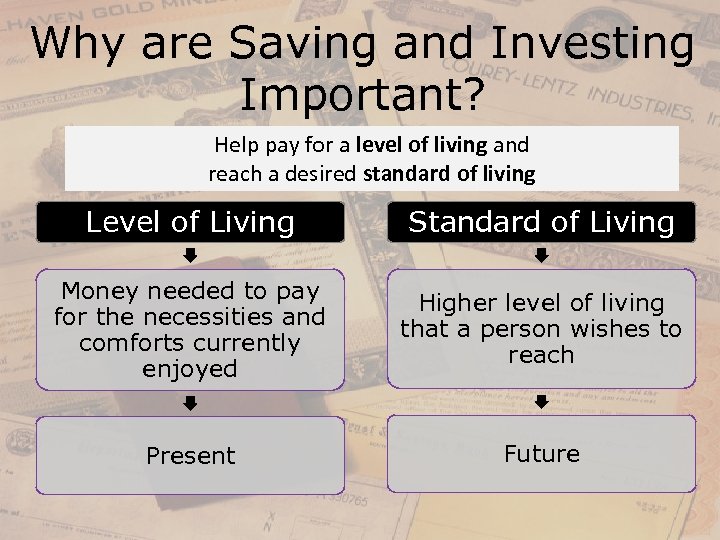 Why are Saving and Investing Important? Help pay for a level of living and reach a desired standard of living Level of Living Standard of Living Money needed to pay for the necessities and comforts currently enjoyed Higher level of living that a person wishes to reach Present Future
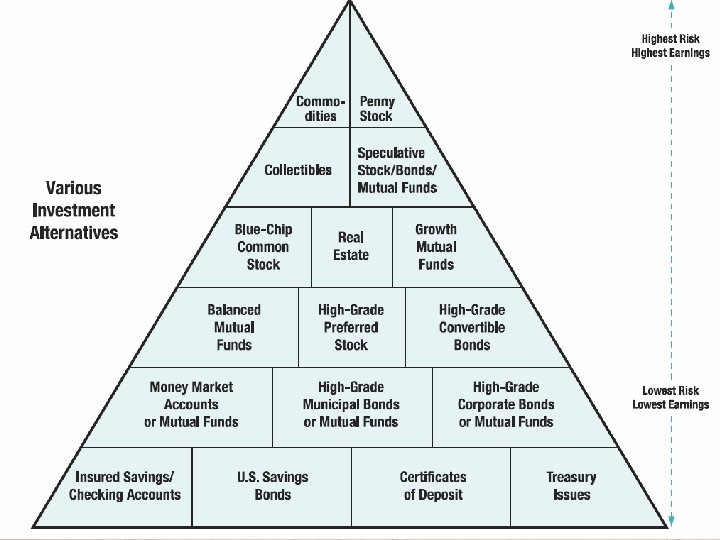
 Types of Investments • Stocks – “Blue Chip” – Common vs Preferred • Bonds • Mutual Funds • Real Estate • Savings/Certificates of Deposit • Collectibles
 Stocks • An investment that represents ownership in a company or corporation.
 “Blue Chip” Stocks • Nickname for a stock that is: – Thought to be safe and has less ups and downs – Well known companies with a long record of profit growth and dividend payment – Have a reputation for quality management • Examples: Coca-Cola, Gillette, Exxon. Mobile, General Electric
 Common vs Preferred Stock • Similarities – Both represent ownership – Both may receive dividend payments • Differences – Preferred stockholders are paid dividends first, on a set schedule and higher than common stockholders, but have no voting rights – Common stockholders are paid dividends only if the Board of Directors of the company decides to pay and there is no set schedule or payment amount – Common stockholders vote on who will sit on the Board of Directions and help form company policy
 Stock Split • When stocks go up in price this may indicate a vote of confidence in the company and its future • If the price gets too high, it can be difficult for new investors to buy blocks of stock • Companies may then issue 2 -for-1 stock splits: – The price of stock is split in half, but the number of shares doubles – Example: Stock closes at $50 at the end of day but opens the next day at $25, if stockholder owned 100 shares before the split, she/he now owns 200 shares of stock at the new price
 Dividend Reinvestment • When a company declares a dividend, it takes profit that it has earned during the year and pays the funds to investors based on the number of shares they hold • Some companies offer a “dividend reinvestment” plan – Money earned through the dividend payment is used to purchase additional shares in the company
 How Well the Stock Market is Doing Overall
 3 Basic Indicators • Dow Jones Industrial Average (“DOW”) – Lists the 30 leading industrial blue chip stocks • Standard and Poor’s 500 Composite Index – Covers market activity for 500 stocks – More accurate than DOW because it evaluates a greater variety of stock • National Association of Security Dealers Automated Quotations (“NASDAQ”) – Monitors fast moving technology companies – Speculative stocks, show dramatic ups and downs
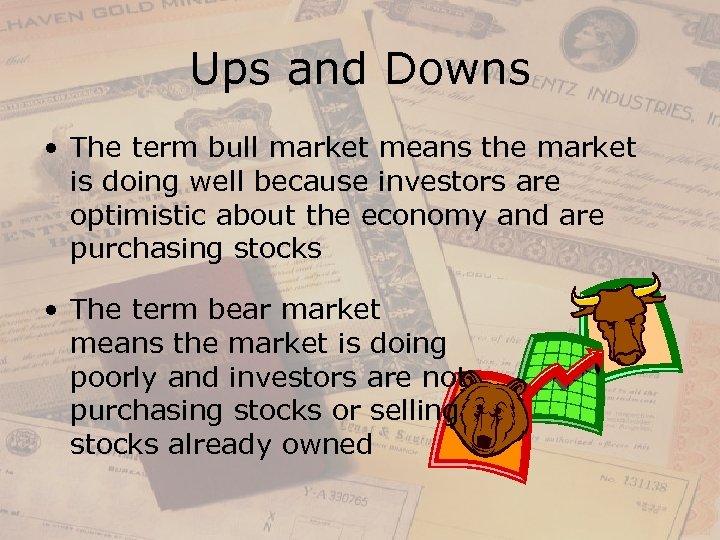 Ups and Downs • The term bull market means the market is doing well because investors are optimistic about the economy and are purchasing stocks • The term bear market means the market is doing poorly and investors are not purchasing stocks or selling stocks already owned
 Purchasing Stock
 Brokers • A Broker is a person who is licensed to buy and sell stocks, provide investment advice, and collect a commission on each purchase or sale – Purchases stocks on an organized exchange (stock market) – Over ¾ of all stocks are bought and sold on an organized exchange
 Organized Exchanges • Minimum requirements for a stock to ensure only reputable companies are used • Each exchange has a limited number of seats available which brokerage firms purchase to give them the legal right to buy and sell stocks on the exchange
 New York Stock Exchange • New York Stock Exchange (NYSE) – Oldest and largest, began in 1792 – 1, 366 seats available – 2, 800 companies – Average stock price is $33. 00 – Strict requirements
 American Stock Exchange • American Stock Exchange – Began in 1849 – 2 nd largest exchange – It’s requirements are not as strict as NYSE allowing younger, smaller companies to list – Average stock price is $24. 00
 Regional Stock Exchanges • Regional Stock Exchanges – Stocks are traded to investors living in a specific geographical area • Including Boston, Cincinnati, Philadelphia, Spokane
 NASDAQ • National Association of Securities Dealers Automated Quotations – Stocks are traded in an over the counter electronic market – 4, 000 small companies • Company requirements are not as strict – More volatile because companies are young and new – Average stock price is $11. 00
 Bonds • A security representing a loan of money from a lender to a borrower for a set time period, which pays a fixed rate of interest • Corporations issue bonds to raise money for expansion or other company operations • Local governments issue Municipal bonds to raise money to build roads, bridges and other construction projects – If you bought a Microsoft bond, you would be lending money to Microsoft to expand the company or for new research and development
 U. S. Savings Bonds • A federally issued debt instrument that you can purchase directly from the Treasury or banks • Savings bonds are conservative instrument on which you can earn interest for up to 30 years – EE bonds cost 50% of face value – Interest earned on EE bonds are exempt from state and local taxes
 Treasury Bills • Nicknamed “T-Bill” – Short-term debt obligation backed by the U. S. government with a maturity of less than one year – Common maturities of: • 1 month (Four weeks) • 3 months (13 weeks) • 6 months (26 weeks) – Sold in denominations of $1, 000 up to a maximum purchase of $5 million • Considered to be a secure, low-risk investment
 Mutual Funds • An investment that pools money from several investors to buy a wide range of different investment instrument, providing diversification
 Retirement • Individual Retirement Accounts – Traditional: • Can deposit up to $5500 per year pre-tax dollars if under age of 50 • Can lower your taxable income thus lowering the amount taxes payable to government • Doesn’t require that you pay taxes on your gains until start withdrawals after 59 ½ years • Can be penalized for early withdrawals • Mandatory withdrawals at 70 ½ years and no further contributions
 Retirement – Roth IRA • Can deposit up to $5500 per year after taxes • Will not lower taxable income • Can withdraw funds at any time without taxes or penalty if Roth is held at least 5 years or 59 ½ years • Can use up to $10, 000 to purchase first home for yourself or family member or pay for higher-education costs for yourself or family member • No mandatory withdrawals and can continue depositing after the age of 70 ½ years
 • 401(k) Retirement – Employer sponsored retirement plan offered to employees of public or private for-profit companies – Money is deducted from paycheck before taxes which lowers taxable income – Maximum contribution of $17, 500 if under the age of 50 – Employers may or may not contribute additional funds – Penalty for early withdrawal – Taxes paid at the time of withdrawal
 Retirement • 403(b) – Employer sponsored retirement savings plan offered to employees of tax-exempt or non-profit organizations – Money is deducted from paycheck before taxes which lowers taxable income but must pay Social Security and Medicare – Money taxed when withdrawn – Penalty for early withdrawal
 Real Estate • An investor buys pieces of property, such as land or a building, in hopes of generating a profit • Investor may buy apartments for rental income: – Careful: Profits may be lower than expected if units go un-rented!
 Savings/Certificates of Deposits • A deposit that earns a fixed interest rate for a specified length of time. – The longer the time period the greater the rate of return. – There is a substantial penalty for early withdrawal.
 Collectibles • Unique items that are relatively rare or highly valued. – Art work – Baseball trading cards – Coins – Automobiles – Antiques – Gems – Comic books – Rare books – Stamps
 Risk vs. Return • On average, stocks have a high rate of return – The increase or decrease in the original purchase price of an investment • Higher rate of return = greater risk – Uncertainty about the outcome of an investment • Stocks provide portfolio diversification – Money invested in a variety of investment tools
 Short-term Investment Strategies • Buying on margin is where an investor borrows part of the money needed to invest in a stock from a brokerage firm – There is a 50% margin requirement. – If you want to purchase $2, 000 worth of stock you can borrow up to $1, 000 to make the purchase
 Short-term Investment Strategies • Short selling is where an investor sells shares of stock that they don’t own with the intent to buy them back later at a lower price. – Let’s use rollerblades as an example.
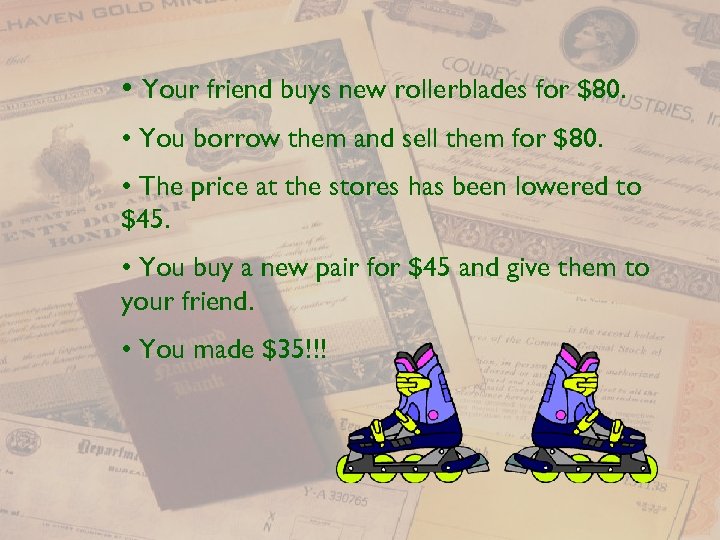 • Your friend buys new rollerblades for $80. • You borrow them and sell them for $80. • The price at the stores has been lowered to $45. • You buy a new pair for $45 and give them to your friend. • You made $35!!!
 Long-term Investment Strategies • Diversification is spreading your assets among different types of investments to reduce risk. – Don’t put all your eggs in one basket.
 Long-term Investment Strategies • Dollar Cost Averaging is buying an equal amount of the same stock at equal intervals. – Invest $100 in e-bay every month. The price you pay for the stock averages out over time.
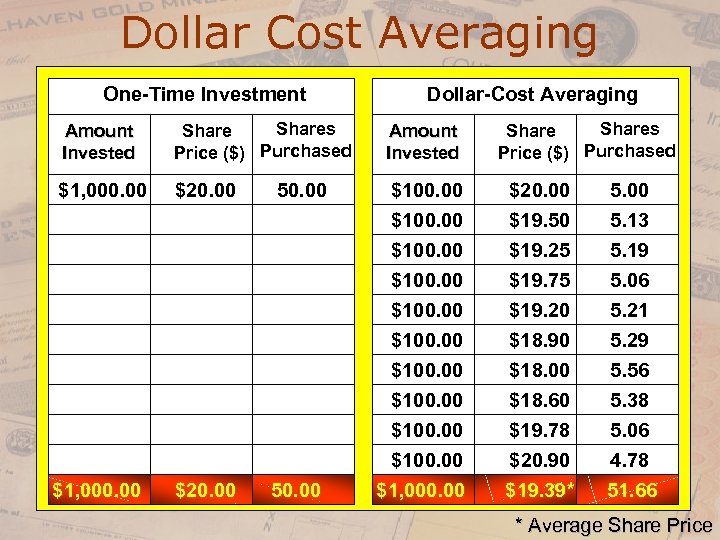 Dollar Cost Averaging One-Time Investment Dollar-Cost Averaging Amount Invested Shares Share Price ($) Purchased $1, 000. 00 $20. 00 50. 00 $100. 00 $20. 00 $19. 50 $19. 25 $19. 75 $19. 20 $18. 90 $18. 00 $18. 60 $19. 78 $20. 90 5. 00 5. 13 5. 19 5. 06 5. 21 5. 29 5. 56 5. 38 5. 06 4. 78 $1, 000. 00 $20. 00 50. 00 $1, 000. 00 $19. 39* 51. 66 * Average Share Price
 Long-term Investment Strategies • Buy and hold technique is where an investor buys stock and holds on to it for a number of years. – During that time you are paid dividends and the price of the stock may go up.
 How Can Government Regulations Protect Investors? • Regulatory Pyramid – A network of safeguards that surrounds the securities industry from individual brokerages all the way up to the U. S. Congress – Companies/corporations must register with SEC (Securities and Exchange Commission) before it can issue stock or bonds
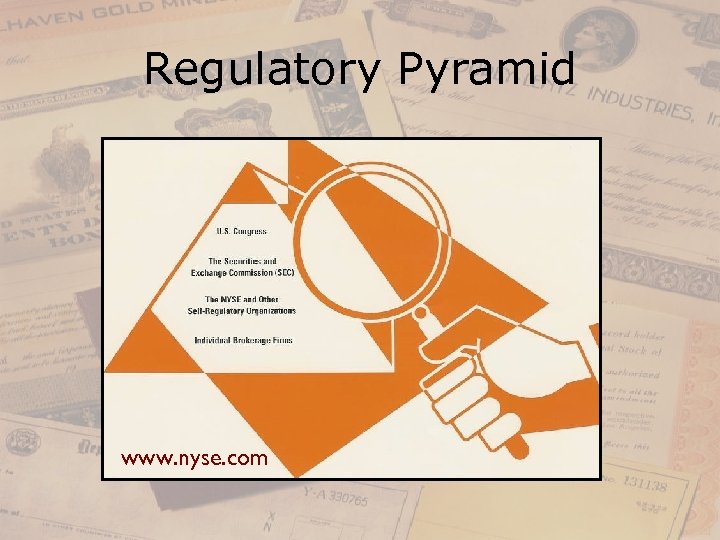 Regulatory Pyramid www. nyse. com
 Sources of Investment Information • Prospectus – A formal written offer to sell securities that sets forth a plan for a proposed business enterprise. A prospectus should contain the facts that an investor needs to make an informed decision. • IPO (Initial Public Offering) – First time a company publicly sells shares of its stock on the open market. – Also known as “going public. ”
 Sources of Investment Information • Annual Report – A document detailing the business activity of a company over the previous year, and containing an income statement, cash flow statement, and balance sheet.
 Sources of Investment Information • Financial publications – Wall Street Journal – Fortune – Kiplingers Personal Finance • Online information – http: //finance. yahoo. com – http: //moneycentral. msn. com
 How Do You Buy and Sell Investments? • Full-service broker – Commissions are typically bases on a percentage of your purchase price • Discount broker – Between $10 and $10 for a trade of 1, 000 shares or less (About 1/3 price of broker) • Online broker – $9 to $15 a trade • Investment advisors
 Capital Gain/Loss • Capital Gain is the profit that results from the sale of stocks, bonds or real estate, where the sale price is more than the original purchase price • Capital Loss is the loss that results from the sale of stocks, bonds or real estate, where the sale price is less than the original purchase price Sale Price – Purchase Price = Capital Gain or Capital Loss
 WATCH OUT! • If companies plan to merge stock prices may be unpredictable • If a company causes a disaster such as an oil spill, the stock price may decrease