


 Скачать презентацию Types of Investment Professionals What Are The Different
591f4a6b00c3899944eeb1c65b19b9ea.ppt
- Количество слайдов: 11
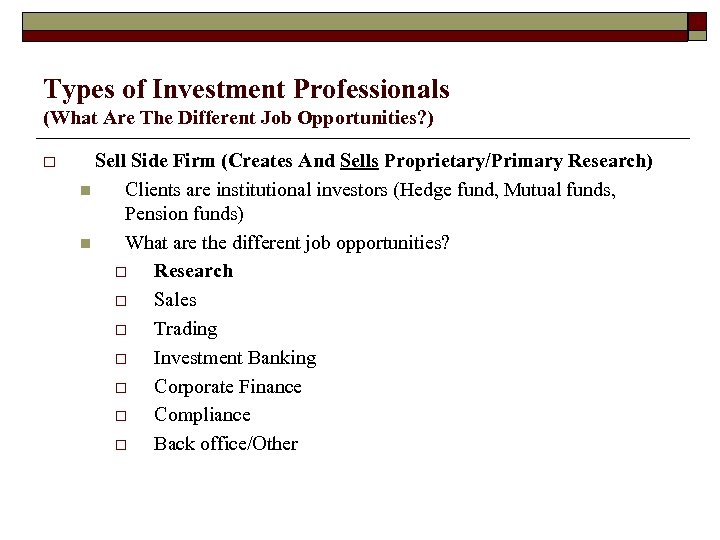 Types of Investment Professionals (What Are The Different Job Opportunities? ) o Sell Side Firm (Creates And Sells Proprietary/Primary Research) n Clients are institutional investors (Hedge fund, Mutual funds, Pension funds) n What are the different job opportunities? o Research o Sales o Trading o Investment Banking o Corporate Finance o Compliance o Back office/Other
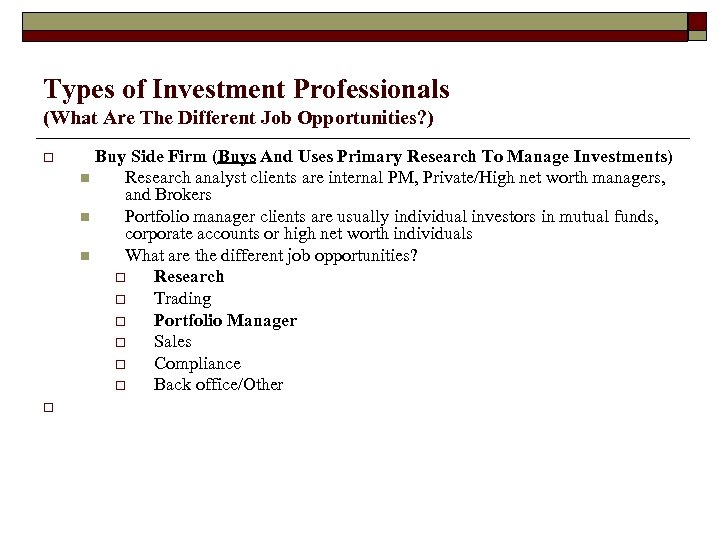 Types of Investment Professionals (What Are The Different Job Opportunities? ) o o Buy Side Firm (Buys And Uses Primary Research To Manage Investments) n Research analyst clients are internal PM, Private/High net worth managers, and Brokers n Portfolio manager clients are usually individual investors in mutual funds, corporate accounts or high net worth individuals n What are the different job opportunities? o Research o Trading o Portfolio Manager o Sales o Compliance o Back office/Other
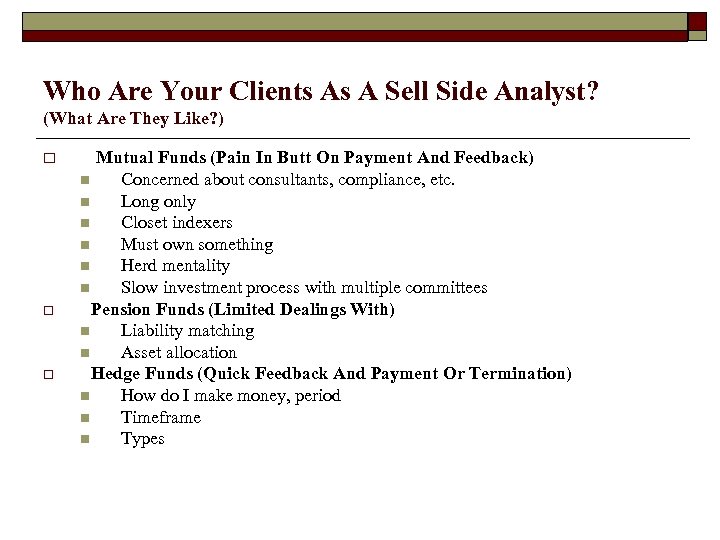 Who Are Your Clients As A Sell Side Analyst? (What Are They Like? ) Mutual Funds (Pain In Butt On Payment And Feedback) o Concerned about consultants, compliance, etc. n Long only n Closet indexers n Must own something n Herd mentality n Slow investment process with multiple committees Pension Funds (Limited Dealings With) n Liability matching n Asset allocation Hedge Funds (Quick Feedback And Payment Or Termination) n How do I make money, period n Timeframe n Types n o o
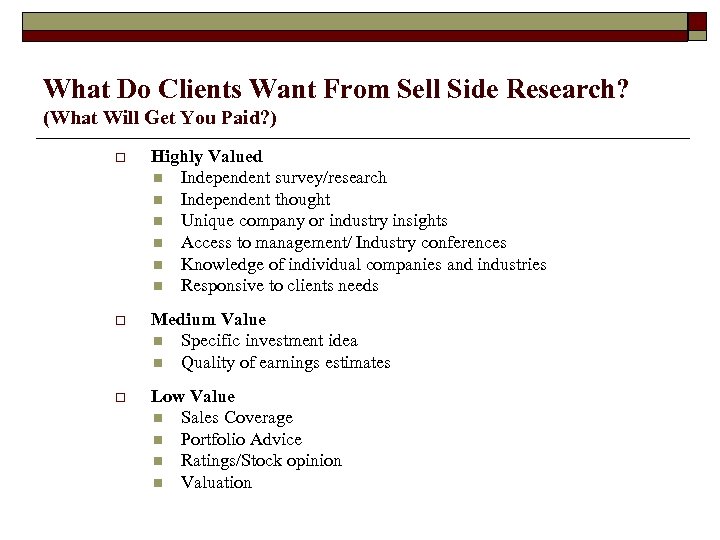 What Do Clients Want From Sell Side Research? (What Will Get You Paid? ) o Highly Valued n Independent survey/research n Independent thought n Unique company or industry insights n Access to management/ Industry conferences n Knowledge of individual companies and industries n Responsive to clients needs o Medium Value n Specific investment idea n Quality of earnings estimates o Low Value n Sales Coverage n Portfolio Advice n Ratings/Stock opinion n Valuation
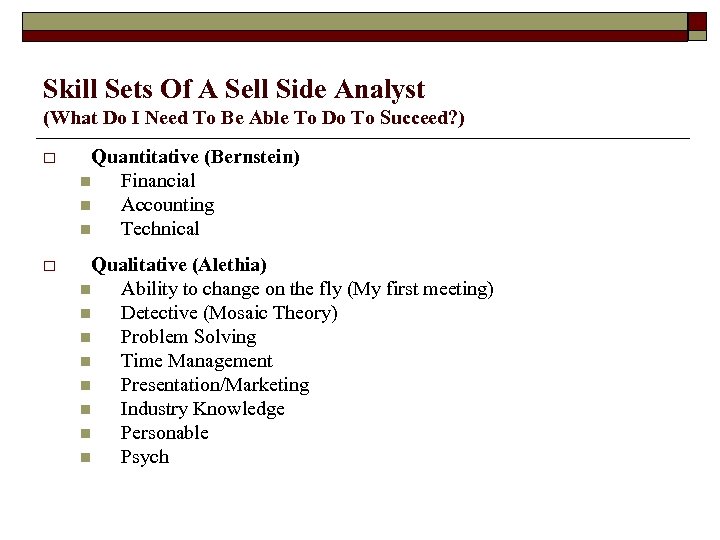 Skill Sets Of A Sell Side Analyst (What Do I Need To Be Able To Do To Succeed? ) o Quantitative (Bernstein) n Financial n Accounting n Technical o Qualitative (Alethia) n Ability to change on the fly (My first meeting) n Detective (Mosaic Theory) n Problem Solving n Time Management n Presentation/Marketing n Industry Knowledge n Personable n Psych
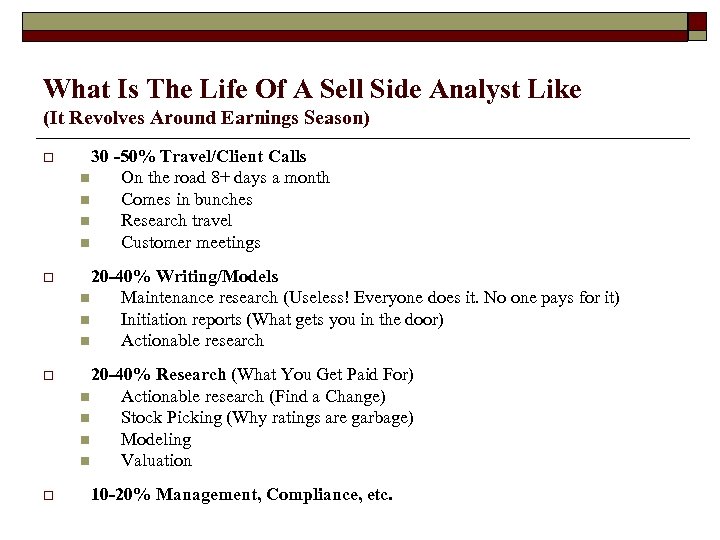 What Is The Life Of A Sell Side Analyst Like (It Revolves Around Earnings Season) o 30 -50% Travel/Client Calls n On the road 8+ days a month n Comes in bunches n Research travel n Customer meetings o 20 -40% Writing/Models n Maintenance research (Useless! Everyone does it. No one pays for it) n Initiation reports (What gets you in the door) n Actionable research o 20 -40% Research (What You Get Paid For) n Actionable research (Find a Change) n Stock Picking (Why ratings are garbage) n Modeling n Valuation o 10 -20% Management, Compliance, etc.
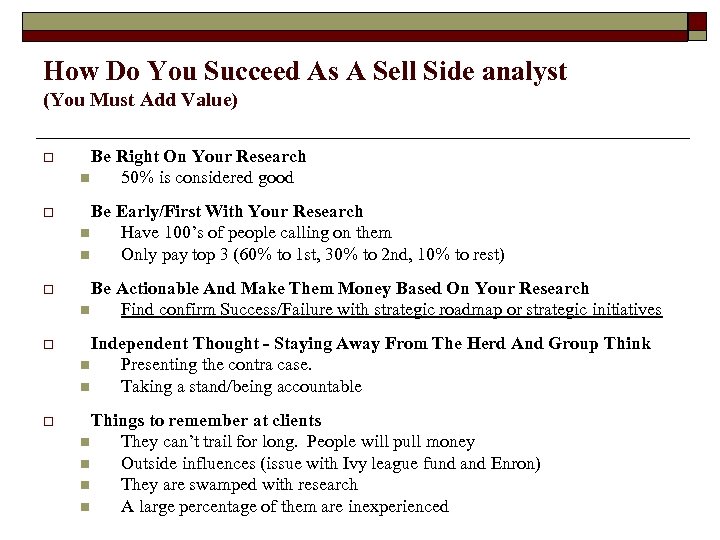 How Do You Succeed As A Sell Side analyst (You Must Add Value) o Be Right On Your Research n 50% is considered good o Be Early/First With Your Research n Have 100’s of people calling on them n Only pay top 3 (60% to 1 st, 30% to 2 nd, 10% to rest) o Be Actionable And Make Them Money Based On Your Research n Find confirm Success/Failure with strategic roadmap or strategic initiatives o Independent Thought - Staying Away From The Herd And Group Think n Presenting the contra case. n Taking a stand/being accountable o Things to remember at clients n They can’t trail for long. People will pull money n Outside influences (issue with Ivy league fund and Enron) n They are swamped with research n A large percentage of them are inexperienced
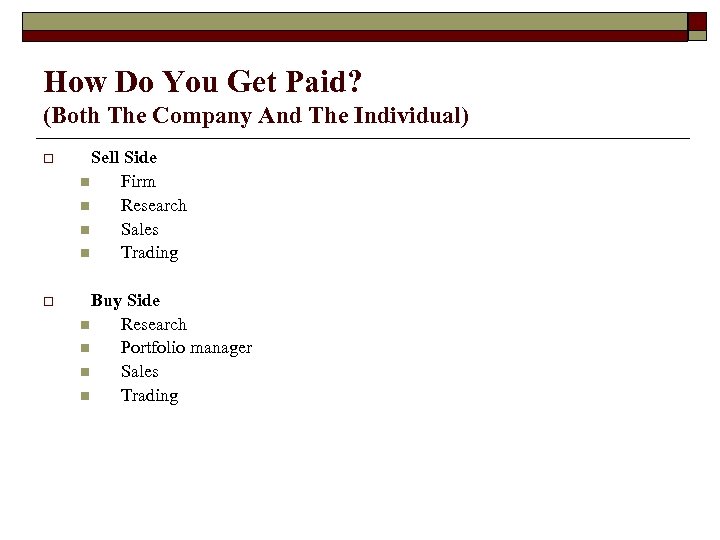 How Do You Get Paid? (Both The Company And The Individual) o Sell Side n Firm n Research n Sales n Trading o Buy Side n Research n Portfolio manager n Sales n Trading
 Why Do Clients Pay Me? o Information based on fundamental research n Find the change to with strategic roadmap or strategic initiatives n Customer, Competitor and end market surveys n Contacts in industry n Why is this important?
 How Did You Get Involved In This Field (High Risk. High Reward) o Sell Side n Wall Street n Regional n Non traditional o Buy Side n Research n Trading n Portfolio management
 Interview Advice (What You Need To Do At A Minimum) n Know something about the company you are interviewing with n Show that you can add value. n Show that you can think on your feet. n Show that you can solve problems. n Convince me that I want to work with you in a high stress, high pressure situation for an extended period of time. n Don’t lie (especially on something I can check on)