


 Скачать презентацию Types of Cipher Machines 2000 Years of Cryptology
9debc057dced85d56acdba7e2d86e87f.ppt
- Количество слайдов: 14
 Types of Cipher Machines 2000 Years of Cryptology Ralph Simpson Ralph@Cipher. Machines. com Copyright © 2016 Cipher. Machines. com
 Agenda § Caesar cipher § Steganography § Transpositions and grills § Vigenère cipher disk § Code books § One-time pads § Jefferson wheel cypher § Electro-mechanical rotor ciphers § Hagelin cipher devices § Navajo code talkers cipher § IFF code wheels § Voice encryption devices Types of Cipher Machines: 2000 Years of Cryptology 2
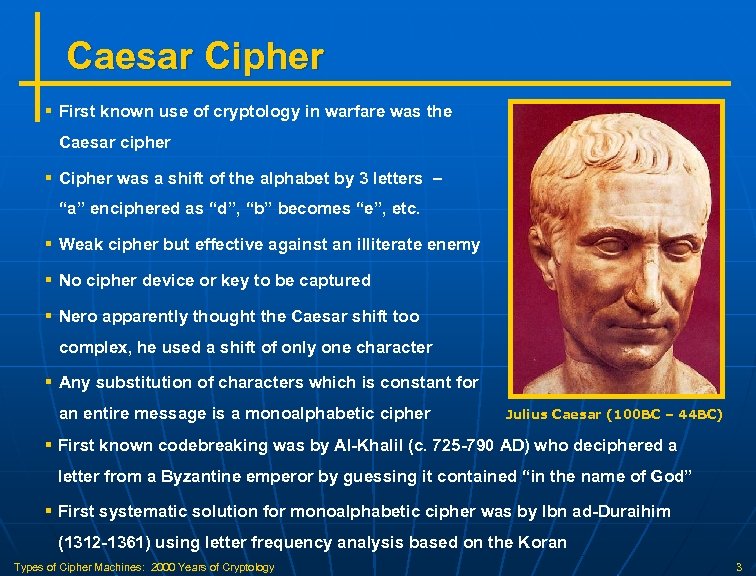 Caesar Cipher § First known use of cryptology in warfare was the Caesar cipher § Cipher was a shift of the alphabet by 3 letters – “a” enciphered as “d”, “b” becomes “e”, etc. § Weak cipher but effective against an illiterate enemy § No cipher device or key to be captured § Nero apparently thought the Caesar shift too complex, he used a shift of only one character § Any substitution of characters which is constant for an entire message is a monoalphabetic cipher Julius Caesar (100 BC – 44 BC) § First known codebreaking was by Al-Khalil (c. 725 -790 AD) who deciphered a letter from a Byzantine emperor by guessing it contained “in the name of God” § First systematic solution for monoalphabetic cipher was by Ibn ad-Duraihim (1312 -1361) using letter frequency analysis based on the Koran Types of Cipher Machines: 2000 Years of Cryptology 3
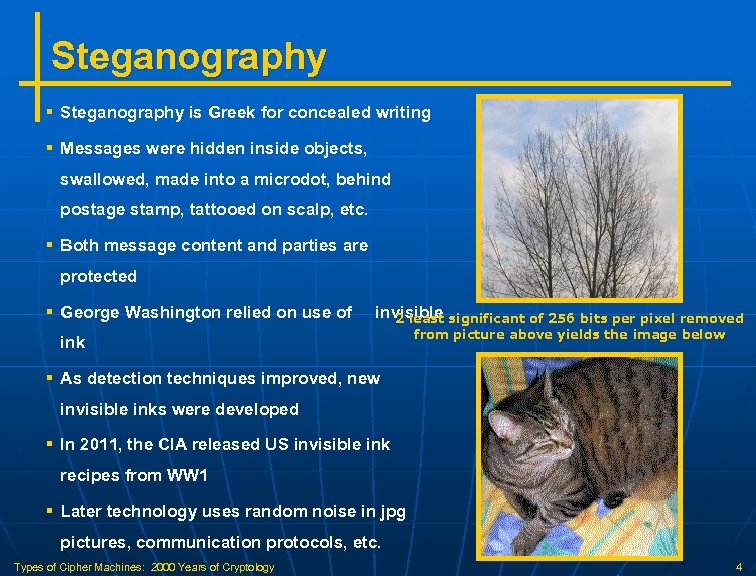 Steganography § Steganography is Greek for concealed writing § Messages were hidden inside objects, swallowed, made into a microdot, behind postage stamp, tattooed on scalp, etc. § Both message content and parties are protected § George Washington relied on use of invisible significant of 256 bits per pixel removed 2 least ink from picture above yields the image below § As detection techniques improved, new invisible inks were developed § In 2011, the CIA released US invisible ink recipes from WW 1 § Later technology uses random noise in jpg pictures, communication protocols, etc. Types of Cipher Machines: 2000 Years of Cryptology 4
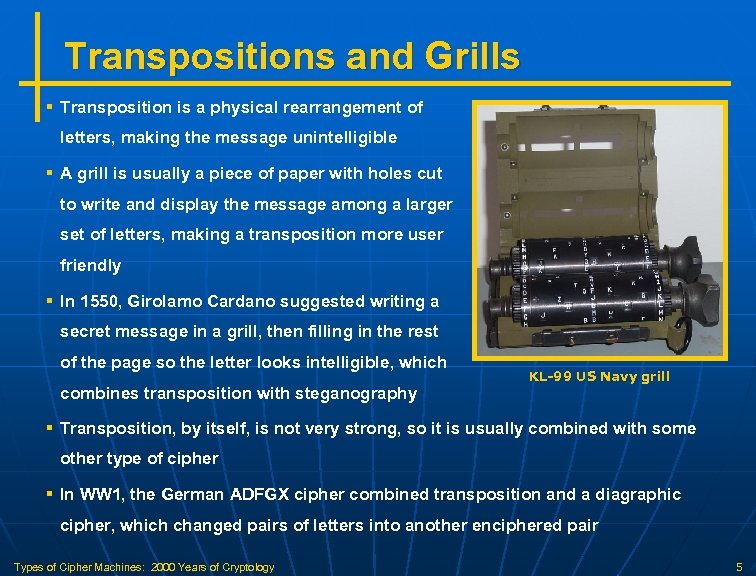 Transpositions and Grills § Transposition is a physical rearrangement of letters, making the message unintelligible § A grill is usually a piece of paper with holes cut to write and display the message among a larger set of letters, making a transposition more user friendly § In 1550, Girolamo Cardano suggested writing a secret message in a grill, then filling in the rest of the page so the letter looks intelligible, which combines transposition with steganography KL-99 US Navy grill § Transposition, by itself, is not very strong, so it is usually combined with some other type of cipher § In WW 1, the German ADFGX cipher combined transposition and a diagraphic cipher, which changed pairs of letters into another enciphered pair Types of Cipher Machines: 2000 Years of Cryptology 5
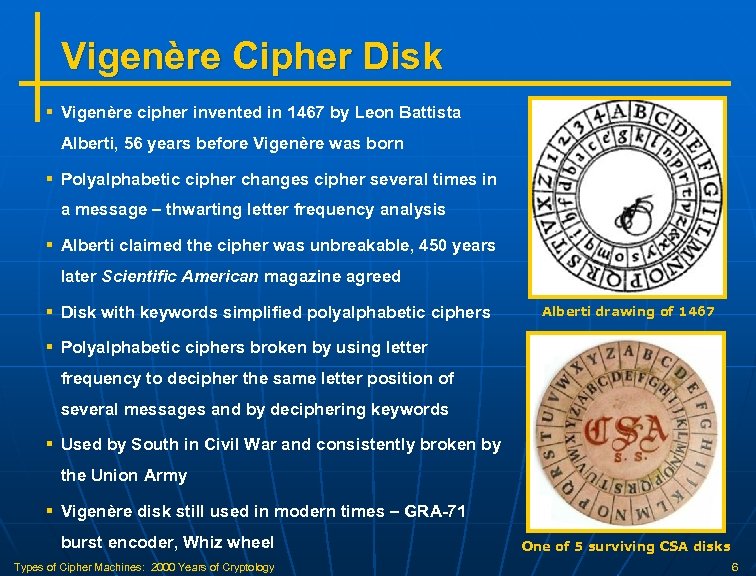 Vigenère Cipher Disk § Vigenère cipher invented in 1467 by Leon Battista Alberti, 56 years before Vigenère was born § Polyalphabetic cipher changes cipher several times in a message – thwarting letter frequency analysis § Alberti claimed the cipher was unbreakable, 450 years later Scientific American magazine agreed § Disk with keywords simplified polyalphabetic ciphers Alberti drawing of 1467 § Polyalphabetic ciphers broken by using letter frequency to decipher the same letter position of several messages and by deciphering keywords § Used by South in Civil War and consistently broken by the Union Army § Vigenère disk still used in modern times – GRA-71 burst encoder, Whiz wheel Types of Cipher Machines: 2000 Years of Cryptology One of 5 surviving CSA disks 6
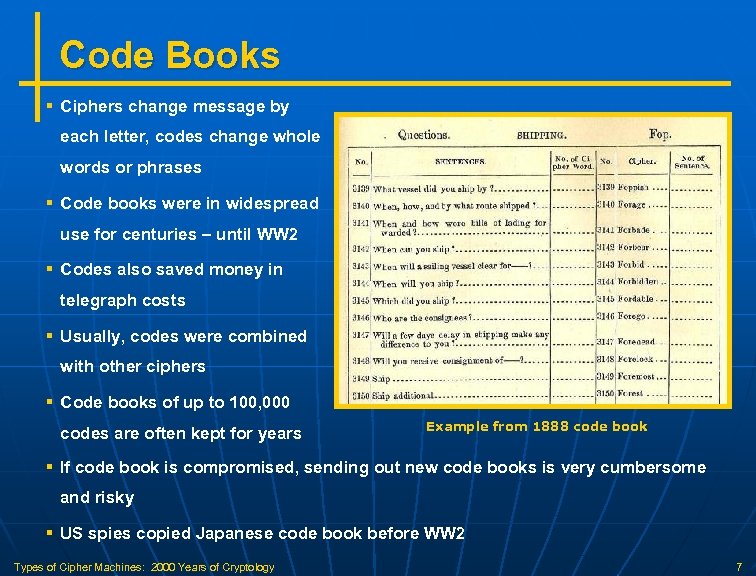 Code Books § Ciphers change message by each letter, codes change whole words or phrases § Code books were in widespread use for centuries – until WW 2 § Codes also saved money in telegraph costs § Usually, codes were combined with other ciphers § Code books of up to 100, 000 codes are often kept for years Example from 1888 code book § If code book is compromised, sending out new code books is very cumbersome and risky § US spies copied Japanese code book before WW 2 Types of Cipher Machines: 2000 Years of Cryptology 7
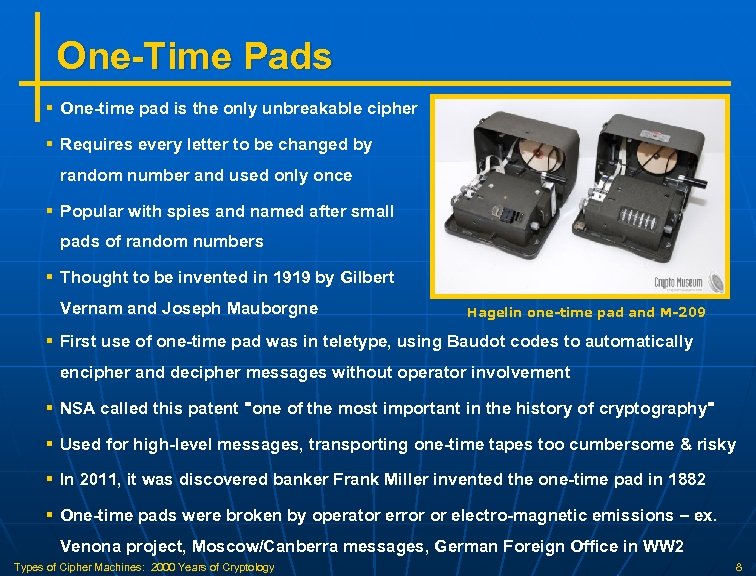 One-Time Pads § One-time pad is the only unbreakable cipher § Requires every letter to be changed by random number and used only once § Popular with spies and named after small pads of random numbers § Thought to be invented in 1919 by Gilbert Vernam and Joseph Mauborgne Hagelin one-time pad and M-209 § First use of one-time pad was in teletype, using Baudot codes to automatically encipher and decipher messages without operator involvement § NSA called this patent "one of the most important in the history of cryptography" § Used for high-level messages, transporting one-time tapes too cumbersome & risky § In 2011, it was discovered banker Frank Miller invented the one-time pad in 1882 § One-time pads were broken by operator error or electro-magnetic emissions – ex. Venona project, Moscow/Canberra messages, German Foreign Office in WW 2 Types of Cipher Machines: 2000 Years of Cryptology 8
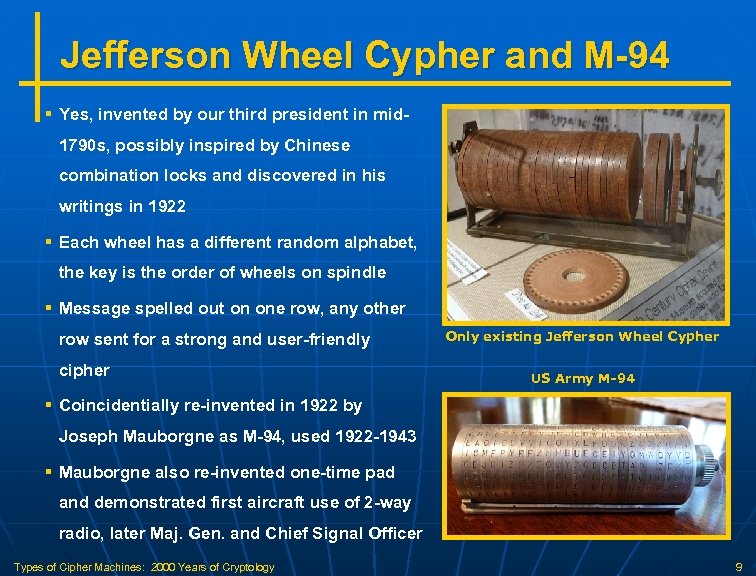 Jefferson Wheel Cypher and M-94 § Yes, invented by our third president in mid 1790 s, possibly inspired by Chinese combination locks and discovered in his writings in 1922 § Each wheel has a different random alphabet, the key is the order of wheels on spindle § Message spelled out on one row, any other row sent for a strong and user-friendly cipher Only existing Jefferson Wheel Cypher US Army M-94 § Coincidentially re-invented in 1922 by Joseph Mauborgne as M-94, used 1922 -1943 § Mauborgne also re-invented one-time pad and demonstrated first aircraft use of 2 -way radio, later Maj. Gen. and Chief Signal Officer Types of Cipher Machines: 2000 Years of Cryptology 9
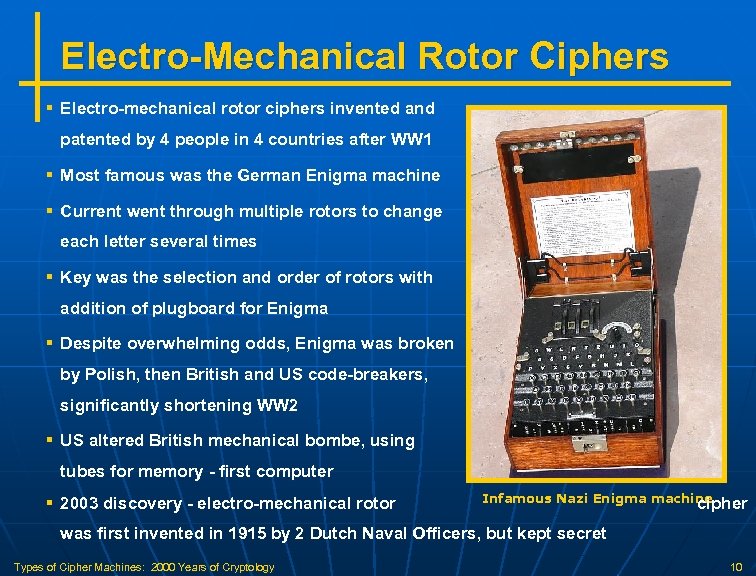 Electro-Mechanical Rotor Ciphers § Electro-mechanical rotor ciphers invented and patented by 4 people in 4 countries after WW 1 § Most famous was the German Enigma machine § Current went through multiple rotors to change each letter several times § Key was the selection and order of rotors with addition of plugboard for Enigma § Despite overwhelming odds, Enigma was broken by Polish, then British and US code-breakers, significantly shortening WW 2 § US altered British mechanical bombe, using tubes for memory - first computer Infamous Nazi Enigma machine § 2003 discovery - electro-mechanical rotor cipher was first invented in 1915 by 2 Dutch Naval Officers, but kept secret Types of Cipher Machines: 2000 Years of Cryptology 10
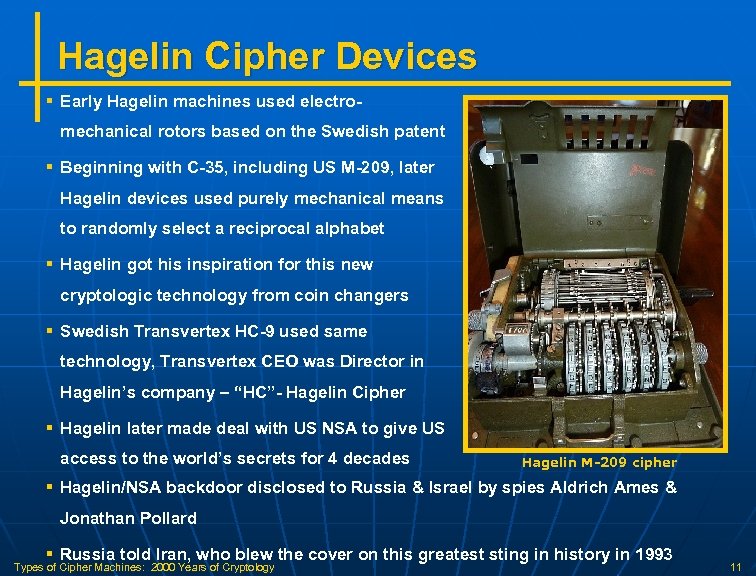 Hagelin Cipher Devices § Early Hagelin machines used electromechanical rotors based on the Swedish patent § Beginning with C-35, including US M-209, later Hagelin devices used purely mechanical means to randomly select a reciprocal alphabet § Hagelin got his inspiration for this new cryptologic technology from coin changers § Swedish Transvertex HC-9 used same technology, Transvertex CEO was Director in Hagelin’s company – “HC”- Hagelin Cipher § Hagelin later made deal with US NSA to give US access to the world’s secrets for 4 decades Hagelin M-209 cipher § Hagelin/NSA backdoor disclosed to Russia & Israel by spies Aldrich Ames & Jonathan Pollard § Russia told Iran, who blew the cover on this greatest sting in history in 1993 Types of Cipher Machines: 2000 Years of Cryptology 11
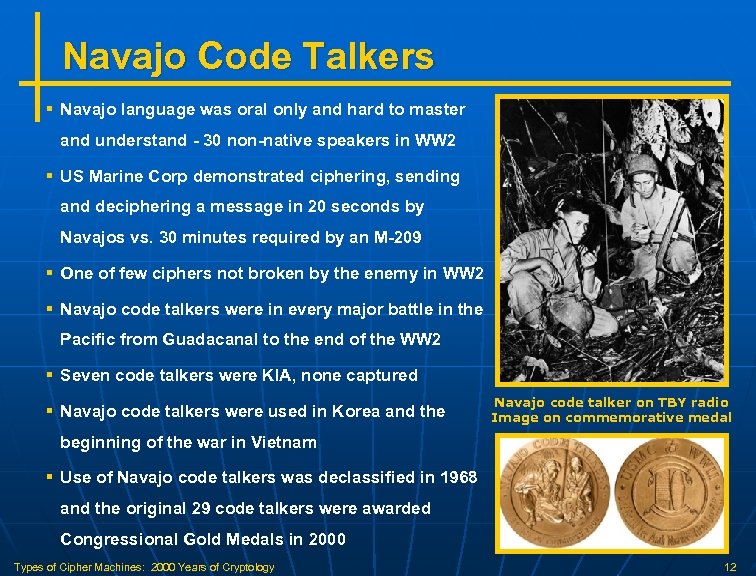 Navajo Code Talkers § Navajo language was oral only and hard to master and understand - 30 non-native speakers in WW 2 § US Marine Corp demonstrated ciphering, sending and deciphering a message in 20 seconds by Navajos vs. 30 minutes required by an M-209 § One of few ciphers not broken by the enemy in WW 2 § Navajo code talkers were in every major battle in the Pacific from Guadacanal to the end of the WW 2 § Seven code talkers were KIA, none captured § Navajo code talkers were used in Korea and the Navajo code talker on TBY radio Image on commemorative medal beginning of the war in Vietnam § Use of Navajo code talkers was declassified in 1968 and the original 29 code talkers were awarded Congressional Gold Medals in 2000 Types of Cipher Machines: 2000 Years of Cryptology 12
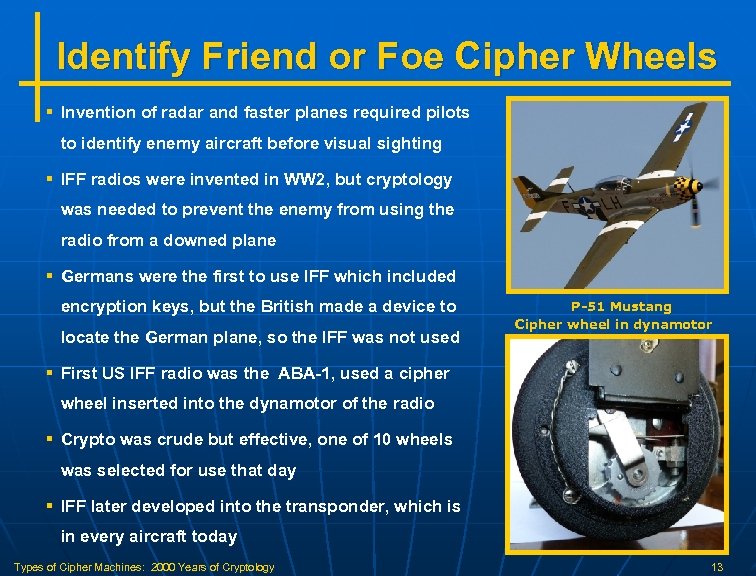 Identify Friend or Foe Cipher Wheels § Invention of radar and faster planes required pilots to identify enemy aircraft before visual sighting § IFF radios were invented in WW 2, but cryptology was needed to prevent the enemy from using the radio from a downed plane § Germans were the first to use IFF which included encryption keys, but the British made a device to locate the German plane, so the IFF was not used P-51 Mustang Cipher wheel in dynamotor § First US IFF radio was the ABA-1, used a cipher wheel inserted into the dynamotor of the radio § Crypto was crude but effective, one of 10 wheels was selected for use that day was § IFF later developed into the transponder, which is in every aircraft today Types of Cipher Machines: 2000 Years of Cryptology 13
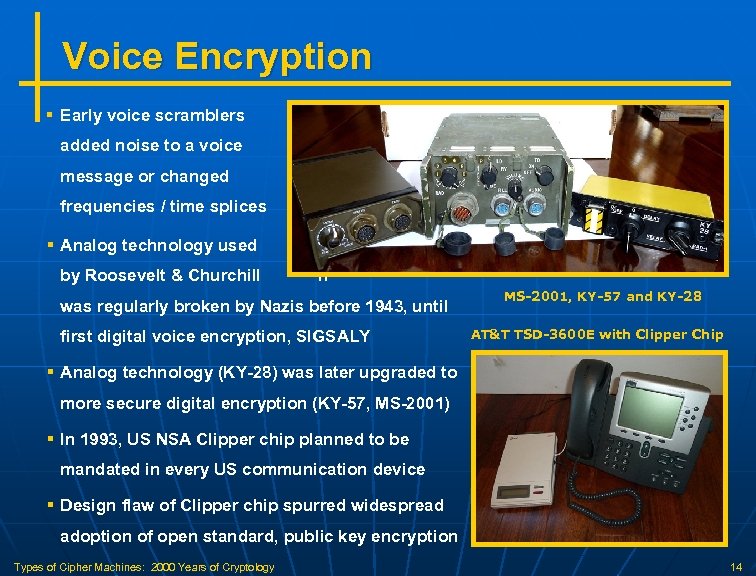 Voice Encryption § Early voice scramblers added noise to a voice message or changed frequencies / time splices § Analog technology used by Roosevelt & Churchill h was regularly broken by Nazis before 1943, until first digital voice encryption, SIGSALY MS-2001, KY-57 and KY-28 AT&T TSD-3600 E with Clipper Chip § Analog technology (KY-28) was later upgraded to more secure digital encryption (KY-57, MS-2001) § In 1993, US NSA Clipper chip planned to be mandated in every US communication device § Design flaw of Clipper chip spurred widespread adoption of open standard, public key encryption Types of Cipher Machines: 2000 Years of Cryptology 14