


 Скачать презентацию Type-Safe Multithreading in Cyclone Dan Grossman Cornell University
daf27a8ed99b0ee9e1d1fd5903c79703.ppt
- Количество слайдов: 28
 Type-Safe Multithreading in Cyclone Dan Grossman Cornell University TLDI 2003 18 Jan 2003 Cyclone Multithreading, Dan Grossman
 Cyclone + threads = ? • Cyclone is a safe language at the C level • Target domains often use threads • Races are a notorious source of errors – Automated help would be welcome • Data races can violate safety – Safety guarantee requires prevention 18 Jan 2003 Cyclone Multithreading, Dan Grossman 2
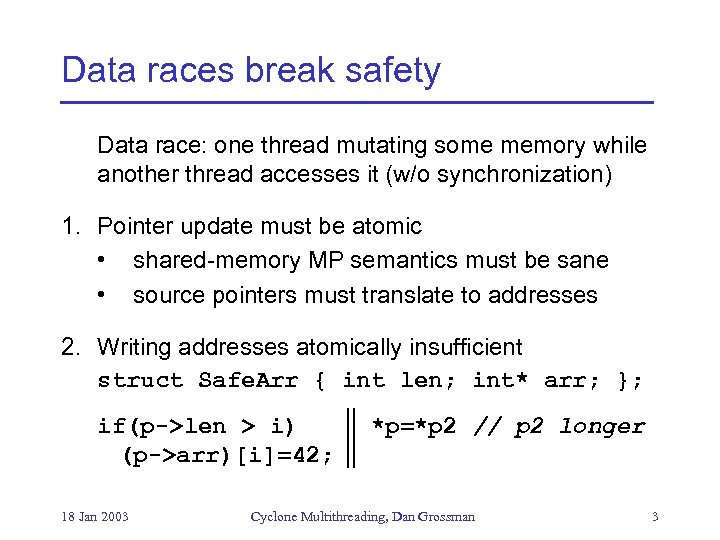 Data races break safety Data race: one thread mutating some memory while another thread accesses it (w/o synchronization) 1. Pointer update must be atomic • shared-memory MP semantics must be sane • source pointers must translate to addresses 2. Writing addresses atomically insufficient struct Safe. Arr { int len; int* arr; }; if(p->len > i) (p->arr)[i]=42; 18 Jan 2003 *p=*p 2 // p 2 longer Cyclone Multithreading, Dan Grossman 3
 Preventing data races • Dynamic – Detect races as they occur – Control scheduling and preemption –. . . • Static – Don’t have threads – Don’t have thread-shared memory – Require mutexes for all memory – Require mutexes for shared memory – Require sound synchronization for shared memory –. . . 18 Jan 2003 Cyclone Multithreading, Dan Grossman 4
 Lock types The type system ensures that: For each (shared) data object, there exists a lock that a thread must hold to access the object • Flanagan, Abadi, Freund, Qadeer – invented basic approach – found real Java bugs • Boyapati, Rinard, Lee – reuse code for shared and local data – advanced features I have not adapted 18 Jan 2003 Cyclone Multithreading, Dan Grossman 5
 Contributions 1. Adapt the approach to a C-level language 2. Integrate with parametric polymorphism 3. Integrate/compare with region-based memory management 4. Kinds to explain thread-local data and code reuse 5. Type-safety result for 1, 2, and 4 for an abstract machine where data races violate safety 18 Jan 2003 Cyclone Multithreading, Dan Grossman 6
 The plan from here • Multithreading language – terms – types – kinds • Limitations • Formalism: insight into why it’s safe • Related work 18 Jan 2003 Cyclone Multithreading, Dan Grossman 7
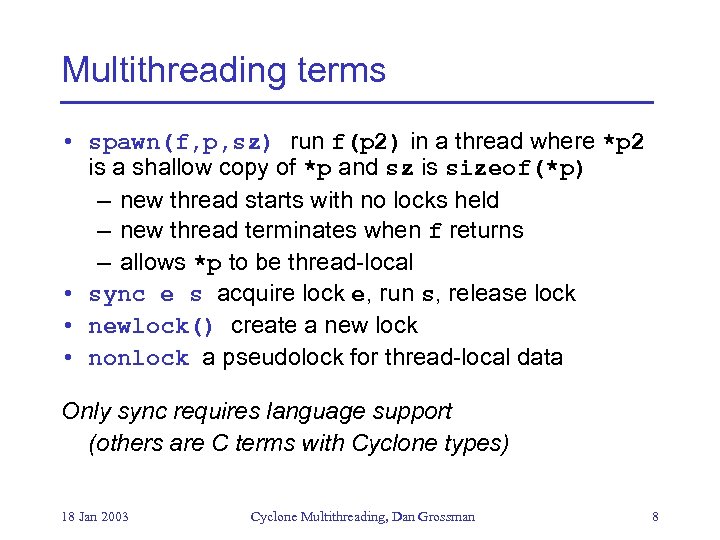 Multithreading terms • spawn(f, p, sz) run f(p 2) in a thread where *p 2 is a shallow copy of *p and sz is sizeof(*p) – new thread starts with no locks held – new thread terminates when f returns – allows *p to be thread-local • sync e s acquire lock e, run s, release lock • newlock() create a new lock • nonlock a pseudolock for thread-local data Only sync requires language support (others are C terms with Cyclone types) 18 Jan 2003 Cyclone Multithreading, Dan Grossman 8
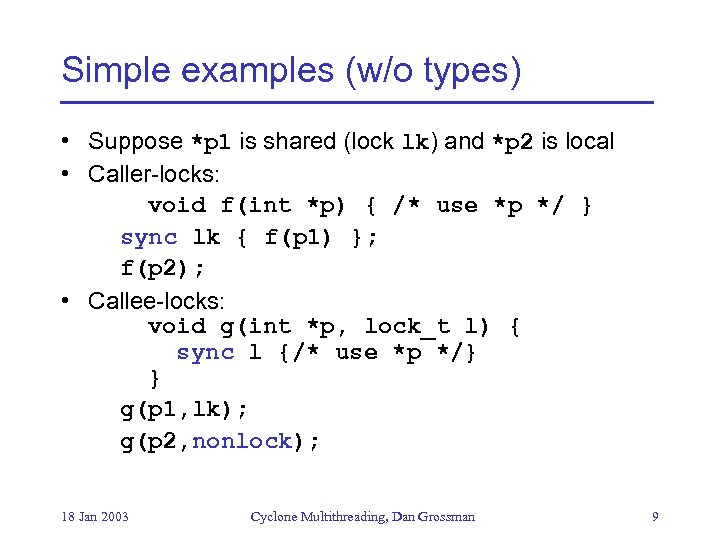 Simple examples (w/o types) • Suppose *p 1 is shared (lock lk) and *p 2 is local • Caller-locks: void f(int *p) { /* use *p */ } sync lk { f(p 1) }; f(p 2); • Callee-locks: void g(int *p, lock_t l) { sync l {/* use *p */} } g(p 1, lk); g(p 2, nonlock); 18 Jan 2003 Cyclone Multithreading, Dan Grossman 9
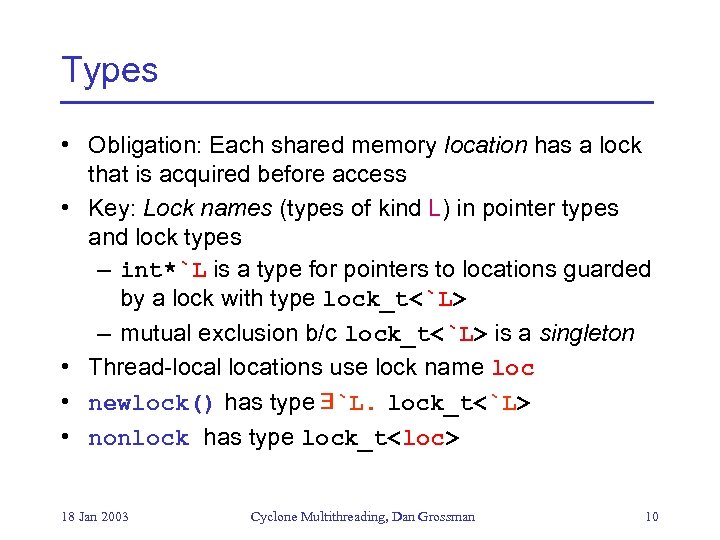 Types • Obligation: Each shared memory location has a lock that is acquired before access • Key: Lock names (types of kind L) in pointer types and lock types – int*`L is a type for pointers to locations guarded by a lock with type lock_t<`L> – mutual exclusion b/c lock_t<`L> is a singleton • Thread-local locations use lock name loc • newlock() has type `L. lock_t<`L> • nonlock has type lock_t
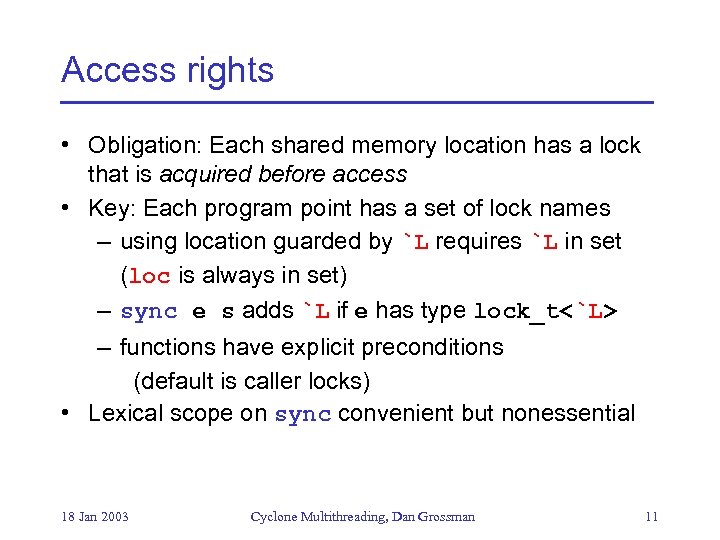 Access rights • Obligation: Each shared memory location has a lock that is acquired before access • Key: Each program point has a set of lock names – using location guarded by `L requires `L in set (loc is always in set) – sync e s adds `L if e has type lock_t<`L> – functions have explicit preconditions (default is caller locks) • Lexical scope on sync convenient but nonessential 18 Jan 2003 Cyclone Multithreading, Dan Grossman 11
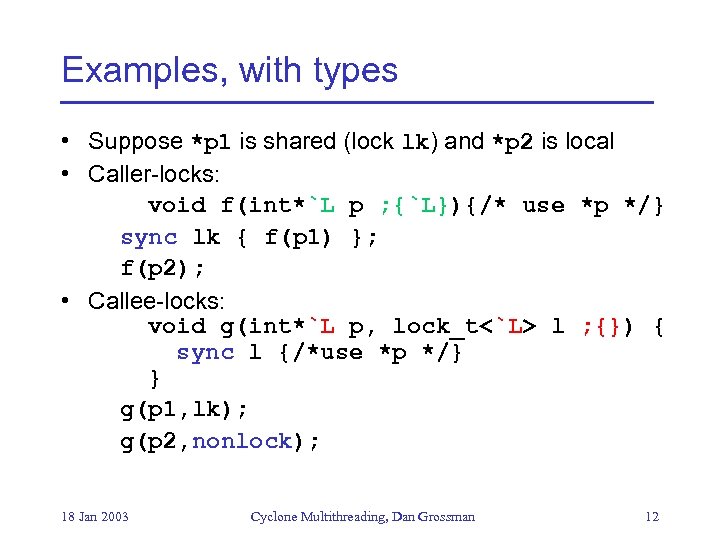 Examples, with types • Suppose *p 1 is shared (lock lk) and *p 2 is local • Caller-locks: void f(int*`L p ; {`L}){/* use *p */} sync lk { f(p 1) }; f(p 2); • Callee-locks: void g(int*`L p, lock_t<`L> l ; {}) { sync l {/*use *p */} } g(p 1, lk); g(p 2, nonlock); 18 Jan 2003 Cyclone Multithreading, Dan Grossman 12
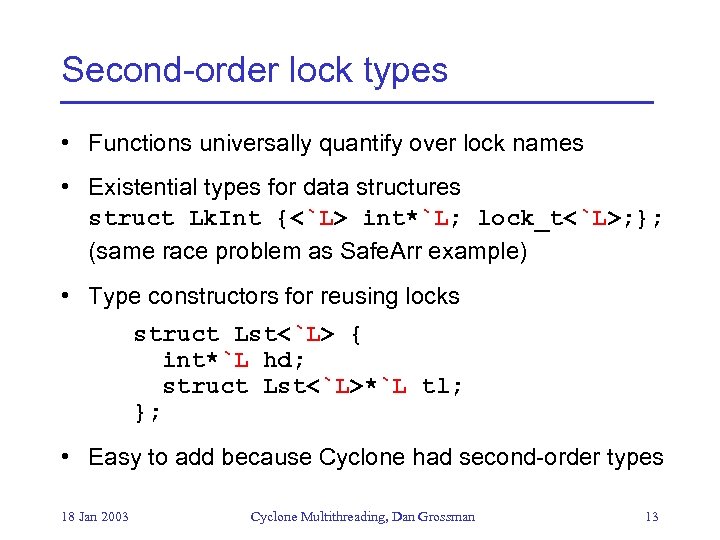 Second-order lock types • Functions universally quantify over lock names • Existential types for data structures struct Lk. Int {<`L> int*`L; lock_t<`L>; }; (same race problem as Safe. Arr example) • Type constructors for reusing locks struct Lst<`L> { int*`L hd; struct Lst<`L>*`L tl; }; • Easy to add because Cyclone had second-order types 18 Jan 2003 Cyclone Multithreading, Dan Grossman 13
 The plan from here • Multithreading language – terms – types – kinds • Limitations • Formalism: insight into why it’s safe • Related work No data races only if local data is really local 18 Jan 2003 Cyclone Multithreading, Dan Grossman 14
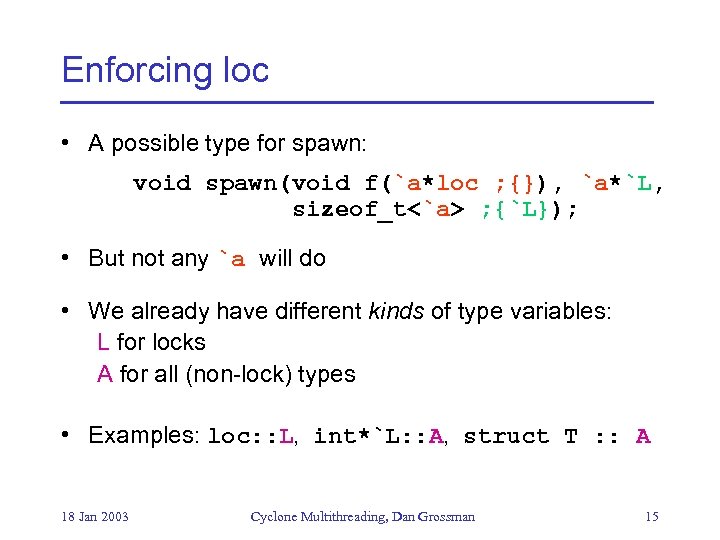 Enforcing loc • A possible type for spawn: void spawn(void f(`a*loc ; {}), `a*`L, sizeof_t<`a> ; {`L}); • But not any `a will do • We already have different kinds of type variables: L for locks A for all (non-lock) types • Examples: loc: : L, int*`L: : A, struct T : : A 18 Jan 2003 Cyclone Multithreading, Dan Grossman 15
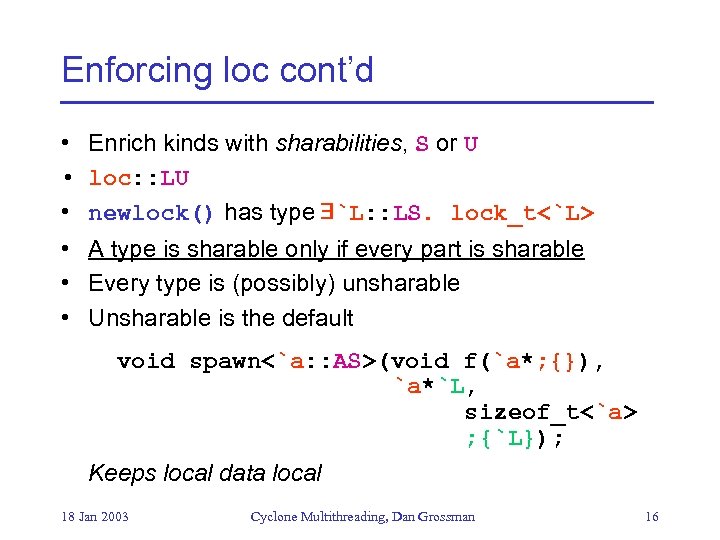 Enforcing loc cont’d • • • Enrich kinds with sharabilities, S or U loc: : LU newlock() has type `L: : LS. lock_t<`L> A type is sharable only if every part is sharable Every type is (possibly) unsharable Unsharable is the default void spawn<`a: : AS>(void f(`a*; {}), `a*`L, sizeof_t<`a> ; {`L}); Keeps local data local 18 Jan 2003 Cyclone Multithreading, Dan Grossman 16
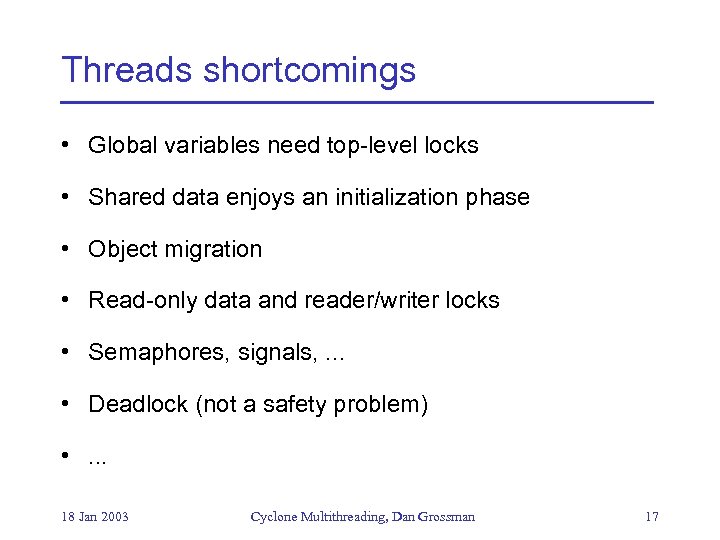 Threads shortcomings • Global variables need top-level locks • Shared data enjoys an initialization phase • Object migration • Read-only data and reader/writer locks • Semaphores, signals, . . . • Deadlock (not a safety problem) • . . . 18 Jan 2003 Cyclone Multithreading, Dan Grossman 17
 The plan from here • Multithreading language – terms – types – kinds • Limitations • Formalism: insight into why it’s safe • Related work 18 Jan 2003 Cyclone Multithreading, Dan Grossman 18
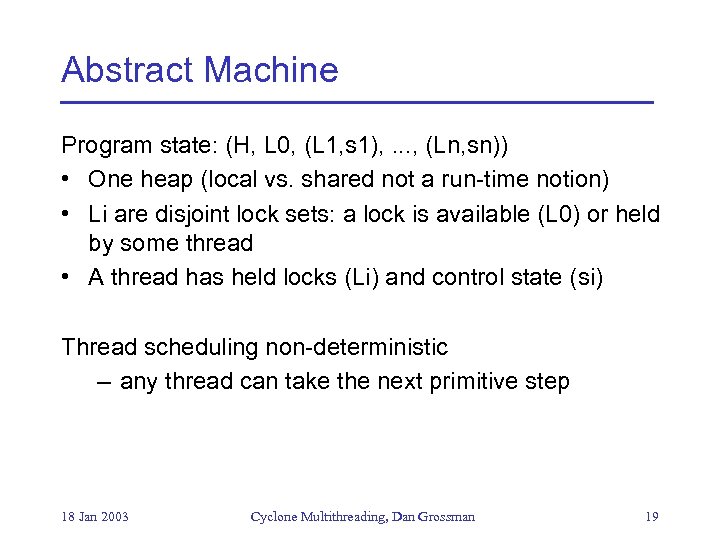 Abstract Machine Program state: (H, L 0, (L 1, s 1), . . . , (Ln, sn)) • One heap (local vs. shared not a run-time notion) • Li are disjoint lock sets: a lock is available (L 0) or held by some thread • A thread has held locks (Li) and control state (si) Thread scheduling non-deterministic – any thread can take the next primitive step 18 Jan 2003 Cyclone Multithreading, Dan Grossman 19
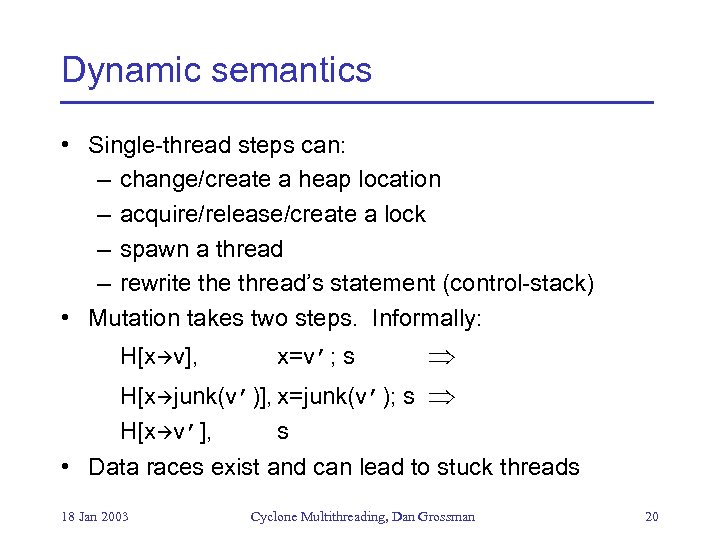 Dynamic semantics • Single-thread steps can: – change/create a heap location – acquire/release/create a lock – spawn a thread – rewrite thread’s statement (control-stack) • Mutation takes two steps. Informally: H[x junk(v’)], x=junk(v’); s H[x v], x=v’; s H[x v’], s • Data races exist and can lead to stuck threads 18 Jan 2003 Cyclone Multithreading, Dan Grossman 20
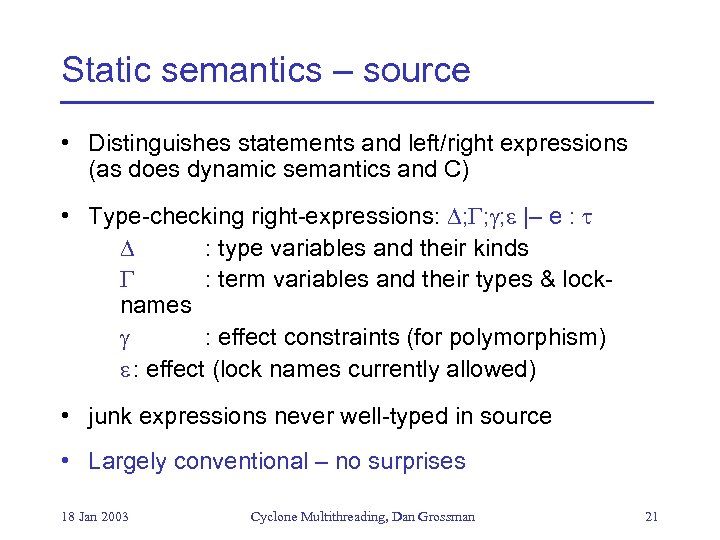 Static semantics – source • Distinguishes statements and left/right expressions (as does dynamic semantics and C) • Type-checking right-expressions: D; G; g; e |– e : t D : type variables and their kinds G : term variables and their types & locknames g : effect constraints (for polymorphism) e : effect (lock names currently allowed) • junk expressions never well-typed in source • Largely conventional – no surprises 18 Jan 2003 Cyclone Multithreading, Dan Grossman 21
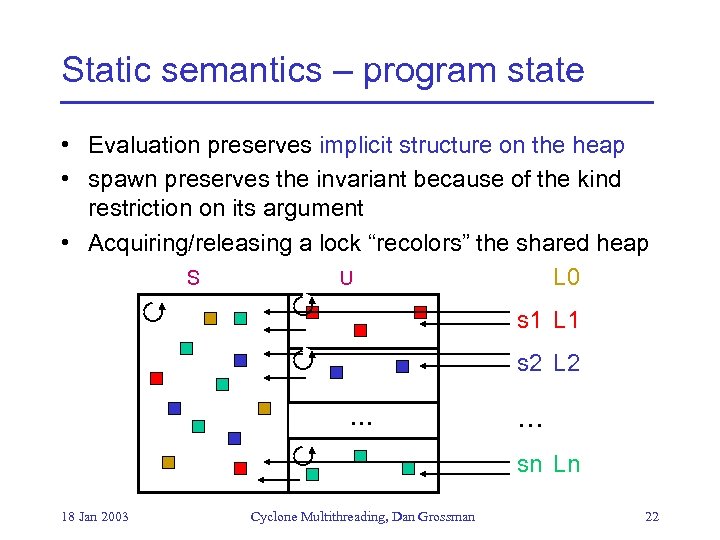 Static semantics – program state • Evaluation preserves implicit structure on the heap • spawn preserves the invariant because of the kind restriction on its argument • Acquiring/releasing a lock “recolors” the shared heap S U L 0 s 1 L 1 s 2 L 2 . . . sn Ln 18 Jan 2003 Cyclone Multithreading, Dan Grossman 22
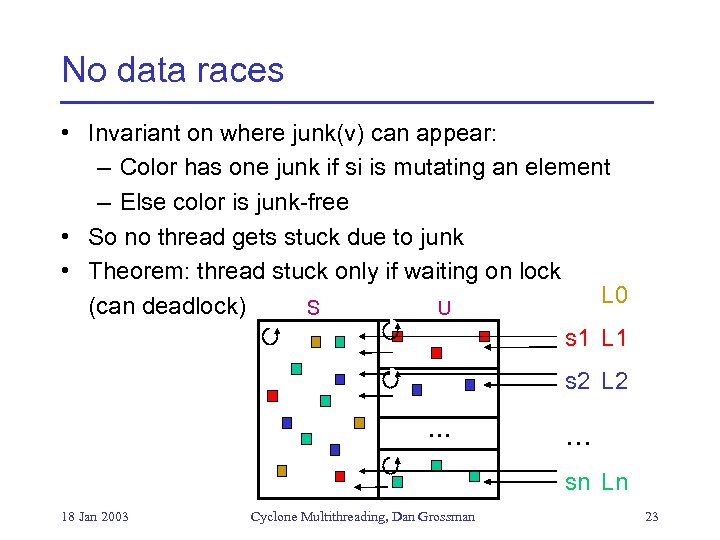 No data races • Invariant on where junk(v) can appear: – Color has one junk if si is mutating an element – Else color is junk-free • So no thread gets stuck due to junk • Theorem: thread stuck only if waiting on lock L 0 (can deadlock) S U s 1 L 1 s 2 L 2 . . . sn Ln 18 Jan 2003 Cyclone Multithreading, Dan Grossman 23
 Formalism summary • • One run-time heap (colors and boxes for the proof) A trick for making data races a problem Straightforward type system for source programs Syntactic safety proof requires understanding how the type system imposes structure on the heap. . . • . . . which was invaluable in understanding, “what’s really going on” especially with spawn • First proof for a system with thread-local data 18 Jan 2003 Cyclone Multithreading, Dan Grossman 24
 Related work • • This work in line of Flanagan, Boyapati, et al. Guava (race-free Java, rigid local/shared distinction) Bug-finding tools (ESC/Java, Warlock, . . . ) Dynamic race detection (novel code and run-time) • Other safe low-level languages (CCured, Vault, PCC, TAL, . . . ) single-threaded Cannot implement an array-bounds check in the presence of data races 18 Jan 2003 Cyclone Multithreading, Dan Grossman 25
 Conclusions • Data races and safe C do not mix well • Static support for lock-based mutual exclusion becoming well understood • Designed and formalized multithreading for Cyclone • May need more bells and whistles for realistic multithreaded programs • Implementation high on the to-do list 18 Jan 2003 Cyclone Multithreading, Dan Grossman 26
![[End of Presentation – an auxiliary slide follows] 18 Jan 2003 Cyclone Multithreading, Dan](https://present5.com/presentation/daf27a8ed99b0ee9e1d1fd5903c79703/image-27.jpg "[End of Presentation – an auxiliary slide follows] 18 Jan 2003 Cyclone Multithreading, Dan") [End of Presentation – an auxiliary slide follows] 18 Jan 2003 Cyclone Multithreading, Dan Grossman 27
[End of Presentation – an auxiliary slide follows] 18 Jan 2003 Cyclone Multithreading, Dan Grossman 27
 Important extensions (see the paper) • Parametric polymorphism – What locks are needed to access an `a – How do we ensure these locks are acquired while allowing polymorphic code • Region-based memory management – How do we prevent one thread from accessing objects another thread has deallocated – Type systems for regions and locks very similar, so what do the differences teach us 18 Jan 2003 Cyclone Multithreading, Dan Grossman 28