 Скачать презентацию TYKKI Workshop December 9 -11 1998 Tokyo Japan
6ea8aa2369fc16de1f31b64c5bd62752.ppt
- Количество слайдов: 23



TYKKI Workshop, December 9 -11, 1998, Tokyo, Japan Information Technology for Ocean Observations and Climate Research Nancy N. Soreide NOAA Pacific Marine Environmental Laboratory
Vision l Societal benefits through climate studies and improved climate prediction – Investing in observations, satellites, models, research – Investments in Information Technology • Remove restrictions of the past • Build a pipeline to the future • Maximize the return on investments
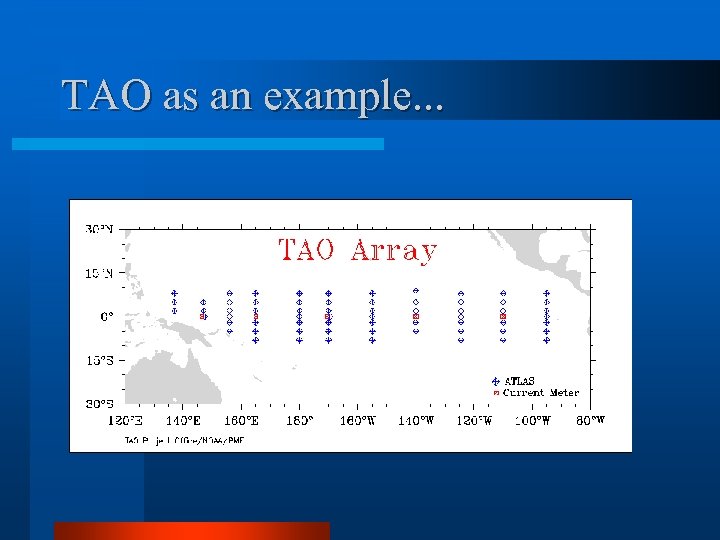
TAO as an example. . .
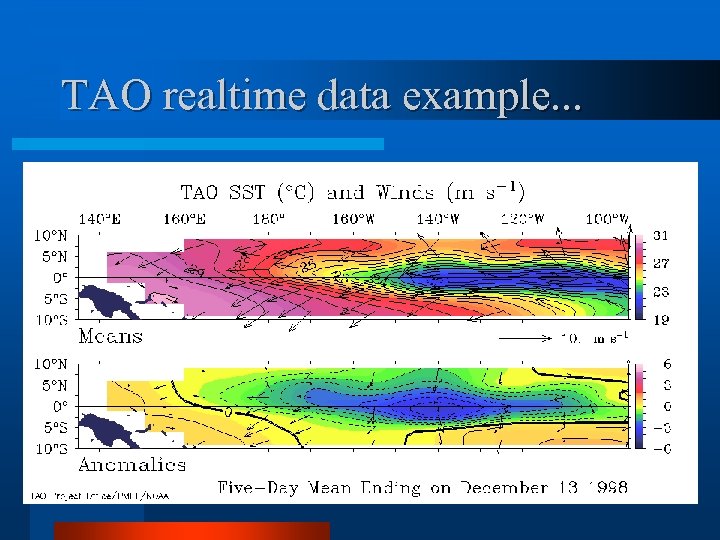
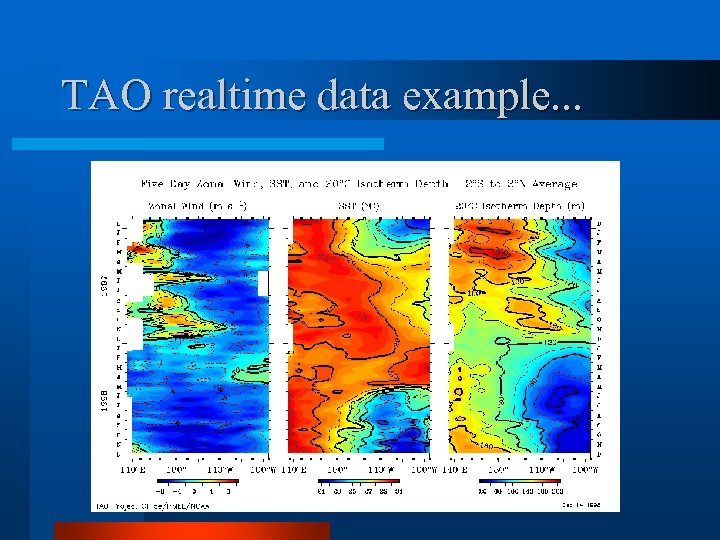
TAO realtime data example. . .
TAO realtime data example. . .
TRITON/TAO l TAO/TRITON data integration – Mechanism for data intercomparisons – Web pages for seamless delivery of integrated l Improved delivery of TRITON/TAO data – – l User defined plotting options Sophisticated Web component Java. Script and Java Servlets* Highly interactive, all-Java application Collaborative PMEL/JAMSTEC effort * A Servlet is a Java application that runs in conjunction with a web server. Java Servlet technology has built-in functionality that makes it a good server technology, with faster response time, better performance, and reliability.
TAO set a standard in the climate community l Data dissemination in initial project planning l – Researcher involvement has assured data quality l Benefits of data dissemination – – l Wide use of TAO data Traditional research, modeling, forecasting groups Over 200 refereed publications in past 5 years Related disciplines, educational, administrative, public With recent advances in technology, we can do much more. . .
How can Information Technology benefit Climate Programs? l Data Access – Centralized, uniform, consistent access to geographically distributed data in a common data format • • Realtime data Satellite data Model outputs Data & information products l “Data Portal” – A “doorway” to climate data
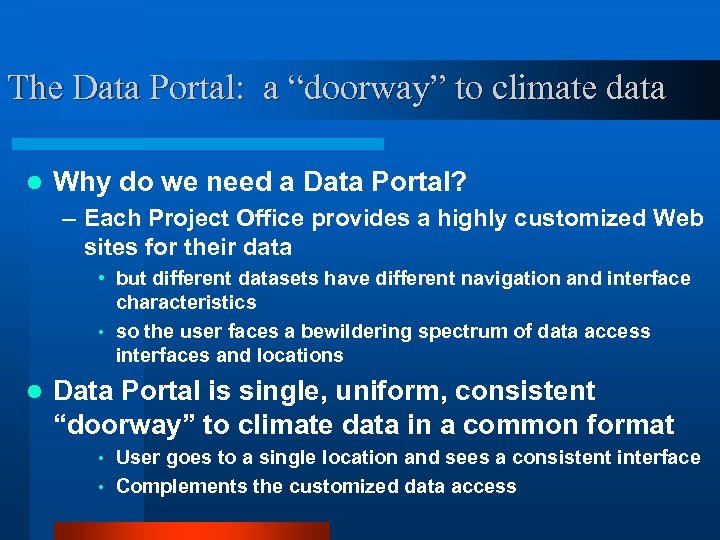
The Data Portal: a “doorway” to climate data l Why do we need a Data Portal? – Each Project Office provides a highly customized Web sites for their data • but different datasets have different navigation and interface characteristics • so the user faces a bewildering spectrum of data access interfaces and locations l Data Portal is single, uniform, consistent “doorway” to climate data in a common format User goes to a single location and sees a consistent interface • Complements the customized data access •
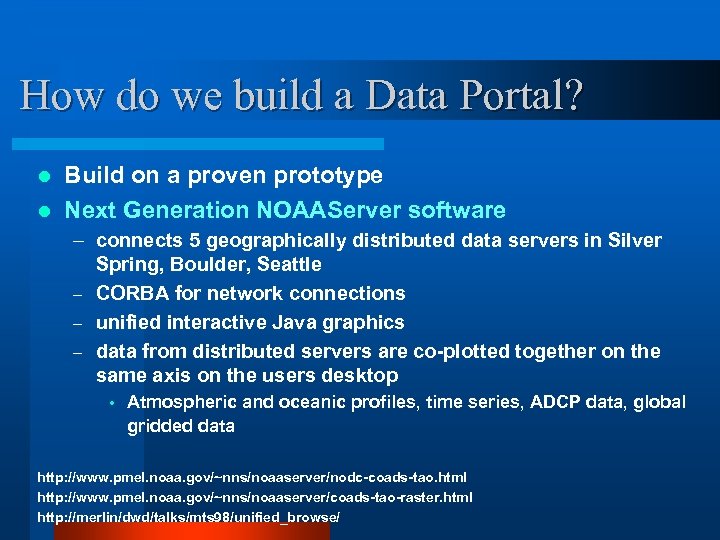
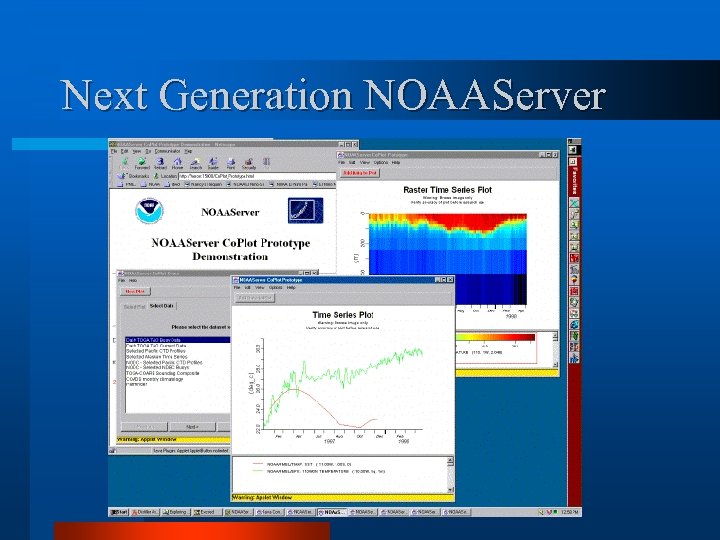
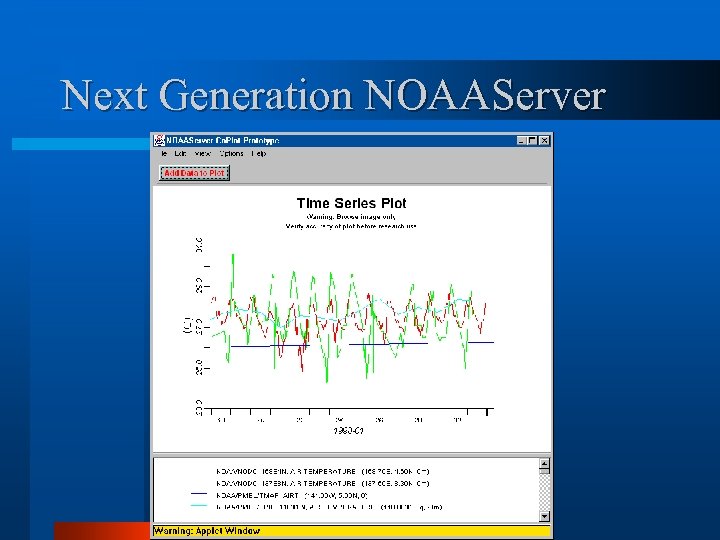
How do we build a Data Portal? Build on a proven prototype l Next Generation NOAAServer software l – connects 5 geographically distributed data servers in Silver Spring, Boulder, Seattle – CORBA for network connections – unified interactive Java graphics – data from distributed servers are co-plotted together on the same axis on the users desktop • Atmospheric and oceanic profiles, time series, ADCP data, global gridded data http: //www. pmel. noaa. gov/~nns/noaaserver/nodc-coads-tao. html http: //www. pmel. noaa. gov/~nns/noaaserver/coads-tao-raster. html http: //merlin/dwd/talks/mts 98/unified_browse/
Next Generation NOAAServer
Next Generation NOAAServer
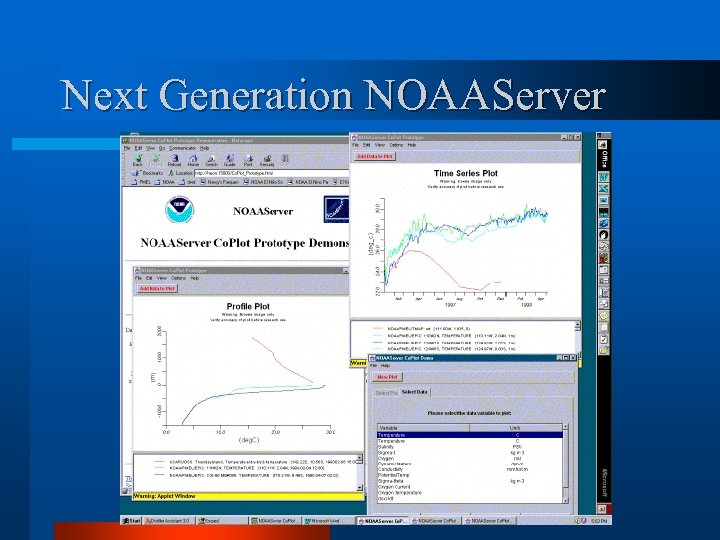
Next Generation NOAAServer
Other technology advances: l Networks (100 Megabits/sec) – Next Generation Internet (NGI) and Internet 2 l Visualization – 3 D – Virtual reality – Immersion technology l Collaboration tools – advanced high-speed telecommunications systems for collaboration applications – tele-immersion systems allow individuals at different locations to share a single virtual environment – Use networks not airplanes
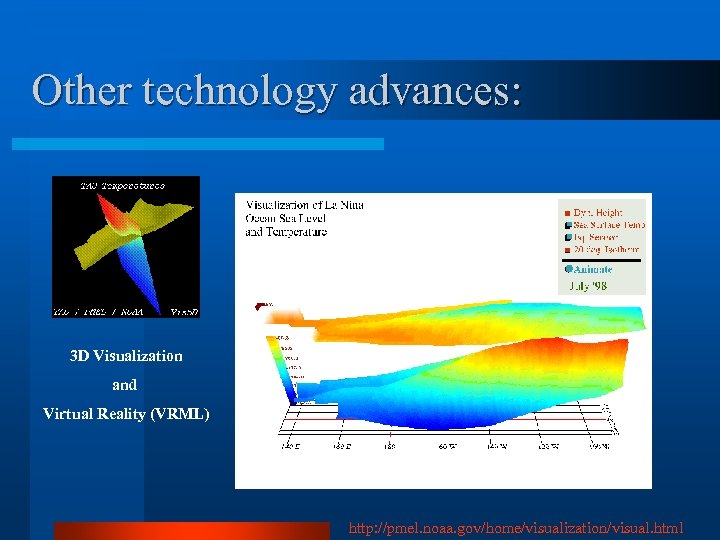
Other technology advances: 3 D Visualization and Virtual Reality (VRML) http: //pmel. noaa. gov/home/visualization/visual. html
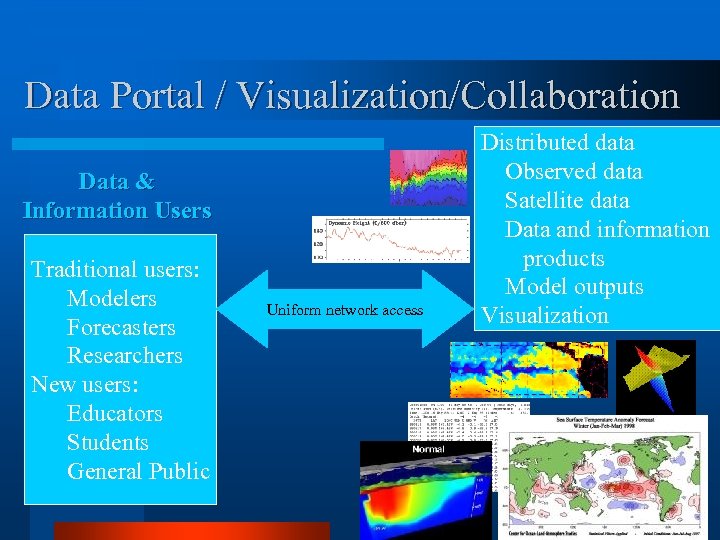
Data Portal / Visualization/Collaboration Data & Information Users Traditional users: Modelers Forecasters Researchers New users: Educators Students General Public Uniform network access Distributed data Observed data Satellite data Data and information products Model outputs Visualization
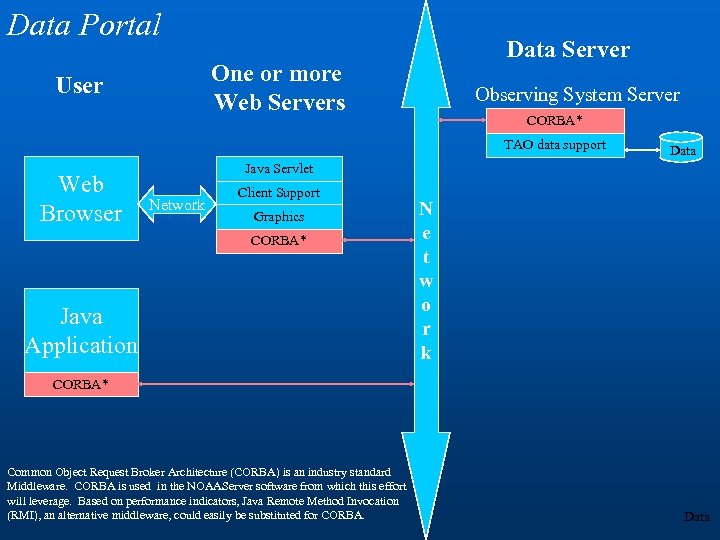
Data Portal Data Server One or more Web Servers User Observing System Server CORBA* TAO data support Web Browser Data Java Servlet Network Client Support Graphics CORBA* Java Application N e t w o r k CORBA* Common Object Request Broker Architecture (CORBA) is an industry standard Middleware. CORBA is used in the NOAAServer software from which this effort will leverage. Based on performance indicators, Java Remote Method Invocation (RMI), an alternative middleware, could easily be substituted for CORBA. Data
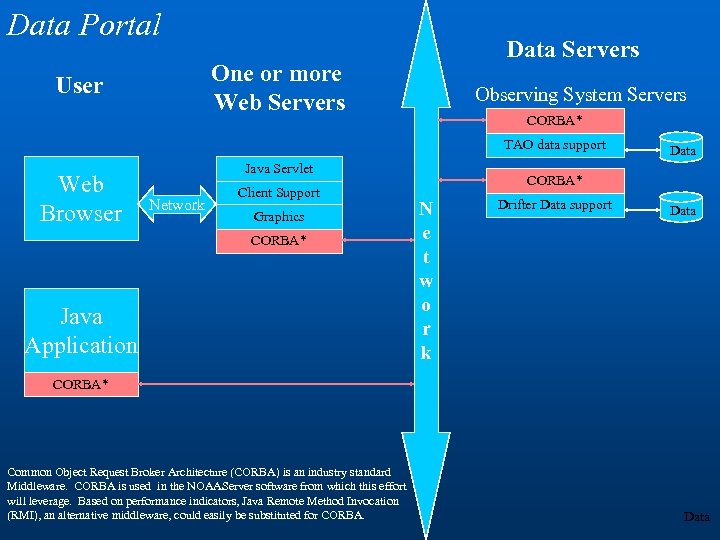
Data Portal Data Servers One or more Web Servers User Observing System Servers CORBA* TAO data support Web Browser Java Servlet Network Client Support Graphics CORBA* Java Application Data CORBA* N e t w o r k Drifter Data support Data CORBA* Common Object Request Broker Architecture (CORBA) is an industry standard Middleware. CORBA is used in the NOAAServer software from which this effort will leverage. Based on performance indicators, Java Remote Method Invocation (RMI), an alternative middleware, could easily be substituted for CORBA. Data
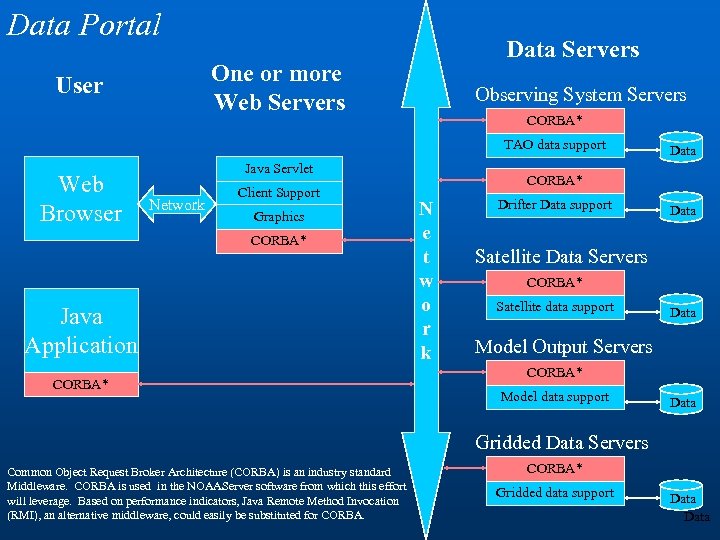
Data Portal Data Servers One or more Web Servers User Observing System Servers CORBA* TAO data support Web Browser Java Servlet Network Client Support Graphics CORBA* Java Application CORBA* Data CORBA* N e t w o r k Drifter Data support Data Satellite Data Servers CORBA* Satellite data support Data Model Output Servers CORBA* Model data support Data Gridded Data Servers Common Object Request Broker Architecture (CORBA) is an industry standard Middleware. CORBA is used in the NOAAServer software from which this effort will leverage. Based on performance indicators, Java Remote Method Invocation (RMI), an alternative middleware, could easily be substituted for CORBA* Gridded data support Data
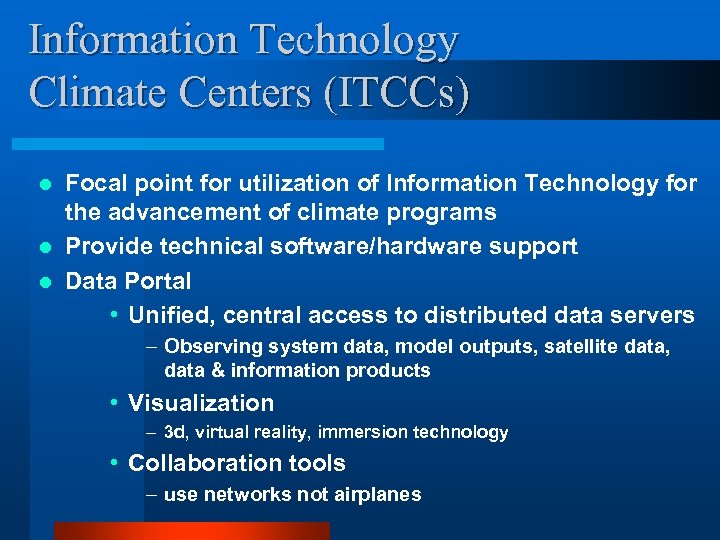
Information Technology Climate Centers (ITCCs) Focal point for utilization of Information Technology for the advancement of climate programs l Provide technical software/hardware support l Data Portal • Unified, central access to distributed data servers l – Observing system data, model outputs, satellite data, data & information products • Visualization – 3 d, virtual reality, immersion technology • Collaboration tools – use networks not airplanes
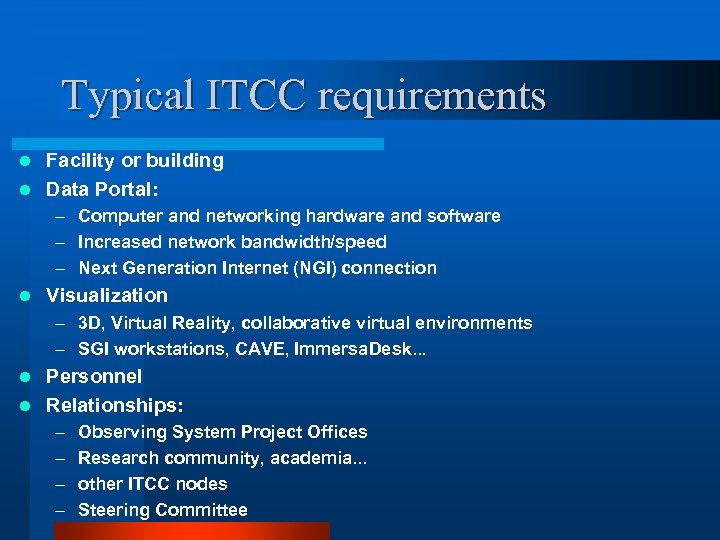
Typical ITCC requirements Facility or building l Data Portal: l – Computer and networking hardware and software – Increased network bandwidth/speed – Next Generation Internet (NGI) connection l Visualization – 3 D, Virtual Reality, collaborative virtual environments – SGI workstations, CAVE, Immersa. Desk. . . Personnel l Relationships: l – – Observing System Project Offices Research community, academia. . . other ITCC nodes Steering Committee
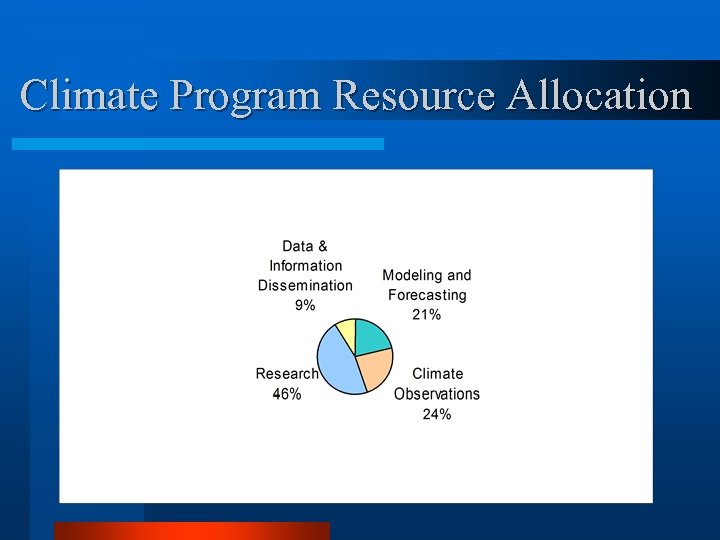
Climate Program Resource Allocation
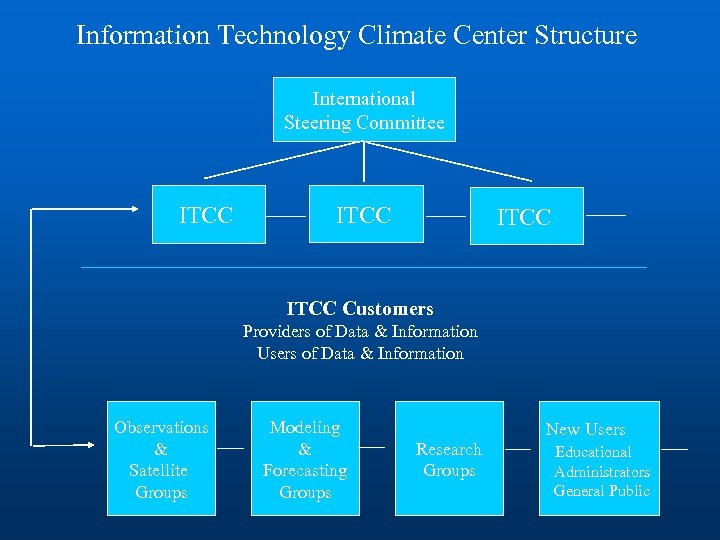
Information Technology Climate Center Structure International Steering Committee ITCC Customers Providers of Data & Information Users of Data & Information Observations & Satellite Groups Modeling & Forecasting Groups Research Groups New Users Educational Administrators General Public
Скачать презентацию TYKKI Workshop December 9 -11 1998 Tokyo Japan
6ea8aa2369fc16de1f31b64c5bd62752.ppt